

ca च – and; also; but
adjective · particle · substantive masculine · Word type unspecified
Dictionary sources
AYI dictionary particle
and; also; but
Cappeller 1891 Word type unspecified
Original text · English · Word type unspecified
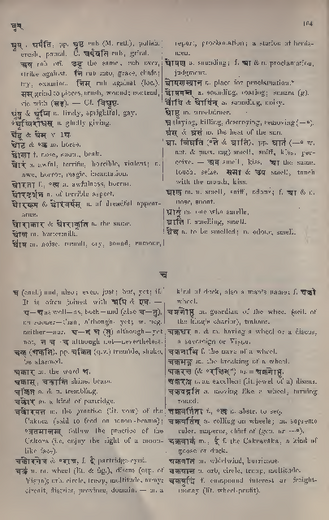
ca ·(encl.) and, also; even, just; but, yet; if. It is often joined with api & eva. -- ca--ca as well--as, both-and (also ca--tu), no sooner-than, although -- yet; w. neg. neither--nor. ca--na ca (tu) although -- yet not, na ca--ca although not--nevertheless.
Monier-Williams 1872 adjective · particle · Word type unspecified
Original text · English · adjective
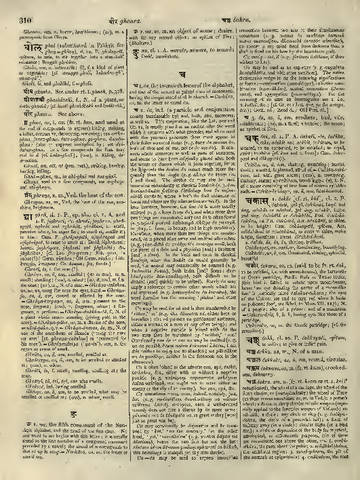
ca 3 . ca, as, ā, am, seedless; bad, vile, mischievous; (as), m. a thief; a tortoise; the moon; an epithet of Śiva.
Original text · English · particle
ca 2 . ca, ind. (a particle and conjunction usually translateable by) and, both, also, moreover, as well as. This conjunction, like the Lat. que and Gr. τε, is usually placed as an enclitic after the word which it connects with what precedes, and when used with the personal pronouns these must appear in their fuller accented forms (e. g. tava ca mama ca, both of thee and of me, not te ca me ca). It con- nects whole sentences as well as parts of sentences, and seems to have been originally placed after both the words or clauses which it joins together, for in the Ṛg-veda the double ca occurs much more fre- quently than the single (e. g. ahaṃ ca tvaṃ ca, I and thou). The double ca may also be used somewhat redundantly in classical Sanskrit (e. g. kva hariṇakānāṃ jīvitaṃ cātilolaṃ kva ca vajra- sārāḥ śarās te, where is both the frail existence of fawns and where are thy adamantine arrows ?). In the later literature, however, the first ca is more usually omitted (e. g. ahaṃ tvaṃ ca), and when more than two things are enumerated only one ca is often found (e. g. tejasā yaśasā lakṣmyā sthityā ca parayā, in glory, in fame, in beauty, and in high condition). Elsewhere, when more than two things are enume- rated, ca is placed after some and omitted after others (e. g. ṛṇa-dātā ca vaidyaśca śrotriyo nadī, both the payer of a debt and a physician [and] a Brāhman [and] a river). In the Veda and even in classical Sanskrit, when the double ca would generally be used, the second may occasionally be omitted (e. g. Indraśca Somaḥ, both Indra [and] Soma; dur- bhedyaśca āśu-sandheyaḥ, both difficult to be divided [and] quickly to be united). Rarely ca may imply a reference to certain other words which are not expressed (e. g. kamaṇḍalau ca karakaḥ, the word karaka has the meaning ‘pitcher’ and other meanings).
Original text · English · Word type unspecified
ca 1 . ca, the twentieth letter of the alphabet, and first of the second or palatal class of consonants, having the simple sound of ch in church.
Original text · English · Word type unspecified
Ca may be used for vā and is then translateable by ‘either,’ ‘or’ (e. g. iha cāmutra vā, either here or hereafter; strī vā pumān vā yaccānyat sattvam, either a woman or a man or any other being); and when a negative particle is joined with ca the two may then be translated by ‘neither,’ ‘nor.’ Occasionally one ca or one na may be omitted (e. g. na ca paribhoktuṃ naiva śaknomi hātum, I am able neither to enjoy nor to abandon; na pūrvāhṇe na ca parāhṇe, neither in the forenoon nor in the afternoon).
Original text · English · Word type unspecified
Ca is often joined to the adverbs eva, api, tathā, tathaiva, &c., either with or without a negative particle (e. g. vairiṇaṃ nopaseveta sahāyaṃ caiva vairiṇaḥ, one ought not to serve either an enemy or the ally of an enemy). See eva, api, &c.
Original text · English · Word type unspecified
Ca sometimes = eva, even, indeed, certainly, just, &c. (e. g. su-cintitaṃ cauṣadhaṃ na nāma- mātreṇa karoty a-rogam, even a well-devised remedy does not cure a disease by its mere name; yāvanta eva te tāvāṃśca sa, as great as they [were] just so great was he).
Original text · English · Word type unspecified
Ca may occasionally be disjunctive and be trans- lated by ‘but,’ ‘on the contrary,’ ‘on the other hand,’ ‘yet,’ ‘nevertheless’ (e. g. varam ādyau na cāntimaḥ, better the two first but not the last; śāntam idam āśrama-padaṃ sphurati ca bāhuḥ, this hermitage is tranquil yet my arm throbs).
Original text · English · Word type unspecified
Ca rarely = cet, if (e. g. jīvituṃ cecchase, if thou wishest to live).
Original text · English · Word type unspecified
Ca may be used as an expletive (e. g. anyaiśca kratubhiśca, and with other sacrifices). The native dictionaries assign to ca the following significations or forces: — conjunction (anv-ācaya), collective com- bination (sam-āhāra), mutual connection (itare- tara), and aggregation (sam-uccaya). For the meaning of ca after an interrogative see 2. ka, 2. kathā, &c.; [cf. Gr. τε; Lat. que, pe (in nempe, &c.); Goth. uh; Zend ca; Old Pers. câ.]
Petersburger 1855 adjective · substantive masculine · Word type unspecified
Original text · German · adjective · substantive masculine
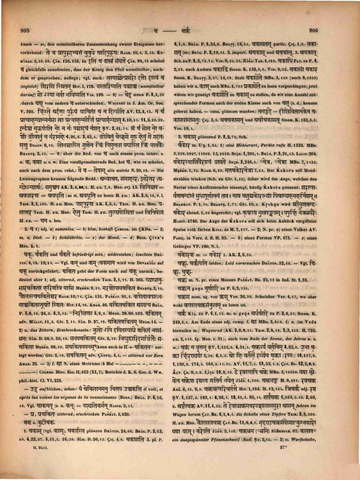
2. ca 1〉 adj. a〉 samenlos. — b〉 böse, boshaft ŚABDAR._im_ŚKDR. — 2〉 m. a〉 Dieb. — b〉 Schildkröte. — c〉 der Mond. — d〉 Bein. Śivaʼs MED. k. 1.
Original text · German · Word type unspecified
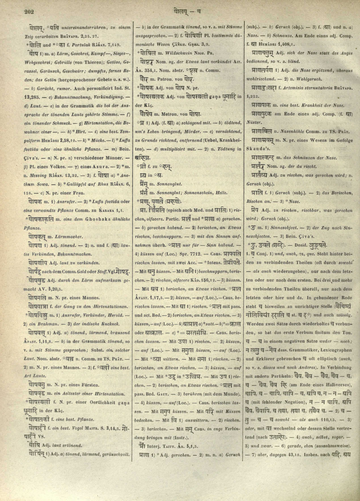
1. ca enklit. Part. ŚĀNT. 1,22. Die Personalpronomina erscheinen in den volleren, betonten Formen nach P. 8,1,24. VOP. 3,143. grāmastava ca svaṃ mama ca svam P., Sch. tubhyaṃ mahyaṃ ca dadyātsvam VOP. 1〉 und, auch, τε, que; einzelne Theile des Satzes oder ganze Sätze aneinanderreihend. Scheint ursprünglich beiden zu verbindenden Wörtern und Satzgliedern nachgestellt worden zu sein und im ṚV. ist das doppelt gesetzte ca noch häufiger als das einfache. a〉 ca — ca, — und, sowohl — als auch: a̱haṃ ca̱ tvaṃ cà ṚV. 8,51,11. mi̱traśco̱bhā varùṇaśca ṚV. 5,68,2. a̱mī ca̱ ye ma̱ghavā̀no va̱yaṃ cà ṚV. 1,141,13. ṚV. 2,1,16. ā ca̱ parā̀ ca ṚV. 1,164,31. ṚV. 1,10,4. ṚV. 1,96,7. ṚV. 7,4,5. ṚV. 7,22,9. daśa cāṣṭau ca achtzehn M. 1,64. R. 1,5,7. asapiṇḍā ca yā māturasagotrā ca yā pituḥ M. 3,5. ācchādya cārcayitvā ca M. 27. saṃjīvayati cājasraṃ pramāpayati cāvyayaḥ M. 1,57. N. 3,21. N. 8,9. ŚĀK. 58. HIT. I, 11. HIT. I,112. HIT. I,164. RAGH. 1,16. RAGH. 1,68. kva ca te kṣatriyabalaṃ kva ca brahmabalaṃ mahat R. 1,56,4. R. 3,13,24. ŚĀK. 10. pūrvāhṇe ca parāhṇe ca talaṃ yasya na muñcati weder — noch Cit. beim Sch. zu ŚĀK. 86. na (aśnīyāt) grāmajātānyārto 'pi mūlāni ca phalāni ca M. 6,16. Das erste verbum fin. behält den Ton nach P. 8,1,58. P. 8,1,59. WHITNEY_in_J. Am. Or. Soc. V, 401. a̱yama̱smānvana̱spati̱rmā ca̱ hā mā cà rīriṣat ṚV. 3,53,20. na̱ma̱syantī̱rupà ca̱ yanti̱ saṃ cā̀ viśanti ṚV. 9,95,3. — b〉 wird an erster Stelle weggelassen: ya̱jñaṃ ha̱viścà ṚV. 1,12,10. a̱mṛta̱ṃ martyàṃ ca ṚV. 35,2. ṚV. 7,4. ṚV. 10,5. ṚV. 13,1. ṚV. 14,1. ṚV. 17,6. ṚV. 25,11. ṚV. 31,9. tejasā yaśasā lakṣmyā sthityā ca parayā N. 12,6. N. 1,9. N. 1,10. HIT. I, 33. pāṭavaṃ saṃskṛtoktiṣu .. vācāṃ sarvatra vaicitryaṃ nītividyāṃ dadāti ca (gehört zu nīti˚) .. HIT. Pr. 2. nipetuste garutmantaḥ sā dadarśa ca tāngaṇān N. 1,22. N. 2,15. dāsānāṃ bhujavegena nadyāḥ srotojalena ca . vāyunā cānukūlena HIḌ. 1,2. na — na ca weder — noch N. 10,21. — c〉 steht nur an erster Stelle: indràśca vāyo ṚV. 4,47,2. indràśca soma ṚV. 7,104,25. ṚV. 4,50,10. a̱gniścà soma ṚV. 1,93,5., iha cāmutra M. 9,322. pretya ceha M. 3,20. durbhedyaścāśusaṃdheyaḥ HIT. I, 86. na khalu ca paribhoktuṃ naiva śaknomi hātum weder — noch ŚAK. 115. — d〉 bei mehreren zu verbindenden Wörtern unregelmässig gesetzt: madhuparke ca yajñe ca pitṛdaivatakarmaṇi (fehlt zuletzt) M. 5,41. karṇau carma ca bālāṃśca vastiṃ snāyuṃ ca rocanām M. 8,234. ṛṇadātā ca vaidyaśca śrotriyaḥ sujalā nadī ad HIT. I, 100. HIT. I, Pr. 26. N. 12,5. — e〉 mit Weglassung desjenigen Wortes oder derjenigen Wörter, an welche angeknüpft wird: kamaṇḍalau ca karakaḥ hat (unter andern) auch die Bedeutung von ka˚ AK. 3,4,1,6. AK. 3,4,1,15. u. s. w. — f〉 bisweilen müssig: īje cāpyaśvamedhena yayātiriva nāhuṣaḥ . anyaiśca bahubhirdhīmānkratubhiścāptadakṣiṇaiḥ .. N. 5,43. — g〉 in Verbind. mit anderen Partikeln: caiva (in M. wohl 300 Mal): vairiṇaṃ nopaseveta sahāyaṃ caiva vairiṇaḥ weder — noch M. 4,133. caiva — caiva N. 22,29. BRĀHMAṆ. 2,25. caiva — ca N. 4,2. N. 4,20. BRĀHMAṆ. 2,25. ca — caiva N. 5,16. caiva hi (am Ende eines Halbverses) M. 2,105. M. 3,116. M. 3,207. M. 3,232. M. 4,25. cāpi M. 1,14. M. 3,179. ca — cāpi N. 10,16. R. 1,4,8. cāpi — ca N. 5,45. api ca (vgl. u. api 2.), na — na — api ca (ohne Neg.) N. 1,13. sakhyaṃ prītiṃ cāpi na kārayet weder — noch HIT. I, 74. na — na cāpi HIT. I, 15. api caiva M. 1,105. caivāpi M. 4,6. M. 8,128. ca tathā M. 6,62. INDR. 1,6. tathā ca N. 4,8. tathaiva ca M. 7,150. M. 7,153. M. 8,291. M. 8,292. M. 9,291. R. 1,3,13. — 2〉 wechselt mit vā oder und vertritt dessen Stelle: iha cāmutra vā M. 12,89. strī vā pumānvā yaccānyatsattvaṃ nagararāṣṭrajam R. 1,9,21. na te bhayaṃ naravyāghra daṃṣṭribhyaḥ śatruto 'pi vā . brahmarṣibhyaśca bhavitā N. 14,18. asyāraṇyasya devī tvamutāho 'sya mahībhṛtaḥ . asyāśca nadyāḥ N. 12,53. — 3〉 auch, selbst, sogar: kasya bibhyati devāśca R. 1,1,4. sucintitaṃ cauṣadhamāturāṇāṃ na nāmamātreṇa karotyarogam HIT. I, 162. yāni kāni ca mitrāṇi kartavyāṇi śatāni ca ad HIT. 17,3. ŚĀK. 6,5. rahitā bhartṛbhiścaiva na krudhyanti kadā ca na N. 18,9. — 4〉 und zwar: dhruvamatra jalasthānaṃ mahacceti matirmama HIḌ. 1,26. āneṣyāmo vayaṃ taṃ ca na ca doṣo bhaviṣyati R. 1,8,21. — 5〉 = eva gerade, eben: te tu yāvanta evājau tāvāṃśca dadṛśe sa taiḥ RAGH. 12,45. Vgl. den Sch. zu P. 2,1,17. P. 2,1,72, der das ca bei P. so auffasst. — 6〉 verbindet Gegensätze, α〉 aber, dagegen: mūrkho 'pi śobhate tāvatsabhāyāṃ vastraveṣṭitaḥ . tāvacca śobhate mūrkho yāvatkiṃcinna bhāṣate .. HIT. Pr. 39. HIT. Pr. I, 33. HIT. Pr. 50. kalinā tatkṛtaṃ karma tvaṃ ca mūḍha na budhyase N. 26,21. pitā yasya tu vṛttaḥ syājjīveccāpi pitāmahaḥ M. 3,221. yadi ca N. 9,35. atha ca v. l. für atha tu ŚĀK. 123. atha vā ca MBH. 12,7328. varamādyau na cāntimaḥ HIT. Pr. 12. HIT. Pr. 16. N. 3,16. — β〉 dennoch: śāntamidamāśramapadaṃ sphurati ca bāhuḥ ŚĀK. 15. kāmātmatā na praśastā na caivehāstyakāmatā M. 2,2. apanetuṃ ca yatito na caiva śakito mayā HIḌ. 4,33. prajākāmaḥ sa cāprajaḥ N. 1,5. N. 1,28. N. 9,4. N. 21,29. R. 1,1,36. VID. 25. — 7〉 ca — ca kaum — so, den unmittelbaren Zusammenhang zweier Ereignisse hervorhebend: te ca prāpurudanvantaṃ bubudhe cādipūruṣaḥ RAGH. 10,6. RAGH. 3,40. KUMĀRAS. 3,58. KUMĀRAS. 3,66. ŚĀK. 126. ŚĀK. 135. in iti ca śastraṃ saṃdhatte ŚĀK. 94,13 scheint ca gleichfalls anzudeuten, dass der König den Pfeil unmittelbar, nachdem er gesprochen, auflege; vgl. auch: tasyāścetprasaro datto dāsyaṃ ca (sogleich) śirasi sthitam HIT. I, 178. yastariṣyati paścācca (unmittelbar darauf) so 'syā bhartā bhaviṣyati VID. 199. — 8〉 = ced wenn P. 8,1,30 (durch caṇ vom andern ca unterschieden). WHITNEY_in_J. Am. Or. Soc. V, 395. hiṃste̱ adàttā̱ purùṣaṃ yāci̱tāṃ ca̱ na ditsàti AV. 12,4,13. na cà pratyāha̱nyānmanàsā tvā pra̱tyāha̱nmītì pra̱tyāhànyāt AV. 8,10,31. AV. 11,3,28. AV. 11,3,29. indràśca mṛ̱ḻayā̀ti no̱ na nàḥ pa̱ścāda̱ghaṃ nàśat ṚV. 2,41,11. tvaṃ cà soma no̱ vaśò jī̱vātu̱ṃ na màrāmahe ṚV. 1,91,6. ṚV. 3,43,4. jīvituṃ cecchase mūḍha hetuṃ me gadataḥ śṛṇu DRAUP. 9,10. lobhaścāsti guṇena kiṃ piśunatā yadyasti kiṃ pātakaiḥ BHARTṚ. 2,45. — 9〉 über die Bed. von ca nach einem pron. interr. s. u. ka, kathā u. s. w. Eine verallgemeinernde Bed. hat ca, wie es scheint, auch nach dem pron. relat.: ye ca — teṣām alle welche N. 20,29. — Die Lexicographen kennen folgende Bedd.: anvācaya, samāhāra, itaretara (anyo'nyārtha), samuccaya AK. 3,4,32,2. H. an. 7,8. MED. avy. 13. viniścaya = avadhāraṇa = avadhṛti (so st. avadhūti zu lesen H. an.) AK. 3,5,15, v. l. TRIK. 3,3,465. H. an. MED. pādapūraṇa AK. 3,5,5. TRIK. H. an. MED. pakṣāntara TRIK. H. an. MED. hetu TRIK. H. an. tulyayogitā und viniyoga H. an. — cana s. bes.

Original text · German · Word type unspecified
1. ca 10〉 ca — na tu obgleich — dennoch nicht Spr. (II) 1672. ca — na ca dass. PAT. a. a. O. 1,49,a. na ca — ca obgleich nicht — so doch ebend.
Böhtlingk 1879 adjective · particle · substantive masculine · Word type unspecified
Original text · German · adjective · substantive masculine
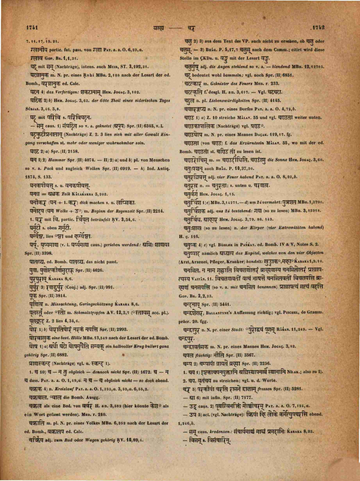
2. *ca — 1〉 Adj. — a〉 rein VIŚVA. — b〉 sich hinundher bewegend ebend. — c〉 bös, boshaft. — d〉 samenlos. — 2〉 m. — a〉 Dieb VIŚVA. — b〉 der Mond. — c〉 Schildkröte.
Original text · German · particle
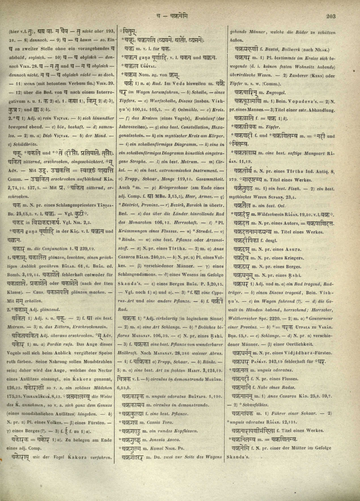
1. ca Conj. — 1〉 und, auch, τε, que. Steht hinter beiden zu verbindenden Theilen (oft durch sowohl — als auch wiederzugeben), nur nach dem letzten oder nur nach dem ersten. Bei drei und mehr zu verbindenden Theilen überall, nur nach dem letzten oder hier und da. In gebundener Rede steht ca bisweilen an unrichtiger Stelle (vaicitryaṃ nītividyāṃ dadāti ca st. ca da˚) und auch müssig. Werden zwei Sätze durch wiederholtes ca verbunden, so hat das erste Verbum finitum den Ton. ca — ca in einem negativen Satze weder -noch; na khalu ca — naiva dass. Grammatiker, Lexicographen und Erklärer gebrauchen ca oft elliptisch (auch so v. a. dieses und noch Anderes). In Verbindung mit andern Partikeln; caiva, caiva — caiva, caiva — ca, ca — caiva, caiva hi (am Ende eines Halbverses), cāpi, ca — cāpi, cāpi — ca, api ca, na — na — api ca (mit fehlender Negation), na — na cāpi, api caiva, caivāpi, ca tathā, tathā ca, tathaiva ca. — 2〉 ca — tu = ca — ca sowohl — als auch Chr. 110,13. — 3〉 oder, mit vā wechselnd oder dessen Stelle vertretend (nach utāho). — 4〉 auch, selbst, sogar. — 5〉 und zwar. — 6〉 gerade, eben (ausnahmsweise). — 7〉 aber, dagegen Chr. 43,18. Insbes. nach yadi, atha [Page2-203-a] (hier v. l. tu), atha vā. na caiva — tu nicht aber Chr. 193,28. — 8〉 dennoch. — 9〉 ca — ca kaum. — so ein ca an zweiter Stelle ohne ein vorangehendes ca alsbald, sogleich. — 10〉 ca — ca obgleich — dennoch VIKR. 28. ca — na tu und ca — na ca obgleich-dennoch nicht. na ca — ca obgleich nicht — so doch. — 11〉 wenn (mit betontem Verbum fin.) VIKR. 39. — 12〉 über die Bed. von ca nach einem Interrogativum s. u. 1. ka 2〉a〉, 1. kathā 1〉, kim 2〉d〉ϑ〉, kutra 7〉 und kva 5〉b〉.
Original text · German · Word type unspecified
1. ca II. Z. 12. fgg. Vgl. Z. d. d. m. G. 41,516. fgg. KNAUER in Festgr. 62. fgg. [Nachtrag, Band 7]
Apte 1890 adjective · particle · substantive masculine
Original text · English · adjective · particle · substantive masculine
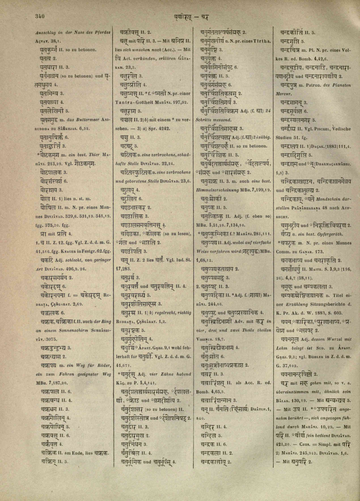
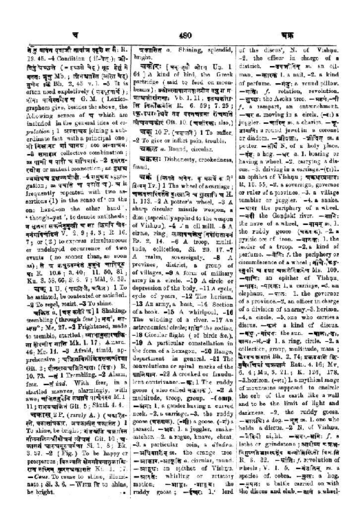
ca a. 1 Seedless. 2 Bad, vile. — caḥ 1 An epithet of Śiva. 2 Chewing, eating. 3 The moon. 4 A tortoise. 5 A thief. — ind. A particle expressing 1 Copulation (and, also as well as, moreover) used to join words or assertions together; (in this sense it is used with each ([Page 0479-2b]) of the words or assertions which it joins together; or it is used after the last of the words or assertions so joined, but it never stands first in a sentence): mano niṣṭhāśūnyaṃ bhramati ca kimapyālikhati ca Māl. 1. 31; tau gururgurupatnī ca prītyā pratinanaṃdatuḥ R. 1. 57; Ms. 1. 64; Ms. 3. 5; ([Page 0479-2c]) kulena kāṃtyā vayasā navena guṇaiśca taistairvinayapradhānaiḥ R. 6. 79; Ms. 1. 105; Ms. 3. 116. 2 Disjunction (but, still, yet); śāṃtamidamāśramapadaṃ raphurati ca bāhuḥ Ś. 1. 16. 3 Certainty, determination, (indeed, certainly, exactly, quite, having the force of eva); atītaḥ paṃthānaṃ tava ca mahimā vāṅmanasayoḥ G. M.; ([Page 0480-a]) te tu yāvaṃta evājau tāvāṃśca dadṛśe sa taiḥ R. 12. 45. 4 Condition (if = cet); jīvituṃ cecchase (= icchase ced) mūḍha hetuṃ me gadataḥ śṛṇu Mb.; lobhaścāsti (asti ced) guṇena kiṃ Bh. 2. 45 v. l. 5 It is often used expletively (pādapūraṇārthe); bhīmaḥ pārthastathaiva ca G. M. (Lexicographers give, besides the above, the following senses of ca which are included in the general idea of copulation; 1 anvācaya joining a subordinate fact with a principal one; bho bhikṣāmaṭa gāṃ cānaya; see anvācaya. 2 samāhāra collective combination; as pāṇī ca pādau ca pāṇipādaṃ. 2 itaṃratarayoga or mutual connection; as plakṣaśca nyagrodhaśca plakṣanyagrodhau. 4 samuccaya aggregation; as pacati ca paṭhati ca). ca is frequently repeated with two assertions (1) in the sense of ‘on the one hand-on the other hand’, ‘though-yet’, to denote antithesis; na sulabhā sakaleṃdumukhī ca sā kimapi cedamanaṃgaviceṣṭitaṃ V. 2. 9; V. 4. 3; R. 16. 7; or (2) to express simultaneous or undelayed occurrence of two events (no sooner than, as soon as); te ca prāpurudanvaṃtaṃ bubudhe cādipūruṣaḥ R. 10. 6; R. 3. 40; R. 11. 50, R. 11. 81; Ku. 3. 58, Ku. 3. 66; Ś. 6. 7; Māl. 9. 39.
Cappeller 1887 Word type unspecified
Original text · German · Word type unspecified
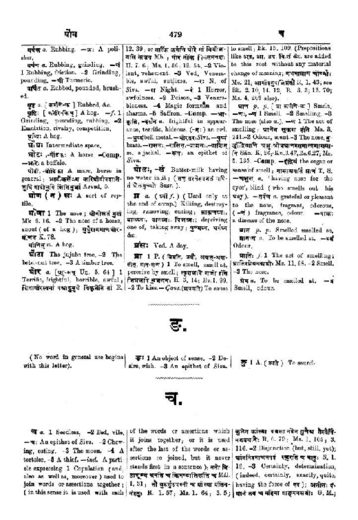
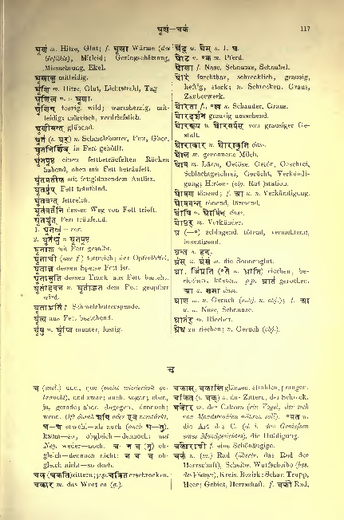
ca (encl.) und, que (meist wiederholt gebraucht), und zwar; auch, sogar; eben, ja, gerade; aber, dagegen, dennoch; wenn. Oft durch api oder eva verstärkt. ca—ca sowohl—als auch (auch ca—tu), kaum — so, obgleich —dennoch; mit Neg. weder—noch. ca—na ca (tu) obgleich—dennoch nicht; na ca—ca obgleich nicht—so doch.
Burnouf 1866 adjective · Word type unspecified
Original text · French · adjective
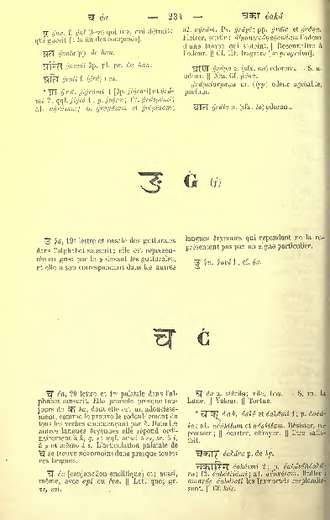
ca ca a. stérile; vile, bas. — S. m. la Lune. Voleur. Tortue.
Original text · French · Word type unspecified
ca ca, 20 lettre et 1ʳᵉ palatale dans l'alphabet sanscrit. Elle procède presque toujours de ka ka, dont elle est un adoucissement, comme le prouve le redoublement de tous les verbes commençant par k. Dans les autres langues âryennes elle répond ordinairement à k, q, ϰ; qqf. aussi à σϰ, sc, à t, à φ et même à s. L'articulation palatale de ca se trouve néanmoins dans presque toutes ces langues.
Original text · French · Word type unspecified
ca ca [conjonction enclitique] et; aussi, même, avec api ou eva. Lat. que; gr. τε, ϰαὶ.
Occurrences in source texts (639)
DYS 92 occurrences
DYS 9–11: Four Yogas 5 occurrences
Direct occurrences
DYS 15–19: Śiva’s Laya 3 occurrences
Direct occurrences
DYS 20–26: Practising Laya 4 occurrences
Direct occurrences
DYS 27–31: Survey of Haṭha 9 occurrences
Direct occurrences
27 more source pages
DYS 54–59: The Yogi’s Hut 4 occurrences
Direct occurrences
DYS 60–66: Prāṇāyāma 3 occurrences
Direct occurrences
DYS 69–72: Avoid and Support 8 occurrences
Direct occurrences
DYS 101–102: Siddhi as Obstacle 2 occurrences
Direct occurrences
DYS 108–111: Suṣumnā 5 occurrences
Direct occurrences
DYS 143–145: Mūlabandha 3 occurrences
Direct occurrences
DYS 146–149: Viparītakaraṇa 4 occurrences
Direct occurrences
DYS 150–153*3: Vajrolī: Secret Teaching 2 occurrences
Direct occurrences
DYS 154–167: Vajrolī for the Male Yogi 10 occurrences
Direct occurrences
DYS 168–179*1: Vajrolī for the Yoginī 6 occurrences
Direct occurrences
DYS 180–183*1: Amarolī and Sahajolī 3 occurrences
Direct occurrences
GoS 45 occurrences
GoS 1–8: Learning and Liberation 3 occurrences
Direct occurrences
GoS 9–11: Breath and Conditioning 5 occurrences
Direct occurrences
GoS 20–28: Setting Sarasvatī in Motion 5 occurrences
Direct occurrences
GoS 29–33: Four Forms of Breath Retention 4 occurrences
Direct occurrences
GoS 34–41: Sun, Sound and Cooling 4 occurrences
Direct occurrences
8 more source pages
GoS 67–73: Examining Obstacles 9 occurrences
Direct occurrences
GoS 74–80: Through the Three Knots 4 occurrences
Direct occurrences
GoS 81–88: Moon, Fluid and Union 3 occurrences
Direct occurrences
GoS 89–94: Body, Names and Reality 2 occurrences
Direct occurrences
HP 163 occurrences
HP 1.4-1.10: Lineage of Siddhas 7 occurrences
Direct occurrences
HP 1.15-1.16*2: Factors of Practice 6 occurrences
Direct occurrences
HP 1.17-1.32: Āsana 7 occurrences
Direct occurrences
HP 1.33-1.43: Siddhāsana 4 occurrences
Direct occurrences
HP 1.44-1.49: Padmāsana 3 occurrences
Direct occurrences
-
HP 1.44 Segment 5
-
HP 1.45–46 Segment 23
-
HP 1.48 Segment 14
HP 1.50–54: Siṃhāsana and Bhadrāsana 6 occurrences
Direct occurrences
-
HP 1.50–52 Segment 2
-
HP 1.50–52 Segment 19
-
HP 1.50–52 Segment 25
-
HP 1.50–52 Segment 47
-
HP 1.53–54 Segment 2
-
HP 1.53–54 Segment 11
44 more source pages
HP 1.64-1.65: Practice and Rājayoga 2 occurrences
Direct occurrences
HP 2.11-2.14: Measure of Practice 2 occurrences
Direct occurrences
HP 2.15-2.20: Correct Practice 4 occurrences
Direct occurrences
HP 2.24-2.29: Dhauti and Basti 4 occurrences
Direct occurrences
HP 2.30-2.33: Neti and Trāṭaka 2 occurrences
Direct occurrences
HP 2.34-2.36: Naulī and Kapālabhātī 2 occurrences
Direct occurrences
HP 2.72-2.78: Kevala Kumbhaka 3 occurrences
Direct occurrences
HP 2.79-2.80: Haṭha Siddhi 3 occurrences
Direct occurrences
HP 3.1-3.5: Foundation of Kuṇḍalinī 2 occurrences
Direct occurrences
HP 3.19-3.25: Mahābandha 6 occurrences
Direct occurrences
HP 3.26-3.31: Mahāvedha 3 occurrences
Direct occurrences
HP 3.33-3.48*1: Khecarī and Soma 8 occurrences
Direct occurrences
HP 3.49-3.57: Mūlabandha 3 occurrences
Direct occurrences
HP 3.58-3.65: Uḍḍiyāna Bandha 3 occurrences
Direct occurrences
HP 3.66-3.72: Jālandhara and the Bandhas 2 occurrences
Direct occurrences
HP 3.73-3.78: Viparīta Karaṇī 5 occurrences
Direct occurrences
HP 3.79-3.86*1: Vajrolī 5 occurrences
Direct occurrences
HP 3.87-3.93*7: Sahajolī and Amarolī 8 occurrences
Direct occurrences
HP 3.94-3.102*1: Śakti Cālana 2 occurrences
Direct occurrences
HP 3.103-3.107*2: Conclusion of the Mudrā Teaching 1 occurrence
Direct occurrences
-
HP 3.107 Segment 9
HP 4.0*1-4.0*14: Samādhi and Laya 3 occurrences
Direct occurrences
HP 4.9-4.11*4: Gaze and Lunar Nectar 2 occurrences
Direct occurrences
HP 4.11*5-4.11*14: Khecarī in Space 4 occurrences
Direct occurrences
-
HP 4.11*8 Segment 5
-
HP 4.11*10 Segment 6
-
HP 4.11*11 Segment 2
-
HP 4.11*14 Segment 7
HP 4.11*15-4.11*28: Space and Laya 5 occurrences
Direct occurrences
-
HP 4.11*19 Segment 6
-
HP 4.11*20 Segment 4
-
HP 4.11*20 Segment 8
-
HP 4.11*24 Segment 10
-
HP 4.11*25 Segment 4
HP 4.12-4.19: Path of Nāda 3 occurrences
Direct occurrences
HP 4.20-4.27: Four Stages of Nāda 2 occurrences
Direct occurrences
HP 4.27*1-4.35: Rājayoga and Haṭha 6 occurrences
Direct occurrences
-
HP 4.32–33 Segment 4
-
HP 4.32–33 Segment 6
-
HP 4.32–33 Segment 11
-
HP 4.32–33 Segment 26
-
HP 4.32–33 Segment 29
-
HP 4.34 Segment 16
HP 4.35*1-4.36: Signs of Samādhi 6 occurrences
Direct occurrences
HP 4.47-4.55*4: Nāda Binds the Mind 3 occurrences
Direct occurrences
HTK 12 occurrences
HTK 10.0*1–5: Sītkā, Śītalī and Sūryabheda 4 occurrences
Direct occurrences
HTK 10.14*2–17*1: Śītalī and Antaraṅgaka-kumbha 4 occurrences
Direct occurrences
HTK 10.26–29*1: Cakra, Śaṅkha, Vāmāvartta, Vartmagati and Gadā 1 occurrence
Direct occurrences
-
HTK 10.29 Segment 10
HTK 10.34*2–38*1: Asvaṅgaśṛṅkhalā and Kumbhāntaraśṛṅkhalā 1 occurrence
Direct occurrences
-
HTK 10.35 Segment 27
IVU 7 occurrences
IVU 9-11: Insufficiency of Knowledge 2 occurrences
Direct occurrences
MAN 1 occurrence
MandUp 5 occurrences
PJH 1 occurrence
PJH 7-8: Tantric Cosmology and the Revelation of Divine Awareness 1 occurrence
Direct occurrences
-
PJH 7 Segment 2
PYS 20 occurrences
PYS 1.44–45: Subtle Samāpatti 2 occurrences
Direct occurrences
12 more source pages
PYS 3.41–42: Divine Hearing and Travel through Space 1 occurrence
Direct occurrences
-
PYS 3.42 Segment 8
SiSa 195 occurrences
SiSa 1.10-1.16: Lehrmeinungen 3 occurrences
Direct occurrences
SiSa 1.17-1.19: Geheime Yoga-Lehre 2 occurrences
Direct occurrences
SiSa 1.20-1.31: Karma und Erkenntnis 4 occurrences
Direct occurrences
SiSa 1.32-1.34: Selbst als Ursprung 4 occurrences
Direct occurrences
SiSa 1.35-1.44: Täuschungs-Gleichnisse 3 occurrences
Direct occurrences
SiSa 1.45-1.50: Rückkehr zum Bewusstsein 2 occurrences
Direct occurrences
73 more source pages
SiSa 1.51-1.64: Selbst als Licht 5 occurrences
Direct occurrences
SiSa 1.71-1.81: Avidyā und Elemente 5 occurrences
Direct occurrences
SiSa 1.93-1.99: Karmische Verkörperung 3 occurrences
Direct occurrences
SiSa 2.1-2.5: Körperkosmos 3 occurrences
Direct occurrences
SiSa 2.6-2.12: Mond und Sonne 2 occurrences
Direct occurrences
SiSa 2.13-2.20: Suṣumṇā und Citrā 4 occurrences
Direct occurrences
SiSa 2.25-2.31: Nāḍī-Netz 3 occurrences
Direct occurrences
SiSa 2.32-2.34: Inneres Feuer 3 occurrences
Direct occurrences
SiSa 2.35-2.40: Jīva und Karma 3 occurrences
Direct occurrences
SiSa 2.49-2.54: Befreiungswissen 2 occurrences
Direct occurrences
SiSa 3.1-3.10: Herzlotus und Prāṇa 6 occurrences
Direct occurrences
SiSa 3.17-3.20: Praxisbeginn 3 occurrences
Direct occurrences
SiSa 3.21-3.31: Nāḍī-Reinigung 10 occurrences
Direct occurrences
SiSa 3.32-3.33: Praxis-Hindernisse 4 occurrences
Direct occurrences
SiSa 3.34-3.38: Förderliche Mittel 3 occurrences
Direct occurrences
SiSa 3.41-3.48: Atemkraft und Hindernisse 4 occurrences
Direct occurrences
SiSa 3.49-3.50: Karma-Reinigung 2 occurrences
Direct occurrences
SiSa 3.51-3.54: Prāṇāyāma-Siddhis 2 occurrences
Direct occurrences
SiSa 3.61-3.67: Paricaya und Niṣpatti 4 occurrences
Direct occurrences
SiSa 3.84-3.87: Siddhāsana 4 occurrences
Direct occurrences
SiSa 4.9-4.20: Yonimudrā-Geheimnis 8 occurrences
Direct occurrences
SiSa 4.21-4.25: Zehn Mudrās 3 occurrences
Direct occurrences
SiSa 4.72-4.77: Uḍḍyānabandha 2 occurrences
Direct occurrences
SiSa 4.91-4.94: Vajrolī-Siddhi 2 occurrences
Direct occurrences
SiSa 5.6-5.9: Dharma-Hindernisse 3 occurrences
Direct occurrences
SiSa 5.10-5.14: Subtile Hindernisse 3 occurrences
Direct occurrences
SiSa 5.21-5.23: Adhimātra und Haṭhayoga 3 occurrences
Direct occurrences
SiSa 5.24-5.28: Adhimātratama 6 occurrences
Direct occurrences
SiSa 5.29-5.35: Pratīka-upāsanā 2 occurrences
Direct occurrences
SiSa 5.77-5.81: Kanda und Hauptnāḍīs 3 occurrences
Direct occurrences
SiSa 5.90-5.93: Mūlādhāra-Wirkungen 4 occurrences
Direct occurrences
SiSa 5.102-5.107: Svādhiṣṭhāna 2 occurrences
Direct occurrences
-
SiSa 5.102 Segment 2
-
SiSa 5.105 Segment 2
SiSa 5.108-5.112: Maṇipūra 3 occurrences
Direct occurrences
-
SiSa 5.111 Segment 2
-
SiSa 5.111 Segment 11
-
SiSa 5.112 Segment 10
SiSa 5.113-5.120: Anāhata 3 occurrences
Direct occurrences
-
SiSa 5.117 Segment 2
-
SiSa 5.118 Segment 3
-
SiSa 5.118 Segment 12
SiSa 5.144-5.155: Ājñā und Khecarī 2 occurrences
Direct occurrences
-
SiSa 5.144 Segment 12
-
SiSa 5.155 Segment 13
SiSa 5.156-5.181: Sahasrāra 5 occurrences
Direct occurrences
-
SiSa 5.158 Segment 3
-
SiSa 5.161 Segment 10
-
SiSa 5.164 Segment 6
-
SiSa 5.170 Segment 6
-
SiSa 5.177 Segment 13
SiSa 5.191-5.207: Kailāsa und Mahāśūnya 2 occurrences
Direct occurrences
-
SiSa 5.192 Segment 12
-
SiSa 5.193 Segment 21
SiSa 5.208-5.222: Rājayoga 4 occurrences
Direct occurrences
-
SiSa 5.209 Segment 2
-
SiSa 5.214 Segment 4
-
SiSa 5.216 Segment 11
-
SiSa 5.217 Segment 7
SiSa 5.234-5.252: Tripurā-Mantra 5 occurrences
Direct occurrences
-
SiSa 5.238 Segment 3
-
SiSa 5.238 Segment 6
-
SiSa 5.243 Segment 2
-
SiSa 5.243 Segment 22
-
SiSa 5.246 Segment 13
SiSa 5.253-5.260: Haushalter-Abschluss 4 occurrences
Direct occurrences
-
SiSa 5.253 Segment 6
-
SiSa 5.254 Segment 13
-
SiSa 5.256 Segment 12
-
SiSa 5.260 Segment 9
SS 1 occurrence
SVU 60 occurrences
SVU 1.7-1.12: Triad and Freedom 6 occurrences
Direct occurrences
SVU 1.13-1.16: The Hidden Fire 3 occurrences
Direct occurrences
13 more source pages
SVU 3.1-3.4: The One Rudra 3 occurrences
Direct occurrences
SVU 3.13-3.18: In the Heart and in the World 2 occurrences
Direct occurrences
SVU 4.1-4.5: The One in Every Form 2 occurrences
Direct occurrences
SVU 4.6-4.10: Two Birds and Māyā 2 occurrences
Direct occurrences
SVU 4.11-4.16: The Hidden Creator 5 occurrences
Direct occurrences
SVU 4.17-4.22: Knowledge and Protection 2 occurrences
Direct occurrences
SVU 5.1–5.6: The Lord of Cosmic Origins 7 occurrences
Direct occurrences
SVU 5.7–5.11: The Wandering Self 6 occurrences
Direct occurrences
SVU 5.12–5.14: Knowledge and Freedom 2 occurrences
Direct occurrences
SVU 6.1–6.6: Lord of Cosmic Unfolding 3 occurrences
Direct occurrences
SVU 6.7–6.13: Lord of All Lords 10 occurrences
Direct occurrences
VBT 37 occurrences
VBT 11–13: Fixations Rejected 3 occurrences
Direct occurrences
13 more source pages
VBT 57–64: Intervals and Equality 2 occurrences
Direct occurrences
VBT 101–109: Śiva-Identity 3 occurrences
Direct occurrences
VBT 121–129: Devotion and Release 3 occurrences
Direct occurrences
VBT 130–138: Name and Fourfoldness 3 occurrences
Direct occurrences
VBT 139–145: Fruit of the Ways 5 occurrences
Direct occurrences
Continue with AYI Free
Image source: AYI archive.