

ap अप् – Wasser; Wassern
Verbalwurzel · Substantiv · Substantiv Feminin · Substantiv Maskulin · Worttyp nicht bestimmt
Wörterbuchquellen
AYI Wörterbuch Substantiv Feminin
Wasser; Wassern
Cappeller 1891 Substantiv · Substantiv Feminin
Originaltext · Englisch · Substantiv
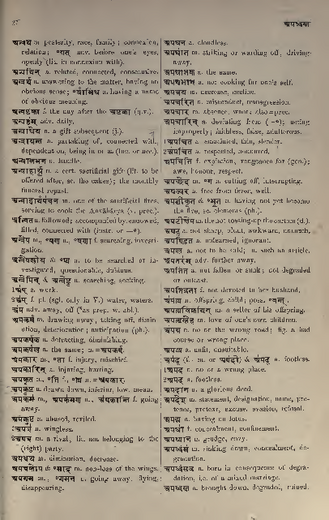
áp1 ·s. work.
Originaltext · Englisch · Substantiv Feminin
áp2 ·f. pl. (sgl. only in V.) water, waters.
Monier-Williams 1872 Worttyp nicht bestimmt
Originaltext · Englisch · Worttyp nicht bestimmt
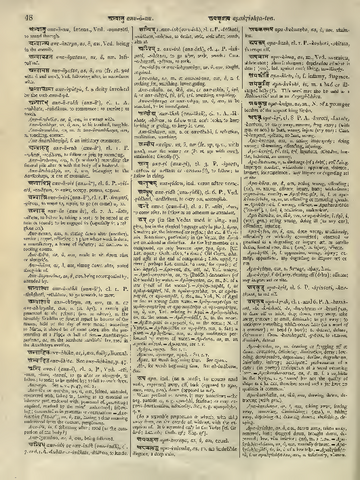
ap ap (in the Vedas used in sing. and plur., but in the classical language only in plur.), āpas, f. water; air, the intermediate region; the star δ Virigi- nis. Sometimes, particularly in the Vedas, the Āpaḥ are considered as divinities. As the last member of a compound, ap may become apa, īpa, ūpa. [Cf. Lat. aqua; Goth. ahva, ‘a river;’ Old Germ. aha, and affa at the end of compounds; Lith. uppê, ‘a river;’ perhaps Lat. amnis, ‘a river,’ for apnis; cf. also ἀφρός].
Petersburger 1855 Substantiv Feminin · Substantiv Maskulin · Worttyp nicht bestimmt
Originaltext · Deutsch · Substantiv Feminin
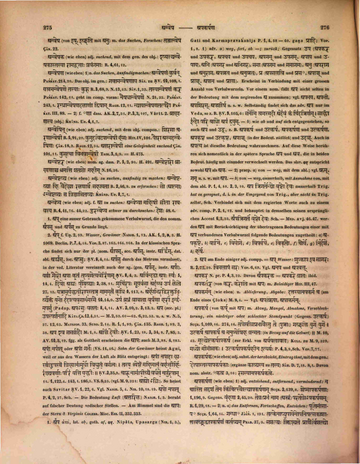
2. áp f. Uṇ. 2,59. Wasser, Gewässer NAIGH. 1,12. AK. 1,2,3,3. H. 1069. Declin. P. 7,4,48. VOP. 3,87. VOP. 3,163. VOP. 3,164. VOP. 3,168. In der klassischen Sprache findet sich nur der pl. (nom. ā́pas, acc. apás, instr. adbhís, dat. abl. adbhyás, loc. apsu; ṚV. 8,4,14. apásu durch das Metrum veranlasst), in der ved. Literatur vereinzelt auch der sg. (gen. apás, instr. apā́). yathā̀ gau̱ro a̱pā kṛ̱taṃ tṛṣya̱nnetyaverìṇam ṚV. 8,4,3. avìndadgā a̱paḥ svàḥ ṚV. 5,14,4. di̱vo a̱dbhyaḥ pṛ̀thi̱vyāḥ ṚV. 2,38,11. śucìra̱paḥ sū̱yavàsā̱ adàbdha̱ upà kṣeti ṚV. 2,27,13. yatrā̱mūrya̱hvatī̱rāpa̱statra̱ māma̱mṛtàṃ kṛdhi ṚV. 9,113,8. ahòbhira̱dbhiraktubhi̱rvyàktaṃ ya̱mo dàdātyava̱sānàmasmai ṚV. 10,14,9. upà bra̱dhnaṃ vā̱vātā̱ vṛṣàṇā̱ harī̱ indràma̱pasù (Padapāṭha padap. apa'su) vakṣataḥ ṚV. 8,4,14. AV. 2,10,2. AV. 3,13,2. apa (acc. pl.) upasparśanādi KĀTY. ŚR. 12,4,31. — M. 2,53. M. 2,60—M. 2,62. M. 6,22. M. 6,53. u. s. w. N. 5,37. N. 12,63. MATSYOP. 33. SUND. 2,14. R. 1,1,89. ŚĀK. 155. RAGH. 1,89. RAGH. 3,58. apa eva sasarjādau M. 1,8. āpò de̱vīḥ ṚV. 1,23,18. ṚV. 3,34,8. ṚV. 7,85,3. AV. 10,5,19. fgg. als Gottheit erscheinen die āpaḥ auch M. 3,88. M. 4,183. a̱pāṃ napā̀t oder a̱pāṃ garbhàḥ (VS. 11,46.) Sohn der Gewässer heisst Agni, weil er aus den Wassern der Luft als Blitz entspringt: a̱pāṃ napā̱dā hyasthā̀du̱pasthàṃ ji̱hmānā̀mū̱rdhvo vi̱dyuta̱ṃ vasā̀naḥ . tasya̱ jyeṣṭhàṃ mahi̱māna̱ṃ vahàntī̱rhiràṇyavarṇā̱ḥ parì yanti ya̱hvīḥ .. ṚV. 2,35,9. cāru̱ nāmā̀pī̱cyàṃ vardhate̱ naptùra̱pām ṚV. 2,35,11. ṚV. 1,122,4. ṚV. 2,143,1. ṚV. 2,186,5. VS. 8,25. (vgl. M. 9,321: adbhyo 'gniḥ). So heisst auch Savitar ṚV. 1,22,6. Vgl. NAIGH. 5,4. NIR. 10,18. NIR. 10,19. apo napāt P. 4,2,27, Sch. — Die Bedeutung Luft (antarikṣa) NAIGH. 1,3. beruht auf falscher Deutung vedischer Stellen. — Am Himmel sind die āpaḥ der Stern δ Virginis COLEBR. Misc. Ess. II, 352. COLEBR. Misc. Ess. II,353.
Originaltext · Deutsch · Substantiv Maskulin
2. ap , acc. pl. āpas auch AV. 13,1,45. MBH. 1,1791. Am Ende, N. eines Sternes; vgl. SŪRYAS. 8,21. āpa m. Comm.
Originaltext · Deutsch · Worttyp nicht bestimmt
1. √ap eine ausser Gebrauch gekommene Verbalwurzel, die den nomm. ápas und apás zu Grunde liegt.
Originaltext · Deutsch · Worttyp nicht bestimmt
2. ap , acc. pl. āpas ṚV. 10,121,8. AV. 14,1,39. AIT. BR. 8,17. MBH. 3,24. BHĀG. P. 10,48,15 (anders der Schol.).
Böhtlingk 1879 Substantiv Feminin · Worttyp nicht bestimmt
Originaltext · Deutsch · Substantiv Feminin
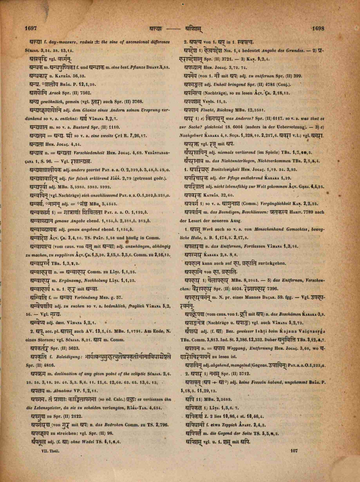
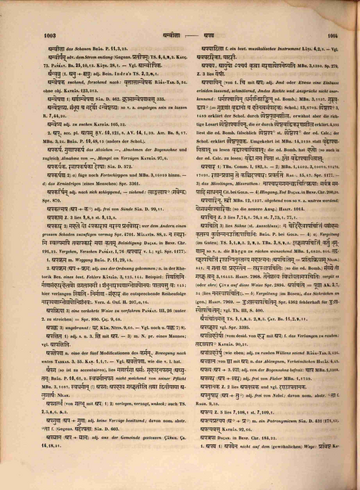
3. áp f. Pl. (im Veda auch Sg.) — 1〉 Wasser, Gewässer. — 2〉 der Stern δ Virginis. — 3〉 *Luft.
Originaltext · Deutsch · Worttyp nicht bestimmt
1. ap thätig sein, arbeiten. apó yádagne vánepu ṚV. 3,6,7.
Originaltext · Deutsch · Worttyp nicht bestimmt
2. áp Werk Gen. apás (abhängig von dhurí) ṚV. 1,151,4. Vgl. aptur.
Apte 1890 Substantiv Feminin
Originaltext · Englisch · Substantiv Feminin
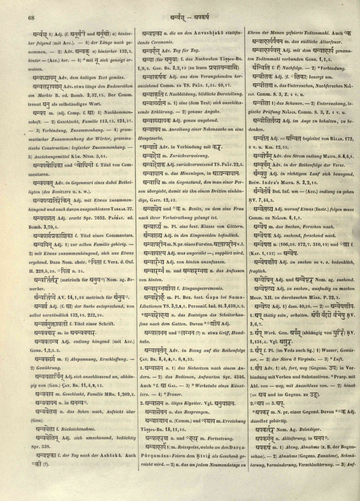
ap f. [āp-kvip-hrasvaśca Uṇ. 2. 58] (Declined in classical language only in pl.; āpaḥ, apaḥ, adbhiḥ, adbhyaḥ apāṃ and apsu, but in singular and pl. in Veda) 1 Water (regarded in Ved. as sacred divinities, āpo devīḥ); khāni caiva spṛśedadbhiḥ Ms. 2. 60. Water is generally considered to be the first of the 5 elements of creation, as in apa eva sasarjādau tāsu bījamavāsṛjat Ms. 1. 8, Ś. 1. 1; but in Ms. 1. 78 it is said to have been created from jyotis or tejas after manas, ākāśa, vāyu and jyotis or agni; jyotiṣaśca vikurvāṇādāpo rasaguṇāḥ smṛtāḥ . adbhyo gaṃdhaguṇā bhūmirityeṣā sṛṣṭirāditaḥ .. 2 Air, the intermediate region. 3 The star Ś virginis. For the changes of ap at the end of comp. see P. V. 4. 74, P. VI. 3. 97-98. [cf. L. aqua, Gr. appos; Lith. uppe; Goth. ahva; Pers. ab; Zend ap; Old Germ. aha]. Comp. — kṛtsnaṃ deep meditation by means of water. — caraḥ an aquatic animal. — patiḥ 1 ‘Lord of waters’, N. of Varuṇa. 2 the ocean. For other comps. see s. v.
Cappeller 1887 Substantiv Feminin · Worttyp nicht bestimmt
Originaltext · Deutsch · Substantiv Feminin
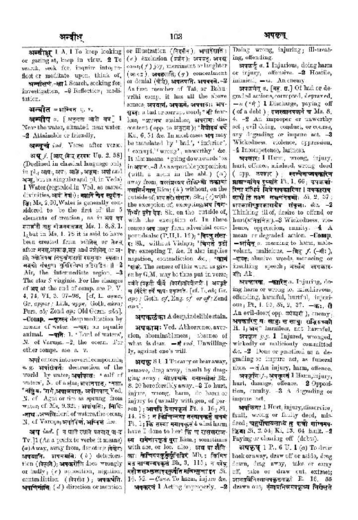
3. áp f. Pl. (Veda auch Sgl.) Wasser.
Originaltext · Deutsch · Worttyp nicht bestimmt
1. ap thätig sein, arbeiten.
Originaltext · Deutsch · Worttyp nicht bestimmt
2. áp Werk.
Burnouf 1866 Verbalwurzel
Originaltext · Französisch · Verbalwurzel
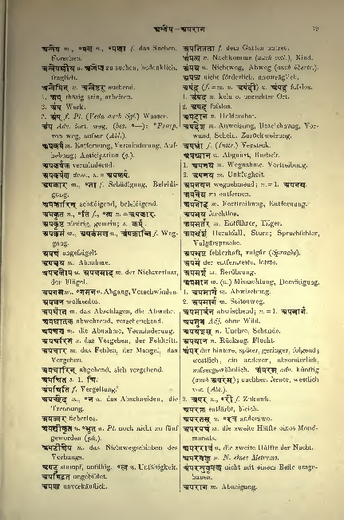
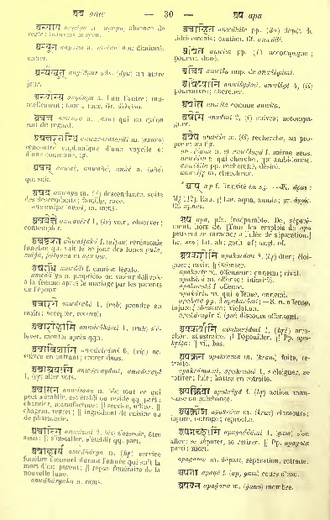
*ap ap f. [inusité au sg. — Pl. āpas: M§ 112]. Eau. Lat. aqua, amnis; gr. ἀφρός. Cf. apnas.
Abgeleitete Wörter
Quelltextfundstellen (9)
HTK 1 Fundstelle
IVU 1 Fundstelle
PJH 1 Fundstelle
SiSa 1 Fundstelle
SVU 5 Fundstellen
Mit AYI Free weitermachen
Bildquelle: AYI Archiv.