

smṛ स्मृ – remember
verbal root · Word type unspecified · verb
Dictionary sources
AYI dictionary verbal root
remember
Cappeller 1891 verb
Original text · English · verb
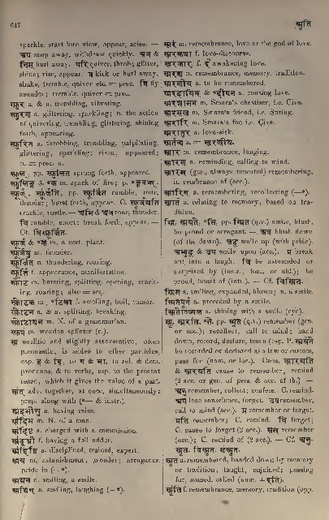
smṛ smárati smára°te ·v pp. smṛta (q.v.) remember (gen. or acc.); recollect, call to mind; hand down, record, declare, teach (esp. P. smaryate be recorded or declared as a law or custom, pass for (nom. or loc.). Caus. smārayati & smarayati cause to remember, remind (2 acc. or gen. of pers. & acc. of th.). -- anu remember, collect; confess. C. remind. apa lose conscience, forget. upa remember, call to mind (acc.). pra remember or forget. prati remember; C. remind. vi forget; C. cause to forget (2 acc.). sam remember (acc.); C. remind of (2 acc.). -- Cf. anusmṛta, vismṛta, saṃsmṛta.
Monier-Williams 1872 Word type unspecified · verb
Original text · English · Word type unspecified
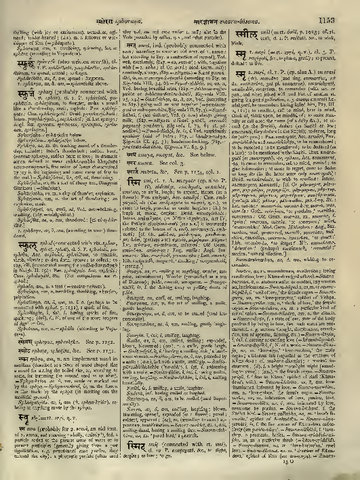
smṛ 1 . smṛ (= rt. spṛ, q. v.), cl. 5. P. smṛṇoti, &c., to please, gratify; to protect, defend; to live.
Original text · English · verb
smṛ 2 . smṛ, cl. 1. P. (ep. also A.) smarati (-te), sasmāra (2nd sing. sasmartha, 1st du. sasmariva, 3rd pl. sasmarus), smariṣyati, asmārṣīt, smartum, to remember (with acc. or gen., and when joined with 2nd Fut. of another rt. giving it a past signification, e. g. amuṃ smarati ha- niṣyati, he remembers having killed him, Pāṇ. III. 2, 112); to recollect, call to mind, bear in mind, think of, think upon, be mindful of; to recite men- tally or call upon the name (of a deity &c.); to re- cord (in the Smṛti), declare (as Smṛti or law; smaranti, they declare in the Smṛti); to desire, long for (with gen.): Pass. smaryate, Aor. asmāri, Prec. smṛṣīṣṭa and smariṣīṣṭa, to be remembered; to be recorded; to be mentioned; to be declared (as a law); to be mentioned in the Smṛti: Caus. smāra- yati (or smarayati), -te, -yitum, Aor. asasmarat, ta, to cause to remember, call to mind, remind; to give information; to cause to regret, cause to desire or long for (in the latter sense only smarayati): Desid. susmūrṣate, to wish to recollect: Intens. sāsmaryate, sāsmarti; [cf. Gr. μέρ-μηρ-α, μέρ-ι-μνα, μερ-μαίζω, μερμηρ-ίζω, μέρ-μερ-ος, μάρ-τυρ, μάρ-τυρ-ο-ς, μάρ-τυ-ς, μαρ-τύρ-ιον, μαρτύρ-ο-μαι, (perhaps also) μέλειν, μέλ-ε-σθαι, μελ-έ-τη, &c.: Lat. me-mor, memor-ia, memor-ā-re, mor-a, mos, mor-is: Goth. mêr-j-an, ‘to proclaim;’ meritha, maurnan: Old Germ. smer-zo, m., smer-za, f. ‘pain;’ smerzan, mâriu, ‘to announce;’ māri, ‘memorable:’ Mod. Germ. Mährchen: Angl. Sax. mœlan, mal, ge-mœred, mœrdh, mœrsian, mel- dian, ameldian, murnan, smeortan, ‘to smart:’ Lith. uz-mirs-tu, ‘to forget:’ Hib. smuairean, ‘dejection;’ (perhaps) smalanach, ‘sorrowful;’ muirn, ‘natural affection.’]
Whitney Roots 1885 verbal root
Original text · English · verbal root
smṛ — remember
Apte 1890 verbal root
Original text · English · verbal root
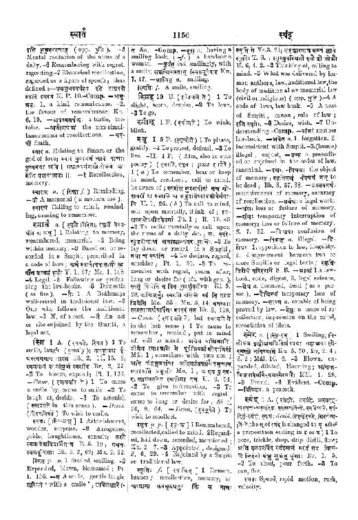
smṛ I. 5 P. (smṛṇoti) 1 To please, gratify. 2 To protect, defend. 3 To live. II. 1 P. (Atm. also in epic poetry) (smarati, smṛta; pass. smaryate) 1 (a) To remember, bear or keep in mind, recollect, call to mind, be aware of; smarosa surasanīrāṃ tatra godāvarīṃ vā smarasi ca tadupāṃteṣvāvayorvartanāni U. 1. 26. (b) To call to mind, call upon mentally, think of; smarātmano'bhīṣṭadevatāṃ Pt. 1; R. 15. 45 2 To recite mentally or call upon the name of a deity &c.; yaḥ smaretpuṃḍarīkākṣaṃ sabāhyābhyaṃtaraḥ śuciḥ. 3 To lay down or record in a Smṛti; tathā ca smaraṃti. 4 To declare, regard, consider; Pt. 1. 30. 5 To remember with regret, yearn after, long or desire for (oft. with gen.); smartuṃ disaṃti na divaḥ surasuṃdarībhyaḥ Ki. 5. 28; kaccidbhartuḥ smarasi rasike tvaṃ hi tasya priyeti Me. 85; Mu. 5. 14; bhavatyāḥ smaratātyarthamarpitaḥ sādaraṃ mama Bk. 8. 118. — Caus. (smārayati-te, but smarayati-te in the last sense) 1 To cause to remember, remind, put in mind of, call to mind; anena matpriyābhiyogena smārayasi me pūrvaśiṣyāṃ saudāminīṃ Māl. 1; sometimes with two acc.; api caṃdraguptadoṣā atikrāṃtapārthivaguṇān smārayaṃti prakṛtīḥ Mu. 1; ya eva duḥsmaraḥ kālastameva smāritā vayaṃ U. 6. 34. 2 To give information. 3 To cause to remember with regret, cause to long or desire for; Śi. 6. 56, Śi. 8. 64. — Desid. (susmūrṣate) To wish to recollect.
Burnouf 1866 verbal root
Original text · French · verbal root
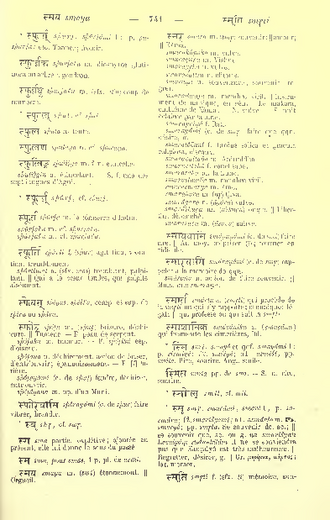
*smṛ smṛ. smarāmi, smare 1; p. sasmāra; f2. smariṣyāmi; a1. asmārṣam. Ps. smarye; pp. smṛta. Se souvenir de, ac.; se souvenir que, ac. ou g. na smariṣyati kaucalyāṃ suduḥkhitām il ne se souviendra pas que Kauśalyā est très-malheureuse. Regretter, désirer, g. Gr. μερίμνα, μάρτυς; lat. memor.
Derived words
Occurrences in source texts (32)
DYS 6 occurrences
GoS 3 occurrences
HP 2 occurrences
HTK 2 occurrences
HTK 10.26–29*1: Cakra, Śaṅkha, Vāmāvartta, Vartmagati and Gadā 1 occurrence
Direct occurrences
-
HTK 10.27*1 Segment 17
IVU 4 occurrences
PYS 6 occurrences
PYS 1.5–11: The Five Vṛtti 2 occurrences
Occurrences through derived words
PYS 4.9–11: Continuity of Saṃskāras 1 occurrence
Occurrences through derived words
-
PYS 4.9 Segment 7
SiSa 5 occurrences
SiSa 5.144-5.155: Ājñā und Khecarī 2 occurrences
Direct occurrences
-
SiSa 5.145 Segment 14
-
SiSa 5.152 Segment 7
VBT 4 occurrences
Continue with AYI Free
Image source: AYI archive.