
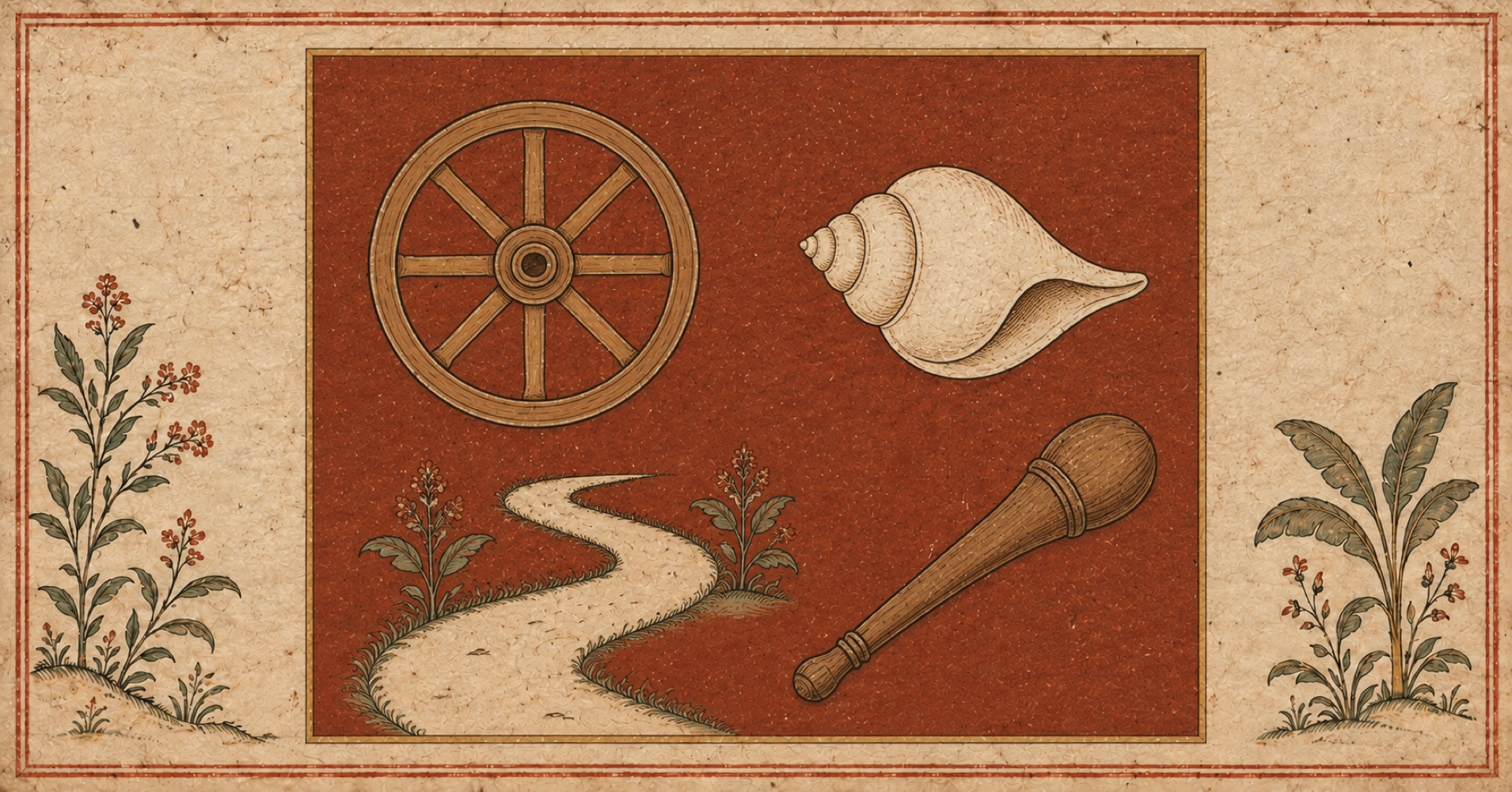
Wheel, conch, winding path and wooden club as four separate motifs.

Haṭhatattvakaumudī 10.26–29*1: Cakra, Śaṅkha, Vāmāvartta, Vartmagati and Gadā: Linking breath passages

Cakra and Vāmāvartta direct breath in opposite directions; Vartmagati uses both nostrils, Śrīgadākumbha both for inhalation and the right for exhalation. Śaṅkha completes the list of names.

Dr. Ronald Steiner Dr. Ronald Steiner
Haṭhatattvakaumudī 10.26
दक्षवामावर्त्तभेदाच्चक्रशङ्खौ द्विधोदितौ सूर्येणापूर्य मरुतं कुम्भयेदुदरस्थितम् |
dakṣa-vāmāvartta-bhedāc; cakra-śaṅkhau dvidhoditau; sūryeṇāpūrya marutaṃ; kumbhayed udara-sthitam | Analysis ▾ Analysis ▴
dakṣa
dvandva-compound
adjective
right
vāma
karmadhāraya-compound
adjective
left
āvartta
tatpuruṣa-compound genitive
substantive masculine
of the direction of rotation
bhedāt
ablative singular
substantive masculine
because of the difference
cakra
dvandva-compound
substantive neuter
wheel
śaṅkhau
nominative dual
substantive masculine
and conch
dvidhā
adverb
twofold
uditau
nominative dual masculine past participle passive
verbal root
named
sūryeṇa
instrumental case singular
substantive masculine
through the sun
āpūrya
absolutus
previx
verbal root
after filling in
marutam
accusative singular
substantive masculine
the breath
kumbhayet
3rd person singular aktive optative denominative
substantive masculine
one should retain
udara
tatpuruṣa-compound lokative
substantive neuter
in the belly
sthitam
accusative singular masculine past participle passive
verbal root
situated
रेचयेदिन्दुना भूयस्तथा दक्षेण पूरयेत्कुम्भयेदिडया रेच्य दक्षिणावर्त्तचक्रकः ||26||
recayed indunā bhūyas; tathā dakṣeṇa pūrayet; kumbhayed iḍayā recya; dakṣiṇāvartta-cakrakaḥ ||26|| Analysis ▾ Analysis ▴
recayet
3rd person singular aktive optative causative
verbal root
one should exhale
indunā
instrumental case singular
substantive masculine
through the moon
bhūyas
adverb
again
tathā
adverb
likewise
dakṣeṇa
instrumental case singular masculine
adjective
through the right
pūrayet
3rd person singular aktive optative causative
verbal root
one should inhale
kumbhayet
3rd person singular aktive optative denominative
substantive masculine
one should retain
iḍayā
instrumental case singular
substantive feminine
through Iḍā
recya
absolutus
verbal root
after exhaling
dakṣiṇa
karmadhāraya-compound
adjective
right
āvartta
bahuvrīhi-compund
substantive masculine
turning
cakrakaḥ
nominative singular
substantive masculine
the small wheel
Metre: Anuṣṭubh
Because of the difference between rightward and leftward rotation (dakṣa-vāmāvartta-bhedāt | abl sg), wheel and conch (cakra-śaṅkhau | nom du) [are] named (uditau | nom du m ppp) in two ways (dvidhā). Having inhaled (āpūrya | abs) through the sun (sūryeṇa | ins sg), one should retain (kumbhayet | 3p sg act opt denom) the breath (marutam | acc sg) situated in the belly (udara-sthitam | acc sg m ppp). One should exhale (recayet | 3p sg act opt caus) through the moon (indunā | ins sg), again (bhūyas) likewise (tathā) inhale (pūrayet | 3p sg act opt caus) through the right [side] (dakṣeṇa | ins sg m) [and] retain (kumbhayet | 3p sg act opt denom). Having exhaled (recya | abs) through Iḍā (iḍayā | ins sg), [one has completed the exercise called] the rightward-turning wheel (dakṣiṇāvartta-cakrakaḥ | nom sg).
Dr. Ronald Steiner - 2026 - historically literal
The wheel makes the recurrence of a sequence tangible. Notice how clearly you still register each step of a familiar sequence as it happens.
Dr. Ronald Steiner - 2026 - modern transfer
sūryeṇāpūrya GDJ2007 ] sūryeṇapūrya GDJ2007-b

kumbhayedudarasthitam GDJ2007 ] kumbhayedurasthitaṃ GDJ2007-b

iḍayā recya GDJ2007 ] iḍayorecyā GDJ2007-b
Critical Apparatus
Haṭhatattvakaumudī 10.27
विलोमो ऽयं चक्रकुम्भो वामावर्त्तः शिवोदितः |
vilomo 'yaṃ cakra-kumbho; vāmāvarttaḥ śivoditaḥ | Analysis ▾ Analysis ▴
vilomaḥ
nominative singular masculine
adjective
reversed
ayam
nominative singular masculine
pronoun dem
this
cakra
karmadhāraya-compound
substantive neuter
wheel
kumbhaḥ
nominative singular
substantive masculine
breath retention
vāma
karmadhāraya-compound
adjective
left
āvarttaḥ
nominative singular masculine
substantive masculine
turning
śiva
tatpuruṣa-compound instrumental case
substantive masculine
by Śiva
uditaḥ
nominative singular masculine past participle passive
verbal root
taught
सूर्यचन्द्राव् इमौ कुम्भौ द्रुहिणेन पुरोदितौ |
sūrya-candrāv imau kumbhau; druhiṇena puroditau | Analysis ▾ Analysis ▴
sūrya
dvandva-compound
substantive masculine
sun
candrau
nominative dual
substantive masculine
and moon
imau
nominative dual masculine
pronoun dem
these two
kumbhau
nominative dual
substantive masculine
breath retentions
druhiṇena
instrumental case singular
substantive masculine
by Druhiṇa
purā
adverb
formerly
uditau
nominative dual masculine past participle passive
verbal root
taught
अत्युष्णशीतलाव् एतौ देशकालप्रयोजितौ ||27||
atyuṣṇa-śītalāv etau; deśa-kāla-prayojitau ||27|| Analysis ▾ Analysis ▴
ati
karmadhāraya-compound
adverb
very
uṣṇa
dvandva-compound
adjective
hot
śītalau
nominative dual masculine
adjective
and cool
etau
nominative dual masculine
pronoun dem
these two
deśa
dvandva-compound
substantive masculine
place
kāla
tatpuruṣa-compound instrumental case
substantive masculine
and according to time
prayojitau
nominative dual masculine past participle passive causative
previx
verbal root
applied
Metre: Anuṣṭubh
This wheel breath retention (ayaṃ cakra-kumbhaḥ | nom sg), [performed] in reverse (vilomaḥ | nom sg m), [is] the leftward-turning one (vāmāvarttaḥ | nom sg m), taught by Śiva (śivoditaḥ | nom sg m ppp). These two breath retentions (imau kumbhau | nom du), sun and moon (sūrya-candrau | nom du), [were] formerly (purā) taught (uditau | nom du m ppp) by Druhiṇa (druhiṇena | ins sg). These two (etau | nom du m), very hot and cool (atyuṣṇa-śītalau | nom du m), [are] applied according to place and time (deśa-kāla-prayojitau | nom du m ppp caus).
Dr. Ronald Steiner - 2026 - historically literal
Reversing a familiar sequence often changes the task of attention. When choosing your practice, also consider place, time of day and how you feel now.
Dr. Ronald Steiner - 2026 - modern transfer
atyuṣṇa GDJ2007 ] atyuṣma GDJ2007-b
Critical Apparatus
Haṭhatattvakaumudī 10.27*1
चक्रकुम्भं द्विधा कुर्यादग्निषोमं तथैकधा |
cakra-kumbhaṃ dvidhā kuryād; agni-ṣomaṃ tathaikadhā | Analysis ▾ Analysis ▴
cakra
karmadhāraya-compound
substantive neuter
wheel
kumbham
accusative singular
substantive masculine
breath retention
dvidhā
adverb
twice, in two ways
kuryāt
3rd person singular aktive optative
verbal root
he should perform
agni
dvandva-compound
substantive masculine
fire
somam
accusative singular
substantive masculine
moon
tathā
adverb
likewise
ekadhā
adverb
once
शङ्खकुम्भो ऽयम् ईशेन पूर्ववद्द्विविधः स्मृतः ||27.1||
śaṅkha-kumbho 'yam īśena; pūrvavad dvi-vidhaḥ smṛtaḥ ||27.1|| Analysis ▾ Analysis ▴
śaṅkha
karmadhāraya-compound
substantive masculine
conch
kumbhaḥ
nominative singular
substantive masculine
breath retention
ayam
nominative singular masculine
pronoun dem
this
īśena
instrumental case singular
substantive masculine
by Īśa
pūrvavat
adverb
as before
dvi
bahuvrīhi-compund
numeral
two
vidhaḥ
nominative singular masculine
substantive masculine
having forms
smṛtaḥ
nominative singular masculine past participle passive
verbal root
taught
Metre: Anuṣṭubh
[One] should perform (kuryāt | 3p sg act opt) the wheel breath retention (cakra-kumbham | acc sg) twice (dvidhā) [each time inhaling through the right nostril, holding the breath and exhaling through the left], and likewise (tathā) [then perform] the fire–moon [alternate-nostril breathing] (agni-ṣomam | acc sg) once (ekadhā) [as one round with two breath retentions: right in, hold, left out; left in, hold, right out]. This (ayam | nom sg m) conch breath retention (śaṅkha-kumbhaḥ | nom sg) [is] taught (smṛtaḥ | nom sg m ppp) by Īśa (īśena | ins sg) in two forms (dvi-vidhaḥ | nom sg m) [rightward and leftward], as before (pūrvavat).
Dr. Ronald Steiner - 2026 - historically literal
Śaṅkha combines two Cakra repetitions in the same direction – inhale through the right nostril, hold, exhale through the left – with one round of Agniṣoma alternate-nostril breathing: right in, hold, left out; left in, hold, right out. The leftward form reverses the sides.
Dr. Ronald Steiner - 2026 - modern transfer
cakrakumbhaṃ … smṛtaḥ conj. ed. ex KP 110 ] om. GDJ2007
Critical Apparatus
Haṭhatattvakaumudī 10.27*2
कौष्म्यम् ईषच्छीतलता कुम्भयोर् अनयोर् भवेत् ||27.2||
kauṣmyam īṣac-chītalatā; kumbhayor anayor bhavet ||27.2|| Analysis ▾ Analysis ▴
kauṣmyam
nominative singular
kauṣmya
substantive neuter
gentle warmth
īṣat
karmadhāraya-compound
adverb
slight
śītalatā
nominative singular
substantive feminine
coolness
kumbhayoḥ
lokative dual
substantive masculine
with the two breath retentions
anayoḥ
lokative dual masculine
pronoun dem
with these two
bhavet
3rd person singular aktive optative
verbal root
it may arise
Metre: Anuṣṭubh
With these two breath retentions (kumbhayor anayoḥ | loc du), gentle warmth (kauṣmyam | nom sg) [or, respectively,] slight coolness (īṣac-chītalatā | nom sg) may arise (bhavet | 3p sg act opt).
Dr. Ronald Steiner - 2026 - historically literal
After a practice, notice whether you feel warmth or coolness. Even subtle differences can help you understand how you feel at that moment.
Dr. Ronald Steiner - 2026 - modern transfer
kauṣmyam … bhavet conj. ed. ex KP 111 ] om. GDJ2007
Critical Apparatus
Haṭhatattvakaumudī 10.28
उभाभ्यां पूरयेद्वायुं कुम्भयित्वा यथाविधि |
ubhābhyāṃ pūrayed vāyuṃ; kumbhayitvā yathā-vidhi | Analysis ▾ Analysis ▴
ubhābhyām
instrumental case dual masculine
ubha
pronoun quant
through both
pūrayet
3rd person singular aktive optative causative
verbal root
one should inhale
vāyum
accusative singular
substantive masculine
the breath
kumbhayitvā
absolutus denominative
substantive masculine
after retaining
yathā
avyayībhāva-compund
adverb
according to
vidhi
avyayībhāva-compund
substantive masculine
the prescription
उभाभ्यां रेचयेद्वर्त्मगतिः कुम्भः शिवोदितः ||28||
ubhābhyāṃ recayed vartma;-gatiḥ kumbhaḥ śivoditaḥ ||28|| Analysis ▾ Analysis ▴
ubhābhyām
instrumental case dual masculine
ubha
pronoun quant
through both
recayet
3rd person singular aktive optative causative
verbal root
one should exhale
vartma
tatpuruṣa-compound genitive
substantive neuter
of the path
gatiḥ
nominative singular
substantive feminine
course
kumbhaḥ
nominative singular
substantive masculine
breath retention
śiva
tatpuruṣa-compound instrumental case
substantive masculine
by Śiva
uditaḥ
nominative singular masculine past participle passive
verbal root
taught
Metre: Anuṣṭubh
One should draw in (pūrayet | 3p sg act opt caus) the breath (vāyum | acc sg) through both [nostrils] (ubhābhyām | ins du m). Having retained [it] (kumbhayitvā | abs denom) as prescribed (yathā-vidhi), one should exhale (recayet | 3p sg act opt caus) through both [nostrils] (ubhābhyām | ins du m). [This is] the breath retention (kumbhaḥ | nom sg) Vartmagati (vartma-gatiḥ | nom sg), taught by Śiva (śivoditaḥ | nom sg m ppp).
Dr. Ronald Steiner - 2026 - historically literal
Feel the breath at both sides of the nose without expecting identical sensations. You can notice differences while staying with a single breath.
Dr. Ronald Steiner - 2026 - modern transfer
ubhābhyāṃ pūrayedvāyuṃ kumbhayitvā yathāvidhi | ubhābhyāṃ recayedvartmagatiḥ kumbhaḥ śivoditaḥ GDJ2007 ] om. GDJ2007-b

ubhābhyāṃ GDJ2007 ] yatrobhābhyāṃ GDJ2007-app
Critical Apparatus
Haṭhatattvakaumudī 10.29
यत्रोभाभ्यां पूरणं ग्लौरविभ्यां सम्यङ् मार्त्तण्डाध्वना रेचनं च |
yatrobhābhyāṃ, pūraṇaṃ glau-ravibhyāṃ; samyaṅ mārttaṇ,ḍādhvanā recanaṃ ca | Analysis ▾ Analysis ▴
yatra
adverb
where
ubhābhyām
instrumental case dual masculine
ubha
pronoun quant
through both
pūraṇam
nominative singular
substantive neuter
inhalation
glau
dvandva-compound
substantive masculine
moon
ravibhyām
instrumental case dual
substantive masculine
and sun
samyak
adverb
proper
mārttaṇḍa
tatpuruṣa-compound genitive
substantive masculine
of the sun
adhvanā
instrumental case singular
substantive masculine
through the path
recanam
nominative singular
substantive neuter
exhalation
ca
particle
and
एषः प्रोक्तः श्रीगदाकुम्भनामा देहे धत्ते श्रीबलं साधकस्य ||29||
eṣaḥ proktaḥ, śrī-gadā-kumbha-nāmā; dehe dhatte, śrī-balaṃ sādhakasya ||29|| Analysis ▾ Analysis ▴
eṣaḥ
nominative singular masculine
pronoun dem
this
proktaḥ
nominative singular masculine past participle passive
previx
verbal root
called
śrī
karmadhāraya-compound
substantive feminine
splendid
gadā
karmadhāraya-compound
substantive feminine
mace
kumbha
bahuvrīhi-compund
substantive masculine
breath retention
nāmā
nominative singular masculine
substantive neuter
bearing the name
dehe
lokative singular
substantive masculine
in the body
dhatte
3rd person singular medial present
verbal root
bestows
śrī
dvandva-compound
substantive feminine
splendour
balam
accusative singular
substantive neuter
and strength
sādhakasya
genitive singular
substantive masculine
of the practitioner
Metre: Śālinī
Where (yatra) inhalation (pūraṇam | nom sg) [takes place] properly (samyak) through both (ubhābhyām | ins du m), moon and sun (glau-ravibhyām | ins du), and (ca) exhalation (recanam | nom sg) [takes place] through the solar path (mārttaṇḍādhvanā | ins sg), this (eṣaḥ | nom sg m) [retention is] known (proktaḥ | nom sg m ppp) by the name Śrīgadākumbha (śrī-gadā-kumbha-nāmā | nom sg m). [It] bestows (dhatte | 3p sg med pres) splendour and strength (śrī-balam | acc sg) in the body (dehe | loc sg) of the practitioner (sādhakasya | gen sg).
Dr. Ronald Steiner - 2026 - historically literal
Taking in through two paths and directing towards one can serve as an image for attention. First notice a range of impressions, then choose one to explore more closely.
Dr. Ronald Steiner - 2026 - modern transfer
recanaṃ ca GDJ2007 ] balaṃ ca GDJ2007-b

dhatte śrībalaṃ GDJ2007 ] dhanedhībalaṃ GDJ2007-b
Critical Apparatus
Haṭhatattvakaumudī 10.29*1
इति चक्रशङ्खवामावर्त्तवर्त्त्मगतिनामानश्चत्वारः कुम्भाः गदाकुम्भो ऽयं पञ्चमः |
iti cakra-śaṅkha-vāmāvartta-varttma-gati-nāmānaś catvāraḥ kumbhāḥ gadā-kumbho 'yaṃ pañcamaḥ | Analysis ▾ Analysis ▴
iti
particle
thus end
cakra
dvandva-compound
substantive neuter
wheel
śaṅkha
dvandva-compound
substantive masculine
conch
vāma
karmadhāraya-compound
adjective
left
āvartta
dvandva-compound
substantive masculine
rotation
varttma
tatpuruṣa-compound genitive
substantive neuter
of the path
gati
bahuvrīhi-compund
substantive feminine
course
nāmānaḥ
nominative plural masculine
substantive neuter
bearing the names
catvāraḥ
nominative plural masculine
numeral
four
kumbhāḥ
nominative plural
substantive masculine
breath retentions
gadā
karmadhāraya-compound
substantive feminine
mace
kumbhaḥ
nominative singular
substantive masculine
breath retention
ayam
nominative singular masculine
pronoun dem
this
pañcamaḥ
nominative singular masculine
pañcama
numeral
fifth
Metre: none
Thus (iti) [end] the four breath retentions (catvāraḥ kumbhāḥ | nom pl) bearing the names Cakra [rightward], Śaṅkha [rightward and leftward], Vāmāvartta [the leftward Cakra] and Vartmagati (cakra-śaṅkha-vāmāvartta-varttma-gati-nāmānaḥ | nom pl m). This (ayam | nom sg m) mace breath retention [Gadā] (gadā-kumbhaḥ | nom sg) [is] the fifth (pañcamaḥ | nom sg m).
Dr. Ronald Steiner - 2026 - historically literal
Five techniques are summarised here: the rightward Cakra, its leftward form Vāmāvartta, Śaṅkha in both directions, Vartmagati and Gadā.
Dr. Ronald Steiner - 2026 - modern transfer

Continue with AYI Free

Illustrations: AI-generated.

Editor

Dr. Ronald Steiner

From Ulm

The "Yoga Doc" - Dr. Ronald Steiner is the founder of the AYI method. This method links traditional Ashtanga Yoga with innovative Yogatherapy and living Philosophy. This forms a practice that is personal for each and... more ›

Messages and ratings
0 messages

Please log in to write a message. Go to login

No messages yet.