
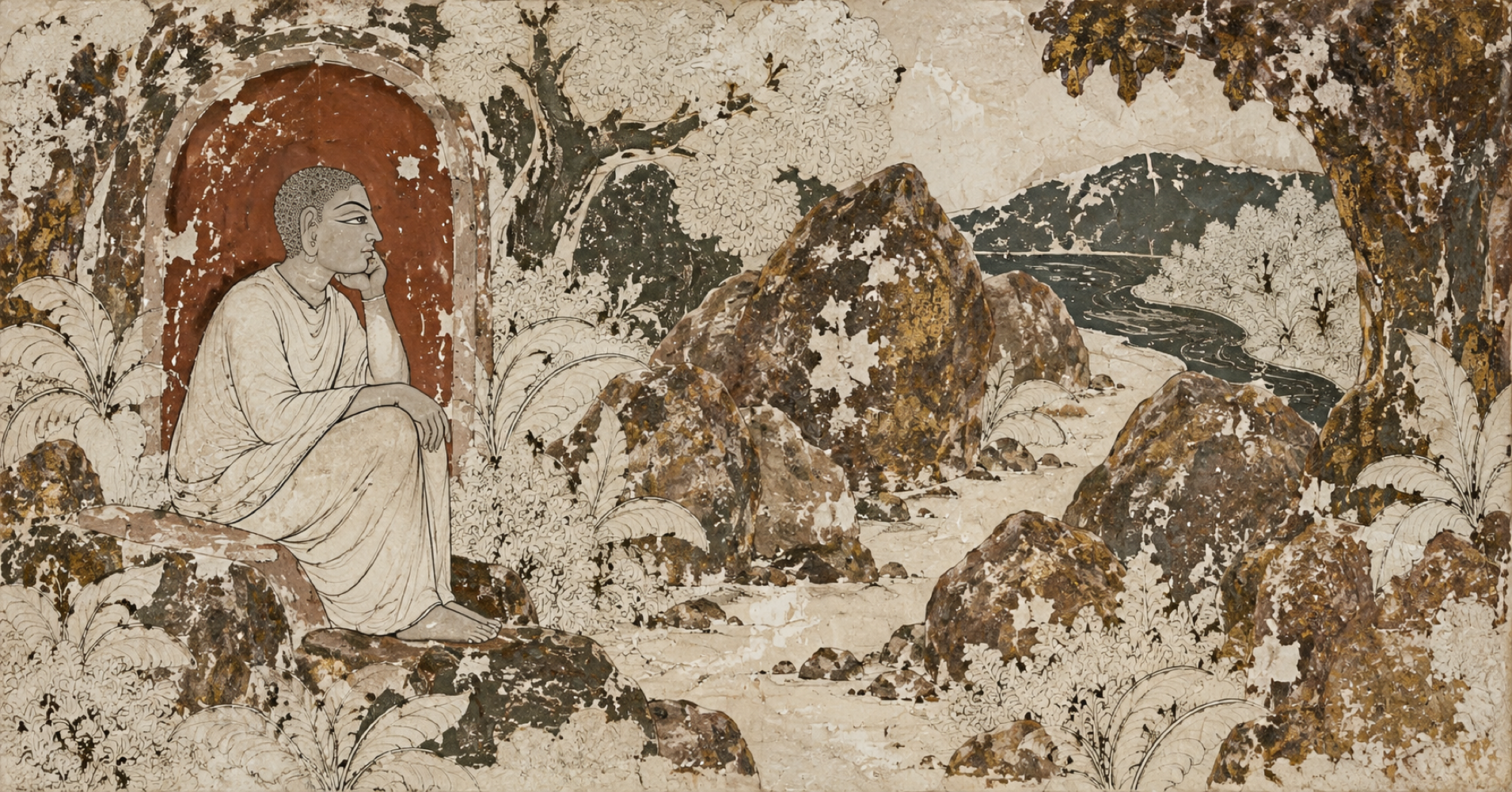
A figure studies a rocky path attentively.

Gorakṣaśataka 67–73: Daily Life, Discomfort and Ten Obstacles

What difficulties accompany practice? The list moves from bodily complaints through doubt and laziness towards discerning understanding.

Dr. Ronald Steiner Dr. Ronald Steiner
Gorakṣaśataka (Original) 67
कर्तव्यः कुंभको नित्यं बन्धत्रयसमन्वितः |
kartavyaḥ kuṃbhako nityaṃ; bandha-traya-samanvitaḥ | Analysis ▾ Analysis ▴
kartavyaḥ
nominative singular masculine future participle passive
verbal root
to be performed
kumbhakaḥ
nominative singular
substantive masculine
breath retention
nityam
adverb
constantly
bandha
tatpuruṣa-compound genitive
substantive masculine
lock
traya
tatpuruṣa-compound instrumental case
substantive neuter
three
samanvitaḥ
nominative singular masculine past participle passive
previx
previx
verbal root
accompanied
दिवा सुप्तिर् निशायां च जागरादतिमैथुनात् ||67||
divā suptir niśāyāṃ ca; jāgarād ati-maithunāt ||67|| Analysis ▾ Analysis ▴
divā
adverb
on the day
suptiḥ
nominative singular
substantive feminine
sleep
niśāyām
lokative singular
substantive feminine
at night
ca
particle
and
jāgarāt
ablative singular
substantive masculine
from wakefulness
ati
karmadhāraya-compound
previx
excessively
maithunāt
ablative singular
substantive neuter
from sexual intercourse
… breath retention (kumbhakaḥ | nom sg) is to be performed (kartavyaḥ | nom sg m pfp) constantly (nityam), accompanied by the three locks (bandha-traya-samanvitaḥ | nom sg m ppp). Sleep (suptiḥ | nom sg) during the day (divā) because of wakefulness (jāgarāt | abl sg) at night (niśāyām | loc sg) and (ca) excessive sexual intercourse (ati-maithunāt | abl sg) …
Dr. Ronald Steiner - 2026 - historically literal
Rest also belongs to practice. Consider your daily life when you feel exhausted.
Dr. Ronald Steiner - 2026 - modern transfer

I connect the statements of causes in 67–68 with the arising of illness in 69. Wakefulness at night and excessive sexual intercourse are read as reasons for daytime sleep. Mallinson (2012, p. 270) understands the sequence similarly. The construction across the verse boundaries therefore introduces no additional “complaints” absent from the wording.

Apparatus Comment
Gorakṣaśataka (Original) 68
बहुसंक्रमणं नित्यं रोधान् मूत्रपुरीषयोः |
bahu-saṃkramaṇaṃ nityaṃ; rodhān mūtra-purīṣayoḥ | Analysis ▾ Analysis ▴
bahu
karmadhāraya-compound
adjective
much
saṃkramaṇam
nominative singular
substantive neuter
disturbance, moving about
nityam
adverb
constantly
rodhāt
ablative singular
substantive masculine
from restraining
mūtra
dvandva-compound
substantive neuter
urine
purīṣayoḥ
genitive dual
substantive neuter
of urine and faeces
विषमासनदोषाश्च प्रयासप्राणचिन्तनात् ||68||
viṣamāsana-doṣāś ca; prayāsa-prāṇa-cintanāt ||68|| Analysis ▾ Analysis ▴
viṣama
karmadhāraya-compound
adjective
uneven, unsuitable
āsana
tatpuruṣa-compound genitive
substantive neuter
seat
doṣāḥ
nominative plural
substantive masculine
disorders
ca
particle
and
prayāsa
tatpuruṣa-compound instrumental case
substantive masculine
effort
prāṇa
tatpuruṣa-compound genitive
substantive masculine
breath
cintanāt
ablative singular
substantive neuter
from concentration
… constant (nityam) great disturbance (bahu-saṃkramaṇam | nom sg) from restraining (rodhāt | abl sg) urine and faeces (mūtra-purīṣayoḥ | gen du), and (ca) disorders of unsuitable posture (viṣama-āsana-doṣāḥ | nom pl) from strenuous concentration on the breath (prayāsa-prāṇa-cintanāt | abl sg) …
Dr. Ronald Steiner - 2026 - historically literal
Your well-being is influenced by more than the practice itself. Notice how you respond to tiredness, bodily needs and inner pressure.
Dr. Ronald Steiner - 2026 - modern transfer

In the context of retaining urine and faeces, I render bahusaṃkramaṇam as “great disturbance”; literally, much movement or walking about is also possible. Mallinson (2012, p. 270) interprets it as excessive agitation. The list continues the sentence begun in 67 and leads into the arising of illness in 69.

Apparatus Comment
Gorakṣaśataka (Original) 69
शीघ्रम् उत्पद्यते रोगः स्तम्भयेद्यदि संयमी |
śīghram utpadyate rogaḥ; stambhayed yadi saṃyamī | Analysis ▾ Analysis ▴
śīghram
adverb
quickly
utpadyate
3rd person singular medial present
previx
verbal root
arises
rogaḥ
nominative singular
substantive masculine
illness
stambhayet
3rd person singular aktive optative causative
verbal root
one should interrupt
yadi
particle
if; when
saṃyamī
nominative singular
substantive masculine
the disciplined practitioner
योगाभ्यासेन मे रोग उत्पन्न इति कथ्यते ||69||
yogābhyāsena me roga; utpanna iti kathyate ||69|| Analysis ▾ Analysis ▴
yoga
tatpuruṣa-compound genitive
substantive masculine
yoga
abhyāsena
instrumental case singular
substantive masculine
through practice
me
genitive singular
pronoun pers 1p
in me
rogaḥ
nominative singular
substantive masculine
illness
utpannaḥ
nominative singular masculine past participle passive
previx
verbal root
arisen
iti
particle
thus
kathyate
3rd person singular passive present
verbal root
is said
… illness (rogaḥ | nom sg) quickly (śīghram) arises (utpadyate | 3p sg med pres). If (yadi) the disciplined practitioner (saṃyamī | nom sg) were to interrupt [the practice] (stambhayet | 3p sg act opt caus), and it is said (kathyate | 3p sg pas pres) thus (iti): “Illness (rogaḥ | nom sg) has arisen (utpannaḥ | nom sg m ppp) in me (me | gen sg) through practising yoga (yoga-abhyāsena | ins sg)” …
Dr. Ronald Steiner - 2026 - historically literal
Discomfort deserves attention even when you practise regularly. Investigate connections openly instead of settling too quickly on a cause.
Dr. Ronald Steiner - 2026 - modern transfer

The conditional construction introduced by yadi, “if”, extends into 70: the practitioner interrupts practice and ultimately abandons it because they attribute their illness to yoga. Following Mallinson (2012, p. 270), I therefore relate stambhayet to practice, not to holding the breath. kathyate is passive, “it is said”; it introduces the quoted explanation. This historical interpretation is not present-day advice on responding to symptoms.

Apparatus Comment
Gorakṣaśataka (Original) 70
ततो ऽभ्यासं त्यजेदेवं प्रथमं विघ्नम् उच्यते |
tato 'bhyāsaṃ tyajed evaṃ; prathamaṃ vighnam ucyate | Analysis ▾ Analysis ▴
tataḥ
adverb
then
abhyāsam
accusative singular
substantive masculine
practice
tyajet
3rd person singular aktive optative
verbal root
one should abandon
evam
adverb
thus
prathamam
nominative singular neuter
adjective
first
vighnam
nominative singular
substantive masculine
obstacle; used as neuter
ucyate
3rd person singular passive present
verbal root
is called
द्वितीयं संशयाख्यं च तृतीयं च प्रमत्तता ||70||
dvitīyaṃ saṃśayākhyaṃ ca; tṛtīyaṃ ca pramattatā ||70|| Analysis ▾ Analysis ▴
dvitīyam
nominative singular neuter
adjective
second
saṃśaya
upapada-compound
substantive masculine
doubt
ākhyam
nominative singular neuter
adjective
called
ca
particle
and
tṛtīyam
nominative singular neuter
adjective
third
ca
particle
and
pramattatā
nominative singular
substantive feminine
carelessness
… and would then (tataḥ) abandon (tyajet | 3p sg act opt) the practice (abhyāsam | acc sg), this (evam) is called (ucyate | 3p sg pas pres) the first (prathamam | nom sg n) obstacle (vighnam | nom sg). And (ca) the second (dvitīyam | nom sg n) is named doubt (saṃśaya-ākhyam | nom sg n), and (ca) the third (tṛtīyam | nom sg n) is carelessness (pramattatā | nom sg).
Dr. Ronald Steiner - 2026 - historically literal
Doubt and inattention can change your practice. Take them seriously and distinguish a necessary pause from an unnoticed loss of direction.
Dr. Ronald Steiner - 2026 - modern transfer

tyajet, “would abandon”, belongs to the condition opened by yadi in 69. The text describes the first obstacle; it does not instruct the reader to abandon practice here. The subsequent obstacles are rendered as separate sentences.

Apparatus Comment
Gorakṣaśataka (Original) 71
आलस्याख्यं चतुर्थं च निद्रारूपं च पंचमम् |
ālasyākhyaṃ caturthaṃ ca; nidrā-rūpaṃ ca paṃcamam | Analysis ▾ Analysis ▴
ālasya
upapada-compound
substantive neuter
laziness
ākhyam
nominative singular neuter
adjective
called
caturtham
nominative singular neuter
adjective
fourth
ca
particle
and
nidrā
tatpuruṣa-compound genitive
substantive feminine
sleep
rūpam
nominative singular neuter
substantive neuter
having the form
ca
particle
and
pañcamam
nominative singular neuter
adjective
fifth
षष्ठं च विरतिर् भ्रान्तिः सप्तमं परिकीर्तितम् ||71||
ṣaṣṭhaṃ ca viratir bhrāntiḥ; saptamaṃ parikīrtitam ||71|| Analysis ▾ Analysis ▴
ṣaṣṭham
nominative singular neuter
adjective
sixth
ca
particle
and
viratiḥ
nominative singular
substantive feminine
withdrawal
bhrāntiḥ
nominative singular
substantive feminine
confusion
saptamam
nominative singular neuter
adjective
seventh
parikīrtitam
nominative singular neuter past participle passive
previx
verbal root
designated
And (ca) the fourth (caturtham | nom sg n) is named laziness (ālasya-ākhyam | nom sg n), and (ca) the fifth (pañcamam | nom sg n) takes the form of sleep (nidrā-rūpam | nom sg n). And (ca) the sixth (ṣaṣṭham | nom sg n) is withdrawal (viratiḥ | nom sg); confusion (bhrāntiḥ | nom sg) is designated (parikīrtitam | nom sg n ppp) the seventh (saptamam | nom sg n).
Dr. Ronald Steiner - 2026 - historically literal
Naming obstacles more precisely can help. Tiredness, a lack of motivation and confusion need not call for the same response.
Dr. Ronald Steiner - 2026 - modern transfer
Gorakṣaśataka (Original) 72
विषमं चाष्टमं चैव अनाख्यं नवमं स्मृतं |
viṣamaṃ cāṣṭamaṃ caiva; anākhyaṃ navamaṃ smṛtaṃ | Analysis ▾ Analysis ▴
viṣamam
nominative singular neuter
adjective
irregularity
ca
particle
and
aṣṭamam
nominative singular neuter
adjective
eighth
ca
particle
and
eva
particle
indeed; precisely
anākhyam
nominative singular neuter
anākhya
adjective
unnamed
navamam
nominative singular neuter
adjective
ninth
smṛtam
nominative singular neuter past participle passive
verbal root
traditionally known
अलब्धिर् योगतत्त्वस्य दशमं प्रोच्यते बुधैः ||72||
alabdhir yoga-tattvasya; daśamaṃ procyate budhaiḥ ||72|| Analysis ▾ Analysis ▴
alabdhiḥ
nominative singular
alabdhi
substantive feminine
failure to attain
yoga
tatpuruṣa-compound genitive
substantive masculine
yoga
tattvasya
genitive singular
substantive neuter
of the essence
daśamam
nominative singular neuter
adjective
tenth
procyate
3rd person singular passive present
previx
verbal root
is called
budhaiḥ
instrumental case plural masculine
adjective
by the wise
And (ca) the eighth (aṣṭamam | nom sg n) is irregularity (viṣamam | nom sg n), and (ca) indeed (eva) the ninth (navamam | nom sg n) is traditionally known (smṛtam | nom sg n ppp) as the unnamed (anākhyam | nom sg n). Failure to attain (alabdhiḥ | nom sg) the essence of yoga (yoga-tattvasya | gen sg) is called (procyate | 3p sg pas pres) the tenth (daśamam | nom sg n) by the wise (budhaiḥ | ins pl m).
Dr. Ronald Steiner - 2026 - historically literal
A lack of progress can also unsettle you. Look more closely rather than giving every difficulty the same name.
Dr. Ronald Steiner - 2026 - modern transfer
viṣamaṃ ] viṣayaṃ R7874apJM
Critical Apparatus

viṣamam is Mallinson’s correction of viṣayam. In the working text the ninth obstacle is called anākhyam, literally “unnamed”. I do not replace it with a conjectured category known from other lists.

Apparatus Comment
Gorakṣaśataka (Original) 73
इत्य् एतद्विघ्नदशकं विचारेण त्यजेद्बुधः |
ity etad vighna-daśakaṃ; vicāreṇa tyajed budhaḥ | Analysis ▾ Analysis ▴
iti
particle
thus
etat
accusative singular neuter
pronoun dem
this
vighna
tatpuruṣa-compound genitive
substantive masculine
obstacles
daśakam
accusative singular
substantive neuter
group of ten
vicāreṇa
instrumental case singular
substantive masculine
through inquiry
tyajet
3rd person singular aktive optative
verbal root
one should abandon
budhaḥ
nominative singular masculine
adjective
the wise practitioner
प्राणाभ्यासस्ततः कार्यो नित्यं सत्त्वास्थया धिया ||73||
prāṇābhyāsas tataḥ kāryo; nityaṃ sattvāsthayā dhiyā ||73|| Analysis ▾ Analysis ▴
prāṇa
tatpuruṣa-compound genitive
substantive masculine
breath
abhyāsaḥ
nominative singular
substantive masculine
practice
tataḥ
adverb
then
kāryaḥ
nominative singular masculine future participle passive
verbal root
to be done
nityam
adverb
constantly
sattva
tatpuruṣa-compound lokative
substantive neuter
reality, clarity
āsthayā
instrumental case singular feminine
āstha
adjective
grounded in it
dhiyā
instrumental case singular
substantive feminine
with understanding
Thus (iti) a wise person (budhaḥ | nom sg m) should abandon (tyajet | 3p sg act opt) this (etat | acc sg n) group of ten obstacles (vighna-daśakam | acc sg) through inquiry (vicāreṇa | ins sg). Thereafter (tataḥ), breath practice (prāṇa-abhyāsaḥ | nom sg) is to be performed (kāryaḥ | nom sg m pfp) constantly (nityam), with understanding (dhiyā | ins sg) grounded in reality (sattva-āsthayā | ins sg f).
Dr. Ronald Steiner - 2026 - historically literal
Inquiry can be part of your practice. Understanding obstacles more clearly makes it easier to find an appropriate response.
Dr. Ronald Steiner - 2026 - modern transfer

I understand sattvāsthayā dhiyā as a connected expression: understanding grounded in reality. -āstha is construed adjectivally with dhī. This accords with Mallinson’s interpretation of the practitioner as grounded in true reality (2012, p. 270). The translation does not divide the expression into two independent means.

Apparatus Comment

Continue with AYI Free

Illustrations: AI-generated.

Editor

Dr. Ronald Steiner

From 89075 Ulm

The "Yoga Doc" - Dr. Ronald Steiner is the founder of the AYI method. This method links traditional Ashtanga Yoga with innovative Yogatherapy and living Philosophy. This forms a practice that is personal for each and... more ›

Messages and ratings
0 messages

Please log in to write a message. Go to login

No messages yet.