
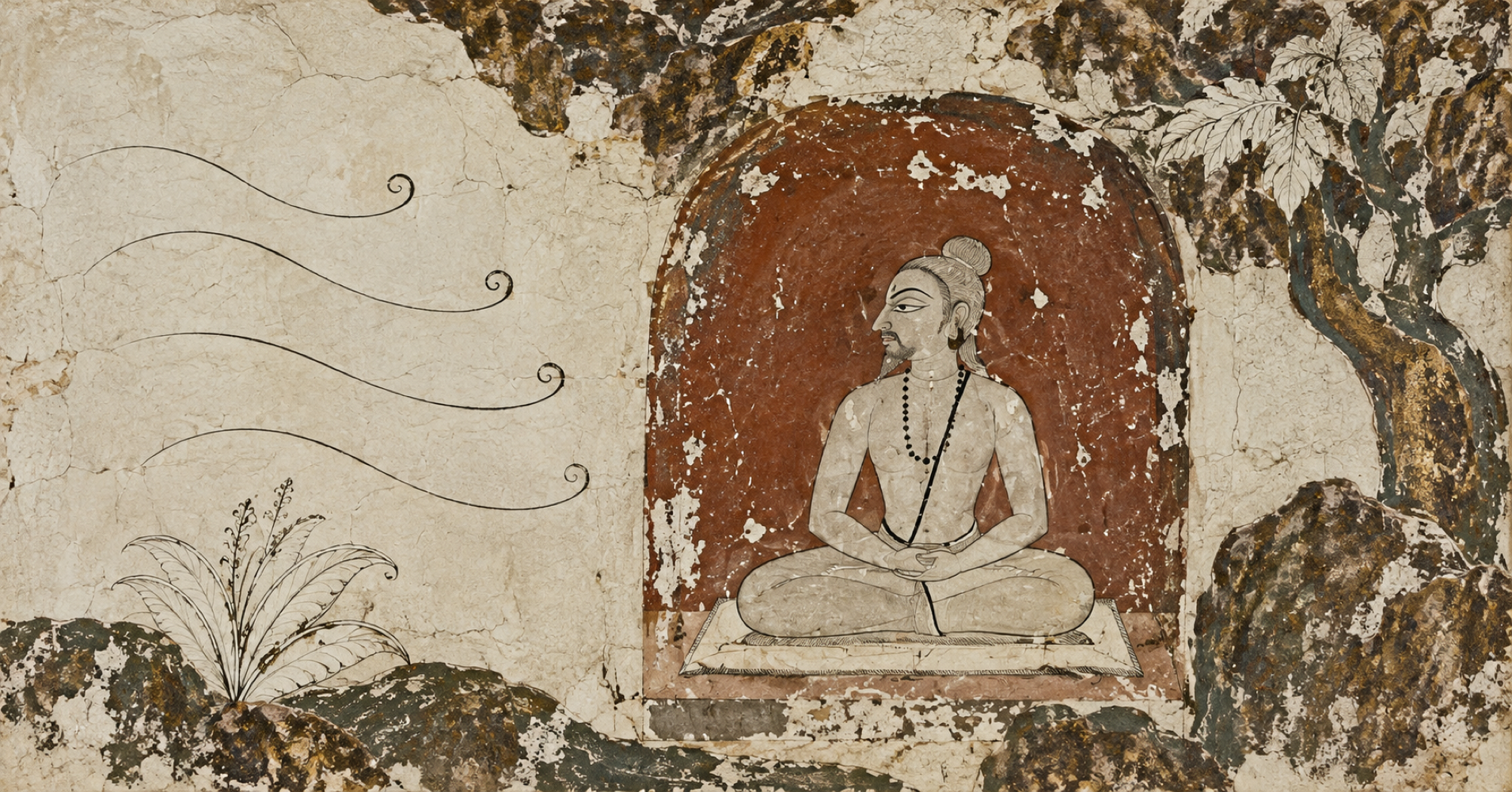
Four fine wind curves beside a seated figure.

Gorakṣaśataka 29–33: Accompanied and Isolated Retention

The text distinguishes two kinds of breath retention, names four accompanied methods and describes place and seat as preparation.

Dr. Ronald Steiner Dr. Ronald Steiner
Gorakṣaśataka (Original) 29
प्राणश्च देहजो वायुर् आयामः कुम्भकः स्मृतः |
prāṇaś ca deha-jo vāyur; āyāmaḥ kumbhakaḥ smṛtaḥ | Analysis ▾ Analysis ▴
prāṇaḥ
nominative singular
substantive masculine
breath
ca
particle
and
deha
upapada-compound
substantive masculine
body
jaḥ
nominative singular masculine
adjective
arisen
vāyuḥ
nominative singular
substantive masculine
breath
āyāmaḥ
nominative singular
substantive masculine
extension, regulation
kumbhakaḥ
nominative singular
substantive masculine
breath retention
smṛtaḥ
nominative singular masculine past participle passive
verbal root
traditionally known
स एव द्विविधः प्रोक्तः सहितः केवलस्तथा ||29||
sa eva dvi-vidhaḥ proktaḥ; sahitaḥ kevalas tathā ||29|| Analysis ▾ Analysis ▴
saḥ
nominative singular masculine
pronoun dem
that one
eva
particle
indeed; precisely
dvi
dvigu-compound
numeral
two
vidhaḥ
nominative singular masculine
adjective
of kinds
proktaḥ
nominative singular masculine past participle passive
previx
verbal root
taught
sahitaḥ
nominative singular masculine
adjective
accompanied
kevalaḥ
nominative singular masculine
adjective
isolated
tathā
adverb
likewise
Prāṇa (prāṇaḥ | nom sg) is the wind (vāyuḥ | nom sg) arising in the body (deha-jaḥ | nom sg m), and (ca) its restraint (āyāmaḥ | nom sg) is traditionally known (smṛtaḥ | nom sg m ppp) as breath retention (kumbhakaḥ | nom sg). This (saḥ | nom sg m) very [retention] (eva) is taught (proktaḥ | nom sg m ppp) as being of two kinds (dvi-vidhaḥ | nom sg m): accompanied (sahitaḥ | nom sg m) and (tathā) isolated (kevalaḥ | nom sg m).
Dr. Ronald Steiner - 2026 - historically literal
You can shape your breathing deliberately; sometimes it also settles by itself. Distinguish a practised form from stillness that arises.
Dr. Ronald Steiner - 2026 - modern transfer

The text explains prāṇāyāma through prāṇa and āyāma, equating the latter with kumbhaka, breath retention. sahita means retention connected with other respiratory processes; kevala means retention detached from them. The following passage develops the distinction.

Apparatus Comment
Gorakṣaśataka (Original) 30
यावत्केवलसिद्धिः स्यात्तावत्सहितम् अभ्यसेत् |
yāvat kevala-siddhiḥ syāt; tāvat sahitam abhyaset | Analysis ▾ Analysis ▴
yāvat
particle
until
kevala
tatpuruṣa-compound genitive
adjective
of the isolated
siddhiḥ
nominative singular
substantive feminine
accomplishment
syāt
3rd person singular aktive optative
verbal root
it would be
tāvat
adverb
for that time
sahitam
accusative singular masculine
adjective
the accompanied
abhyaset
3rd person singular aktive optative
previx
verbal root
one should practise
सूर्योज्जायी शीतली च भस्त्री चैव चतुर्थिका ||30||
sūryojjāyī śītalī ca; bhastrī caiva caturthikā ||30|| Analysis ▾ Analysis ▴
sūrya
dvandva-compound
substantive masculine
solar method
ujjāyī
nominative singular masculine
ujjāyin
adjective
Ujjāyī
śītalī
nominative singular feminine
śītalī
adjective
the cooling one
ca
particle
and
bhastrī
nominative singular
substantive feminine
bellows method
ca
particle
and
eva
particle
indeed; precisely
caturthikā
nominative singular feminine
caturthika
adjective
fourth
Until (yāvat) the accomplishment of isolated [retention] (kevala-siddhiḥ | nom sg) comes about (syāt | 3p sg act opt), one should practise (abhyaset | 3p sg act opt) the accompanied [kind] (sahitam | acc sg m) in the meantime (tāvat). [Its forms are] the solar [method] and Ujjāyī (sūrya-ujjāyī | nom sg m), Śītalī (śītalī | nom sg f), and (ca) the bellows (bhastrī | nom sg), and (ca) indeed (eva) this is the fourth (caturthikā | nom sg f).
Dr. Ronald Steiner - 2026 - historically literal
Learn a manageable form first. Familiarity with the method can make room for an experience that needs less deliberate direction.
Dr. Ronald Steiner - 2026 - modern transfer

The second line lists four methods. sūryojjāyī combines sūrya and ujjāyī. The working text contains an unresolved metrical suggestion to insert ca; I retain its main text.

Apparatus Comment
Gorakṣaśataka (Original) 31
भेदैर् एव समं कुंभो यः स्यात्सहितकुम्भकः |
bhedair eva samaṃ kuṃbho; yaḥ syāt sahita-kumbhakaḥ | Analysis ▾ Analysis ▴
bhedaiḥ
instrumental case plural
substantive masculine
with distinctions
eva
particle
indeed; precisely
samam
adverb
together
kumbhaḥ
nominative singular
substantive masculine
retention
yaḥ
nominative singular masculine
pronoun rel
which
syāt
3rd person singular aktive optative
verbal root
it would be
sahita
karmadhāraya-compound
adjective
accompanied
kumbhakaḥ
nominative singular
substantive masculine
breath retention
अथवा लक्षणं सम्यक्कथयामि समासतः ||31||
athavā lakṣaṇaṃ samyak; kathayāmi samāsataḥ ||31|| Analysis ▾ Analysis ▴
athavā
particle
or rather
lakṣaṇam
accusative singular
substantive neuter
defining feature
samyak
adverb
accurately
kathayāmi
1st person singular aktive present
verbal root
I explain
samāsataḥ
adverb
briefly
That (yaḥ | nom sg m) retention (kumbhaḥ | nom sg) which would be (syāt | 3p sg act opt) accompanied (samam) precisely (eva) by these distinct forms (bhedaiḥ | ins pl) is accompanied breath retention (sahita-kumbhakaḥ | nom sg). Or rather (athavā), I shall explain (kathayāmi | 1p sg act pres) its defining feature (lakṣaṇam | acc sg) accurately (samyak) and briefly (samāsataḥ).
Dr. Ronald Steiner - 2026 - historically literal
Different forms help you discover differences. Begin by understanding what makes a practice what it is.
Dr. Ronald Steiner - 2026 - modern transfer

athavā ordinarily means “or”. Because the classification is followed here by descriptions of the individual methods, the German rendering uses “now” as a transition. The English “or rather” retains the particle while conveying that transition. Mallinson (2012, p. 268) likewise understands the passage as announcing the characteristics that follow; the word does not introduce an alternative breathing technique here.

Apparatus Comment
Gorakṣaśataka (Original) 32
पवित्रे निर्जने देशे मशकादिविवर्जिते |
pavitre nirjane deśe; maśakādi-vivarjite | Analysis ▾ Analysis ▴
pavitre
lokative singular masculine
adjective
in a pure
nirjane
lokative singular masculine
adjective
deserted
deśe
lokative singular
substantive masculine
place
maśaka
tatpuruṣa-compound genitive
substantive masculine
mosquitoes
ādi
tatpuruṣa-compound instrumental case
substantive masculine
and the like
vivarjite
lokative singular masculine past participle passive
previx
verbal root
free from
धनुःप्रमाणपर्यन्ते शीताग्निजलवर्जिते ||32||
dhanuḥ-pramāṇa-paryante; śītāgni-jala-varjite ||32|| Analysis ▾ Analysis ▴
dhanuḥ
tatpuruṣa-compound genitive
substantive neuter
bow measure
pramāṇa
tatpuruṣa-compound genitive
substantive neuter
extent
paryante
lokative singular masculine
adjective
bounded by
śīta
dvandva-compound
substantive neuter
cold
agni
dvandva-compound
substantive masculine
fire
jala
tatpuruṣa-compound instrumental case
substantive neuter
water
varjite
lokative singular masculine past participle passive
verbal root
free from
In a pure (pavitre | loc sg m), deserted (nirjane | loc sg m) place (deśe | loc sg), free from mosquitoes and the like (maśaka-ādi-vivarjite | loc sg m ppp), extending to the measure of a bow (dhanuḥ-pramāṇa-paryante | loc sg m), free from cold, fire and water (śīta-agni-jala-varjite | loc sg m ppp) …
Dr. Ronald Steiner - 2026 - historically literal
Choose a place where you can gather your attention. Address small distractions before you begin.
Dr. Ronald Steiner - 2026 - modern transfer

The instruction continues through 33 into the account of breathing in 34. dhanuḥ is a traditional measure of length; no exact modern conversion is established here.

Apparatus Comment
Gorakṣaśataka (Original) 33
पवित्रे नात्युच्चनीचे ह्य् आसने शुभदे सुखे |
pavitre nāty-ucca-nīce; hy āsane śubha-de sukhe | Analysis ▾ Analysis ▴
pavitre
lokative singular masculine
adjective
in a pure
na
particle
not
ati
karmadhāraya-compound
previx
excessively
ucca
dvandva-compound
adjective
high
nīce
lokative singular neuter
adjective
low
hi
particle
for
āsane
lokative singular
substantive neuter
seat
śubha
upapada-compound
substantive neuter
well-being
de
lokative singular neuter
adjective
giving
sukhe
lokative singular neuter
adjective
pleasant
बद्ध्वा पद्मासनं कृत्वा सरस्वत्याश्च चालनम् ||33||
baddhvā padmāsanaṃ kṛtvā; sarasvatyāś ca cālanam ||33|| Analysis ▾ Analysis ▴
baddhvā
absolutus
verbal root
having assumed
padma
karmadhāraya-compound
substantive neuter
lotus
āsanam
accusative singular
substantive neuter
the seated posture
kṛtvā
absolutus
verbal root
having performed
sarasvatyāḥ
genitive singular
substantive feminine
of Sarasvatī
ca
particle
and
cālanam
accusative singular
substantive neuter
moving
… on a pure (pavitre | loc sg m), comfortable (sukhe | loc sg n), beneficial (śubha-de | loc sg n) seat (āsane | loc sg) that is not (na) too high or low (ati-ucca-nīce | loc sg n), indeed (hi), having assumed (baddhvā | abs) the lotus posture (padma-āsanam | acc sg) and (ca) performed (kṛtvā | abs) the moving (cālanam | acc sg) of Sarasvatī (sarasvatyāḥ | gen sg) …
Dr. Ronald Steiner - 2026 - historically literal
Arrange your space to suit the practice. A sound starting point lets you practise with fewer distractions.
Dr. Ronald Steiner - 2026 - modern transfer

Continue with AYI Free

Illustrations: AI-generated.

Editor

Dr. Ronald Steiner

From Ulm

The "Yoga Doc" - Dr. Ronald Steiner is the founder of the AYI method. This method links traditional Ashtanga Yoga with innovative Yogatherapy and living Philosophy. This forms a practice that is personal for each and... more ›

Messages and ratings
0 messages

Please log in to write a message. Go to login

No messages yet.