

dvitīya द्वितीय – second
adjective · numeral · substantive masculine · substantive neuter · Word type unspecified
Dictionary sources
AYI dictionary adjective · numeral
Cappeller 1891 adjective
Original text · English · adjective
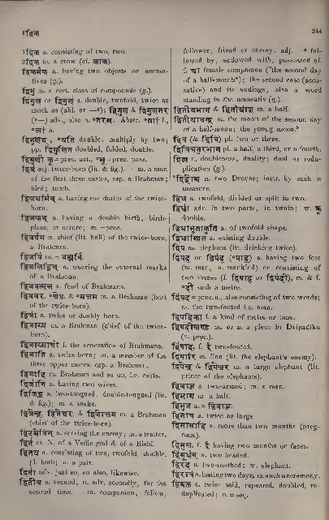
dvitī́ya ·a. second, n. adv. secondly, for the second time. -- m. companion, fellow, follower, friend or enemy, adj. --° followed by, endowed with, possessed of. f. ā female companion (*the second day of a half-month*); the second case (accusative) and its endings, also a word standing in the accusativ (g.).
Monier-Williams 1872 adjective
Original text · English · adjective
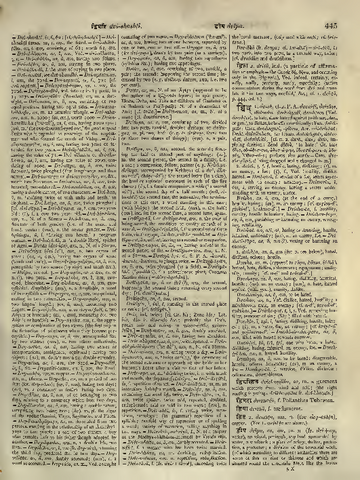
Dvitīya, as, ā, am, second, the second; form- ing the half or second part of anything; (as), m. the second person, the second in a family, i. e. a son; a companion, fellow, partner (e. g. Kṛṣṇa- dvitīya, accompanied by Kṛṣṇa; cf. a-dv˚, dha- nur-dv˚, chāyā-dv˚); the second letter (in a class), the hard or aspirated consonant in each of the five classes; (ā), f. a female companion, a wife (‘a second self’); the second day of a half month; (scil. vi- bhakti) the second case, the accusative, the termina- tions of this case, a word standing in this case; (with bhāga) the second half; (am), n. the half; (am), ind. for the second time, a second time, again.
Petersburger 1855 adjective · substantive masculine
Original text · German · adjective · substantive masculine
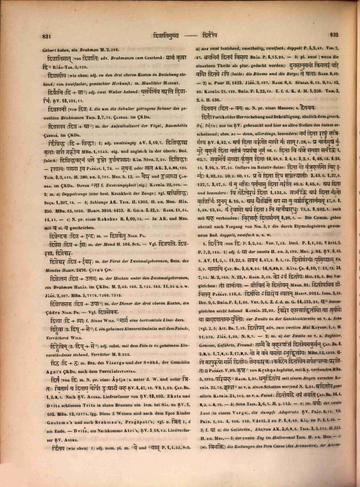
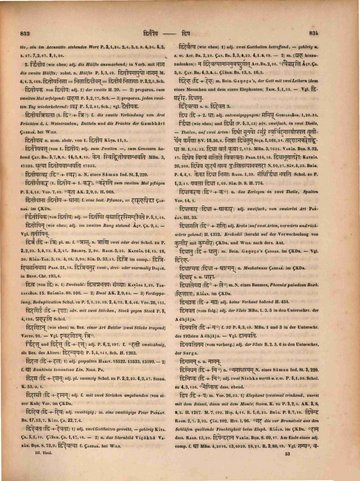
1. dvitī́ya (von dvi) P. 5,2,54. VOP. 7,43. Decl. P. 1,1,36, Vārtt. 2. P. 7,3,115. 1〉 adj. f. ā der zweite H. an. 3,490. MED. y. 84. ṚV. 8,49,9. AV. 11,5,4. AV. 19,22,9. savana AV. 6,47,2. AV. 9,1,12. dvi̱tīyàsyāṃ pṛthi̱vyām VS. 5,9. nāmāni ŚAT. BR. 3,6,2,24. ŚAT. BR. 14,8,15,9. KĀTY. ŚR. 4,10,7. KĀTY. ŚR. 4,11,12. KĀTY. ŚR. 24,7,14. M. 2,169. N. 22,8. RAGH. 3,49. ko 'yaṃ dvitīyaḥ HIT. 18,1. Bei Vergleichen: tāṃ jānīyāḥ — jīvitaṃ me dvitīyam MEGH. 81. dvitīyamiva jīvitam PAÑCAT. 116,6. dvitīyo 'gniriva jvalan HARIV. 1011. INDR. 2,22. HIT. 9,6. BHĀG. P. 5,1,30. VET. 5,5. Z. d. d. m. G. 14,575,21. a˚ Seinesgleichen nicht habend KATHĀS. 22,90. īśvaro hāsmāddvitīyo vā tṛtīyo vā brāhmaṇatāmabhyupaitoḥ der Zweite in der Geschlechtsreihe so v. a. Sohn (vgl. KATHĀS. 2,b) AIT. BR. 7,29. dvitīyam adv. zum zweiten Mal KAṬHOP. 1,4. M. 11,232. YĀJÑ. 1,39. N. 8,7. — 2〉 m. a〉 der Zweite so v. a. Begleiter, Genosse, Gefährte, Freund: tasmai vai bṛhaspatiṃ dvitīyamakurvan ŚAT. BR. 9,2,3,3. ŚAT. BR. 1,7,1,3. ŚAT. BR. 3,17,3,9. yo me vane vasato 'bhūddvitīyaḥ MBH. 13,4899. api kāpuruṣo mārge dvitīyaḥ kṣemakārakaḥ . karkaṭena dvitīyena sarpātpānthaḥ prarakṣitaḥ .. PAÑCAT. V, 89. kṛṣṇa˚ von Kṛṣṇa begleitet, mit Kṛ. verbunden MBH. 5,1992. parigraha˚ RAGH. 1,95. dhanurdvitīya mit einem Bogen versehen KATHĀS. 22,76. chāyā˚ so v. a. einen Schatten werfend N. 5,24. advitīya ganz allein KATHĀS. 24,103. so v. a. Feind: dvitīyādvai bhayaṃ bhavati ŚAT. BR. 14,4,2,3. ŚAT. BR. 14,4,2,4. ŚAT. BR. 14,4,3,19. — b〉 Sohn TRIK. 2,6,7. H. ś. 113. — c〉 (sc. varṇa) der zweite Laut (in einem Varga), die dumpfe Adspirata ṚV. PRĀT. 6,15. VS. PRĀT. 1,54. VS. PRĀT. 4,106. VS. PRĀT. 4,119. Vārtt. 3 zu P. 8,4,48. KĀŚ._zu_P. 1,1,50. — 3〉 f. ā a〉 die Gefährtin, Ehefrau AK. 2,6,1,5. TRIK. 3,3,314. H. 513. H. an. MED. — b〉 der zweite Tag im Halbmonat TRIK. H. an. MED. — c〉 (sc. vibhakti) die Endungen des 2ten Casus (des Accusativs), der Accusativ, ein im Accusativ stehendes Wort P. 2,1,24. P. 2,2,4. P. 2,3,2. P. 2,1,8. P. 2,4,34. P. 6,2,2. P. 6,2,47. P. 7,2,87. P. 8,1,20.
Original text · German · adjective
2. dvítīya (wie eben) adj. die Hälfte ausmachend; in Verb. mit bhāga die zweite Hälfte; subst. n. Hälfte P. 5,3,49. dvitīyamāyuṣo bhāgam M. 4,1. M. 5,169. dvitīyabhikṣā = bhikṣādvitīyam = dvitīyaṃ bhikṣāyāḥ P. 2,2,3, Sch.
Original text · German · adjective
1. dvitīya 1〉 ˚vayas adj. im zweiten Lebensalter stehend HALĀY. 2,329.
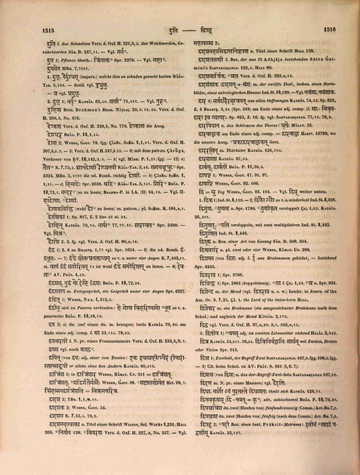
Böhtlingk 1879 adjective · substantive masculine · substantive neuter
Original text · German · adjective · substantive masculine
1. dvitī́ya — 1〉 Adj. (f. ā) der zweite. tasmāddvitīyo vā tṛtīyo vā so v. a. sein Sohn oder sein Enkel. ˚yam Adv. zweitens, zum zweiten Mal Chr. 37,12. Chr. 38,8. — 2〉 m. — a〉 Begleiter, Genosse, Gefährte, Freund. Am Ende eines adj. Comp. so v. a. begleitet von, verbunden —, versehen mit. — b〉 Feind. — c〉 *Sohn; vgl. u. 1〉d〉 der zweite Laut in einem Varga, die dumpfe Adspirata. — 3〉 f. ā — a〉 Begleiterin, Gefährtin Chr. 134,8. — b〉 *Gattin. — c〉 der zweite Tag im Halbmonat Chr. 319,16 (im Prākrit). — d〉 die Endungen des zweiten Casus, Accusativ, ein im Accusativ stehendes Wort.
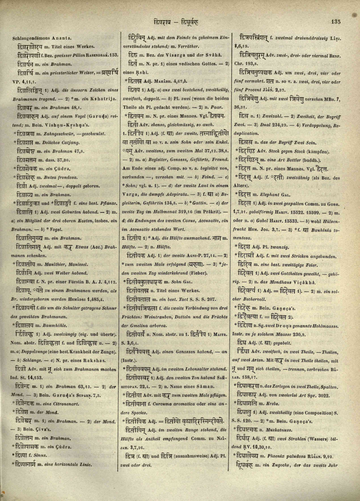
Original text · German · adjective · substantive neuter
2. dvitīya — 1〉 *Adj. die Hälfte ausmachend. bhāgā m. Hälfte. — 2〉 n. Hälfte.
Apte 1890 adjective · substantive masculine · substantive neuter
Original text · English · adjective · substantive masculine · substantive neuter
dvitīya a. Second; tvaṃ jīvitaṃ tvamasi me hṛdayaṃ dvitīyaṃ U. 3. 26; Me. 83; R. 3. 49. — yaḥ 1 The second in a family, a son 2 A companion, partner, friend; (usually at the end of comp.); prayataparigrahadvitīyaḥ R. 1. 95; Ku. 3. 35; so chāyā˚, duḥkha˚ &c. 3 The second letter of a class. 4 The second person (in gram.). — yā 1 The second day of a lunar fortnight. 2 A wife, companion, partner. 3 (In gram.) The accusative case. — yaṃ The half. — yaṃ ind. A second time, again. Comp. — āśramaḥ the second stage or period of the religious life of a Brāhmaṇa, i. e. gārhasthya. — vayas a. having arrived at the second stage of life.
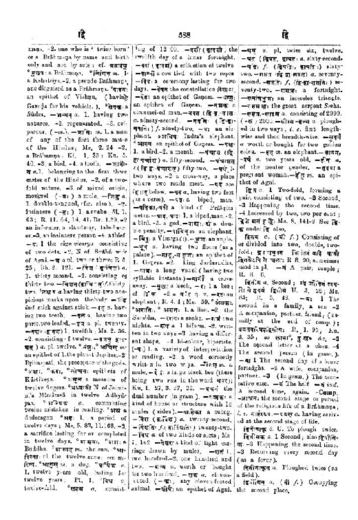
Cappeller 1887 Word type unspecified
Original text · German · Word type unspecified
dvitī́ya der zweite. n. adv. zweitens. o. zum zweiten Mal. m. Genosse, Begleiter, Freund; Nebenbuhler, Feind; adj. —˚ begleitet von, verschen mit. f. ā der zweite Tag im Halbmonat; die Endung des zweiten Casus (Accusativ) u. dieser selbst (g.).
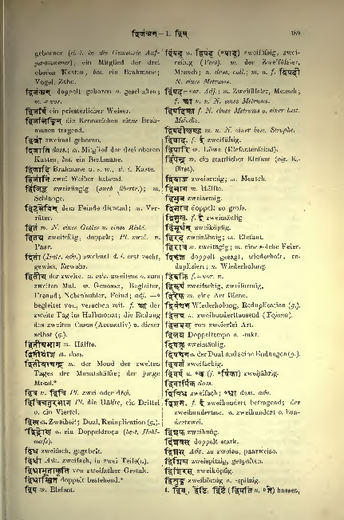
Burnouf 1866 adjective
Original text · French · adjective
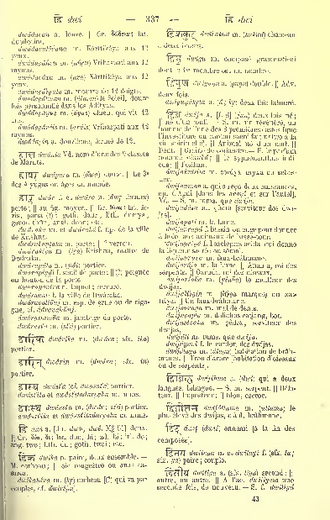
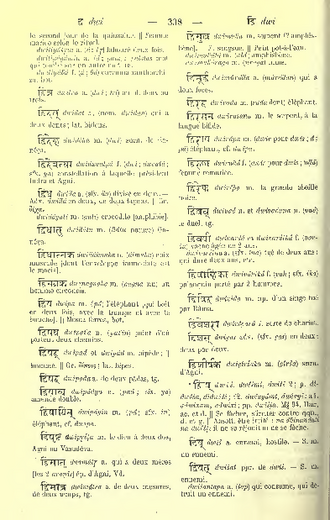
dvitīya dvitīya a. (sfx. tīya) second; autre, un autre. À l'ac. dvitīyam une seconde fois, de nouveau. — S. f. dvitīyā [Page338-1] le second jour de la quinzaine. Femme mariée selon le rituel. dvitīyākṛta a. (ā; kṛ) labouré deux fois. dvitīyāgāmin a. (ā; gam): śabdas mot qui tombe sur un autre mot, tg. dvitīyābhā f. (ā; bhā) curcuma xanthorrhiza, bot.
Occurrences in source texts (17)
DYS 3 occurrences
GoS 3 occurrences
HP 3 occurrences
HTK 1 occurrence
MandUp 2 occurrences
SiSa 3 occurrences
SS 1 occurrence
SVU 1 occurrence
Continue with AYI Free
Image source: AYI archive.