

kāya काय – body
adjective · substantive masculine · substantive neuter · Word type unspecified
Dictionary sources
AYI dictionary substantive masculine · substantive neuter
Cappeller 1891 substantive masculine · Word type unspecified
Original text · English · Word type unspecified
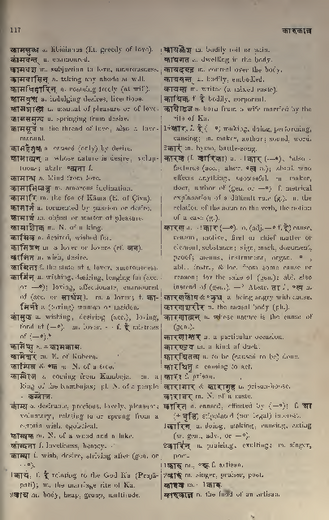
kāyá ·f. ī1 relating to the God Ka (Prajapati); m. the marriage rite of Ka.
Original text · English · substantive masculine
kāya2 ·m. body, heap, group, multitude.
Monier-Williams 1872 adjective · Word type unspecified
Original text · English · adjective
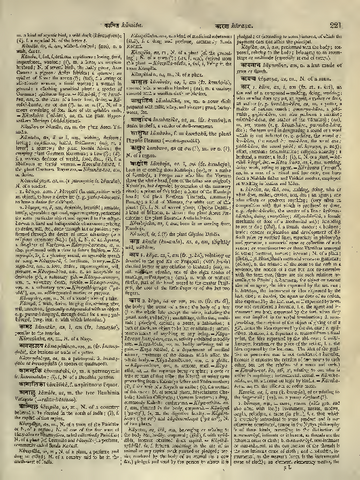
kāya 1 . kāya, as, ī, am (fr. 3. ka), relating or devoted to the god Ka or Prajāpati; (with havis) clarified butter or any oblation to Brahmā; (as), m. scil. vidhi or vivāha, one of the eight modes of marriage, = Prājāpatya; (am), n. with or without tīrtha, part of the hand sacred to the creator Prajā- pati, the root of the little finger or of the last two fingers.
Original text · English · Word type unspecified
kāya 2 . kāya, as or am, m. n. (fr. rt. ci), the body; the trunk of a tree; the body of a lute (i. e. the whole lute except the wires, including the gourd, neck, and belly); assemblage, collection, multi- tude; principal, capital; a house, a habitation; a butt or mark, an object to be hit or attained; natural temperament of anything or any being.
Petersburger 1855 adjective · substantive masculine · substantive neuter · Word type unspecified
Original text · German · adjective · substantive masculine · substantive neuter
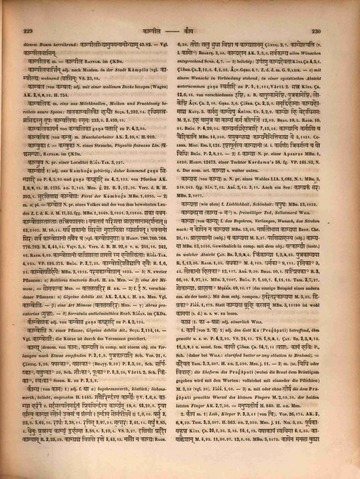
1. kāyá (von 2. ka) 1〉 adj. den Gott Ka (Prajāpati) betreffend, ihm geweiht u. s. w. P. 4,2,25. VS. 24,15. TS. 1,8,3,1. ŚAT. BR. 2,5,2,13. ŚAT. BR. 11,5,2,3 u. sonst. fem. kāyī ŚĀṄKH. ŚR. 14,7,14 (vaśā). kāyaṃ haviḥ P., Sch. (daher bei WILS.: clarified butter or any oblation to Brahmā). = kadaivata TRIK. 3,3,307. H. an. 2,350. MED. y. 11. — 2〉 m. (sc. vidhi oder vivāha) die Eheform des Prajāpati (wobei die Braut dem Bräutigam gegeben wird mit den Worten: vollziehet mit einander die Pflichten) M. 3,38 (vgl. M. 3,30). YĀJÑ. 1,60. — 3〉 n. mit oder ohne tīrtha die dem Prajāpati geweihte Wurzel des kleinen Fingers M. 2,59. M. 2,58. der beiden letzten Finger AK. 2,7,50. = manuṣyatīrtha H. 840. H. an. MED.
Original text · German · substantive masculine
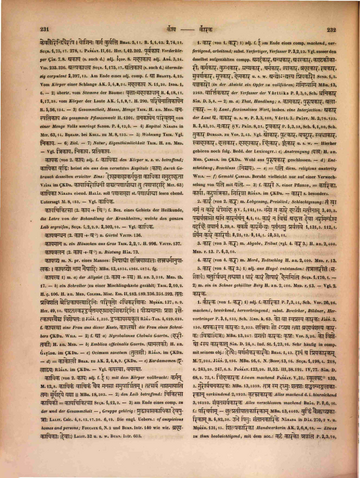
2. kā́ya m. 1〉 Leib, Körper P. 3,3,41 (von ci). VOP. 26,174. AK. 2,6,2,22. TRIK. 3,3,307. H. 563. H. an. 2,350. MED. y. 11. NIR. 5,25. pūrvakāyakṛṣṇa KĀTY. ŚR. 20,1,35. KĀTY. ŚR. 20,5,15. KĀTY. ŚR. 16,1,19. yathākāyaṃ sthavimā KĀTY. ŚR. 6,1,35. kāyakleśān M. 4,92. M. 11,90. M. 11,97. M. 12,8. M. 12,10. MBH. 3,1472. kāyena manasā buddhyā kevalairindriyairapi . yoginaḥ karma kurvanti BHAG. 5,11. R. 1,1,62. R. 2,74,21. SUŚR. 1,75,17. SUŚR. 1,278,1. PAÑCAT. II, 61. HIT. I, 42. HIT. I,202. pūrvakāya Vorderkörper ŚĀK. 7. ŚĀK. 8. akāya (s. auch d.) adj. ĪŚOP. 8. mahākāya adj. ARJ. 3,24. VID. 235. VID. 326. alpakāyatva SUŚR. 1,175,17. atikāya (s. auch d.) übermässig corpulent SUŚR. 2,397,13. Am Ende eines adj. comp. f. ā BHARTṚ. 4,25. Vom Körper einer Schlange AK. 3,4,3,24. mahākāya N. 11,20. INDR. 1,6. — 2〉 übertr. vom Stamme der Bäume: vṛkṣānmahākāyān R. 4,18,11. R. 6,17,28. vom Körper der Laute AK. 1,1,7,7. H. 290. parighenātikāyena R. 5,56,124. — 3〉 Gesammtheit, Masse, Menge TRIK. H. an. MED. vanaspatikāya die gesammte Pflanzenwelt H. 1201. janakāyena parivṛtam von einer Menge Volks umringt SADDH. P. 4,12,b. — 4〉 Kapital NĀRADA_in_MIT. 63,14. BṚHASP._bei_KULL._zu_M. 8,153. — 5〉 Wohnung TRIK. Vgl. nikāya. — 6〉 Ziel. — 7〉 Natur, Eigenthümlichkeit TRIK. H. an. MED. — Vgl. trikāya, nikāya, pratikāya.
Original text · German · Word type unspecified
2. kāya 4〉 dārāste ye bhajanasahāyāḥ putrāste ye taddhanakāyāḥ welche die dazu erforderlichen Geldmittel besitzen MOHAM._im_ŚKDR. u. bhajana.
Böhtlingk 1879 adjective · substantive masculine · substantive neuter · Word type unspecified
Original text · German · adjective · substantive masculine · substantive neuter
1. kā́ya — 1〉 Adj. (f. ī) den Gott Ka (Prajāpati) betreffend, ihm geweiht u. s. w. — 2〉 m. die Eheform des Prajāpati. — 3〉 n. die dem Prajāpati geweihte Wurzel des kleinen Fingers.
Original text · German · substantive masculine
2. kāya m. (adj. Comp. f. ā) — 1〉 Leib, Körper. — 2〉 Masse, Umfang, Menge, Gruppe. — 3〉 Kapital. — 4〉 *Wohnung. — 5〉 Ziel. — 6〉 *Natur Eigenthümlichkeit.
Original text · German · Word type unspecified
1. kāyá , so zu betonen. [Nachtrag, Band 6]
Original text · German · Word type unspecified
1. kāyá II. 6. [Nachtrag, Band 7]
Apte 1890 substantive masculine · substantive neuter
Original text · English · substantive masculine · substantive neuter
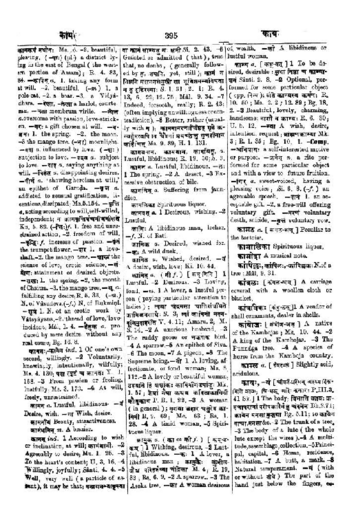
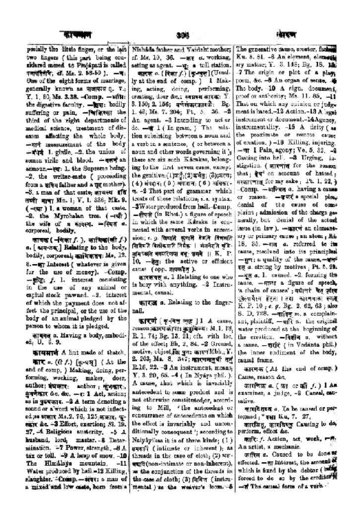
kāyaḥ, -yaṃ [cīyate'smin asthyādika miti kāyaḥ; ci-ghañ ādeḥ kakāraḥ P. III. 3. 41 Sk.] 1 The body; vibhāti kāyaḥ karuṇāparāṇā paropakārairna tu caṃdanena Bh. 2. 71; kāyena manasā buddhyā Bg. 5. 11; so kāyena vācā, manasā &c. 2 The trunk of a tree. 3 The body of a lute (the whole lute except the wires). 4 A multitude, assemblage, collection. 5 Principal, capital. 6 Home, residence, habitation. 7 A butt, a mark. 8 Natural temperament. — yaṃ (with or without tīrtha) The part of the hand just below the fingers, ([Page 0396-a]) especially the little finger, or the last two fingers (this part being considered sacred to Prajāpati is called prajāpatitīrtha; cf. Ms. 2. 58-59). — yaḥ One of the eight forms of marriage, generally known as prājāpatya q. v.; Y. 1. 60; Ms. 3. 38. Comp. — agniḥ the digestive faculty. — kleśaḥ bodily suffering or pain. — cikitsā the third of the eight departments of medical science, treatment of diseases affecting the whole body. — mānaṃ measurement of the body — baṃdhanaṃ 1 girdle. 2 the union of semen virile and blood. — valanaṃ an armour. — sthaḥ 1 the Supreme being. 2 the writer-caste (proceeding from a kṣatriya father and a śūdra mother). 3 a man of that caste; kāyastha iti laghvī mātrā Mu. 1; Y. 1. 336; Mk. 9. — (sthā) 1 a woman of that caste. 2 the Myrobalan tree. — (sthī) the wife of a kāyastha. — sthita a. corporeal, bodily.
Original text · English · substantive masculine · substantive neuter
kāyaḥ, -yaṃ [cīyate'smin asthyādika miti kāyaḥ; ci-ghañ ādeḥ kakāraḥ P. III. 3. 41 Sk.] 1 The body; vibhāti kāyaḥ karuṇāparāṇā paropakārairna tu caṃdanena Bh. 2. 71; kāyena manasā buddhyā Bg. 5. 11; so kāyena vācā, manasā &c. 2 The trunk of a tree. 3 The body of a lute (the whole lute except the wires). 4 A multitude, assemblage, collection. 5 Principal, capital. 6 Home, residence, habitation. 7 A butt, a mark. 8 Natural temperament. — yaṃ (with or without tīrtha) The part of the hand just below the fingers, ([Page 0396-a]) especially the little finger, or the last two fingers (this part being considered sacred to Prajāpati is called prajāpatitīrtha; cf. Ms. 2. 58-59). — yaḥ One of the eight forms of marriage, generally known as prājāpatya q. v.; Y. 1. 60; Ms. 3. 38. Comp. — agniḥ the digestive faculty. — kleśaḥ bodily suffering or pain. — cikitsā the third of the eight departments of medical science, treatment of diseases affecting the whole body. — mānaṃ measurement of the body — baṃdhanaṃ 1 girdle. 2 the union of semen virile and blood. — valanaṃ an armour. — sthaḥ 1 the Supreme being. 2 the writer-caste (proceeding from a kṣatriya father and a śūdra mother). 3 a man of that caste; kāyastha iti laghvī mātrā Mu. 1; Y. 1. 336; Mk. 9. — (sthā) 1 a woman of that caste. 2 the Myrobalan tree. — (sthī) the wife of a kāyastha. — sthita a. corporeal, bodily.
Cappeller 1887 substantive masculine
Original text · German · substantive masculine
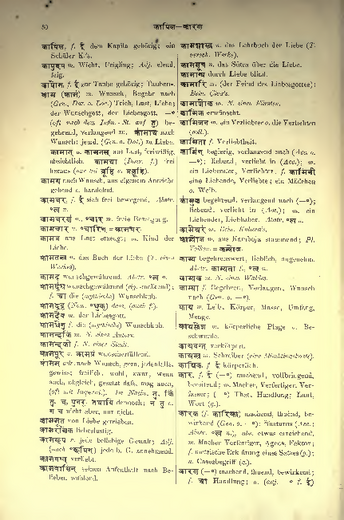
kāya m. Leib, Körper, Masse, Umfang, Menge.
Burnouf 1866 substantive masculine · substantive neuter
Original text · French · substantive masculine · substantive neuter
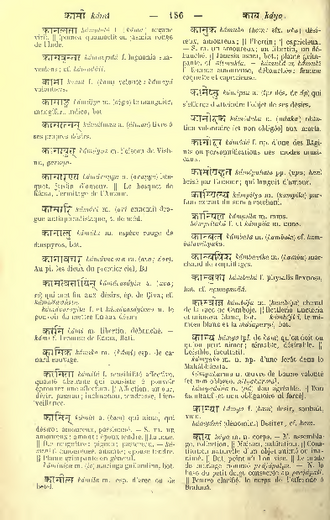
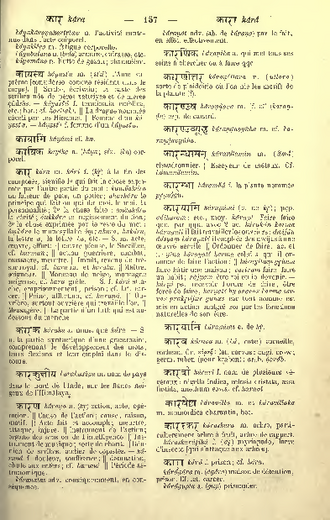
kāya kāya m. n. corps. — M. assemblage, collection. Maison, habitation. Constitution naturelle d'un objet animé ou inanimé. But, point où l'on vise. Le mode de mariage nommé prājāpalya. — N. la base du petit doigt consacrée au prajāpati. Beurre clarifié. le corps de l'offrande à Brahmā. [Page157-1] kāyakhāraṇakartṛtva n. l'activité contenue dans l'acte corporel. kāyakleśa m. fatigue corporelle. kāyabalana n. (bala) armure, cuirasse, etc. kāyamāna n. hutte de gazon; chaumière.
Derived words
Occurrences in source texts (23)
DYS 1 occurrence
GoS 2 occurrences
HP 8 occurrences
2 more source pages
IVU 1 occurrence
PYS 6 occurrences
PYS 3.41–42: Divine Hearing and Travel through Space 1 occurrence
Direct occurrences
-
PYS 3.42 Segment 1
SiSa 5 occurrences
Continue with AYI Free
Image source: AYI archive.