DYS 54–59: The Yogi’s Hut

Dattātreyayogaśāstra 54–59: A Protected Place for Concentrated Practice

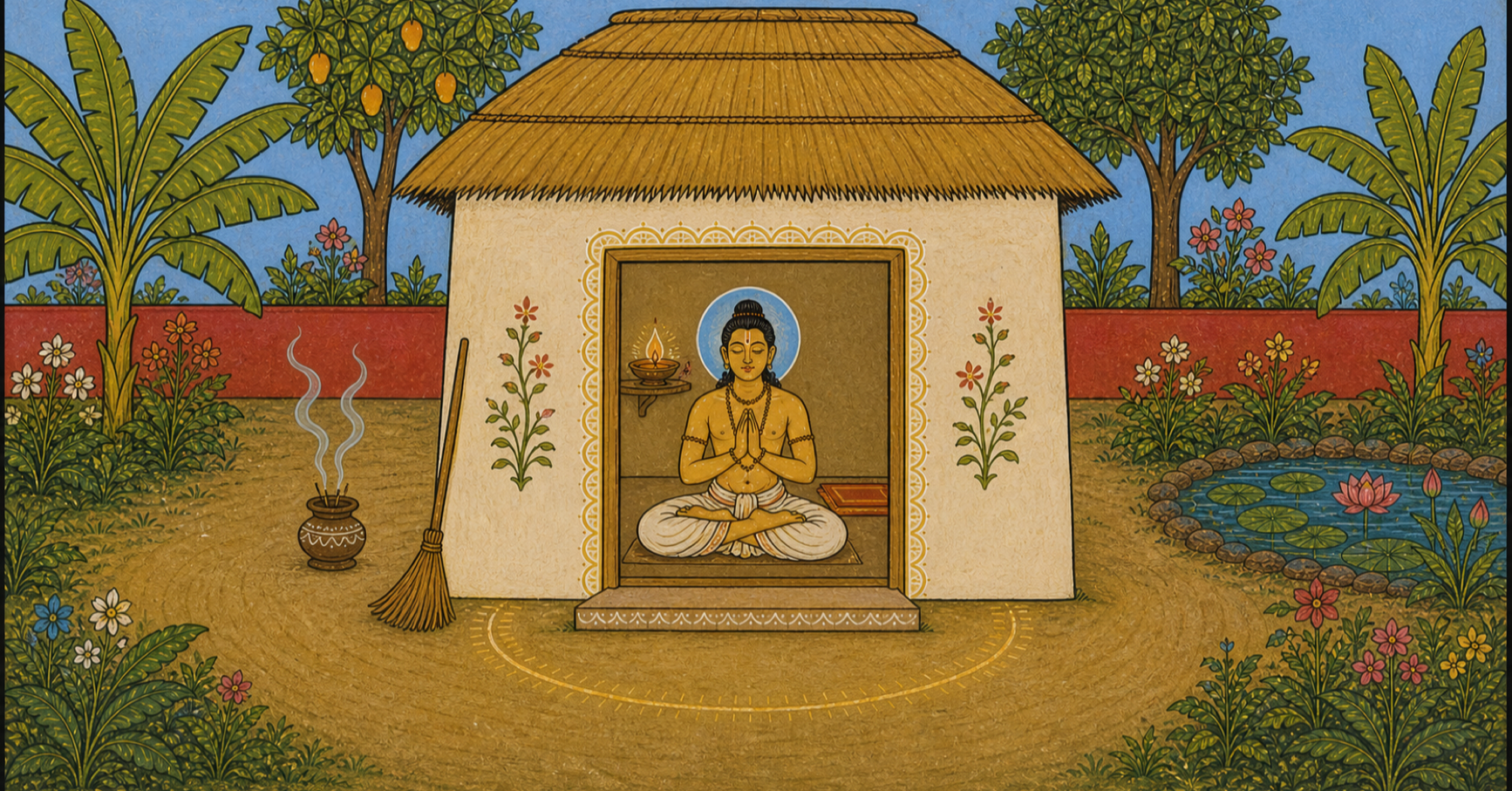
The ideal hut has a small opening but no other holes or damaged places, is clean, free from animals and disturbance, and furnished with a suitable seat; there the yogi begins after honouring his chosen deity.

Dr. Ronald Steiner Dr. Ronald Steiner Nils Jacob Liersch Nils Jacob Liersch
Dattātreyayogaśāstra 54
प्राणायामं ततः कुर्यात्पद्मासनगतः सदा |
prāṇāyāmaṃ tataḥ kuryāt; padmāsana-gataḥ sadā | Analysis ▾ Analysis ▴
prāṇa
tatpuruṣa-compound genitive
substantive masculine
Prāṇa
āyāmam
accusative singular
substantive masculine
retention, restraint
tataḥ
adverb
then
kuryāt
3rd person singular aktive optative
verbal root
should perform
padma
tatpuruṣa-compound genitive
substantive neuter
lotus
āsana
tatpuruṣa-compound accusative
substantive neuter
posture, seat
gataḥ
nominative singular masculine past participle passive
verbal root
adopted, entered
sadā
adverb
always
सुशोभनं मठं कुर्यात्सूक्ष्मद्वारं तु निर्व्रणम् ||54||
su-śobhanaṃ maṭhaṃ kuryāt; sūkṣma-dvāraṃ tu nir-vraṇam ||54|| Analysis ▾ Analysis ▴
su
karmadhāraya-compound
previx
good, beautiful
śobhanam
accusative singular neuter
adjective
beautiful, pleasant
maṭham
accusative singular
substantive masculine
hut, hermitage
kuryāt
3rd person singular aktive optative
verbal root
should perform
sūkṣma
karmadhāraya-compound
adjective
small, narrow
dvāram
accusative singular
substantive neuter
door, opening
tu
particle
but
nir
bahuvrīhi-compund
previx
without, free from
vraṇam
accusative singular
substantive neuter
opening, fissure
Metre: Anuṣṭubh
After that (tataḥ), while always seated in the lotus posture (padmāsana-gataḥ | nom sg m ppp), he should practise breath control (prāṇāyāmaṃ | acc sg). He should make (kuryāt | 3p sg act opt) a beautiful hut (suśobhanaṃ maṭham | acc sg) with a small opening (sūkṣma-dvāram | acc sg), but (tu) without holes (nirvraṇam | acc sg n).
Dr. Ronald Steiner - 2026 - historically literal
He then begins breath practice in the lotus posture. For it, he prepares a beautiful, intact hut with a small entrance.
Dr. Ronald Steiner - 2026 - modern transfer
sadā JM2024 ] svayam DYŚ
Critical Apparatus
Dattātreyayogaśāstra 55
सुष्ठु लिप्तं गोमयेन सुधया वा प्रयत्नतः |
suṣṭhu liptaṃ gomayena; sudhayā vā prayatnataḥ | Analysis ▾ Analysis ▴
suṣṭhu
adverb
well, thoroughly
liptam
accusative singular neuter past participle passive
verbal root
smeared, plastered
gomayena
instrumental case singular
substantive neuter
with cow dung
sudhayā
instrumental case singular
substantive feminine
with whitewash
vā
particle
or
prayatnataḥ
adverb
carefully
मत्कुणैर्मशकैर्लूतैर्वर्जितं च प्रयत्नतः ||55||
matkuṇair maśakair lūtair; varjitaṃ ca prayatnataḥ ||55|| Analysis ▾ Analysis ▴
matkuṇaiḥ
instrumental case plural
substantive masculine
by bedbugs
maśakaiḥ
instrumental case plural
substantive masculine
by mosquitoes
lūtaiḥ
instrumental case plural
lūta
substantive masculine
by spiders
varjitam
accusative singular neuter past participle passive
verbal root
free from
ca
particle
and
prayatnataḥ
adverb
carefully
Metre: Anuṣṭubh
It should be thickly (suṣṭhu) and carefully (prayatnataḥ) smeared (liptam | acc sg n ppp) with cow dung (gomayena | ins sg) or (vā) whitewash (sudhayā | ins sg), and (ca) carefully cleared (varjitam | acc sg n ppp) of bedbugs (matkuṇaiḥ | ins pl), mosquitoes (maśakaiḥ | ins pl), and spiders (lūtaiḥ | ins pl).
Dr. Ronald Steiner - 2026 - historically literal
The hut should be carefully plastered and kept free of bedbugs, mosquitoes, and spiders.
Dr. Ronald Steiner - 2026 - modern transfer
matkuṇair maśakair lūtair JM2024 ] matkuṇaiḥ maśakaiḥ bhūtaiḥ DYŚ
Critical Apparatus
Dattātreyayogaśāstra 56
दिने दिने सुसंमृष्टं संमार्जन्याप्यतन्द्रितः |
dine dine susaṃmṛṣṭaṃ; saṃmārjanyāpy atandritaḥ | Analysis ▾ Analysis ▴
dine
lokative singular
substantive masculine
day
dine
lokative singular
substantive masculine
day
susaṃmṛṣṭam
accusative singular neuter past participle passive
previx
previx
verbal root
well swept
saṃmārjanyā
instrumental case singular
substantive feminine
with a broom
api
particle
also
atandritaḥ
nominative singular masculine
adjective
untiring
वासितं च सुगन्धेन धूपितं गुग्गुलादिभिः ||56||
vāsitaṃ ca su-gandhena; dhūpitaṃ guggulādibhiḥ ||56|| Analysis ▾ Analysis ▴
vāsitam
accusative singular neuter past participle passive
verbal root
scented
ca
particle
and
su
karmadhāraya-compound
previx
good, beautiful
gandhena
instrumental case singular
substantive masculine
with fragrance
dhūpitam
accusative singular neuter past participle passive
verbal root
fumigated
guggula
dvandva-compound
substantive masculine
bdellium
ādibhiḥ
instrumental case plural masculine
adjective
and similar substances
Metre: Anuṣṭubh
Day after day (dine dine | loc sg), the tireless practitioner (atandritaḥ | nom sg m) should also (api) keep it well swept (susaṃmṛṣṭam | acc sg n ppp) with a broom (saṃmārjanyā | ins sg), scented (vāsitam | acc sg n ppp) with fine fragrance (sugandhena | ins sg), and (ca) fumigated (dhūpitam | acc sg n ppp) with bdellium and similar substances (guggulādibhiḥ | ins pl m).
Dr. Ronald Steiner - 2026 - historically literal
Every day the hut is swept, pleasantly scented, and purified with fragrant smoke.
Dr. Ronald Steiner - 2026 - modern transfer
susaṃmṛṣṭaṃ saṃmārjanyāpy JM2024 ] susammṛṣṭaṃ sammarjanyā hy DYŚ
Critical Apparatus
Dattātreyayogaśāstra 57
मलमूत्रादिभिर्वर्गैरष्टादशभिरेव च |
mala-mūtrādibhir vargair; aṣṭādaśabhir eva ca | Analysis ▾ Analysis ▴
mala
dvandva-compound
substantive masculine
faeces, impurity
mūtra
dvandva-compound
substantive neuter
urine
ādibhiḥ
instrumental case plural masculine
adjective
and similar substances
vargaiḥ
instrumental case plural
substantive masculine
by types, groups
aṣṭādaśabhiḥ
instrumental case plural masculine
numeral
by eighteen
eva
particle
precisely
ca
particle
and
वर्जितं द्वारसम्पन्नं वस्त्रावरणमेव वा ||57||
varjitaṃ dvāra-sampannaṃ; vastrāvaraṇam eva vā ||57|| Analysis ▾ Analysis ▴
varjitam
accusative singular neuter past participle passive
verbal root
free from
dvāra
tatpuruṣa-compound instrumental case
substantive neuter
door, opening
sampannam
accusative singular neuter past participle passive
previx
verbal root
provided with
vastra
tatpuruṣa-compound instrumental case
substantive neuter
cloth
āvaraṇam
accusative singular
substantive neuter
covering, enclosure
eva
particle
precisely
vā
particle
or
Metre: Anuṣṭubh
It should be free (varjitam | acc sg n ppp) from the eighteen (aṣṭādaśabhiḥ | ins pl m) types (vargaiḥ | ins pl) [of impurity], beginning with faeces and urine (malamūtrādibhiḥ | ins pl m), and (ca) either (vā) have a door (dvāra-sampannam | acc sg n ppp) or be enclosed only (eva) by a cloth (vastrāvaraṇam | acc sg).
Dr. Ronald Steiner - 2026 - historically literal
It should be free from the eighteen types of impurity and either have a door or be enclosed only by a cloth.
Dr. Ronald Steiner - 2026 - modern transfer
dvārasampannaṃ vastrāvaraṇam JM2024 ] dvārasampannam vastraṃ vājinam DYŚ
Critical Apparatus
Dattātreyayogaśāstra 58
नात्युन्नतं नातिनीचं परसंगविवर्जितम् |
nāty-unnataṃ nāti-nīcaṃ; para-saṃga-vivarjitam | Analysis ▾ Analysis ▴
na
particle
not
ati
karmadhāraya-compound
previx
too, excessively
unnatam
accusative singular neuter past participle passive
previx
verbal root
high, elevated
na
particle
not
ati
karmadhāraya-compound
previx
too, excessively
nīcam
accusative singular neuter
adjective
low
para
karmadhāraya-compound
adjective
other
saṃga
tatpuruṣa-compound ablative
substantive masculine
company, association
vivarjitam
accusative singular neuter past participle passive
previx
verbal root
free from
तस्मिन्मठे समास्तीर्य आसनं निस्तरङ्गकम् ||58||
tasmin maṭhe samāstīrya; āsanaṃ nis-taraṅgakam ||58|| Analysis ▾ Analysis ▴
tasmin
lokative singular masculine
pronoun
in that
maṭhe
lokative singular
substantive masculine
in the hermitage
samāstīrya
absolutus
previx
previx
verbal root
having spread out
āsanam
accusative singular
substantive neuter
posture
nis
bahuvrīhi-compund
previx
without
taraṅgakam
accusative singular neuter
substantive masculine
wave, ripple
Metre: Anuṣṭubh
It should be neither too high (nātyunnatam | acc sg n) nor too low (nātinīcam | acc sg n), and it should be free from other people’s company (parasaṃgavivarjitam | acc sg n). In that hermitage (tasmin maṭhe | loc sg), having spread [a base] (samāstīrya | abs), he should [lay down] a wrinkle-free mat (āsanaṃ nistaraṅgakam | acc sg n).
Dr. Ronald Steiner - 2026 - historically literal
The hermitage should be neither too high nor too low and should offer privacy. The yogi spreads out a smooth, wrinkle-free mat there.
Dr. Ronald Steiner - 2026 - modern transfer
nātyunnataṃ nātinīcaṃ parasaṃgavivarjitam JM2024 ] nānyatra staraṇāsīnaḥ parasaṃsargavarjitaḥ DYŚ
Critical Apparatus
Dattātreyayogaśāstra 59
तत्रोपविश्य मेधावी पद्मासनसमन्वितः |
tatropaviśya medhāvī; padmāsana-samanvitaḥ | Analysis ▾ Analysis ▴
tatra
adverb
there
upaviśya
absolutus
previx
verbal root
having sat down
medhāvī
nominative singular masculine
adjective
the wise practitioner
padma
tatpuruṣa-compound genitive
substantive neuter
lotus
āsana
tatpuruṣa-compound instrumental case
substantive neuter
posture, seat
samanvitaḥ
nominative singular masculine past participle passive
previx
previx
verbal root
endowed with, adopting
ऋजुकायः प्राञ्जलिश्च प्रणमेदिष्टदेवताम् ||59||
ṛju-kāyaḥ prāñjaliś ca; praṇamed iṣṭa-devatām ||59|| Analysis ▾ Analysis ▴
ṛju
karmadhāraya-compound
adjective
straight, upright
kāyaḥ
nominative singular
substantive masculine
body
prāñjaliḥ
nominative singular masculine
adjective
with joined palms
ca
particle
and
praṇamet
3rd person singular aktive optative
previx
verbal root
he should bow
iṣṭa
karmadhāraya-compound past participle passive
verbal root
chosen, revered
devatām
accusative singular
substantive feminine
deity
Metre: Anuṣṭubh
Having sat down (upaviśya | abs) there (tatra), the wise man (medhāvī | nom sg m) should adopt the lotus posture (padmāsanasamanvitaḥ | nom sg m ppp), keep his body straight (ṛjukāyaḥ | nom sg), join his palms (prāñjaliḥ | nom sg m), and (ca) bow (praṇamet | 3p sg act opt) to his chosen deity (iṣṭadevatām | acc sg).
Dr. Ronald Steiner - 2026 - historically literal
He sits down in the lotus posture, straightens his body, joins his hands, and bows to his chosen deity.
Dr. Ronald Steiner - 2026 - modern transfer
medhāvī JM2024 ] meghāvī DYŚ
Critical Apparatus

Continue with AYI Free

Illustrations: AI-generated.

Editor

Dr. Ronald Steiner

From Ulm

The "Yoga Doc" - Dr. Ronald Steiner is the founder of the AYI method. This method links traditional Ashtanga Yoga with innovative Yogatherapy and living Philosophy. This forms a practice that is personal for each and... more ›

Nils Jacob Liersch

Meine Begeisterung für Yoga, indische Philosophie und Sanskrit führte mich zum Studium der Indologie und Religionswissenschaft an der Universität Heidelberg. Seit 2004 befinde ich mich auf meinem persönlichen Yogaweg... more ›

Messages and ratings
5 messages Ø

Please log in to write a message. Go to login

Mantra-Rezitation als Hindernis? Wäre spannend, mehr darüber zu erfahren ...
Hallo Mona,
ich denke es geht hier um das bloße mechanische Wiederholen. Genau darüber ist auch in der Kena Upanishad ein Witz formuliert. Es geht letztendlich um die meditative Erfahrung und nicht das stupide Aufsagen von Worten.
Viel Freude wünscht Dir
Ronald
Dann möge er Atemkontrolle üben. Wie wahr .......
Kann es überhaupt noch schönere Atemübungen geben?!
... und die Atemübungen im Dattatreya Yoga Shastra sind die besten und schönsten überhaupt!