
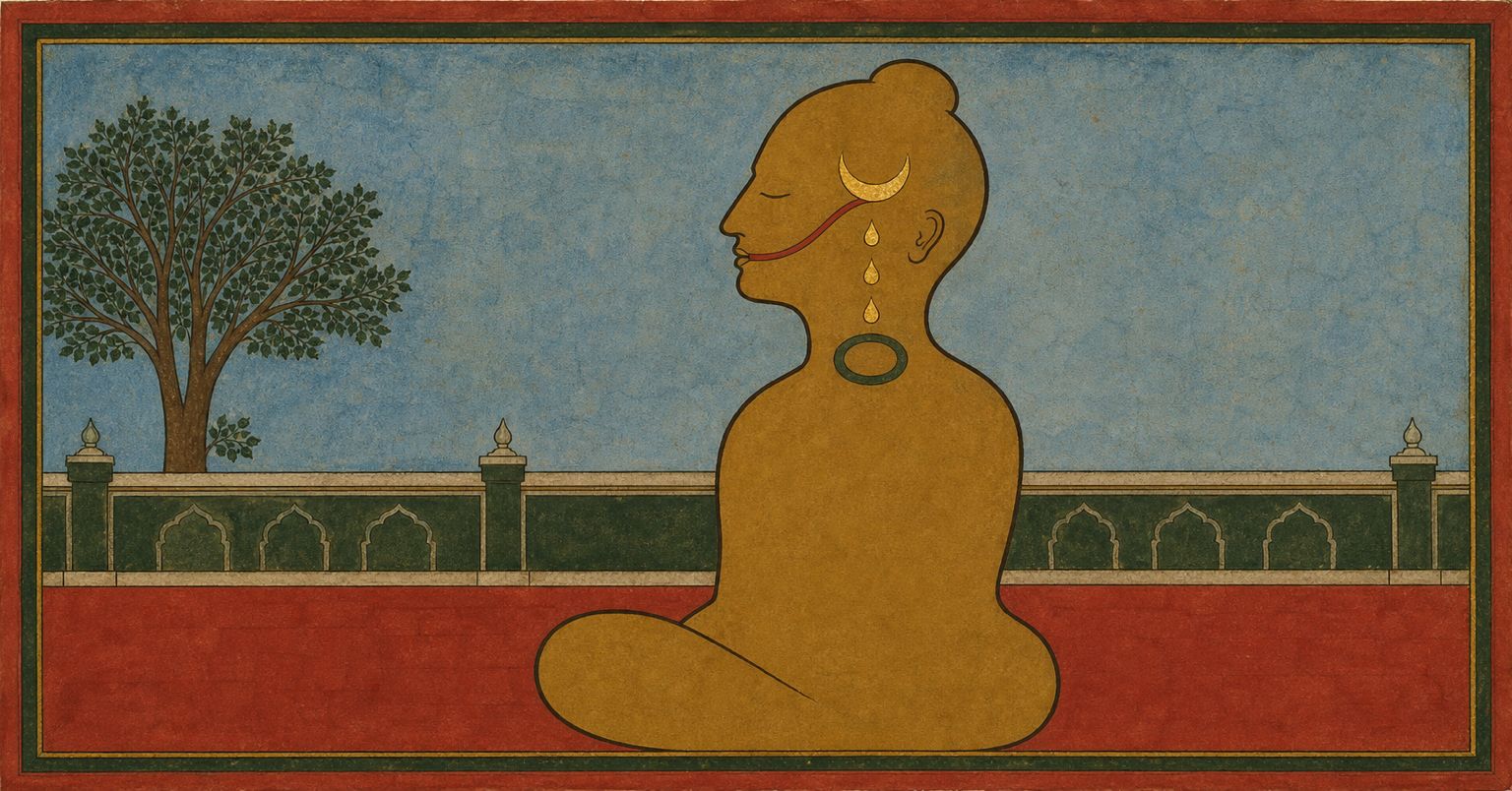
Illustration for the Haṭha Pradīpikā section “HP 3.33-3.48*1: Khecarī and Soma”.

Haṭha Pradīpikā 3.33-3.48*1: Khecarī and the Preservation of Soma

Khecarī leads the tongue into the inner space; Bindu, Soma, and nectar are preserved and associated with freedom from old age and death.

Dr. Ronald Steiner Dr. Ronald Steiner
Haṭha Pradīpikā 3.33
कपालकुहरे जिह्वा प्रविष्टा विपरीतगा |
kapāla-kuhare jihvā; praviṣṭā viparīta-gā | Analysis ▾ Analysis ▴
kapāla
tatpuruṣa-compound genitive
substantive neuter
skull
kuhare
lokative singular
substantive neuter
cavity
jihvā
nominative singular
substantive feminine
tongue
praviṣṭā
nominative singular feminine past participle passive
previx
verbal root
entered
viparīta
karmadhāraya-compound past participle passive
previx
previx
verbal root
reversed
gā
nominative singular feminine
adjective
going
भ्रुवोरन्तर्गता दृष्टिर् मुद्रा भवति खेचरी ||33||
bhruvor antar-gatā dṛṣṭir; mudrā bhavati khecarī ||33|| Analysis ▾ Analysis ▴
bhruvoḥ
genitive dual
substantive feminine
of both eyebrows
antar
tatpuruṣa-compound lokative
adverb
inside, between
gatā
nominative singular feminine past participle passive
verbal root
gone, directed
dṛṣṭiḥ
nominative singular
substantive feminine
gaze
mudrā
nominative singular
substantive feminine
mudrā
bhavati
3rd person singular aktive present
verbal root
becomes, arises
khecarī
nominative singular
substantive feminine
Khecarī
Metre: Anuṣṭubh
When the tongue (jihvā | nom sg), turned backward (viparīta-gā | nom sg f), has entered (praviṣṭā | nom sg f ppp) the cavity of the skull (kapāla-kuhare | loc sg), and the gaze (dṛṣṭiḥ | nom sg) has gone within (antar-gatā | nom sg f ppp) between the two eyebrows (bhruvoḥ | gen du), the mudrā (mudrā | nom sg) Khecarī (khecarī | nom sg) arises (bhavati | 3p sg act pres).
Dr. Ronald Steiner - 2026 - historically literal
Khecarī arises when the reversed tongue enters the cavity of the skull and the gaze rests between the eyebrows.
Dr. Ronald Steiner - 2026 - modern transfer

Brahmānanda defines Khecarīmudrā through two simultaneous orientations. The tongue, turned backward, enters the cranial cavity above the palate, while the gaze is directed inward toward the space between the eyebrows. The Mudrā thus combines the position of the tongue with concentration of the gaze.

Brahmānanda's Jyotsnā - 19th c.
kapālakuhare jihvā praviṣṭā viparītagā bhruvor antargatā dṛṣṭir mudrā bhavati khecarī MBHDL2026 ] transp. NS1882 ante HP 3.32
Critical Apparatus
The Khechari Mudrâ is accomplished by thrusting the tongue into the gullet, by turning it over itself, and keeping the eyesight in the middle of the eyebrows.
Pancham Sinh - 1915
Die umgebogene Zunge wird in die Rachenhöhle gebracht, der Blick auf die Stelle zwischen den Augenbrauen gerichtet, so entsteht die Khecarî.
Hermann Walter - 1893
Haṭha Pradīpikā 3.34
कलां पराङ्मुखीं कृत्वा क्षणार्धं यदि तिष्ठति |
kalāṃ parāṅ-mukhīṃ kṛtvā; kṣaṇārdhaṃ yadi tiṣṭhati | Analysis ▾ Analysis ▴
kalām
accusative singular
substantive feminine
tongue, part
parāñc
karmadhāraya-compound
adjective
turned back
mukhīm
accusative singular feminine
adjective
directed
kṛtvā
absolutus
verbal root
having made
kṣaṇa
tatpuruṣa-compound genitive
substantive neuter
moment
ardham
accusative singular
substantive neuter
half
yadi
particle
when
tiṣṭhati
3rd person singular aktive present
verbal root
remains
क्षणेन मुच्यते योगी व्याधिमृत्युजरादिभिः ||34||
kṣaṇena mucyate yogī; vyādhi-mṛtyu-jarādibhiḥ ||34|| Analysis ▾ Analysis ▴
kṣaṇena
instrumental case singular
substantive neuter
instantly
mucyate
3rd person singular passive present
verbal root
is liberated
yogī
nominative singular
substantive masculine
the yogin
vyādhi
dvandva-compound
substantive neuter
disease
mṛtyu
dvandva-compound
substantive neuter
death
jarā
dvandva-compound
substantive feminine
age
ādibhiḥ
ablative plural
adjective
and so forth
Metre: Anuṣṭubh
If (yadi), having turned (kṛtvā | abs) the tongue (kalām | acc sg) backward (parāṅ-mukhīm | acc sg f), one remains (tiṣṭhati | 3p sg act pres) for half an instant (kṣaṇa-ardham | acc sg), the yogi (yogī | nom sg) is instantly (kṣaṇena | ins sg) freed (mucyate | 3p sg pas pres) from disease, death, old age, and the like (vyādhi-mṛtyu-jarā-ādibhiḥ | abl pl).
Dr. Ronald Steiner - 2026 - historically literal
If the yogi turns the tongue backward and remains in this position for even half a moment, the text says that disease, death, old age, and the like disappear at once.
Dr. Ronald Steiner - 2026 - modern transfer
kalāṃ parāṅmukhīṃ kṛtvā kṣaṇārdhaṃ yadi tiṣṭhati kṣaṇena mucyate yogī vyādhimṛtyujarādibhiḥ MBHDL2026 ] om. NS1882
Critical Apparatus
Haṭha Pradīpikā
कलां पराङ्मुखीं कृत्वा त्रिपथे परिवर्तयेत् |
kalāṃ parāṅ-mukhīṃ kṛtvā; tri-pathe parivartayet | Analysis ▾ Analysis ▴
kalām
accusative singular
substantive feminine
tongue, part
parāñc
karmadhāraya-compound
adjective
turned back
mukhīm
accusative singular feminine
adjective
directed
kṛtvā
absolutus
verbal root
having made
tri
dvigu-compound
numeral
three
pathe
lokative singular
substantive neuter
way, path
parivartayet
3rd person singular causative optative
previx
verbal root
should turn, rotate
सा भवेत्खेचरी मुद्रा व्योमचक्रं तदुच्यते ||34*1||
sā bhavet khecarī mudrā; vyoma-cakraṃ tad ucyate ||34*1|| Analysis ▾ Analysis ▴
sā
nominative singular feminine
pronoun
it
bhavet
3rd person singular aktive optative
verbal root
becomes
khecarī
nominative singular
substantive feminine
Khecarī
mudrā
nominative singular
substantive feminine
mudrā
vyoma
tatpuruṣa-compound genitive
substantive neuter
space, sky
cakram
nominative singular
substantive neuter
wheel, centre
tat
nominative singular neuter
pronoun
that
ucyate
3rd person singular passive present
verbal root
is called
रसनामूर्ध्वगां कृत्वा क्षणार्धं यदि तिष्ठति |
rasanām ūrdhva-gāṃ kṛtvā; kṣaṇārdhaṃ yadi tiṣṭhati | Analysis ▾ Analysis ▴
rasanām
accusative singular
substantive feminine
tongue
ūrdhva
karmadhāraya-compound
adjective
upward
gām
accusative singular feminine
adjective
going
kṛtvā
absolutus
verbal root
having made
kṣaṇa
tatpuruṣa-compound genitive
substantive neuter
moment
ardham
accusative singular
substantive neuter
half
yadi
particle
when
tiṣṭhati
3rd person singular aktive present
verbal root
remains
क्षणेन मुच्यते योगी व्याधिमृत्युजरादिभिः ||34*2||
kṣaṇena mucyate yogī; vyādhi-mṛtyu-jarādibhiḥ ||34*2|| Analysis ▾ Analysis ▴
kṣaṇena
instrumental case singular
substantive neuter
instantly
mucyate
3rd person singular passive present
verbal root
is liberated
yogī
nominative singular
substantive masculine
the yogin
vyādhi
dvandva-compound
substantive neuter
disease
mṛtyu
dvandva-compound
substantive neuter
death
jarā
dvandva-compound
substantive feminine
age
ādibhiḥ
ablative plural
adjective
and so forth
Metre: Anuṣṭubh
Having turned (kṛtvā | abs) the tongue (kalām | acc sg) backward (parāṅ-mukhīm | acc sg f), one should rotate it (parivartayet | 3p sg caus opt) at the threefold path (tri-pathe | loc sg). This (sā | nom sg f) is (bhavet | 3p sg act opt) Khecarī Mudrā (khecarī mudrā | nom sg); that (tat | nom sg n) is called (ucyate | 3p sg pas pres) the space Cakra (vyoma-cakram | nom sg). If (yadi), having turned (kṛtvā | abs) the tongue (rasanām | acc sg) upward (ūrdhva-gām | acc sg f), one remains (tiṣṭhati | 3p sg act pres) for half an instant (kṣaṇa-ardham | acc sg), the yogi (yogī | nom sg) is instantly (kṣaṇena | ins sg) freed (mucyate | 3p sg pas pres) from disease, death, old age, and the like (vyādhi-mṛtyu-jarā-ādibhiḥ | abl pl).
Dr. Ronald Steiner - 2026 - historically literal
The tongue is directed backward into the inner three-way junction and upward. Even a brief stay in this Khecarī Mudrā is said to free one from disease, death, and old age.
Dr. Ronald Steiner - 2026 - modern transfer

For the stanzas additionally inserted in NS1882, Brahmānanda gives an exceptionally concrete historical description of the gradual severing of the frenulum of the tongue. At intervals of seven days, a layer the width of a hair is cut; the site is treated morning and evening until the restriction is said to disappear after six months. Rock salt and Harītakī are named, or Khadira and Harītakī for Haṭha practitioners who avoid salt. The commentary thereby transmits an invasive procedure that goes far beyond the brief definition of Khecarī.

Brahmānanda's Jyotsnā - 19th c.
om. MBHDL2026 ] add. snuhīpatranibhaṃ śastraṃ sutīkṣṇaṃ snigdhanirmalam / samādāya tatas tena romamātraṃ samucchinet NS1882 ante kalāṃ parāṅmukhīṃ kṛtvā
Critical Apparatus
Turning the tongue upwards, it is fixed on the three ways (œsophagus, windpipe and palate.) Thus it makes the Khechari Mudrâ, and is called the Vyoma Chakra.

The Yogî who sits for a minute turning his tongue upwards, is saved from poisons, diseases, death, old age, etc.
Pancham Sinh - 1915
Nachdem man die Zunge rückwärtsgebogen hat, bringe man sie mit dem Dreipfad (tripatha) in Berührung; daselbst entsteht die Khecarî Mudrâ und (jene Stelle) wird Vyomacakra genannt.

Mit der Zunge aufwärtsgerichtet (d. h. in der Höhlung oberhalb des Gaumens, Com.) verweile man einen halben Kshaņa (= 2 Min.) lang. Der Yogin wird auf diese Weise von Gift, Krankheit, Tod, Alter u. s. w. befreit.
Hermann Walter - 1893
Haṭha Pradīpikā 3.35
न रोगो मरणं तस्य न निद्रा न क्षुधा तृषा |
na rogo maraṇaṃ tasya; na nidrā na kṣudhā tṛṣā | Analysis ▾ Analysis ▴
na
particle
no
rogaḥ
nominative singular
substantive masculine
disease
maraṇam
nominative singular
substantive neuter
death
tasya
genitive singular masculine
pronoun
for him
na
particle
no
nidrā
nominative singular
substantive feminine
sleep
na
particle
no
kṣudhā
nominative singular
substantive feminine
hunger
tṛṣā
nominative singular
substantive feminine
thirst
न च मूर्छा भवेत्तस्य यो मुद्रां वेत्ति खेचरीम् ||35||
na ca mūrchā bhavet tasya; yo mudrāṃ vetti khecarīm ||35|| Analysis ▾ Analysis ▴
na
particle
not
ca
particle
and
mūrchā
nominative singular
substantive feminine
fainting
bhavet
3rd person singular aktive optative
verbal root
becomes
tasya
genitive singular masculine
pronoun
for him
yaḥ
nominative singular masculine
pronoun
who
mudrām
accusative singular
substantive feminine
mudrā
vetti
3rd person singular aktive present
verbal root
knows
khecarīm
accusative singular
substantive feminine
Khecarī
Metre: Anuṣṭubh
For one (tasya | gen sg m) who (yaḥ | nom sg m) knows (vetti | 3p sg act pres) the mudrā (mudrām | acc sg) Khecarī (khecarīm | acc sg), there is no (na) disease (rogaḥ | nom sg), no death (maraṇam | nom sg), no (na) sleep (nidrā | nom sg), no (na) hunger (kṣudhā | nom sg) or thirst (tṛṣā | nom sg), and no (na ca) fainting (mūrchā | nom sg).
Dr. Ronald Steiner - 2026 - historically literal
One who knows Khecarī is said to be free from disease, death, sleep, hunger, thirst, and fainting.
Dr. Ronald Steiner - 2026 - modern transfer
maraṇaṃ tasya MBHDL2026 ] maraṇaṃ tandrā NS1882
Critical Apparatus
He who knows the Khechari Mudrâ is not afflicted with disease, death, sloth, sleep, hunger, thirst, and swooning.
Pancham Sinh - 1915
Derjenige, welcher mit der Khecarî Mudrâ vertraut ist, kennt nicht Krankheit, Tod, Erschöpfung, Schlaf, Hunger, Durst, Ohnmacht.
Hermann Walter - 1893
Haṭha Pradīpikā 3.36
पीड्यते न स रोगेण न च लिप्यति कर्मणा |
pīḍyate na sa rogeṇa; na ca lipyati karmaṇā | Analysis ▾ Analysis ▴
pīḍyate
3rd person singular passive present
verbal root
is oppressed, afflicted
na
particle
not
saḥ
nominative singular masculine
pronoun
he
rogeṇa
instrumental case singular
substantive masculine
by disease
na
particle
not
ca
particle
and
lipyati
3rd person singular aktive present
verbal root
adheres, is stained
karmaṇā
instrumental case singular
substantive neuter
by action, karma
बाध्यते न च कालेन यो मुद्रां वेत्ति खेचरीम् ||36||
bādhyate na ca kālena; yo mudrāṃ vetti khecarīm ||36|| Analysis ▾ Analysis ▴
bādhyate
3rd person singular passive present
verbal root
is oppressed
na
particle
not
ca
particle
and
kālena
instrumental case singular
substantive masculine
by time, death
yaḥ
nominative singular masculine
pronoun
he who
mudrām
accusative singular
substantive feminine
mudrā
vetti
3rd person singular aktive present
verbal root
knows
khecarīm
accusative singular
substantive feminine
Khecarī
Metre: Anuṣṭubh
One (saḥ | nom sg m) who (yaḥ | nom sg m) knows (vetti | 3p sg act pres) the mudrā (mudrām | acc sg) Khecarī (khecarīm | acc sg) is not (na) afflicted (pīḍyate | 3p sg pas pres) by disease (rogeṇa | ins sg), nor (na ca) tainted (lipyati | 3p sg act pres) by karma (karmaṇā | ins sg), nor (na ca) tormented (bādhyate | 3p sg pas pres) by death (kālena | ins sg).
Dr. Ronald Steiner - 2026 - historically literal
Khecarī protects the one who knows it from disease, karmic bondage, and the power of time.
Dr. Ronald Steiner - 2026 - modern transfer
na ca lipyati karmaṇā MBHDL2026 ] lipyate na ca karmaṇā NS1882

bādhyate na ca kālena MBHDL2026 ] bādhyate na sa kālena NS1882
Critical Apparatus
He who knows the Khechari Mudrâ, is not troubled by diseases, is not stained with karmas, and is not snared by time.
Pancham Sinh - 1915
Wer die Khecarî kennt, wird von Krankheit nicht geplagt, vom Karma nicht befleckt, vom Tod nicht getödtet.
Hermann Walter - 1893
Haṭha Pradīpikā 3.37
चित्तं चरति खे यस्माज् जिह्वा चरति खे गता |
cittaṃ carati khe yasmāj; jihvā carati khe gatā | Analysis ▾ Analysis ▴
cittam
nominative singular
substantive neuter
mind
carati
3rd person singular aktive present
verbal root
moves
khe
lokative singular
substantive neuter
in space, ether
yasmāt
ablative singular
pronoun
because
jihvā
nominative singular
substantive feminine
tongue
carati
3rd person singular aktive present
verbal root
moves
khe
lokative singular
substantive neuter
in space, the cavity
gatā
nominative singular feminine past participle passive
verbal root
gone
तेनैषा खेचरी नाम मुद्रा सिद्धैर्नमस्कृता ||37||
tenaiṣā khecarī nāma; mudrā siddhair namaskṛtā ||37|| Analysis ▾ Analysis ▴
tena
instrumental case singular neuter
pronoun
therefore
eṣā
nominative singular feminine
pronoun
this
khecarī
nominative singular
substantive feminine
Khecarī
nāma
adverb
named
mudrā
nominative singular
substantive feminine
mudrā
siddhaiḥ
instrumental case plural
substantive masculine
by siddhas
namaskṛtā
nominative singular feminine past participle passive
verbal root
revered, saluted
Metre: Anuṣṭubh
Because (yasmāt | abl sg) the mind (cittam | nom sg) moves (carati | 3p sg act pres) in space (khe | loc sg), and the tongue (jihvā | nom sg), having gone (gatā | nom sg f ppp) into space (khe | loc sg), moves (carati | 3p sg act pres) there, therefore (tena | ins sg n) this (eṣā | nom sg f) mudrā (mudrā | nom sg) is called (nāma) Khecarī (khecarī | nom sg) and is revered (namaskṛtā | nom sg f ppp) by the Siddhas (siddhaiḥ | ins pl).
Dr. Ronald Steiner - 2026 - historically literal
It is called Khecarī because the mind and tongue move through the inner space. For this reason, the Siddhas revere this Mudrā.
Dr. Ronald Steiner - 2026 - modern transfer

Brahmānanda explains the name Khecarī literally as “that which moves in space.” Both the mind and the tongue move in kha, the inner space between the eyebrows or the corresponding cranial cavity. The name designates the joint movement of tongue and consciousness within the same subtle space.

Brahmānanda's Jyotsnā - 19th c.
namaskṛtā MBHDL2026 ] nirūpitā NS1882
Critical Apparatus
The Siddhas have devised this Khechari Mudrâ from the fact that the mind and the tongue reach âkâśa by its practice.
Pancham Sinh - 1915
Weil das Bewusstsein sich in dem Raume (zwischen den Augenbrauen) befindet und die Zunge in (eben diesem) Raume, deshalb wurde diese Mudrâ als Khecarî von den Vollendeten bestimmt.
Hermann Walter - 1893
Haṭha Pradīpikā 3.38
खेचर्या मुद्रितं येन विवरं लम्बिकोर्ध्वतः |
khecaryā mudritaṃ yena; vivaraṃ lambikordhvataḥ | Analysis ▾ Analysis ▴
khecaryā
instrumental case singular
substantive feminine
by Khecarī
mudritam
nominative singular neuter past participle passive
mudr
verbal root
sealed
yena
instrumental case singular masculine
pronoun
by whom, by the one who
vivaram
nominative accusative singular
substantive neuter
opening, cavity
lambikā
tatpuruṣa-compound genitive
substantive feminine
uvula
ūrdhvataḥ
adverb
above
तस्य न क्षरते बिन्दुः कामिन्याश्लेषितस्य च ||38||
tasya na kṣarate binduḥ; kāminyāśleṣitasya ca ||38|| Analysis ▾ Analysis ▴
tasya
genitive singular masculine
pronoun
his
na
particle
not
kṣarate
3rd person singular medial present
verbal root
flows, drips
binduḥ
nominative singular
substantive masculine
bindu, semen
kāminyā
instrumental case singular
substantive feminine
by a desirous woman
aśleṣitasya
genitive singular masculine past participle passive
previx
verbal root
embraced
ca
particle
even
Metre: Anuṣṭubh
For one by whom (yena | ins sg m) the opening (vivaram | nom acc sg) above the uvula (lambikā-ūrdhvataḥ) has been sealed (mudritam | nom sg n ppp) by Khecarī (khecaryā | ins sg), his (tasya | gen sg m) Bindu (binduḥ | nom sg) does not (na) flow out (kṣarate | 3p sg med pres), even (ca) when he is embraced (āśleṣitasya | gen sg m ppp) by a desirous woman (kāminyā | ins sg).
Dr. Ronald Steiner - 2026 - historically literal
When Khecarī seals the opening above the uvula, Bindu is said not to be lost even during erotic arousal.
Dr. Ronald Steiner - 2026 - modern transfer

According to Brahmānanda, the opening sealed by Khecarī lies above the Lambikā, the palatal region. He explains the subsequent Yonimudrā as a contraction of the sexual organ and recognizes in it an initial reference to Vajrolī. The moving Bindu, here the reproductive substance, is thereby to be led upward again through Suṣumṇā.

Brahmānanda's Jyotsnā - 19th c.
tasya na kṣarate MBHDL2026 ] na tasya kṣarate NS1882
Critical Apparatus
If the hole behind the palate be stopped with Khechari by turning the tongue upwards, then bindu cannot leave its place even if a woman were embraced.
Pancham Sinh - 1915
Wer durch die Khecarî die Höhlung oberhalb der uvula versiegelt hat, von dem geht kein Tropfen (bindu) verloren, wie von einem Mann, der von seiner Geliebten umfangen ist.
Hermann Walter - 1893
Haṭha Pradīpikā 3.39
चलितो ऽपि यदा बिन्दुः संप्राप्तो योनिमण्डलम् |
calito 'pi yadā binduḥ; saṃprāpto yoni-maṇḍalam | Analysis ▾ Analysis ▴
calitaḥ
nominative singular masculine past participle passive
verbal root
moved, discharged
api
particle
even
yadā
adverb
if
binduḥ
nominative singular
substantive masculine
bindu, semen
saṃprāptaḥ
nominative singular masculine past participle passive
previx
previx
verbal root
reaches
yoni
tatpuruṣa-compound genitive
substantive feminine
yoni, perineum
maṇḍalam
accusative singular
substantive neuter
region, circle
व्रजत्यूर्ध्वं हतः शक्त्या निबद्धो योनिमुद्रया ||39||
vrajaty ūrdhvaṃ hataḥ śaktyā; nibaddho yoni-mudrayā ||39|| Analysis ▾ Analysis ▴
vrajati
3rd person singular aktive present
verbal root
goes
ūrdhvam
adverb
upward
hataḥ
nominative singular masculine past participle passive
verbal root
struck, driven
śaktyā
instrumental case singular
substantive feminine
by śakti
nibaddhaḥ
nominative singular masculine past participle passive
previx
verbal root
bound, retained
yoni
tatpuruṣa-compound genitive
substantive feminine
yoni
mudrayā
instrumental case singular
substantive feminine
through the mudrā
Metre: Anuṣṭubh
Even (api) when (yadā) Bindu (binduḥ | nom sg), having moved (calitaḥ | nom sg m ppp), has reached (saṃprāptaḥ | nom sg m ppp) the region of the yoni (yoni-maṇḍalam | acc sg), it goes (vrajati | 3p sg act pres) upward (ūrdhvam), driven (hataḥ | nom sg m ppp) by Śakti (śaktyā | ins sg) and bound (nibaddhaḥ | nom sg m ppp) by Yoni Mudrā (yoni-mudrayā | ins sg).
Dr. Ronald Steiner - 2026 - historically literal
Even if Bindu has already moved downward, it is said to be bound through Śakti and Yoni Mudrā and drawn upward again.
Dr. Ronald Steiner - 2026 - modern transfer
hataḥ MBHDL2026 ] hṛtaḥ NS1882
Critical Apparatus
Sollte aber doch ein Tropfen fallen, und kommt er in die Gegend des perinaeum (yoni), so geht er wieder aufwärts, angezogen durch die Şakti und angehalten durch die Yonimudrâ.
Hermann Walter - 1893
Haṭha Pradīpikā 3.39*1
कपालकुहरे जिह्वा कलासन्धानमुद्रया ||39*1||
kapāla-kuhare jihvā; kalā-sandhāna-mudrayā ||39*1|| Analysis ▾ Analysis ▴
kapāla
tatpuruṣa-compound genitive
substantive neuter
skull
kuhare
lokative singular
substantive neuter
in the cavity
jihvā
nominative singular
substantive feminine
tongue
kalā
tatpuruṣa-compound genitive
substantive feminine
kalā
sandhāna
tatpuruṣa-compound genitive
substantive neuter
conjunction
mudrayā
instrumental case singular
substantive feminine
through the mudrā
Metre: Anuṣṭubh
Through the mudrā of joining Kalā (kalā-sandhāna-mudrayā | ins sg), the tongue (jihvā | nom sg) [is placed] in the cavity of the skull (kapāla-kuhare | loc sg).
Dr. Ronald Steiner - 2026 - historically literal
Through Kalāsandhāna Mudrā, the tongue is led into the cavity of the skull.
Dr. Ronald Steiner - 2026 - modern transfer
kapālakuhare jihvā kalāsandhānamudrayā MBHDL2026 ] om. NS1882
Critical Apparatus
Haṭha Pradīpikā 3.40
ऊर्ध्वजिह्वः स्थितो भूत्वा सोमपानं करोति यः |
ūrdhva-jihvaḥ sthito bhūtvā; soma-pānaṃ karoti yaḥ | Analysis ▾ Analysis ▴
ūrdhva
karmadhāraya-compound
adjective
upward
jihvaḥ
nominative singular masculine
adjective
with the tongue
sthitaḥ
nominative singular masculine past participle passive
verbal root
standing, remaining
bhūtvā
absolutus
verbal root
having become
soma
tatpuruṣa-compound genitive
substantive neuter
soma, nectar
pānam
accusative singular
substantive neuter
drinking
karoti
3rd person singular aktive present
verbal root
performs
yaḥ
nominative singular masculine
pronoun
whoever
मासार्धेन न संदेहो मृत्युं जयति योगवित् ||40||
māsārdhena na saṃdeho; mṛtyuṃ jayati yoga-vit ||40|| Analysis ▾ Analysis ▴
māsa
tatpuruṣa-compound genitive
substantive neuter
month
ardhena
instrumental case singular
substantive neuter
by half
na
particle
not
saṃdehaḥ
nominative singular
substantive masculine
doubt
mṛtyum
accusative singular
substantive neuter
death
jayati
3rd person singular aktive present
verbal root
conquers
yoga
tatpuruṣa-compound genitive
substantive masculine
yoga
vit
nominative singular masculine
adjective
knower
Metre: Anuṣṭubh
One who (yaḥ | nom sg m), having become so (bhūtvā | abs), remains (sthitaḥ | nom sg m ppp) with the tongue turned upward (ūrdhva-jihvaḥ | nom sg m) and performs (karoti | 3p sg act pres) the drinking of Soma (soma-pānam | acc sg), that knower of yoga (yoga-vit | nom sg m) conquers (jayati | 3p sg act pres) death (mṛtyum | acc sg) in half a month (māsa-ardhena | ins sg); there is no (na) doubt (saṃdehaḥ | nom sg).
Dr. Ronald Steiner - 2026 - historically literal
The knower of yoga who drinks Soma with the tongue turned upward is said to conquer death within half a month.
Dr. Ronald Steiner - 2026 - modern transfer

For Brahmānanda, the Soma drunk in Khecarī is the lunar nectar that drips from the opening above the palatal region. “With the tongue directed upward” accordingly means that the tongue faces precisely this opening while the body remains motionless.

Brahmānanda's Jyotsnā - 19th c.
sthito MBHDL2026 ] sthiro NS1882
Critical Apparatus
If the Yogî drinks Somarasa (juice) by sitting with the tongue turned backwards and mind concentrated, there is no doubt he conquers death within 15 days.
Pancham Sinh - 1915
Der Yogakundige, welcher mit der Zunge nach oben gerichtet unbeweglich bleibt und den Soma trinkt, der wird ohne Zweifel den Tod einen halben Monat lang besiegen.
Hermann Walter - 1893
Haṭha Pradīpikā 3.41
नित्यं सोमकलापूर्णं शरीरं यस्य योगिनः |
nityaṃ soma-kalā-pūrṇaṃ; śarīraṃ yasya yoginaḥ | Analysis ▾ Analysis ▴
nityam
adverb
always
soma
tatpuruṣa-compound genitive
substantive neuter
soma, moon
kalā
tatpuruṣa-compound genitive
substantive feminine
portion, digit
pūrṇam
nominative singular neuter past participle passive
verbal root
filled
śarīram
nominative singular
substantive neuter
body
yasya
genitive singular masculine
pronoun
whose
yoginaḥ
genitive singular
substantive masculine
of the yogin
तक्षकेणापि दष्टस्य विषं तस्य न सर्पति ||41||
takṣakeṇāpi daṣṭasya; viṣaṃ tasya na sarpati ||41|| Analysis ▾ Analysis ▴
takṣakeṇa
instrumental case singular
substantive masculine
by Takṣaka
api
particle
even
daṣṭasya
genitive singular masculine past participle passive
verbal root
bitten
viṣam
nominative singular
substantive neuter
poison
tasya
genitive singular masculine
pronoun
his
na
particle
not
sarpati
3rd person singular aktive present
verbal root
creeps, spreads
Metre: Anuṣṭubh
For one whose (yasya | gen sg m) body (śarīram | nom sg), the body of the yogi (yoginaḥ | gen sg), is always (nityam) filled with the lunar Kalā (soma-kalā-pūrṇam | nom sg n ppp), even (api) when he has been bitten (daṣṭasya | gen sg m ppp) by Takṣaka (takṣakeṇa | ins sg), its (tasya | gen sg m) poison (viṣam | nom sg) does not (na) spread (sarpati | 3p sg act pres).
Dr. Ronald Steiner - 2026 - historically literal
When the yogi's body is continually filled with Soma, even snake venom is said to have no power over it.
Dr. Ronald Steiner - 2026 - modern transfer
If the Yogî, whose body is full of Somarasa (juice), were bitten by Takshaka (snake), its poison cannot permeate his body.
Pancham Sinh - 1915
In dem beständig mit Soma gefüllten Körper des Yogins, kann selbst das Gift von einem Takschakabisse nicht einherschleichen.
Hermann Walter - 1893
Haṭha Pradīpikā 3.42
इन्धनानि यथा वह्निस् तैलवर्तिं च दीपकः |
indhanāni yathā vahnis; taila-vartiṃ ca dīpakaḥ | Analysis ▾ Analysis ▴
indhanāni
accusative plural
substantive neuter
fuel
yathā
adverb
like
vahniḥ
nominative singular
substantive masculine
fire
taila
tatpuruṣa-compound genitive
substantive neuter
oil
vartim
accusative singular
substantive feminine
wick
ca
particle
and
dīpakaḥ
nominative singular
substantive masculine
lamp
तथा सोमकलापूर्णं देही देहं न मुञ्चति ||42||
tathā soma-kalā-pūrṇaṃ; dehī dehaṃ na muñcati ||42|| Analysis ▾ Analysis ▴
tathā
adverb
thus
soma
tatpuruṣa-compound genitive
substantive neuter
soma, moon
kalā
tatpuruṣa-compound genitive
substantive feminine
portion, digit
pūrṇam
accusative singular masculine past participle passive
verbal root
filled
dehī
nominative singular
substantive masculine
embodied one
deham
accusative singular
substantive masculine
body
na
particle
not
muñcati
3rd person singular aktive present
verbal root
leaves
Metre: Anuṣṭubh
Just as (yathā) fire (vahniḥ | nom sg) does not leave its fuels (indhanāni | acc pl), nor a lamp (dīpakaḥ | nom sg) its oil-soaked wick (taila-vartim | acc sg), so (tathā) the embodied one (dehī | nom sg) does not (na) leave (muñcati | 3p sg act pres) the body filled with the lunar Kalā (soma-kalā-pūrṇam deham | acc sg).
Dr. Ronald Steiner - 2026 - historically literal
Just as fire remains with its fuel and a lamp with its oiled wick, the embodied being does not leave a body filled with Soma.
Dr. Ronald Steiner - 2026 - modern transfer
As fire is inseparably connected with the wood and light is connected with the wick and oil, so does the soul not leave the body full of nectar exuding from the Soma.
Pancham Sinh - 1915
Wie das Feuer das Brennholz nicht verlässt, die Flamme nicht den Oeldocht, so verlässt auch das Leben den Körper nicht, so lang derselbe mit Soma gefüllt ist.
Hermann Walter - 1893
Haṭha Pradīpikā 3.43
गोमांसं भक्षयेन्नित्यं पिबेदमरवारुणीम् |
go-māṃsaṃ bhakṣayen nityaṃ; pibed amara-vāruṇīm | Analysis ▾ Analysis ▴
go
tatpuruṣa-compound genitive
substantive masculine
cow
māṃsam
accusative singular
substantive neuter
flesh
bhakṣayet
3rd person singular aktive optative
verbal root
he should eat
nityam
adverb
always
pibet
3rd person singular aktive optative
verbal root
he should drink
amara
tatpuruṣa-compound genitive
substantive neuter
immortals, gods
vāruṇīm
accusative singular
substantive feminine
Vāruṇī, wine
कुलीनं तमहं मन्ये इतरे कुलघातकाः ||43||
kulīnaṃ tam ahaṃ manye; itare kula-ghātakāḥ ||43|| Analysis ▾ Analysis ▴
kulīnam
accusative singular masculine
adjective
noble, of good family
tam
accusative singular masculine
pronoun
him
aham
nominative singular
pronoun
I
manye
1st person singular medial present
verbal root
consider, regard
itare
nominative plural masculine
adjective
the others
kula
tatpuruṣa-compound genitive
substantive neuter
family, lineage
ghātakāḥ
nominative plural masculine
adjective
destroying
Metre: Anuṣṭubh
One should always (nityam) eat (bhakṣayet | 3p sg act opt) "cow flesh" (go-māṃsam | acc sg) and drink (pibet | 3p sg act opt) the immortal Vāruṇī (amara-vāruṇīm | acc sg); I (aham | nom sg) consider (manye | 1p sg med pres) that person (tam | acc sg m) noble (kulīnam | acc sg m), and the others (itare | nom pl m) destroyers of the lineage (kula-ghātakāḥ | nom pl m).
Dr. Ronald Steiner - 2026 - historically literal
The text speaks enigmatically: one who eats “cow's flesh” and drinks the “wine of the gods” is considered truly Kulīna; everyone else misses the lineage.
Dr. Ronald Steiner - 2026 - modern transfer

Brahmānanda reads the seemingly offensive expressions “eating cow's flesh” and “drinking the wine of immortality” as technical imagery of Khecarī:

  • Go here denotes the tongue; its entry into the opening above the palate is called “eating cow's flesh.”
  • In this conception, the resulting heat causes the fluid of the inner moon to flow; this fluid is called amaravāruṇī, “wine of the immortals.”

In his interpretation, the passage requires neither the consumption of meat nor of alcohol.

Brahmānanda's Jyotsnā - 19th c.
Those who eat the flesh of the cow and drink the immortal liquor daily, are regarded by me men of noble family. Others are but a disgrace to their families.
Pancham Sinh - 1915
Sogar Kuhfleisch mag er immer essen und Amaravâruņî trinken, ich würde ihn dennoch für einen Mann aus guter Familie (kulina) halten; Andere wären (unter solchen Umständen) Familienschänder.
Hermann Walter - 1893
Haṭha Pradīpikā 3.44
गोशब्देनोदिता जिह्वा तत्प्रवेशो हि तालुनि |
go-śabdenoditā jihvā; tat-praveśo hi tāluni | Analysis ▾ Analysis ▴
go
tatpuruṣa-compound genitive
substantive masculine
cow
śabdena
instrumental case singular
substantive masculine
by the word
uditā
nominative singular feminine past participle passive
verbal root
designated, called
jihvā
nominative singular
substantive feminine
tongue
tat
tatpuruṣa-compound genitive
pronoun
its
praveśaḥ
nominative singular
substantive masculine
entry
hi
particle
namely
tāluni
lokative singular
substantive neuter
into the palate
गोमांसभक्षणं तत्तु महापातकनाशनम् ||44||
go-māṃsa-bhakṣaṇaṃ tat tu; mahā-pātaka-nāśanam ||44|| Analysis ▾ Analysis ▴
go
tatpuruṣa-compound genitive
substantive masculine
cow
māṃsa
tatpuruṣa-compound genitive
substantive neuter
flesh
bhakṣaṇam
nominative singular
substantive neuter
eating
tat
nominative singular neuter
pronoun
that
tu
particle
but, now
mahā
karmadhāraya-compound
adjective
great
pātaka
tatpuruṣa-compound genitive
substantive neuter
transgression, sin
nāśanam
nominative singular
substantive neuter
destruction
Metre: Anuṣṭubh
By the word "cow" (go-śabdena | ins sg), the tongue (jihvā | nom sg) is designated (uditā | nom sg f ppp); its entry (tat-praveśaḥ | nom sg) into the palate (tāluni | loc sg), indeed (hi), that (tat | nom sg n) is, however (tu), the eating of "cow flesh" (go-māṃsa-bhakṣaṇam | nom sg) and the destruction of great transgressions (mahā-pātaka-nāśanam | nom sg).
Dr. Ronald Steiner - 2026 - historically literal
Here, “eating cow's flesh” does not mean literal meat, but placing the tongue into the palate. This is regarded as erasing grave transgressions.
Dr. Ronald Steiner - 2026 - modern transfer
The word गी means tongue; eating it is thrusting it in the gullet which destroys great sins.
Pancham Sinh - 1915
Durch das Wort „Kuh" u. s. w. wird die Zunge bezeichnet, durch das „Kuhfleischessen " ihr Eintritt in den Gaumen. Dies aber bewirkt die Zerstörung von Todsünden.
Hermann Walter - 1893
Haṭha Pradīpikā 3.45
जिह्वाप्रवेशसंभूत वह्निनोत्पादितः खलु |
jihvā-praveśa-saṃbhūta; vahninotpāditaḥ khalu | Analysis ▾ Analysis ▴
jihvā
tatpuruṣa-compound genitive
substantive feminine
tongue
praveśa
tatpuruṣa-compound genitive
substantive neuter
entry
saṃbhūta
tatpuruṣa-compound past participle passive
previx
verbal root
arisen
vahninā
instrumental case singular
substantive masculine
through the fire
utpāditaḥ
nominative singular masculine past participle passive
previx
verbal root
produced
khalu
particle
indeed
चन्द्रात्स्रवति यः सारः सा स्यादमरवारुणी ||45||
candrāt sravati yaḥ sāraḥ; sā syād amara-vāruṇī ||45|| Analysis ▾ Analysis ▴
candrāt
ablative singular
substantive masculine
from the moon
sravati
3rd person singular aktive present
verbal root
flows
yaḥ
nominative singular masculine
pronoun
which
sāraḥ
nominative singular
substantive masculine
essence
sā
nominative singular feminine
pronoun
that
syāt
3rd person singular aktive optative
verbal root
is, may be
amara
tatpuruṣa-compound genitive
substantive neuter
immortals, gods
vāruṇī
nominative singular
substantive feminine
Vāruṇī, wine
Metre: Anuṣṭubh
The essence (sāraḥ | nom sg) that (yaḥ | nom sg m) flows (sravati | 3p sg act pres) from the moon (candrāt | abl sg), truly (khalu) produced (utpāditaḥ | nom sg m ppp) by the fire (vahninā | ins sg) arising from the tongue's entry (jihvā-praveśa-saṃbhūta | ppp), this (sā | nom sg f) is (syāt | 3p sg act opt) the immortal Vāruṇī (amara-vāruṇī | nom sg).
Dr. Ronald Steiner - 2026 - historically literal
“Amaravāruṇī” is the essence flowing down from the moon, produced by the fire that arises when the tongue enters.
Dr. Ronald Steiner - 2026 - modern transfer
Immortal liquor is the nectar exuding from the moon (Chandra situated on the left side of the space between the eyebrows). It is produced by the fire which is generated by thrusting the tongue.
Pancham Sinh - 1915
Der Saft, der durch die Wärme hervorgebracht wird, die das Eindringen der Zunge (in die Rachenhöhle) erzeugt, und der vom Candra herunterfliesst, ist Amaravâruņî.
Hermann Walter - 1893
Haṭha Pradīpikā 3.46
मूर्ध्नः षोडशपद्मपत्त्रगलितं प्राणादवाप्तं हठाद् ऊर्ध्वास्यो रसनां नियम्य विवरे शक्तिं परां चिन्तयेत् |
mūrdhnaḥ ṣoḍaśa-padma-pattra-galitaṃ, prāṇād avāptaṃ haṭhād ūrdhvāsyo rasanāṃ niyamya vivare, śaktiṃ parāṃ cintayet | Analysis ▾ Analysis ▴
mūrdhnaḥ
ablative genitive singular
substantive masculine
from the head
ṣoḍaśa
tatpuruṣa-compound
numeral
sixteen
padma
tatpuruṣa-compound genitive
substantive neuter
lotus
pattra
tatpuruṣa-compound genitive
substantive neuter
petal
galitam
accusative singular neuter past participle passive
verbal root
dripped down
prāṇāt
ablative singular
substantive masculine
by prāṇa, breath
avāptam
accusative singular neuter past participle passive
previx
verbal root
obtained
haṭhāt
adverb
forcefully
ūrdhva
karmadhāraya-compound
adjective
upward
āsyaḥ
nominative singular
substantive masculine
face, mouth
rasanām
accusative singular
substantive feminine
tongue
niyamya
absolutus
previx
verbal root
having fixed
vivare
lokative singular
substantive neuter
in the opening
śaktim
accusative singular
substantive feminine
śakti
parām
accusative singular feminine
adjective
highest
cintayet
3rd person singular aktive optative
verbal root
should contemplate, visualise
उत्कल्लोलकलाजलं च विमलं धारामृतं यः पिबेन्निर्दोषः स मृणालकोमलवपुर्योगी चिरं जीवति ||46||
utkallola-kalā-jalaṃ ca vimalaṃ, dhārāmṛtaṃ yaḥ piben nir-doṣaḥ sa mṛṇāla-komala-vapur, yogī ciraṃ jīvati ||46|| Analysis ▾ Analysis ▴
utkallola
karmadhāraya-compound masculine
adjective
surging, wave
kalā
tatpuruṣa-compound genitive
substantive feminine
moon digit, portion
jalam
accusative singular
substantive neuter
water, fluid
ca
particle
and
vimalam
accusative singular neuter
adjective
pure
dhārā
tatpuruṣa-compound genitive
substantive feminine
stream
amṛtam
accusative singular
substantive neuter
nectar, drink of immortality
yaḥ
nominative singular masculine
pronoun
whoever
pibet
3rd person singular aktive optative
verbal root
should drink
nir
bahuvrīhi-compund
previx
without, free from
doṣaḥ
nominative singular
substantive masculine
fault, disease
saḥ
nominative singular masculine
pronoun
he
mṛṇāla
tatpuruṣa-compound genitive
substantive neuter
lotus fibre
komala
karmadhāraya-compound
adjective
soft, delicate
vapuḥ
nominative singular neuter
substantive neuter
body
yogī
nominative singular
substantive masculine
the yogin
ciram
adverb
long
jīvati
3rd person singular aktive present
verbal root
lives
Metre: Śārdūlavikrīḍita
With the face turned upward (ūrdhva-āsyaḥ | nom sg), having fixed (niyamya | abs) the tongue (rasanām | acc sg) in the opening (vivare | loc sg), one should contemplate (cintayet | 3p sg act opt) the supreme Śakti (śaktim parām | acc sg): the nectar obtained (avāptam | acc sg n ppp) forcefully (haṭhāt) through Prāṇa (prāṇāt | abl sg), having dripped from the head (mūrdhnaḥ | abl gen sg) into the sixteen lotus petals (ṣoḍaśa-padma-pattra-galitam | acc sg n ppp). The one who (yaḥ | nom sg m) drinks (pibet | 3p sg act opt) the surging water of the lunar Kalā (utkallola-kalā-jalam | acc sg) and (ca) the pure (vimalam | acc sg n) stream of nectar (dhārā-amṛtam | acc sg), that (saḥ | nom sg m) yogi (yogī | nom sg) lives (jīvati | 3p sg act pres) long (ciram), free from disease (nir-doṣaḥ | nom sg), with a body soft as lotus fibre (mṛṇāla-komala-vapuḥ | nom sg n).
Dr. Ronald Steiner - 2026 - historically literal
With the face raised and the tongue fixed, the yogi visualizes the supreme Śakti as nectar flowing down from the lotus petals at the head. One who drinks this pure stream is said to be free from disease, have a delicate body, and live long.
Dr. Ronald Steiner - 2026 - modern transfer

Brahmānanda understands the upward-facing bodily position as a reference to Viparītakaraṇī. While the tongue is held in the cranial cavity, meditation is directed toward Kuṇḍalinī. In his interpretation, the “water of the lunar phase” that is drunk drips from the sixteen-petaled lotus at the throat; bodily and mental techniques are explicitly joined here.

Brahmānanda's Jyotsnā - 19th c.
mūrdhnaḥ ṣoḍaśapadmapattragalitaṃ prāṇād avāptaṃ haṭhād … sa mṛṇālakomalavapur yogī ciraṃ jīvati MBHDL2026 ] transp. NS1882 post HP 3.47

ṣoḍaśapadmapattragalitaṃ MBHDL2026 ] ṣoḍaśapatrapadmagalitaṃ NS1882

cintayet MBHDL2026 ] cintayan NS1882

dhārāmṛtaṃ MBHDL2026 ] dhārāmayaṃ NS1882
Critical Apparatus
He who drinks the clear stream of liquor of the moon (soma) falling from the brain to the sixteen-petalled lotus (in the heart), obtained by means of Prâṇa, by applying the tongue to the hole of the pendant in the palate, and by meditating on the great power (Kuṇḍalinî), becomes free from disease and tender in body, like the stalk of a lotus, and the Yogî lives a very long life.
Pancham Sinh - 1915
Der Yogin, welcher das Freudensomawasser trinkt, das reine, aus Tropfen bestehende, welches aus dem Kopf auf den sechzehnblättrigen Lotus (Visuddhicakra) herabfällt, durch Athem und Uebung gewonnen, während er mit erhobenem Gesicht die Zunge in die Höhlung steckt über die höchste Şakti nachsinnend, der wird von Krankheiten befreit, dessen Körper wird so weich wie eine Lotusfaser, er lebt lange.
Hermann Walter - 1893
Haṭha Pradīpikā 3.47
चुम्बन्ती यदि लम्बिकाग्रमनिशं जिह्वा रसस्यन्दिनी सक्षारा कटुकाथ दुग्धसदृशा मध्वाज्यतुल्याथवा |
cumbantī yadi lambikāgram aniśaṃ, jihvā rasa-syandinī sa-kṣārā kaṭukātha dugdha-sadṛśā, madhvājya-tulyāthavā | Analysis ▾ Analysis ▴
cumbantī
nominative singular feminine present participle active
verbal root
touching, kissing
yadi
particle
when
lambikā
tatpuruṣa-compound genitive
substantive feminine
uvula
agram
accusative singular
substantive neuter
tip
aniśam
adverb
continually
jihvā
nominative singular
substantive feminine
tongue
rasa
tatpuruṣa-compound genitive
substantive masculine
nectar, fluid
syandinī
nominative singular feminine
adjective
flowing, dripping
sa
bahuvrīhi-compund
previx
with
kṣārā
nominative singular feminine
adjective
salty, alkaline
kaṭukā
nominative singular feminine
adjective
pungent
atha
adverb
or, then
dugdha
tatpuruṣa-compound genitive
substantive neuter
milk
sadṛśā
nominative singular feminine
adjective
similar
madhu
dvandva-compound
substantive neuter
honey
ājya
dvandva-compound
substantive neuter
ghee
tulyā
nominative singular feminine
adjective
equal
athavā
particle
or
व्याधीनां हरणं जरान्तकरणं शास्त्रागमोदीरणं तस्य स्यादमरत्वमष्टगुणवत्सिद्धाङ्गनाकर्षणम् ||47||
vyādhīnāṃ haraṇaṃ jarānta-karaṇaṃ, śāstrāgamodīraṇaṃ tasya syād amaratvam aṣṭa-guṇa-vat, siddhāṅganākarṣaṇam ||47|| Analysis ▾ Analysis ▴
vyādhīnām
genitive plural
substantive masculine
of diseases
haraṇam
nominative singular
substantive neuter
removal
jarā
tatpuruṣa-compound genitive
substantive feminine
age
anta
tatpuruṣa-compound genitive
substantive neuter
ending
karaṇam
nominative singular
substantive neuter
producing
śāstra
dvandva-compound
substantive neuter
śāstra, treatise
āgama
dvandva-compound
substantive neuter
tradition
udīraṇam
nominative singular
substantive neuter
utterance, recitation
tasya
genitive singular masculine
pronoun
for him
syāt
3rd person singular aktive optative
verbal root
becomes
amaratvam
nominative singular
substantive neuter
immortality
aṣṭa
dvigu-compound
numeral
eight
guṇa
tatpuruṣa-compound genitive
substantive masculine
quality, power
vat
suffix
endowed with
siddha
tatpuruṣa-compound genitive
substantive masculine
siddha
aṅganā
tatpuruṣa-compound genitive
substantive feminine
woman
ākarṣaṇam
nominative singular
substantive neuter
attracting, attraction
Metre: Śārdūlavikrīḍita
If (yadi) the tongue (jihvā | nom sg), causing nectar to flow (rasa-syandinī | nom sg f), continuously (aniśam) kisses (cumbantī | nom sg f pca) the tip of the uvula (lambikā-agram | acc sg), whether it is salty (sa-kṣārā | nom sg f), pungent (kaṭukā | nom sg f), like milk (dugdha-sadṛśā | nom sg f), or (athavā) equal to honey and ghee (madhu-ājya-tulyā | nom sg f), then for him (tasya | gen sg m) there will be (syāt | 3p sg act opt) the removal (haraṇam | nom sg) of diseases (vyādhīnām | gen pl), the ending of old age (jarā-anta-karaṇam | nom sg), the manifestation of Śāstra and Āgama (śāstra-āgama-udīraṇam | nom sg), immortality (amaratvam | nom sg), eightfold power (aṣṭa-guṇa-vat), and the attraction of Siddha women (siddha-aṅganā-ākarṣaṇam | nom sg).
Dr. Ronald Steiner - 2026 - historically literal
When the tongue continually touches the uvula and nectar flows, different flavors appear. The text says that healing, the end of aging, knowledge of scripture, immortality, eight powers, and personal magnetism follow.
Dr. Ronald Steiner - 2026 - modern transfer
cumbantī yadi lambikāgram aniśaṃ jihvā … tasya syād amaratvam aṣṭaguṇavat siddhāṅganākarṣaṇam MBHDL2026 ] transp. NS1882 ante HP 3.46

jihvā rasasyandinī MBHDL2026 ] jihvārasaspandinī NS1882
Critical Apparatus
If the tongue can touch with its end the hole from which falls the rasa (juice) which is saltish, bitter, sour, milky and similar to ghee and honey, one can drive away disease, destroy old age, can evade an attack of arms, become immortal in eight ways and can attract fairies.
Pancham Sinh - 1915
Wenn nun die Zunge die Spitze der uvula leicht berührt, und von ihr beständig der Saft herabträufelt, und sie (in Folge dessen) salzig ist, bitter, sauer, wie Milch, wie Honig, wie Butter, so werden seine (d. h. des Yogins) Krankheiten geheilt, dem Alter wird ein Ende gemacht, Waffenangriff wird von ihm abgewehrt, er erlangt die mit den acht übernatürlichen Kräften ausgestattete Unsterblichkeit und die Macht, die SiddhaFrauen (übernatürliche Wesen) anzuziehen.
Hermann Walter - 1893
Haṭha Pradīpikā 3.48
एकं सृष्टिमयं बीजम् एका मुद्रा च खेचरी |
ekaṃ sṛṣṭi-mayaṃ bījam; ekā mudrā ca khecarī | Analysis ▾ Analysis ▴
ekam
nominative singular neuter
numeral
one
sṛṣṭi
tatpuruṣa-compound genitive
substantive neuter
creation
mayam
nominative singular neuter
suffix
consisting of, filled with
bījam
nominative singular
substantive neuter
seed, seed syllable
ekā
nominative singular feminine
numeral
one
mudrā
nominative singular
substantive feminine
mudrā
ca
particle
and
khecarī
nominative singular
substantive feminine
Khecarī
एको देवो निरालम्ब एकावस्था मनोन्मनी ||48||
eko devo nir-ālamba; ekāvasthā manonmanī ||48|| Analysis ▾ Analysis ▴
ekaḥ
nominative singular masculine
numeral
one
devaḥ
nominative singular
substantive masculine
god
nir
bahuvrīhi-compund
previx
without, free from
ālambaḥ
nominative singular
substantive masculine
support
ekā
nominative singular feminine
numeral
one
avasthā
nominative singular
substantive feminine
state
manas
tatpuruṣa-compound genitive
substantive neuter
mind
unmanī
nominative singular
substantive feminine
Unmanī, beyond mind
Metre: Anuṣṭubh
One (ekam | nom sg n) seed filled with creation (sṛṣṭi-mayam bījam | nom sg), one (ekā | nom sg f) mudrā (mudrā | nom sg), namely Khecarī (khecarī | nom sg), and (ca) one (ekaḥ | nom sg m) unsupported god (devaḥ nir-ālambaḥ | nom sg); one (ekā | nom sg f) state (avasthā | nom sg), Unmanī beyond mind (manas-unmanī | nom sg).
Dr. Ronald Steiner - 2026 - historically literal
The Khecarī section culminates in unity: one creative seed, one Mudrā, one unsupported god, and one state beyond mind.
Dr. Ronald Steiner - 2026 - modern transfer

Brahmānanda understands the repeated word “one” as “the foremost in each category.” Oṃ is the foremost seed-syllable sound, Khecarī the foremost Mudrā, the unsupported self the highest deity, and Unmanī, the state beyond the ordinary mind, the highest state of consciousness.

Brahmānanda's Jyotsnā - 19th c.
ekaṃ sṛṣṭimayaṃ bījam ekā mudrā ca khecarī eko devo nirālamba ekāvasthā manonmanī MBHDL2026 ] transp. NS1882 post HP 3.48*1
Critical Apparatus
There is only one seed germinating the whole universe from it; and there is only one Mudrâ, called Khecharî. There is only one deva (god) without any one's support, and there is one condition called Manonmaṇi.
Pancham Sinh - 1915
Es gibt nur einen schöpfungsfähigen Keim, nur eine Mudra Khecari, nur einen absoluten Gott, nur eine Manonmanî.
Hermann Walter - 1893
Haṭha Pradīpikā 3.48*1
पाताले यद् विशति सुषिरं मेरुमूले तदस्मिन् तत्त्वं चैतत् प्रवदति सुधीस् तन्मुखं निम्नगानाम् |
pātāle yad, viśati suṣiraṃ, meru-mūle tad asmin; tattvaṃ caitat, pravadati sudhīs, tan mukhaṃ nimnagānām | Analysis ▾ Analysis ▴
pātāle
lokative singular
substantive neuter
into the underworld, downward
yad
nominative accusative singular neuter
pronoun
what
viśati
3rd person singular aktive present
verbal root
enters
suṣiram
nominative accusative singular
substantive neuter
the opening
meru
tatpuruṣa-compound genitive
substantive masculine
Meru
mūle
lokative singular
substantive neuter
at the root
tad
nominative accusative singular neuter
pronoun
that
asmin
lokative singular neuter
pronoun
in this
tattvam
nominative accusative singular
substantive neuter
truth, principle
ca
particle
and
etat
nominative accusative singular neuter
pronoun
this
pravadati
3rd person singular aktive present
previx
verbal root
says, proclaims
sudhīs
nominative singular
substantive masculine
the wise one
tat
accusative singular neuter
pronoun
this
mukham
nominative accusative singular
substantive neuter
mouth, source
nimnagānām
genitive plural
substantive feminine
of rivers
चन्द्रात् सारः स्रवति वपुषस् तेन मृत्युर्नराणां तं बध्नीयात् सुकरणमृदा नान्यथा कायसिद्धिः ||48*1||
candrāt sāraḥ, sravati vapuṣas, tena mṛtyur narāṇāṃ; taṃ badhnīyāt, su-karaṇa-mṛdā, nānyathā kāya-siddhiḥ ||48*1|| Analysis ▾ Analysis ▴
candrāt
ablative singular
substantive masculine
from the moon
sāraḥ
nominative singular
substantive masculine
essence
sravati
3rd person singular aktive present
verbal root
flows
vapuṣas
genitive singular
substantive neuter
of the body
tena
instrumental case singular neuter
pronoun
thereby
mṛtyuḥ
nominative singular
substantive masculine
death
narāṇām
genitive plural
substantive masculine
of people
tam
accusative singular masculine
pronoun
this
badhnīyāt
3rd person singular aktive optative
verbal root
should bind, block
su
karmadhāraya-compound
previx
well
karaṇa
tatpuruṣa-compound genitive
substantive neuter
technique, means
mṛdā
instrumental case singular
substantive feminine
with clay
na
particle
not
anyathā
adverb
otherwise
kāya
tatpuruṣa-compound genitive
substantive neuter
of the body
siddhiḥ
nominative singular
substantive feminine
perfection
Metre: Mandākrāntā
What (yad | nom acc sg n) enters (viśati | 3p sg act pres) below, in Pātāla (pātāle | loc sg), into the opening (suṣiram | nom acc sg), that (tad | nom acc sg n) [is situated] at this (asmin | loc sg n) root of Meru (meru-mūle | loc sg). And (ca) this (etat | nom acc sg n), this principle (tattvam | nom acc sg), this mouth (tat mukham | acc sg n) of the rivers (nimnagānām | gen pl), the wise one (sudhīs | nom sg) proclaims (pravadati | 3p sg act pres). From the moon (candrāt | abl sg) flows (sravati | 3p sg act pres) the essence (sāraḥ | nom sg) of the body (vapuṣas | gen sg); through it (tena | ins sg n) arises the death (mṛtyuḥ | nom sg) of people (narāṇām | gen pl). One should bind (badhnīyāt | 3p sg act opt) this stream (tam | acc sg m) with the clay of the good technique (su-karaṇa-mṛdā | ins sg); otherwise (anyathā), there is no (na) perfection of the body (kāya-siddhiḥ | nom sg).
Dr. Ronald Steiner - 2026 - historically literal
The body's essence flows from the moon into the opening at the root of Meru. This stream is to be bound through the Khecarī technique; otherwise, perfection of the body is impossible.
Dr. Ronald Steiner - 2026 - modern transfer

In the version commented upon by Brahmānanda, the opening lies within the summit of Meru, at the upper end of Suṣumṇā, and contains the water of the inner moon. A sattvic insight free from Rajas and Tamas recognizes the self there. The mouths of Iḍā, Piṅgalā, Suṣumṇā, and further channels converge at this point. An additional verse names five streams and describes the opening as the source of direct realization of the self, free from ignorance, grief, and delusion.

Brahmānanda's Jyotsnā - 19th c.
pātāle yad viśati suṣiraṃ merumūle … taṃ badhnīyāt sukaraṇamṛdā nānyathā kāyasiddhiḥ MBHDL2026 ] transp. NS1882 ante HP 3.48

pātāle yad viśati suṣiraṃ merumūle tad asmin MBHDL2026 ] yat prāleyaṃ prahitasuṣiraṃ merumūrdhāntarasthaṃ tasmin NS1882
Critical Apparatus
On the top of the Merû (vertebral column), concealed in a hole, is the Somarasa (nectar of Chandra); the wise, whose intellect is not overpowered by Raja and Tama guṇas, but in whom Satwa guṇa is predominant, say there is the (universal spirit) âtma in it. It is the source of the down-going Idâ, Pingalâ and Suṣumnâ Nâdis, which are the Ganges, the Yamuna and the Sarasvati. From that Chandra is shed the essence of the body which causes death of men. It should, therefore, be stopped from shedding. This (Khechari Mudrâ) is a very good instrument for this purpose. There is no other means of achieving this end.
Pancham Sinh - 1915
Die Natur dieser Flüssigkeit, welche, in ihrer Höhlung verborgen, im oberen Theil des Innern der Sushumna (merumûrdhântarastham: meruvat sarvonnatâ sushumna, Com.) vorhanden ist, wird der Lehrer hier auseinandersetzen. Hier ist auch die Mündung der Flüsse (d. h. der Nâdî). Aus dem Candra fliesst der Lebenssaft des Körpers; dadurch wird den Menschen der Tod. Daher möge man diese schöne Uebung ausführen; auf keine andere Weise erlangt man Vollkommenheit des Körpers.
Hermann Walter - 1893

Continue with AYI Free

Illustrations: AI-generated.

Editor

Dr. Ronald Steiner

From Ulm

The "Yoga Doc" - Dr. Ronald Steiner is the founder of the AYI method. This method links traditional Ashtanga Yoga with innovative Yogatherapy and living Philosophy. This forms a practice that is personal for each and... more ›

Messages and ratings
0 messages

Please log in to write a message. Go to login

No messages yet.