
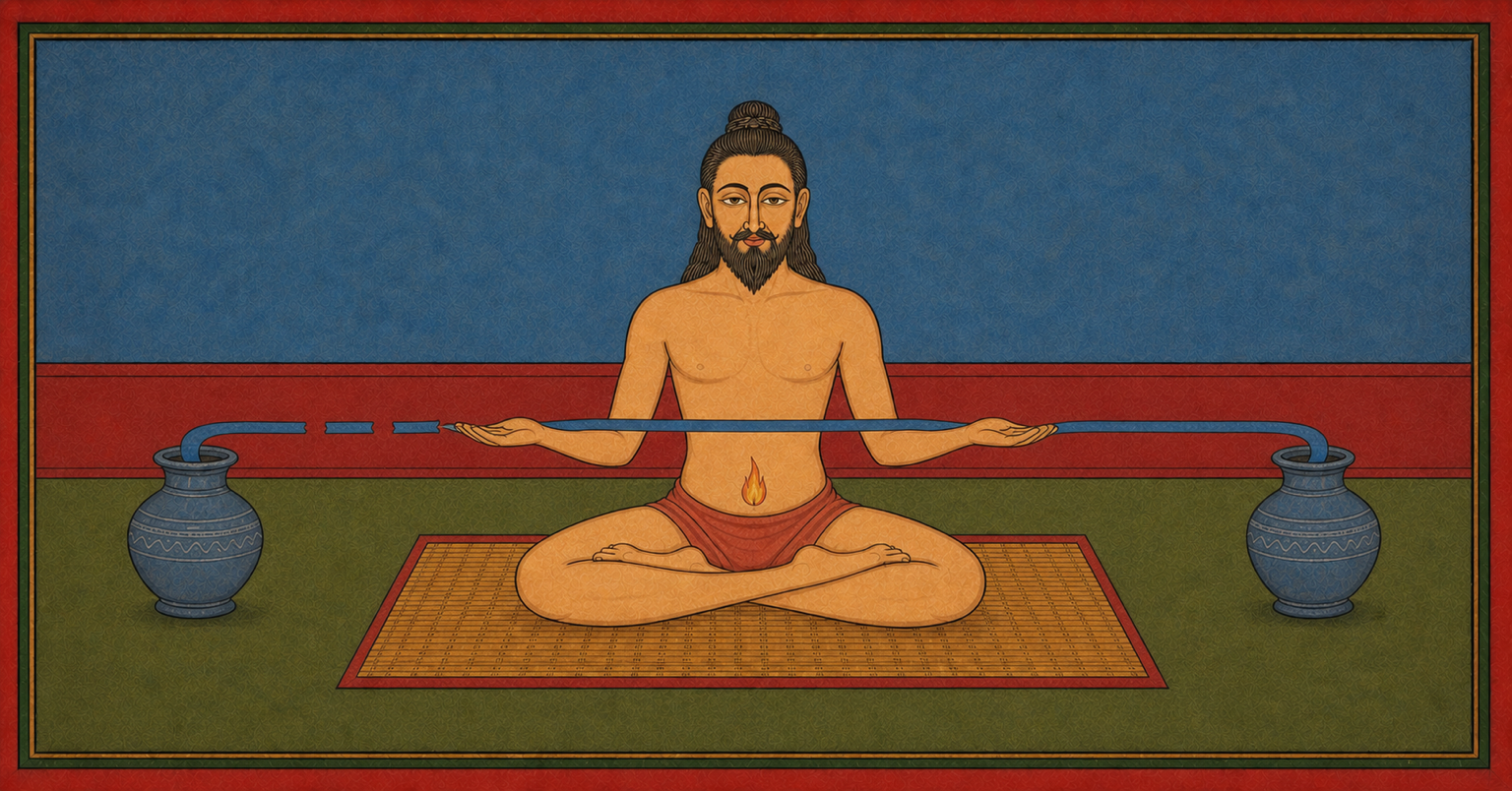
Illustration for the Haṭha Pradīpikā section “HP 2.15-2.20: Correct Practice”.

Haṭha Pradīpikā 2.15-2.20: Correct Practice

The text warns against incorrect practice and names the effects of proper breath control: health, sound, fire, and purity of the Nāḍīs.

Dr. Ronald Steiner Dr. Ronald Steiner
Haṭha Pradīpikā 2.15
यथा सिंहो गजो व्याघ्रो भवेद्वश्यः शनैः शनैः |
yathā siṃho gajo vyāghro; bhaved vaśyaḥ śanaiḥ śanaiḥ | Analysis ▾ Analysis ▴
yathā
adverb
like
siṃhaḥ
nominative singular
substantive masculine
the lion
gajaḥ
nominative singular
substantive masculine
the elephant
vyāghraḥ
nominative singular
substantive masculine
the tiger
bhavet
3rd person singular aktive optative
verbal root
should become
vaśyaḥ
nominative singular masculine
adjective
tamed, docile
śanaiḥ
adverb
slowly
śanaiḥ
adverb
gradually
तथैव सेवितो वायुरन्यथा हन्ति साधकम् ||15||
tathaiva sevito vāyur; anyathā hanti sādhakam ||15|| Analysis ▾ Analysis ▴
tathā
adverb
likewise
eva
particle
precisely
sevitaḥ
nominative singular masculine past participle passive
verbal root
practised, cultivated
vāyuḥ
nominative singular
substantive masculine
the breath
anyathā
adverb
otherwise
hanti
3rd person singular aktive present
verbal root
kills, harms
sādhakam
accusative singular
substantive masculine
the practitioner
Metre: Anuṣṭubh
Just as (yathā) a lion (siṃhaḥ | nom sg), an elephant (gajaḥ | nom sg), or a tiger (vyāghraḥ | nom sg) should become (bhavet | 3p sg act opt) tame (vaśyaḥ | nom sg m) slowly and gradually (śanaiḥ śanaiḥ), so indeed (tathaiva) the breath (vāyuḥ | nom sg) is to be cultivated (sevitaḥ | nom sg m ppp). Otherwise (anyathā), it kills (hanti | 3p sg act pres) the practitioner (sādhakam | acc sg).
Dr. Ronald Steiner - 2026 - historically literal
Just as a lion, elephant, or tiger can only be tamed gradually, the breath too must be cultivated gently. Forceful practice harms the practitioner.
Dr. Ronald Steiner - 2026 - modern transfer

The comparison with wild animals establishes a methodological principle: Prāṇa is brought under control gradually, not through the resolve to achieve a rapid victory. Brahmānanda reads the simile literally as a warning that forceful control can harm the practitioner just as an attack on a wild animal made too soon can do.

Brahmānanda's Jyotsnā - 19th c.
Just as lions, elephants and tigers are controlled by and by, so the breath is controlled by slow degrees, otherwise (i.e., by being hasty or using too much force) it kills the practiser himself.
Pancham Sinh - 1915
As we tame lions, elephants and tigers gradually, so also should Prana be brought under control. Else it will kill the practitioner.
Srinivasa Iyangar - 1893
Wie Löwe, Elephant und Tiger nach und nach dem Willen unterthan werden, so auch der Athem durch Uebung; anders tödtet er den Uebenden.
Hermann Walter - 1893
Haṭha Pradīpikā 2.16
प्राणायामेन युक्तेन सर्वरोगक्षयो भवेत् |
prāṇāyāmena yuktena; sarva-roga-kṣayo bhavet | Analysis ▾ Analysis ▴
prāṇa
tatpuruṣa-compound genitive
substantive masculine
of the breath
āyāmena
instrumental case singular
substantive neuter
through regulation, prāṇāyāma
yuktena
instrumental case singular masculine past participle passive
verbal root
correctly applied, properly joined
sarva
tatpuruṣa-compound genitive
adjective
all
roga
tatpuruṣa-compound genitive
substantive masculine
diseases
kṣayaḥ
nominative singular
substantive masculine
destruction, disappearance
bhavet
3rd person singular aktive optative
verbal root
should occur, happens
अयुक्ताभ्यासयोगेन सर्वरोगसमुद्भवः ||16||
ayuktābhyāsa-yogena; sarva-roga-samudbhavaḥ ||16|| Analysis ▾ Analysis ▴
ayukta
karmadhāraya-compound
previx
verbal root
unjoined, incorrect
abhyāsa
tatpuruṣa-compound instrumental case
substantive masculine
practice
yogena
instrumental case singular
substantive masculine
through yoga, through practice
sarva
tatpuruṣa-compound genitive
adjective
all
roga
tatpuruṣa-compound genitive
substantive masculine
diseases
samudbhavaḥ
nominative singular
substantive masculine
arising, emergence
Metre: Anuṣṭubh
Through properly applied (yuktena | ins sg m ppp) breath control (prāṇāyāmena | ins sg), the destruction of all diseases (sarva-roga-kṣayaḥ | nom sg) should occur (bhavet | 3p sg act opt); through the discipline of incorrect practice (ayukta-abhyāsa-yogena | ins sg) [comes] the arising of all diseases (sarva-roga-samudbhavaḥ | nom sg).
Dr. Ronald Steiner - 2026 - historically literal
Breathwork practised carefully and correctly can reduce discomfort. When practised carelessly or excessively, however, it can create new problems.
Dr. Ronald Steiner - 2026 - modern transfer

For Brahmānanda, “correctly performed” Prāṇāyāma encompasses more than the rhythm of breathing. It requires a suitable diet and the correct use of Jālandhara and the other Bandhas. Without these conditions, the practice is ayukta, methodologically unintegrated, and is understood as a cause of illness.

Brahmānanda's Jyotsnā - 19th c.
prāṇāyāmena yuktena MBHDL2026 ] prāṇāyāmādiyuktena NS1882
Critical Apparatus
When Prâṇayama, etc., are performed properly, they eradicate all diseases; but an improper practice generates diseases.
Pancham Sinh - 1915
By the practice of Pranayama one is freed from all diseases. By mistaken course of Yoga, the Yogi brings upon himself all diseases.
Srinivasa Iyangar - 1893
Durch einen Yoga, der mit Prânâyâma und den andern Uebungen verbunden ist, wird allen Krankheiten ein Ende gemacht; durch einen Yoga, bei dem keine solchen Uebungen ausgeführt werden, entstehen alle Krankheiten.
Hermann Walter - 1893
Haṭha Pradīpikā 2.17
हिक्का श्वासश्च कासश्च शिरःकर्णाक्षिवेदनाः |
hikkā śvāsaś ca kāsaś ca; śiraḥ-karṇākṣi-vedanāḥ | Analysis ▾ Analysis ▴
hikkā
nominative singular
substantive feminine
hiccup
śvāsaḥ
nominative singular
substantive masculine
shortness of breath, wheezing
ca
particle
and
kāsaḥ
nominative singular
substantive masculine
cough
ca
particle
and
śiras
dvandva-compound
substantive neuter
of the head
karṇa
dvandva-compound
substantive masculine
of the ears
akṣi
dvandva-compound
substantive neuter
of the eyes
vedanāḥ
nominative plural
substantive feminine
pains
भवन्ति विविधा दोषाः पवनस्य व्यतिक्रमात् ||17||
bhavanti vividhā doṣāḥ; pavanasya vyatikramāt ||17|| Analysis ▾ Analysis ▴
bhavanti
3rd person plural aktive present
verbal root
arise, occur
vividhāḥ
nominative plural masculine
adjective
various, manifold
doṣāḥ
nominative plural
substantive masculine
disorders, faults, ailments
pavanasya
genitive singular
substantive masculine
of the breath wind, prāṇa
vyatikramāt
ablative singular
substantive masculine
through deviation, imbalance
Metre: Anuṣṭubh
Hiccups (hikkā | nom sg), breathlessness (śvāsaḥ | nom sg), and (ca) coughing (kāsaḥ | nom sg), as well as (ca) pains in the head, ears, and eyes (śiraḥ-karṇa-akṣi-vedanāḥ | nom pl): various disorders (vividhā doṣāḥ | nom pl) arise (bhavanti | 3p pl act pres) from the breath wind (pavanasya | gen sg) going awry (vyatikramāt | abl sg).
Dr. Ronald Steiner - 2026 - historically literal
When the breath falls “out of rhythm,” becoming too forceful, fast, or tense, the body often responds immediately with hiccups, tightness, coughing, pressure in the head, or irritation of the senses.
Dr. Ronald Steiner - 2026 - modern transfer
vividhā doṣāḥ MBHDL2026 ] vividhāḥ rogāḥ NS1882

vyatikramāt MBHDL2026 ] prakopataḥ NS1882
Critical Apparatus
Hiccough, asthma, cough, pain in the head, the ears, and the eyes; these and other various kinds of diseases are generated by the disturbance of the breath.
Pancham Sinh - 1915
By a wrong course of Pranayama the breath becomes deteriorated, and hence, cough, asthma, pains in the head, eyes and the ears and various other diseases arise.
Srinivasa Iyangar - 1893
Schluchzer, Asthma, Husten, Kopfweh, Ohrenweh, und andere Leiden entstehen durch das Aufwallen des Athems (pavanasya prakopatah).
Hermann Walter - 1893
Haṭha Pradīpikā 2.18
युक्तं युक्तं त्यजेद्वायुं युक्तं युक्तं च पूरयेत् |
yuktaṃ yuktaṃ tyajed vāyuṃ; yuktaṃ yuktaṃ ca pūrayet | Analysis ▾ Analysis ▴
yuktam
accusative singular masculine past participle passive
verbal root
appropriately, correctly
yuktam
accusative singular masculine past participle passive
verbal root
appropriately, correctly
tyajet
3rd person singular aktive optative
verbal root
he should exhale, release
vāyum
accusative singular
substantive masculine
the breath
yuktam
accusative singular masculine past participle passive
verbal root
appropriately, correctly
yuktam
accusative singular masculine past participle passive
verbal root
appropriately, correctly
ca
particle
and
pūrayet
3rd person singular aktive optative
verbal root
he should fill, inhale
युक्तं युक्तं च बध्नीयादेवं शुद्धिमवाप्नुयात् ||18||
yuktaṃ yuktaṃ ca badhnīyād; evaṃ śuddhim avāpnuyāt ||18|| Analysis ▾ Analysis ▴
yuktam
accusative singular masculine past participle passive
verbal root
appropriately, correctly
yuktam
accusative singular masculine past participle passive
verbal root
appropriately, correctly
ca
particle
and
badhnīyāt
3rd person singular aktive optative
verbal root
he should bind, retain
evam
adverb
thus, in this way
śuddhim
accusative singular
substantive feminine
purification
avāpnuyāt
3rd person singular aktive optative
previx
verbal root
he should attain
Metre: Anuṣṭubh
Appropriately (yuktam yuktam), he should exhale (tyajet | 3p sg act opt) the breath (vāyum | acc sg), and (ca), appropriately (yuktam yuktam), he should inhale (pūrayet | 3p sg act opt); and (ca), appropriately (yuktam yuktam), he should hold it (badhnīyāt | 3p sg act opt). Thus (evam), he should attain (avāpnuyāt | 3p sg act opt) purification (śuddhim | acc sg).
Dr. Ronald Steiner - 2026 - historically literal
When exhalation, inhalation, and retention are truly “correct,” meaning appropriate, calm, and unforced, Prāṇāyāma has a clarifying and stabilizing effect.
Dr. Ronald Steiner - 2026 - modern transfer

Brahmānanda resolves the repeated word “appropriately” into three rules: exhalation is slow, inhalation is neither insufficient nor excessive, and retention is combined with the appropriate Bandhas. For him, success comes from correct measure and correct integration, not from maximum intensity.

Brahmānanda's Jyotsnā - 19th c.
śuddhim MBHDL2026 ] siddhim NS1882
Critical Apparatus
The air should be expelled with proper tact and should be filled in skilfully; and when it has been kept confined properly it brings success.
Pancham Sinh - 1915
He should gradually inhale the breath and as gradually exhale it; he should also restrain it gradually. Thus it is that a man obtains Siddhis.
Srinivasa Iyangar - 1893
Sorgfältig soll man den Athem herauslassen, einziehen, anhalten, denn so erlangt man Vollendung.
Hermann Walter - 1893
Haṭha Pradīpikā 2.19
यदा तु नाडीशुद्धिः स्यात्तदा चिह्नानि बाह्यतः |
yadā tu nāḍī,-śuddhiḥ syāt; tadā cihnāni bāhyataḥ | Analysis ▾ Analysis ▴
yadā
adverb
when, as soon as
tu
particle
but, now
nāḍī
tatpuruṣa-compound genitive
substantive feminine
of the nāḍīs, channels
śuddhiḥ
nominative singular
substantive feminine
purification
syāt
3rd person singular aktive optative
verbal root
should be, be present
tadā
adverb
then
cihnāni
nominative plural
substantive neuter
signs, marks
bāhyataḥ
adverb
externally
कायस्य कृशता कान्तिस्तथा जायेत निश्चितम् ||19||
kāyasya kṛśatā kāntis; tathā jāyeta niścitam ||19|| Analysis ▾ Analysis ▴
kāyasya
genitive singular
substantive masculine
of the body
kṛśatā
nominative singular
substantive feminine
slenderness, leanness
kāntiḥ
nominative singular
substantive feminine
lustre, radiance
tathā
adverb
likewise, then
jāyeta
3rd person singular medial optative
verbal root
may arise, occurs
niścitam
adverb
certainly
Metre: Anuṣṭubh
When (yadā), however (tu), purity of the channels (nāḍī-śuddhiḥ | nom sg) is present (syāt | 3p sg act opt), then (tadā) signs (cihnāni | nom pl) [appear] outwardly (bāhyataḥ): leanness (kṛśatā | nom sg) and lustre (kāntiḥ | nom sg) of the body (kāyasya | gen sg) then (tathā) certainly (niścitam) arise (jāyeta | 3p sg med opt).
Dr. Ronald Steiner - 2026 - historically literal
When the channels truly become “clear,” this often shows outwardly as well: greater lightness in the body, less heaviness, and a calm, natural presence.
Dr. Ronald Steiner - 2026 - modern transfer
tadā cihnāni MBHDL2026 ] tathā cihnāni NS1882

tathā jāyeta MBHDL2026 ] tadā jāyeta NS1882
Critical Apparatus
When the nâdîs become free from impurities, and there appear the outward signs of success, such as lean body and glowing colour, then one should feel certain of success.
Pancham Sinh - 1915
When the Nadis are purified the consequent signs are perceptible, i.e., the body becomes slender and bright.
Srinivasa Iyangar - 1893
Wenn aber das Reinigen der Nâdî zu Stande kommt, so zeigen sich sicher auch äusserlich die Zeichen: Schlankheit und Schönheit des Körpers.
Hermann Walter - 1893
Haṭha Pradīpikā 2.20
यथेष्टं धारणं वायोरनलस्य प्रदीपनम् |
yatheṣṭaṃ dhāraṇaṃ vāyor; analasya pradīpanam | Analysis ▾ Analysis ▴
yatheṣṭam
adverb
at will
dhāraṇam
nominative singular
substantive neuter
holding, retention
vāyoḥ
genitive singular
substantive masculine
of the breath, wind
analasya
genitive singular
substantive masculine
of the fire, digestive fire
pradīpanam
nominative singular
substantive neuter
kindling, ignition
नादाभिव्यक्तिरारोग्यं जायते नाडिशोधनात् ||20||
nādābhivyaktir ārogyaṃ; jāyate nāḍi-śodhanāt ||20|| Analysis ▾ Analysis ▴
nāda
tatpuruṣa-compound genitive
substantive masculine
of sound, inner tone
abhivyaktiḥ
nominative singular
substantive feminine
manifestation, becoming audible
ārogyam
nominative singular
substantive neuter
health, freedom from disease
jāyate
3rd person singular medial present
verbal root
arises, occurs
nāḍi
tatpuruṣa-compound genitive
substantive feminine
of the nāḍīs
śodhanāt
ablative singular
substantive neuter
through purification
Metre: Anuṣṭubh
From purification of the channels (nāḍī-śodhanāt | abl sg) arise (jāyate | 3p sg med pres) the ability to hold the breath at will (yatheṣṭaṃ vāyoḥ dhāraṇam | nom sg), kindling of the fire (analasya pradīpanam | nom sg), manifestation of the inner sound (nāda-abhivyaktiḥ | nom sg), and health (ārogyam | nom sg).
Dr. Ronald Steiner - 2026 - historically literal
As the channels become clearer, the practical effects are tangible: you can retain the breath more easily and for longer, digestion becomes steadier, inner perception grows subtler, and overall health and resilience increase.
Dr. Ronald Steiner - 2026 - modern transfer
By removing the impurities, the air can be restrained, according to one's wish and the appetite is increased, the divine sound is awakened, and the body becomes healthy.
Pancham Sinh - 1915
If the Nadis are purified, he is able to restrain his breath longer, the gastric fire becomes more active, the Nada (inner sounds) is heard, and he enjoys perfect health.
Srinivasa Iyangar - 1893
Folge der Reinigung der Nâdî ist beliebiges Anhalten des Athems, Anfachung des Verdauungsfeuers, Offenbarwerden des Nâda und Krankheitslosigkeit.
Hermann Walter - 1893

Continue with AYI Free

Illustrations: AI-generated.

Editor

Dr. Ronald Steiner

From 89075 Ulm

The "Yoga Doc" - Dr. Ronald Steiner is the founder of the AYI method. This method links traditional Ashtanga Yoga with innovative Yogatherapy and living Philosophy. This forms a practice that is personal for each and... more ›

Messages and ratings
0 messages

Please log in to write a message. Go to login

No messages yet.