

kumbha कुम्भ – kumbhaka; pot; breath retention
substantive masculine · substantive neuter · Word type unspecified
Dictionary sources
AYI dictionary substantive masculine
kumbhaka; pot; breath retention
Cappeller 1891 substantive masculine
Original text · English · substantive masculine
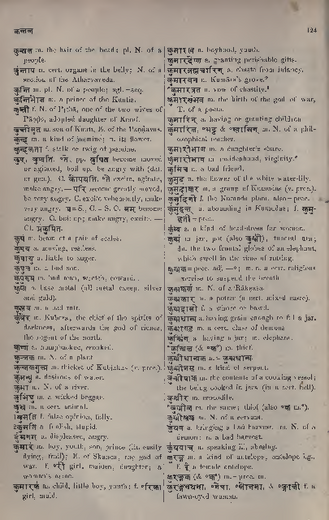
kumbhá ·m. jar, pot (also kumbhī́), funeral urn; du. the two frontal globes of an elephant, which swell in the time of rutting.
Monier-Williams 1872 substantive masculine
Original text · English · substantive masculine
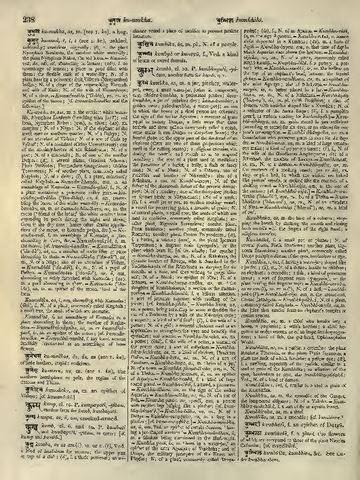
kumbha kumbha, as, m. a jar, pitcher, water- pot, ewer, a small water-jar, (often in compounds, e. g. chidra-kumbha, a perforated pitcher; āma- kumbha, a jar of unbaked clay; hema-kumbha, a golden ewer; jala-kumbha, a water-pot); an urn in which the bones of a dead person are collected; the sign of the zodiac Aquarius; a measure of grain equal to twenty Droṇas, a little more than three bushels and three gallons (commonly called a comb, some make it two Droṇas or sixty-four Seers); the frontal globe on the upper part of the forehead of an elephant (there are two of these projections which swell in the rutting season); a religious exercise, viz. closing the nostrils and mouth so as to suspend breathing; the root of a plant used in medicine; the paramour of a harlot, a bully, a flash or fancy man; N. of a Muni; N. of a Dānava, son of Prahlāda and brother of Nikumbha; also of a Rākṣasa, a son of Kumbha-karṇa; N. of the father of the nineteenth Arhat of the present Avasar- piṇī; N. of a monkey; one of the thirty-four jātakas or former births of Śākya-muni; title of a work; (ī), f. a small jar or pot, an earthen cooking vessel; a vessel for preserving grain, a measure of grain; N. of several plants, a small tree, the seeds of which are used in medicine, commonly called Kaṭphala; an- other plant, Bignonia Suaveolens; another plant, Pistia Stratiotes; another plant, commonly called Romaśa; another plant, Croton Polyandrum; (ā), f. a harlot, a whore; (am), n. the plant Ipomœa Turpethum; a fragrant resin (guggulu), or the plant which bears it; [cf. Gr. κύμβη Lat. cymba.]
Petersburger 1855 substantive masculine · substantive neuter · Word type unspecified
Original text · German · substantive masculine · substantive neuter
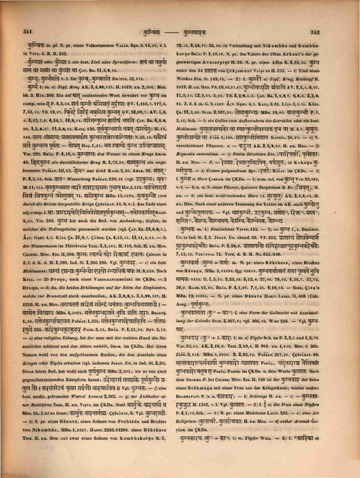
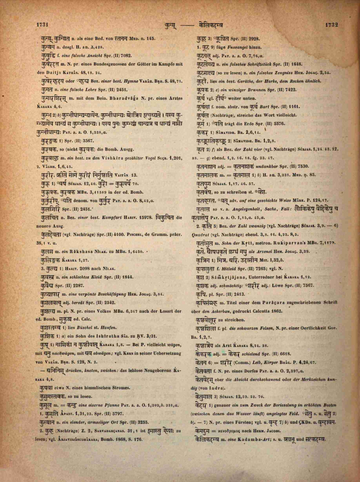
kumbhá 1〉 m. a〉 Topf, Krug AK. 3,4,22,137. H. 1019. H. an. 2,306. MED. bh. 2. HĀR. 209. Ein auf as auslautendes Wort bewahrt vor kumbha im comp. sein s P. 8,3,46. śa̱taṃ ku̱mbhām̐ àsiñcata̱ṃ surā̀yāḥ ṚV. 1,116,7. ṚV. 1,117,6. ṚV. 7,33,13. VS. 19,87. bi̱bhedà gi̱riṃ nava̱minna ku̱mbham ṚV. 10,89,7. AV. 1,6,4. AV. 3,12,7. AV. 3,12,8. AV. 4,34,7. AV. 10,8,14. yasminkumbha ṛjīṣaṃ bhavati ŚAT. BR. 4,4,5,20. ŚAT. BR. 5,5,4,27. ŚAT. BR. 11,5,5,13. KAUŚ. 136. pūrṇakumbhamapāṃ navam (prāsyeyuḥ) M. 11,186. tasya (māṃsasya) prakṣālanārthāya kumbhāstatropakalpitāḥ N. 23,10. aśrauṣaṃ jale kumbhasya pūryataḥ — ghoṣam DAŚ. 1,21. mama skandhe kumbha utkṣipyatām VID. 292. BHĀG. P. 6,18,5. kumbhāmbhaḥ das Wasser in einem Kruge AMAR. 40. chidrakumbha ein durchlöcherter Krug R. 1,73,20. āmakumbha ein ungebrannter PAÑCAT. III, 13. hema˚ aus Gold RAGH. 2,36. AMAR. 95. ayas˚ P. 8,3,46, Sch. jala˚ Wasserkrug PAÑCAT. 238,16 (vgl. udakumbha). ghṛta˚ M. 11,134. ghṛtakumbhasamā nārī taptāṅgārasamaḥ pumān HIT. I, 112. varjayettādṛśaṃ mitraṃ viṣakumbhaṃ payomukham HIT. I,71. agnikumbha MBH. 13,5490. kucakumbhau zwei durch die Brüste dargestellte Krüge ŚṚṄGĀRAT. 14. ŚṚṄGĀRAT. 9, v. l. Am Ende eines adj. comp. f. āḥ prāgdvāravediviniveśitapūrṇakumbhām — navopakāryām RAGH. 5,63. VID. 289. kumbha hat auch die Bed. von Aschenkrug, Gefäss, in welches die Todtengebeine gesammelt werden (vgl. ŚAT. BR. 13,8,3,4.), ĀŚV. GṚHY. 4,5. KĀTY. ŚR. 25,8,7. ŚĀṄKH. ŚR. 4,15,14. ŚĀṄKH. ŚR. 13,11,3. ŚĀṄKH. ŚR. 13,11,11. — b〉 der Wassermann im Thierkreise TRIK. 3,3,285. H. 116, Sch. H. an. MED. COLEBR. Misc. Ess. II, 369. kumbhaḥ skandhe naro riktaghaṭaṃ dadhānaḥ ŚRĪPATI_in_Z. f. d. K. d. M. 3,389. Ind. St. 2,260. Ind. St. 2,280. Vgl. kumbhadhara. — c〉 ein best. Hohlmaass: dhānyaṃ daśabhyaḥ kumbhebhyo harato 'bhyadhikaṃ vadhaḥ M. 8,320. Nach KULL. = 20 Droṇa, nach einer VAIDYAKAPARIBHĀṢĀ_im_ŚKDR. = 2 Droṇa. — d〉 du. die beiden Erhöhungen auf der Stirn des Elephanten, welche zur Brunstzeit stark anschwellen, AK. 2,8,2,5. AK. 3,4,22,137. H. 1226. H. an. MED. tamāpatantaṃ tvaritaṃ gajendraṃ dhanaṃjayaḥ kumbhavibhāgamadhye . — vāṇena vivyādha MBH. 4,2093. mattebhakumbhadalane bhuvi santi śūrāḥ BHARTṚ. 1,58. mattebhakumbhavidalana PAÑCAT. I, 351. mattebhakumbhapariṇāhini — payodharayuge PAÑCAT. I,224. kārikumbhakūṭakuhara PRAB. 3,15. BHĀG. P. 6,11,10. DEV. 3,13. — e〉 eine religiöse Uebung, bei der man mit der rechten Hand die Nasenlöcher schliesst und den Athem anhält, DHAR._im_ŚKDR. Hat ihren Namen wohl von den aufgeblasenen Backen, die den Anschein eines Kruges oder Topfes erhalten (vgl. indessen YOGAT. UP._in_Ind. St. 2,50). Diese letzte Bed. hat wohl auch pūrṇakumbha MBH. 2,903, wo es von zwei gegenüberstehenden Kämpfern heisst: urohastaṃ tataścakre pūrṇakumbhau prayujya tau . karasaṃpīḍanaṃ kṛtvā garjantau vāraṇāviva .. Vgl. kumbhaka. — f〉 eine best. medic. gebrauchte Wurzel AINSLIE 2,362. — g〉 der Liebhaber einer Buhldirne TRIK. H. an. VIŚVA_im_ŚKDR. Statt kārmuke vāranāryāṃ ca MED. bh. 2 ist zu lesen: kāmuke vāranāryāśca. ŚṚṄGĀRAT. 9. Vgl. kumbhadāsī. — h〉 N. pr. eines Dānava, eines Sohnes von Prahlāda und Bruders von Nikumbha. MBH. 1,2527. HARIV. 2283. HARIV. 14284. eines Rākṣasa TRIK. H. an. MED. und zwar eines Sohnes von Kumbhakarṇa R. 5,79,15. R. 6,18,17. R. 6,35,18. in Verbindung mit Nikumbha und Kumbhakarṇa BHĀG. P. 9,10,18. N. pr. des Vaters des 19ten Arhantʼs der gegenwärtigen Avasarpiṇī H. 38. N. pr. eines Affen R. 4,33,14. kumbha unter den R. 4,33,34 jātaka von Śākyamuni VYĀḌI_zu_H. 233. — i〉 Titel eines Werkes SĀH. D. 183,15. — 2〉 f. kumbhī́ a〉 Topf, Krug, Kochtopf H. 1019. H. an. MED. VS. 19,16. VS. 19,27. VS. 19,87. ku̱mbhīmadhya̱gnau śràyāmi AV. 9,5,5. AV. 9,6,17. AV. 11,3,11. AV. 12,2,51. AV. 12,3,23. TS. 3,2,8,4. TS. 3,2,8,5. ŚAT. BR. 1,1,2,7. ŚAT. BR. 1,8,1,3. ŚAT. BR. 2,5,3,16. Z. d. d. m. G. 9, LXXV. ĀŚV. GṚHY. 4,5. KAUŚ. 6. KAUŚ. 61. LĀṬY. 5,4. LĀṬY. 5,14. KĀTY. ŚR. 19,3,20. SUŚR. 2,397,21. lohakumbhyaḥ MBH. 18,85. ayaskumbhī P. 8,3,46, Sch. — b〉 ein Gefäss zum Aufbewahren des Getraides oder ein best. Hohlmaass: kuśūladhānyako vā syātkumbhīdhānyaka eva vā M. 4,7. kuśūlakumbhīdhānyo vā YĀJÑ. 1,128. saptakumbhīnidhāna KATHĀS. 24,87. — c〉 N. verschiedener Pflanzen: α〉 = kaṭphala AK. 2,4,2,21. H. an. MED. — β〉 Bignonia suaveolens. — γ〉 Pistia Stratiotes Lin. (vāriparṇī, pṛśnikā) H. an. MED. — δ〉 = romaśa, romāluviṭapin, parpaṭadruma, in Kokaṇa kumbhīpuṣpa. — ε〉 Croton polyandrum Spr. (dantī) RĀJAN._im_ŚKDR. — 3〉 f. kumbhā a〉 Hure ŚABDAM._im_ŚKDR. — b〉 nom. act. von kumbh VOP. 26,192, v. l. — 4〉 n. a〉 N. einer Pflanze, Ipomoea Turpethum R. Br. (trivṛt), H. an. — b〉 ein best. wohlriechendes Harz (s. guggulu) AK. 2,4,2,14. H. an. MED. Nach einer anderen Trennung des Textes im AK. auch kumbholu und kumbholūkhalaka. — Vgl. aśakumbhī, udakumbha, gaṇeśa˚, rikta˚, śāta˚, hasti˚, kaumbha, kaumbhāyana, kaumbhi, kaumbheyaka, kaumbhya.
Original text · German · Word type unspecified
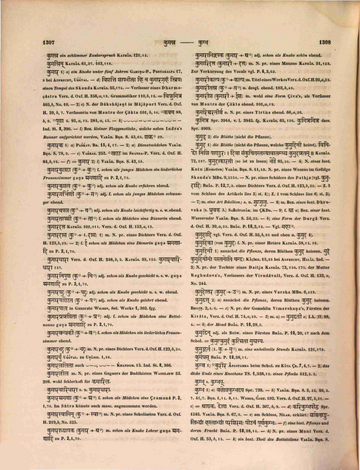
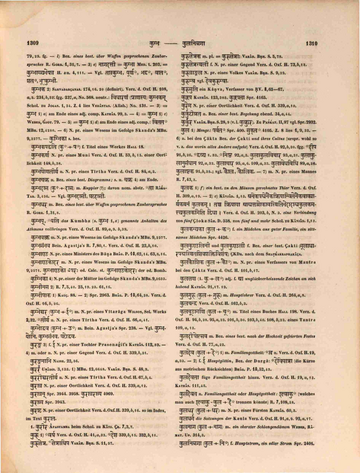
kumbha 1〉a〉 vakṣojakumbhadvaya Spr. 739. — b〉 VARĀH. BṚH. S. 5,42. VARĀH. BṚH. S. 40,3. VARĀH. BṚH. S. 40,7. VARĀH. BṚH. S. 41,7. BṚH. 1,14. BṚH. 8,11. WEBER, JYOT. 102. Verz. d. Oxf. H. 97,b,31. — c〉 = āḍhaka, droṇa Verz. d. Oxf. H. 307,b,9. — d〉 karikumbhapīṭha Spr. 1545. VARĀH. BṚH. S. 67,6. — e〉 am Schluss, NĪLAK. erklärt: grathitāṅgulibhyāṃ hastābhyāṃ paraśirasaḥ pīḍanaṃ pūrṇakumbhaḥ. — f〉 eine best. Pflanze und deren Frucht BHĀG. P. 10,18,14. — h〉 N. pr. eines Muni Verz. d. Oxf. H. 53,b,15. — k〉 ein best. Theil des Bettstollens VARĀH. BṚH. S. 79,29. fg. — l〉 Bez. eines best. über Waffen gesprochenen Zauberspruches R. GORR. 1,31,7. — 3〉c〉 nāgadantī = kumbhā MED. t. 203. = kumbhākhyabheṣaja H. an. 4,111. — Vgl. taptakumbha, pūrṇa˚, bhadra˚, vāta˚, śata˚, bhūkumbhī.
Original text · German · Word type unspecified
kumbha 2〉b〉 kumbhīdhānyanyāyena, kumbhīdhānyaḥ śrotriya ityucyate . yasya kumbhyāmeva dhānyaṃ sa kumbhīdhānyaḥ . yasya punaḥ kumbhyāṃ cānyatra ca dhānyaṃ nāsau kumbhīdhānyaḥ PAT. a. a. O. 1,238,a.
Böhtlingk 1879 substantive masculine · substantive neuter
Original text · German · substantive masculine · substantive neuter
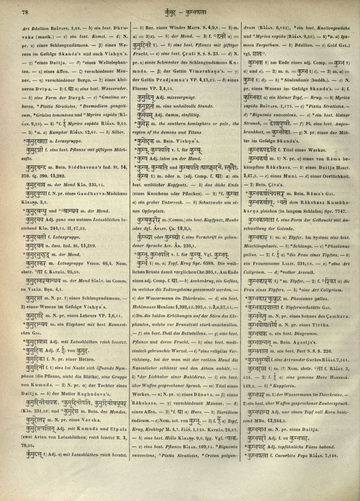
kumbhá — 1〉 m. — a〉 Topf, Krug Spr. 6588. Die weiblichen Brüste damit verglichen Chr. 305,1. Am Ende eines adj. Comp. f. ā. — b〉 Aschenkrug, ein Gefäss, in welches die Todtengebeine gesammelt werden. — c〉 der Wassermann im Thierkreise. — d〉 ein best. Hohlmaass HEMĀDRI 1,392,22. 393,4. 5. 2,a,57,14. — e〉 Du. die beiden Erhöhungen auf der Stirn des Elephanten, welche zur Brunstzeit stark anschwellen. — f〉 ein best. Theil des Bettstollens. — g〉 eine best. Pflanze und deren Frucht. — h〉 ein best. medicinisch gebrauchte Wurzel. — i〉 *eine religiöse Verrichtung, bei der man mit der rechten Hand die Nasenlöcher schliesst und den Athem anhält. — k〉 *der Liebhaber einer Buhldirne. — l〉 ein best. über Waffen gesprochener Spruch. — m〉 Titel eines Werkes. — n〉 N. pr. — α〉 eines Dānava. — β〉 eines Rākṣasa. — γ〉 verschiedener Männer. — δ〉 eines Affen. — 2〉 *f. ā — a〉 Hure. — b〉 Tiaridium indicum. — c〉 Nom. act. von kumbh. — 3〉 f. ī́ — a〉 Topf, Krug, Kochtopf M. 4,7. YĀJÑ. 1,128. KATHĀS. 24,87. — b〉 eine best. Hölle KĀRAṆḌ. 9,6. fgg. Vgl. ˚pāka. — c〉 eine best. Pflanze BĀLAR. 169,14. *Bignonia suaveolens, *Pistia stratiotes, *Croton polyandrus [Page2-078-c] (RĀJAN. 6,162), *ein best. Knollengewächs und *Myrica sapida (RĀJAN. 9,20). — 4〉 *n. — a〉 Ipomoea turpethum. — b〉 Bdellion. — c〉 Gold GAL.; vgl. śāta˚.
Cappeller 1887 substantive masculine
Original text · German · substantive masculine
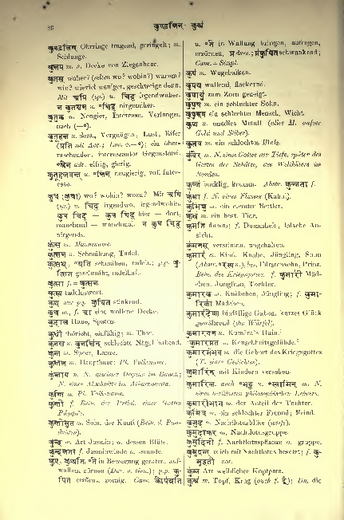
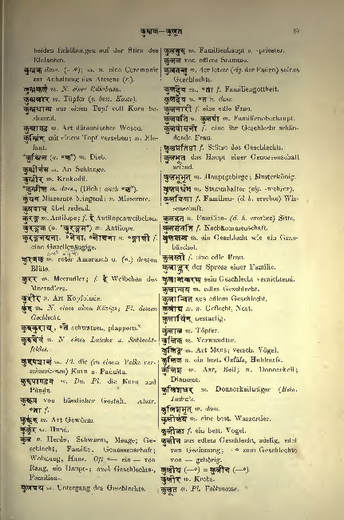
kumbhá m. Topf. Krug (auch f. ī); Du. die [Page087-1] beiden Erhöhungen auf der Stirn des Elefanten.
Burnouf 1866 substantive masculine
Original text · French · substantive masculine
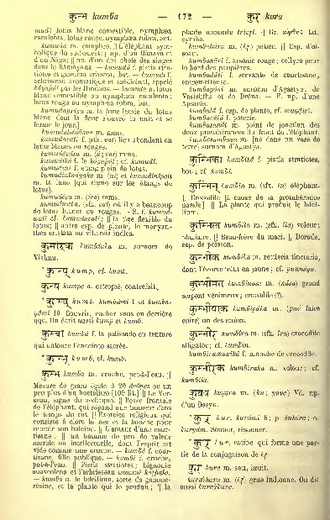
kumbha kumbha m. cruche, pot-à-l'eau. Mesure de grain égale à 20 droṇas ou un peu plus d'un hectolitre [109 lit.]. Le Verseau, signe du zodiaque. Bosse frontale de l'éléphant, qui répand une humeur dans le temps du rut. Exercice religieux qui consiste à clore le nez et la bouche pour retenir son haleine. L'amant d'une courtisane; un homme de peu de valeur morale ou intellectuelle, dont l'esprit est vide comme une cruche. — kumbhā f. courtisane, fille publique. — kumbhī f. cruche, pot-à-l'eau. Pistia stratiotes; bignonia suaveolens et l'arbrisseau nommé kaṭphala. -kumbha n. le bdellium, sorte de gomme résine, et la plante qui le produit; la [Page172-2] plante nommée trivṛt. Gr. ϰύμϐη; lat. cymba. kumbhakāra m. (kṛ) potier. Esp. d'oiseau. kumbhakārī f. arsenic rouge; collyre pour le bord des paupières. kumbhadāsī f. servante de courtisane, entremetteuse. kumbhayoni m. surnom d'Agastya, de Vasiṣṭha et de Droṇa. — F. np. d'une Apsaras. kumbhalā f. esp. de plante, cf. muṇḍirī. kumbhaśālā f. poterie. kumbhasandhi m. point de jonction des deux protubérances du front de l'éléphant. kumbhasambhava m. [né dans un vase de terre] surnom d'Agastya.
Occurrences in source texts (48)
GoS 1 occurrence
HP 4 occurrences
HP 4.11*15-4.11*28: Space and Laya 2 occurrences
Direct occurrences
-
HP 4.11*21 Segment 6
-
HP 4.11*21 Segment 15
HTK 42 occurrences
HTK 10.6*2–9*1: Ujjāyī / Ujjāyikā and Sūryabheda 3 occurrences
Direct occurrences
HTK 10.11*2–14*1: Bhastrikā: Breath like a bellows 1 occurrence
Direct occurrences
-
HTK 10.14 Segment 8
HTK 10.14*2–17*1: Śītalī and Antaraṅgaka-kumbha 2 occurrences
Direct occurrences
8 more source pages
HTK 10.21*2–23*1: Utkarṣa and Apakarṣa 4 occurrences
Direct occurrences
-
HTK 10.22 Segment 19
-
HTK 10.22*1 Segment 3
-
HTK 10.23 Segment 14
-
HTK 10.23*1 Segment 3
HTK 10.24–25*2: Karṣaka and Sahaja 5 occurrences
Direct occurrences
-
HTK 10.24 Segment 4
-
HTK 10.24 Segment 19
-
HTK 10.25*1 Segment 3
-
HTK 10.25*2 Segment 3
-
HTK 10.25*2 Segment 5
HTK 10.26–29*1: Cakra, Śaṅkha, Vāmāvartta, Vartmagati and Gadā 12 occurrences
Direct occurrences
-
HTK 10.26 Segment 12
-
HTK 10.26 Segment 22
-
HTK 10.27 Segment 4
-
HTK 10.27 Segment 13
-
HTK 10.27*1 Segment 2
-
HTK 10.27*1 Segment 11
-
HTK 10.27*2 Segment 4
-
HTK 10.28 Segment 4
-
HTK 10.28 Segment 12
-
HTK 10.29 Segment 16
-
HTK 10.29*1 Segment 10
-
HTK 10.29*1 Segment 12
HTK 10.30–33*1: Nāḍī-viśudhy-ākhyaka-kumbha and Nāḍīśuddhi 3 occurrences
Direct occurrences
HTK 10.34*2–38*1: Asvaṅgaśṛṅkhalā and Kumbhāntaraśṛṅkhalā 5 occurrences
Direct occurrences
-
HTK 10.35 Segment 11
-
HTK 10.35 Segment 20
-
HTK 10.35 Segment 29
-
HTK 10.38 Segment 4
-
HTK 10.38*1 Segment 3
HTK 10.39–39*1: Jīvacālaka / Jīvacāla 2 occurrences
Direct occurrences
SiSa 1 occurrence
Continue with AYI Free
Image source: AYI archive.