
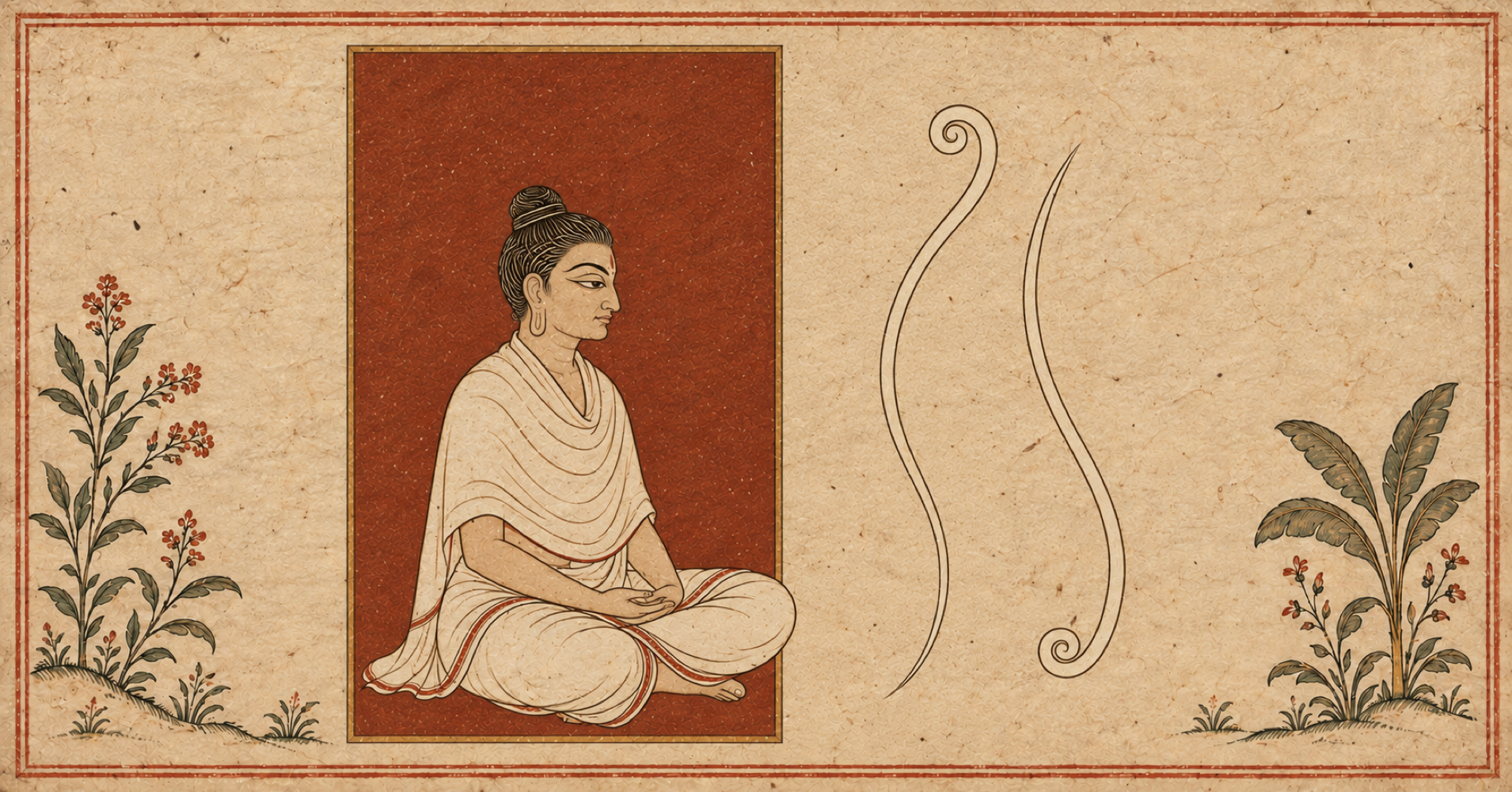
Two curving lines rise and fall beside a figure in profile.

Haṭhatattvakaumudī 10.39–39*1: Jīvacālaka / Jīvacāla: Moving the vital breath down and up

In Jīvacālaka, the mind moves the vital breath downwards and upwards during retention. The closing formula calls the technique Jīvacāla.

Dr. Ronald Steiner Dr. Ronald Steiner
Haṭhatattvakaumudī 10.39
हठेन वै कुम्भितमारुतस्य चेत्प्राणस्य सञ्चालनम् अङ्ग मानसात् |
haṭhena vai kumbhita-mārutasya cet; prāṇasya sañcālanam aṅga mānasāt | Analysis ▾ Analysis ▴
haṭhena
instrumental case singular
substantive masculine
with force
vai
particle
certainly
kumbhita
bahuvrīhi-compund past participle passive denominative
substantive masculine
retained
mārutasya
genitive singular masculine
substantive masculine
whose breath is
cet
particle
when
prāṇasya
genitive singular
substantive masculine
of the vital breath
sañcālanam
nominative singular
substantive neuter
movement
aṅga
particle
now
mānasāt
ablative singular
substantive neuter
from the mind
अधस्तथोर्ध्वं यमिनः स कुम्भो नाम्ना शिवोक्तः किल जीवचालकः ||39||
adhas tathordhvaṃ yaminaḥ sa kumbho; nāmnā śivoktaḥ kila jīva-cālakaḥ ||39|| Analysis ▾ Analysis ▴
adhas
adverb
downwards
tathā
adverb
likewise
ūrdhvam
adverb
upwards
yaminaḥ
genitive singular
substantive masculine
of the self-restrained
saḥ
nominative singular masculine
pronoun dem
this
kumbhaḥ
nominative singular
substantive masculine
breath retention
nāmnā
instrumental case singular
substantive neuter
by name
śiva
tatpuruṣa-compound instrumental case
substantive masculine
by Śiva
uktaḥ
nominative singular masculine past participle passive
verbal root
taught
kila
particle
as it is said
jīva
upapada-compound
substantive masculine
the vital breath
cālakaḥ
nominative singular masculine
cālaka
adjective
moving
Metre: Pāda 1: Vaṃśastha; Pāda 2: Indravaṃśā; Pāda 3: Upendravajrā; Pāda 4: Indravaṃśā
If (cet), now (aṅga), in the self-restrained person (yaminaḥ | gen sg), whose breath is retained (kumbhita-mārutasya | gen sg m) with force (haṭhena | ins sg), movement (sañcālanam | nom sg) of the vital breath (prāṇasya | gen sg) indeed (vai) [takes place] from the mind (mānasāt | abl sg), downwards (adhas) and likewise (tathā) upwards (ūrdhvam), [then] that breath retention (saḥ kumbhaḥ | nom sg), as it is said (kila), [is] taught by Śiva (śivoktaḥ | nom sg m ppp). [It bears] the name (nāmnā | ins sg) Jīvacālaka (jīva-cālakaḥ | nom sg m).
Dr. Ronald Steiner - 2026 - historically literal
Let your attention travel down through the body and back up. Notice where you feel something distinctly and where you are mainly following an image.
Dr. Ronald Steiner - 2026 - modern transfer
Haṭhatattvakaumudī 10.39*1
इति जीवचाल कुम्भकः |
iti jīva-cāla kumbhakaḥ | Analysis ▾ Analysis ▴
iti
particle
thus ends
jīva
tatpuruṣa-compound genitive
substantive masculine
of the vital breath
cāla
unclear: part of the name Jīvacāla, movement of the vital breath
kumbhakaḥ
nominative singular
substantive masculine
breath retention
Metre: none
Thus (iti) [ends] the breath retention (kumbhakaḥ | nom sg) [called] Jīvacāla (jīva-cāla).
Dr. Ronald Steiner - 2026 - historically literal
To finish, note whether and where you feel alive or in motion. A quiet sensation also deserves space.
Dr. Ronald Steiner - 2026 - modern transfer

Continue with AYI Free

Illustrations: AI-generated.

Editor

Dr. Ronald Steiner

From Ulm

The "Yoga Doc" - Dr. Ronald Steiner is the founder of the AYI method. This method links traditional Ashtanga Yoga with innovative Yogatherapy and living Philosophy. This forms a practice that is personal for each and... more ›

Messages and ratings
0 messages

Please log in to write a message. Go to login

No messages yet.