
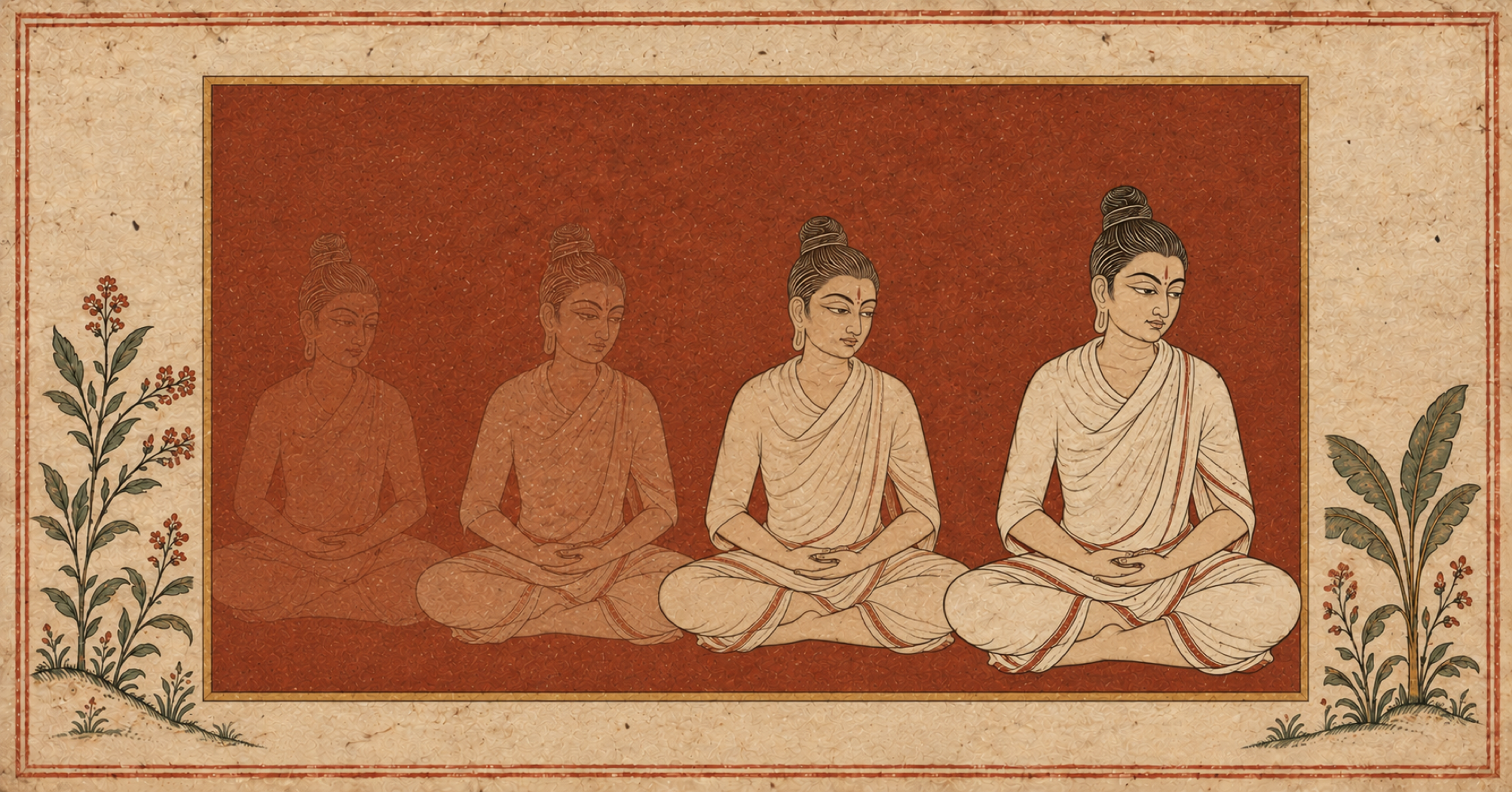
Repeated seated figures gradually become clearer.

Haṭhatattvakaumudī 10.39*2–41: Merucālaka: Practising Ameru and allowing Meru to arise

Under the heading Merucālaka, the text distinguishes Ameru and Meru. It describes measured breath retention and Meru arising naturally after prolonged practice.

Dr. Ronald Steiner Dr. Ronald Steiner
Haṭhatattvakaumudī 10.39*2
अथ मेरुचालकः |
atha meru-cālakaḥ | Analysis ▾ Analysis ▴
atha
particle
now
meru
upapada-compound
substantive masculine
Meru
cālakaḥ
nominative singular masculine
cālaka
adjective
moving
Metre: none
Now (atha) [follows] Merucālaka (meru-cālakaḥ | nom sg m).
Dr. Ronald Steiner - 2026 - historically literal
Meru, the mountain in this breathing form's name, can serve as an image of an inner axis. Explore how it invites you to sit upright.
Dr. Ronald Steiner - 2026 - modern transfer
Haṭhatattvakaumudī 10.40
अमेरुमेरुप्रभिदा महेशो द्विधा ऽवदत्कुम्भम् इहादिमो फलः |
ameru-meru-prabhidā maheśo; dvidhā 'vadat kumbham ihādimo phalaḥ | Analysis ▾ Analysis ▴
ameru
dvandva-compound
ameru
substantive masculine
Ameru
meru
tatpuruṣa-compound genitive
substantive masculine
and Meru
prabhidā
instrumental case singular
previx
substantive feminine
according to the distinction
maheśaḥ
nominative singular
substantive masculine
Maheśa
dvidhā
adverb
twofold
avadat
3rd person singular aktive preterite
verbal root
taught
kumbham
accusative singular
substantive masculine
breath retention
iha
adverb
here
ādimaḥ
nominative singular masculine
adjective
the first
phalaḥ
unclear: fruitful in context; form and syntax unresolved
न वर्धयेद्रोधम् अथो सुसंयमं कृतं यथाशक्ति चिरेण सिद्धिदः ||40||
na vardhayed rodham atho su-saṃyamaṃ; kṛtaṃ yathā-śakti cireṇa siddhi-daḥ ||40|| Analysis ▾ Analysis ▴
na
particle
not
vardhayet
3rd person singular aktive optative causative
verbal root
one should extend
rodham
accusative singular
substantive masculine
retention
atho
particle
then
su
karmadhāraya-compound
adverb
good
saṃyamam
accusative singular
substantive masculine
control
kṛtam
accusative singular masculine past participle passive
verbal root
performed
yathā
avyayībhāva-compund
adverb
according to
śakti
avyayībhāva-compund
substantive feminine
of strength
cireṇa
cireṇa
adverb
after a long time
siddhi
upapada-compound
substantive feminine
accomplishment
daḥ
nominative singular masculine
adjective
giving
Metre: Pāda 1: Upendravajrā; Pādas 2–4: Vaṃśastha
Maheśa (maheśaḥ | nom sg) here (iha) taught (avadat | 3p sg act pret) breath retention (kumbham | acc sg) in two forms (dvidhā), according to the distinction between Ameru and Meru (ameru-meru-prabhidā | ins sg). The first [form] (ādimaḥ | nom sg m) bears fruit (phalaḥ). One should not (na) extend (vardhayet | 3p sg act opt caus) the retention (rodham | acc sg). Then (atho), [the following applies]: good control (su-saṃyamam | acc sg), performed (kṛtam | acc sg m ppp) according to one's strength (yathā-śakti), [grants] accomplishment (siddhi-daḥ | nom sg m) after a long time (cireṇa).
Dr. Ronald Steiner - 2026 - historically literal

I provisionally understand ādimaḥ phalaḥ as “The first [form] bears fruit”.

I construe na with vardhayet: “One should not extend the retention.” Despite the case shift, I join accusative su-saṃyamaṃ kṛtam and nominative siddhidaḥ as “good control … [grants] accomplishment”.

Translation Comment
Adapt the extent of your practice to how you feel now. On some days, simply maintaining or simplifying a familiar form calls for attention.
Dr. Ronald Steiner - 2026 - modern transfer
atho GDJ2007 ] mathā GDJ2007-b
Critical Apparatus
Haṭhatattvakaumudī 10.41
अमुम् अभ्यसतः पुंसो नैसर्गिकमेरुसम्भूतिः |
amum abhyasataḥ puṃso, naisargika-meru-sambhūtiḥ | Analysis ▾ Analysis ▴
amum
accusative singular masculine
pronoun dem
this
abhyasataḥ
genitive singular masculine present participle active
previx
verbal root
of the practitioner
puṃsaḥ
genitive singular
substantive masculine
of the person
naisargika
karmadhāraya-compound
adjective
natural
meru
tatpuruṣa-compound genitive
substantive masculine
of Meru
sambhūtiḥ
nominative singular
substantive feminine
arising
बहुभिः कालैर् भूयादगण्यपुण्यैः परासुमतेः ||41||
bahubhiḥ kālair bhūyād, agaṇya-puṇyaiḥ parāsumateḥ ||41|| Analysis ▾ Analysis ▴
bahubhiḥ
instrumental case plural masculine
adjective
many
kālaiḥ
instrumental case plural
substantive masculine
after periods of time
bhūyāt
3rd person singular aktive precative
verbal root
may arise
agaṇya
karmadhāraya-compound
adjective
countless
puṇyaiḥ
instrumental case plural
substantive neuter
through merits
parāsumateḥ
unclear
Metre: Upagīti
For a person (puṃsaḥ | gen sg) practising (abhyasataḥ | gen sg m pca) this [breath retention] (amum | acc sg m), the natural arising of Meru (naisargika-meru-sambhūtiḥ | nom sg) may occur (bhūyāt | 3p sg act prec) after many periods of time (bahubhiḥ kālaiḥ | ins pl), through countless merits (agaṇya-puṇyaiḥ | ins pl).
Dr. Ronald Steiner - 2026 - historically literal
Give an exercise time to become familiar. Notice when you still consciously arrange its steps and when they begin to feel natural.
Dr. Ronald Steiner - 2026 - modern transfer
puṃso GDJ2007 ] puṃsau GDJ2007-b

parā GDJ2007 ] parāḥ GDJ2007-b
Critical Apparatus

Continue with AYI Free

Illustrations: AI-generated.

Editor

Dr. Ronald Steiner

From Ulm

The "Yoga Doc" - Dr. Ronald Steiner is the founder of the AYI method. This method links traditional Ashtanga Yoga with innovative Yogatherapy and living Philosophy. This forms a practice that is personal for each and... more ›

Messages and ratings
0 messages

Please log in to write a message. Go to login

No messages yet.