
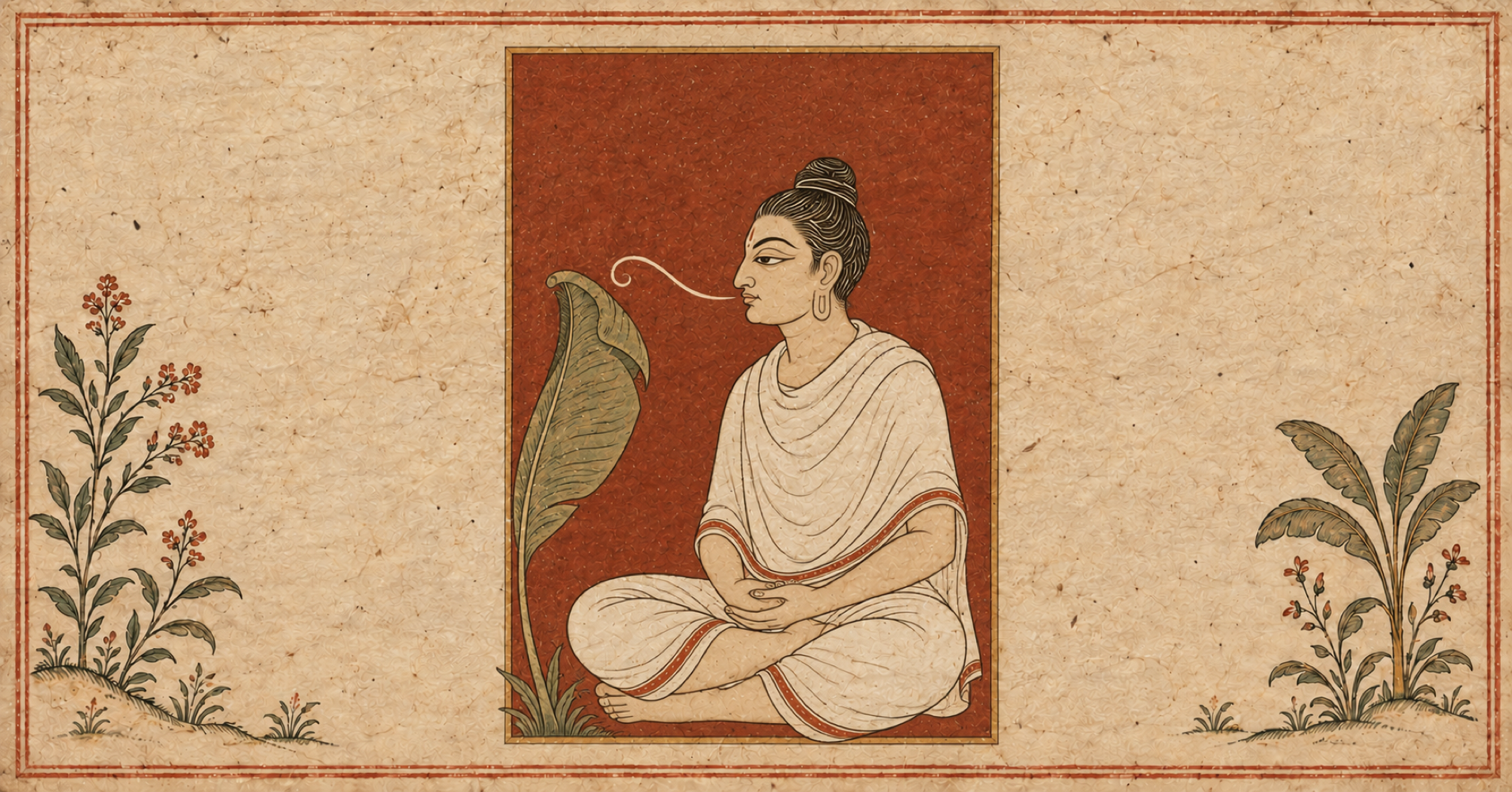

Haṭhatattvakaumudī 10.15
आकृष्याकृष्य वायुं भृशम् अति प्राग्वच्चाकृष्य बद्ध्वा लघु |
ākṛṣyākṛṣya vāyuṃ bhṛśam ati prāgvac cākṛṣya baddhvā laghu | Analysis ▾ Analysis ▴
सुरसकृद्रेचकपूरकाभ्यां कुम्भो ऽयं चान्तरङ्गकः |
surasakṛd recaka-pūrakābhyāṃ; kumbho 'yaṃ cāntaraṅgakaḥ; | Analysis ▾ Analysis ▴
इति ||15||
iti ||15|| Analysis ▾ Analysis ▴
|
iti
|
thus |
Metre: Line 1: prose; then Upendravajrā, Anuṣṭubh; iti extrametrical
[One should] draw in (ākṛṣya | abs) the breath (vāyum | acc sg) very (ati) forcefully (bhṛśam), draw [it] in [again] (ākṛṣya | abs), and (ca) draw [it] in (ākṛṣya | abs) as before (prāgvat), [then] bind [it] (baddhvā | abs) briefly (laghu). [Then] release [it] in a controlled manner (surasakṛt). And (ca) through exhalation and inhalation (recaka-pūrakābhyām | ins du) [arises] this (ayam | nom sg m) internal (antaraṅgakaḥ | nom sg m) breath retention (kumbhaḥ | nom sg). Thus (iti) [runs the description].
Recaka-pūrakābhyām supports connecting the preceding expression with a change of breath.
Observe the transitions between inhaling and exhaling in your natural breath. You may also notice when one movement ends and the next begins.
Haṭhatattvakaumudī 10.16
जिह्वां बहिर् निःसार्य दन्तमूले कृत्वा वायुम् आकृष्य पूरकं भवेत्पूर्ववत् |
jihvāṃ bahir niḥsārya danta-mūle kṛtvā vāyum ākṛṣya pūrakaṃ bhavet pūrvavat | Analysis ▾ Analysis ▴
ततो मन्दनासाभ्यां वायुं अधस्त्यजेत्शनकैर् आशिखाग्रम् आनखाग्रावध्य् उच्चैश्चानु नासापुटयुगलबिलाभ्यां ततो रेचयेत् ||16||
tato manda-nāsābhyāṃ vāyuṃ adhas tyajet śanakair ā-śikhāgram ā-nakhāgrāvadhy uccaiś cānu nāsā-puṭa-yugala-bilābhyāṃ tato recayet ||16|| Analysis ▾ Analysis ▴
|
tataḥ
|
thereupon | |
|
manda
|
gentle | |
|
nāsābhyām
|
through both nostrils | |
|
vāyum
|
the breath | |
|
adhaḥ
|
downwards | |
|
tyajet
|
one should release | |
|
śanakaiḥ
|
śanakaiḥ
|
slowly |
|
ā
|
up to | |
|
śikhā
|
of the topknot | |
|
agram
|
up to the tip | |
|
ā
|
up to | |
|
nakha
|
of the nail | |
|
agra
|
tip | |
|
avadhi
|
avadhi
|
up to |
|
uccaiḥ
|
upwards | |
|
ca
|
and | |
|
anu
|
thereupon | |
|
nāsā
|
of the nose | |
|
puṭa
|
of the opening | |
|
yugala
|
of the pair | |
|
bilābhyām
|
through both cavities | |
|
tataḥ
|
then | |
|
recayet
|
one should release |
Metre: none
[One should] extend (niḥsārya | abs) the tongue (jihvām | acc sg) outwards (bahiḥ), place [it] (kṛtvā | abs) at the roots of the teeth (danta-mūle | loc sg), [and] draw in (ākṛṣya | abs) the breath (vāyum | acc sg). Inhalation (pūrakam | nom sg) should take place (bhavet | 3p sg act opt) as before (pūrvavat). Thereupon (tataḥ), [one] should release (tyajet | 3p sg act opt) the breath (vāyum | acc sg) downwards (adhaḥ) through the “gentle nostrils” (manda-nāsābhyām | ins du), slowly (śanakaiḥ), up to the tip of the topknot (ā-śikhāgram), as far as the nail tips (ā-nakhāgrāvadhi) and (ca) upwards (uccaiḥ). Afterwards (anu), [as the next step] (tataḥ), [one] should release [the breath] (recayet | 3p sg act opt caus) through the two cavities of the pair of nostrils (nāsā-puṭa-yugala-bilābhyām | ins du).
I provisionally take pūrakam as a neuter name for an action. I render the unusual manda-nāsābhyām literally as “through the gentle nostrils”.
The mouth, nose and chest offer different places to feel your breath. Choose one and stay with that sensation for a moment.
jihvāṃ bahirniḥsārya GDJ2007 ] jihvāṃ virdinisāryaṃ GDJ2007-b
pūrakaṃ GDJ2007 ] pūraṃ GDJ2007-b
bhavet GDJ2007 ] kumbhavet GDJ2007-b
vāyuṃ adhastyajet śanakairāśikhāgramānakhāgrāvadhyuccaiścānu nāsāpuṭayugalabilābhyāṃ GDJ2007 ] om. GDJ2007-b
recayet GDJ2007 ] recayetaṃ GDJ2007-b
pūrakaṃ GDJ2007 ] pūraṃ GDJ2007-b
bhavet GDJ2007 ] kumbhavet GDJ2007-b
vāyuṃ adhastyajet śanakairāśikhāgramānakhāgrāvadhyuccaiścānu nāsāpuṭayugalabilābhyāṃ GDJ2007 ] om. GDJ2007-b
recayet GDJ2007 ] recayetaṃ GDJ2007-b
Haṭhatattvakaumudī 10.17
गुल्मप्लीहोदरघ्नो ज्वरक्षवथुतृषं यक्ष्मपित्ते निहन्ति |
gulma-plīhodara-ghno, jvara-kṣavathu-tṛṣaṃ, yakṣma-pitte nihanti | Analysis ▾ Analysis ▴
|
gulma
|
abdominal swelling | |
|
plīha
|
spleen (according to Meulenbeld 1974, p. 457) | |
|
udara
|
abdominal disease | |
|
ghnaḥ
|
removing | |
|
jvara
|
fever | |
|
kṣavathu
|
sneezing | |
|
tṛṣam
|
thirst | |
|
yakṣma
|
consumption (according to Meulenbeld 1974, p. 328) | |
|
pitte
|
bile | |
|
nihanti
|
it destroys |
दोषं देवं च हन्यादिति मददलनः शीतली नाम कुम्भः ||17||
Metre: Sragdharā
The breath retention (kumbhaḥ | nom sg) named (nāma) Śītalī (śītalī | nom sg), which removes abdominal swellings and diseases of the spleen and abdomen (gulma-plīhodara-ghnaḥ | nom sg m), destroys (nihanti | 3p sg act pres) fever, sneezing and thirst (jvara-kṣavathu-tṛṣam | acc sg), consumption and bile (yakṣma-pitte | acc du). And (ca), [as] a destroyer of intoxication (mada-dalanaḥ | nom sg m), [it] should remove (hanyāt | 3p sg act opt) the disorder [caused by] deities (doṣaṃ devam | acc sg), thus (iti) [it is said].
I provisionally connect deva with doṣa as an adjective.
The image of cooling and becoming sober invites you to examine what you expect from an exercise. Begin by describing what you actually experienced.
gulmaplīho GDJ2007 ] gulmīho GDJ2007-b
kṣavathutṛṣaṃ GDJ2007 ] kṣutṛṣaṃ GDJ2007-b
doṣaṃ devaṃ GDJ2007 ] doṣaṃ kṣvedaṃ GDJ2007-b
śītalī GDJ2007 ] śītalo GDJ2007-a
hanyāditi conj. ed. ] hanyādīti GDJ2007
kṣavathutṛṣaṃ GDJ2007 ] kṣutṛṣaṃ GDJ2007-b
doṣaṃ devaṃ GDJ2007 ] doṣaṃ kṣvedaṃ GDJ2007-b
śītalī GDJ2007 ] śītalo GDJ2007-a
hanyāditi conj. ed. ] hanyādīti GDJ2007
Haṭhatattvakaumudī 10.17*1
इति शीतलीकुम्भकः |
Metre: none
Thus (iti) [ends] the Śītalī breath retention (śītalī-kumbhakaḥ | nom sg).
At the end of your exploration of cooling breath, gather your impressions: what was clear, and what remained indistinct?
Continue with AYI Free
Illustrations: AI-generated.

Please log in to write a message. Go to login
No messages yet.