
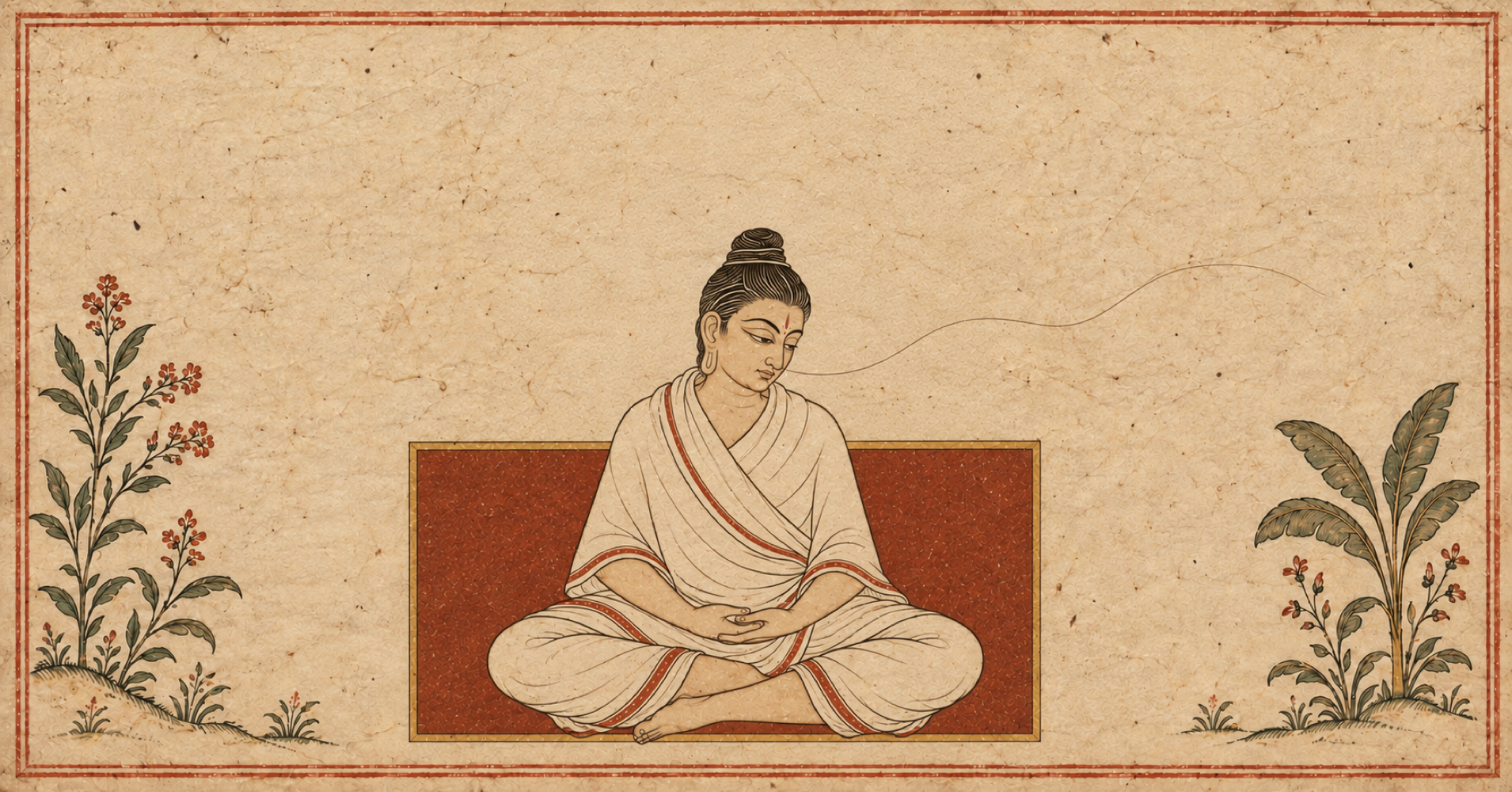
Seated figure with gently lowered head and a fading line.

Haṭhatattvakaumudī 10.18*1–19*1: Mūrcchā / Manomūrcchanā: Throat lock and slow exhalation

A firm throat lock at the end of inhalation defines Mūrcchā, also called Manomūrcchanā. The text links the slow exhalation that follows with blissful stupefaction of the mind.

Dr. Ronald Steiner Dr. Ronald Steiner
Haṭhatattvakaumudī 10.18*1
अथ मूर्च्छा कुम्भकः |
atha mūrcchā kumbhakaḥ | Analysis ▾ Analysis ▴
atha
particle
now
mūrcchā
nominative singular
substantive feminine
stupefaction
kumbhakaḥ
nominative singular
substantive masculine
breath retention
Metre: none
Now (atha) [follows] the breath retention (kumbhakaḥ | nom sg) Mūrcchā (mūrcchā | nom sg).
Dr. Ronald Steiner - 2026 - historically literal
Mūrcchā here means stupefaction; for a contemporary reflection, I draw on the image of thoughts receding. The focus is a calm in which you remain awake and responsive.
Dr. Ronald Steiner - 2026 - modern transfer
Haṭhatattvakaumudī 10.19
पुरा पूरकान्ते विधाय प्रगाढं गले जालबन्धं शनैः रेचयेत्तम् |
purā pūrakānte vidhāya pragāḍhaṃ; gale jāla-bandhaṃ śanaiḥ recayet tam | Analysis ▾ Analysis ▴
purā
adverb
first
pūraka
tatpuruṣa-compound genitive
substantive masculine
of inhalation
ante
lokative singular
substantive masculine
at the end
vidhāya
absolutus
previx
verbal root
having applied
pragāḍham
accusative singular masculine
adjective
very firmly
gale
lokative singular
substantive masculine
at the throat
jāla
tatpuruṣa-compound genitive
substantive neuter
of the net
bandham
accusative singular
substantive masculine
lock
śanaiḥ
adverb
slowly
recayet
3rd person singular aktive optative causative
verbal root
one should release
tam
accusative singular masculine
pronoun dem
it
मनोमूर्च्छनानामकः कुम्भ एषो मनोमूर्च्छना सौख्यदा योगिनो ऽस्मात् ||19||
mano-mūrcchanā-nāmakaḥ kumbha eṣo; mano-mūrcchanā saukhya-dā yogino 'smāt ||19|| Analysis ▾ Analysis ▴
manaḥ
tatpuruṣa-compound genitive
substantive neuter
of the mind
mūrcchanā
upapada-compound
mūrcchanā
substantive feminine
stupefaction
nāmakaḥ
nominative singular masculine
adjective
named
kumbhaḥ
nominative singular
substantive masculine
breath retention
eṣaḥ
nominative singular masculine
pronoun dem
this
manaḥ
tatpuruṣa-compound genitive
substantive neuter
of the mind
mūrcchanā
nominative singular
mūrcchanā
substantive feminine
stupefaction
saukhya
upapada-compound
substantive neuter
happiness
dā
nominative singular feminine
adjective
giving
yoginaḥ
genitive singular
substantive masculine
of the yogin
asmāt
ablative singular masculine
pronoun dem
from this
Metre: Bhujaṅgaprayāta
First (purā), at the end of inhalation (pūrakānte | loc sg), having applied (vidhāya | abs) a very firm (pragāḍham | acc sg m) net lock (jāla-bandham | acc sg) at the throat (gale | loc sg), [one] should slowly (śanaiḥ) release (recayet | 3p sg act opt caus) it (tam | acc sg m). This (eṣaḥ | nom sg m) breath retention (kumbhaḥ | nom sg) [is] named “stupefaction of the mind” (mano-mūrcchanā-nāmakaḥ | nom sg m). From it (asmāt | abl sg m) [arises] a stupefaction of the mind (mano-mūrcchanā | nom sg) that gives happiness (saukhya-dā | nom sg f) to the yogin (yoginaḥ | gen sg).
Dr. Ronald Steiner - 2026 - historically literal
You do not have to pursue every thought as soon as it arises. Explore noticing it while remaining in contact with your surroundings.
Dr. Ronald Steiner - 2026 - modern transfer
Haṭhatattvakaumudī 10.19*1
इति मूर्च्छा कुम्भकः |
iti mūrcchā kumbhakaḥ | Analysis ▾ Analysis ▴
iti
particle
thus
mūrcchā
nominative singular
substantive feminine
stupefaction
kumbhakaḥ
nominative singular
substantive masculine
breath retention
Metre: none
Thus (iti) [ends] the breath retention (kumbhakaḥ | nom sg) Mūrcchā (mūrcchā | nom sg).
Dr. Ronald Steiner - 2026 - historically literal
End this inward reflection by orienting yourself in the room and noticing what needs your attention now.
Dr. Ronald Steiner - 2026 - modern transfer

Continue with AYI Free

Illustrations: AI-generated.

Editor

Dr. Ronald Steiner

From 89075 Ulm

The "Yoga Doc" - Dr. Ronald Steiner is the founder of the AYI method. This method links traditional Ashtanga Yoga with innovative Yogatherapy and living Philosophy. This forms a practice that is personal for each and... more ›

Messages and ratings
0 messages

Please log in to write a message. Go to login

No messages yet.