

pṝ पॄ – cl. 9. and 3. P. (Ved. also A.) pṛṇāti (-ṇīte), piparti (3rd du. pipṛtas or pipūrtas, Vopa-deva X. 5), papāra (3rd du.…
verbal root · Word type unspecified
Dictionary sources
Monier-Williams 1872 Word type unspecified
Original text · English · Word type unspecified
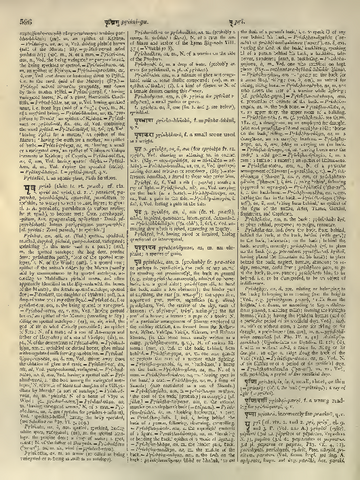
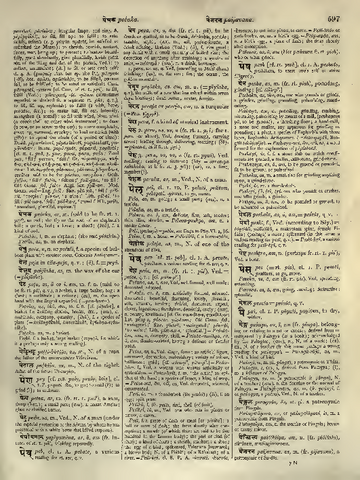
pṝ pṝ [cf. rts. 1. and 2. pṛ, pṛṇ], cl. 9. and 3. P. (Ved. also A.) pṛṇāti (-ṇīte), piparti (3rd du. pipṛtas or pipūrtas, Vopa-deva X. 5), papāra (3rd du. paparatus or papratus, 3rd pl. paparus or paprus, Pāṇ. VII. 4, 12), pariṣyati, parīṣyati, apārīt, Prec. pūryāt, pa- ritum, parītu (Ved. forms, Impf. 3rd sing. A. apiprata, Impv. 2nd sing. pūrdhi, Aor. parṣi, parṣat, pāriṣat; irregular Impv. 2nd sing. A. pipīpṛhi?), to fill, fill up; to fulfil; to sate, satisfy, refresh (e. g. pitṝn apārīt, he satisfied or refreshed the Manes); to cherish, nourish, nurture, foster, rear, bring up; to protect; to bestow bounti- fully, grant abundantly, give plentifully, lavish (with acc. of the thing and dat. of the person, Ved.); to collect, accumulate; (A.) to fill or sate one's self; cl. 4. A. (properly Pass. but ep. also P.), pūryate (-ti), Aor. apūri, apūriṣṭa, to be filled, become full, to be fulfilled; to be sated or satisfied; Caus. pārayati, -yitum [cf. Caus. of rt. 1. pṛ], to fill, fulfil (Ved.); pūrayati, -te, -yitum (sometimes regarded as derived fr. a separate rt. pūr, q. v.), to fill, fill up, replenish; to fulfil (a wish, hope, promise, &c.); to make full, fill out, intensify, strengthen (a sound); to fill with wind, blow, wind (a conch-shell or other wind instrument); to draw (a bow, or an arrow to the ear); to cover completely, cover up, surround, envelop; to load or enrich (with gifts); to spend the whole (of a period of time): Desid. pipariṣati, piparīṣati, pupūrṣati, pu- pūrṣate: Intens. popūryate, pāparti, popūrti; [cf. rt. 1. prā, 3. pur, pura, puru, pulu: Zend par, ‘fill;’ perena, ‘full:’ Gr. πί-μ-πλη-μι, πλή-θ-ω, πλέ-ω-ς, πλή-ρ-ης, πλη-θ-ύ-ς, πλῆ-θ-ος, πλοῦ-το-ς: Lat. im-ple-o, plē-nu-s, plē-be-s, pŏ-pul-u-s, multus said to be for pūrtas, am-plu-s: Goth. full-s, ‘full;’ fullo, ‘fulness;’ full-yan, ‘to fill:’ Old Germ. fol, folc: Angl. Sax. fyll-an: Mod. Germ. voll = Eng. full: Slav. plŭ-nŭ, ‘full;’ plŭ- kŭ, ‘people;’ ple-me, ‘a tribe:’ Lith. pil-ti, ‘to fill;’ pī1l-na-s, ‘full;’ pùl-ka-s, ‘crowd:’ Hib. pailt, ‘abundant, plentiful, copious.’]
Apte 1890 Word type unspecified
Original text · English · Word type unspecified
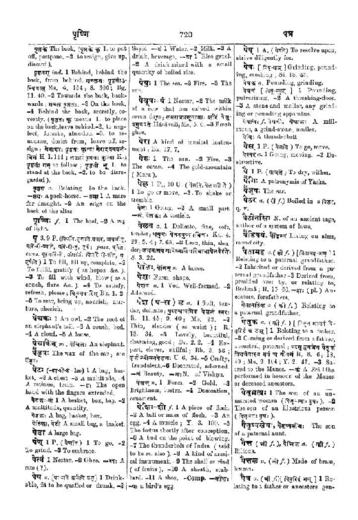
pṝ 3 9 P. (pirpīṃta, pṛṇāti, papāra, apārīt, pari-rī-ṣyati, pari-rī-tuṃ, pūrṇa; pass. pūryate; caus. pūrayati-te; desid. pipari-rī-ṣati, pupūrṣati) 1 To fill, fill up, complete. 2 To fulfil, gratify (as hopes &c.). 3 To fill with wind, blow (as a conch, flute &c.). 4 To satisfy, refresh, please; pitṝnapārit Bk. 1. 2 5 To rear, bring up, nourish, nurture, cherish.
Cappeller 1887 Word type unspecified
Original text · German · Word type unspecified
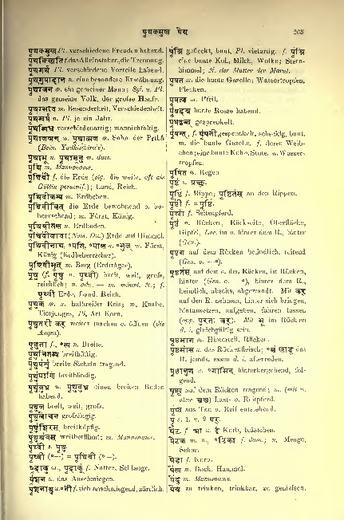
pṝ s. 1. u. 2 par.
Burnouf 1866 verbal root
Original text · French · verbal root
*pṝ pṝ. piparmi 3 et pṛṇāmi 9; p. papāra [3p. pl. paparus et paprus]; f2. pariṣyāmi et pariṣyāmi; a1. apārīṣam; o. puryāsam. Ps. pūrye; a1. 3p. apūri et apūriṣṭa; pp. pūrṇa et qqf. pūrita et pūrta. Remplir: jalena d'eau, nisvanais de bruits divers. Rassasier, haviṣā de beurre sacré. Répandre, prodiguer, rāyas les biens, Vd. Protéger, défendre, tā aṃhasas pipṛhi préserve-les du mal, Vd. Faire passer qqn., pāram à l'autre rive. Gr. πίμπλημι, πλέως; lat. plenus; lith. pilnas.

Occurrences in source texts (33)
DYS 6 occurrences
GoS 7 occurrences
GoS 42–49: Breath as Bellows 4 occurrences
Direct occurrences
HP 2 occurrences
HP 4.11*5-4.11*14: Khecarī in Space 2 occurrences
Direct occurrences
-
HP 4.11*10 Segment 10
-
HP 4.11*11 Segment 4
HTK 13 occurrences
HTK 10.11*2–14*1: Bhastrikā: Breath like a bellows 6 occurrences
Direct occurrences
HTK 10.19*2–21*1: Plāvanī: Supported on water 2 occurrences
Direct occurrences
HTK 10.26–29*1: Cakra, Śaṅkha, Vāmāvartta, Vartmagati and Gadā 3 occurrences
Direct occurrences
HTK 10.30–33*1: Nāḍī-viśudhy-ākhyaka-kumbha and Nāḍīśuddhi 1 occurrence
Direct occurrences
-
HTK 10.30 Segment 10
HTK 10.34*2–38*1: Asvaṅgaśṛṅkhalā and Kumbhāntaraśṛṅkhalā 1 occurrence
Direct occurrences
-
HTK 10.35 Segment 5
SiSa 3 occurrences
Continue with AYI Free
Image source: AYI archive.