
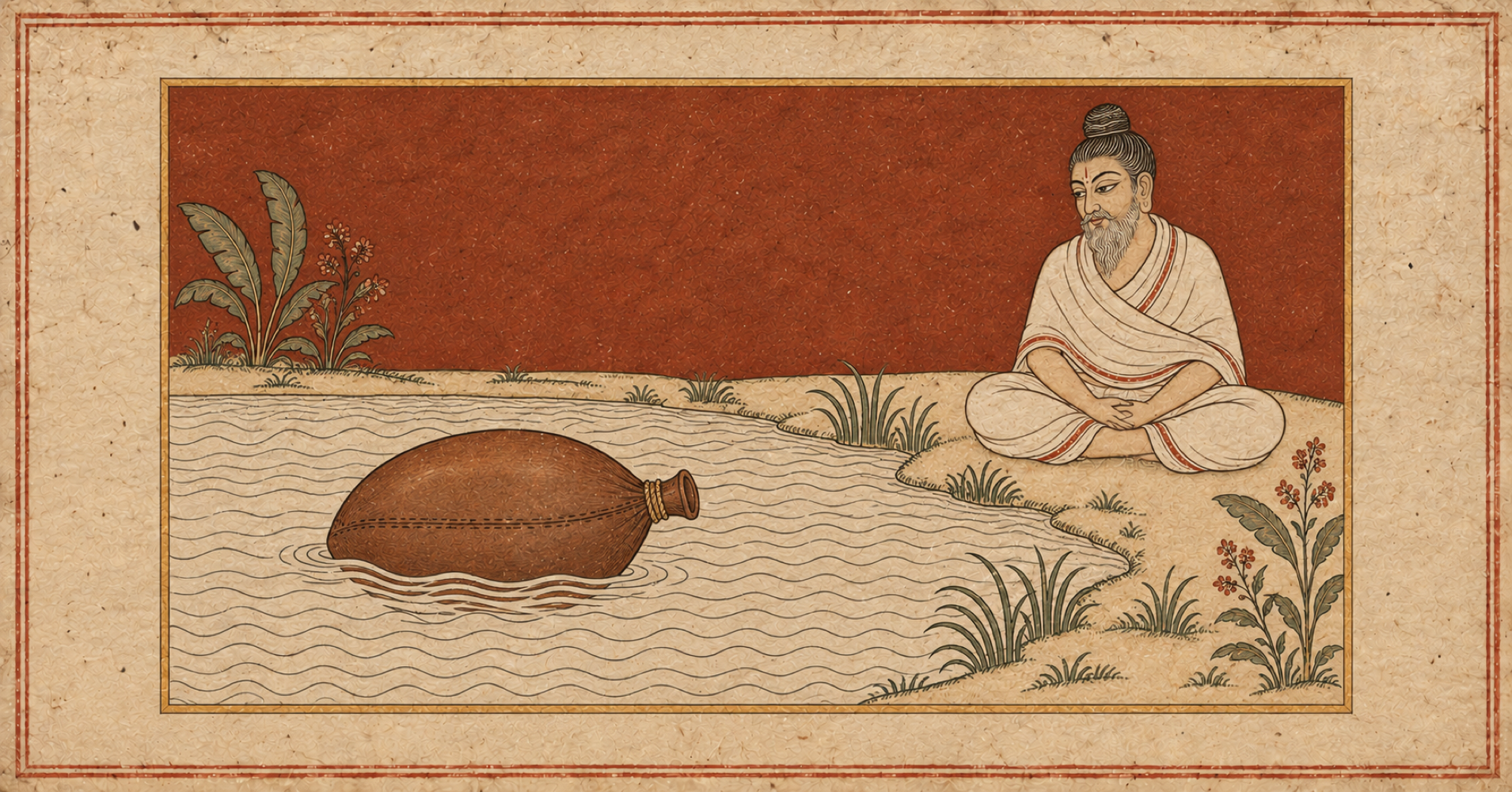
Inflated leather bag floating on water, with a seated observer on the bank.

Haṭhatattvakaumudī 10.19*2–21*1: Plāvanī: Air in the belly and the image of a leather bag

In Plāvanī, the belly is filled with air. The text describes floating on water and illustrates the buoyancy through the image of a filled leather bag.

Dr. Ronald Steiner Dr. Ronald Steiner
Haṭhatattvakaumudī 10.19*2
अथ प्लावनी कुम्भकः |
atha plāvanī kumbhakaḥ | Analysis ▾ Analysis ▴
atha
particle
now
plāvanī
nominative singular
plāvanī
substantive feminine
Plāvanī, the floating one
kumbhakaḥ
nominative singular
substantive masculine
breath retention
Metre: none
Now (atha) [follows] the breath retention (kumbhakaḥ | nom sg) Plāvanī (plāvanī | nom sg).
Dr. Ronald Steiner - 2026 - historically literal
The “floating” breath opens an image of being supported. For this contemporary reflection, I relate it to contact with the ground.
Dr. Ronald Steiner - 2026 - modern transfer
atha plāvanī kumbhakaḥ GDJ2007 ] om. GDJ2007-b
Critical Apparatus
Haṭhatattvakaumudī 10.20
अभ्यन्तरप्रवर्त्तितभूरितराधारवायुपूरितजठरः |
abhyantara-pravarttita,-bhūritarādhāra-vāyu-pūrita-jaṭharaḥ | Analysis ▾ Analysis ▴
abhyantara
tatpuruṣa-compound lokative
substantive neuter
within
pravarttita
karmadhāraya-compound past participle passive causative
previx
verbal root
set in motion
bhūritara
karmadhāraya-compound comperative
adjective
very abundant
ādhāra
bahuvrīhi-compund
substantive masculine
support, basis
vāyu
tatpuruṣa-compound instrumental case
substantive masculine
with air
pūrita
bahuvrīhi-compund past participle passive causative
verbal root
filled
jaṭharaḥ
nominative singular masculine
substantive neuter
having a belly
अतलस्पर्शे पयसि प्लवते योगी सुखेन चिरम् ||20||
atala-sparśe payasi, plavate yogī sukhena ciram ||20|| Analysis ▾ Analysis ▴
atala
karmadhāraya-compound
adjective
bottomless
sparśe
lokative singular neuter
substantive masculine
having contact
payasi
lokative singular
substantive neuter
in water
plavate
3rd person singular medial present
verbal root
he floats
yogī
nominative singular
substantive masculine
the yogin
sukhena
instrumental case singular
substantive neuter
with ease
ciram
adverb
for a long time
Metre: Āryā — first half: 32 instead of 30 mātrās
The yogin (yogī | nom sg), whose belly is filled with abundant air brought inside (abhyantara-pravarttita-bhūritarādhāra-vāyu-pūrita-jaṭharaḥ | nom sg m), floats (plavate | 3p sg med pres) with ease (sukhena | ins sg), for a long time (ciram), in water (payasi | loc sg) where the bottom is not touched (atala-sparśe | loc sg n).
Dr. Ronald Steiner - 2026 - historically literal
Sitting or lying down, feel where the surface beneath you supports your weight. Allow yourself to notice that contact as your breath flows naturally.
Dr. Ronald Steiner - 2026 - modern transfer
bhūritarādhāra GDJ2007 ] bhūrijarā'dhāra GDJ2007-a
Critical Apparatus
Haṭhatattvakaumudī 10.21
ऊर्ध्वम् आकर्षितापाना दृतिवत्पूरितोदरः |
ūrdhvam ākarṣitāpānā; dṛtivat pūritodaraḥ | Analysis ▾ Analysis ▴
ūrdhvam
adverb
upwards
ākarṣita
karmadhāraya-compound past participle passive causative
previx
verbal root
drawn
apānā
unclear
dṛtivat
dṛtivat
adverb
like a leather bag
pūrita
bahuvrīhi-compund past participle passive causative
verbal root
filled
udaraḥ
nominative singular masculine
substantive neuter
having a belly
जले सुप्त्वा ऽप्सु प्लवते समवाहे जिते ऽनिले ||21||
jale suptvā 'psu plavate; sama-vāhe jite 'nile ||21|| Analysis ▾ Analysis ▴
jale
lokative singular
substantive neuter
in water
suptvā
absolutus
verbal root
having lain down
apsu
lokative plural
substantive feminine
on the waters
plavate
3rd person singular medial present
verbal root
he floats
sama
karmadhāraya-compound
adjective
evenly
vāhe
lokative absolutus singular masculine
adjective
flowing
jite
lokative absolutus singular masculine past participle passive
verbal root
when mastered
anile
lokative absolutus singular
substantive masculine
the breath
Metre: Anuṣṭubh
[With] Apāna drawn (ākarṣitāpānā) upwards (ūrdhvam), with the belly filled (pūritodaraḥ | nom sg m) like a leather bag (dṛtivat), [the yogin], having lain down (suptvā | abs) in water (jale | loc sg), floats (plavate | 3p sg med pres) on the waters (apsu | loc pl), when the evenly flowing (sama-vāhe | loc absl sg m) breath (anile | loc absl sg) [is] mastered (jite | loc absl sg m ppp).
Dr. Ronald Steiner - 2026 - historically literal

I connect ākarṣitāpānā with Apāna drawn upwards and dṛtivat with the filled belly.

Translation Comment
Lying on a firm surface, notice where you still hold your weight. Follow your natural breath without imposing a particular shape on it.
Dr. Ronald Steiner - 2026 - modern transfer
Haṭhatattvakaumudī 10.21*1
इति प्लावनीकुम्भकः |
iti plāvanī-kumbhakaḥ | Analysis ▾ Analysis ▴
iti
particle
thus
plāvanī
karmadhāraya-compound
plāvanī
substantive feminine
Plāvanī
kumbhakaḥ
nominative singular
substantive masculine
breath retention
Metre: none
Thus (iti) [ends] the Plāvanī breath retention (plāvanī-kumbhakaḥ | nom sg).
Dr. Ronald Steiner - 2026 - historically literal
Take from this reflection your own sense of what it feels like to release weight and accept support.
Dr. Ronald Steiner - 2026 - modern transfer

Continue with AYI Free

Illustrations: AI-generated.

Editor

Dr. Ronald Steiner

From Ulm

The "Yoga Doc" - Dr. Ronald Steiner is the founder of the AYI method. This method links traditional Ashtanga Yoga with innovative Yogatherapy and living Philosophy. This forms a practice that is personal for each and... more ›

Messages and ratings
0 messages

Please log in to write a message. Go to login

No messages yet.