
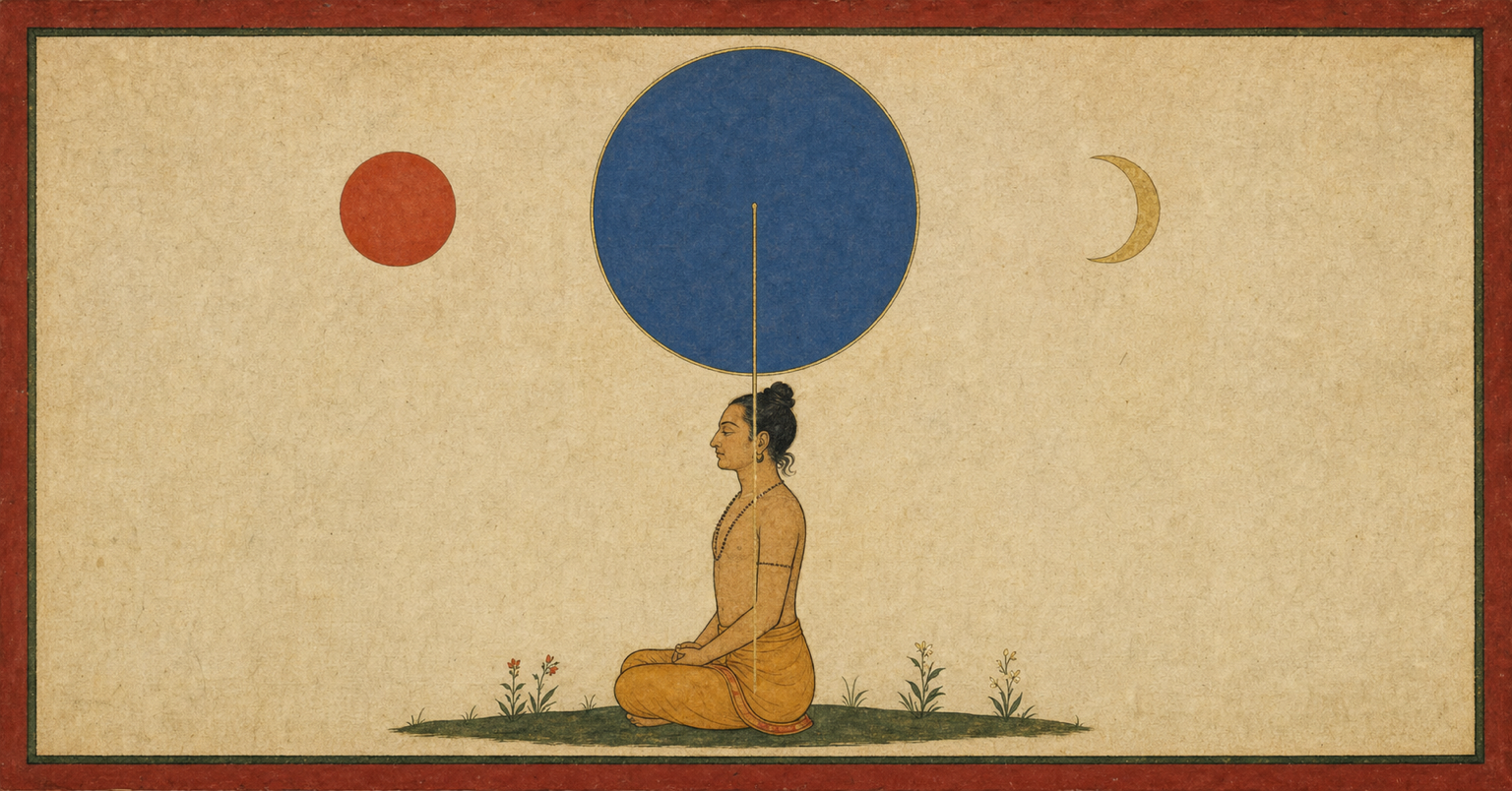
HP 4.11*5-4.11*14: Khecarī in Space

Haṭha Pradīpikā 4.11*5-4.11*14: Khecarī in Empty Space

Khecarī is located in Suṣumṇā, the Vyoma Cakra, the center of the brows, and between sun and moon, and is connected with Unmanī.

Dr. Ronald Steiner Dr. Ronald Steiner
Haṭha Pradīpikā 4.11*5
सुषिरो ज्ञानजनकः पञ्चस्रोतःसमन्वितः |
suṣiro jñāna-janakaḥ; pañca-srotaḥ-samanvitaḥ | Analysis ▾ Analysis ▴
suṣiraḥ
nominative singular masculine
substantive masculine
cavity, opening
jñāna
tatpuruṣa-compound genitive
substantive neuter
knowledge
janakaḥ
nominative singular masculine
adjective
producing
pañca
karmadhāraya-compound
numeral
five
srotas
dvandva-compound
substantive neuter
streams
samanvitaḥ
nominative singular masculine past participle passive
previx
previx
verbal root
endowed with
तिष्ठते खेचरी मुद्रा तस्मिञ्शून्ये निरञ्जने ||11*5||
tiṣṭhate khecarī mudrā; tasmiñ śūnye nirañjane ||11*5|| Analysis ▾ Analysis ▴
tiṣṭhate
3rd person singular medial present
verbal root
abides, is situated
khecarī
nominative singular
substantive feminine
Khecarī
mudrā
nominative singular
substantive feminine
mudrā
tasmin
lokative singular masculine neuter
pronoun
in this
śūnye
lokative singular neuter
adjective
void
nirañjane
lokative singular neuter
adjective
stainless
Metre: Anuṣṭubh
There is a hollow (suṣiraḥ | nom sg m) that gives rise to knowledge (jñāna-janakaḥ | nom sg m) and is furnished with five streams (pañca-srotaḥ-samanvitaḥ | nom sg m). In that (tasmin | loc sg n) stainless void (śūnye nirañjane | loc sg n) abides (tiṣṭhate | 3p sg med pres) Khecarī Mudrā (khecarī mudrā | nom sg).
Dr. Ronald Steiner - 2026 - historically literal
Khecarī Mudrā abides in that stainless void which gives rise to knowledge and is connected with five streams.
Dr. Ronald Steiner - 2026 - modern transfer
suṣiro jñānajanakaḥ pañcasrotaḥsamanvitaḥ tiṣṭhate khecarī mudrā tasmiñ śūnye nirañjane MBHDL2026 ] om. NS1882
Critical Apparatus
Haṭha Pradīpikā 4.11*6
सव्यदक्षिणनाडीस्थो मध्ये चलति मारुतः |
savya-dakṣiṇa-nāḍī-stho; madhye calati mārutaḥ | Analysis ▾ Analysis ▴
savya
dvandva-compound
adjective
left
dakṣiṇa
dvandva-compound
adjective
right
nāḍī
tatpuruṣa-compound lokative
substantive feminine
in the channels
sthaḥ
nominative singular masculine
adjective
situated
madhye
lokative singular
substantive neuter
into the middle
calati
3rd person singular aktive present
verbal root
moves
mārutaḥ
nominative singular
substantive masculine
breath, wind
तिष्ठते खेचरी मुद्रा तस्मिन् स्थाने न संशयः ||11*6||
tiṣṭhate khecarī mudrā; tasmin sthāne na saṃśayaḥ ||11*6|| Analysis ▾ Analysis ▴
tiṣṭhate
3rd person singular medial present
verbal root
abides, is situated
khecarī
nominative singular
substantive feminine
Khecarī
mudrā
nominative singular
substantive feminine
mudrā
tasmin
lokative singular masculine neuter
pronoun
in this
sthāne
lokative singular
substantive neuter
place
na
particle
not
saṃśayaḥ
nominative singular
substantive masculine
doubt
Metre: Anuṣṭubh
The breath-wind (mārutaḥ | nom sg), situated in the left and right channels (savya-dakṣiṇa-nāḍī-sthaḥ | nom sg m), moves (calati | 3p sg act pres) into the middle (madhye | loc sg). In that place (tasmin sthāne | loc sg) abides (tiṣṭhate | 3p sg med pres) Khecarī Mudrā (khecarī mudrā | nom sg); there is no doubt about this (na saṃśayaḥ | nom sg).
Dr. Ronald Steiner - 2026 - historically literal
When the breath enters the center from the left and right channels, Khecarī Mudrā is present there without doubt.
Dr. Ronald Steiner - 2026 - modern transfer

For Brahmānanda, Khecarī is complete only when Prāṇa remains steady in the “empty center,” Suṣumṇā. He locates the Vyomacakra named in this connection between the eyebrows, where the inner channels meet. The position of the tongue alone therefore does not yet fulfill the definition.

Brahmānanda's Jyotsnā - 19th c.
calati MBHDL2026 ] carati NS1882
Critical Apparatus
When the air has ceased to move in the right and the left nostrils, and has begun to flow in the middle path, then the Khecharî Mudrâ, can be accomplished there. There is no doubt of this.
Pancham Sinh - 1915
Der in der linken und rechten Nâdî befindliche Athem bewegt sich in der Mitte; an diesem Ort befindet sich ohne Zweifel die Khecarî Mudrâ.
Hermann Walter - 1893
Haṭha Pradīpikā 4.11*8
इडापिङ्गलयोर्योगे शून्यं चैवानिलं ग्रसेत् |
iḍā-piṅgalayor yoge; śūnyaṃ caivānilaṃ graset | Analysis ▾ Analysis ▴
iḍā
dvandva-compound
substantive feminine
Iḍā
piṅgalayoḥ
genitive lokative dual
substantive feminine
Piṅgalā
yoge
lokative singular
substantive masculine
at the junction
śūnyam
nominative accusative singular neuter
adjective
the void
ca
particle
and
eva
particle
indeed
anilam
accusative singular
substantive masculine
breath, wind
graset
3rd person singular aktive optative
verbal root
should swallow
तिष्ठते खेचरी मुद्रा तत्र सत्यं न संशयः ||11*8||
tiṣṭhate khecarī mudrā; tatra satyaṃ na saṃśayaḥ ||11*8|| Analysis ▾ Analysis ▴
tiṣṭhate
3rd person singular medial present
verbal root
abides, is situated
khecarī
nominative singular
substantive feminine
Khecarī
mudrā
nominative singular
substantive feminine
mudrā
tatra
adverb
there
satyam
adverb
indeed
na
particle
not
saṃśayaḥ
nominative singular
substantive masculine
doubt
Metre: Anuṣṭubh
At the union of Iḍā and Piṅgalā (iḍā-piṅgalayoḥ yoge | loc sg), the void (śūnyam | nom acc sg n) itself (eva) should devour (graset | 3p sg act opt) the breath-wind (anilam | acc sg). There (tatra) abides (tiṣṭhate | 3p sg med pres) Khecarī Mudrā (khecarī mudrā | nom sg); this is true (satyam), and there is no doubt about it (na saṃśayaḥ | nom sg).
Dr. Ronald Steiner - 2026 - historically literal
At the meeting of Iḍā and Piṅgalā, the void devours the breath. Khecarī Mudrā abides there; of this there is no doubt.
Dr. Ronald Steiner - 2026 - modern transfer
yoge MBHDL2026 ] madhye NS1882
Critical Apparatus
If the Prâṇa can be drawn into the Śûnya (Suṣumnâ), which is between the Idâ and the Pingalâ, and made motionless there, then the Khecharî Mudrâ can truly become steady there.
Pancham Sinh - 1915
Der zwischen Idâ und Pingalâ befindliche leere Raum verschlingt den Athem; daselbst befindet sich sicher immer wieder die Khecarî.
Hermann Walter - 1893
Haṭha Pradīpikā 4.11*9
सोमसूर्यद्वयोर्मध्ये निरालम्बे तले पुनः |
soma-sūrya-dvayor madhye; nirālambe tale punaḥ | Analysis ▾ Analysis ▴
soma
dvandva-compound
substantive masculine
moon
sūrya
dvandva-compound
substantive masculine
sun
dvayoḥ
genitive lokative dual
substantive neuter
of the pair
madhye
lokative singular
substantive neuter
in the middle
nirālambe
lokative singular neuter
adjective
in the unsupported
tale
lokative singular
substantive neuter
on the plane, level
punar
adverb
again
संस्थिता व्योमचक्रे या सा मुद्रा नाम खेचरी ||11*9||
saṃsthitā vyoma-cakre yā; sā mudrā nāma khecarī ||11*9|| Analysis ▾ Analysis ▴
saṃsthitā
nominative singular feminine past participle passive
previx
verbal root
established, situated
vyoman
tatpuruṣa-compound genitive
substantive neuter
of space
cakre
lokative singular
substantive neuter
in the wheel
yā
nominative singular feminine
pronoun
she who
tad
nominative singular feminine
pronoun
she, this
mudrā
nominative singular
substantive feminine
mudrā
nāma
adverb
by name, called
khecarī
nominative singular
substantive feminine
Khecarī
Metre: Anuṣṭubh
That (yā | nom sg f) Mudrā (mudrā | nom sg) which is situated between the pair of Soma and the sun (soma-sūrya-dvayoḥ madhye | loc sg), again (punaḥ) on the ground without support (nirālambe tale | loc sg), and established within the wheel of space (vyoma-cakre saṃsthitā | nom sg f ppp), that (sā | nom sg f) is called Khecarī (khecarī nāma | nom sg).
Dr. Ronald Steiner - 2026 - historically literal
The Mudrā that rests between Soma and the sun in the unsupported Vyoma Cakra is called Khecarī.
Dr. Ronald Steiner - 2026 - modern transfer
nirālambe tale MBHDL2026 ] nirālambāntare NS1882
Critical Apparatus
That Mudrâ is called Khecharî which is performed in the supportless space between the Sûrya and the Chandra (the Idâ and the Pingalâ) and called the Vyoma Chakra.
Pancham Sinh - 1915
Zwischen Sûrya und Candra befindet sich ein unabhängiger (niralamba) Raum; die Mudrâ, welche da im Vyomacakra zu Stande kommt, heisst Khecarî.
Hermann Walter - 1893
Haṭha Pradīpikā 4.11*10
सा मयोद्भेदिता वामा साक्षाच्च शिववल्लभा |
sā mayodbheditā vāmā; sākṣāc ca śiva-vallabhā | Analysis ▾ Analysis ▴
sā
nominative singular feminine
pronoun
she, this
mayā
instrumental case singular
pronoun
by me
udbheditā
nominative singular feminine past participle passive
previx
verbal root
brought forth, opened
vāmā
nominative singular feminine
adjective
beautiful, left
sākṣāt
adverb
directly
ca
particle
and
śiva
tatpuruṣa-compound genitive
substantive masculine
of Śiva
vallabhā
nominative singular
substantive feminine
beloved
पूरयेन्मारुतं दिव्यं सुषुम्णा पश्चिमे मुखे ||11*10||
pūrayen mārutaṃ divyaṃ; suṣumṇā paścime mukhe ||11*10|| Analysis ▾ Analysis ▴
pūrayet
3rd person singular causative optative
verbal root
should fill
mārutam
accusative singular
substantive masculine
breath, wind
divyam
accusative singular masculine
adjective
divine
suṣumṇā
nominative singular
substantive feminine
Suṣumṇā
paścime
lokative singular neuter
adjective
at the rear
mukhe
lokative singular
substantive neuter
opening
Metre: Anuṣṭubh
She (sā | nom sg f), the beautiful one (vāmā | nom sg f) opened up by me (mayā udbheditā | nom sg f ppp), directly (sākṣāt) Śiva's beloved (śiva-vallabhā | nom sg), Suṣumṇā (suṣumṇā | nom sg), should fill (pūrayet | 3p sg caus opt) the divine breath-wind (mārutaṃ divyam | acc sg m) at the rear opening (paścime mukhe | loc sg).
Dr. Ronald Steiner - 2026 - historically literal
This beautiful Suṣumṇā, opened by me and directly beloved of Śiva, is to fill the divine breath at the posterior mouth.
Dr. Ronald Steiner - 2026 - modern transfer

Brahmānanda describes two complementary seals. The tongue turned backward covers the posterior opening of Suṣumṇā at the upper palate, while Prāṇa fills its anterior entrance. A tongue position without the corresponding state of the breath may produce faintness, but is not a perfected Khecarīmudrā.

Brahmānanda's Jyotsnā - 19th c.
sā mayodbheditā vāmā sākṣāc ca MBHDL2026 ] somād yatroditā dhārā sākṣāt sā NS1882
Critical Apparatus
The Khecharî which causes the stream to flow from the Chandra (Śoma) is beloved of Śiva. The incomparable divine Suṣumnâ should be closed by the tongue drawn back.
Pancham Sinh - 1915
Wo der Somastrom vom Candra fällt, da ist der Liebling des Siva, die Khecarî, zugegen. Man fülle die unvergleichliche, herrliche Sushumna im hinteren Theil des Mundes (mit der Zunge, Com.).
Hermann Walter - 1893
Haṭha Pradīpikā 4.11*11
पुरस्ताच्चैव पूर्येत निश्चिता खेचरी भवेत् |
purastāc caiva pūryeta; niścitā khecarī bhavet | Analysis ▾ Analysis ▴
purastāt
adverb
from the front
ca
particle
and
eva
particle
indeed
pūryeta
3rd person singular passive optative
verbal root
should be filled
niścitā
nominative singular feminine past participle passive
previx
verbal root
certainly, surely
khecarī
nominative singular
substantive feminine
Khecarī
bhavet
3rd person singular aktive optative
verbal root
will arise
अभ्यसेत्खेचरीमुद्राम् उन्मनी संप्रजायते ||11*11||
abhyaset khecarī-mudrām; unmanī saṃprajāyate ||11*11|| Analysis ▾ Analysis ▴
abhyaset
3rd person singular aktive optative
previx
verbal root
should practise
khecarī
karmadhāraya-compound
substantive feminine
Khecarī
mudrām
accusative singular
substantive feminine
mudrā
unmanī
nominative singular
substantive feminine
unmanī
saṃprajāyate
3rd person singular medial present
previx
previx
verbal root
arises
Metre: Anuṣṭubh
When she is filled (pūryeta | 3p sg pas opt) also precisely from the front (purastāt ca eva), Khecarī (khecarī | nom sg) surely arises (niścitā | nom sg f ppp). One should practise (abhyaset | 3p sg act opt) Khecarī Mudrā (khecarī-mudrām | acc sg); Unmanī (unmanī | nom sg) arises (saṃprajāyate | 3p sg med pres).
Dr. Ronald Steiner - 2026 - historically literal
When it also fills from the front, Khecarī certainly arises. Through the practice of Khecarī Mudrā, Unmanī appears.
Dr. Ronald Steiner - 2026 - modern transfer
abhyaset khecarīmudrām MBHDL2026 ] abhyastā khecarī mudrāpy NS1882
Critical Apparatus
It can be closed from the front also (by stopping the movements of the Prâṇa), and then surely it becomes the Khecharî. By practice, this Khecharî leads to Unmanî.
Pancham Sinh - 1915
Zuerst aber fülle man (die Sushumnâ mit Athem, Com.), dann wird die Khecarî sicher; und wenn die Khecarî sicher ist, entsteht auch die Unmanî (Samadhi).
Hermann Walter - 1893
Haṭha Pradīpikā 4.11*12
अभ्यसेत्खेचरीमुद्रां तावत्स्याद्योगनिद्रितः |
abhyaset khecarī-mudrāṃ; tāvat syād yoga-nidritaḥ | Analysis ▾ Analysis ▴
abhyaset
3rd person singular aktive optative
previx
verbal root
should practise
khecarī
karmadhāraya-compound
substantive feminine
Khecarī
mudrām
accusative singular
substantive feminine
mudrā
tāvat
adverb
so long as
syāt
3rd person singular aktive optative
verbal root
is, becomes
yoga
tatpuruṣa-compound genitive
substantive masculine
of yoga
nidritaḥ
nominative singular masculine past participle passive
verbal root
asleep
संप्राप्तयोगनिद्रस्य कालो नास्ति कदाचन ||11*12||
saṃprāpta-yoga-nidrasya; kālo nāsti kadācana ||11*12|| Analysis ▾ Analysis ▴
saṃprāpta
karmadhāraya-compound past participle passive
previx
previx
verbal root
attains
yoga
tatpuruṣa-compound genitive
substantive masculine
yoga
nidrasya
genitive singular
substantive feminine
of sleep
kālaḥ
nominative singular
substantive masculine
time, death
na
particle
not
asti
3rd person singular aktive present
verbal root
is, exists
kadācana
adverb
ever
Metre: Anuṣṭubh
One should practise (abhyaset | 3p sg act opt) Khecarī Mudrā (khecarī-mudrām | acc sg) for so long (tāvat) that one is (syāt | 3p sg act opt) immersed in yogic sleep (yoga-nidritaḥ | nom sg m ppp). For one who has attained yogic sleep (saṃprāpta-yoga-nidrasya | gen sg), death (kālaḥ | nom sg) never (kadācana) exists (asti | 3p sg act pres).
Dr. Ronald Steiner - 2026 - historically literal
Khecarī Mudrā is to be practised until yogic sleep arises. One who has reached it is never again subject to time or death.
Dr. Ronald Steiner - 2026 - modern transfer

Here Yoganidrā denotes the extinction of all movements of the mind. Brahmānanda connects it with Turīya, the “fourth” state beyond waking, dreaming, and deep sleep. Because the solar and lunar currents are still in this model, the yogi is also said to transcend time and death. This expresses the commentary's goal of liberation.

Brahmānanda's Jyotsnā - 19th c.
abhyaset khecarīmudrāṃ tāvat syād yoganidritaḥ saṃprāptayoganidrasya kālo nāsti kadācana MBHDL2026 ] transp. NS1882 post HP 4.11*13
Critical Apparatus
The Khecharî should be practised till there is Yoga-nidrâ (Samâdhi). One who has induced Yoga-nidrâ, cannot fall a victim to death.
Pancham Sinh - 1915
Man übe die Khecarî so lange, bis man sich im Yogaschlaf befindet. Für den im Yogaschlaf befindlichen gibt es keinen Tod.
Hermann Walter - 1893
Haṭha Pradīpikā 4.11*13
भ्रुवोर्मध्ये शिवस्थानं मनस्तत्र विलीयते |
bhruvor madhye śiva-sthānaṃ; manas tatra vilīyate | Analysis ▾ Analysis ▴
bhruvoḥ
genitive lokative dual
substantive feminine
of both eyebrows
madhye
lokative singular
substantive neuter
in the middle
śiva
tatpuruṣa-compound genitive
substantive masculine
of Śiva
sthānam
nominative accusative singular
substantive neuter
place
manas
nominative accusative singular
substantive neuter
mind
tatra
particle
therein, among these
vilīyate
3rd person singular medial present
previx
verbal root
dissolves
ज्ञातव्यं तत्पदं तुर्यं तत्र कालो न विद्यते ||11*13||
jñātavyaṃ tat padaṃ turyaṃ; tatra kālo na vidyate ||11*13|| Analysis ▾ Analysis ▴
jñātavyam
nominative accusative singular neuter future participle passive
verbal root
to be known
tat
nominative accusative singular neuter
pronoun
that
padam
nominative accusative singular
substantive neuter
state
turyam
nominative accusative singular neuter
adjective
fourth
tatra
adverb
there
kālaḥ
nominative singular
substantive masculine
time, death
na
particle
not
vidyate
3rd person singular medial present
verbal root
is present, exists
Metre: Anuṣṭubh
Between the two brows (bhruvoḥ madhye | loc sg) is Śiva's abode (śiva-sthānam | nom acc sg); there (tatra) the mind (manas | nom acc sg) dissolves (vilīyate | 3p sg med pres). That fourth state (tat padaṃ turyam | nom acc sg n) is to be known (jñātavyam | nom acc sg n pfp); there (tatra) death (kālaḥ | nom sg) does not (na) exist (vidyate | 3p sg med pres).
Dr. Ronald Steiner - 2026 - historically literal
Between the eyebrows is Śiva's abode; there the mind dissolves. This state is to be recognized as Turya, where time does not exist.
Dr. Ronald Steiner - 2026 - modern transfer
bhruvor madhye śivasthānaṃ manas tatra vilīyate jñātavyaṃ tat padaṃ turyaṃ tatra kālo na vidyate MBHDL2026 ] transp. NS1882 ante HP 4.11*12
Critical Apparatus
The seat of Śiva is between the eyebrows, and the mind becomes absorbed there. This condition (in which the mind is thus absorbed) is known as Tûrya, and death has no access there.
Pancham Sinh - 1915
Zwischen den Brauen ist das Şivasthana, dort wird das Bewusstsein vernichtet. Diesen Ort soll man als den Vierten kennen. Dort ist der Tod nicht zu finden.
Hermann Walter - 1893
Haṭha Pradīpikā 4.11*14
चन्द्रसूर्यद्वयोर्मध्ये मुद्रां दद्याच्च खेचरीम् |
candra-sūrya-dvayor madhye; mudrāṃ dadyāc ca khecarīm | Analysis ▾ Analysis ▴
candra
dvandva-compound
substantive masculine
moon
sūrya
dvandva-compound
substantive masculine
sun
dvayoḥ
genitive lokative dual
substantive neuter
of the pair
madhye
lokative singular
substantive neuter
in the middle
mudrām
accusative singular
substantive feminine
mudrā
dadyāt
3rd person singular aktive optative
verbal root
should apply, place
ca
particle
and
khecarīm
accusative singular
substantive feminine
Khecarī
निरालम्बे महाशून्ये व्योमचक्रे व्यवस्थिताम् ||11*14||
nirālambe mahā-śūnye; vyoma-cakre vyavasthitām ||11*14|| Analysis ▾ Analysis ▴
nirālambe
lokative singular neuter
adjective
in the unsupported
mahā
karmadhāraya-compound
adjective
great
śūnye
lokative singular neuter
adjective
in the void
vyoman
tatpuruṣa-compound genitive
substantive neuter
of space
cakre
lokative singular
substantive neuter
in the wheel
vyavasthitām
accusative singular feminine past participle passive
previx
previx
verbal root
firmly established
Metre: Anuṣṭubh
Between the pair of moon and sun (candra-sūrya-dvayoḥ madhye | loc sg), one should apply (dadyāt | 3p sg act opt) Khecarī Mudrā (mudrāṃ khecarīm | acc sg), which is firmly established (vyavasthitām | acc sg f ppp) in the great unsupported void (nirālambe mahā-śūnye | loc sg n), in the wheel of space (vyoma-cakre | loc sg).
Dr. Ronald Steiner - 2026 - historically literal
Between moon and sun, the yogi should apply Khecarī Mudrā, which is established in the great unsupported space, the Vyoma Cakra.
Dr. Ronald Steiner - 2026 - modern transfer
candrasūryadvayor madhye mudrāṃ dadyāc ca khecarīm nirālambe mahāśūnye vyomacakre vyavasthitām MBHDL2026 ] om. NS1882
Critical Apparatus

Continue with AYI Free

Illustrations: AI-generated.

Editor

Dr. Ronald Steiner

From Ulm

The "Yoga Doc" - Dr. Ronald Steiner is the founder of the AYI method. This method links traditional Ashtanga Yoga with innovative Yogatherapy and living Philosophy. This forms a practice that is personal for each and... more ›

Messages and ratings
0 messages

Please log in to write a message. Go to login

No messages yet.