
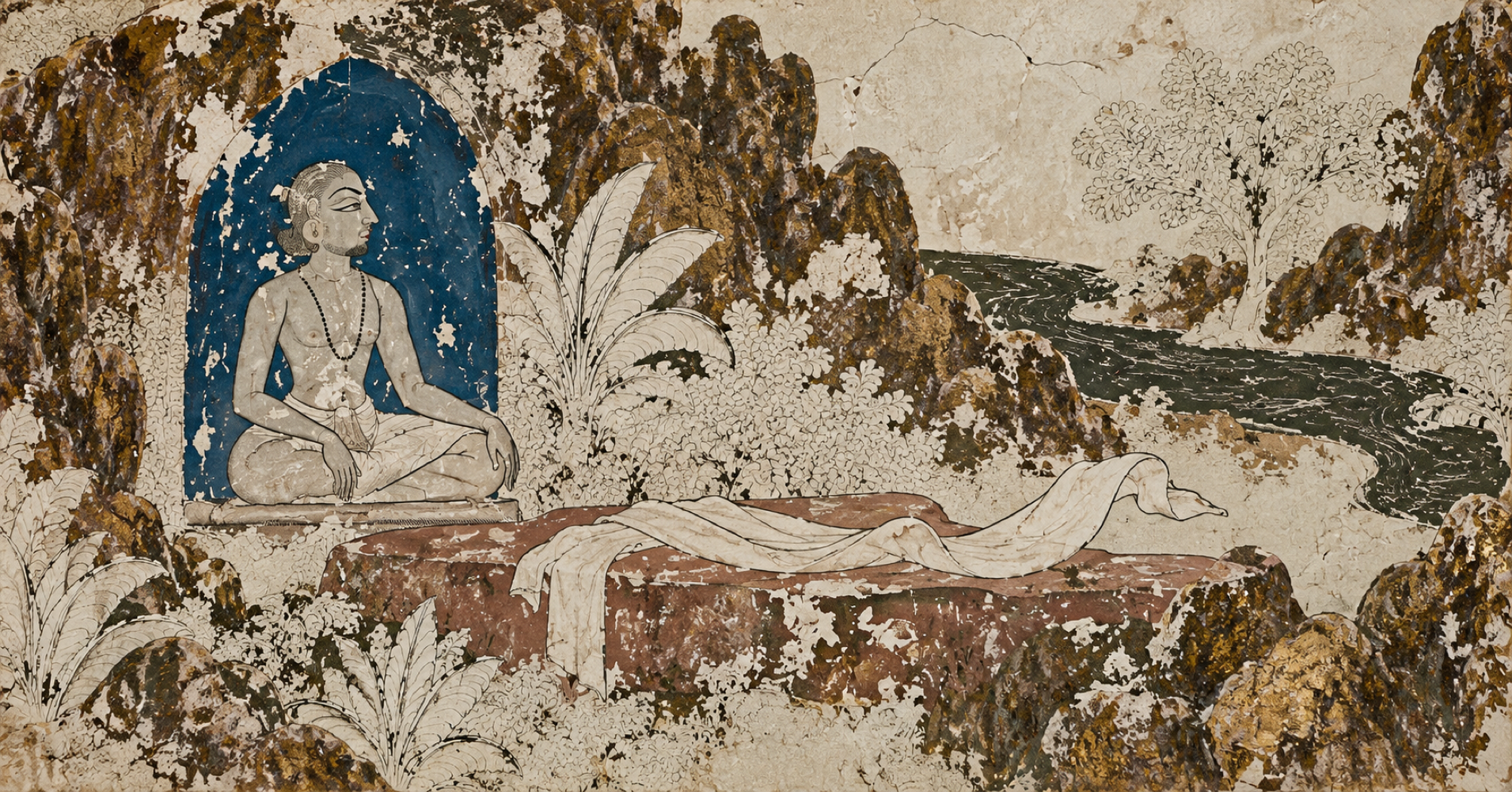
A long folded strip of cloth before a seated figure.

Gorakṣaśataka 20–28: Cloth, Pull and Breath in a Difficult Passage

How do the manual actions fit together? The working text gives a partly uncertain technical sequence and sweeping historical claims of efficacy.

Dr. Ronald Steiner Dr. Ronald Steiner
Gorakṣaśataka (Original) 20
इडायां वहति प्राणे बद्ध्वा पद्मासनं दृढम् |
iḍāyāṃ vahati prāṇe; baddhvā padmāsanaṃ dṛḍham | Analysis ▾ Analysis ▴
iḍāyām
lokative singular
substantive feminine
in Iḍā
vahati
lokative absolutus singular masculine present participle active
verbal root
while flowing
prāṇe
lokative singular
substantive masculine
breath
baddhvā
absolutus
verbal root
having assumed
padma
karmadhāraya-compound
substantive neuter
lotus
āsanam
accusative singular
substantive neuter
the seated posture
dṛḍham
adverb
firmly
द्वादशाङ्गुलदैर्घ्यं च अम्बरं चतुरङ्गुलम् ||20||
dvādaśāṅgula-dairghyaṃ ca*; ambaraṃ catur-aṅgulam ||20|| Analysis ▾ Analysis ▴
dvādaśa
dvigu-compound
numeral
twelve
aṅgula
tatpuruṣa-compound genitive
substantive neuter
fingerbreadths
dairghyam
accusative singular
substantive neuter
length
ca
particle
and
ambaram
accusative singular
substantive neuter
cloth
catur
dvigu-compound
numeral
four
aṅgulam
accusative singular neuter
substantive neuter
measuring fingerbreadths
While the breath (prāṇe | loc sg) flows (vahati | loc absl sg m pca) in Iḍā (iḍāyām | loc sg), having firmly (dṛḍham) assumed (baddhvā | abs) the lotus posture (padma-āsanam | acc sg), and (ca) [taking] a cloth (ambaram | acc sg) twelve fingerbreadths long (dvādaśa-aṅgula-dairghyam | acc sg) and four fingerbreadths [wide] (catur-aṅgulam | acc sg n) …
Dr. Ronald Steiner - 2026 - historically literal
Prepare in a way that allows your attention to remain with the practice. Posture, breath and your immediate surroundings belong together.
Dr. Ronald Steiner - 2026 - modern transfer
ca* ambaraṃ ] cāmbaraṃ JMoJ
Critical Apparatus

20–22 form a continuous technical instruction that is difficult to interpret. Iḍā is the left breath channel in the yogic model. The cloth’s dimensions alone do not establish an unambiguously reconstructable procedure.

For metrical reading, I resolve cāmbaraṃ into ca* ambaraṃ. The asterisk marks the additional syllable obtained by undoing sandhi; the IAST base remains unchanged. Fifteen syllables become two eight-syllable pādas: dvādaśāṅguladairghyaṃ ca* and ambaraṃ caturaṅgulam, with the patterns GLGLLGGG and GLGLLGLG. G denotes a heavy syllable, L a light one. Yogakuṇḍalinī-Upaniṣad 1.11ab already reads ca ambaraṃ in the checked Sanskrit Documents version. This parallel supports my metrical resolution but is not an independent textual witness to the Gorakṣaśataka.

Apparatus Comment
Gorakṣaśataka (Original) 21
विस्तीर्य तेन तन् नाडीं वेष्टयित्वा ततः सुधीः |
vistīrya tena tan nāḍīṃ; veṣṭayitvā tataḥ sudhīḥ | Analysis ▾ Analysis ▴
vistīrya
absolutus
previx
verbal root
having spread out
tena
instrumental case singular neuter
pronoun dem
through that
tām
accusative singular feminine
pronoun dem
this
nāḍīm
accusative singular
substantive feminine
the channel
veṣṭayitvā
absolutus
verbal root
having wrapped
tataḥ
adverb
then
sudhīḥ
nominative singular masculine
adjective
the wise practitioner
अङ्गुष्ठतर्जनीभ्यां तु हस्ताभ्यां धारयेद्दृढम् ||21||
aṅguṣṭha-tarjanībhyāṃ tu; hastābhyāṃ dhārayed dṛḍham ||21|| Analysis ▾ Analysis ▴
aṅguṣṭha
dvandva-compound
substantive masculine
thumbs
tarjanībhyām
instrumental case dual
substantive feminine
with the index fingers
tu
particle
however
hastābhyām
instrumental case dual
substantive masculine
with both hands
dhārayet
3rd person singular aktive optative causative
verbal root
one should hold
dṛḍham
adverb
firmly
… having spread it out (vistīrya | abs) and wrapped (veṣṭayitvā | abs) that (tām | acc sg f) channel (nāḍīm | acc sg) with it (tena | ins sg n), the wise practitioner (sudhīḥ | nom sg m) should then (tataḥ), however (tu), hold (dhārayet | 3p sg act opt caus) it firmly (dṛḍham) with the thumbs and index fingers (aṅguṣṭha-tarjanībhyām | ins du) of both hands (hastābhyām | ins du).
Dr. Ronald Steiner - 2026 - historically literal
A delicate movement needs reliable support. Notice how support and mobility make each other possible.
Dr. Ronald Steiner - 2026 - modern transfer

tan nāḍīṃ is an unusual combination of forms; I provisionally relate tan to the feminine nāḍīṃ. Exactly what is wrapped and held remains insufficiently specified in the working text. The translation does not fill this gap with modern anatomy.

Apparatus Comment
Gorakṣaśataka (Original) 22
स्वशक्त्या चालयेद्वामे दक्षिणे च पुनः पुनः |
sva-śaktyā cālayed vāme; dakṣiṇe ca punaḥ punaḥ | Analysis ▾ Analysis ▴
sva
karmadhāraya-compound
adjective
own
śaktyā
instrumental case singular
substantive feminine
with strength
cālayet
3rd person singular aktive optative causative
verbal root
one should move
vāme
lokative singular masculine
adjective
to the left
dakṣiṇe
lokative singular masculine
adjective
to the right
ca
particle
and
punaḥ
adverb
again
punaḥ
adverb
again
मुहूर्तद्वयपर्यन्तं निर्भयाच्चालयेदसौ ||22||
muhūrta-dvaya-paryantaṃ; nirbhayāc cālayed asau ||22|| Analysis ▾ Analysis ▴
muhūrta
tatpuruṣa-compound genitive
substantive masculine
muhūrta, a period of time
dvaya
tatpuruṣa-compound genitive
substantive neuter
pair
paryantam
accusative singular
substantive masculine
until the end
nirbhayāt
ablative singular neuter
adjective
from fearlessness
cālayet
3rd person singular aktive optative causative
verbal root
one should move
asau
nominative singular masculine
pronoun dem
that person
One should move it (cālayet | 3p sg act opt caus) to the left (vāme | loc sg m) and (ca) right (dakṣiṇe | loc sg m) with one’s own strength (sva-śaktyā | ins sg), again (punaḥ) and again (punaḥ). That person (asau | nom sg m) should move it (cālayet | 3p sg act opt caus) fearlessly (nirbhayāt | abl sg n) for two muhūrtas (muhūrta-dvaya-paryantam | acc sg).
Dr. Ronald Steiner - 2026 - historically literal
Repetition lets you sense differences. Remain attentive to your own measure and limits.
Dr. Ronald Steiner - 2026 - modern transfer

The source specifies two muhūrtas. The German rendering calls these “periods of time”; the English retains the traditional unit muhūrta. The passage provides no sufficient basis for prescribing a present-day practice duration. nirbhayāt is formally ablative and is understood adverbially.

Apparatus Comment
Gorakṣaśataka (Original) 23
ऊर्ध्वम् आकर्षयेत्किंचित्सुषुम्नां कुण्डलीगताम् |
ūrdhvam ākarṣayet kiṃcit; suṣumnāṃ kuṇḍalī-gatām | Analysis ▾ Analysis ▴
ūrdhvam
adverb
upwards
ākarṣayet
3rd person singular aktive optative causative
previx
verbal root
one should draw
kiṃcit
accusative singular neuter
pronoun inter
particle
a little
suṣumnām
accusative singular
suṣumnā
substantive feminine
Suṣumnā
kuṇḍalī
tatpuruṣa-compound accusative
substantive feminine
Kuṇḍalī
gatām
accusative singular feminine past participle passive
verbal root
having reached
तेन कुण्डलिनी तस्या सुषुम्नाया मुखं व्रजेत् ||23||
tena kuṇḍalinī tasyā; suṣumnāyā mukhaṃ vrajet ||23|| Analysis ▾ Analysis ▴
tena
instrumental case singular neuter
pronoun dem
through that
kuṇḍalinī
nominative singular
substantive feminine
Kuṇḍalinī
tasyāḥ
genitive singular feminine
pronoun dem
of her
suṣumnāyāḥ
genitive singular
suṣumnā
substantive feminine
of Suṣumnā
mukham
accusative singular
substantive neuter
the opening
vrajet
3rd person singular aktive optative
verbal root
she should reach
One should draw (ākarṣayet | 3p sg act opt caus) Suṣumnā (suṣumnām | acc sg), which is situated at Kuṇḍalī (kuṇḍalī-gatām | acc sg f ppp), a little (kiṃcit | acc sg n) upwards (ūrdhvam). Through this (tena | ins sg n), Kuṇḍalinī (kuṇḍalinī | nom sg) should reach (vrajet | 3p sg act opt) the opening (mukham | acc sg) of that (tasyāḥ | gen sg f) Suṣumnā (suṣumnāyāḥ | gen sg).
Dr. Ronald Steiner - 2026 - historically literal
A small change of direction can open a way in. Attend to transitions as well as the destination.
Dr. Ronald Steiner - 2026 - modern transfer

Suṣumnā is the central channel of the yogic model of the body. kuṇḍalīgatām is ambiguous; I first translate its recognisable formation without fixing an anatomical interpretation of the process.

Apparatus Comment
Gorakṣaśataka (Original) 24
जहाति तस्मात्प्राणो ऽपि सुषुम्नां व्रजति स्वतः |
jahāti tasmāt prāṇo 'pi; suṣumnāṃ vrajati svataḥ | Analysis ▾ Analysis ▴
jahāti
3rd person singular aktive present
verbal root
leaves
tasmāt
ablative singular neuter
pronoun dem
therefore
prāṇaḥ
nominative singular
substantive masculine
breath
api
particle
also
suṣumnām
accusative singular
suṣumnā
substantive feminine
Suṣumnā
vrajati
3rd person singular aktive present
verbal root
moves
svataḥ
adverb
of itself
तुन्दे तु ताणं कुर्याच्च कण्ठसंकोचने कृते ||24||
tunde tu tāṇaṃ kuryāc ca; kaṇṭha-saṃkocane kṛte ||24|| Analysis ▾ Analysis ▴
tunde
lokative singular
substantive neuter
in the belly
tu
particle
however
tāṇam
accusative singular
tāṇa
substantive masculine
a pull
kuryāt
3rd person singular aktive optative
verbal root
one should perform
ca
particle
and
kaṇṭha
tatpuruṣa-compound genitive
substantive masculine
of the throat
saṃkocane
lokative singular
substantive neuter
in contraction
kṛte
lokative absolutus singular neuter past participle passive
verbal root
when performed
[The breath] leaves [that place] (jahāti | 3p sg act pres); therefore (tasmāt | abl sg n) the breath (prāṇaḥ | nom sg) too (api) enters (vrajati | 3p sg act pres) Suṣumnā (suṣumnām | acc sg) of its own accord (svataḥ). And (ca) one should, however (tu), perform (kuryāt | 3p sg act opt) a pull (tāṇam | acc sg) in the belly (tunde | loc sg), when contraction of the throat (kaṇṭha-saṃkocane | loc sg) has been performed (kṛte | loc absl sg n ppp).
Dr. Ronald Steiner - 2026 - historically literal
A change in one place may appear elsewhere. Explore these connections without trying to force them.
Dr. Ronald Steiner - 2026 - modern transfer
tunde ] ante R7874apJM
kaṇṭha ] karṇa R7874apJM
Critical Apparatus

I take the unexpressed subject of jahāti to be the breath: it leaves its previous location and enters the central channel. This accords with the context in Mallinson 2012, pp. 267–268. Its resumption by prāṇaḥ remains in the Sanskrit. This does not settle the exact physical execution of the pull and throat lock.

Apparatus Comment
Gorakṣaśataka (Original) 25
सरस्वत्याश्चालनेन वक्षः स्यादूर्ध्वगो मरुत् |
sarasvatyāś cālanena; vakṣaḥ syād ūrdhva-go marut | Analysis ▾ Analysis ▴
sarasvatyāḥ
genitive singular
substantive feminine
of Sarasvatī
cālanena
instrumental case singular
substantive neuter
through moving
vakṣaḥ
accusative singular
substantive neuter
the chest
syāt
3rd person singular aktive optative
verbal root
it would be
ūrdhva
upapada-compound
adjective
upward
gaḥ
nominative singular masculine
adjective
going
marut
nominative singular
substantive masculine
breath
सूर्येण पूरयेद्वायुं सरस्वत्याश्च चालने ||25||
sūryeṇa pūrayed vāyuṃ; sarasvatyāś ca cālane ||25|| Analysis ▾ Analysis ▴
sūryeṇa
instrumental case singular
substantive masculine
through the sun
pūrayet
3rd person singular aktive optative causative
verbal root
one should fill
vāyum
accusative singular
substantive masculine
breath
sarasvatyāḥ
genitive singular
substantive feminine
of Sarasvatī
ca
particle
and
cālane
lokative singular
substantive neuter
in moving
Through moving (cālanena | ins sg) Sarasvatī (sarasvatyāḥ | gen sg), the breath (marut | nom sg) would (syāt | 3p sg act opt) rise (ūrdhva-gaḥ | nom sg m) to the chest (vakṣaḥ | acc sg). One should draw in (pūrayet | 3p sg act opt caus) the breath (vāyum | acc sg) through the sun (sūryeṇa | ins sg). And (ca) in moving (cālane | loc sg) Sarasvatī (sarasvatyāḥ | gen sg) …
Dr. Ronald Steiner - 2026 - historically literal
Giving the breath a direction can change perception. Notice where your attention travels with it.
Dr. Ronald Steiner - 2026 - modern transfer

The Sanskrit source brackets part of this passage; a bracketed clause also continues in 26. I translate all the active wording, including its repetitions. The source brackets remain visible in the Sanskrit. In the German and English translations, square brackets enclose only supplied words, not these transmitted passages. Mallinson’s printed translation (2012, pp. 267–268) brings the sequence together without the repetition. The working text’s direction “up to the chest” also differs from his “up from the chest”; here I retain the closer correspondence to the words.

Apparatus Comment
Gorakṣaśataka (Original) 26
कण्ठसंकोचनं कृत्वा वक्षः स्यादूर्ध्वगो मरुत् |
kaṇṭha-saṃkocanaṃ kṛtvā; vakṣaḥ syād ūrdhva-go marut | Analysis ▾ Analysis ▴
kaṇṭha
tatpuruṣa-compound genitive
substantive masculine
of the throat
saṃkocanam
accusative singular
substantive neuter
contraction
kṛtvā
absolutus
verbal root
having performed
vakṣaḥ
accusative singular
substantive neuter
the chest
syāt
3rd person singular aktive optative
verbal root
it would be
ūrdhva
upapada-compound
adjective
upward
gaḥ
nominative singular masculine
adjective
going
marut
nominative singular
substantive masculine
breath
तस्मात्संचालयेन् नित्यं शब्दगर्भां सरस्वतीम् ||26||
tasmāt saṃcālayen nityaṃ; śabda-garbhāṃ sarasvatīm ||26|| Analysis ▾ Analysis ▴
tasmāt
ablative singular neuter
pronoun dem
therefore
saṃcālayet
3rd person singular aktive optative causative
previx
verbal root
one should move
nityam
adverb
constantly
śabda
bahuvrīhi-compund
substantive masculine
sound
garbhām
accusative singular feminine
adjective
containing
sarasvatīm
accusative singular
substantive feminine
Sarasvatī
… after [one] has performed (kṛtvā | abs) contraction of the throat (kaṇṭha-saṃkocanam | acc sg), the breath (marut | nom sg) would (syāt | 3p sg act opt) rise (ūrdhva-gaḥ | nom sg m) to the chest (vakṣaḥ | acc sg). Therefore (tasmāt | abl sg n) one should constantly (nityam) move (saṃcālayet | 3p sg act opt caus) Sarasvatī (sarasvatīm | acc sg), who contains sound (śabda-garbhām | acc sg f).
Dr. Ronald Steiner - 2026 - historically literal
Sound, breath and movement can come together. Listen more closely instead of merely reproducing an outward form.
Dr. Ronald Steiner - 2026 - modern transfer
saṃcālayen ] saṃcālen R7874apJM
Critical Apparatus

The bracketed passage in the working text is translated; its source brackets are not transferred as supplementation brackets into the translation. śabdagarbhā, “containing sound”, refers to Sarasvatī. The exact connection between channel, sound and manual action remains unresolved by this description alone.

Apparatus Comment
Gorakṣaśataka (Original) 27
यस्याः संचालनेनैव योगी रोगैः प्रमुच्यते |
yasyāḥ saṃcālanenaiva; yogī rogaiḥ pramucyate | Analysis ▾ Analysis ▴
yasyāḥ
genitive singular feminine
pronoun rel
whose
sañcālanena
instrumental case singular
substantive neuter
through moving
eva
particle
indeed; precisely
yogī
nominative singular
substantive masculine
the yogin
rogaiḥ
instrumental case plural
substantive masculine
from diseases
pramucyate
3rd person singular passive present
previx
verbal root
is freed
गुल्मं जलोदरप्लीहा ये चान्ये तुन्दमध्यगाः ||27||
gulmaṃ jalodara-plīhā; ye cānye tunda-madhya-gāḥ ||27|| Analysis ▾ Analysis ▴
gulmam
accusative singular
substantive masculine
abdominal mass
jala
tatpuruṣa-compound genitive
substantive neuter
water
udara
dvandva-compound
substantive neuter
belly
plīhā
nominative singular
substantive masculine
spleen disease
ye
nominative plural masculine
pronoun rel
which
ca
particle
and
anye
nominative plural masculine
pronoun quant
other
tunda
tatpuruṣa-compound genitive
substantive neuter
belly
madhya
tatpuruṣa-compound lokative
substantive neuter
middle
gāḥ
nominative plural masculine
adjective
situated
Through moving (sañcālanena | ins sg) her (yasyāḥ | gen sg f) alone (eva), the yogin (yogī | nom sg) is freed (pramucyate | 3p sg pas pres) from diseases (rogaiḥ | ins pl): an abdominal mass (gulmam | acc sg), dropsy and spleen disease (jala-udara-plīhā | nom sg), and (ca) whatever (ye | nom pl m) other (anye | nom pl m) [conditions] are located within the belly (tunda-madhya-gāḥ | nom pl m) …
Dr. Ronald Steiner - 2026 - historically literal
Your abdomen belongs within your awareness of your body. Attend to discomfort and seek appropriate assessment.
Dr. Ronald Steiner - 2026 - modern transfer

The disease names belong to a historical medical system. Their equivalence with present-day diagnoses is not established. The list shifts between grammatical cases; its sentence ends in 28. The asserted cure is translated as a claim of the text.

Apparatus Comment
Gorakṣaśataka (Original) 28
सर्वे ते शक्तिचालेन रोगा नश्यन्ति निश्चयम् |
sarve te śakti-cālena; rogā naśyanti niścayam | Analysis ▾ Analysis ▴
sarve
nominative plural masculine
pronoun quant
all
te
nominative plural masculine
pronoun dem
these
śakti
tatpuruṣa-compound genitive
substantive feminine
of the power
cālena
instrumental case singular
substantive masculine
through moving
rogāḥ
nominative plural
substantive masculine
diseases
naśyanti
3rd person plural aktive present
verbal root
disappear
niścayam
niścayam
adverb
certainly
प्राणरोधम् अथेदानीं प्रवक्ष्यामि समासतः ||28||
prāṇa-rodham athedānīṃ; pravakṣyāmi samāsataḥ ||28|| Analysis ▾ Analysis ▴
prāṇa
tatpuruṣa-compound genitive
substantive masculine
of the breath
rodham
accusative singular
substantive masculine
restraint
atha
particle
now
idānīm
adverb
now
pravakṣyāmi
1st person singular aktive future
previx
verbal root
I shall explain
samāsataḥ
adverb
briefly
All (sarve | nom pl m) these (te | nom pl m) diseases (rogāḥ | nom pl) certainly (niścayam) disappear (naśyanti | 3p pl act pres) through moving the power (śakti-cālena | ins sg). Next (atha), I shall now (idānīm) explain (pravakṣyāmi | 1p sg act fut) briefly (samāsataḥ) the restraining of the breath (prāṇa-rodham | acc sg).
Dr. Ronald Steiner - 2026 - historically literal
A new focus can take the place of a previous phase of practice. Notice the transition from movement to observing the breath.
Dr. Ronald Steiner - 2026 - modern transfer

The two half-verses address different topics: the end of moving the power and the beginning of the teaching on breath. I retain the working text’s number while making the thematic transition visible. The source reads “sarve te śakticālena rogā”; that word order is binding for the base text.

Apparatus Comment

Continue with AYI Free

Illustrations: AI-generated.

Editor

Dr. Ronald Steiner

From Ulm

The "Yoga Doc" - Dr. Ronald Steiner is the founder of the AYI method. This method links traditional Ashtanga Yoga with innovative Yogatherapy and living Philosophy. This forms a practice that is personal for each and... more ›

Messages and ratings
0 messages

Please log in to write a message. Go to login

No messages yet.