
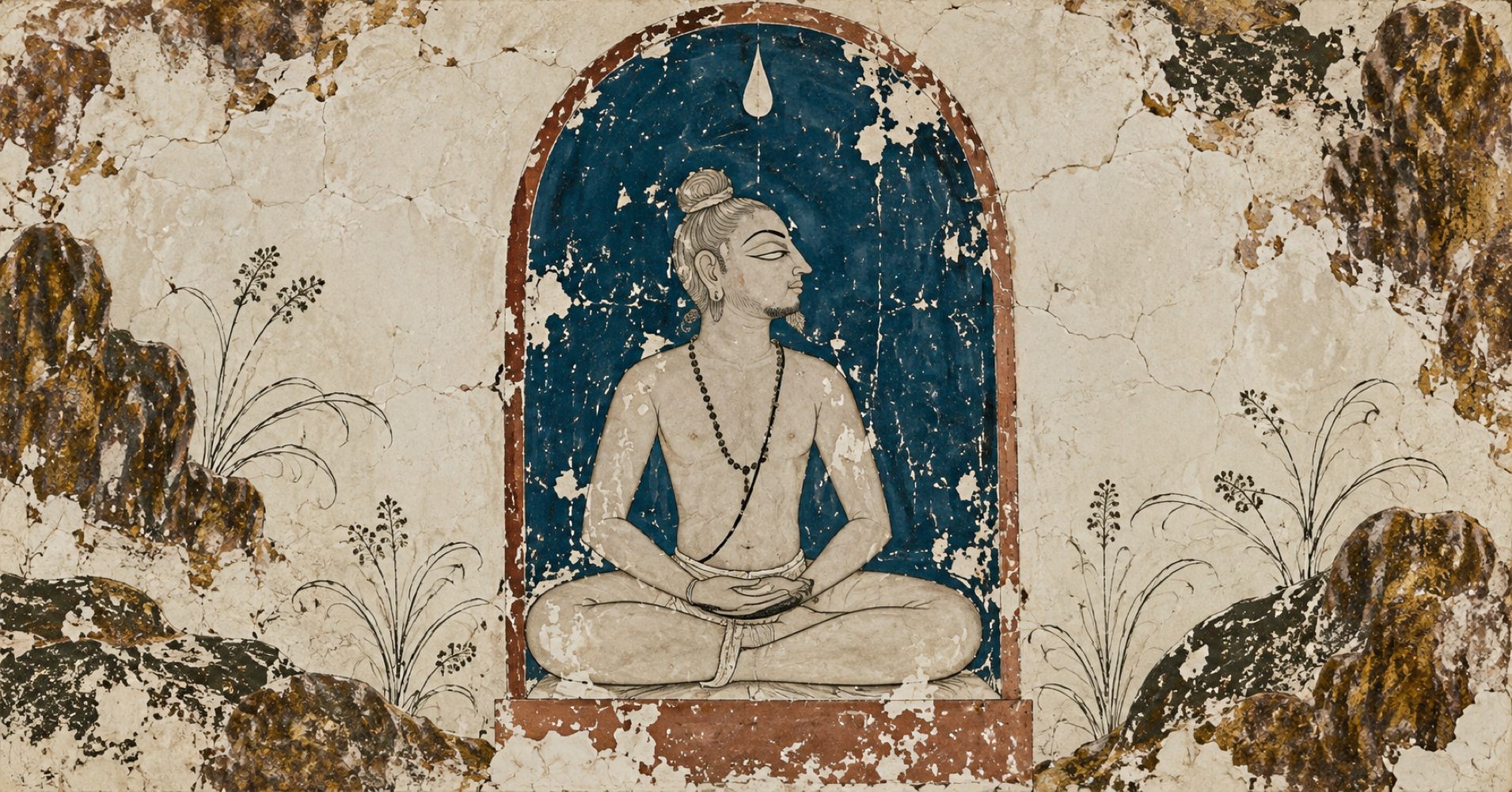
Quiet seated figure with a pale drop and curved grasses.

Gorakṣaśataka 101–101.1: Wine, Meat and Union as Inner Images

The final stanza recasts outward forms of enjoyment as inward yogic processes. A crux remains unresolved; the colophon closes the text.

Dr. Ronald Steiner Dr. Ronald Steiner
Gorakṣaśataka (Original) 101
या बिन्द्वाख्येति धारा विगलितमनसा तां पिबामो न मद्यं |
yā bindv-ākhyeti dhārā vigalita-manasā tāṃ pibāmo na madyaṃ | Analysis ▾ Analysis ▴
yā
nominative singular feminine
pronoun rel
which
bindu
upapada-compound
substantive masculine
drop
ākhyā
nominative singular feminine
adjective
called
iti
particle
thus
dhārā
nominative singular
substantive feminine
stream
vigalita
karmadhāraya-compound past participle passive
previx
verbal root
dissolved
manasā
instrumental case singular
substantive neuter
with mind
tām
accusative singular feminine
pronoun dem
this
pibāmaḥ
1st person plural aktive present
verbal root
we drink
na
particle
not
madyam
accusative singular
substantive neuter
wine
पञ्चानाम् इन्द्रियाणां विषयनिरसनं चर्वयामो न मांसम् |
pañcānām indriyāṇāṃ viṣaya-nirasanaṃ carvayāmo na māṃsam | Analysis ▾ Analysis ▴
pañcānām
genitive plural neuter
numeral
of the five
indriyāṇām
genitive plural
substantive neuter
senses
viṣaya
tatpuruṣa-compound genitive
substantive masculine
objects
nirasanam
accusative singular
substantive neuter
rejection
carvayāmaḥ
1st person plural aktive present
verbal root
we chew
na
particle
not
māṃsam
accusative singular
substantive neuter
meat
आलिङ्गामो न कान्तां कुशकुटिलतनुं नाडिकां तां सुषुम्नां |
āliṅgāmo na kāntāṃ kuśa-kuṭila-tanuṃ nāḍikāṃ tāṃ suṣumnāṃ | Analysis ▾ Analysis ▴
āliṅgāmaḥ
1st person plural aktive present
previx
verbal root
we embrace
na
particle
not
kāntām
accusative singular
kāntā
substantive feminine
lover
kuśa
tatpuruṣa-compound genitive
substantive masculine
kuśa grass
kuṭila
karmadhāraya-compound
adjective
curved
tanum
accusative singular feminine
substantive feminine
having the form
nāḍikām
accusative singular
substantive feminine
channel
tām
accusative singular feminine
pronoun dem
this
suṣumnām
accusative singular
suṣumnā
substantive feminine
Suṣumnā
शून्ये चित्ते प्रलीने प्रविलय विवशा मैथुनं चेन् न योनौ ||101||
śūnye citte pralīne pravilaya vivaśā maithunaṃ cen na yonau ||101|| Analysis ▾ Analysis ▴
śūnye
lokative singular neuter
adjective
empty
citte
lokative singular
substantive neuter
mind
pralīne
lokative absolutus singular neuter past participle passive
previx
verbal root
when dissolved
pravilaya
unclear: complete dissolution; crux
vivaśā
unclear: powerless; grammatical connection uncertain
maithunam
nominative singular
substantive neuter
sexual union
cet
particle
if; when
na
particle
not
yonau
lokative singular
substantive feminine
in the female sexual organ
We drink (pibāmaḥ | 1p pl act pres) that (tām | acc sg f) stream (dhārā | nom sg) which (yā | nom sg f) is called the drop (bindu-ākhyā | nom sg f)—thus (iti) [it is named]—with a dissolved mind (vigalita-manasā | ins sg), not (na) wine (madyam | acc sg). We chew (carvayāmaḥ | 1p pl act pres) the rejection of the objects (viṣaya-nirasanam | acc sg) of the five (pañcānām | gen pl n) senses (indriyāṇām | gen pl), not (na) meat (māṃsam | acc sg). We embrace (āliṅgāmaḥ | 1p pl act pres) not (na) a lover (kāntām | acc sg), [but] that (tām | acc sg f) Suṣumnā (suṣumnām | acc sg), the channel (nāḍikām | acc sg) whose form is curved like kuśa grass (kuśa-kuṭila-tanum | acc sg f). If (cet) there is sexual union (maithunam | nom sg), [it is] in complete dissolution (pravilaya), without volition (vivaśā), when the mind (citte | loc sg) has dissolved (pralīne | loc absl sg n ppp) in the void (śūnye | loc sg n), not (na) in the female sexual organ (yonau | loc sg).
Dr. Ronald Steiner - 2026 - historically literal
The closing image turns drinking, enjoyment and union inwards. Ask which experience you seek behind an outward form.
Dr. Ronald Steiner - 2026 - modern transfer
vivaśā ] vivaśan R7874apJM
Critical Apparatus

The final stanza interprets wine, meat and sexual union as inward yogic processes. bindu, “drop”, names the stream being drunk. I relate cet to union: “if there is union”. The preceding locative construction describes the mind dissolved in the void. I render the damaged words pravilaya and vivaśā according to their recognisable sense as “in complete dissolution” and “without volition”; their case and subject connections are uncertain. pravilaya is explicitly marked as a crux in the working text, while vivaśā is already Mallinson’s conjecture. His printed translation (2012, p. 272) confirms the inward interpretation of union but does not resolve these forms individually. The translated sentence connection is therefore provisional. In the kuśa comparison, I understand tanu as the form or body of the channel, without adding “slender” as a further quality.

Apparatus Comment
Gorakṣaśataka (Original) 101.1
इति गोरक्षशतकम् संपूर्णम् ||101.1||
iti gorakṣa-śatakam saṃpūrṇam ||101.1|| Analysis ▾ Analysis ▴
iti
particle
thus
gorakṣa
tatpuruṣa-compound genitive
substantive masculine
Gorakṣa’s
śatakam
nominative singular
substantive neuter
hundred verses
saṃpūrṇam
nominative singular neuter past participle passive
previx
verbal root
complete
Thus (iti) Gorakṣa’s Hundred Verses (gorakṣa-śatakam | nom sg) is complete (saṃpūrṇam | nom sg n ppp).
Dr. Ronald Steiner - 2026 - historically literal
A text ends; your engagement with it can continue.
Dr. Ronald Steiner - 2026 - modern transfer

Continue with AYI Free

Illustrations: AI-generated.

Editor

Dr. Ronald Steiner

From Ulm

The "Yoga Doc" - Dr. Ronald Steiner is the founder of the AYI method. This method links traditional Ashtanga Yoga with innovative Yogatherapy and living Philosophy. This forms a practice that is personal for each and... more ›

Messages and ratings
0 messages

Please log in to write a message. Go to login

No messages yet.