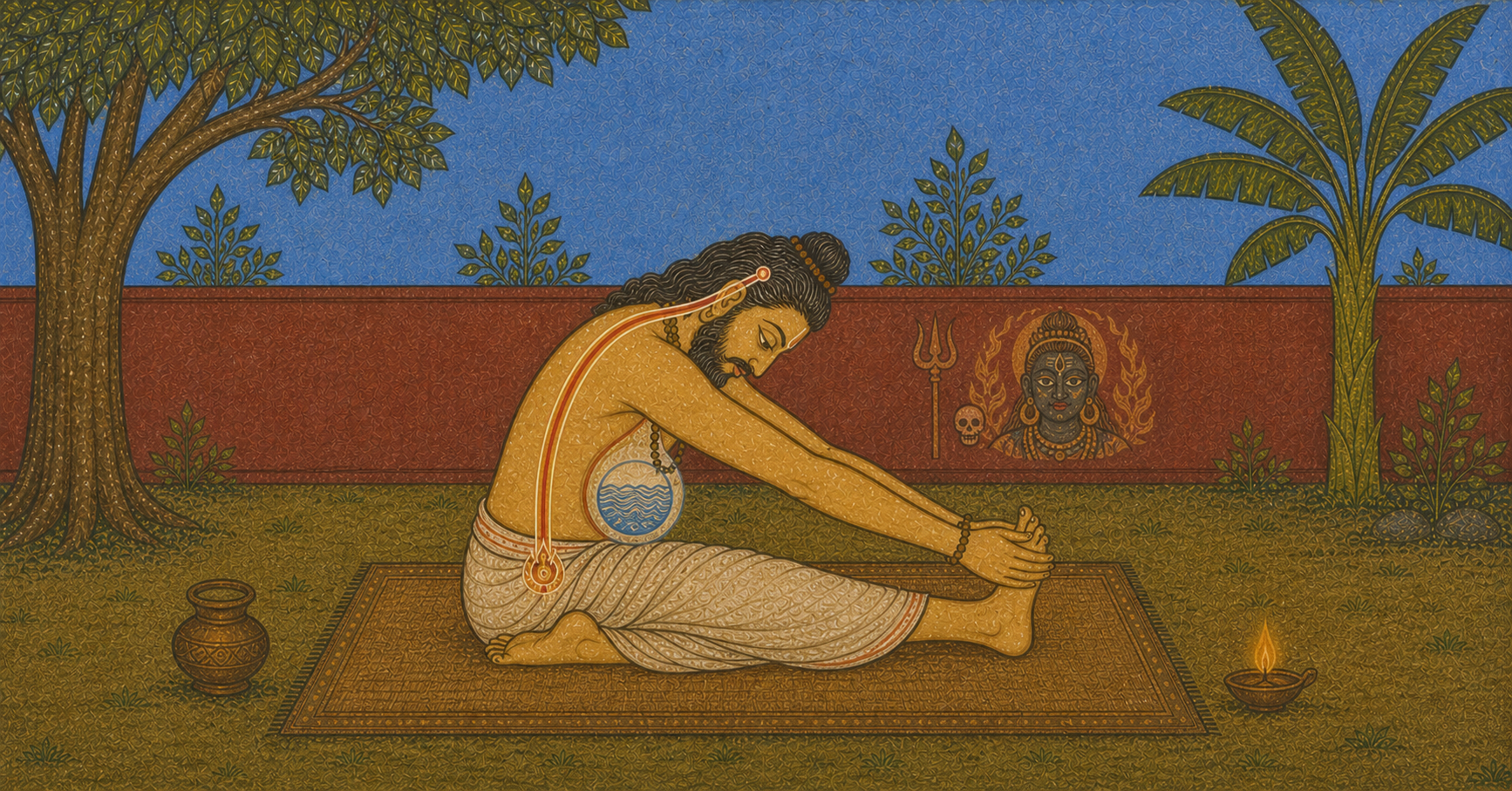
DYS 132–134: Mahāmudrā

Dattātreyayogaśāstra 132–134: Heel Pressure, Extension, and Breath Restraint

The left heel is placed at the perineum, the right leg extended and held with both hands. With the chin on the chest, the breath is filled and held before the method is practised on the other side.

Dr. Ronald Steiner Dr. Ronald Steiner Nils Jacob Liersch Nils Jacob Liersch
Dattātreyayogaśāstra 132
महामुद्रां प्रवक्ष्यामि भैरवेणोक्तमादरात् |
mahā-mudrāṃ pravakṣyāmi; bhairaveṇoktam ādarāt | Analysis ▾ Analysis ▴
mahā
karmadhāraya-compound
adjective
great
mudrām
accusative singular
substantive feminine
seal
pravakṣyāmi
1st person singular future
previx
verbal root
I shall teach
bhairaveṇa
instrumental case singular
substantive masculine
by Bhairava
uktam
nominative singular neuter past participle passive
verbal root
taught
ādarāt
ablative singular
substantive masculine
out of respect
पार्ष्णिं वामस्य पादस्य योनिस्थाने नियोजयेत् ||132||
pārṣṇiṃ vāmasya pādasya; yoni-sthāne niyojayet ||132|| Analysis ▾ Analysis ▴
pārṣṇim
accusative singular
substantive masculine
heel
vāmasya
genitive singular masculine
adjective
of the left
pādasya
genitive singular
substantive masculine
foot
yoni
tatpuruṣa-compound genitive
substantive feminine
perineal region
sthāne
lokative singular
substantive neuter
place
niyojayet
3rd person singular aktive optative
previx
verbal root
he should place
Metre: Anuṣṭubh
Out of respect (ādarāt | abl sg), I shall proclaim (pravakṣyāmi | 1p sg fut) the great seal (mahā-mudrām | acc sg), taught (uktam | acc sg) by Bhairava (bhairaveṇa | ins sg). He should place (niyojayet | 3p sg act opt) the heel (pārṣṇim | acc sg) of the left (vāmasya | gen sg) foot (pādasya | gen sg) at the perineum (yoni-sthāne | loc sg).
Dr. Ronald Steiner - 2026 - historically literal
Out of respect for the tradition, Dattātreya begins with Mahāmudrā: the left heel is placed at the perineum.
Dr. Ronald Steiner - 2026 - modern transfer
Dattātreyayogaśāstra 133
प्रसार्य दक्षिणं पादं हस्ताभ्यां धारयेद्दृढम् |
prasārya dakṣiṇaṃ pādaṃ; hastābhyāṃ dhārayed dṛḍham | Analysis ▾ Analysis ▴
prasārya
absolutus
previx
verbal root
having extended
dakṣinam
accusative singular masculine
adjective
right
pādam
accusative singular
substantive masculine
foot
hastābhyām
instrumental case dual
substantive masculine
with both hands
dhārayet
3rd person singular aktive optative
verbal root
he should hold
dṛḍham
adverb
firmly
चिबुकं हृदि विन्यस्य पूरयेद्वायुना पुनः ||133||
cibukaṃ hṛdi vinyasya; pūrayed vāyunā punaḥ ||133|| Analysis ▾ Analysis ▴
cibukam
accusative singular
substantive neuter
chin
hṛdi
lokative singular
substantive neuter
on the chest
vinyasya
absolutus
previx
verbal root
having placed
pūrayet
3rd person singular aktive optative
verbal root
should fill
vāyunā
instrumental case singular
substantive masculine
with air
punaḥ
adverb
again
Metre: Anuṣṭubh
Having extended (prasārya | abs) the right (dakṣiṇam | acc sg) foot (pādam | acc sg), he should hold (dhārayet | 3p sg act opt) it firmly (dṛḍham) with both hands (hastābhyām | ins du). Having placed (vinyasya | abs) the chin (cibukam | acc sg) on the chest (hṛdi | loc sg), he should again (punaḥ) fill himself (pūrayet | 3p sg act opt) with air (vāyunā | ins sg).
Dr. Ronald Steiner - 2026 - historically literal
The right leg is extended and held firmly with both hands. The chin is set on the chest and the practitioner inhales once more.
Dr. Ronald Steiner - 2026 - modern transfer
Dattātreyayogaśāstra 134
कुम्भकेन यथाशक्त्या धारयित्वा तु रेचयेत् |
kumbhakena yathā-śaktyā; dhārayitvā tu recayet | Analysis ▾ Analysis ▴
kumbhakena
instrumental case singular
substantive masculine
breath retention
yathā
adverb
according to
śaktyā
instrumental case singular
substantive feminine
capacity
dhārayitvā
absolutus
verbal root
having retained
tu
particle
but
recayet
3rd person singular aktive optative
verbal root
he should exhale
वामाङ्गेन समभ्यस्य दक्षिणाङ्गेन चाभ्यसेत् ||134||
vāmāṅgena samabhyasya; dakṣiṇāṅgena cābhyaset ||134|| Analysis ▾ Analysis ▴
vāma
karmadhāraya-compound
adjective
left
aṅgena
instrumental case singular
substantive neuter
with the side
samabhyasya
absolutus
previx
previx
verbal root
having practised
dakṣina
karmadhāraya-compound
adjective
right
aṅgena
instrumental case singular
substantive neuter
with the side
ca
particle
and
abhyaset
3rd person singular aktive optative
previx
verbal root
should practise
Metre: Anuṣṭubh
Having held [the breath] (dhārayitvā | abs) with a retention (kumbhakena | ins sg) for as long as possible (yathā-śaktyā | ins sg), he should then (tu) exhale (recayet | 3p sg act opt). Having practised (samabhyasya | abs) on the left side (vāmāṅgena | ins sg), he should also (ca) practise (abhyaset | 3p sg act opt) on the right side (dakṣiṇāṅgena | ins sg).
Dr. Ronald Steiner - 2026 - historically literal
The breath is retained for as long as possible and then released. After practice on the left side, the same method is performed on the right.
Dr. Ronald Steiner - 2026 - modern transfer
recayet JM2024 ] recayed DYŚ
Critical Apparatus

Continue with AYI Free

Illustrations: AI-generated.

Editor

Dr. Ronald Steiner

From Ulm

The "Yoga Doc" - Dr. Ronald Steiner is the founder of the AYI method. This method links traditional Ashtanga Yoga with innovative Yogatherapy and living Philosophy. This forms a practice that is personal for each and... more ›

Nils Jacob Liersch

Meine Begeisterung für Yoga, indische Philosophie und Sanskrit führte mich zum Studium der Indologie und Religionswissenschaft an der Universität Heidelberg. Seit 2004 befinde ich mich auf meinem persönlichen Yogaweg... more ›

Messages and ratings
0 messages

Please log in to write a message. Go to login

No messages yet.