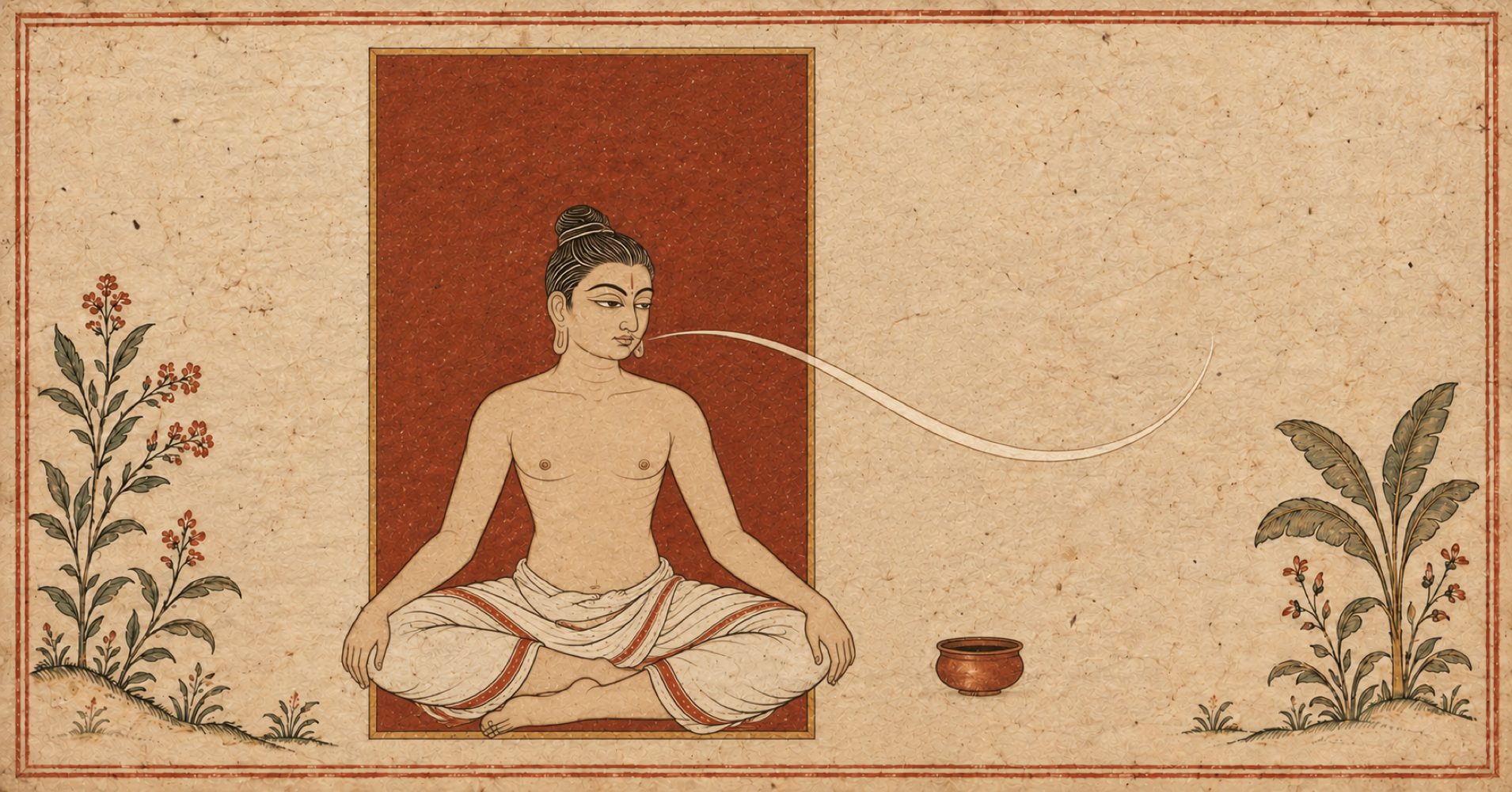
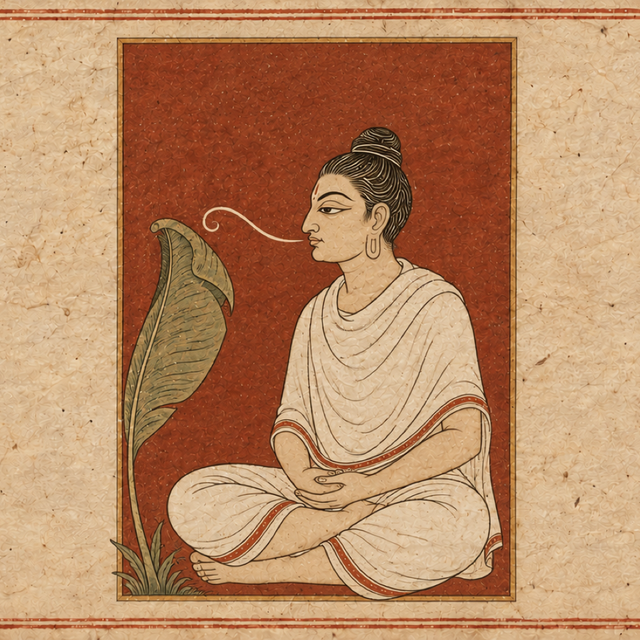
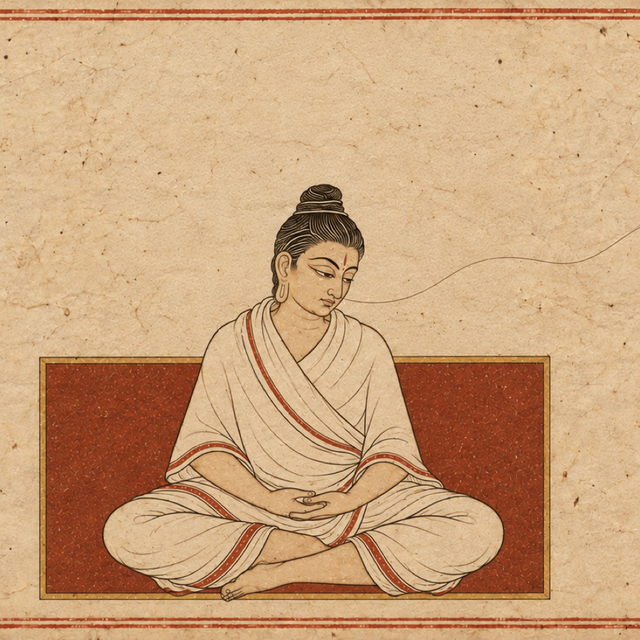
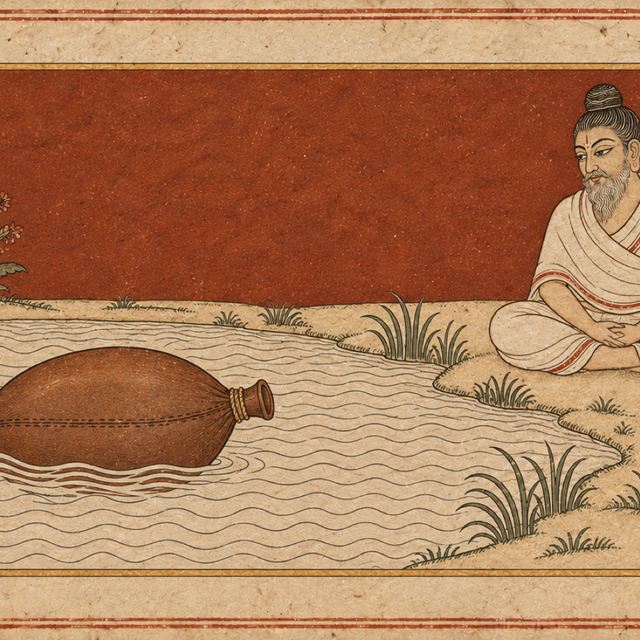
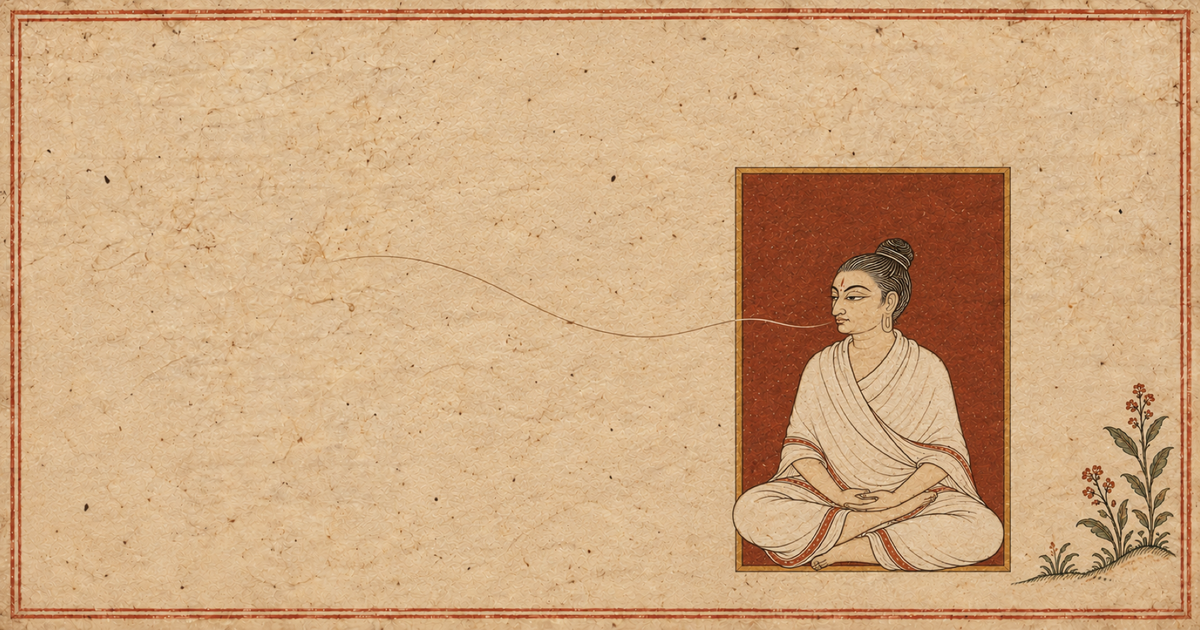


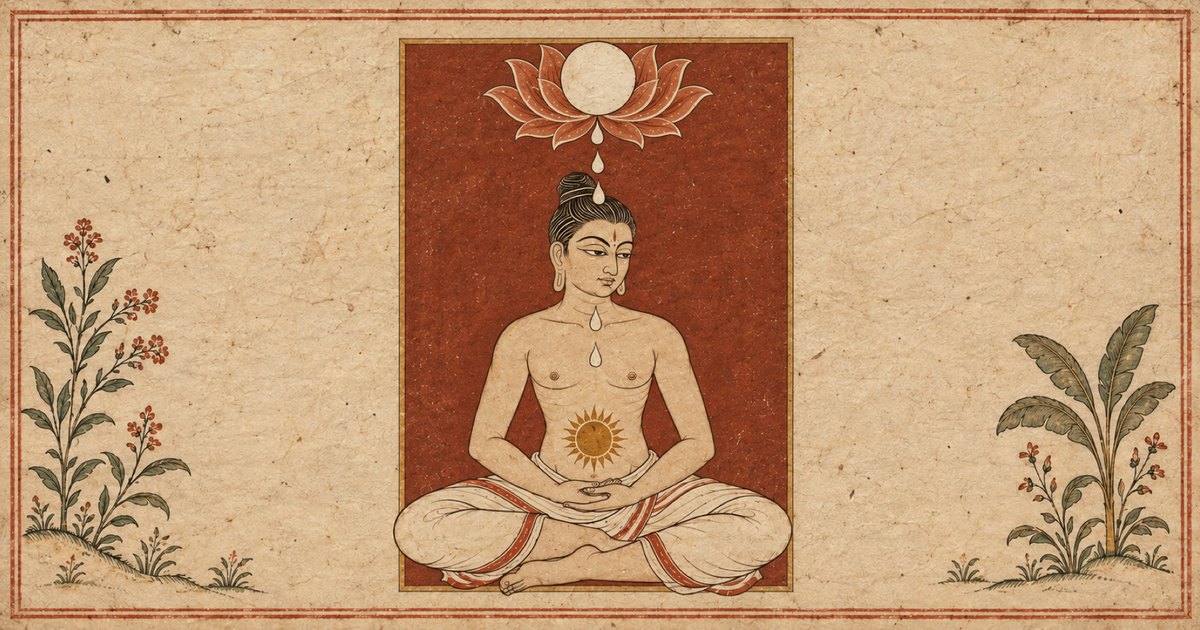
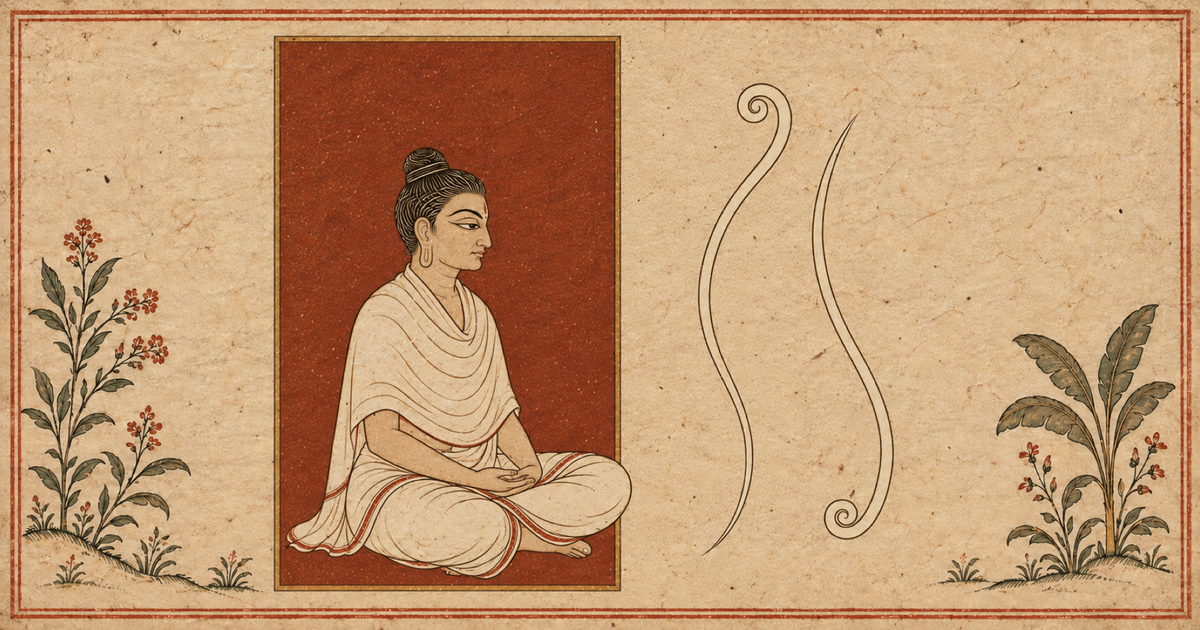

Seated figure with a broad arc of breath and a small copper vessel.

Haṭhatattvakaumudī 10: Breathing forms, inner images and the measure of time

Eight breathing forms open the collection. Further variants combine breath passages, inner images and chains of practice. Stages and time measures close it.

Dr. Ronald Steiner Dr. Ronald Steiner
Seated figure between a dry branch and fresh foliage.

Haṭhatattvakaumudī 10.0*1–5: Sītkā, Śītalī and Sūryabheda through the seasons

Sītkā and Śītalī are described as cooling, Sūryabheda as warming. The introduction links breath retention with purifying the channels, Unmanī and Śāṃbhavī.

Haṭhatattvakaumudī 10.0*1
Metre: none
Now (atha) [follows] a summary of the collection of breath retentions (kumbhaka-saṃgraha-samāsaḥ | nom sg).
Dr. Ronald Steiner - 2026 - historically literal
Haṭhatattvakaumudī 10.0*2
Metre: none
At the beginning (ādau | loc sg), therein (tatra), [stands] the group of eight breath retentions (kumbhakāṣṭakam | nom sg).
Dr. Ronald Steiner - 2026 - historically literal
Haṭhatattvakaumudī 10.1
Metre: Bhujaṅgaprayāta
And (ca) the practitioner (sādhakaḥ | nom sg) should always (sadā) practise (bhajet | 3p sg act opt) the hissing breath Sītkā (sītkām | acc sg), which removes thirst, burning, Pitta and fatigue (tṛṣā-dāha-pitta-śrama-ghnīm | acc sg f), or (vā) Śītalī (śītalīm | acc sg), indeed (eva) in cases of fever and the like (jvarādau | loc sg), and likewise (tathā) in summertime (grīṣma-kāle | loc sg). Then (atha), in the wintry [season] (haime | loc sg m), in cases of Kapha (kaphe | loc sg) and (ca) wind (mārute | loc sg), one who understands (budhaḥ | nom sg) [should practise] Sūryabheda, [the] piercing of the sun (sūrya-bhedam | acc sg).
Dr. Ronald Steiner - 2026 - historically literal
Haṭhatattvakaumudī 10.2
Metre: Drutavilambita
Even (api) a sage (muniḥ | nom sg) afflicted by many diseases (bahu-gadākalitaḥ | nom sg m ppp) [and] without strength (a-balaḥ | nom sg m), through intense (bhṛśam) practice of holding the breath (pavana-sandharaṇābhyasanāt | abl sg), does not (na) expect (manute | 3p sg med pres) in the slightest (manāk) to be overpowered (damanam | acc sg) by the god of death (śamanāt | abl sg). [He lives] on earth (bhuvi | loc sg), his fear gone (gata-bhayaḥ | nom sg m) [and] his mind restrained (saṃyata-mānasaḥ | nom sg m).
Dr. Ronald Steiner - 2026 - historically literal
Haṭhatattvakaumudī 10.3
Metre: Puṣpitāgrā
When the network of vessels (śirā-valaye | loc absl sg) within (antaḥ) the body (vapuṣi | loc sg) has been purified (viśodhite | loc absl sg m ppp) according to the prescribed method (vidhivat) through restraints of the upward-directed breath (uti-samīraṇa-prarodhaiḥ | ins pl), the breath (marut | nom sg) enters (viśati | 3p sg act pres) the mouth of the great path (mahā-pathāsye | loc sg) easily (aram) [and] (ca) without (vinā) force (haṭham | acc sg). For (hi) the serpent (bhujagī | nom sg) [has] withdrawn (apāsya | abs) its mouth (mukham | acc sg).
Dr. Ronald Steiner - 2026 - historically literal
Haṭhatattvakaumudī 10.4
Metre: Bhujaṅgaprayāta
When (yadā) the breath (mārutaḥ | nom sg) [is] skilled in flowing through the middle (madhya-sañcāra-dakṣaḥ | nom sg m), then (tadā) this (etat | nom sg n) mind (cittam | nom sg) of the sage (muneḥ | gen sg) reaches (eti | 3p sg act pres) steadiness (sthairyam | acc sg). That (sā | nom sg f) state (daśā | nom sg) of the heart (hṛdaḥ | gen sg), which (yā | nom sg f) [is] called (uktā | nom sg f ppp) steadiness of mind (manaḥ-sthairyam | nom sg) [and] Unmanī (unmanīm | acc sg), may (syāt | 3p sg act opt) then (tadā) grant the accomplishment of Śāṃbhavī (śāṃbhavī-siddhi-dā | nom sg f) to him (asya | gen sg m).
Dr. Ronald Steiner - 2026 - historically literal
Haṭhatattvakaumudī 10.5
Metre: Pāda 1: Indravajrā; Pāda 2: Indravaṃśā; Pāda 3: Upendravajrā; Pāda 4: Vaṃśastha
For its accomplishment (tat-siddhaye | dat sg), the composed [practitioners] (dhīrāḥ | nom pl m), who know the proper procedure (sādhu-vidhāna-vijñāḥ | nom pl m), also (ca) perform (kurvanti | 3p pl act pres) various (vividhān | acc pl m) breath retentions (kumbhakān | acc pl). Through practising manifold breath retentions (vicitra-kumbhābhyasanāt | abl sg), those (te | nom pl m) practitioners who practise correctly (su-sādhakāḥ | nom pl) attain (bhajanti | 3p pl act pres) varied (vicitrām | acc sg f) hosts of accomplishments (siddhi-gaṇān | acc pl).
Dr. Ronald Steiner - 2026 - historically literal
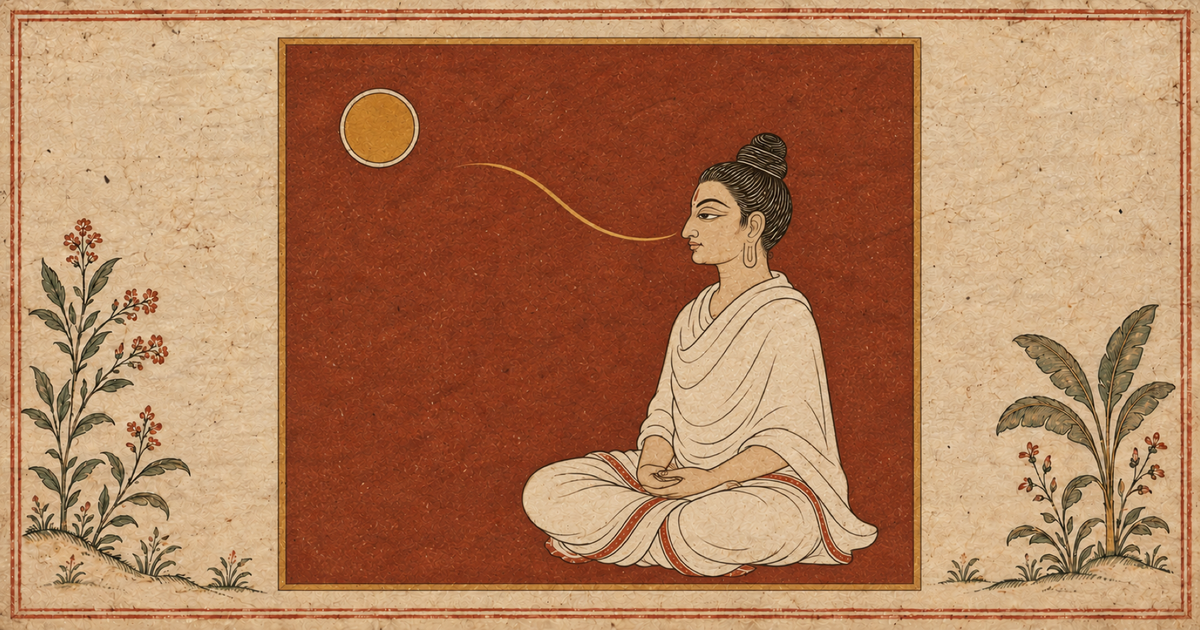
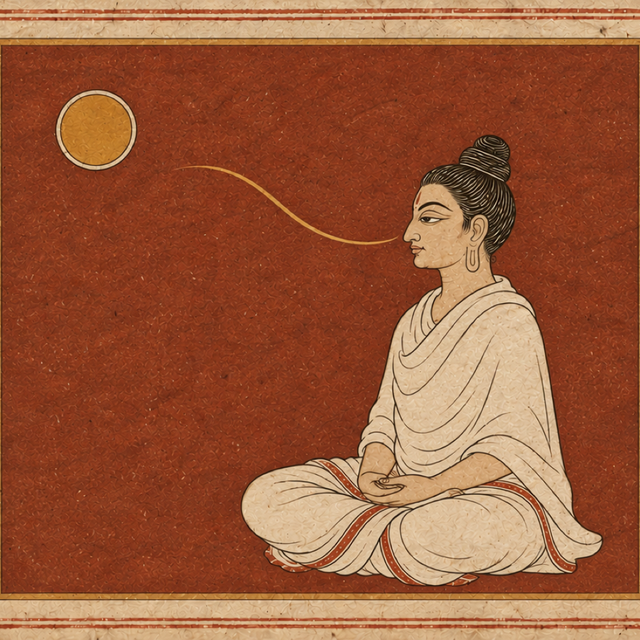
Figure in profile with a small sun and a golden line of breath.

Haṭhatattvakaumudī 10.5*1–6*1: Sūryabhedana / Sūryabheda: Breathing through the solar channel

Sūryabhedana, also called Sūryabheda, combines slow inhalation through the solar channel with retention and slow exhalation. The text describes it as warming.

Haṭhatattvakaumudī 10.5*1
Metre: none
Now (atha) [follows] the Sūryabhedana breath retention, [the] piercing of the sun (sūrya-bhedana-kumbhakaḥ | nom sg).
Dr. Ronald Steiner - 2026 - historically literal
Haṭhatattvakaumudī 10.6
Metre: Sragdharā
Having first (prāk) assumed (baddhvā | abs) Vajrāsana (vajrāsanam | acc sg), [one should] then (anu) draw in (upākṛṣya | abs) the breath (pavanam | acc sg) flowing in from outside (bāhyābhivāham | acc sg m), slowly (mandam), in the solar channel (mārtaṇḍa-nāḍyām | loc sg). And (ca) after (anu) that [inhalation] (tat | acc sg n), [one] should retain [it] (ākumbhayet | 3p sg act opt denom) as far as the ends of the hair and nail tips (kaca-nakhāgrāntam | acc sg).

Afterwards (anu), [one] should slowly (śanaiḥ) release (recayet | 3p sg act opt caus) the retained (ruddham | acc sg m ppp) breath (pavanam | acc sg), [which has] risen (udayātam) through the energy channel (nāḍyā | ins sg). This (etat | nom sg n) Sūryabheda (sūrya-bhedam | nom sg) is described (uktam | nom sg n ppp) [as a procedure] that removes wind (vāta-ghnam | nom sg n) [and] purifies the forehead (bhāla-saṃśodhanam | nom sg n). [It is] indeed (aho) to be performed (vidheyam | nom sg n pfp) repeatedly (asakṛt).
Dr. Ronald Steiner - 2026 - historically literal
Haṭhatattvakaumudī 10.6*1
Metre: none
Thus (iti) [is described] the Sūryabheda breath retention (sūrya-bheda-kumbhakaḥ | nom sg), which removes diseases of Kapha and Vāta, worm disorders and ailments of cold (kapha-vāta-roga-kṛmi-doṣa-śaitya-vikāra-haraḥ | nom sg m), [and] has heating potency (uṣṇa-vīryaḥ | nom sg m).
Dr. Ronald Steiner - 2026 - historically literal
Large profile figure with closed mouth and fine lines of sound.

Haṭhatattvakaumudī 10.6*2–9*1: Ujjāyī / Ujjāyikā: Sound and warmth compared with Sūryabheda

Ujjāyī, also called Ujjāyikā, combines audible inhalation with retention and exhalation through the left channel. The text compares its warmth with Sūryabheda.

Haṭhatattvakaumudī 10.6*2
Metre: none
Now (atha) [follows] the Ujjāyī breath retention (ujjāyī-kumbhakaḥ | nom sg).
Dr. Ronald Steiner - 2026 - historically literal
Haṭhatattvakaumudī 10.7
Metre: Sragdharā
Having closed (saṃyamya | abs) the mouth (āsyam | acc sg), [one should] draw in (samākṛṣya | abs) the breath (vāyum | acc sg) through the two cavities of the nostrils (nāsā-puṭa-yuga-suṣirābhyām | ins du), slowly (mandam), slowly (mandam), so that (yathā) it (asau | nom sg m) makes contact (lagati | 3p sg act pres), audibly (sa-śabdaḥ | nom sg m), from the edge of the throat (gala-taṭāt | abl sg) into the heart (ā-hṛd-antaḥ). Having retained (ruddhvā | abs) that (amum | acc sg m) breath (pavanam | acc sg) from the hair [of the head] (keśāt | abl sg) to the nail tips (nakhāgrāvadhi), [one] should release [it] (recayet | 3p sg act opt caus) through the left channel (vāma-nāḍyā | ins sg). The breath retention (kumbhaḥ | nom sg) [is] thus (iti) called (proktaḥ | nom sg m ppp) Ujjāyī (ujjāyī | nom sg). [It] destroys diseases of phlegm (kapha-gada-dalanaḥ | nom sg m) [and] kindles (dīpti-kṛt | nom sg m) the digestive fire (jāṭharāgneḥ | gen sg).
Dr. Ronald Steiner - 2026 - historically literal
Haṭhatattvakaumudī 10.8
Metre: Sragviṇī
This (eṣaḥ | nom sg m) breath retention (kumbhaḥ | nom sg), named Ujjāyikā (ujjāyikākhyaḥ | nom sg m), however (tu), [is] in great measure (bhṛśam) a forest fire destroying diseases hidden in the bodily constituents (dhātu-līnāmayadhvaṃsa-dāvānalaḥ | nom sg). Practised (sevitaḥ | nom sg m ppp) by the yogin (yoginā | ins sg) while walking (gacchatā | ins sg m pca) [or] standing (tiṣṭhatā | ins sg m pca), [it is] a remover of enlarged channels and fluid accumulation and abdominal disorders (vṛddha-nāḍī-natāmbūdara-dhvaṃsanaḥ | nom sg m).
Dr. Ronald Steiner - 2026 - historically literal
Haṭhatattvakaumudī 10.9
Metre: Anuṣṭubh
Ujjāyī and Sūryabheda (ujjāyī-sūrya-bhedau | nom du), the two (dvau | nom du m) breath retentions (kumbhau | nom du), are considered (smṛtau | nom du m ppp) heating (uṣṇau | nom du m) because of the removal of poison from the vessels by heat rays whose form is consciousness (cid-rūpoṣmāṃśu-dhamanī-viṣa-vāhatayā | ins sg) in the body (tanau | loc sg) of the sage (muneḥ | gen sg).
Dr. Ronald Steiner - 2026 - historically literal
Haṭhatattvakaumudī 10.9*1
Metre: none
Thus (iti) [ends] the Ujjāyī breath retention (ujjāyī-kumbhakaḥ | nom sg).
Dr. Ronald Steiner - 2026 - historically literal
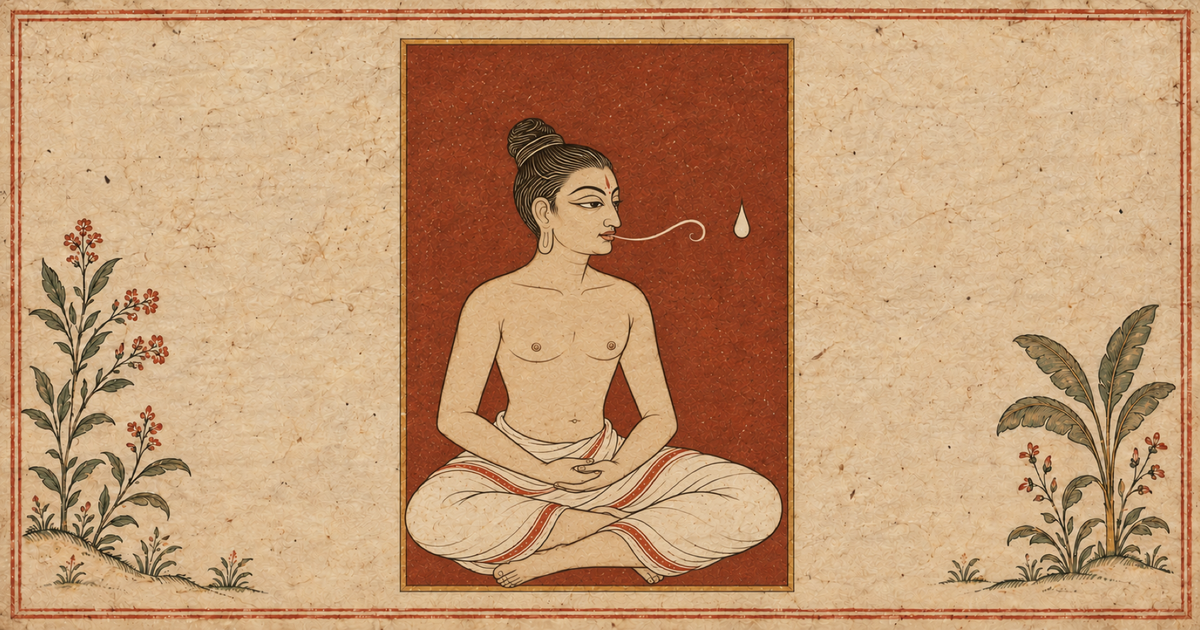
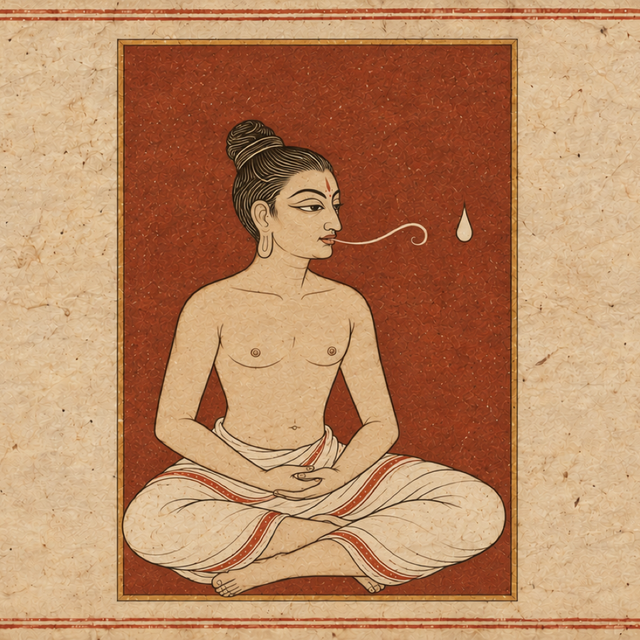
Figure in profile with slightly parted lips, an air current and a nectar drop.

Haṭhatattvakaumudī 10.9*2–11*1: Sītkā / Sītkārī and Śītalī: Hissing, coolness and nectar

Sītkā begins with a hiss in the mouth. Through tongue, palate and the image of nectar, the text connects this technique, also called Sītkārī, with Śītalī.

Haṭhatattvakaumudī 10.9*2
Metre: none
Now (atha) [follows] the Sītkā breath retention (sītkā-kumbhakaḥ | nom sg).
Dr. Ronald Steiner - 2026 - historically literal
Haṭhatattvakaumudī 10.10
Metre: Sragdharā
First (prathamam), [one] should produce (dadyāt | 3p sg act opt) a hissing sound (sītkām | acc sg) with the mouth (mukhena | ins sg), and (ca) afterwards (anu) [bring about] an expansion [of breath] (vijṛmbhām | acc sg) through both nostrils (nāsā-puṭābhyām | ins du). Thus (iti), through the application of constant practice (nityābhyāsa-prayogāt | abl sg), a person (naraḥ | nom sg) becomes (bhavati | 3p sg act pres) a second (dvitīyaḥ | nom sg m) god of love (kāma-devaḥ | nom sg). Free from sleep, sluggishness, hunger and thirst (nidrālasya-kṣudhā-tṛṭ-rahitaḥ | nom sg m ppp), [he] may move (caret | 3p sg act opt) here (iha), worthy of reverence from the circle of Yoginīs (yoginī-cakra-sevyaḥ | nom sg m pfp). Bringing about dissolution (saṃhāra-kārī | nom sg m) of creation (sṛṣṭeḥ | gen sg), he (saḥ | nom sg m) always (sadā) moves (viharati | 3p sg act pres) upon the earth (pṛthivyām | loc sg), [with] no (na) affliction (upadravaḥ | nom sg).
Dr. Ronald Steiner - 2026 - historically literal
Haṭhatattvakaumudī 10.11
Metre: Anuṣṭubh
Having touched (spṛṣṭvā | abs) the nectar-secreting (sudhā-srāvi | acc sg n) palate at the opening of the vessels (śirā-randhra-tālu | acc sg), the cool (himaḥ | nom sg m) breath (marut | nom sg), joined to the tip of the tongue (jihvāgra-yuk | nom sg m), [is] nectar (amṛtam | nom sg). Therefore (ataḥ), Sītkārī (sītkārī | nom sg) [is] precisely (eva) Śītalī (śītalī | nom sg), [and] free of disease (arujā | nom sg f).
Dr. Ronald Steiner - 2026 - historically literal
Haṭhatattvakaumudī 10.11*1
Metre: none
Thus (iti) [is described] the hissing breath retention (sītkāra-kumbhakaḥ | nom sg) for Pitta, fever, burning, thirst and the like (pitta-jvara-dāha-tṛṣādau | loc sg).
Dr. Ronald Steiner - 2026 - historically literal
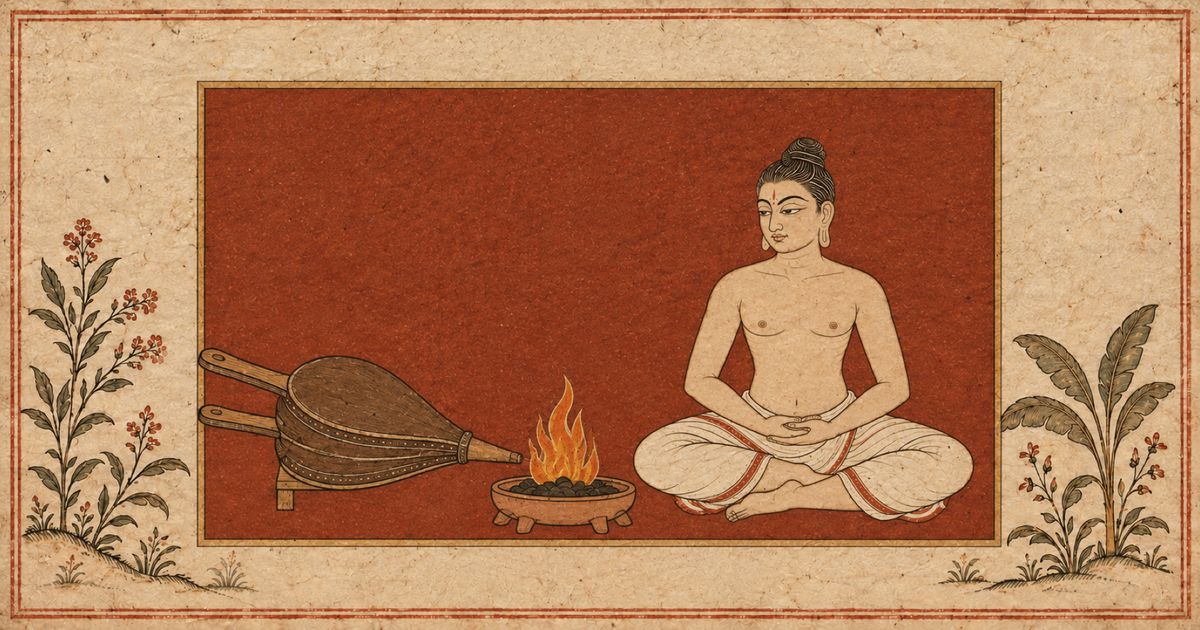
Seated figure facing bellows and a small flame.

Haṭhatattvakaumudī 10.11*2–14*1: Bhastrikā: Rapid breathing followed by retention

In Bhastrikā, breath moves like a bellows. Retention and exhalation on the left follow; the text promises stronger inner fire and the loosening of three knots.

Haṭhatattvakaumudī 10.11*2
Metre: none
Now (atha) [follows] the bellows breath retention (bhastrikā-kumbhakaḥ | nom sg).
Dr. Ronald Steiner - 2026 - historically literal
Haṭhatattvakaumudī 10.12
Metre: Śārdūlavikrīḍita
Having taken a seat (sthitvā | abs) in the lotus [posture] (abje | loc sg), with neck, abdomen and trunk straight (sama-kandharodara-tanuḥ | nom sg m), [and] carefully (yatnāt | abl sg) closed (saṃyamya | abs) the mouth (mukham | acc sg), [one should] quickly (āśu) fill [the body] well (supūrya | abs) through the nose (ghrāṇena | ins sg). [The breath] makes contact (saṃśliṣati | 3p sg act pres) in the heart and throat (hṛt-kaṇṭhe | loc sg), as far as the skull (kapālāvadhi).

Having released (viricya | abs) the properly (samyak) held [breath] (dhṛtam | acc sg m ppp) through that [nostril] (yayā | ins sg f), [one should] also (api) fill [it] in (āpūrya | abs) again (punar) with force (vegāt | abl sg), afterwards (anu) bring [it] in (hṛtya | abs) alone (kevalam), also (api) let [it] go (tyaktvā | abs) again (punar), [and] fill [the body] (pūrayet | 3p sg act opt caus) again (punaḥ).
Dr. Ronald Steiner - 2026 - historically literal
Haṭhatattvakaumudī 10.13
Metre: Śārdūlavikrīḍita
[One] should continually (śaśvat) proceed (upācaret | 3p sg act opt) in this way (ittham), thus (iti) [runs the instruction]: as (yathā) a bellows (bhastrā | nom sg) would, as it were (iva), set [air] in motion (sañcālayet | 3p sg act opt caus), just so (tathaiva) the intelligent person (buddhimān | nom sg m) should move (sañcālayet | 3p sg act opt caus) the breath (pavanam | acc sg) within the body (deha-stham | acc sg m), with full attention (matinā). But (tu) when (yadā) fatigue (śrāntiḥ | nom sg) arises (syāt | 3p sg act opt) in one's own body (nija-tanau | loc sg), then (tadā) [one] should inhale fully (saṃpūrayet | 3p sg act opt caus) through the sun [the right nostril] (sūryeṇa | ins sg): having envisaged (ākalayya | abs) one's own belly (svodaram | acc sg) as full (pūrṇam | acc sg n ppp), [one] should thus (tathā) fill [it] (pūrayet | 3p sg act opt caus) slowly (mandam) with breath (marutā | ins sg).
Dr. Ronald Steiner - 2026 - historically literal
Haṭhatattvakaumudī 10.14
Metre: Śārdūlavikrīḍita; pāda 3: one extra Guru syllable (at the end)
Then (tataḥ) he (saḥ | nom sg m) [should hold] the middle of the nose (nāsā-madhyamam | acc sg) very firmly (sudṛḍham) [closed], without (antareṇa) the index finger [and the middle finger] (tarjanībhyām | ins du). Having performed (āvidhāya | abs) the breath retention (kumbham | acc sg) as before (pūrvavat), [he] should release (recayet | 3p sg act opt caus) that (tam | acc sg m) breath (pavanam | acc sg) through the left [side] (vāmayā | ins sg f). The breath retention (kumbhakaḥ | nom sg) called the bellows (bhastrākhyaḥ | nom sg m) certainly (khalu) removes (syati | 3p sg act pres) phlegm (kapham | acc sg), bile (pittam | acc sg), wind (samīram | acc sg) [and] bad phlegm (duḥ-kapham | acc sg) situated in the region of Suṣumṇā (suṣumṇāṅga-stham | acc sg m). [It] produces digestive fire (agni-daḥ | nom sg m) [and] breaks open the three knots arising from the three fundamental qualities (tri-guṇa-ja-granthi-trayodbhedakaḥ | nom sg m).
Dr. Ronald Steiner - 2026 - historically literal
Haṭhatattvakaumudī 10.14*1
Metre: none
Thus (iti) [is described] the bellows breath retention (bhastrikā-kumbhakaḥ | nom sg), which dries up the impurities of all pathogenic factors (sarva-doṣa-mala-śoṣaṇaḥ | nom sg m), removes all distress (sarva-pīḍā-haraḥ | nom sg m) [and] digests undigested matter [and] remedies indigestion (āmājīrṇa-jāraṇaḥ | nom sg m).
Dr. Ronald Steiner - 2026 - historically literal
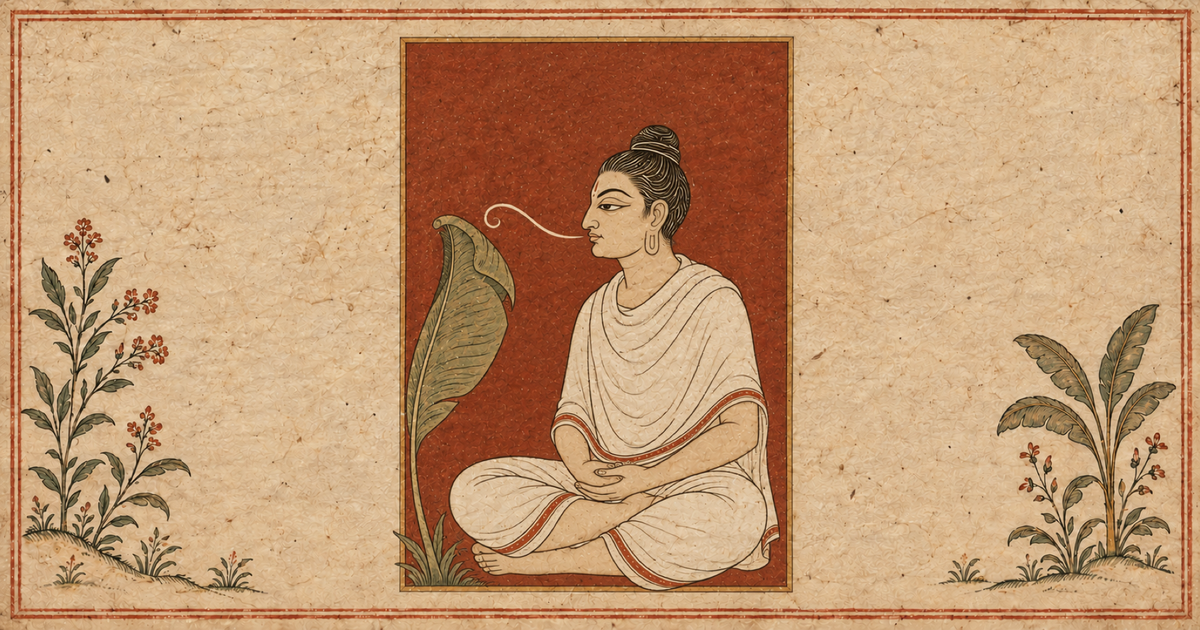
Seated figure beside a rolled leaf and a pale current of air.

Haṭhatattvakaumudī 10.14*2–17*1: Śītalī and Antaraṅgaka-kumbha: Tongue position and breath

The Śītalī section begins with Antaraṅgaka-kumbha, the internal breathing procedure. Tongue position, the course of breath and effects attributed to Śītalī...

Haṭhatattvakaumudī 10.14*2
Metre: none
Now (atha) [follows] the Śītalī breath retention (śītalī-kumbhakaḥ | nom sg).
Dr. Ronald Steiner - 2026 - historically literal
Haṭhatattvakaumudī 10.15
Metre: Line 1: prose; then Upendravajrā, Anuṣṭubh; iti extrametrical
[One should] draw in (ākṛṣya | abs) the breath (vāyum | acc sg) very (ati) forcefully (bhṛśam), draw [it] in [again] (ākṛṣya | abs), and (ca) draw [it] in (ākṛṣya | abs) as before (prāgvat), [then] bind [it] (baddhvā | abs) briefly (laghu). [Then] release [it] in a controlled manner (surasakṛt). And (ca) through exhalation and inhalation (recaka-pūrakābhyām | ins du) [arises] this (ayam | nom sg m) internal (antaraṅgakaḥ | nom sg m) breath retention (kumbhaḥ | nom sg). Thus (iti) [runs the description].
Dr. Ronald Steiner - 2026 - historically literal
Haṭhatattvakaumudī 10.16
Metre: none
[One should] extend (niḥsārya | abs) the tongue (jihvām | acc sg) outwards (bahiḥ), place [it] (kṛtvā | abs) at the roots of the teeth (danta-mūle | loc sg), [and] draw in (ākṛṣya | abs) the breath (vāyum | acc sg). Inhalation (pūrakam | nom sg) should take place (bhavet | 3p sg act opt) as before (pūrvavat). Thereupon (tataḥ), [one] should release (tyajet | 3p sg act opt) the breath (vāyum | acc sg) downwards (adhaḥ) through the “gentle nostrils” (manda-nāsābhyām | ins du), slowly (śanakaiḥ), up to the tip of the topknot (ā-śikhāgram), as far as the nail tips (ā-nakhāgrāvadhi) and (ca) upwards (uccaiḥ). Afterwards (anu), [as the next step] (tataḥ), [one] should release [the breath] (recayet | 3p sg act opt caus) through the two cavities of the pair of nostrils (nāsā-puṭa-yugala-bilābhyām | ins du).
Dr. Ronald Steiner - 2026 - historically literal
Haṭhatattvakaumudī 10.17
Metre: Sragdharā
The breath retention (kumbhaḥ | nom sg) named (nāma) Śītalī (śītalī | nom sg), which removes abdominal swellings and diseases of the spleen and abdomen (gulma-plīhodara-ghnaḥ | nom sg m), destroys (nihanti | 3p sg act pres) fever, sneezing and thirst (jvara-kṣavathu-tṛṣam | acc sg), consumption and bile (yakṣma-pitte | acc du). And (ca), [as] a destroyer of intoxication (mada-dalanaḥ | nom sg m), [it] should remove (hanyāt | 3p sg act opt) the disorder [caused by] deities (doṣaṃ devam | acc sg), thus (iti) [it is said].
Dr. Ronald Steiner - 2026 - historically literal
Haṭhatattvakaumudī 10.17*1
Metre: none
Thus (iti) [ends] the Śītalī breath retention (śītalī-kumbhakaḥ | nom sg).
Dr. Ronald Steiner - 2026 - historically literal
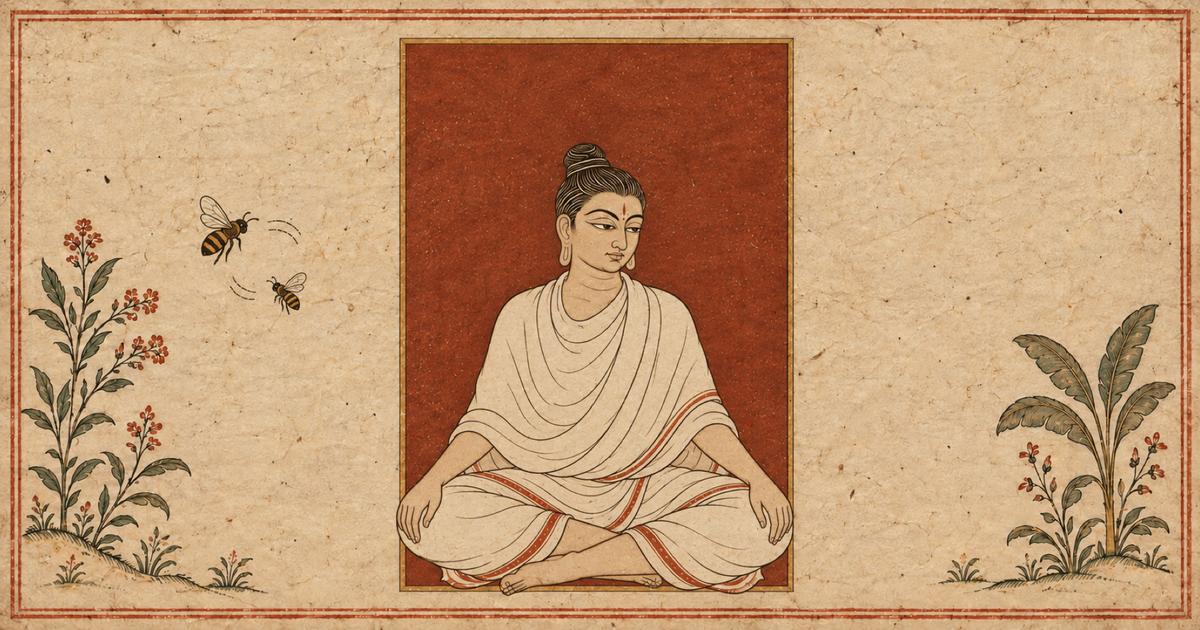
Seated figure surrounded by two bees and arcs of sound.

Haṭhatattvakaumudī 10.17*2–18: Bhrāmarī: Two bee sounds in inhalation and exhalation

Bhrāmarī pairs forceful inhalation with the sound of a male bee and slow exhalation with a female bee's sound. The text describes a stupefaction through bliss.

Seated figure with gently lowered head and a fading line.

Haṭhatattvakaumudī 10.18*1–19*1: Mūrcchā / Manomūrcchanā: Throat lock and slow exhalation

A firm throat lock at the end of inhalation defines Mūrcchā, also called Manomūrcchanā. The text links the slow exhalation that follows with blissful...

Inflated leather bag floating on water, with a seated observer on the bank.

Haṭhatattvakaumudī 10.19*2–21*1: Plāvanī: Air in the belly and the image of a leather bag

In Plāvanī, the belly is filled with air. The text describes floating on water and illustrates the buoyancy through the image of a filled leather bag.

Haṭhatattvakaumudī 10.19*2
Metre: none
Now (atha) [follows] the breath retention (kumbhakaḥ | nom sg) Plāvanī (plāvanī | nom sg).
Dr. Ronald Steiner - 2026 - historically literal
Haṭhatattvakaumudī 10.20
Metre: Āryā — first half: 32 instead of 30 mātrās
The yogin (yogī | nom sg), whose belly is filled with abundant air brought inside (abhyantara-pravarttita-bhūritarādhāra-vāyu-pūrita-jaṭharaḥ | nom sg m), floats (plavate | 3p sg med pres) with ease (sukhena | ins sg), for a long time (ciram), in water (payasi | loc sg) where the bottom is not touched (atala-sparśe | loc sg n).
Dr. Ronald Steiner - 2026 - historically literal
Haṭhatattvakaumudī 10.21
Metre: Anuṣṭubh
[With] Apāna drawn (ākarṣitāpānā) upwards (ūrdhvam), with the belly filled (pūritodaraḥ | nom sg m) like a leather bag (dṛtivat), [the yogin], having lain down (suptvā | abs) in water (jale | loc sg), floats (plavate | 3p sg med pres) on the waters (apsu | loc pl), when the evenly flowing (sama-vāhe | loc absl sg m) breath (anile | loc absl sg) [is] mastered (jite | loc absl sg m ppp).
Dr. Ronald Steiner - 2026 - historically literal
Haṭhatattvakaumudī 10.21*1
Metre: none
Thus (iti) [ends] the Plāvanī breath retention (plāvanī-kumbhakaḥ | nom sg).
Dr. Ronald Steiner - 2026 - historically literal
Two open lines of breath in front of a half-length figure.

Haṭhatattvakaumudī 10.21*2–23*1: Utkarṣa and Apakarṣa: Directing breath at the nostrils

Utkarṣa and Apakarṣa open a supplementary collection. These procedures combine closures at the nose with retention or with exhalation and inhalation.

Haṭhatattvakaumudī 10.21*2
Metre: none
Now (atha), here (atra), [follows] a particular feature (viśeṣaḥ | nom sg) from another treatise (granthāntare | loc sg).
Dr. Ronald Steiner - 2026 - historically literal
Haṭhatattvakaumudī 10.21*3
Metre: none
Now (atha), on this occasion (prasaṅgāt | abl sg), some (kecana | nom pl m) suitable breath retentions (upayuktāḥ kumbhakāḥ | nom pl) are described (kathyante | 3p pl pas pres) for the purpose of practice (abhyāsārtham | acc sg).
Dr. Ronald Steiner - 2026 - historically literal
Haṭhatattvakaumudī 10.22
Metre: Indravajrā
The one drawing in (saṅkarṣakaḥ | nom sg m) [retains the breath] for as long as (yāvat) the strength to retain [allows] (rodha-balam | acc sg). For (hi), having closed (sammuhya | abs) the base of the two nostril openings (nāsā-yuga-randhra-mūlam | acc sg), one should certainly (nanu) afterwards (tad-agre | loc sg) perform (kuryāt | 3p sg act opt) exhalation and inhalation (reca-pūrau | acc du). This (saḥ | nom sg m) [practice is] called (kathitaḥ | nom sg m ppp) the Utkarṣa breath retention (utkarṣa-kumbhaḥ | nom sg) by the creator (dhātrā | ins sg).
Dr. Ronald Steiner - 2026 - historically literal
Haṭhatattvakaumudī 10.22*1
Metre: none
Thus (iti) [ends] the Utkarṣa breath retention (utkarṣa-kumbhaḥ | nom sg).
Dr. Ronald Steiner - 2026 - historically literal
Haṭhatattvakaumudī 10.23
Metre: Pādas 1–2: Indravajrā; Pāda 3: Upendravajrā; Pāda 4: Indravajrā
When (yat) [someone], having closed (āmuhya | abs) one half of the nose (ghoṇārdham | acc sg), remains (tiṣṭhan | nom sg m pca) in the lower region (adho-vibhāge | loc sg) [and] performs (vidadhāti | 3p sg act pres) exhalation and inhalation (reca-pūrau | acc du), that (saḥ | nom sg m) [is] this breath retention (eṣaḥ kumbhaḥ | nom sg). This (ayam | nom sg m) [is] called (gaditaḥ | nom sg m ppp) Apakarṣa (apakarṣaḥ | nom sg) by name (nāmnā | ins sg), by the creator (vidhātrā | ins sg), whose essence is Oṃ (praṇavātmanā | ins sg m).
Dr. Ronald Steiner - 2026 - historically literal
Haṭhatattvakaumudī 10.23*1
Metre: none
Thus (iti) [ends] the Apakarṣa breath retention (apakarṣa-kumbhaḥ | nom sg).
Dr. Ronald Steiner - 2026 - historically literal
Small seated figure in an open field of paper, with a faint breath line.

Haṭhatattvakaumudī 10.24–25*2: Karṣaka and Sahaja: From drawing in to natural retention

In Karṣaka, breath becomes longer and subtler; Sahaja denotes its natural retention without force. The text links this with purification, long life and inner...

Haṭhatattvakaumudī 10.24
Metre: Svāgatā
When the breath retention (kumbhe | loc absl sg) has been performed (pravihite | loc absl sg m ppp) in the drawing-in [procedure] (karṣake | loc absl sg m), the breath (śvāsakaḥ | nom sg) becomes (bhavati | 3p sg act pres), as it is said (kila), longer (dīrghataraḥ | nom sg m comp) [and] subtle (aṇuḥ | nom sg m). The retention (saṃdhṛtiḥ | nom sg) of breathing (śvasanasya | gen sg) in a state of remaining (sthiti-gatau | loc sg) [occurs] not (no) through force (balāt | abl sg). This (saḥ | nom sg m) [is] the natural (sahajaḥ | nom sg m), auspicious breath retention (śubha-kumbhaḥ | nom sg).
Dr. Ronald Steiner - 2026 - historically literal
Haṭhatattvakaumudī 10.25
Metre: Anuṣṭubh
Through practising the natural [Kumbha] (sahajābhyāsataḥ), [the following] should arise (bhavet | 3p sg act opt): purification of the channels (nāḍī-śuddhim | acc sg), likewise (tathā) health (ārogyam | nom sg), great well-being (su-sukham | nom sg), long life (dīrgha-jīvitam | nom sg), hearing sound (nāda-śrutiḥ | nom sg) [and] destruction of evil (pāpa-nāśaḥ | nom sg).
Dr. Ronald Steiner - 2026 - historically literal
Haṭhatattvakaumudī 10.25*1
Metre: none
Thus (iti) [end] the effects of the natural breath retention (sahaja-kumbha-guṇāḥ | nom pl).
Dr. Ronald Steiner - 2026 - historically literal
Haṭhatattvakaumudī 10.25*2
Metre: none
Thus (iti) [end] the drawing-in and natural breath retentions (karṣaka-kumbha-sahaja-kumbhau | nom du).
Dr. Ronald Steiner - 2026 - historically literal
Wheel, conch, winding path and wooden club as four separate motifs.

Haṭhatattvakaumudī 10.26–29*1: Cakra, Śaṅkha, Vāmāvartta, Vartmagati and Gadā: Linking breath passages

Cakra and Vāmāvartta direct breath in opposite directions; Vartmagati uses both nostrils, Śrīgadākumbha both for inhalation and the right for exhalation...

Haṭhatattvakaumudī 10.26
Metre: Anuṣṭubh
Because of the difference between rightward and leftward rotation (dakṣa-vāmāvartta-bhedāt | abl sg), wheel and conch (cakra-śaṅkhau | nom du) [are] named (uditau | nom du m ppp) in two ways (dvidhā). Having inhaled (āpūrya | abs) through the sun (sūryeṇa | ins sg), one should retain (kumbhayet | 3p sg act opt denom) the breath (marutam | acc sg) situated in the belly (udara-sthitam | acc sg m ppp). One should exhale (recayet | 3p sg act opt caus) through the moon (indunā | ins sg), again (bhūyas) likewise (tathā) inhale (pūrayet | 3p sg act opt caus) through the right [side] (dakṣeṇa | ins sg m) [and] retain (kumbhayet | 3p sg act opt denom). Having exhaled (recya | abs) through Iḍā (iḍayā | ins sg), [one has completed the exercise called] the rightward-turning wheel (dakṣiṇāvartta-cakrakaḥ | nom sg).
Dr. Ronald Steiner - 2026 - historically literal
Haṭhatattvakaumudī 10.27
Metre: Anuṣṭubh
This wheel breath retention (ayaṃ cakra-kumbhaḥ | nom sg), [performed] in reverse (vilomaḥ | nom sg m), [is] the leftward-turning one (vāmāvarttaḥ | nom sg m), taught by Śiva (śivoditaḥ | nom sg m ppp). These two breath retentions (imau kumbhau | nom du), sun and moon (sūrya-candrau | nom du), [were] formerly (purā) taught (uditau | nom du m ppp) by Druhiṇa (druhiṇena | ins sg). These two (etau | nom du m), very hot and cool (atyuṣṇa-śītalau | nom du m), [are] applied according to place and time (deśa-kāla-prayojitau | nom du m ppp caus).
Dr. Ronald Steiner - 2026 - historically literal
Haṭhatattvakaumudī 10.27*1
Metre: Anuṣṭubh
[One] should perform (kuryāt | 3p sg act opt) the wheel breath retention (cakra-kumbham | acc sg) twice (dvidhā) [each time inhaling through the right nostril, holding the breath and exhaling through the left], and likewise (tathā) [then perform] the fire–moon [alternate-nostril breathing] (agni-ṣomam | acc sg) once (ekadhā) [as one round with two breath retentions: right in, hold, left out; left in, hold, right out]. This (ayam | nom sg m) conch breath retention (śaṅkha-kumbhaḥ | nom sg) [is] taught (smṛtaḥ | nom sg m ppp) by Īśa (īśena | ins sg) in two forms (dvi-vidhaḥ | nom sg m) [rightward and leftward], as before (pūrvavat).
Dr. Ronald Steiner - 2026 - historically literal
Haṭhatattvakaumudī 10.27*2
Metre: Anuṣṭubh
With these two breath retentions (kumbhayor anayoḥ | loc du), gentle warmth (kauṣmyam | nom sg) [or, respectively,] slight coolness (īṣac-chītalatā | nom sg) may arise (bhavet | 3p sg act opt).
Dr. Ronald Steiner - 2026 - historically literal
Haṭhatattvakaumudī 10.28
Metre: Anuṣṭubh
One should draw in (pūrayet | 3p sg act opt caus) the breath (vāyum | acc sg) through both [nostrils] (ubhābhyām | ins du m). Having retained [it] (kumbhayitvā | abs denom) as prescribed (yathā-vidhi), one should exhale (recayet | 3p sg act opt caus) through both [nostrils] (ubhābhyām | ins du m). [This is] the breath retention (kumbhaḥ | nom sg) Vartmagati (vartma-gatiḥ | nom sg), taught by Śiva (śivoditaḥ | nom sg m ppp).
Dr. Ronald Steiner - 2026 - historically literal
Haṭhatattvakaumudī 10.29
Metre: Śālinī
Where (yatra) inhalation (pūraṇam | nom sg) [takes place] properly (samyak) through both (ubhābhyām | ins du m), moon and sun (glau-ravibhyām | ins du), and (ca) exhalation (recanam | nom sg) [takes place] through the solar path (mārttaṇḍādhvanā | ins sg), this (eṣaḥ | nom sg m) [retention is] known (proktaḥ | nom sg m ppp) by the name Śrīgadākumbha (śrī-gadā-kumbha-nāmā | nom sg m). [It] bestows (dhatte | 3p sg med pres) splendour and strength (śrī-balam | acc sg) in the body (dehe | loc sg) of the practitioner (sādhakasya | gen sg).
Dr. Ronald Steiner - 2026 - historically literal
Haṭhatattvakaumudī 10.29*1
Metre: none
Thus (iti) [end] the four breath retentions (catvāraḥ kumbhāḥ | nom pl) bearing the names Cakra [rightward], Śaṅkha [rightward and leftward], Vāmāvartta [the leftward Cakra] and Vartmagati (cakra-śaṅkha-vāmāvartta-varttma-gati-nāmānaḥ | nom pl m). This (ayam | nom sg m) mace breath retention [Gadā] (gadā-kumbhaḥ | nom sg) [is] the fifth (pañcamaḥ | nom sg m).
Dr. Ronald Steiner - 2026 - historically literal
Seated figure with a sun at the navel, a moon in a lotus and nectar drops.

Haṭhatattvakaumudī 10.30–33*1: Nāḍī-viśudhy-ākhyaka-kumbha and Nāḍīśuddhi: Haṃsa, sun and moon

Haṃsa accompanies inhalation through both nostrils and alternating exhalation. The sun at the navel and moon nectar in Iḍā accompany the Nāḍīśuddhi procedures...

Haṭhatattvakaumudī 10.30
Metre: Indravajrā
“Haṃsa” (haṃsa | voc sg), thus [runs the formula] (iti). Knowing [this formula] (vidvāṃsamanu), the thoughtful person (manasvī | nom sg m) [should] inhale (āpūrya | abs) through both [nostrils] (dvayābhyām | ins du) [and hold the breath; then] release [it alternately] (muñcet | 3p sg act opt) through sun [the right nostril] and moon [the left nostril] (ravi-śītagubhyām | ins du), through contemplating Haṃsa (haṃsa-sañcintanataḥ) within himself (sve | loc sg n). This (eṣaḥ | nom sg m) [is] the breath retention called Nāḍīviśuddhi (nāḍī-viśudhy-ākhyaka-kumbhaḥ | nom sg).
Dr. Ronald Steiner - 2026 - historically literal
Haṭhatattvakaumudī 10.31
Metre: Pāda 1: Upendravajrā; Pādas 2–4: Indravajrā
[When the practitioner has] visualised (āvibhāvya | abs caus) in the navel (nābhau | loc sg) the disc (maṇḍalam | acc sg) of the sun (raveḥ | gen sg), resembling the midday sun in the hot season (nidāgha-madhyandina-sūrya-tulyam | acc sg n), [and when, after inhaling] through the [right] solar channel (mārtaṇḍa-nāḍyā | ins sg), a correct breath retention (su-kumbhe | loc absl sg) has been performed (vihite | loc absl sg m ppp), the channels (nāḍyaḥ | nom pl) of the person practising correctly (su-sādhakasya | gen sg) become pure (viśudhyanti | 3p pl act pres).
Dr. Ronald Steiner - 2026 - historically literal
Haṭhatattvakaumudī 10.32
Metre: Anuṣṭubh
An autumn full-moon night (śarad-rākā | nom sg): [When the practitioner has] meditated (dhyātvā | abs) during breath retention (kumbhe | loc sg) [on the form of] the midnight moon at the centre of the thousand-petalled [lotus] (niśīthendu-sahasra-dala-madhya-gam | acc sg n), streaming (sravat | acc sg n pca) nectar (sudhām | acc sg) [into] Iḍā (iḍām | acc sg), the channels (nāḍikāḥ | nom pl) become pure (śudhyanti | 3p pl act pres).
Dr. Ronald Steiner - 2026 - historically literal
Haṭhatattvakaumudī 10.33
Metre: Svāgatā
Through the moon (śaśinā | ins sg), the removal of the bile disorder (pitta-doṣa-dalanam | nom sg) should occur (syāt | 3p sg act opt); through the sun (bhāskareṇa | ins sg), [there should be] an end to impurity from phlegm and wind (kapha-vāta-malāntaḥ | nom sg). Through practice (abhyasanena | ins sg) over three months (māsakaiḥ tribhiḥ | ins pl), indeed (aho), spotless (amalā | nom sg f) purity of the channels (nāḍi-śuddhiḥ | nom sg) arises (samudeti | 3p sg act pres).
Dr. Ronald Steiner - 2026 - historically literal
Haṭhatattvakaumudī 10.33*1
Metre: none
Thus (iti) [ends] the breath retention named Nāḍīśuddhi (nāḍī-śuddhy-ākhya-kumbhakaḥ | nom sg), which serves the purification of the channels (nāḍī-śuddhy-upayogī | nom sg m), [performed] twenty times (viṃśad-vāram | acc sg) at four times [of day] (catuḥ-kāleṣu | loc pl).
Dr. Ronald Steiner - 2026 - historically literal
Six simple circles beside a seated figure.

Haṭhatattvakaumudī 10.33*2–34*1: Bhūtaśuddhi: Closing the nostrils and a sixfold sequence

Bhūtaśuddhi combines closing both nostrils with a sixfold sequence. The text attributes this procedure to Śambhu, the primordial lord.

Three linked loops beside two seated people in conversation.

Haṭhatattvakaumudī 10.34*2–38*1: Asvaṅgaśṛṅkhalā and Kumbhāntaraśṛṅkhalā: Chains of breath

Asvaṅgaśṛṅkhalā links inhalation, retention and exhalation into a chain. Kumbhāntaraśṛṅkhalā combines different breathing techniques under guidance.

Haṭhatattvakaumudī 10.34*2
Metre: none
Now (atha) [follows] the breath retention (kumbhakaḥ | nom sg) [called] “chain” (śṛṅkhalā | nom sg).
Dr. Ronald Steiner - 2026 - historically literal
Haṭhatattvakaumudī 10.35
Metre: Śārdūlavikrīḍita
The intelligent person (budhaḥ | nom sg m) should continually (śaśvat) carry out correctly (suvibhṛyāt | 3p sg act opt) inhalation and breath retention (pūraka-kumbhakau | acc du). Tired by breath retention (kumbhaka-śrāntaḥ | nom sg m ppp), one should inhale (saṃpūrayet | 3p sg act opt caus); having reached (parigataḥ | nom sg m ppp) fatigue (śramam | acc sg) from inhaling (pūrakataḥ), one should perform (vidadhyāt | 3p sg act opt) a breath retention (kumbham | acc sg). One should practise (ācaret | 3p sg act opt) a filling inhalation (pūraṃ pūrakam | acc sg), then (atha) likewise (tathā) perform (caret | 3p sg act opt) breath retention (kumbham | acc sg), [namely] Kumbhaka (kumbhakam | acc sg). And (ca) afterwards (anu), one should perform (kalayet | 3p sg act opt) exhalation (recakam | acc sg) according to one's strength (yāvacchakti), [then] turn (saṃśrayet | 3p sg act opt) again (punaḥ) to breath retention (kumbham | acc sg).
Dr. Ronald Steiner - 2026 - historically literal
Haṭhatattvakaumudī 10.36
Metre: Pāda 1: Indravajrā; Pāda 2: Vaṃśastha; Pāda 3: Upendravajrā; Pāda 4: Indravaṃśā
The knowledgeable person (jñaḥ | nom sg m), having gone to a secluded place (raho-gataḥ | nom sg m ppp), should practise (ācaret | 3p sg act opt) exhalation (recam | acc sg) [and] again (punaḥ) breath retention (kumbhakam | acc sg), as (yathā) [accords with] the teacher's instruction (gurūpadiṣṭena | ins sg n ppp). Now (aṅga), one should perform (kuryāt | 3p sg act opt) one's own exhalation (sva-recakam | acc sg), [namely] exhalation (recakam | acc sg). [Thus] the chain (śṛṅkhalā | nom sg) named Asvaṅga (asvaṅga-nāmnī | nom sg f) is taught (uditā | nom sg f ppp), as it is said (kila).
Dr. Ronald Steiner - 2026 - historically literal
Haṭhatattvakaumudī 10.37
Metre: Śārdūlavikrīḍita
The power (śaktiḥ | nom sg) reaches (upaiti | 3p sg act pres) awakening (bodham | acc sg); the breath (vāyuḥ | nom sg) reaches (ayate | 3p sg med pres) purity (śuddhim | acc sg). Likewise (tathā), the channels (nāḍikāḥ | nom pl) reach (yāti | 3p sg act pres) purity (śuddhim | acc sg). [The practice] quickly (āśu) brings about (tanute | 3p sg med pres) slenderness (kṛśatvam | acc sg), makes (vidhatte | 3p sg med pres) exhalation (recam | acc sg) good (śubham | acc sg m) [and] certainly (dhruvam) increases (vardhayati | 3p sg act pres caus) inhalation (pūram | acc sg). That chain (asau śṛṅkhalā | nom sg), taught (uktā | nom sg f ppp) by me (mayā | ins sg), [is] especially auspicious (śubhatarā | nom sg f). The one (saḥ | nom sg m) in whom (yasya | gen sg m) [it] exists (syāt | 3p sg act opt) [is] an accomplished one (siddhaḥ | nom sg) in the circle of the earth (bhū-maṇḍale | loc sg), praised (abhinutaḥ | nom sg m ppp) by gods and demons together (sa-surāsuraiḥ | ins pl).
Dr. Ronald Steiner - 2026 - historically literal
Haṭhatattvakaumudī 10.37*1
Metre: none
Thus (iti) [ends] the Asvaṅga chain breath retention (asvaṅga-śṛṅkhalā-kumbhakaḥ | nom sg).
Dr. Ronald Steiner - 2026 - historically literal
Haṭhatattvakaumudī 10.38
Metre: Pādas 1–2: Rathoddhatā; Pāda 3: Svāgatā; Pāda 4: Rathoddhatā
But (tu), through joining another breath retention (itara-kumbha-saṅgamāt | abl sg) to a breath retention (kumbhake | loc sg), [there arises a] correct chain of different breath retentions (kumbhakāntara-su-śṛṅkhalā | nom sg), [as it is] called (uditā | nom sg f ppp). Through the path shown by the teacher (tīrtha-darśita-pathena | ins sg), the attainment of auspicious and varied fruits (śubha-citra-phalāptiḥ | nom sg) arises (jāyate | 3p sg med pres) for the practitioner (sādhakasya | gen sg).
Dr. Ronald Steiner - 2026 - historically literal
Haṭhatattvakaumudī 10.38*1
Metre: none
Thus (iti) [ends] the further (aparaḥ | nom sg m) breath retention (kumbhakaḥ | nom sg), [the] chain of different breath retentions (kumbhāntara-śṛṅkhalā | nom sg).
Dr. Ronald Steiner - 2026 - historically literal
Two curving lines rise and fall beside a figure in profile.

Haṭhatattvakaumudī 10.39–39*1: Jīvacālaka / Jīvacāla: Moving the vital breath down and up

In Jīvacālaka, the mind moves the vital breath downwards and upwards during retention. The closing formula calls the technique Jīvacāla.

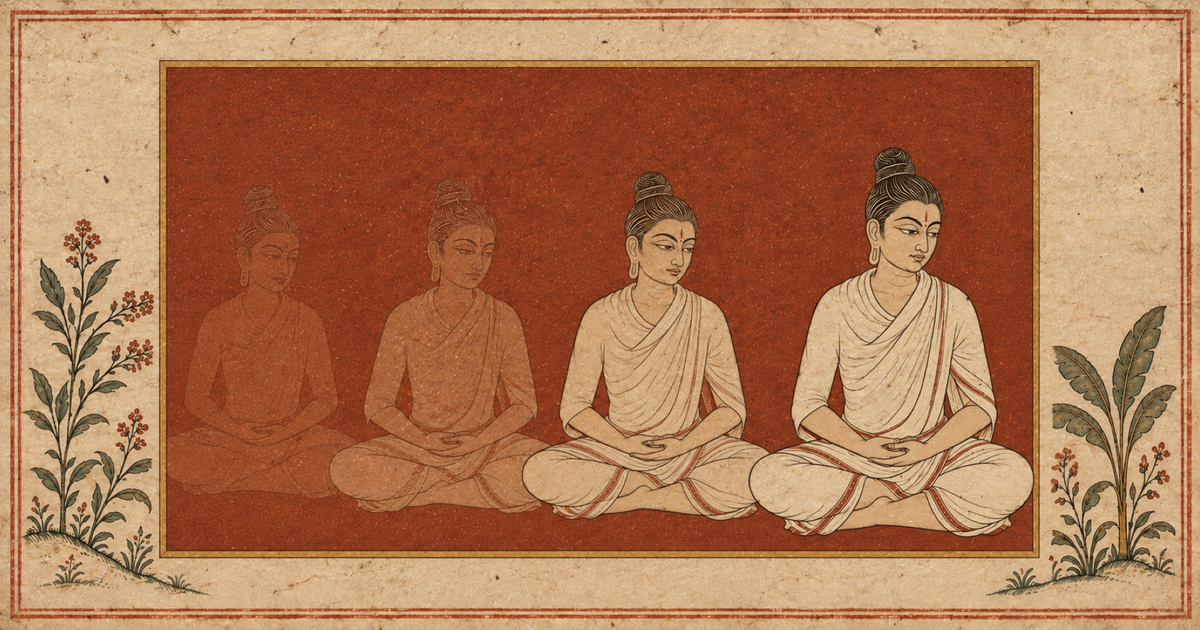
Repeated seated figures gradually become clearer.

Haṭhatattvakaumudī 10.39*2–41: Merucālaka: Practising Ameru and allowing Meru to arise

Under the heading Merucālaka, the text distinguishes Ameru and Meru. It describes measured breath retention and Meru arising naturally after prolonged practice.

Haṭhatattvakaumudī 10.39*2
Metre: none
Now (atha) [follows] Merucālaka (meru-cālakaḥ | nom sg m).
Dr. Ronald Steiner - 2026 - historically literal
Haṭhatattvakaumudī 10.40
Metre: Pāda 1: Upendravajrā; Pādas 2–4: Vaṃśastha
Maheśa (maheśaḥ | nom sg) here (iha) taught (avadat | 3p sg act pret) breath retention (kumbham | acc sg) in two forms (dvidhā), according to the distinction between Ameru and Meru (ameru-meru-prabhidā | ins sg). The first [form] (ādimaḥ | nom sg m) bears fruit (phalaḥ). One should not (na) extend (vardhayet | 3p sg act opt caus) the retention (rodham | acc sg). Then (atho), [the following applies]: good control (su-saṃyamam | acc sg), performed (kṛtam | acc sg m ppp) according to one's strength (yathā-śakti), [grants] accomplishment (siddhi-daḥ | nom sg m) after a long time (cireṇa).
Dr. Ronald Steiner - 2026 - historically literal
Haṭhatattvakaumudī 10.41
Metre: Upagīti
For a person (puṃsaḥ | gen sg) practising (abhyasataḥ | gen sg m pca) this [breath retention] (amum | acc sg m), the natural arising of Meru (naisargika-meru-sambhūtiḥ | nom sg) may occur (bhūyāt | 3p sg act prec) after many periods of time (bahubhiḥ kālaiḥ | ins pl), through countless merits (agaṇya-puṇyaiḥ | ins pl).
Dr. Ronald Steiner - 2026 - historically literal
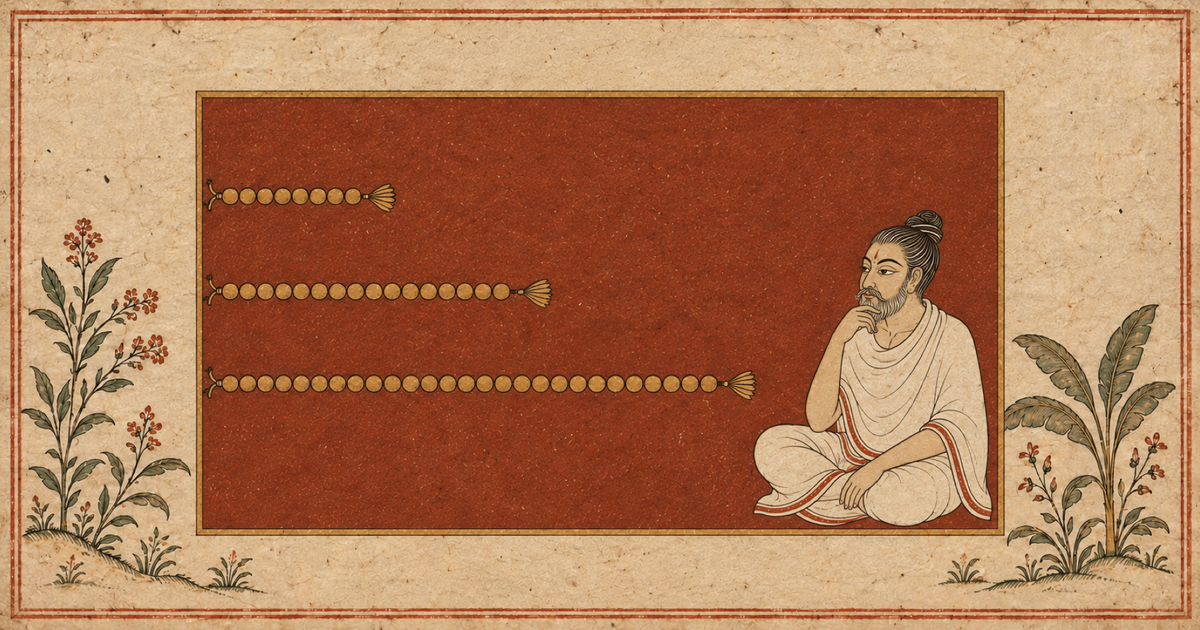
Three bead rows of different lengths suggest graduated durations.

Haṭhatattvakaumudī 10.42–43: Meru: Twelve, twenty-four and thirty-six time units

The discussion of Meru leads to three stages of twelve, twenty-four and thirty-six time units. The text associates them with sweating, trembling and rising.

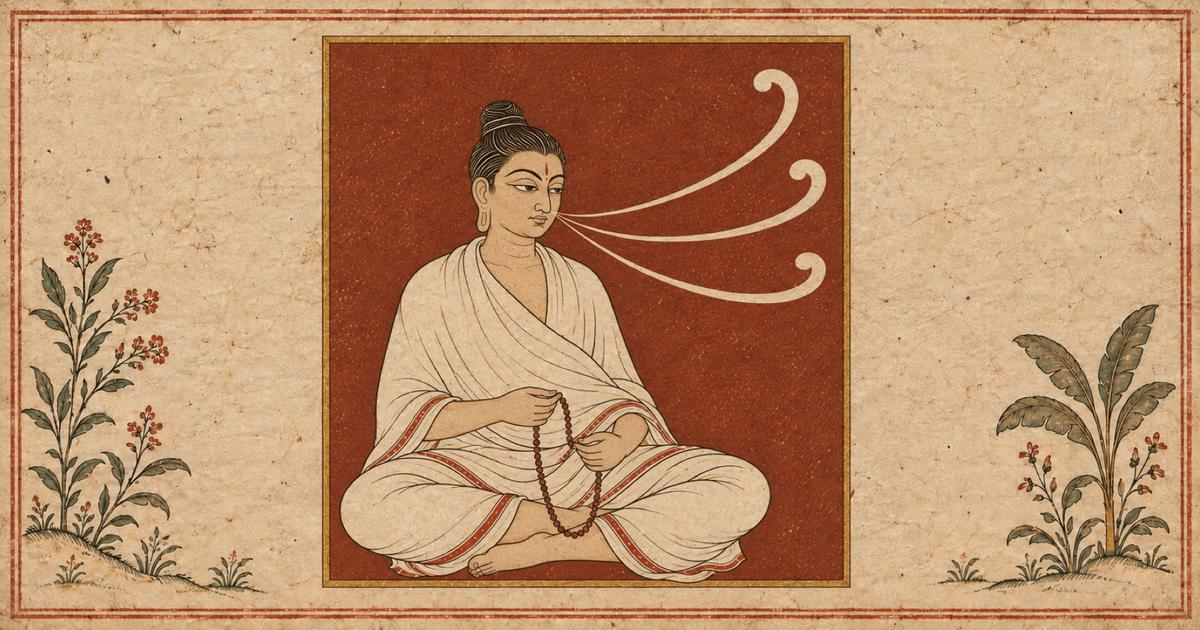
Seated person holding counting beads beside three arcs of breath.

Haṭhatattvakaumudī 10.44–46*1: Ekameru, Dvimeru and Trimeru: Extending and timing breath phases

Ekameru extends retention; Dvimeru includes inhalation, and Trimeru exhalation as well. Observation and counting establish the time units.

Haṭhatattvakaumudī 10.44
Metre: Upagīti
The number of time units (mātrā-saṃkhyā | nom sg) [can be established] slowly (mandam), through knowledge of movement (sañcāra-jñānataḥ) in the external and internal domain (bāhyābhyantara-viṣaye | loc sg), [and] through determining the duration of the breath measure (śvāsa-pramāṇa-samayāvadhāraṇataḥ).
Dr. Ronald Steiner - 2026 - historically literal
Haṭhatattvakaumudī 10.45
Metre: Upagīti
Or (vā) [one may establish it] by counts of fourteen [time units] (manu-gaṇanaiḥ | ins pl). Where (yatra) breath retention (kumbhaḥ | nom sg) indeed (vai) lengthens (pravardhate | 3p sg med pres) gradually (kramaśaḥ), this (ayam | nom sg m) [is] called (uktaḥ | nom sg m ppp) Ekameru (eka-meruḥ | nom sg) by Maheśa (maheśena | ins sg), [a] secret of yoga (yoga-rahasyam | nom sg).
Dr. Ronald Steiner - 2026 - historically literal
Haṭhatattvakaumudī 10.46
Metre: Anuṣṭubh
Through extended inhalation (pūrakeṇābhivṛddhena | ins sg) [and] through ascending Meru (meru-rohaṇāt | abl sg), [the breath retention is called] Dvimeru (dvimeru). Through exhalation (recakena | ins sg) also (api), [when it is] extended (vṛddhena | ins sg m ppp), [it is called] Trimeru (tri-meruḥ | nom sg), [and] bestows accomplishment (siddhi-dāyakaḥ | nom sg m).
Dr. Ronald Steiner - 2026 - historically literal
Haṭhatattvakaumudī 10.46*1
Metre: none
Thus (iti) [ends] the Meru breath retention (meru-kumbhakaḥ | nom sg).
Dr. Ronald Steiner - 2026 - historically literal
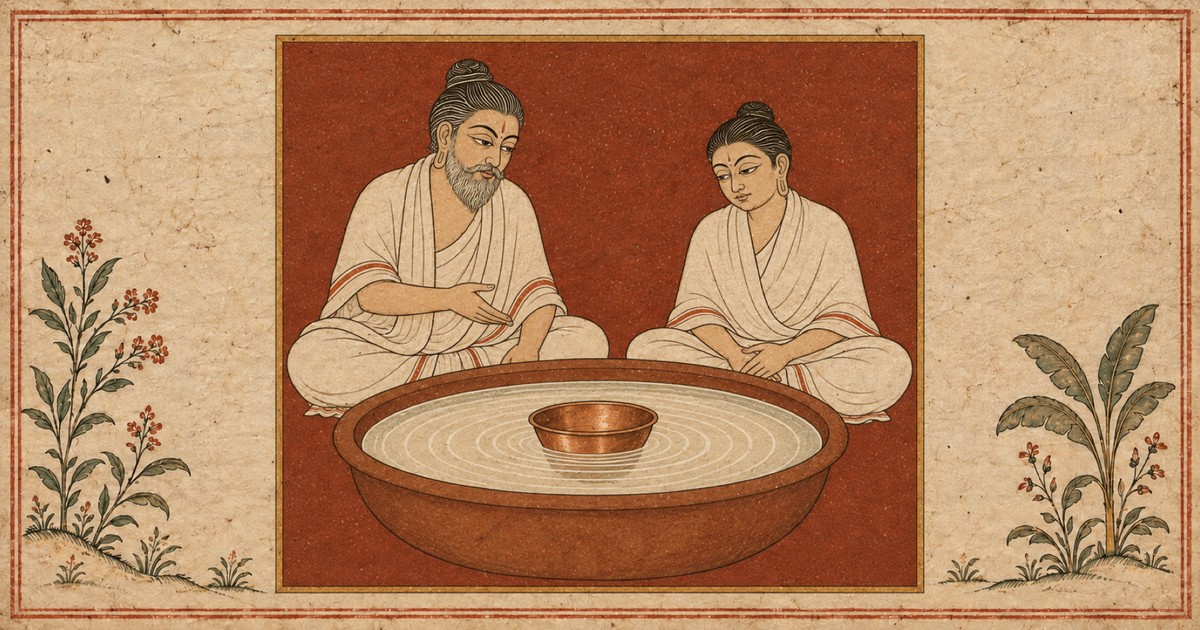
Two seated people watch a copper bowl floating in a water basin.

Haṭhatattvakaumudī 10.47–47*1: Ghaṭikābandha / Ghaṭibandha: A water clock for Meru practice

In Ghaṭikābandha, a copper-vessel water clock measures retention to support Meru practice. The closing formula calls the technique Ghaṭibandha.

Two hands wrap a cloth around a stack of manuscript leaves.

Haṭhatattvakaumudī 10.47*2: Kumbhaka: Closing note on names, forms and effects

The closing note names Sundaradeva as author and Kumbhaka as the chapter's subject: the names, essential forms and effects of the breathing techniques...

Continue with AYI Free

Illustrations: AI-generated.

Editor

Dr. Ronald Steiner

From Ulm

The "Yoga Doc" - Dr. Ronald Steiner is the founder of the AYI method. This method links traditional Ashtanga Yoga with innovative Yogatherapy and living Philosophy. This forms a practice that is personal for each and... more ›