
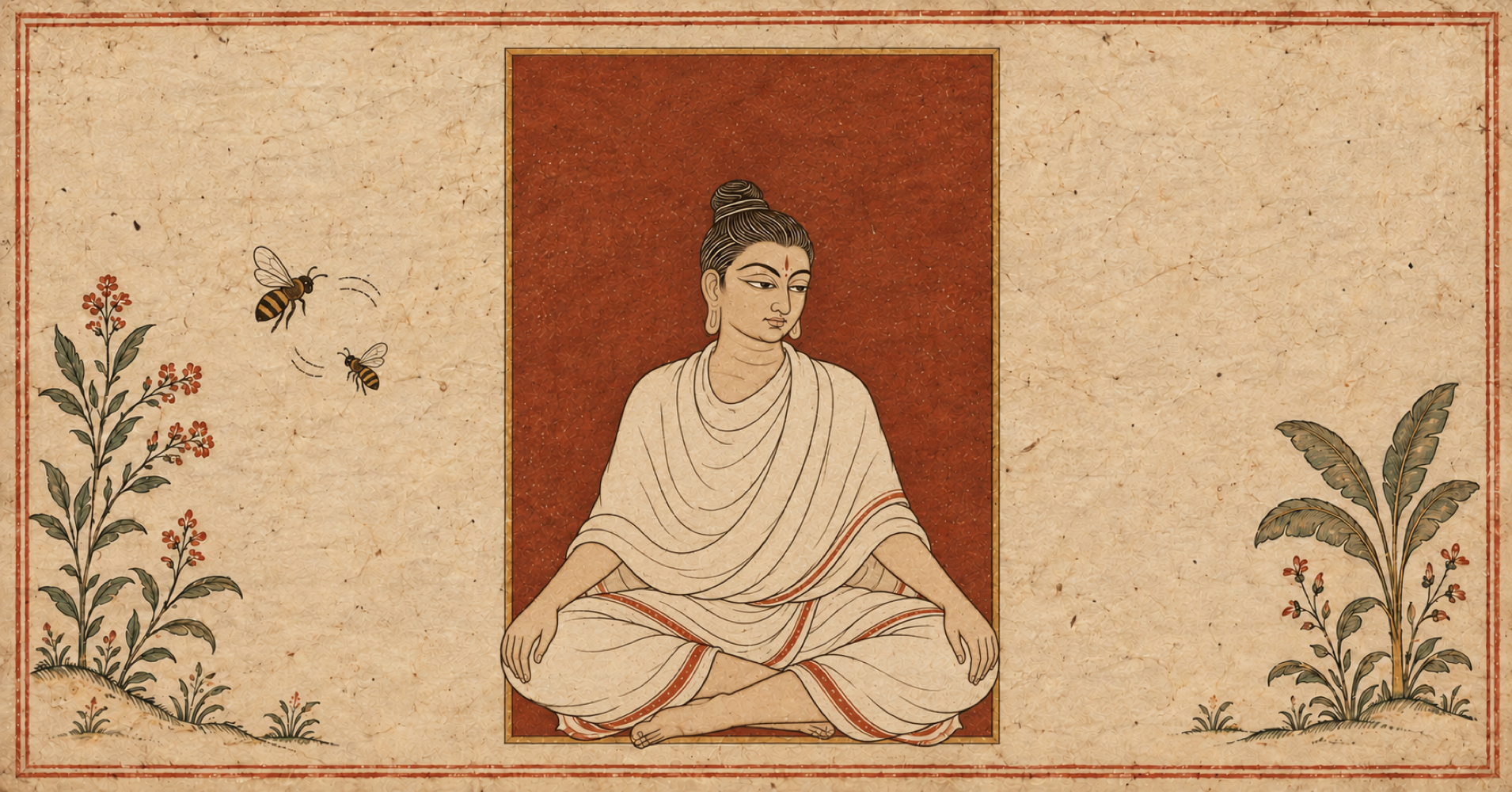
Seated figure surrounded by two bees and arcs of sound.

Haṭhatattvakaumudī 10.17*2–18: Bhrāmarī: Two bee sounds in inhalation and exhalation

Bhrāmarī pairs forceful inhalation with the sound of a male bee and slow exhalation with a female bee's sound. The text describes a stupefaction through bliss.

Dr. Ronald Steiner Dr. Ronald Steiner
Haṭhatattvakaumudī 10.17*2
अथ भ्रामरी कुम्भकः |
atha bhrāmarī kumbhakaḥ | Analysis ▾ Analysis ▴
atha
particle
now
bhrāmarī
nominative singular
bhrāmarī
substantive feminine
Bhrāmarī, bee
kumbhakaḥ
nominative singular
substantive masculine
breath retention
Metre: none
Now (atha) [follows] the breath retention (kumbhakaḥ | nom sg) Bhrāmarī (bhrāmarī | nom sg).
Dr. Ronald Steiner - 2026 - historically literal
The bee gives the next form of breathing its name. Its humming invites attention to sound and its lingering resonance.
Dr. Ronald Steiner - 2026 - modern transfer
Haṭhatattvakaumudī 10.18
वेगाकृष्टं पूरकं भृङ्गनादं भृङ्गीनादं रेचकं मन्दमन्दम् |
vegākṛṣṭaṃ, pūrakaṃ bhṛṅga-nādaṃ; bhṛṅgī-nādaṃ, recakaṃ manda-mandam | Analysis ▾ Analysis ▴
vega
tatpuruṣa-compound instrumental case
substantive masculine
with force
ākṛṣṭam
accusative singular masculine past participle passive
previx
verbal root
drawn in
pūrakam
accusative singular
substantive masculine
inhalation
bhṛṅga
bahuvrīhi-compund
substantive masculine
bee, male bee
nādam
accusative singular masculine
substantive masculine
having a sound
bhṛṅgī
bahuvrīhi-compund
substantive feminine
female bee
nādam
accusative singular masculine
substantive masculine
having a sound
recakam
accusative singular
substantive masculine
exhalation
manda
karmadhāraya-compound
adjective
slowly
mandam
mandam
adverb
very slowly
योगीन्द्राणाम् एवम् अभ्यासयोगाच्चित्ते जाता काचिदानन्दमूर्च्छा ||18||
yogīndrāṇām, evam abhyāsa-yogāc; citte jātā, kācid ānanda-mūrcchā ||18|| Analysis ▾ Analysis ▴
yogi
tatpuruṣa-compound genitive
substantive masculine
of the yogins
indrāṇām
genitive plural
substantive masculine
of the lords
evam
adverb
thus
abhyāsa
tatpuruṣa-compound genitive
substantive masculine
of practice
yogāt
ablative singular
substantive masculine
through application
citte
lokative singular
substantive neuter
in the mind
jātā
nominative singular feminine past participle passive
verbal root
arisen
kācit
nominative singular feminine
kiñcid
pronoun
a certain
ānanda
tatpuruṣa-compound instrumental case
substantive masculine
through bliss
mūrcchā
nominative singular
substantive feminine
stupefaction
Metre: Śālinī
[One should perform] inhalation (pūrakam | acc sg), drawn in with force (vegākṛṣṭam | acc sg m ppp), with the sound of a male bee (bhṛṅga-nādam | acc sg m), [and] exhalation (recakam | acc sg) very slowly (manda-mandam), with the sound of a female bee (bhṛṅgī-nādam | acc sg m). Through applying the practice (abhyāsa-yogāt | abl sg) in this way (evam), a certain (kācit | nom sg f) stupefaction through bliss (ānanda-mūrcchā | nom sg) [has] arisen (jātā | nom sg f ppp) in the mind (citte | loc sg) of the foremost yogins (yogīndrāṇām | gen pl).
Dr. Ronald Steiner - 2026 - historically literal
A gentle hum as you breathe out can become a focus for your attention. Listen as it fades before returning to natural breathing.
Dr. Ronald Steiner - 2026 - modern transfer

Continue with AYI Free

Illustrations: AI-generated.

Editor

Dr. Ronald Steiner

From Ulm

The "Yoga Doc" - Dr. Ronald Steiner is the founder of the AYI method. This method links traditional Ashtanga Yoga with innovative Yogatherapy and living Philosophy. This forms a practice that is personal for each and... more ›

Messages and ratings
0 messages

Please log in to write a message. Go to login

No messages yet.