

kṛ कृ – do; make; cause
verbal root · Word type unspecified · verb
Dictionary sources
AYI dictionary verbal root
do; make; cause
Cappeller 1891 Word type unspecified
Original text · English · Word type unspecified
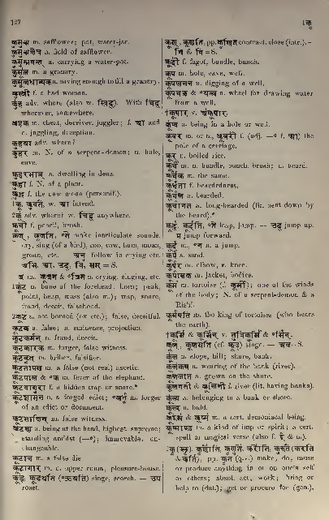
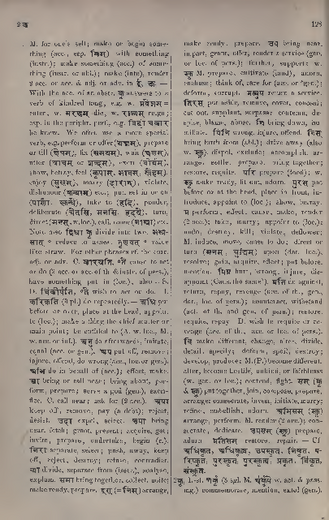
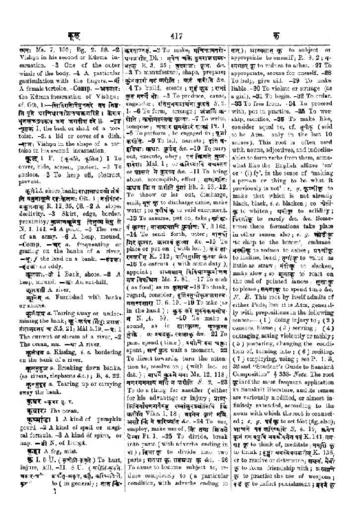
kṛ1 ·(skṛ), kṛṇóti, kṛṇuté, karóti, kurute (karati & karti), pp. kṛtá (q.v.) make, do, cause or produce anything in or on one's self or others; absol. act, work; bring or help to (dat.); get or procure for (gen.), M. for one's self; make or begin something (acc., esp. kim) with something (instr.); make something (acc.) of something (instr. or abl.); make (into), render 2 acc. or acc. & adj. or adv. in ī, ū -- With the acc. of an abstr. kṛ answers to a verb of kindred mng, e.g. w. praveśam = enter, w. maraṇam die, w. rājyam reign; esp. in the periphr. perf., e.g. vidāṃ cakāra he knew. We often use a more special verb, e.g. perform or offer (yajñam), prepare or till (kṣetram), fix (samayam), wait (kṣaṇam), utter (vācam or śabdam), exert (vīryam), show, betray, feel (kṛpām, bhāvam, sneham), enjoy (sukham), marry (dārān), violate, dishonour (kanyām) etc.; put, set in or on (pāṇau, skandhe), take to (hṛdi); ponder, deliberate (cetasi, manasi, hṛdaye), turn, direct (manas, w. loc.), call, name (nāmnā) etc. Note also dvidhā kṛ divide into two, bhasmasāt° reduce to ashes, tṛṇavat° value like straw. For other phrases cf. the corr. adj. or adv. C. {kArayati, kṛṇóti, kṛṇuté, karóti, kurute (karati & karti), pp. kṛtá (q.v.) make, do, cause or produce anything in or on one's self or others; absol. act, work; bring or help to (dat.); get or procure for (gen.), M. for one's self; make or begin something (acc., esp. kim) with something (instr.); make something (acc.) of something (instr. or abl.); make (into), render 2 acc. or acc. & adj. or adv. in ī, ū -- With the acc. of an abstr. kṛ answers to a verb of kindred mng, e.g. w. praveśam = enter, w. maraṇam die, w. rājyam reign; esp. in the periphr. perf., e.g. vidāṃ cakāra he knew. We often use a more special verb, e.g. perform or offer (yajñam), prepare or till (kṣetram), fix (samayam), wait (kṣaṇam), utter (vācam or śabdam), exert (vīryam), show, betray, feel (kṛpām, bhāvam, sneham), enjoy (sukham), marry (dārān), violate, dishonour (kanyām) etc.; put, set in or on (pāṇau, skandhe), take to (hṛdi); ponder, deliberate (cetasi, manasi, hṛdaye), turn, direct (manas, w. loc.), call, name (nāmnā) etc. Note also dvidhā kṛ divide into two, bhasmasāt° reduce to ashes, tṛṇavat° value like straw. For other phrases cf. the corr. adj. or adv. C. kāraya°te cause to act or do (2 acc. or acc. of th. & instr. of pers.), have something put in (loc.), also = S. D. cíkīrṣati, °te wish to act or do. I. karikrati (3 pl.) do repeatedly. --adhi put before or over, place at the head, appoint to (loc.); make a thing the chief matter or main point; be entitled to (A. w. loc., M. w. acc. or inf.). anu do afterwards, imitate, equal (acc. or gen.). apa put off, remove; injure, offend, do wrong (acc., loc. or gen.). abhi do in behalf of (acc.); effect, make. ā bring or call near; bring about, perform, prepare; serve a god (gen.), sacrifice. C. call near; ask for (2 acc.). apā keep off, remove, pay (a debt); reject, desist. udā expel, select. upā bring near, fetch; grant, present; acquire, get; invite, prepare, undertake, begin (r.). nirā separate, select; push, away, keep off, reject, destroy; refuse, contradict. vyā divide, separate from (instr.), analyse, explain. samā bring together, collect, unite; make ready, prepare. is ( = nis) arrange, make ready, prepare. upa bring near, impart, grant, offer, render a service (gen. or loc. of pers.); further, support; w. skṛ M. prepare, cultivate (land), adorn. enchase; think of, care for (acc. or *gen.); deform, corrupt. pratyupa return a service. tiras put aside, remove, cover, conceal; cut out, supplant, surpass; contemn, despise, blame, abuse. ni bring down, humiliate. vini wrong, injure, offend. nis bring forth from (abl.); drive away (also w. skṛ), dispel, exclude; accomplish, arrange, settle, prepare, bring together; restore, requite. pari prepare (food); w. skṛ make ready, fit out, adorn. puras put before or at the head, place in front, introduce, appoint to (loc.); show, betray. pra perform, effect, cause, make, render (2 acc.); take, marry; appoint to (loc.); undo, destroy, kill; violate, deflower; M. induce, move, cause to do; direct or turn (manasṃ, buddhim) upon (dat. loc.). resolve; gain, acquire, effect; put before, mention. pipra hurt, wrong, injure, disappoint (Caus. the same*). prati do against, return, repay, revenge (acc. of th., gen., dat., loc. of pers.); counteract, withstand (act. of th. and gen. of pers.); restore, requite, repay. D. wish to requite or revenge (acc. of th., acc. or loc. of pers.). vi make different, change, alter, divide. detail, specify; deform, spoil, destroy; develop, produce; M. (P.) become different, alter, become hostile, unkind, or faithless (w. gen. or loc.); contend, fight. sam (kṛ & skṛ) put together, join, compose, prepare, arrange; consecrate, invest, initiate, marry; refine, embellish, adorn. abhisam (skṛ) arrange, perform. M. render (2 acc.); consecrate, dedicate. upasam (skṛ) prepare, adorn. pratisam restore, repair. -- Cf. adhikṛta, adhikṛtya, upaskṛta, nikṛta, pariṣ3kṛta, puraskṛta, puraskṛtya, prakṛta, víkṛta, saṃskṛta.
Original text · English · Word type unspecified
kṛ ·I.-st. carkṛ2 (3 sgl. M. cárkṛṣe w. act. & pass. mg.) commemorate, mention, extol (gen.).
Original text · English · Word type unspecified
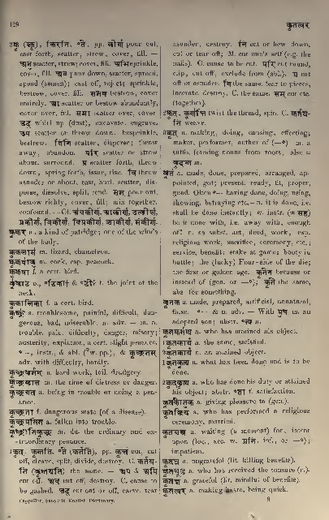
kṛ3 ·(skṛ), {kira3ti, kirá°te, pp. kīrṇa pour out, cast forth, scatter, strew, cover, fill. -- anu scatter, strew; cover, fill. abhi sprinkle, cover, fill. ava pour down, scatter, spread, spend (semen); cast off, reject; sprinkle, bestrew, cover, fill. samava bestrew, cover entirely. ā scatter or bestow abundantly, cover over, fill. samā scatter over, cover. ud whirl up (dust); excavate, engrave. upa scatter or throw down, besprinkle, bestrew. vini scatter, disperse; throw away, abandon. pari scatter or strew about, surround. pra scatter forth, throw down; spring forth, issue, rise. vi throw asunder or about, cast, hurl, scatter, disperse, dissolve, split, rend. sam pour out, bestow richly, cover, fill; mix together, confound. -- Cf. ávakīrna, ākīrṇa, utkīrṇa, prakīrṇa, vikīrṇa, viprakīrṇa, vyākīrṇa, saṃkīrṇa.
Monier-Williams 1872 Word type unspecified · verb
Original text · English · Word type unspecified
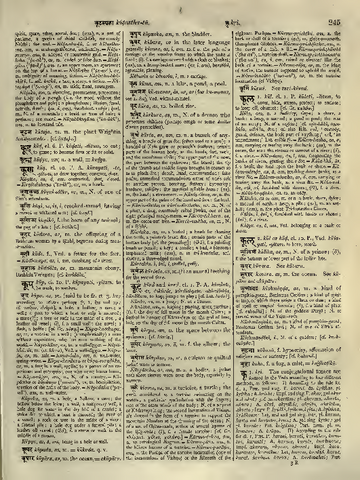
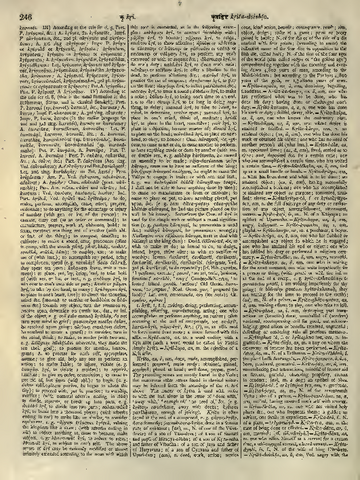
kṛ 1 . kṛ. The conjugational tenses are formed in the Veda according to four different methods, as follows: I) According to the rule for cl. 2, Pres. 2nd sing. P. karṣi, du. kṛthas, pl. kṛtha; A. kṛṣe; Impf. 2nd sing. P. akar, 3rd akar and akat; 3rd du. akartām; pl. akarma, akarta, akran; A. akri, akṛthās, akṛta, akrātām, akrata; Impv. P. kṛdhi, kṛtam, kṛta; A. kṛṣva, kṛdhvam: Leṭ, 2nd and 3rd sing. kar, pl. karma, karta and kartana, kran; A. 3rd sing. kṛta; 3rd pl. kranta: Pot. kriyāma; Part. nom. pl. m. krantas; A. krāṇa. II) According to the rule for cl. 1. Pres. P. karasi, karati, karathas, kara- tas, karanti; A. karase, karate, karāmahe; Impf. akaram, akaras, akarat; Impf. kara, karatam, karatām: Leṭ, karam, karāṇi, karas, karat, karāma, karan; A. karāmahai; Part. karantī. III) According to the rule for cl. 5, Pres. P. kṛṇomi, &c.; A. kṛṇve, du. kṛṇvaite; Impf. P. akṛṇavam, &c., 2nd pl. akṛṇuta and akṛṇo- tana; A. 3rd sing. akṛṇuta; Impv. P. kṛṇu or kṛṇuhi or kṛṇutāt, kṛṇotu; kṛṇutam, kṛṇutām; kṛṇuta or kṛṇota or kṛṇotana; kṛṇvantu; A. kṛṇuṣva, kṛṇutām, kṛṇvāthām, kṛṇudhvam; Leṭ, kṛṇavas, kṛṇavat and kṛṇa- vāt, kṛṇavāva, kṛṇavāma, kṛṇavātha, kṛṇava- tha, kṛṇavan; A. kṛṇavai, kṛṇavase, kṛṇa- vate, kṛṇavāvahai, kṛṇavāmahai, 3rd pl. kṛṇa- vanta or kṛṇavante or kṛṇvata: Pot. A. kṛṇvīta; Part. P. kṛṇvat, A. kṛṇvāna. IV) According to the rule for cl. 8, (this is the usual formation in the Brāhmaṇas, Sūtras, and in classical Sanskrit), Pres. P. karomi (ep. kurmi), karoṣi, &c., kurmas; A. kurve; Impf. P. akaravam; A. 3rd sing. akuruta; Impv. P. kuru, karotu (in the earlier language for 2nd and 3rd sing. kurutāt), kuruta or kurutana; A. kuruṣva, kurudhvam, kurvatām: Leṭ, P. karavāṇi, karavas, karavāt, &c.; A. karavai, kuruthās, karavāvahai (ep. karavāvahe), kara- vaithe, karavaite, karavāmahai (ep. karavā- mahe); Pot. P. kuryām, A. kurvīya; Part. P. kurvat, A. kurvāṇa: Perf. P. cakāra, cakartha, &c.; A. cakre, &c.; Part. P. cakṛvas (Acc. sing. Ved. cakruṣam); A. cakrāṇa; 2nd Fut. kariṣyati; Leṭ, 2nd sing. kariṣyās; 1st Fut. kartā; Prec. kriyāsam; Aor. P., Ved. cakaram, acakriran, acakrat; A. kṛṣe; Class. akārṣīt (poet. akā- raṣīt); Pass. Aor. reflex. akāri and akṛta; Inf. kartum; Ved. kartave, kartavai, kartos; Ind. Part. kṛtvā, Ved. kṛtvī and kṛtvāya; to do, make, perform, accomplish, cause, effect, prepare, undertake; to do anything for the advantage or injury of another (with gen. or loc. of the person); to execute, carry out (as an order or command); to manufacture, prepare, work at, elaborate, build; to form, construct one thing out of another (with abl. or inst. of the thing); to compose, describe; to cultivate; to make a sound, utter, pronounce (often in comp. with the sounds phaṭ, phuṭ, bhāṇ, vaṣaṭ, svadhā, svāhā, him); to employ, use; to make use of (with inst.); to accomplish any period, bring to completion, spend (e. g. varṣāṇi daśa cakruḥ, they spent ten years; kṣaṇaṃ kuru, wait a mo- ment); to place, put, lay, bring, lead, to take hold of (with acc. or loc. or inst., e. g. ardhaṃ kṛ, to win over to one's own side or party; haste or pāṇau kṛ, to take by the hand, to marry; hṛdayena kṛ, to place in one's heart, love); to direct the thoughts, mind &c. (manaḥ or matim or buddhim or bhā- vam &c.) towards any object, turn the attention to, resolve upon, determine on (with loc., dat., or inf. of the object, e. g. mā śoke manaḥ kṛthāḥ, do not turn your mind to grief; gamanāya matiṃ cakre, he resolved upon going; alābuṃ sraṣṭuṃ cakre, he resolved to create a gourd); to consider, turn in the mind, think; to make, to render (with two acc., e. g. ādityaṃ kāṣṭhām akurvata, they made the sun their goal); to procure for another, bestow, grant; A. to procure for one's self, appropriate, assume; to give aid, help any one to perform an action; to make liable; to injure, violate (e. g. kanyāṃ kṛ, to violate a maiden); to appoint, institute; to give an order, commission; to cause to get rid of, free from (with abl.); to begin (e. g. cakre śobhayitum purīm, he began to adorn the city); to proceed with, put in practice; to worship, sacrifice; (with numeral adverbs ending in dhā) to divide, separate, or break up into parts, e. g. dvidhā kṛ, to divide into two parts; sahasradhā kṛ, to break into a thousand pieces; (with adverbs ending in vat) to make like or similar, to consider equivalent, e. g. rājyaṃ tṛṇavat kṛtvā, valuing the kingdom like a straw; (with adverbs ending in sāt) to reduce anything to, cause to become, make subject, e. g. bhasmasāt kṛ, to reduce to ashes; ātmasāt kṛ, to subject to one's self. The above senses of kṛ may be variously modified or almost infinitely extended according to the noun with which this root is connected, as in the following exam- ples: sakhyaṃ kṛ, to contract friendship with; pūjāṃ kṛ, to honour; rājyaṃ kṛ, to reign; snehaṃ kṛ, to show affection; ājñāṃ or nideśaṃ or śāsanaṃ or kāmaṃ or yācanāṃ or vacaḥ or vacanaṃ or vākyaṃ kṛ, to perform any one's command or wish or request &c.; dharmaṃ kṛ, to do one's duty; nakhāni kṛ, to clean one's nails; udakaṃ or salilaṃ kṛ, to offer a libation to the dead, to perform ablutions &c.; astrāṇi kṛ, to practice the use of weapons; darduraṃ kṛ, to play on the flute; daṇḍaṃ kṛ, to inflict punishment &c.; svaraṃ kṛ, to utter a sound; śabdaṃ kṛ, to make a noise; kālaṃ kṛ, to bring one's time to an end, i. e. to die; ciraṃ kṛ, to be long in doing any- thing, to delay; manasi kṛ, to take to heart, to mind, to determine, resolve upon; manasā kṛ, to place in one's mind, think of, meditate; hṛdi kṛ, to place in the heart, remember; vaśe kṛ, to place in subjection, become master of; śirasā kṛ, to place on the head; mūrdhnā kṛ, to place on one's head, to obey, to honour: Caus. kārayati, -te, -yi- tum, to cause to act or do, to cause another to perform, to have anything made or done by another (with acc. or double acc., e. g. sabhāṃ kāritavān, he caused an assembly to be made; rāja-darśanam māṃ kāraya, cause me to have an audience of the king; bānijyaṃ kārayed vaiśyam, he ought to cause the Vaiśya to engage in trade; or with acc. and inst., e. g. na śakṣyāmi kiñcit kārayituṃ tvayā, I shall not be able to have anything done by thee); to cause to manufacture or form or cultivate; to cause to place or put, to have anything placed, put upon, &c. (e. g. taṃ citra-paṭaṃ vāsa-gṛhe bhittāv akārayat, he had the picture placed on the wall in his house). Sometimes the Caus. of kṛ is used for the simple verb or without a causal significa- tion (e. g. padaṃ kārayati, he pronounces a word &c.; mithyā kārayati, he pronounces wrongly; Kaikeyīm anu rājānaṃ kāraya, treat or deal with Kaikeyī as the king does): Desid. cikīrṣati, -te, to wish to make or do; to intend to do, to design, intend, begin, strive after; to wish to sacrifice or worship: Intens. carkarti, carikarti, carīkarti, carkarīti, carikarīti, carīkarīti, cekrīyate, Ved. 3rd pl. karikrati, to do repeatedly; [cf. Hib. caraim, ‘I perform, execute;’ ceard, ‘an art, trade, business, function;’ sucridh, ‘easy;’ Cambro-Brit. creu, ‘to form;’ Island. gerdh, ‘action;’ Old Germ. kara- wan, ‘to prepare;’ Mod. Germ. gar, ‘prepared (as food);’ Lat. creo, cœremonia, ars (for cars); Gr. κραίνω, κρόνος.]
Original text · English · Word type unspecified
kṛ 3 . kṛ, to injure &c. See 2. kṝ.

Original text · English · verb
kṛ 2 . kṛ, cl. 3. P., Ved. cakarti, akārīt, Intens. carkarti, to make mention of, to praise, to speak highly of (with gen.); [cf. kāru, kīri, kīrti.]
Whitney Roots 1885 verbal root
Original text · English · verbal root
kṛ [1], skṛ — make
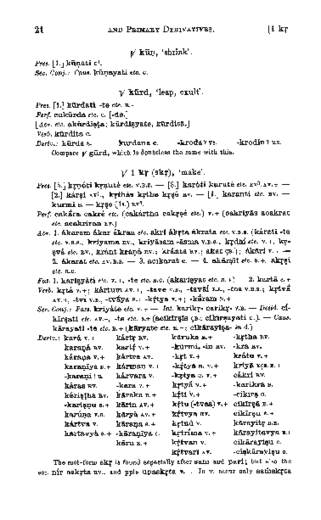
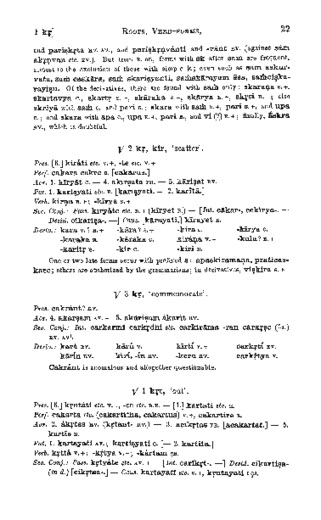
Original text · English · verbal root
kṛ [2], kir — scatter
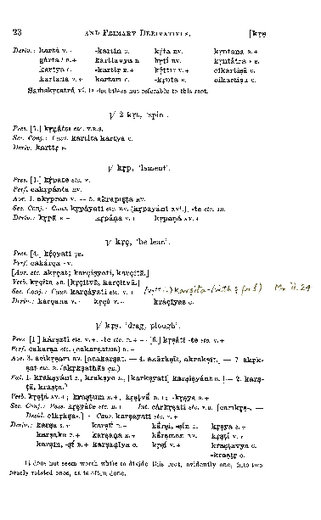
Original text · English · verbal root
kṛ [3] — commemorate
Apte 1890 verbal root
Original text · English · verbal root
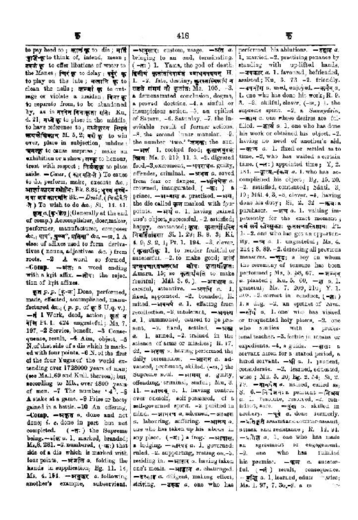
kṛ I. 5 U. (kṛṇoti-kṛṇute) To hurt, injure, kill. II. 8 U. (karoti-kurute, cakāra-cakre, akārṣīt-akṛta, kartuṃ, kariṣyati-te, kṛta) 1 To do (in general); tāta ([Page 0417-b]) kiṃkaravāṇyahaṃ. 2 To make; gaṇikāmavarodhamakarot Dk; nṛpeṇa cakre yuvarājaśabdabhāk R. 3. 35; yuvarājaḥ kṛtaḥ &c. 3 To manufacture, shape, prepare; kuṃbhakāro ghaṭaṃ karoti; kaṭaṃ karoti &c. 4 To build, create; gṛhaṃ kuru; sabhāṃ kuru madarthe bhoḥ 5 To produce, cause, engender; ratimubhayaprārthanā kurute Ś. 2. 1. 6 To form, arrange; aṃjaliṃ karoti; kapotahastakaṃ kṛtvā. 7 To write, compose; cakāra sumanoharaṃ śāstraṃ Pt. 1. 8 To perform, be engaged in; pūjāṃ karoti. 9 To tell, narrate; iti bahuvidhāḥ kathāḥ kurvan &c. 10 To carry out, execute, obey; evaṃ kriyate yuṣmadādeśaḥ Māl. 1; or kariṣyāmi vacastava or śāsanaṃ me kuruṣva &c. 11 To bring about, accomplish, effect; satsaṃgatiḥ kathaya kiṃ na karoti pusāṃ Bh. 2. 23. 12 To throw or let out, discharge, emit; mūtraṃ kṛ to discharge urine, make water; so purīṣaṃ kṛ to void excrement. 13 To assume, put on, take; strīrūpaṃ kṛtvā; nānārūpāṇi kurvāṇaḥ Y. 3. 162. 14 To send forth, utter; mānuṣīṃ giraṃ kṛtvā, kalaravaṃ kṛtvā &c. 15 To place or put on (with loc.); kaṃṭhe hāramakaret K. 212; pāṇimurasi kṛtvā &c. 16 To entrust (with some duty), appoint; adhyakṣān vividhānkuryāttatra tatra vipaścitaḥ Ms. 7. 81. 17 To cook (as food) as in kṛtānnaṃ. 18 To think, regard, consider; dṛṣṭistṛṇīkṛtajagattrayasattvasārā U. 6. 19. 19 To take (as in the hand); kuru kare gurumekamayoghanaṃ N. 4. 59. 20 To make a sound, as in khātkṛtya, phūtkṛtya bhuṃkte; so vaṣaṭakṛ, svāhākṛ &c. 21 To pass, spend (time); varṣāṇi daśa cakruḥ spent; kṣaṇaṃ kuru wait a moment. 22 To direct towards, turn the attention to, resolve on; (with loc. or dat.); nādharme kurute manaḥ Ms. 12. 118; nagaragamanāya matiṃ na karoti Ś. 2. 23 To do a thing for another, either for his advantage or injury; prāptāgninirvāpaṇagarvamaṃbu ratnāṃkurajyotiṣi kiṃ karoti Vikr. 1. 18; yadanena kṛtaṃ mayi, asau kiṃ me kariṣyati &c. 24 To use, employ, make use of; kiṃ tayā kriyate dhenvā Pt. 1. 25 To divide, break into parts (with adverbs ending in dhā); dvidhā kṛ to divide into two parts; śatadhā kṛ, sahasradhā kṛ &c. 26 To cause to become subject to, reduce completely to (a particular condition, with adverbs ending in ([Page 0417-c]) sāt); ātmasāt kṛ to subject or appropriate to oneself; R. 8. 2; bhasmasāt kṛ to reduce to ashes. 27 To appropriate, secure for oneself. 28 To help, give aid. 29 To make liable. 30 To violate or outrage (as a girl). 31 To begin. 32 To order. 33 To free from. 34 To proceed with, put in practice. 35 To worship, sacrifice. 36 To make like, consider equal to, cf. tṛṇīkṛ (said to be Atm. only in the last 10 senses). This root is often used with nouns, adjectives, and indeclinables to form verbs from them, somewhat like the English affixes ‘en’ or ‘(i) fy’, in the sense of ‘making a person or thing to be what it previously is not’; e. g. kṛṣṇīkṛ to make that which is not already black, black, i. e. blacken; so śvetīkṛ to whiten; ghanīkṛ to solidify; viralīkṛ to rarefy &c. &c. Sometimes these formations take place in other senses also; e. g. kroḍīkṛ ‘to clasp to the bosom’, embrace bhasmīkṛ to reduce to ashes; pravaṇīkṛ to incline, bend; tṛṇīkṛ to value as little as straw; maṃdīkṛ to slacken, make slow; so śūlākṛ to roast on the end of pointed lances; sukhākṛ to please; samayākṛ to spend time &c. N. B. This root by itself admits of either Pada; but it is Atm. generally with prepositions in the following senses:-(1) doing injury to; (2) censure, blame; (3) serving; (4) outraging, acting violently or rashly; (5) preparing, changing the condition of, turning into; (6) reciting. (7) employing, using; see P. I. 3. 32 and “Student's Guide to Sanskrit Composition” § 338. Note. The root kṛ is of the most frequent application in Sanskrit literature, and its senses are variously modified, or almost infinitely extended, according to the noun with which the root is connected; e. g. padaṃ kṛ to set foot (fig. also); āśrame padaṃ kariṣyasi Ś. 4. 19; krameṇa kṛtaṃ mama vapuṣi navayauvanena padaṃ K. 141; manasā kṛ to think of, meditate; manasi kṛ to think; dṛṣṭvā manasyevamakarot K. 136; or to resolve or determine; sakhyaṃ, maitrīṃ kṛ to form friendship with; astrāṇi kṛ to practise the use of weapons; daṃḍaṃ kṛ to inflict punishment; hṛdaye kṛ ([Page 0418-a]) to pay heed to; kālaṃ kṛ to die; matiṃ duddhiṃ-kṛ to think of, intend, mean; udakaṃ kṛ to offer libations of water to the Manes; ciraṃ kṛ to delay; darduraṃ kṛ to play on the lute; nakhāni kṛ to clean the nails; kanyāṃ kṛ to outrage or violate a maiden; vinā kṛ to separate from, to be abandoned by, as in madanena vinākṛtā ratiḥ Ku. 4. 21; madhye kṛ to place in the middle, to have reference to; madhyekṛtya sthitaṃ krathakaiśikān M. 5. 2; vaśe kṛ to win over, place in subjection, subdue; camatkṛ to cause surprise; make an exhibition or a show; satkṛ to honour, treat with respect; tiryakkṛ to place aside. — Caus. (kārayati-te) To cause to do, perform, make, execute &c.; ājñāṃ kāraya rakṣebhiḥ Bk. 8. 84; bhṛtyaṃ bhṛtyena vā kaṭaṃ kārayati Sk. — Desid. (cikīrṣīti-te) To wish to do &c.; Śi. 14. 41.
Cappeller 1887 Word type unspecified
Original text · German · Word type unspecified
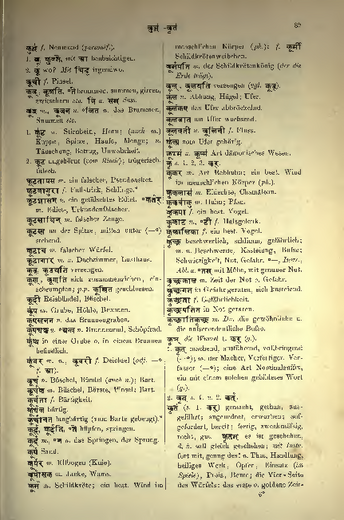
kṛ s. 1. 2. 3. kar.
Burnouf 1866 verbal root · Word type unspecified
Original text · French · verbal root
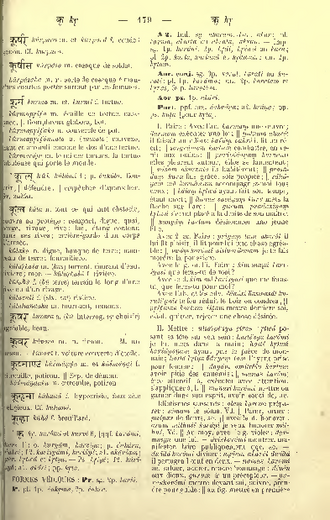
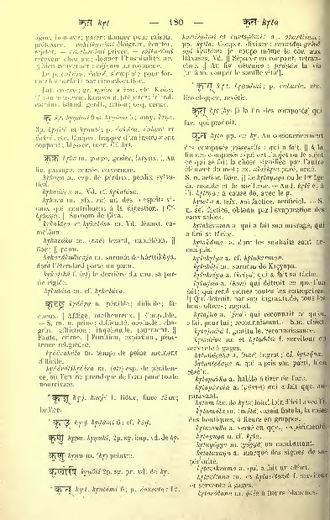
*kṛ kṛ. karomi et kurve 8, [qqf. karāmi, kare 1]; o. kuryām, kurvīya; p. cakāra, cakre; f2. kariṣyāmi, kariṣye; a1. akārṣam; gér. kṛtvā et kṛtya. — Ps. kriye; f2. kārisye; a1. akāri; pp. kṛta. FORMES VEDIQUES: Pr. sg. 2p. karṣi. P. pl. 1p. cakṛma 2p. cakrā. [Page179-2] A2. Ind. sg. akaram, kar, akar; pl. karma, akarta ou akrata, akran. — Imp. sg. 1p. karāṇi, 2p. kṛdhi, kṛṣvā ou kara; pl. 2p. karta, kartanā et kṛdhvam; du. 2p. kṛtam. Aor. conjf. sg. 3p. karat, karati ou karate; pl. 1p. karāma; du. 2p. karatam et kṛthas, 3ᵉ p. karatām. Aor. ps. 1p. akāri. Part. ppf. act. cakrāṇa; a2. krāṇa; pp. ps. kuṭa [pour kṛta]. I. Faire: Avec l'ac. karmaṃ une œuvre; dharmam exécuter une loi; yatnam akarot il faisait un effort; kathāṃ cakre il fit un récit; saṅgrāmaṃ kartum combattre, en venir aux mains; paricocaṇam kurvanti elles pleurent autour, elles se lamentent; vāsam akurvata ils habitèrent; prasādaṃ kuru fais grâce, sois propice; sāhāyam me kurudhvam accompagnez-moi tous deux; kālaṃ kṛtvā ayant fait son temps, étant mort; dhanuḥ savāṇaṃ kuru mets la fleche sur l'arc; gurum pradakṣiṇaṃ kṛtvā s'étant placé à la droite de son maître; kanyāṃ kartum déshonorer une jeune fille. Avec 2 ac. Faire: priyaṃ tam akarot il lui fit plaisir, il fit pour lui une chose agréable; tvāṃ karomi kṣitivardhanam je te fais mordre la poussière. Avec le g. ou l'i. Faire: kim mayā kariṣyasi que feras-tu de moi? Avec le d. kim me kariṣyasi que me ferastu, que feras-tu pour moi? Avec l'ab. et les adv. edhaṃsi bhasmasāt kurule'gnis le feu réduit le bois en cendres; pṛṣṭhataḥ kartum iṣṭam mettre derriere soi, c-à-d. quitter, rejeter une chose désirée. II. Mettre: utsaṅge'sya śiras ṛtvā posant sa tête sur son sein; haste'sya karomi je lui mets dans la main; haste kṛtvā karṣāpaṇam ayant pris la pièce de monnaie; haste kṛtya bhāryāṃ tām l'ayant prise pour femme; dayām amitreṣu kartum avoir pitié des ennemis; manas karom) être attentif à, exécuter avec attention, s'appliquer à, 1. manasi karomi mettre ou garder dans son esprit, avoir souci de, ac. Idiotismes sanscrits: alaṃ karomi préparer: somam le soma, Vd. Parer, orner: puṣpais de fleurs, ac. avec le d. honorer: aram mīlhuṣe karāṇi je veux honorer mīlhuṣ, Vd. Au moy. avec le g. violer: dharmasya une loi. — āviskaromi montrer, manifester, faire publiquement qqc. ac. — dvidhā karomi diviser: aṇḍam akarot dvidhā il partagea l'œuf en deux. — namas karomi ac. saluer, adorer, rendre hommage: devān aux dieux, gurum à un précepteur. — puraskaromi mettre devant soi, suivre, prendre pour guide; au fig. mettre en première [Page180-1] ligne, honorer; parer; donner pour raison, prétexter. — vahiṣkaromi éloigner, écarter, rejeter. — vinākaromi priver. — satkaromi recevoir chez soi; donner l'hospitalité, ac. bien gouverner: rājyam un royaume. Le p. cakāra, cakre, s'emploie pour former les parfaits par circonlocution. Lat. creare; gr. ϰραίνω, ϰράτος, etc. Κρόνος (?); ancien germ. karawam, préparer; irland. caraim, island. gerdh, action; osq. cerus.
Original text · French · Word type unspecified
kṛ kṛ. kṛṇāmi 9 et kṛṇomi 5; moy. kṛṇe, 3p. kṛṇīte et kṛṇute; p. cakāra, cakare et cakre; etc. Couper, frapper d'un instrument coupant; blesser, tuer. Cf. kṛt.
Derived words
More direct derivatives (6)
Occurrences in source texts (478)
DYS 46 occurrences
DYS 43–49: False Yogis 5 occurrences
Direct occurrences
-
DYS 49 Segment 9
Occurrences through derived words
17 more source pages
DYS 60–66: Prāṇāyāma 7 occurrences
Direct occurrences
DYS 103–105: Students as Obstacle 2 occurrences
Occurrences through derived words
DYS 112–121: Five Elements 3 occurrences
Direct occurrences
DYS 154–167: Vajrolī for the Male Yogi 5 occurrences
Direct occurrences
Occurrences through derived words
-
DYS 165 Segment 15
GoS 28 occurrences
GoS 1–8: Learning and Liberation 2 occurrences
Direct occurrences
-
GoS 5 Segment 5
Occurrences through derived words
-
GoS 4 Segment 2
GoS 20–28: Setting Sarasvatī in Motion 3 occurrences
Direct occurrences
GoS 34–41: Sun, Sound and Cooling 2 occurrences
Direct occurrences
6 more source pages
GoS 50–63: Three Locks 8 occurrences
Direct occurrences
GoS 64–66: An Order for Practice 2 occurrences
Direct occurrences
GoS 81–88: Moon, Fluid and Union 3 occurrences
Direct occurrences
Occurrences through derived words
-
GoS 86 Segment 1
HP 80 occurrences
HP 1.17-1.32: Āsana 6 occurrences
Direct occurrences
HP 1.44-1.49: Padmāsana 4 occurrences
Direct occurrences
-
HP 1.45–46 Segment 3
-
HP 1.45–46 Segment 13
-
HP 1.48 Segment 1
Occurrences through derived words
-
HP 1.44 Segment 29
HP 1.55-1.57: Transition to Kumbhaka 3 occurrences
Direct occurrences
-
HP 1.57 Segment 14
Occurrences through derived words
32 more source pages
HP 1.64-1.65: Practice and Rājayoga 1 occurrence
Occurrences through derived words
-
HP 1.65 Segment 5
HP 2.34-2.36: Naulī and Kapālabhātī 1 occurrence
Occurrences through derived words
-
HP 2.35 Segment 18
HP 2.37-2.43: Path to Manonmanī 2 occurrences
Direct occurrences
HP 2.44-2.47: Eight Kumbhakas 3 occurrences
Direct occurrences
HP 3.33-3.48*1: Khecarī and Soma 7 occurrences
Direct occurrences
-
HP 3.34 Segment 4
-
HP 3.34*1–34*2 Segment 4
-
HP 3.34*1–34*2 Segment 21
-
HP 3.40 Segment 7
Occurrences through derived words
HP 3.58-3.65: Uḍḍiyāna Bandha 4 occurrences
Direct occurrences
HP 3.66-3.72: Jālandhara and the Bandhas 3 occurrences
Direct occurrences
HP 3.79-3.86*1: Vajrolī 2 occurrences
Direct occurrences
-
HP 3.81 Segment 11
Occurrences through derived words
-
HP 3.81 Segment 14
HP 3.87-3.93*7: Sahajolī and Amarolī 3 occurrences
Direct occurrences
Occurrences through derived words
-
HP 3.93*7 Segment 3
HP 3.94-3.102*1: Śakti Cālana 5 occurrences
Direct occurrences
HP 3.103-3.107*2: Conclusion of the Mudrā Teaching 1 occurrence
Direct occurrences
-
HP 3.105 Segment 10
HP 4.0*1-4.0*14: Samādhi and Laya 3 occurrences
Occurrences through derived words
HP 4.9-4.11*4: Gaze and Lunar Nectar 1 occurrence
Occurrences through derived words
-
HP 4.9 Segment 29
HP 4.11*15-4.11*28: Space and Laya 6 occurrences
Direct occurrences
-
HP 4.11*15 Segment 3
-
HP 4.11*19 Segment 4
-
HP 4.11*20 Segment 3
-
HP 4.11*20 Segment 10
-
HP 4.11*20 Segment 15
-
HP 4.11*22 Segment 4
HTK 8 occurrences
HTK 10.9*2–11*1: Sītkā / Sītkārī and Śītalī 1 occurrence
Occurrences through derived words
-
HTK 10.10 Segment 32
HTK 10.26–29*1: Cakra, Śaṅkha, Vāmāvartta, Vartmagati and Gadā 1 occurrence
Direct occurrences
-
HTK 10.27*1 Segment 4
HTK 10.33*2–34*1: Bhūtaśuddhi: Purifying the elements 1 occurrence
Direct occurrences
-
HTK 10.34 Segment 4
IVU 5 occurrences
MAN 6 occurrences
Patañjali Mantra 2 occurrences
Direct occurrences
-
MAN PY 1.2 Segment 2
Occurrences through derived words
-
MAN PY 2.1 Segment 4
PJH 3 occurrences
PJH 15-16: Attaining Power, the Joy of Awareness (cidānanda), and Liberation While Living (jīvanmukti) 1 occurrence
Direct occurrences
-
PJH 15 Segment 5
PYS 31 occurrences
PYS 1.50–51: Samādhi without Seed 2 occurrences
Occurrences through derived words
18 more source pages
PYS 2.15–17: Everything Is Suffering 1 occurrence
Occurrences through derived words
-
PYS 2.15 Segment 3
PYS 2.18–19: The Evolution of Prakṛti 1 occurrence
Occurrences through derived words
-
PYS 2.18 Segment 2
PYS 2.30–34: Vows and Counterreflection 2 occurrences
Direct occurrences
PYS 3.9–12: Three Transformations of Citta 2 occurrences
Occurrences through derived words
PYS 3.17–20: Extraordinary Knowledge 2 occurrences
Occurrences through derived words
PYS 3.21–22: Invisibility and Time of Death 1 occurrence
Occurrences through derived words
-
PYS 3.22 Segment 4
PYS 3.49–51: Omniscience or Kaivalya 1 occurrence
Occurrences through derived words
-
PYS 3.51 Segment 5
PYS 4.2–3: Change of Life Form 2 occurrences
Occurrences through derived words
PYS 4.9–11: Continuity of Saṃskāras 1 occurrence
Occurrences through derived words
-
PYS 4.9 Segment 8
PYS 4.22-24: Citta as Mirror 2 occurrences
Occurrences through derived words
PYS 4.27–28: The Return of Old Saṃskāras 1 occurrence
Occurrences through derived words
-
PYS 4.27 Segment 5
SiSa 206 occurrences
SiSa 1.4-1.9: Begrenzte Wege 7 occurrences
Direct occurrences
Occurrences through derived words
SiSa 1.10-1.16: Lehrmeinungen 2 occurrences
Direct occurrences
-
SiSa 1.16 Segment 15
Occurrences through derived words
-
SiSa 1.12 Segment 16
SiSa 1.20-1.31: Karma und Erkenntnis 16 occurrences
Direct occurrences
-
SiSa 1.22 Segment 11
Occurrences through derived words
-
SiSa 1.20 Segment 1
-
SiSa 1.20 Segment 16
-
SiSa 1.21 Segment 3
-
SiSa 1.21 Segment 11
-
SiSa 1.21 Segment 12
-
SiSa 1.21 Segment 18
-
SiSa 1.21 Segment 19
-
SiSa 1.24 Segment 2
-
SiSa 1.24 Segment 7
-
SiSa 1.24 Segment 9
-
SiSa 1.26 Segment 2
-
SiSa 1.26 Segment 6
-
SiSa 1.29 Segment 2
-
SiSa 1.30 Segment 7
-
SiSa 1.31 Segment 1
58 more source pages
SiSa 1.65-1.70: Māyā-Aufhebung 3 occurrences
Direct occurrences
-
SiSa 1.69 Segment 12
Occurrences through derived words
SiSa 1.82-1.90: Guṇas und Gegenstände 1 occurrence
Occurrences through derived words
-
SiSa 1.83 Segment 11
SiSa 1.93-1.99: Karmische Verkörperung 6 occurrences
Direct occurrences
-
SiSa 1.98 Segment 4
Occurrences through derived words
SiSa 2.21-2.24: Ādhāra und Kuṇḍalī 2 occurrences
Direct occurrences
-
SiSa 2.24 Segment 15
Occurrences through derived words
-
SiSa 2.23 Segment 4
SiSa 2.35-2.40: Jīva und Karma 6 occurrences
Direct occurrences
-
SiSa 2.37 Segment 12
Occurrences through derived words
SiSa 2.41-2.43: Māyā-Projektion 2 occurrences
Occurrences through derived words
SiSa 2.44-2.48: Erkenntnisweg 4 occurrences
Occurrences through derived words
SiSa 2.49-2.54: Befreiungswissen 6 occurrences
Direct occurrences
Occurrences through derived words
SiSa 3.1-3.10: Herzlotus und Prāṇa 5 occurrences
Direct occurrences
Occurrences through derived words
SiSa 3.11-3.16: Guru und Śraddhā 3 occurrences
Direct occurrences
Occurrences through derived words
-
SiSa 3.13 Segment 10
SiSa 3.21-3.31: Nāḍī-Reinigung 3 occurrences
Direct occurrences
SiSa 3.34-3.38: Förderliche Mittel 3 occurrences
Direct occurrences
SiSa 3.51-3.54: Prāṇāyāma-Siddhis 1 occurrence
Occurrences through derived words
-
SiSa 3.54 Segment 24
SiSa 3.61-3.67: Paricaya und Niṣpatti 7 occurrences
Occurrences through derived words
SiSa 3.68-3.80: Vāyusādhana 4 occurrences
Direct occurrences
SiSa 3.88-3.91: Padmāsana 3 occurrences
Direct occurrences
SiSa 4.9-4.20: Yonimudrā-Geheimnis 2 occurrences
Direct occurrences
SiSa 4.31-4.36: Mahāmudrā-Wirkung 2 occurrences
Direct occurrences
SiSa 4.37-4.42: Mahābandha 2 occurrences
Direct occurrences
SiSa 4.43-4.50: Mahāvedha 4 occurrences
Direct occurrences
SiSa 4.51-4.59: Khecarīmudrā 2 occurrences
Direct occurrences
SiSa 4.69-4.71: Viparītakṛti 3 occurrences
Direct occurrences
SiSa 4.72-4.77: Uḍḍyānabandha 2 occurrences
Direct occurrences
SiSa 4.81-4.90: Bindu-Bewahrung 3 occurrences
Direct occurrences
SiSa 4.105-4.111: Śakticālana 4 occurrences
Direct occurrences
-
SiSa 4.107 Segment 11
-
SiSa 4.108 Segment 2
-
SiSa 4.110 Segment 2
-
SiSa 4.110 Segment 11
SiSa 5.10-5.14: Subtile Hindernisse 2 occurrences
Direct occurrences
-
SiSa 5.10 Segment 5
Occurrences through derived words
-
SiSa 5.11 Segment 9
SiSa 5.29-5.35: Pratīka-upāsanā 3 occurrences
Direct occurrences
Occurrences through derived words
-
SiSa 5.34 Segment 6
SiSa 5.38-5.47: Nāda-Laya 3 occurrences
Direct occurrences
Occurrences through derived words
-
SiSa 5.40 Segment 15
SiSa 5.48-5.71: Innere Meditation 8 occurrences
Direct occurrences
SiSa 5.90-5.93: Mūlādhāra-Wirkungen 2 occurrences
Direct occurrences
-
SiSa 5.90 Segment 2
Occurrences through derived words
-
SiSa 5.91 Segment 12
SiSa 5.94-5.101: Mūlādhāra-Siddhis 4 occurrences
Direct occurrences
-
SiSa 5.94 Segment 12
-
SiSa 5.96 Segment 11
-
SiSa 5.99 Segment 4
-
SiSa 5.100 Segment 2
SiSa 5.108-5.112: Maṇipūra 2 occurrences
Direct occurrences
-
SiSa 5.110 Segment 5
Occurrences through derived words
-
SiSa 5.112 Segment 3
SiSa 5.132-5.143: Innere Vārāṇasī 2 occurrences
Occurrences through derived words
-
SiSa 5.136 Segment 3
-
SiSa 5.139 Segment 2
SiSa 5.144-5.155: Ājñā und Khecarī 11 occurrences
Direct occurrences
-
SiSa 5.145 Segment 2
-
SiSa 5.145 Segment 12
-
SiSa 5.146 Segment 6
-
SiSa 5.146 Segment 10
-
SiSa 5.148 Segment 1
-
SiSa 5.151 Segment 2
-
SiSa 5.151 Segment 12
-
SiSa 5.153 Segment 7
-
SiSa 5.153 Segment 13
Occurrences through derived words
-
SiSa 5.145 Segment 13
-
SiSa 5.153 Segment 11
SiSa 5.156-5.181: Sahasrāra 4 occurrences
Direct occurrences
-
SiSa 5.160 Segment 12
-
SiSa 5.174 Segment 3
Occurrences through derived words
-
SiSa 5.167 Segment 23
-
SiSa 5.172 Segment 7
SiSa 5.182-5.190: Sahasrāra-Mond 4 occurrences
Direct occurrences
-
SiSa 5.182 Segment 15
-
SiSa 5.186 Segment 2
-
SiSa 5.187 Segment 10
-
SiSa 5.189 Segment 15
SiSa 5.191-5.207: Kailāsa und Mahāśūnya 5 occurrences
Direct occurrences
-
SiSa 5.193 Segment 18
-
SiSa 5.194 Segment 16
-
SiSa 5.196 Segment 2
-
SiSa 5.199 Segment 12
-
SiSa 5.203 Segment 4
SiSa 5.208-5.222: Rājayoga 8 occurrences
Direct occurrences
-
SiSa 5.209 Segment 4
-
SiSa 5.210 Segment 10
-
SiSa 5.211 Segment 13
-
SiSa 5.213 Segment 13
-
SiSa 5.216 Segment 12
-
SiSa 5.217 Segment 6
-
SiSa 5.218 Segment 11
Occurrences through derived words
-
SiSa 5.218 Segment 2
SiSa 5.223-5.233: Praxis im Leben 9 occurrences
Direct occurrences
-
SiSa 5.224 Segment 4
-
SiSa 5.225 Segment 8
-
SiSa 5.227 Segment 3
-
SiSa 5.227 Segment 11
-
SiSa 5.229 Segment 14
-
SiSa 5.231 Segment 10
Occurrences through derived words
-
SiSa 5.228 Segment 3
-
SiSa 5.228 Segment 7
-
SiSa 5.228 Segment 12
SiSa 5.234-5.252: Tripurā-Mantra 6 occurrences
Direct occurrences
-
SiSa 5.240 Segment 2
-
SiSa 5.240 Segment 7
-
SiSa 5.244 Segment 15
-
SiSa 5.245 Segment 14
-
SiSa 5.247 Segment 7
Occurrences through derived words
-
SiSa 5.252 Segment 7
SiSa 5.253-5.260: Haushalter-Abschluss 5 occurrences
Direct occurrences
-
SiSa 5.257 Segment 12
-
SiSa 5.258 Segment 10
Occurrences through derived words
-
SiSa 5.257 Segment 1
-
SiSa 5.257 Segment 10
-
SiSa 5.259 Segment 9
SS 5 occurrences
SVU 30 occurrences
SVU 1.1-1.3: The Search for the Cause 2 occurrences
Occurrences through derived words
SVU 4.6-4.10: Two Birds and Māyā 2 occurrences
Direct occurrences
-
SVU 4.8 Segment 17
Occurrences through derived words
-
SVU 4.10 Segment 3
6 more source pages
SVU 5.1–5.6: The Lord of Cosmic Origins 2 occurrences
Direct occurrences
SVU 5.7–5.11: The Wandering Self 4 occurrences
Direct occurrences
-
SVU 5.7 Segment 7
Occurrences through derived words
SVU 5.12–5.14: Knowledge and Freedom 1 occurrence
Occurrences through derived words
-
SVU 5.12 Segment 12
SVU 6.1–6.6: Lord of Cosmic Unfolding 7 occurrences
Direct occurrences
Occurrences through derived words
VBT 30 occurrences
VBT 7–10: Forms Relativized 2 occurrences
Direct occurrences
-
VBT 7 Segment 2
Occurrences through derived words
-
VBT 10 Segment 5
VBT 22–23: Practical Access 2 occurrences
Direct occurrences
-
VBT 22 Segment 11
Occurrences through derived words
-
VBT 23 Segment 4
8 more source pages
VBT 75–85: Thresholds and Sky 7 occurrences
Direct occurrences
-
VBT 76 Segment 7
-
VBT 79 Segment 5
-
VBT 79 Segment 12
-
VBT 80 Segment 12
-
VBT 81 Segment 12
-
VBT 84 Segment 4
Occurrences through derived words
-
VBT 85 Segment 11
VBT 86–92: Light and Darkness 2 occurrences
Direct occurrences
-
VBT 91 Segment 6
Occurrences through derived words
-
VBT 92 Segment 2
VBT 101–109: Śiva-Identity 3 occurrences
Direct occurrences
Occurrences through derived words
-
VBT 102 Segment 8
VBT 130–138: Name and Fourfoldness 2 occurrences
Occurrences through derived words
VBT 139–145: Fruit of the Ways 3 occurrences
Direct occurrences
Occurrences through derived words
-
VBT 140 Segment 11
Continue with AYI Free
Image source: AYI archive.