
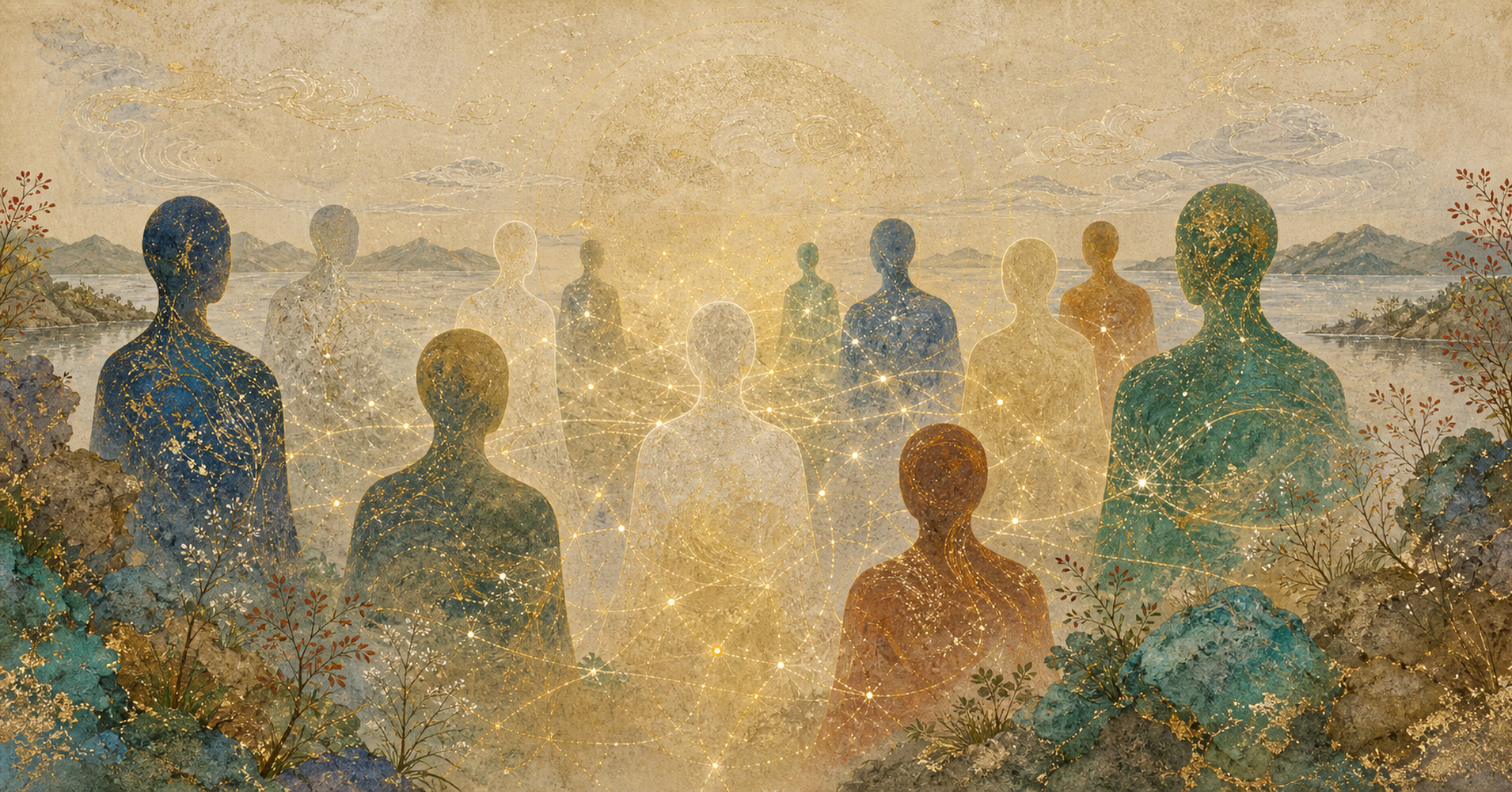
IVU 6-7: All Beings in the Self

Īśāvāsya Upaniṣad 6-7: Unity without Aversion

Whoever sees all beings in the Self and the Self in all beings overcomes aversion, delusion, and sorrow.

Dr. Ronald Steiner Dr. Ronald Steiner
Īśāvāsya Upaniṣad 6
यस्तु सर्वाणि भूतानि आत्मन्येवानुपश्यति |
yas tu sarvāṇi bhūtāni*; ātmany evānupaśyati | Analysis ▾ Analysis ▴
yaḥ
nominative singular masculine
pronoun rel
who, whoever
tu
particle
but
sarvāṇi
accusative plural neuter
pronoun quant
all
bhūtāni
accusative plural
substantive neuter
beings
ātmani
lokative singular
substantive masculine
in the Self
eva
particle
indeed, precisely
anupaśyati
3rd person singular aktive present
previx
verbal root
sees, beholds
सर्वभूतेषु चात्मानम् ततो न विजुगुप्सते ||6||
sarva-bhūteṣu cātmānam; tato na vijugupsate ||6|| Analysis ▾ Analysis ▴
sarva
karmadhāraya-compound
pronoun quant
all
bhūteṣu
lokative plural
substantive neuter
among beings
ca
particle
and, also
ātmānam
accusative singular
substantive masculine
the Self
tataḥ
adverb
therefore, then
na
particle
not
vijugupsate
3rd person singular medial present desiderative
previx
verbal root
shrinks away, feels aversion
Metre: Anuṣṭubh
But (tu) whoever (yaḥ | nom sg m) sees (anupaśyati | 3p sg act pres) all beings (sarvāṇi bhūtāni | acc pl) precisely (eva) in the Self (ātmani | loc sg), and (ca) the Self (ātmānaṃ | acc sg) in all beings (sarva-bhūteṣu | loc pl), does not (na) therefore (tataḥ) feel aversion (vijugupsate | 3p sg med pres des).
Dr. Ronald Steiner - 2026 - historically literal
Whoever sees all beings in the Self and the Self in all beings no longer turns away from anything.
Dr. Ronald Steiner - 2026 - modern transfer

For Śaṅkara, the seer here is the mumukṣu (seeker of liberation) or parivrāj (wandering renunciate), who sees all beings in the Self and the Self in all beings. Vijugupsā (aversion or avoidance) falls away because it arises only toward something seen as other or impure. Whoever sees only the pure Self has no object of rejection left.

Īśā-Upaniṣad Śaṅkara-Bhāṣya
bhūtāni* conj. ed. ] bhūtāny GRETIL2018, LV1958
Critical Apparatus
Now, he who on all beings
Looks as just (eva) in the Self (Ātman),
And on the Self as in all beings—<2>
He does not shrink away from Him.<3>

<2: This universal presence is claimed by Kṛishṇa for himself at BhG. 6. 30 a, b.>
<3: The indefinite word tatas may mean ‘from these beings,’ or ‘from this Self,’ or ‘from this time on,’ or pregnantly all these.—The whole line recurs at Bṛih. 4. 4. 15 d; Kaṭha 4. 5 d, 4. 12 d. >
Robert Hume - 1921
Doch wer die Wesen hier alle
Wiedererkennt im eignen Selbst
Und sich in allem, was lebet,
Der ängstigt sich vor keinem mehr.
Paul Deussen - 1897
And he who beholds all beings in the Self, and the Self in all beings, he never turns away from it <2>.

<2: Vikikitsati, Vâg. Samh.; vigugupsate, Upan. >
Max Müller - 1879
Īśāvāsya Upaniṣad 7
यस्मिन्सर्वाणि भूतानि आत्मैवाभूद्विजानतः |
yasmin sarvāṇi bhūtāni*; ātmaivābhūd vijānataḥ | Analysis ▾ Analysis ▴
yasmin
lokative singular neuter
pronoun rel
in whom
sarvāṇi
nominative plural neuter
pronoun quant
all
bhūtāni
nominative plural
substantive neuter
beings
ātmā
nominative singular
substantive masculine
the Self
eva
particle
indeed, precisely
abhūt
3rd person singular aktive aorist
verbal root
became
vijānataḥ
genitive singular masculine present participle active
previx
verbal root
of the knower
तत्र को मोहः कः शोक एकत्वमनुपश्यतः ||7||
tatra ko mohaḥ kaḥ śoka; ekatvam anupaśyataḥ ||7|| Analysis ▾ Analysis ▴
tatra
adverb
there, then
kaḥ
nominative singular masculine
pronoun inter
what
mohaḥ
nominative singular
substantive masculine
delusion
kaḥ
nominative singular masculine
pronoun inter
what
śokaḥ
nominative singular
substantive masculine
sorrow
ekatvam
accusative singular
substantive neuter
oneness
anupaśyataḥ
genitive singular masculine present participle active
previx
verbal root
of one who sees
Metre: Anuṣṭubh
In whom (yasmin | loc sg n) all beings (sarvāṇi bhūtāni | nom pl), for the one who knows (vijānataḥ | gen sg m pca), have become (abhūt | 3p sg act aor) the Self (ātmā | nom sg) alone (eva), there (tatra): what delusion (ko mohaḥ | nom sg), what sorrow (kaḥ śokaḥ | nom sg) [remains] for the one who sees (anupaśyataḥ | gen sg m pca) unity (ekatvam | acc sg)?
Dr. Ronald Steiner - 2026 - historically literal
For the one who knows, to whom all beings have become the Self, no room remains for delusion or sorrow, because that one sees unity.
Dr. Ronald Steiner - 2026 - modern transfer

Śaṅkara understands moha (delusion) and śoka (sorrow) as effects of avidyā (ignorance), desire, and action. When all beings have truly become ātman (Self) for the knower, they lose all ground. The verse therefore offers not only comfort, but the complete breaking off of saṃsāra (the cycle of existence) together with its cause.

Īśā-Upaniṣad Śaṅkara-Bhāṣya
bhūtāni* conj. ed. ] bhūtāny GRETIL2018, LV1958
Critical Apparatus
In whom all beings
Have become just (eva) the Self of the discerner—
Then what delusion (moha), what sorrow (śoka) is there,
Of him who perceives the unity!
Robert Hume - 1921
Wo zu den Wesen hier allen
Das Selbst ward des Erkennenden,
– Wo wäre Wahn, und wo Kummer
Für ihn, der so die Einheit schaut?
Paul Deussen - 1897
When to a man who understands, the Self has become all things, what sorrow, what trouble can there be to him who once beheld that unity?
Max Müller - 1879

Continue with AYI Free

Illustrations: AI-generated.

Editor

Dr. Ronald Steiner

From 89075 Ulm

The "Yoga Doc" - Dr. Ronald Steiner is the founder of the AYI method. This method links traditional Ashtanga Yoga with innovative Yogatherapy and living Philosophy. This forms a practice that is personal for each and... more ›

Messages and ratings
1 messages Ø

Please log in to write a message. Go to login