
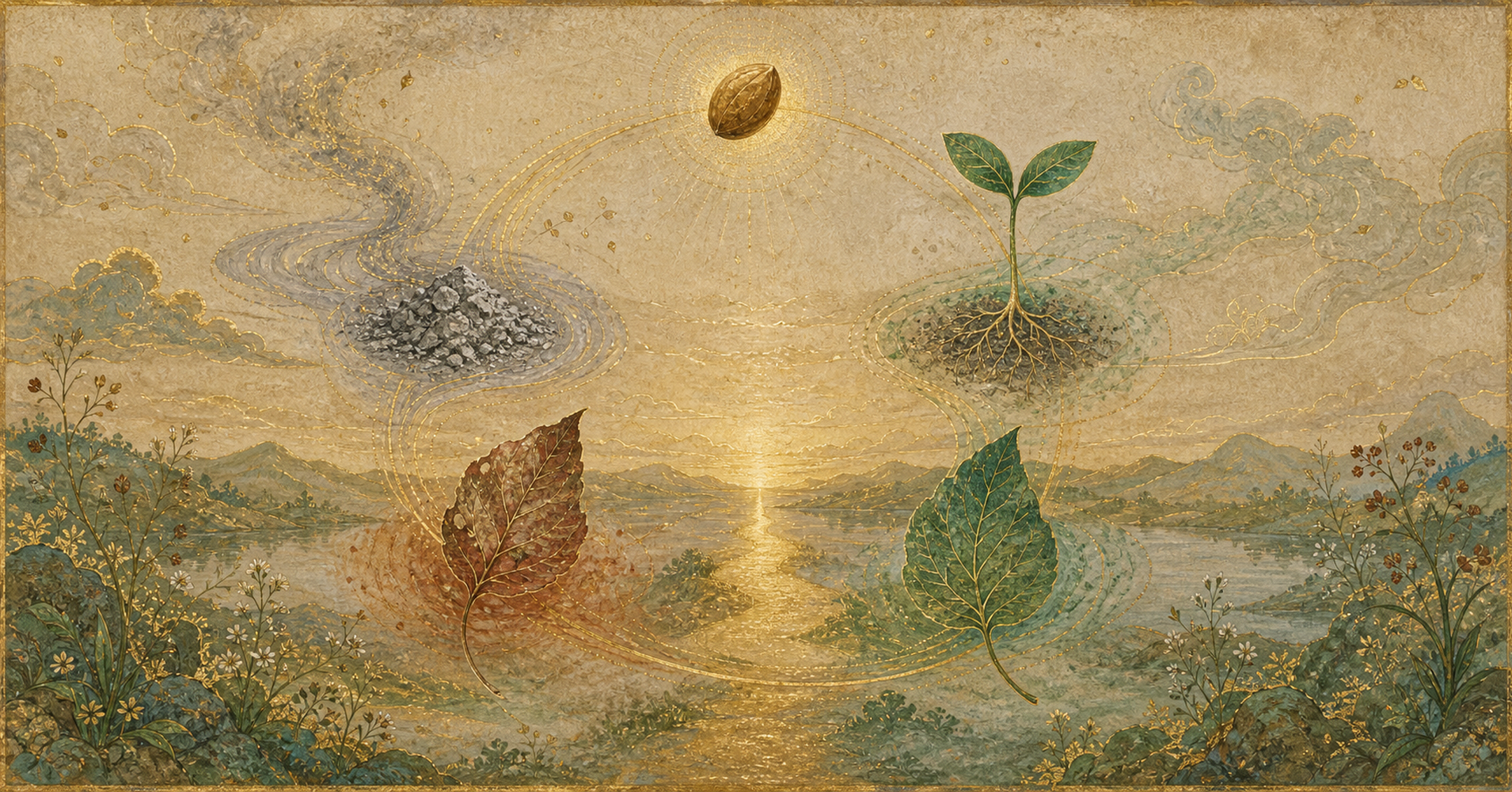
IVU 12-14: Insufficiency of Becoming

Īśāvāsya Upaniṣad 12-14: Becoming and Passing Away

Becoming and passing away are shown as limited paths; only their connection opens the way beyond death.

Dr. Ronald Steiner Dr. Ronald Steiner
Īśāvāsya Upaniṣad 12
अन्धं तमः प्रविशन्ति ये ऽसम्भूतिमुपासते |
andhaṃ tamaḥ praviśanti; ye 'sambhūtim upāsate | Analysis ▾ Analysis ▴
andham
accusative singular neuter
adjective
blind
tamas
accusative singular
substantive neuter
darkness
praviśanti
3rd person plural aktive present
previx
verbal root
enter
ye
nominative plural masculine
pronoun rel
who
asambhūtim
accusative singular
substantive feminine
non-becoming, non-arising
upāsate
3rd person plural medial present
previx
verbal root
worship, devote themselves to
ततो भूय इव ते तमो य उ सम्भूतियां रताः ||12||
tato bhūya iva te tamo; ya u sambhūti*yāṃ ratāḥ ||12|| Analysis ▾ Analysis ▴
tataḥ
adverb
from that, thereafter
bhūyaḥ
accusative singular neuter comperative
adjective
greater
iva
particle
as if
te
nominative plural masculine
pronoun dem
they
tamas
accusative singular
substantive neuter
darkness
ye
nominative plural masculine
pronoun rel
who
u
particle
indeed, but
sambhūtyām
lokative singular
substantive feminine
in becoming, in arising
ratāḥ
nominative plural masculine past participle passive
verbal root
delighting, devoted
Metre: Anuṣṭubh
Those (ye | nom pl m) who worship (upāsate | 3p pl med pres) non-arising (asambhūtim | acc sg) enter (praviśanti | 3p pl act pres) blind (andhaṃ | acc sg n) darkness (tamaḥ | acc sg); then (tataḥ) those (te | nom pl m) who (ye | nom pl m) are indeed (u) absorbed (ratāḥ | nom pl m ppp) in becoming (sambhūtyām | loc sg), as it were (iva), [enter] still greater (bhūyaḥ | acc sg n comp) darkness (tamaḥ | acc sg).
Dr. Ronald Steiner - 2026 - historically literal
Those who worship non-arising enter blind darkness. Into still deeper darkness, it seems, go those who lose themselves in becoming.
Dr. Ronald Steiner - 2026 - modern transfer

Śaṅkara interprets asambhūti (non-arising, the unmanifest) as prakṛti/avyākṛta (primordial nature, the not-yet-unfolded), the seed-form of desire and action. Sambhūti (arising, becoming) is for him the arisen kārya-brahman (active, produced Brahman), that is Hiraṇyagarbha (the golden germ, cosmic creator-form). The warning is directed against one-sided worship of either pole.

Īśā-Upaniṣad Śaṅkara-Bhāṣya
sambhūti*yāṃ conj. ed. ] sambhūtyāṃ GRETIL2018, LV1958
Critical Apparatus
Into blind darkness enter they
Who worship non-becoming (a-sambhūti);
Into darkness greater than that, as it were, they
Who delight in becoming (sambhūti).
Robert Hume - 1921
In blinde Finsternis eingeht,
Wer ein Werden zu Nichts geglaubt,
In blindere wohl noch jener,
Der ein Werden zu Etwas glaubt.
Paul Deussen - 1897
All who worship what is not the true cause, enter into blind darkness: those who delight in the true cause, enter, as it were, into greater darkness.
Max Müller - 1879
Īśāvāsya Upaniṣad 13
अन्यदेवाहुः संभवादन्यदाहुरसंभवात् |
anyad evāhuḥ saṃbhavād; anyad āhur asaṃbhavāt | Analysis ▾ Analysis ▴
anyat
nominative singular neuter
adjective
different, other
eva
particle
indeed, precisely
āhuḥ
3rd person plural aktive perfekte
verbal root
they say
sambhavāt
ablative singular
substantive masculine
from becoming, from origin
anyat
nominative singular neuter
adjective
different, other
āhuḥ
3rd person plural aktive perfekte
verbal root
they say
asambhavāt
ablative singular
substantive masculine
from non-becoming
इति शुश्रुम धीराणाम् ये नस्तद्विचचक्षिरे ||13||
iti śuśruma dhīrāṇām; ye nas tad vicacakṣire ||13|| Analysis ▾ Analysis ▴
iti
particle
thus
śuśruma
1st person plural aktive perfekte
verbal root
we have heard
dhīrāṇām
genitive plural
substantive masculine
of the wise
ye
nominative plural masculine
pronoun rel
who
naḥ
dative plural
pronoun pers 1p
to us
tat
accusative singular neuter
pronoun dem
this
vicacakṣire
3rd person plural medial perfekte
previx
verbal root
explained, taught
Metre: Anuṣṭubh
[Something] different (anyat | nom sg n) indeed (eva), they say (āhuḥ | 3p pl act perf), [comes] from becoming (saṃbhavāt | abl sg); [something] different (anyat | nom sg n), they say (āhuḥ | 3p pl act perf), [comes] from non-becoming (asaṃbhavāt | abl sg). Thus (iti) we have heard (śuśruma | 1p pl act perf) from the wise (dhīrāṇām | gen pl), who (ye | nom pl m) explained (vicacakṣire | 3p pl med perf) this (tat | acc sg n) to us (naḥ | dat pl).
Dr. Ronald Steiner - 2026 - historically literal
One result, the wise say, comes from becoming; another comes from non-becoming. So we have heard from those who explained this to us.
Dr. Ronald Steiner - 2026 - modern transfer

As in verse 10, Śaṅkara stresses the difference of fruits. Worship of sambhūti (arising, produced reality) leads to powers such as aṇimā (becoming minute); worship of the unmanifest leads to prakṛti-laya (dissolution into primordial nature). The teacher tradition distinguishes both so that their connection can be grounded properly.

Īśā-Upaniṣad Śaṅkara-Bhāṣya
Other, indeed—they say—than origin (sambhava)!
Other—they say—than non-origin (a-sambhava)!
—Thus have we heard from the wise
Who to us have explained It.
Robert Hume - 1921
Verschieden ist es von Werdung,
Von Nichtswerdung verschieden auch,
So haben von den Altmeistern
Die Lehre überkommen wir.
Paul Deussen - 1897
One thing, they say, is obtained from (knowledge of) the cause; another, they say, from (knowledge of) what is not the cause. Thus we have heard from the wise who taught us this.
Max Müller - 1879
Īśāvāsya Upaniṣad 14
संभूतिं च विनाशं च यस्तद्वेदोभयं सह |
saṃbhūtiṃ ca vināśaṃ ca; yas tad vedobhayaṃ saha | Analysis ▾ Analysis ▴
sambhūtim
accusative singular
substantive feminine
becoming, arising
ca
particle
and
vināśam
accusative singular
substantive masculine
destruction, dissolution
ca
particle
and
yaḥ
nominative singular masculine
pronoun rel
who
tat
accusative singular neuter
pronoun dem
this
veda
3rd person singular aktive perfekte
verbal root
knows
ubhayam
accusative singular neuter
adjective
both
saha
particle
together
विनाशेन मृत्युं तीर्त्वा संभूत्यामृतमश्नुते ||14||
vināśena mṛtyuṃ tīrtvā; saṃbhūtyāmṛtam aśnute ||14|| Analysis ▾ Analysis ▴
vināśena
instrumental case singular
substantive masculine
through destruction, through dissolution
mṛtyum
accusative singular
substantive masculine
death
tīrtvā
absolutus
verbal root
having crossed
sambhūtyā
instrumental case singular
substantive feminine
through becoming, through arising
amṛtam
accusative singular
substantive neuter
immortality
aśnute
3rd person singular medial present
verbal root
attains, enjoys
Metre: Anuṣṭubh
Whoever (yaḥ | nom sg m) knows (veda | 3p sg act perf) becoming (saṃbhūtiṃ | acc sg) and (ca) passing away (vināśaṃ | acc sg), and (ca) this (tat | acc sg n) pair (ubhayam | acc sg n) together (saha), crosses (tīrtvā | abs) death (mṛtyum | acc sg) through passing away (vināśena | ins sg) and attains (aśnute | 3p sg med pres) immortality (amṛtam | acc sg) through becoming (saṃbhūtyā | ins sg).
Dr. Ronald Steiner - 2026 - historically literal
Whoever recognizes becoming and passing away together crosses death through passing away and attains immortality through becoming.
Dr. Ronald Steiner - 2026 - modern transfer

Śaṅkara explains vināśa (perishing, destruction) as the produced sphere and connects it with Hiraṇyagarbha-upāsanā (worship or meditation on Hiraṇyagarbha, the cosmic creator-form). Through this, lack of power, wrongdoing, and desire-born faults are crossed as mṛtyu (death). Through worship of the unmanifest, a relative amṛta (immortality) is reached: prakṛti-laya (dissolution into primordial nature), not highest Self-knowledge.

Īśā-Upaniṣad Śaṅkara-Bhāṣya
Becoming (sambhūti) and destruction (vināśa)—
He who this pair conjointly (saha) knows,
With destruction passing over death,
With becoming wins the immortal.
Robert Hume - 1921
Wer Werden und Zunichtwerden
Beide [als nicht vorhanden] weiß,
Der überschreitet durch beides
Den Tod und hat Unsterblichkeit.
Paul Deussen - 1897
He who knows at the same time both the cause and the destruction (the perishable body), overcomes death by destruction (the perishable body), and obtains immortality through (knowledge of ) the true cause.
Max Müller - 1879

Continue with AYI Free

Illustrations: AI-generated.

Editor

Dr. Ronald Steiner

From Ulm

The "Yoga Doc" - Dr. Ronald Steiner is the founder of the AYI method. This method links traditional Ashtanga Yoga with innovative Yogatherapy and living Philosophy. This forms a practice that is personal for each and... more ›

Messages and ratings
1 messages Ø

Please log in to write a message. Go to login