

pūrṇa पूर्ण – voll; vollständig; gefüllt
Adjektiv · Substantiv Maskulin · Substantiv Neutrum · Worttyp nicht bestimmt
Wörterbuchquellen
AYI Wörterbuch Adjektiv
voll; vollständig; gefüllt
Cappeller 1891 Adjektiv
Originaltext · Englisch · Adjektiv
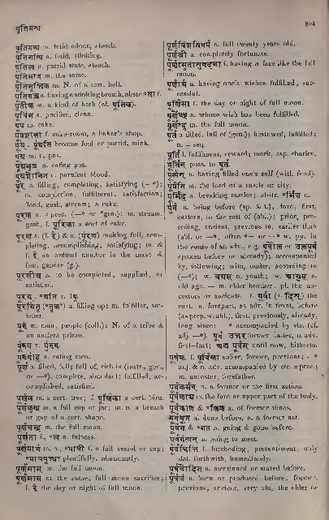
pūrṇá ·a. filled, full; full of, rich in (instr., gen., or --°), complete, abundant; fulfilled, accomplished, satisfied.
Monier-Williams 1872 Adjektiv
Originaltext · Englisch · Adjektiv
Pūrṇa, as, ā, am, filled, full, filled with, full of (e. g. bhāṇḍa-pūrṇāni yānāni, waggons filled with goods; sometimes with inst. or with gen., e. g. vasunā pūrṇaḥ, full of wealth; ghaṭa apām pūrṇaḥ, a pitcher full of water); fulfilled, finished, ended, accomplished; completed, complete, all, en- tire (e. g. daśa pūrṇaṃ śatāni, full ten hundred); past, elapsed; satisfied, contented; drawn, bent (as a bow); uttering the full and natural cry, full- sounding, sonorous (a term of augury applied to the cry of birds and sometimes to that of beasts; opposed to dīpta, pra-dīpta, q. v.); strong, powerful, able; selfish, self-indulgent; (as), m., N. of a Nāga; of a Deva-gandharva; of a Buddhist ascetic frequently called the son of Maitrāyaṇī; (ā), f. an epithet of the fifteenth Kalā of the moon; of the fifth, tenth, and fifteenth Tithis; N. of a woman; of a river; (am), n., Ved. fulness, plenty, abundance; water.
Petersburger 1855 Adjektiv · Substantiv Maskulin
Originaltext · Deutsch · Adjektiv · Substantiv Maskulin
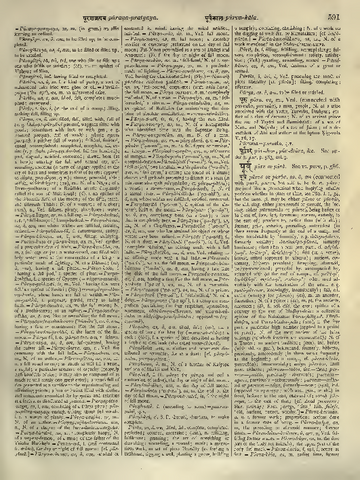
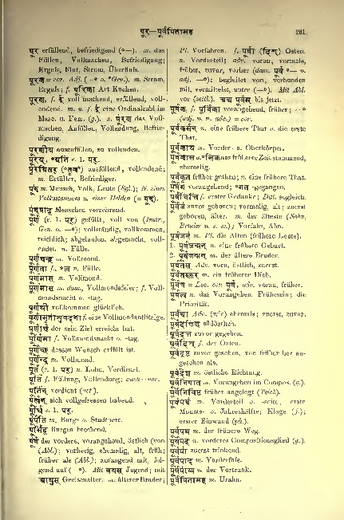
pūrṇa (partic. von 1. par) 1〉 adj. s. u. 1. par. Nachzutragen wäre hier voll, vollständig (im Gegens. zu dīpta, pradīpta) vom Geschrei der Vögel und Thiere: vañjulakarutaṃ titirīti dīptamatha kilikilīti tatpūrṇam VARĀH. BṚH. S. 87,11 auch vom Thiere gesagt, wenn es den vollen, natürlichen Laut von sich giebt: chucchundarī cicciḍiti pradīptā pūrṇā tu sā tittiḍiti svanena 47. — 2〉 m. N. pr. eines Nāga MBH. 1,2146. eines Devagandharva MBH. 1,2554. eines buddh. Religiösen (BURNOUF nimmt zwei Personen dieses Namens an) BURN. Intr. 132. fg. BURN. Intr. 196. BURN. Intr. 235. fgg. BURN. Intr. 260. BURN. Intr. 448. fg. BURN. Intr. 478. LALIT. ed. Calc. 1,10. Lot. de la b. l. 121. Lot. de la b. l. 123. SCHIEFNER, Lebensb. 248 (18). 283 (53). 294 (64). pūrṇāvadāna BURN. Intr. 39. Pūrṇa wird häufig Sohn der Maitrāyaṇī genannt, aber in Lot. de la b. l. so wie bei HIOUEN-THSANG I, 208 wird ein pūrṇamaitrāyaṇīputra genannt, was unmöglich Pūrṇa, Sohn der Maitr., bedeuten kann, aber auf der anderen Seite wohl auch keine neue Persönlichkeit bezeichnen wird. Es wird also wohl auch hier pūrṇo mai˚ zu lesen sein. — 3〉 f. ā a〉 Bez. der 15ten Kalā des Mondes BRAHMA-P._in_Verz. d. Oxf. H. 18,b,26. — b〉 Bez. der 5ten, 10ten und 15ten Tithi VARĀH. BṚH. S. 98,2. BHAṬṬOTP._zu_VARĀH. BṚH. S. 93,11. — c〉 N. pr. eines Frauenzimmers ŚUK. in LA. 44,3. — d〉 N. pr. eines Flusses LIA. I, 88.
Originaltext · Deutsch · Substantiv Maskulin
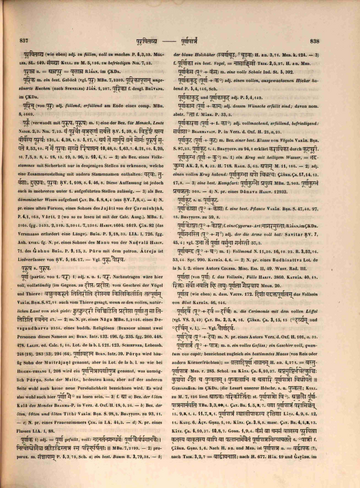
pūrṇa 3〉d〉 ˚nadī Verz. d. Oxf. H. 254,b,35. — e〉 N. pr. einer Verfasserin von Mantra bei den Śākta Verz. d. Oxf. H. 101,b,8. — 4〉 m. eine Form der Sonne Verz. d. Oxf. H. 148,b,16. — Vgl. mahā˚.
Böhtlingk 1879 Adjektiv · Substantiv Maskulin · Substantiv Neutrum · Worttyp nicht bestimmt
Originaltext · Deutsch · Adjektiv · Substantiv Maskulin · Substantiv Neutrum
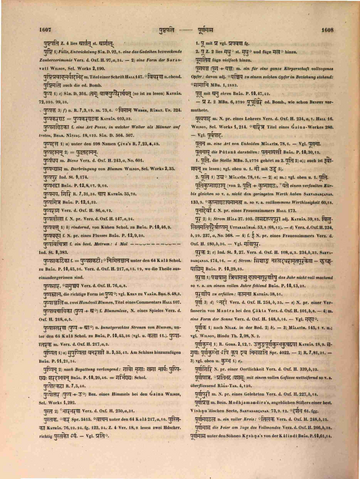
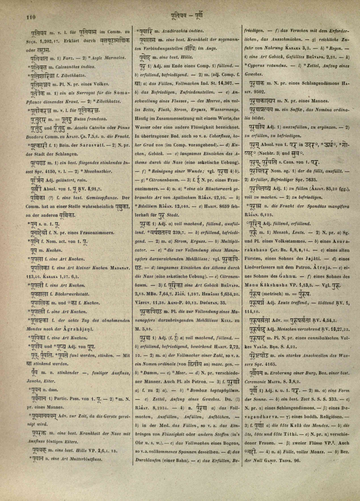
pūrṇá — 1〉 Adj. s. u. 1. par — 2〉 m. — a〉 eine Form der Sonne. — b〉 ein best. Tact S. S. S. 232. — c〉 N. pr. — α〉 eines Schlangendämons. — β〉 eines Devagandharva. — γ〉 eines buddh. Religiösen. — 3〉 f. pūrṇā — a〉 die 15te Kalā des Mondes. — b〉 die 5te, 10te und 15te Tithi. — c〉 N. pr. — α〉 verschiedener Frauen. — β〉 zweier Flüsse VP.² Auch ˚nadī — 4〉 n. — a〉 Fülle, volles Maass. — b〉 Bez. der Null GAṆIT. TRIPR. 96.
Originaltext · Deutsch · Worttyp nicht bestimmt
pūrṇa auch ein best. Baum R. ed. Bomb. 4,1,77. Vgl. pūrṇaka 1〉a〉. [Nachtrag, Band 7]
Apte 1890 Adjektiv · Substantiv Neutrum
Originaltext · Englisch · Adjektiv · Substantiv Neutrum
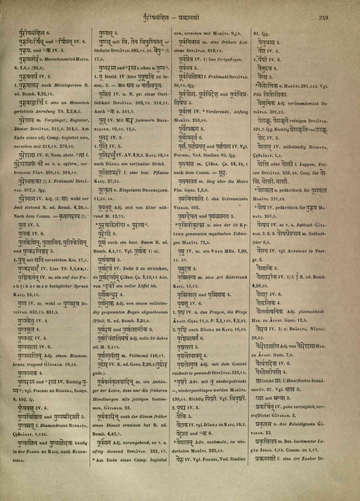
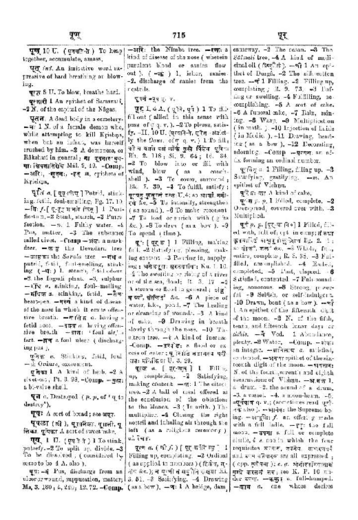
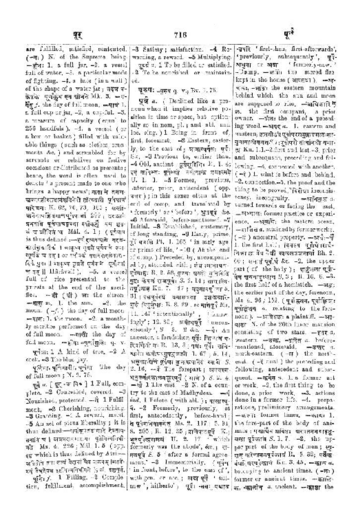
pūrṇa p. p. [pur-kta ni˚] 1 Filled, filled with, full of; opt. in comp; taṃ tathā kṛpayāviṣṭaṃ aśrupūrṇākulekṣaṇaṃ Bg. 2. 1; so śoka˚, jala˚ &c. 2 Whole, full, entire, complete; R. 3. 38. 3 Fulfilled, accomplished. 4 Ended, completed. 5 Past, elapsed. 6 Satisfied, contented. 7 Full-sounding, sonorous. 8 Strong, powerful. 9 Selfish, or self-indulgent. 10 Drawn, bent (as a bow). — rṇā 1 An epithet of the fifteenth digit of the moon. 2 N. of the fifth, tenth, and fifteenth lunar days or tithis. — rṇaṃ Ved. 1 Abundance, plenty. 2 Water. Comp. — aṃkaḥ an integer. — abhilāṣa a. satisfied, contented. — amṛtā epithet of the sixteenth digit of the moon. — avatāraḥ N. of the fourth, seventh and eighth incarnations of Viṣṇu. — ānakaṃ 1 a drum. 2 the sound of a drum. 3 a vessel. 4 a moon-beam. 5 = pūrṇapātra q. v.; (sometimes read pūrṇālaka also). — ānaṃdaḥ the Supreme being. — āhūtiḥ f. an offering made with a full ladle. — iṃduḥ the full moon. — upamā a full or complete simile, i. e. one in which the four requisites upamāna, upameya, sādhāraṇadharma and upamāpratipādaka are all expressed; (opp. luptopamā); e. g. aṃbhoruhamivātāmraṃ mugdhe karatalaṃ tava; see K. P. 10 under upamā. — kakuda a. full-humped. — kāma a. one whose desires ([Page 0716-a]) are fulfilled, satisfied, contented. — (maḥ) N. of the Supreme being. — kuṃbhaḥ 1 a full jar. 2 a vessel full of water. 3 a particular mode of fighting. 4 a hole (in a wall) of the shape of a water-jar; tadatra pakveṣṭake pūrṇakuṃbha eva śobhate Mk. 3. — parveṃdu f. the day of full moon. — pātraṃ 1 a full cup or jar. 2 a cup-ful. 3 a measure of capacity (equal to 256 handfuls). 4 a vessel (or a box or basket) filled with valuable things (such as clothes, ornaments &c.) and scrambled for by servants or relatives on festive occasions or distributed as presents; hence, the word is often used to denote ‘a present made to one who brings a happy news’; kadā me tanayajanmamahotsavānaṃdanirmaro hariṣyati pūrṇapātraṃ parijanaḥ K. 62, K. 70, K. 73, K. 165; sakhījanenāpahriyamāṇapūrṇapātrāṃ K. 299; tatkāmaṃ prabhavati pūrṇapātravṛttyā svīkartuṃ mama hṛdayaṃ ca jīvitaṃ ca Māl. 4. 1; (pūrṇapātra is thus defined; — harṣādutsavakāle yadalaṃkārāṃśukādikaṃ . ākṛṣya gṛhyate pūrṇapātraṃ syātpūrṇakaṃ ca tat . or vardhāpakaṃ yadānaṃdādalaṃkārādikaṃ punaḥ .. ākṛṣya gṛhyate pūrṇapātraṃ pūrṇānakaṃ ca tat .. Hārāvalī). 5 a vessel full of rice presented to the priests at the end of the sacrifice. — bī (vī) jaḥ the citron. — mās m. 1 the sun. 2 the moon. (f.) the day of full moon — māsaḥ 1 the moon. 2 a monthly sacrifice performed on the day of full moon. — māsī the day of full moon. — homaḥ = pūrṇāhutiḥ q. v.
Cappeller 1887 Worttyp nicht bestimmt
Originaltext · Deutsch · Worttyp nicht bestimmt
pūrṇa (s. 1. par) gefüllt, voll von (Instr., Gen. o. —˚); vollständig, vollkommen, reichlich; abgelaufen, abgemacht, vollendet. n. Fülle.
Burnouf 1866 Worttyp nicht bestimmt
Originaltext · Französisch · Worttyp nicht bestimmt
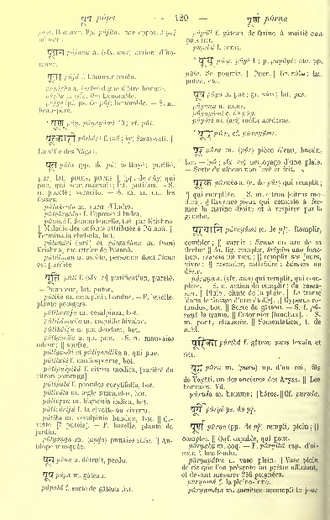
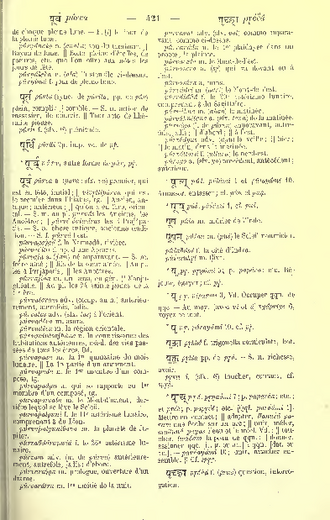
pūrṇa pūrṇa (pp. de pṝ) rempli, plein; complet. Qqf. capable, qui peut. pūrṇaka m. coq. — F. pūrṇikā esp. d'oiseau à bec fendu. pūrṇapātra n. vase plein. Vase plein de riz que l'on présente au prêtre officiant, et devant mesurer 256 poignées. pūrṇamā f. la pleine-lune. pūrṇamāsa m. sacrifice accompli le jour [Page421-1] de chaque pleine lune. — F. [i] le jour de la pleine lune. pūrṇānaka n. (anaka) son du tambour. Rayon de lune. Boite pleine d'étoffes, de parures, etc. que l'on offre aux hôtes les jours de fête. pūrṇātaka n. (ala) l'ustensile ci-dessus. pūrṇimā f. jour de pleine lune.
Abgeleitete Wörter
Quelltextfundstellen (31)
HP 4 Fundstellen
HP 4.11*15-4.11*28: Raum und Laya 3 Fundstellen
Direkt belegt
-
HP 4.11*21 Segment 11
-
HP 4.11*21 Segment 13
-
HP 4.11*21 Segment 14
IVU 7 Fundstellen
MAN 7 Fundstellen
Pūrṇamadaḥ 7 Fundstellen
Direkt belegt
-
MAN PA 1.1 Segment 1
-
MAN PA 1.1 Segment 3
-
MAN PA 1.1 Segment 5
-
MAN PA 1.1 Segment 6
-
MAN PA 1.2 Segment 1
-
MAN PA 1.2 Segment 2
-
MAN PA 1.2 Segment 4
PJH 2 Fundstellen
SiSa 9 Fundstellen
SiSa 1.51-1.64: Selbst als Licht 3 Fundstellen
Direkt belegt
Mit AYI Free weitermachen
Bildquelle: AYI Archiv.