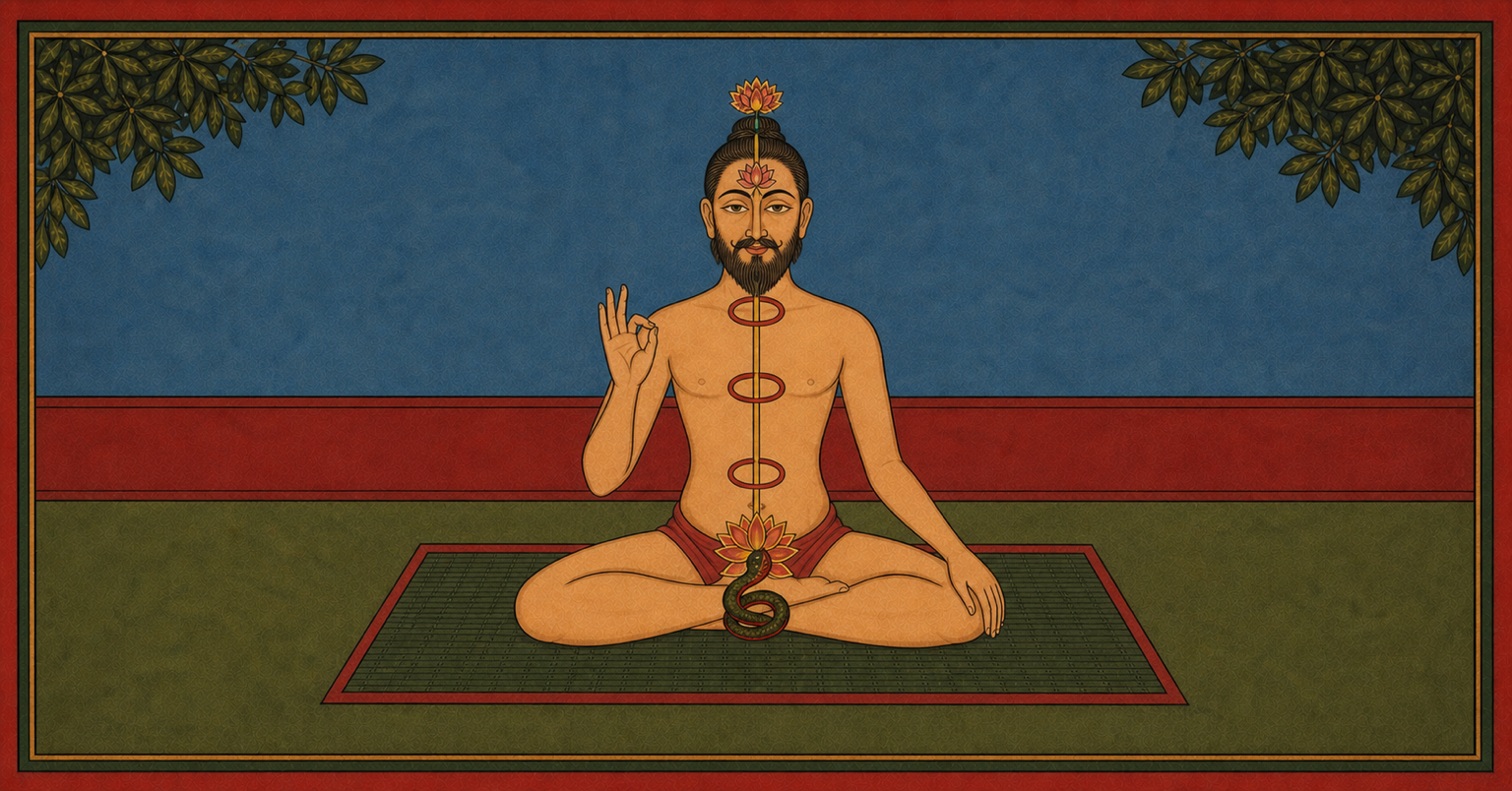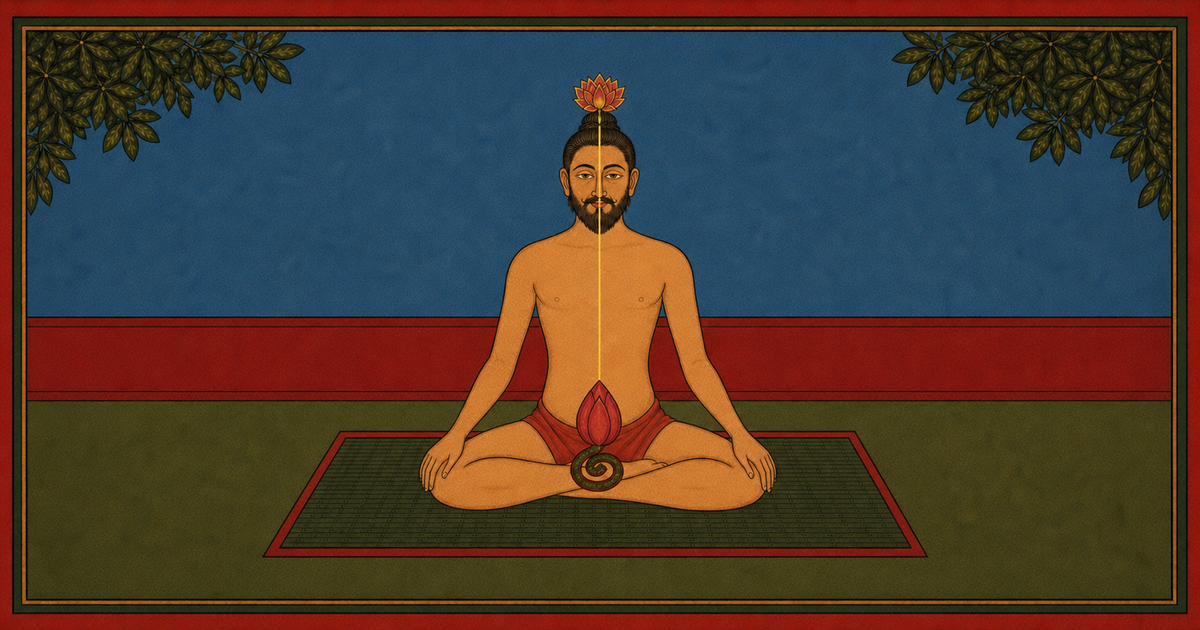

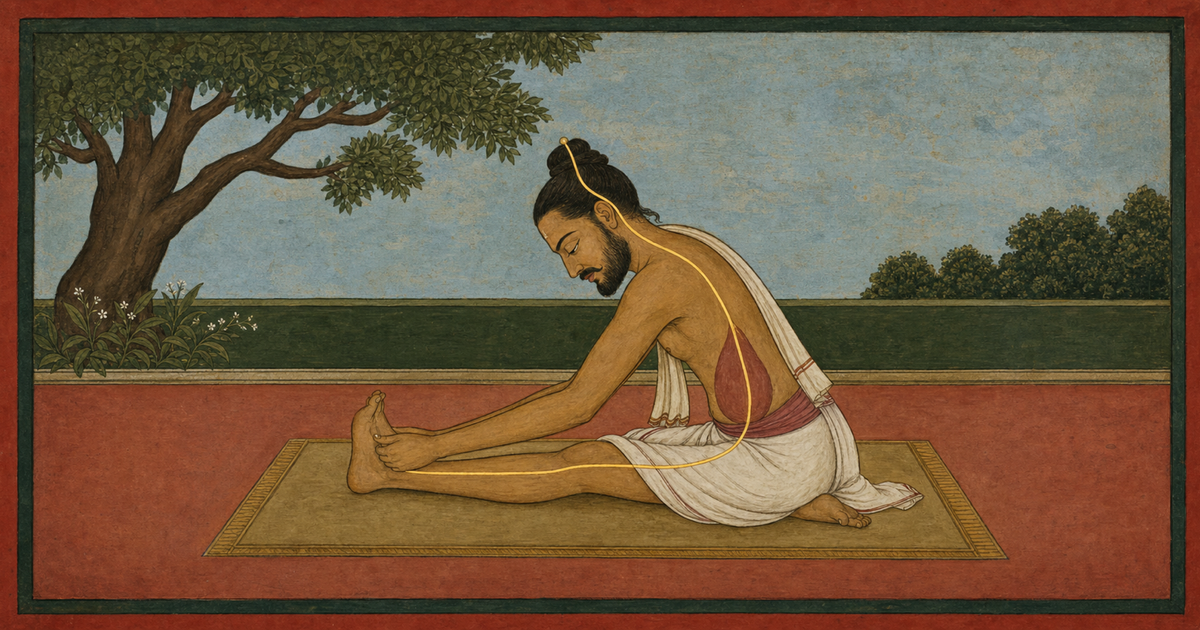
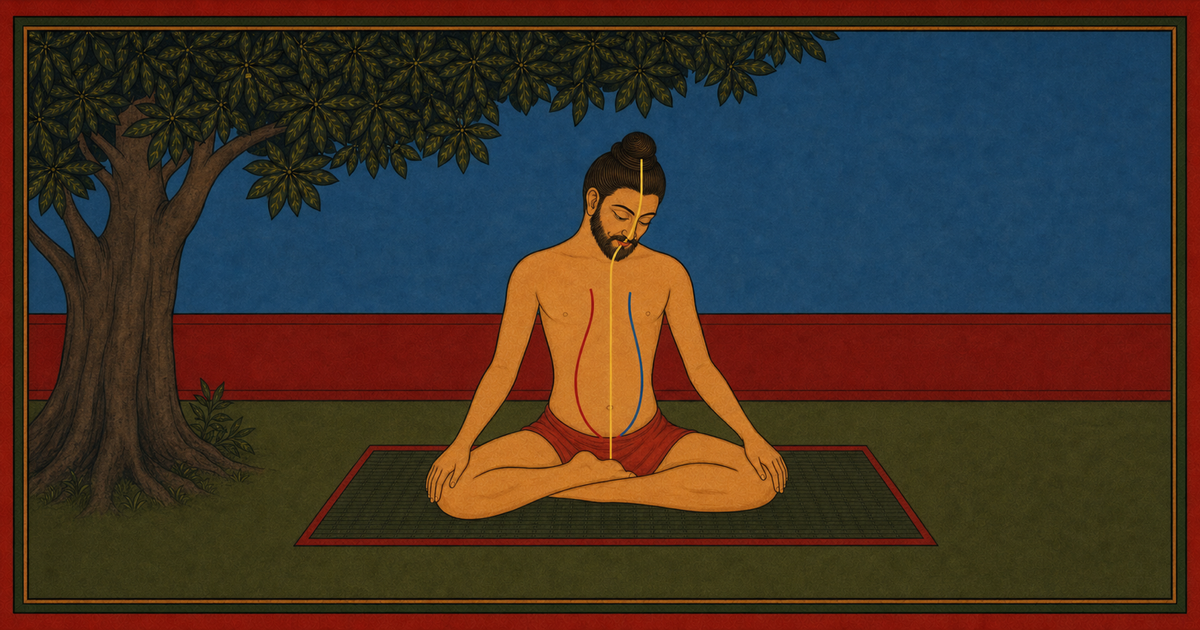
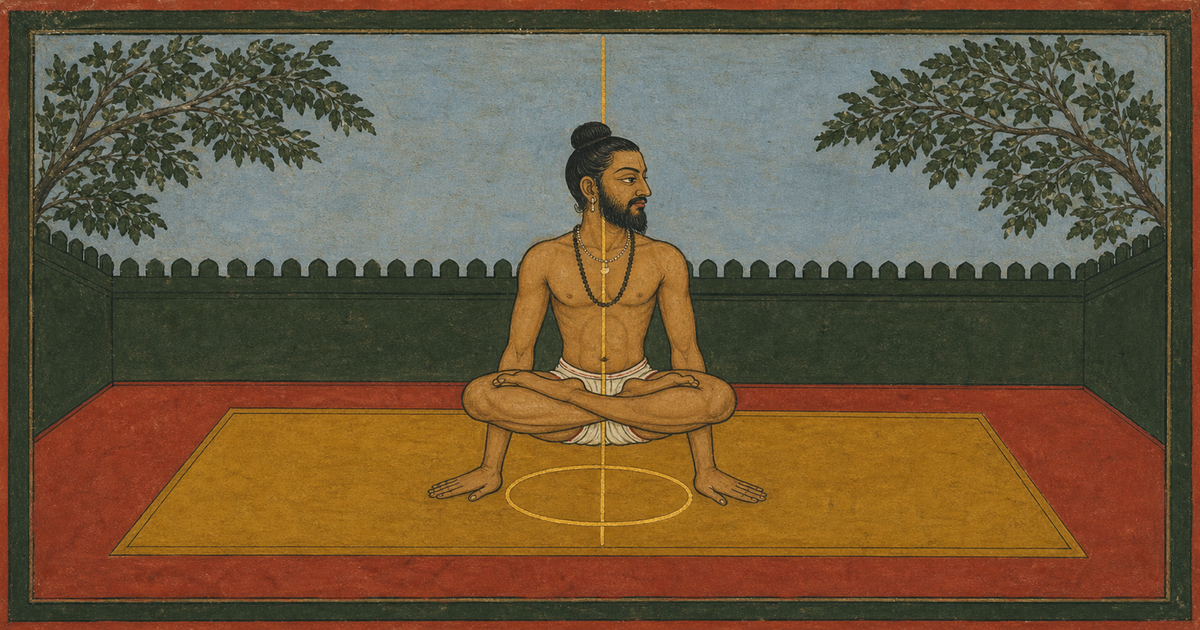
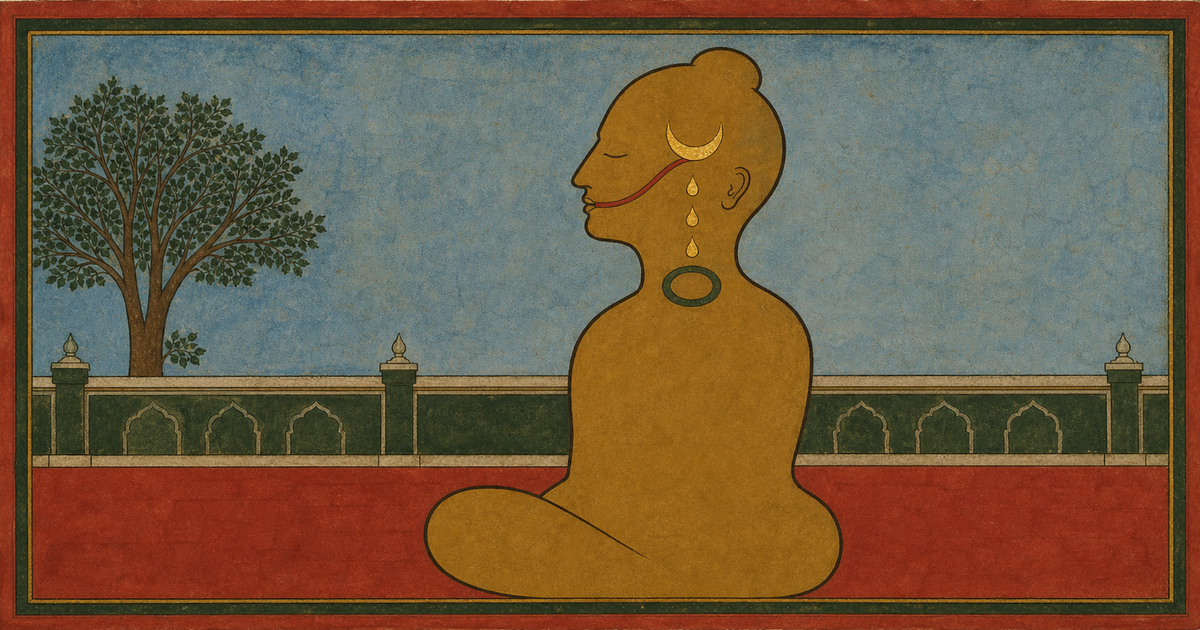

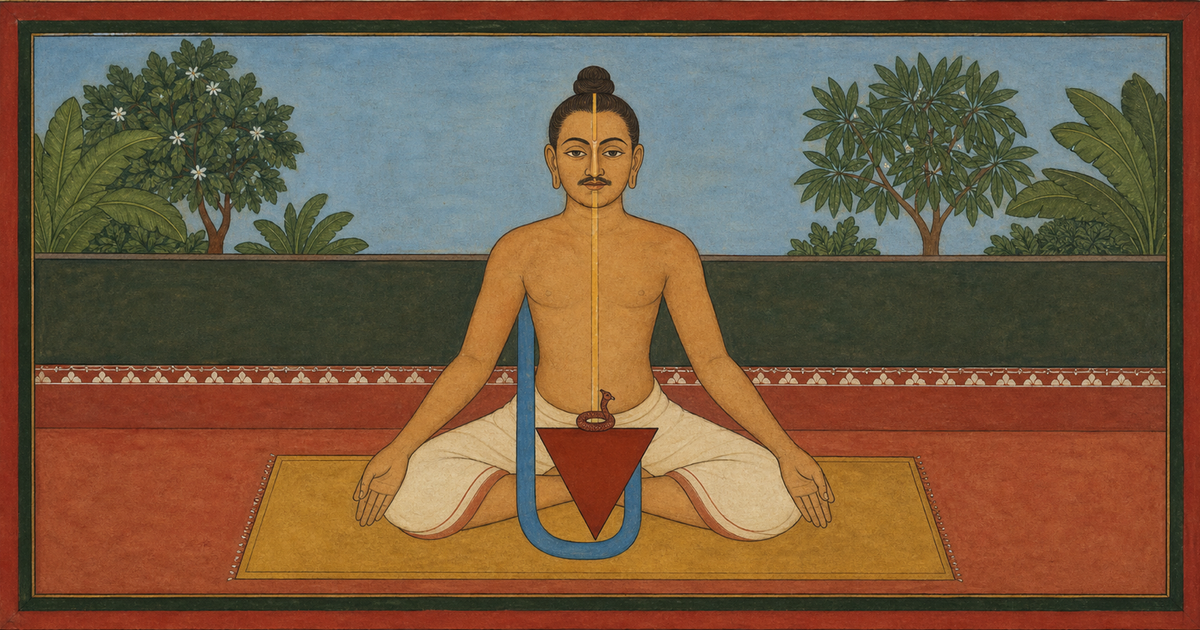
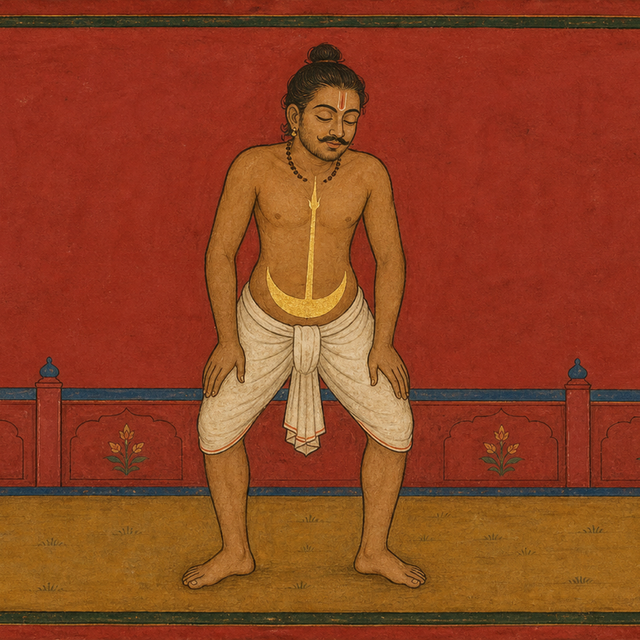
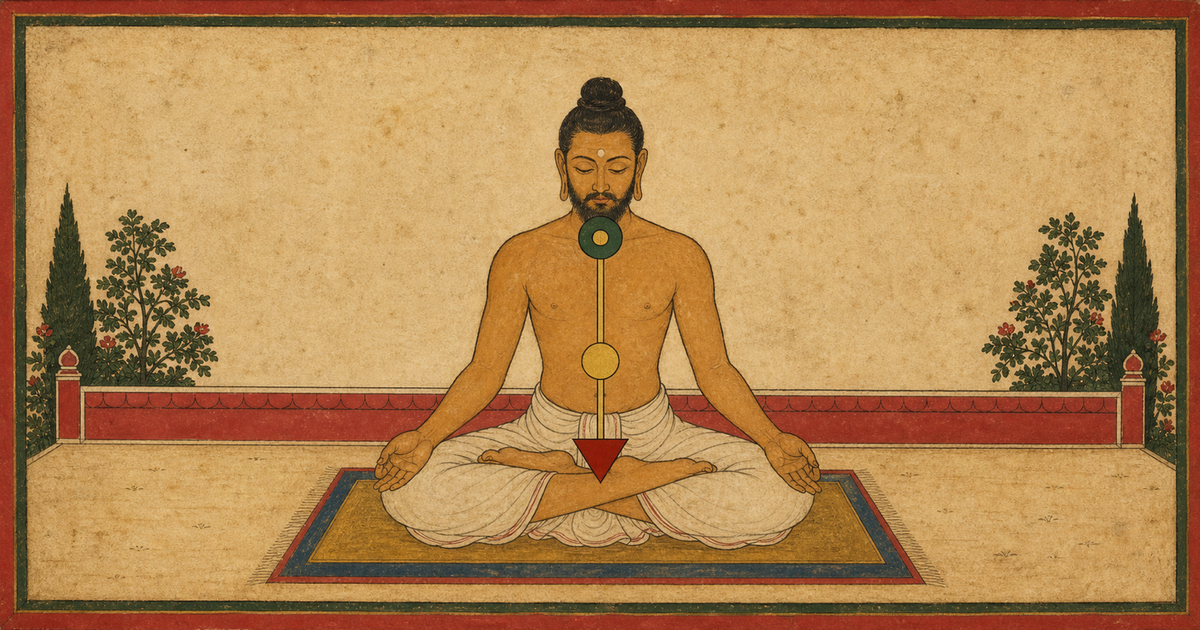

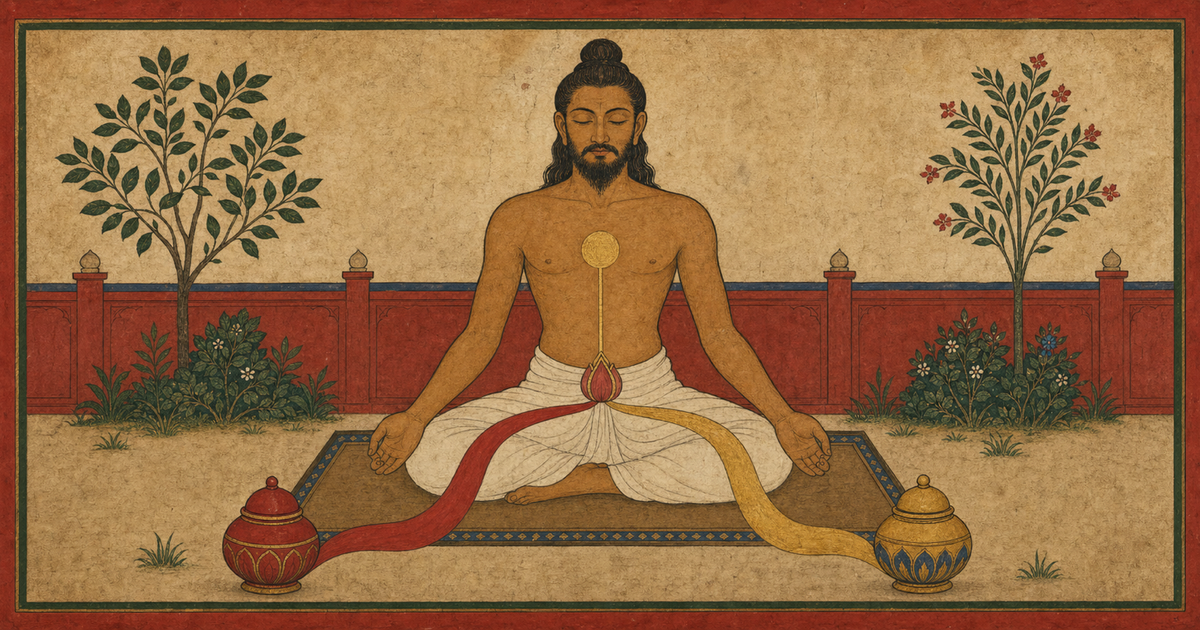
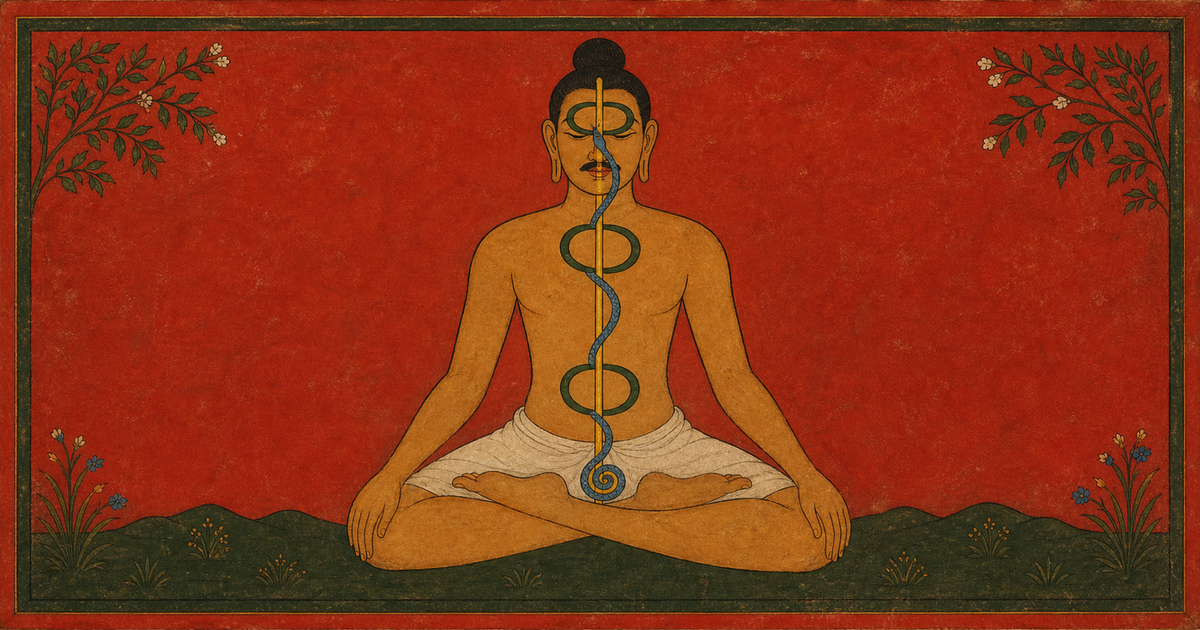

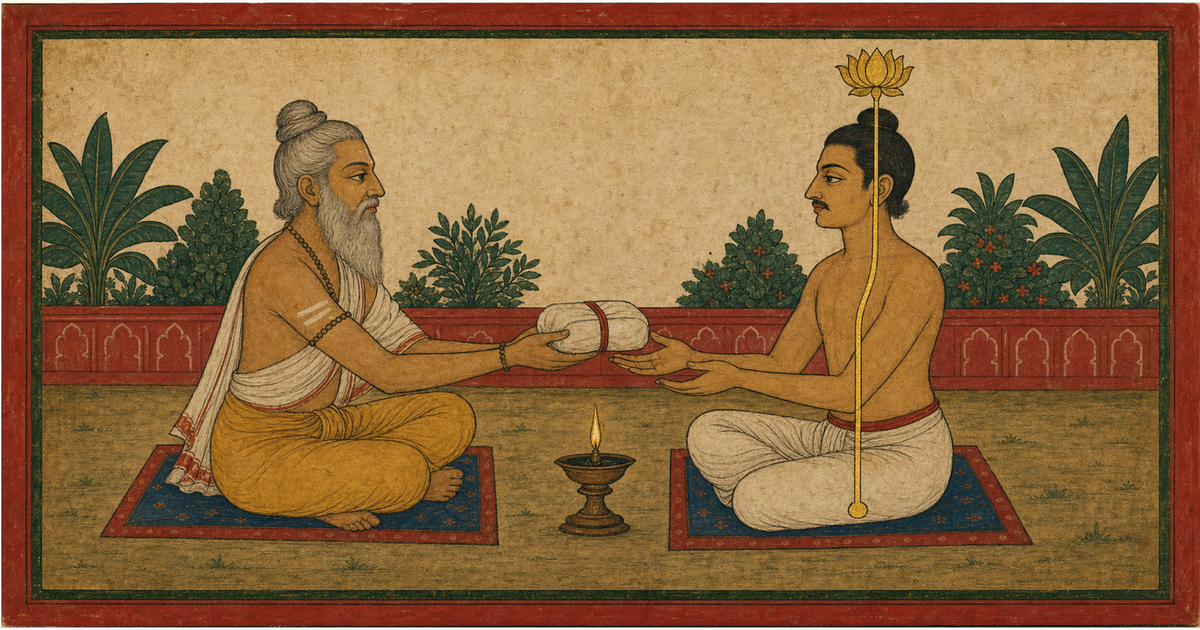
A meditating yogi forms a mudrā; lotus blossoms and rings mark the body’s center, while a serpent coils at the pelvis.

Haṭhapradīpikā 3: Mudrā and Kuṇḍalinī

Mudrās, Bandhas, and work with Kuṇḍalinī are intended to lead the breath into the central channel and foster yogic accomplishment.

Dr. Ronald Steiner Dr. Ronald Steiner
Illustration for the Haṭha Pradīpikā section “HP 3.1-3.5: Foundations of Kuṇḍalinī”.

Haṭha Pradīpikā 3.1-3.5: Kuṇḍalinī and the Practice of Mudrā

Kuṇḍalinī, Suṣumṇā, and the gate of Brahman are introduced as the foundation and goal of the practice of Mudrā that now begins.

Haṭha Pradīpikā 3.1
Metre: Anuṣṭubh
Just as (yathā) the lord of snakes (ahi-nāyakaḥ | nom sg) is the foundation (ādhāraḥ | nom sg) of the earth together with its mountains and forests (sa-śaila-vana-dhātrīṇām | gen pl), so (tathā) Kuṇḍalinī (kuṇḍalī | nom sg) is indeed (hi) the foundation (ādhāraḥ | nom sg) of all systems of yoga (sarveṣām yoga-tantrāṇām | gen pl).
Dr. Ronald Steiner - 2026 - historically literal
Haṭha Pradīpikā 3.2
Metre: Anuṣṭubh
When (yadā) Kuṇḍalinī (kuṇḍalī | nom sg), asleep (suptā | nom sg f ppp), awakens (jāgarti | 3p sg act pres) through the guru's favour (guru-prasādena | ins sg), then (tadā) all the lotuses (sarvāṇi padmāni | nom pl) and also (api ca) the knots (granthayaḥ | nom pl) are pierced open (bhidyante | 3p pl pas pres).
Dr. Ronald Steiner - 2026 - historically literal
Haṭha Pradīpikā 3.3
Metre: Anuṣṭubh
Then (tadā) the empty pathway (śūnya-padavī | nom sg) becomes the royal road (rāja-pathāyate | 3p sg denom pres) for Prāṇa (prāṇasya | gen sg); then (tadā) the mind (cittam | nom sg) becomes supportless (nir-ālambam | nom sg), and then (tadā) occurs the deceiving (vañcanam | nom sg) of time, death (kālasya | gen sg).
Dr. Ronald Steiner - 2026 - historically literal
Haṭha Pradīpikā 3.4
Metre: Anuṣṭubh
Suṣumṇā (suṣumṇā | nom sg), the empty pathway (śūnya-padavī | nom sg), the great path to the aperture of Brahman (brahma-randhra-mahā-pathaḥ | nom sg), the cremation ground (śmaśānam | nom sg), Śāmbhavī (śāmbhavī | nom sg), and the middle path (madhya-mārgaḥ | nom sg), and so (ca iti), are a set of synonymous designations (eka-vācakāḥ | nom pl m).
Dr. Ronald Steiner - 2026 - historically literal
Haṭha Pradīpikā 3.5
Metre: Anuṣṭubh
Therefore (tasmāt | abl sg), with every effort (sarva-prayatnena | ins sg), in order to awaken (prabodhayitum | inf caus) the goddess (īśvarīm | acc sg) sleeping (suptām | acc sg f ppp) at the entrance to the gate of Brahman (brahma-dvāra-mukhe | loc sg), one should perform (samācaret | 3p sg act opt) the practice of mudrā (mudrā-abhyāsam | acc sg).
Dr. Ronald Steiner - 2026 - historically literal
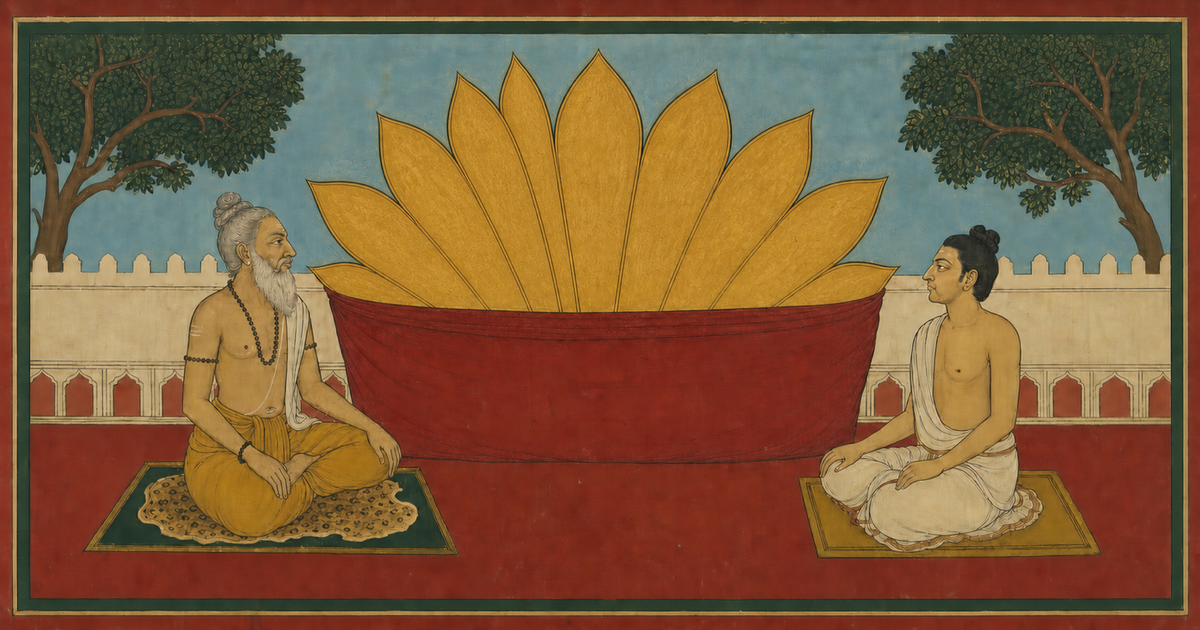
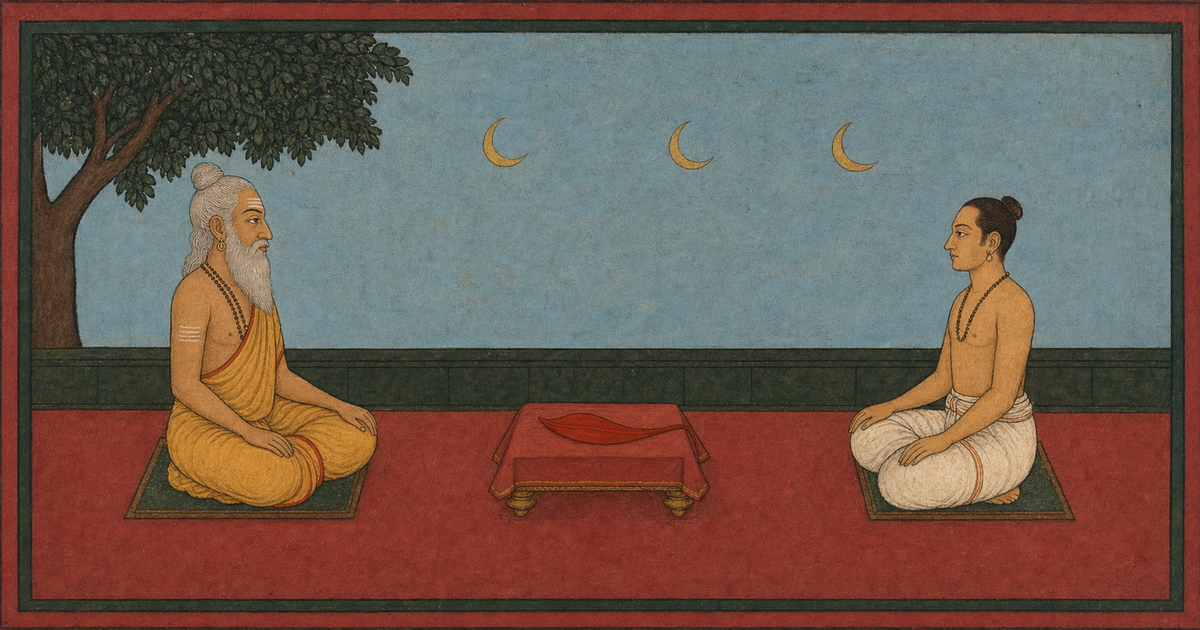
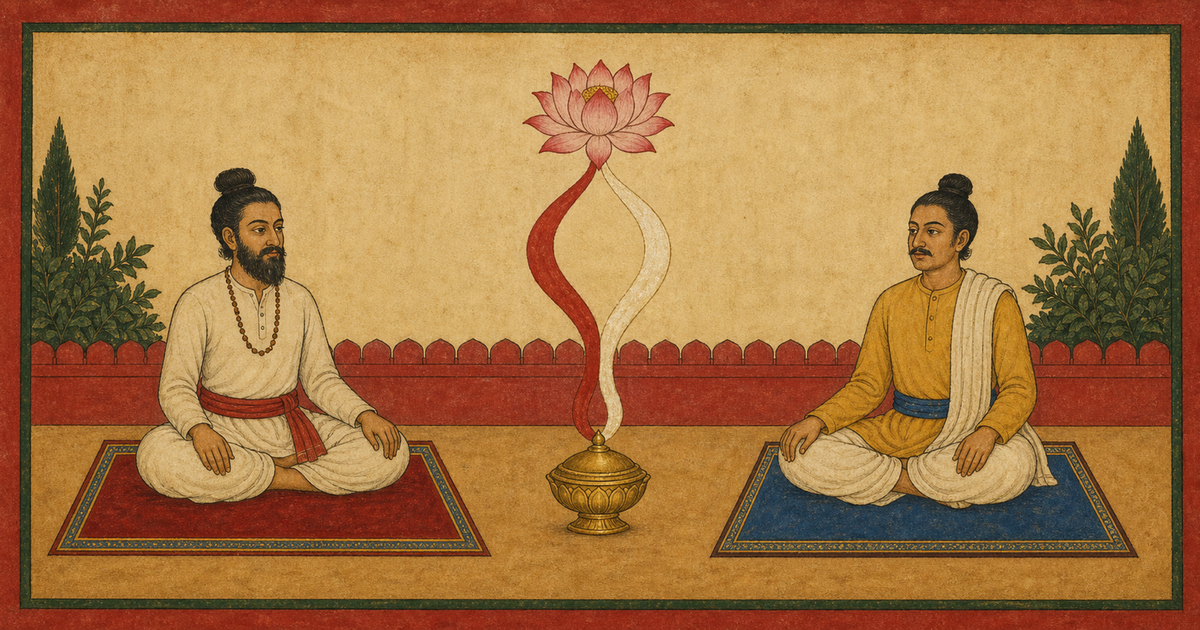
Illustration for the Haṭha Pradīpikā section “HP 3.6-3.9: The Ten Mudrās”.

Haṭha Pradīpikā 3.6-3.9: Ten Mudrās and Secrecy

The ten Mudrās are enumerated, framed as a divine transmission, and introduced as a practice to be kept secret.

Haṭha Pradīpikā 3.6
Metre: Anuṣṭubh
Mahāmudrā (mahā-mudrā | nom sg), Mahābandha (mahā-bandhaḥ | nom sg), Mahāvedha (mahā-vedhaḥ | nom sg), and (ca) Khecarī (khecarī | nom sg); Uḍḍīyāṇa (uḍḍīyāṇam | nom sg), Mūlabandha (mūla-bandhaḥ | nom sg), and afterwards (tataḥ) the [lock] called Jālandhara (jālandhara-abhidhaḥ | nom sg m),
Dr. Ronald Steiner - 2026 - historically literal
Haṭha Pradīpikā 3.7
Metre: Anuṣṭubh
the technique (karaṇī | nom sg) called inverted (viparīta-ākhyā | nom sg f), Vajrolī (vajrolī | nom sg), and moving Śakti (śakti-cālanam | nom sg): this (idam | nom sg n) group of ten mudrās and other practices (mudrā-ādi-daśakam | nom sg) destroys old age and death (jarā-maraṇa-nāśanam | nom sg).
Dr. Ronald Steiner - 2026 - historically literal
Haṭha Pradīpikā 3.8
Metre: Anuṣṭubh
Taught by the primordial Lord (ādi-nātha-uditam | nom sg n ppp), divine (divyam | nom sg n), bestowing the eight supernatural powers (aṣṭa-aiśvarya-pradāyakam | nom sg n), cherished (vallabham | nom sg n) by all adepts (sarva-siddhānām | gen pl), it is difficult to obtain (durlabham | nom sg n), even (api) for the gods (marutām | gen pl).
Dr. Ronald Steiner - 2026 - historically literal
Haṭha Pradīpikā 3.9
Metre: Anuṣṭubh
It should be concealed (gopanīyam | nom sg n pfp) with care (prayatnena | ins sg), like (yathā) a jewel casket (ratna-karaṇḍakam | nom sg); it must never (na eva) be told (vaktavyam | nom sg n pfp) to any person (kasyacit | gen sg m), like (yathā) sexual union with a woman of good family (kula-strī-suratam | nom sg).
Dr. Ronald Steiner - 2026 - historically literal
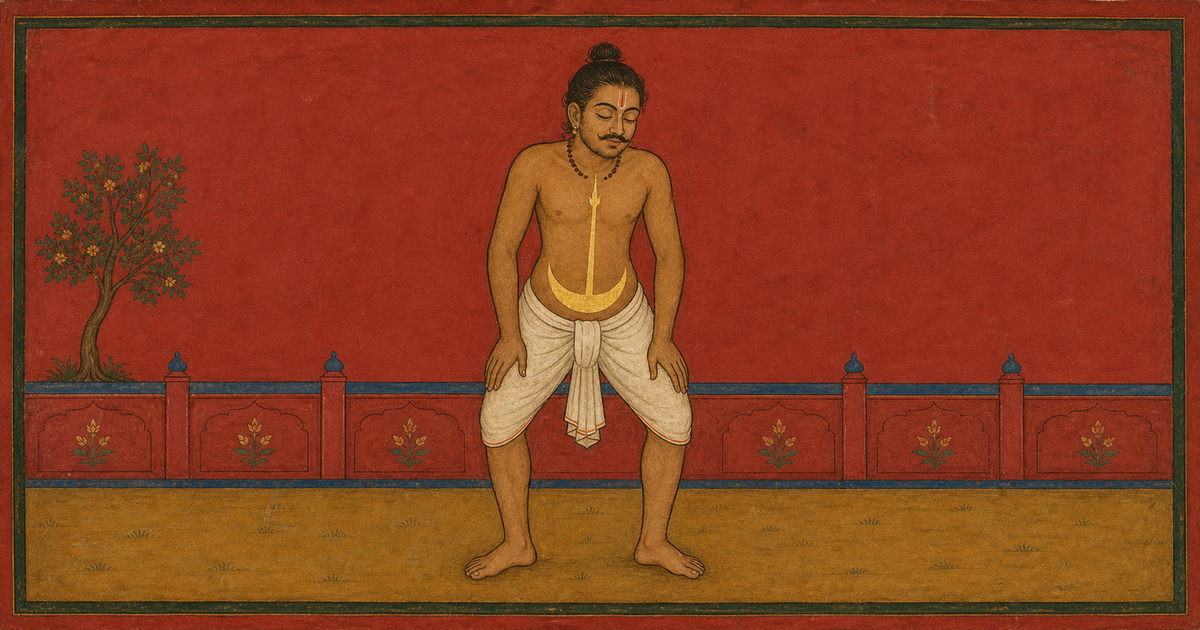
Illustration for the Haṭha Pradīpikā section “HP 3.10-3.18: Mahāmudrā”.

Haṭha Pradīpikā 3.10-3.18: Mahāmudrā

The section explains Mahāmudrā through body position, direction of the breath, changing sides, effects, and the duty of secrecy.

Haṭha Pradīpikā 3.10
Metre: Anuṣṭubh
Having pressed (saṃpīḍya | abs) the perineal region (yonim | acc sg) with the heel of the left foot (pāda-mūlena vāmena | ins sg), one should hold (dhṛtvā | abs), with both hands (karābhyām | ins du), the right (dakṣiṇam | acc sg m), extended (prasāritam | acc sg m ppp) foot (pādam | acc sg) and inhale (pūrayet | 3p sg act opt caus) through the mouth (mukhe | loc sg).
Dr. Ronald Steiner - 2026 - historically literal
Haṭha Pradīpikā 3.11
Metre: Anuṣṭubh
Having applied (samāropya | abs) the lock (bandham | acc sg) at the throat (kaṇṭhe | loc sg), one should hold (dhārayet | 3p sg act opt caus) the breath (vāyum | acc sg) above (ūrdhvataḥ), just as (yathā) a snake struck by a staff (daṇḍa-āhataḥ sarpaḥ | nom sg) assumes (prajāyate | 3p sg med pres) the shape of a staff (daṇḍa-ākāraḥ | nom sg).
Dr. Ronald Steiner - 2026 - historically literal
Haṭha Pradīpikā 3.12
Metre: Anuṣṭubh
So (tathā) Śakti (śaktiḥ | nom sg), Kuṇḍalinī (kuṇḍalī | nom sg), becomes (bhavet | 3p sg act opt) suddenly (sahasā) straightened (ṛjvī-bhūtā | nom sg f ppp); then (tadā) arises (jāyate | 3p sg med pres) this (asau | nom sg f) death-like state (maraṇa-avasthā | nom sg), resting in the vessel with two halves (dvi-puṭa-aśritā | nom sg f ppp).
Dr. Ronald Steiner - 2026 - historically literal
Haṭha Pradīpikā 3.13
Metre: Anuṣṭubh
Afterwards (tataḥ), one should exhale (recayet | 3p sg act opt caus) slowly (śanaiḥ), slowly (śanaiḥ), indeed (eva), but not (na tu) forcefully (vegataḥ); this (iyam | nom sg f) is truly (khalu) Mahāmudrā (mahā-mudrā | nom sg), revealed (pradarśitā | nom sg f ppp) by the great adepts (mahā-siddhaiḥ | ins pl).
Dr. Ronald Steiner - 2026 - historically literal
Haṭha Pradīpikā 3.14
Metre: Anuṣṭubh
Disorders (doṣāḥ | nom pl) such as the great afflictions (mahā-kleśa-ādayaḥ | nom pl m), as well as death and the rest (maraṇa-ādayaḥ | nom pl m), dissolve (jīryante | 3p pl pas pres). And (ca) precisely for that reason (tena eva), the foremost sages (vibudha-uttamāḥ | nom pl m) call (vadanti | 3p pl act pres) it Mahāmudrā (mahā-mudrām | acc sg).
Dr. Ronald Steiner - 2026 - historically literal
Haṭha Pradīpikā 3.15
Metre: Anuṣṭubh
Having now (tu) practised (samabhyasya | abs) on the lunar side (candra-aṅge | loc sg), one should then (punar) practise (abhyaset | 3p sg act opt) on the solar side (sūrya-aṅge | loc sg); when (yāvat) the count (saṃkhyā | nom sg) has become (bhavet | 3p sg act opt) equal (tulyā | nom sg f), then (tataḥ) one should release (visarjayet | 3p sg act opt) the mudrā (mudrām | acc sg).
Dr. Ronald Steiner - 2026 - historically literal
Haṭha Pradīpikā 3.16
Metre: Anuṣṭubh
For (hi) there is no (na) wholesome food (pathyam | nom sg n) or (vā) unwholesome food (apathyam | nom sg n); all flavours (rasāḥ sarve | nom pl) are also (api) without effect (nīrasāḥ | nom pl m). Even (api) terrible poison that has been eaten (bhuktaṃ viṣaṃ ghoram | nom sg) is digested (jīryate | 3p sg pas pres) like (iva) nectar (pīyūṣam | nom sg).
Dr. Ronald Steiner - 2026 - historically literal
Haṭha Pradīpikā 3.17
Metre: Anuṣṭubh
For one (tasya | gen sg m) who (yaḥ | nom sg m), indeed (tu), practises (abhyaset | 3p sg act opt) Mahāmudrā (mahā-mudrām | acc sg), disorders (doṣāḥ | nom pl) led by consumption, skin disease, constipation, swelling, and indigestion (kṣaya-kuṣṭha-gudāvarta-gulma-ajīrṇa-puro-gamāḥ | nom pl m) pass (yānti | 3p pl act pres) into dissolution (kṣayam | acc sg).
Dr. Ronald Steiner - 2026 - historically literal
Haṭha Pradīpikā 3.18
Metre: Anuṣṭubh
This (iyam | nom sg f) Mahāmudrā (mahā-mudrā | nom sg), which brings about great accomplishment (mahā-siddhi-karī | nom sg f) for people (nṛṇām | gen pl), has been taught (kathitā | nom sg f ppp); it is to be concealed (gopanīyā | nom sg f pfp) with care (prayatnena | ins sg) and not (na) given (deyā | nom sg f pfp) to whomever (yasya | gen sg m), that is, just anyone (kasyacit | gen sg m).
Dr. Ronald Steiner - 2026 - historically literal
Illustration for the Haṭha Pradīpikā section “HP 3.19-3.25: Mahābandha”.

Haṭha Pradīpikā 3.19-3.25: Mahābandha and Mahāvedha

Mahābandha is described technically, interpreted through its effects on Nāḍī, mind, and the noose of death, and opened toward Mahāvedha.

Haṭha Pradīpikā 3.19
Metre: Anuṣṭubh
One should place (niyojayet | 3p sg act opt caus) the heel (pārṣṇim | acc sg) of the left foot (vāmasya pādasya | gen sg) at the perineal region (yoni-sthāne | loc sg); having likewise (tathā) placed (saṃsthāpya | abs) the right foot (dakṣiṇam caraṇam | acc sg) upon the left thigh (vāma-ūru-upari),
Dr. Ronald Steiner - 2026 - historically literal
Haṭha Pradīpikā 3.20
Metre: Anuṣṭubh
having inhaled (pūrayitvā | abs) the breath (vāyum | acc sg) through the mouth (mukhe | loc sg), firmly lowered (nibhṛtya | abs) the chin (cibukam dṛḍham | acc sg) to the chest (hṛdaye | loc sg), and contracted (ākuñcya | abs) the perineal region (yonim | acc sg), one should direct (niyojayet | 3p sg act opt caus) the mind (manaḥ | acc sg) into the centre (madhye | loc sg).
Dr. Ronald Steiner - 2026 - historically literal
Haṭha Pradīpikā 3.21
Metre: Anuṣṭubh
And (ca) one should exhale (recayet | 3p sg act opt) very slowly (śanaiḥ eva). This (ayam | nom sg m) is called (ucyate | 3p sg pas pres) Mahābandha (mahā-bandhaḥ | nom sg).
Dr. Ronald Steiner - 2026 - historically literal
Haṭha Pradīpikā 3.21*1
Metre: Anuṣṭubh
Having held (dhārayitvā | abs) the breath according to one's capacity (yathā-śaktyā | ins sg), one should slowly (śanaiḥ) exhale (recayet | 3p sg act opt) the breath wind (anilam | acc sg). Having practised (samabhyasya | abs) on the left side (savyāṅge | loc sg), one should also (ca) practise (samabhyaset | 3p sg act opt) on the right side (dakṣāṅge | loc sg).
Dr. Ronald Steiner - 2026 - historically literal
Haṭha Pradīpikā 3.21*2
Metre: Anuṣṭubh
Here, however (atra tu), some (keṣāṃcit | gen pl) hold the view (matam | nom sg n ppp) that one should release (visarjayet | 3p sg act opt) the throat lock (kaṇṭha-bandham | acc sg). There (tatra), so it is said (iti), one should use the tongue (jihvayā | ins sg) to support (uttambhayet | 3p sg caus opt) the cavity at the Rājadanta (rāja-danta-bilam | acc sg).
Dr. Ronald Steiner - 2026 - historically literal
Haṭha Pradīpikā 3.22
Metre: Anuṣṭubh
Having practised (samabhyasya | abs) on the left side (savyāṅge | loc sg) this (amum | acc sg m) Mahābandha that bestows great accomplishment (mahā-siddhi-pradāyakaṃ mahā-bandham | acc sg), the yogi (yogī | nom sg) should also (ca) practise it (samabhyaset | 3p sg act opt) on the right side (dakṣāṅge | loc sg).
Dr. Ronald Steiner - 2026 - historically literal
Haṭha Pradīpikā 3.22*1
Metre: Anuṣṭubh
This (ayam | nom sg m) is truly (khalu) the great lock (mahā-bandhaḥ | nom sg), which bestows great accomplishment (mahā-siddhi-pradāyakaḥ | nom sg m). It is skilled at releasing the great bond of the noose of death (kāla-pāśa-mahā-bandha-vimocana-vicakṣaṇaḥ | nom sg m).
Dr. Ronald Steiner - 2026 - historically literal
Haṭha Pradīpikā 3.23
Metre: Anuṣṭubh
This (ayam | nom sg m) also (ca) awakens the upward movement (ūrdhvam-gati-vibodhakaḥ | nom sg m) of all the channels (sarva-nāḍīnām | gen pl). It brings about (dhatte | 3p sg med pres) the confluence at Triveṇī (triveṇī-saṅgamam | acc sg) and should cause (prāpayet | 3p sg caus opt) the mind (manaḥ | acc sg) to reach Kedāra (kedāram | acc sg).
Dr. Ronald Steiner - 2026 - historically literal
Haṭha Pradīpikā 3.24
Metre: Anuṣṭubh
Just as (yathā) a woman (strī | nom sg), endowed with beauty and grace (rūpa-lāvaṇya-saṃpannā | nom sg f ppp), is fruitless without (vinā) a man (puruṣam | acc sg), so Mahāmudrā and Mahābandha (mahā-mudrā-mahā-bandhau | nom du), when deprived of Vedha (vedha-varjitau | nom du m ppp), are fruitless (niṣphalau | nom du m).
Dr. Ronald Steiner - 2026 - historically literal
Haṭha Pradīpikā 3.25
Metre: Anuṣṭubh
The yogi established in Mahābandha (mahā-bandha-sthito yogī | nom sg), one-pointed in mind (eka-dhīḥ | nom sg m bv), having performed (kṛtvā | abs) the inhalation (pūrakam | acc sg) and firmly (nibhṛtam | acc sg n ppp) blocked (āvṛtya | abs) the movement (gatim | acc sg) of the bodily winds (vāyūnām | gen pl) with the throat seal (kaṇṭha-mudrayā | ins sg),
Dr. Ronald Steiner - 2026 - historically literal
Illustration for the Haṭha Pradīpikā section “HP 3.26-3.31: Mahāvedha”.

Haṭha Pradīpikā 3.26-3.31: Mahāvedha and the Threefold Practice

Mahāvedha completes Mahāmudrā and Mahābandha; the three practices are regarded as secret means against old age and death.

Haṭha Pradīpikā 3.26
Metre: Anuṣṭubh
with both hands placed evenly on the ground (sama-hasta-yugaḥ | nom sg), should gently (śanaiḥ) tap (saṃtāḍayet | 3p sg caus opt) both halves of the buttocks (sphijau | acc du) on the ground (bhūmau | loc sg). Having entered (samākramya | abs) the pair of two openings (puṭa-dvayam | acc sg), the breath (vāyuḥ | nom sg) pulses (sphurati | 3p sg act pres) quickly (satvaram).
Dr. Ronald Steiner - 2026 - historically literal
Haṭha Pradīpikā 3.27
Metre: Anuṣṭubh
The union of moon, sun, and fire (soma-sūrya-agni-saṃbandhaḥ | nom sg) arises (jāyate | 3p sg med pres), and (ca) indeed (vai) leads to immortality (amṛtāya | dat sg); when the death-like state (mṛta-avasthā | nom sg) has arisen (samutpannā | nom sg f ppp), whence (kutaḥ), then (tataḥ), could fear of death (mṛtyu-bhayam | nom sg) come?
Dr. Ronald Steiner - 2026 - historically literal
Haṭha Pradīpikā 3.28
Metre: Anuṣṭubh
Through practice (abhyāsāt | abl sg), this Mahāvedha (mahāvedho’yam | nom sg) bestows great accomplishment (mahā-siddhi-pradāyakaḥ | nom sg m); it destroys wrinkles, grey hair, and trembling (valī-palita-vepa-ghnaḥ | nom sg m) and is practised (sevyate | 3p sg pas pres) by the foremost practitioners (sādhakottamaiḥ | ins pl).
Dr. Ronald Steiner - 2026 - historically literal
Haṭha Pradīpikā 3.29
Metre: Anuṣṭubh
This triad (etat trayam | nom sg) is a great secret (mahā-guhyam | nom sg n), destroys old age and death (jarā-mṛtyu-vināśanam | nom sg n), brings about the growth of the fire (vahni-vṛddhi-karam | nom sg n), and indeed (caiva) bestows the powers beginning with Aṇimā (aṇimā-ādi-guṇa-pradam | nom sg n).
Dr. Ronald Steiner - 2026 - historically literal
Haṭha Pradīpikā 3.30
Metre: Anuṣṭubh
This (etat | nom sg n) is practised (kriyate | 3p sg pas pres) eightfold (aṣṭa-dhā), at every three-hour period (yāme yāme | loc sg), day after day (dine dine | loc sg). It produces an abundance of merit (puṇya-saṃbhāra-saṃbhāvi | nom sg n) and always (sadā) breaks apart the flood of demerit (pāpa-ogha-bhiduram | nom sg n).
Dr. Ronald Steiner - 2026 - historically literal
Haṭha Pradīpikā 3.31
Metre: Anuṣṭubh
Only (eva) to those who have been properly instructed (samyak-śikṣā-vatām | gen pl) should it be given in small measure (svalpam | acc sg n) at the beginning of practice (prathama-sādhane | loc sg); at the outset (ādau | loc sg), one should prescribe (ādiśet | 3p sg act opt) avoidance (varjanam | acc sg) of frequenting fire, women, and roads (vahni-strī-patha-sevānām | gen pl).
Dr. Ronald Steiner - 2026 - historically literal
Illustration for the Haṭha Pradīpikā section “HP 3.32: Preparation for Khecarī”.

Haṭha Pradīpikā 3.32: Preparation for Khecarī

The verse describes the lengthening and mobilization of the tongue over several months as a historical preparation for Khecarī.

Illustration for the Haṭha Pradīpikā section “HP 3.33-3.48*1: Khecarī and Soma”.

Haṭha Pradīpikā 3.33-3.48*1: Khecarī and the Preservation of Soma

Khecarī leads the tongue into the inner space; Bindu, Soma, and nectar are preserved and associated with freedom from old age and death.

Haṭha Pradīpikā 3.33
Metre: Anuṣṭubh
When the tongue (jihvā | nom sg), turned backward (viparīta-gā | nom sg f), has entered (praviṣṭā | nom sg f ppp) the cavity of the skull (kapāla-kuhare | loc sg), and the gaze (dṛṣṭiḥ | nom sg) has gone within (antar-gatā | nom sg f ppp) between the two eyebrows (bhruvoḥ | gen du), the mudrā (mudrā | nom sg) Khecarī (khecarī | nom sg) arises (bhavati | 3p sg act pres).
Dr. Ronald Steiner - 2026 - historically literal
Haṭha Pradīpikā 3.34
Metre: Anuṣṭubh
If (yadi), having turned (kṛtvā | abs) the tongue (kalām | acc sg) backward (parāṅ-mukhīm | acc sg f), one remains (tiṣṭhati | 3p sg act pres) for half an instant (kṣaṇa-ardham | acc sg), the yogi (yogī | nom sg) is instantly (kṣaṇena | ins sg) freed (mucyate | 3p sg pas pres) from disease, death, old age, and the like (vyādhi-mṛtyu-jarā-ādibhiḥ | abl pl).
Dr. Ronald Steiner - 2026 - historically literal
Haṭha Pradīpikā
Metre: Anuṣṭubh
Having turned (kṛtvā | abs) the tongue (kalām | acc sg) backward (parāṅ-mukhīm | acc sg f), one should rotate it (parivartayet | 3p sg caus opt) at the threefold path (tri-pathe | loc sg). This (sā | nom sg f) is (bhavet | 3p sg act opt) Khecarī Mudrā (khecarī mudrā | nom sg); that (tat | nom sg n) is called (ucyate | 3p sg pas pres) the space Cakra (vyoma-cakram | nom sg). If (yadi), having turned (kṛtvā | abs) the tongue (rasanām | acc sg) upward (ūrdhva-gām | acc sg f), one remains (tiṣṭhati | 3p sg act pres) for half an instant (kṣaṇa-ardham | acc sg), the yogi (yogī | nom sg) is instantly (kṣaṇena | ins sg) freed (mucyate | 3p sg pas pres) from disease, death, old age, and the like (vyādhi-mṛtyu-jarā-ādibhiḥ | abl pl).
Dr. Ronald Steiner - 2026 - historically literal
Haṭha Pradīpikā 3.35
Metre: Anuṣṭubh
For one (tasya | gen sg m) who (yaḥ | nom sg m) knows (vetti | 3p sg act pres) the mudrā (mudrām | acc sg) Khecarī (khecarīm | acc sg), there is no (na) disease (rogaḥ | nom sg), no death (maraṇam | nom sg), no (na) sleep (nidrā | nom sg), no (na) hunger (kṣudhā | nom sg) or thirst (tṛṣā | nom sg), and no (na ca) fainting (mūrchā | nom sg).
Dr. Ronald Steiner - 2026 - historically literal
Haṭha Pradīpikā 3.36
Metre: Anuṣṭubh
One (saḥ | nom sg m) who (yaḥ | nom sg m) knows (vetti | 3p sg act pres) the mudrā (mudrām | acc sg) Khecarī (khecarīm | acc sg) is not (na) afflicted (pīḍyate | 3p sg pas pres) by disease (rogeṇa | ins sg), nor (na ca) tainted (lipyati | 3p sg act pres) by karma (karmaṇā | ins sg), nor (na ca) tormented (bādhyate | 3p sg pas pres) by death (kālena | ins sg).
Dr. Ronald Steiner - 2026 - historically literal
Haṭha Pradīpikā 3.37
Metre: Anuṣṭubh
Because (yasmāt | abl sg) the mind (cittam | nom sg) moves (carati | 3p sg act pres) in space (khe | loc sg), and the tongue (jihvā | nom sg), having gone (gatā | nom sg f ppp) into space (khe | loc sg), moves (carati | 3p sg act pres) there, therefore (tena | ins sg n) this (eṣā | nom sg f) mudrā (mudrā | nom sg) is called (nāma) Khecarī (khecarī | nom sg) and is revered (namaskṛtā | nom sg f ppp) by the Siddhas (siddhaiḥ | ins pl).
Dr. Ronald Steiner - 2026 - historically literal
Haṭha Pradīpikā 3.38
Metre: Anuṣṭubh
For one by whom (yena | ins sg m) the opening (vivaram | nom acc sg) above the uvula (lambikā-ūrdhvataḥ) has been sealed (mudritam | nom sg n ppp) by Khecarī (khecaryā | ins sg), his (tasya | gen sg m) Bindu (binduḥ | nom sg) does not (na) flow out (kṣarate | 3p sg med pres), even (ca) when he is embraced (āśleṣitasya | gen sg m ppp) by a desirous woman (kāminyā | ins sg).
Dr. Ronald Steiner - 2026 - historically literal
Haṭha Pradīpikā 3.39
Metre: Anuṣṭubh
Even (api) when (yadā) Bindu (binduḥ | nom sg), having moved (calitaḥ | nom sg m ppp), has reached (saṃprāptaḥ | nom sg m ppp) the region of the yoni (yoni-maṇḍalam | acc sg), it goes (vrajati | 3p sg act pres) upward (ūrdhvam), driven (hataḥ | nom sg m ppp) by Śakti (śaktyā | ins sg) and bound (nibaddhaḥ | nom sg m ppp) by Yoni Mudrā (yoni-mudrayā | ins sg).
Dr. Ronald Steiner - 2026 - historically literal
Haṭha Pradīpikā 3.39*1
Metre: Anuṣṭubh
Through the mudrā of joining Kalā (kalā-sandhāna-mudrayā | ins sg), the tongue (jihvā | nom sg) [is placed] in the cavity of the skull (kapāla-kuhare | loc sg).
Dr. Ronald Steiner - 2026 - historically literal
Haṭha Pradīpikā 3.40
Metre: Anuṣṭubh
One who (yaḥ | nom sg m), having become so (bhūtvā | abs), remains (sthitaḥ | nom sg m ppp) with the tongue turned upward (ūrdhva-jihvaḥ | nom sg m) and performs (karoti | 3p sg act pres) the drinking of Soma (soma-pānam | acc sg), that knower of yoga (yoga-vit | nom sg m) conquers (jayati | 3p sg act pres) death (mṛtyum | acc sg) in half a month (māsa-ardhena | ins sg); there is no (na) doubt (saṃdehaḥ | nom sg).
Dr. Ronald Steiner - 2026 - historically literal
Haṭha Pradīpikā 3.41
Metre: Anuṣṭubh
For one whose (yasya | gen sg m) body (śarīram | nom sg), the body of the yogi (yoginaḥ | gen sg), is always (nityam) filled with the lunar Kalā (soma-kalā-pūrṇam | nom sg n ppp), even (api) when he has been bitten (daṣṭasya | gen sg m ppp) by Takṣaka (takṣakeṇa | ins sg), its (tasya | gen sg m) poison (viṣam | nom sg) does not (na) spread (sarpati | 3p sg act pres).
Dr. Ronald Steiner - 2026 - historically literal
Haṭha Pradīpikā 3.42
Metre: Anuṣṭubh
Just as (yathā) fire (vahniḥ | nom sg) does not leave its fuels (indhanāni | acc pl), nor a lamp (dīpakaḥ | nom sg) its oil-soaked wick (taila-vartim | acc sg), so (tathā) the embodied one (dehī | nom sg) does not (na) leave (muñcati | 3p sg act pres) the body filled with the lunar Kalā (soma-kalā-pūrṇam deham | acc sg).
Dr. Ronald Steiner - 2026 - historically literal
Haṭha Pradīpikā 3.43
Metre: Anuṣṭubh
One should always (nityam) eat (bhakṣayet | 3p sg act opt) "cow flesh" (go-māṃsam | acc sg) and drink (pibet | 3p sg act opt) the immortal Vāruṇī (amara-vāruṇīm | acc sg); I (aham | nom sg) consider (manye | 1p sg med pres) that person (tam | acc sg m) noble (kulīnam | acc sg m), and the others (itare | nom pl m) destroyers of the lineage (kula-ghātakāḥ | nom pl m).
Dr. Ronald Steiner - 2026 - historically literal
Haṭha Pradīpikā 3.44
Metre: Anuṣṭubh
By the word "cow" (go-śabdena | ins sg), the tongue (jihvā | nom sg) is designated (uditā | nom sg f ppp); its entry (tat-praveśaḥ | nom sg) into the palate (tāluni | loc sg), indeed (hi), that (tat | nom sg n) is, however (tu), the eating of "cow flesh" (go-māṃsa-bhakṣaṇam | nom sg) and the destruction of great transgressions (mahā-pātaka-nāśanam | nom sg).
Dr. Ronald Steiner - 2026 - historically literal
Haṭha Pradīpikā 3.45
Metre: Anuṣṭubh
The essence (sāraḥ | nom sg) that (yaḥ | nom sg m) flows (sravati | 3p sg act pres) from the moon (candrāt | abl sg), truly (khalu) produced (utpāditaḥ | nom sg m ppp) by the fire (vahninā | ins sg) arising from the tongue's entry (jihvā-praveśa-saṃbhūta | ppp), this (sā | nom sg f) is (syāt | 3p sg act opt) the immortal Vāruṇī (amara-vāruṇī | nom sg).
Dr. Ronald Steiner - 2026 - historically literal
Haṭha Pradīpikā 3.46
Metre: Śārdūlavikrīḍita
With the face turned upward (ūrdhva-āsyaḥ | nom sg), having fixed (niyamya | abs) the tongue (rasanām | acc sg) in the opening (vivare | loc sg), one should contemplate (cintayet | 3p sg act opt) the supreme Śakti (śaktim parām | acc sg): the nectar obtained (avāptam | acc sg n ppp) forcefully (haṭhāt) through Prāṇa (prāṇāt | abl sg), having dripped from the head (mūrdhnaḥ | abl gen sg) into the sixteen lotus petals (ṣoḍaśa-padma-pattra-galitam | acc sg n ppp). The one who (yaḥ | nom sg m) drinks (pibet | 3p sg act opt) the surging water of the lunar Kalā (utkallola-kalā-jalam | acc sg) and (ca) the pure (vimalam | acc sg n) stream of nectar (dhārā-amṛtam | acc sg), that (saḥ | nom sg m) yogi (yogī | nom sg) lives (jīvati | 3p sg act pres) long (ciram), free from disease (nir-doṣaḥ | nom sg), with a body soft as lotus fibre (mṛṇāla-komala-vapuḥ | nom sg n).
Dr. Ronald Steiner - 2026 - historically literal
Haṭha Pradīpikā 3.47
Metre: Śārdūlavikrīḍita
If (yadi) the tongue (jihvā | nom sg), causing nectar to flow (rasa-syandinī | nom sg f), continuously (aniśam) kisses (cumbantī | nom sg f pca) the tip of the uvula (lambikā-agram | acc sg), whether it is salty (sa-kṣārā | nom sg f), pungent (kaṭukā | nom sg f), like milk (dugdha-sadṛśā | nom sg f), or (athavā) equal to honey and ghee (madhu-ājya-tulyā | nom sg f), then for him (tasya | gen sg m) there will be (syāt | 3p sg act opt) the removal (haraṇam | nom sg) of diseases (vyādhīnām | gen pl), the ending of old age (jarā-anta-karaṇam | nom sg), the manifestation of Śāstra and Āgama (śāstra-āgama-udīraṇam | nom sg), immortality (amaratvam | nom sg), eightfold power (aṣṭa-guṇa-vat), and the attraction of Siddha women (siddha-aṅganā-ākarṣaṇam | nom sg).
Dr. Ronald Steiner - 2026 - historically literal
Haṭha Pradīpikā 3.48
Metre: Anuṣṭubh
One (ekam | nom sg n) seed filled with creation (sṛṣṭi-mayam bījam | nom sg), one (ekā | nom sg f) mudrā (mudrā | nom sg), namely Khecarī (khecarī | nom sg), and (ca) one (ekaḥ | nom sg m) unsupported god (devaḥ nir-ālambaḥ | nom sg); one (ekā | nom sg f) state (avasthā | nom sg), Unmanī beyond mind (manas-unmanī | nom sg).
Dr. Ronald Steiner - 2026 - historically literal
Haṭha Pradīpikā 3.48*1
Metre: Mandākrāntā
What (yad | nom acc sg n) enters (viśati | 3p sg act pres) below, in Pātāla (pātāle | loc sg), into the opening (suṣiram | nom acc sg), that (tad | nom acc sg n) [is situated] at this (asmin | loc sg n) root of Meru (meru-mūle | loc sg). And (ca) this (etat | nom acc sg n), this principle (tattvam | nom acc sg), this mouth (tat mukham | acc sg n) of the rivers (nimnagānām | gen pl), the wise one (sudhīs | nom sg) proclaims (pravadati | 3p sg act pres). From the moon (candrāt | abl sg) flows (sravati | 3p sg act pres) the essence (sāraḥ | nom sg) of the body (vapuṣas | gen sg); through it (tena | ins sg n) arises the death (mṛtyuḥ | nom sg) of people (narāṇām | gen pl). One should bind (badhnīyāt | 3p sg act opt) this stream (tam | acc sg m) with the clay of the good technique (su-karaṇa-mṛdā | ins sg); otherwise (anyathā), there is no (na) perfection of the body (kāya-siddhiḥ | nom sg).
Dr. Ronald Steiner - 2026 - historically literal
Illustration for the Haṭha Pradīpikā section “HP 3.49-3.57: Mūlabandha”.

Haṭha Pradīpikā 3.49-3.57: Mūlabandha

Mūlabandha raises Apāna, unites Prāṇa, Apāna, Nāda, and Bindu, and awakens the sleeping Kuṇḍalinī through inner heat.

Haṭha Pradīpikā 3.49
Metre: Anuṣṭubh
Having pressed (saṃpīḍya | abs) the perineum (yonim | acc sg) with the part of the heel (pārṣṇi-bhāgena | ins sg), one should contract (ākuñcayet | 3p sg act opt) the anus (gudam | acc sg); having drawn (ākṛṣya | abs) Apāna (apānam | acc sg) upward (ūrdhvam), this (ayam | nom sg m) is considered (iṣyate | 3p sg pas pres) Mūlabandha (mūla-bandhaḥ | nom sg).
Dr. Ronald Steiner - 2026 - historically literal
Haṭha Pradīpikā 3.50
Metre: Anuṣṭubh
One forcefully (balāt | abl sg) makes (kurute | 3p sg med pres) Apāna (apānam | acc sg), which moves downward (adhas-gatim | acc sg), move upward (ūrdhva-gam | acc sg m), indeed (vai). Because of the contraction (ākuñcanena | ins sg), the yogis (yoginaḥ | nom pl) therefore (hi) call (prāhuḥ | 3p pl perf) it (tam | acc sg m) Mūlabandha (mūla-bandham | acc sg).
Dr. Ronald Steiner - 2026 - historically literal
Haṭha Pradīpikā 3.51
Metre: Anuṣṭubh
Having pressed (saṃpīḍya | abs) the anus (gudam | acc sg) with the heel (pārṣṇyā | ins sg), one should now (tu) forcefully (balāt | abl sg) contract (ākuñcayet | 3p sg act opt) the wind (vāyum | acc sg), again (vāram) and again (vāram), so that (yathā) the breath (samīraṇaḥ | nom sg) also (ca) goes (samāyāti | 3p sg act pres) upward (ūrdhvam).
Dr. Ronald Steiner - 2026 - historically literal
Haṭha Pradīpikā 3.52
Metre: Anuṣṭubh
Prāṇa and Apāna (prāṇa-apānau | nom du), as well as Nāda and Bindu (nāda-bindū | nom du), having reached (gatvā | abs) unity (ekatām | acc sg) through Mūlabandha (mūla-bandhena | ins sg), and (ca) bestowing (yacchataḥ | nom du pca) the complete accomplishment (saṃsiddhim | acc sg) of yoga (yogasya | gen sg), leave no (na) doubt (saṃśayaḥ | nom sg) here (atra).
Dr. Ronald Steiner - 2026 - historically literal
Haṭha Pradīpikā 3.53
Metre: Anuṣṭubh
Through continuous (satatam) Mūlabandha (mūla-bandhanāt | abl sg) arise the unity (aikyam | nom sg) of Apāna and Prāṇa (apāna-prāṇayoḥ | gen du) and the reduction (kṣayaḥ | nom sg) of urine and faeces (mūtra-purīṣayoḥ | gen du); even (api) an old man (vṛddhaḥ | nom sg m) becomes (bhavati | 3p sg act pres) young (yuvā | nom sg m).
Dr. Ronald Steiner - 2026 - historically literal
Haṭha Pradīpikā 3.54
Metre: Anuṣṭubh
When Apāna (apāne | loc sg) has also (ca) become (jāte | loc sg m ppp) upward-moving (ūrdhva-ge | loc sg m) and has reached (saṃprāpte | loc sg m ppp) the orb of fire (vahni-maṇḍalam | acc sg), then (tadā) the flame of fire (anala-śikhā | nom sg), made tall (dīrghā | nom sg f), grows (vardhate | 3p sg med pres), fanned (āhatā | nom sg f ppp) by the wind (vāyunā | ins sg).
Dr. Ronald Steiner - 2026 - historically literal
Haṭha Pradīpikā 3.55
Metre: Anuṣṭubh
Thereupon (tataḥ), fire and Apāna (vahni-apānau | nom du) have gone (yātau | nom du m ppp) to Prāṇa (prāṇam | acc sg), which has a hot nature (uṣṇa-svarūpakam | acc sg m). Through this (tena | ins sg n), then (tadā), the fire (jvalanaḥ | nom sg) born in the body (deha-jaḥ | nom sg m) also (tu) becomes intensely kindled (atyanta-pradīptaḥ | nom sg m ppp).
Dr. Ronald Steiner - 2026 - historically literal
Haṭha Pradīpikā 3.56
Metre: Anuṣṭubh
Through this (tena | ins sg n), the sleeping (suptā | nom sg f ppp) Kuṇḍalinī (kuṇḍalinī | nom sg), heated (saṃtaptā | nom sg f ppp), awakens (saṃprabudhyate | 3p sg med pres). Like (iva) a female snake struck by a staff (daṇḍa-āhatā bhujaṅgī | nom sg), having hissed (niśvasya | abs), she should become (vrajet | 3p sg act opt) straight (ṛjutām | acc sg).
Dr. Ronald Steiner - 2026 - historically literal
Haṭha Pradīpikā 3.57
Metre: Anuṣṭubh
Then (tataḥ), like (iva) one that has entered (praviṣṭā | nom sg f ppp) a hole (bilam | acc sg), she should enter (vrajet | 3p sg act opt) the interior of the Brahma channel (brahma-nāḍī-antaram | acc sg). Therefore (tasmāt | abl sg), Mūlabandha (mūla-bandhaḥ | nom sg) is to be practised (kartavyaḥ | nom sg m pfp) by yogis (yogibhiḥ | ins pl) always (sadā) and regularly (nityam).
Dr. Ronald Steiner - 2026 - historically literal
Illustration for the Haṭha Pradīpikā section “HP 3.58-3.65: Uḍḍiyāna Bandha”.

Haṭha Pradīpikā 3.58-3.65: Uḍḍiyāna Bandha

Uḍḍiyāna is explained as the upward-flying path of Prāṇa in Suṣumṇā and described as an easy Bandha that nevertheless depends on the Guru.

Haṭha Pradīpikā 3.58
Metre: Anuṣṭubh
Because (yataḥ), when bound (baddhaḥ | nom sg m ppp) by it (yena | ins sg m), Prāṇa (prāṇaḥ | nom sg) now (tu) flies upward (uḍḍīyate | 3p sg pas pres) in Suṣumṇā (suṣumṇāyām | loc sg), therefore (tasmāt | abl sg) this (ayam | nom sg m) is named and declared (samudāhṛtaḥ | nom sg m ppp) by yogis (yogibhiḥ | ins pl) as Uḍḍīyaṇa (uḍḍīyaṇa-ākhyaḥ | nom sg m).
Dr. Ronald Steiner - 2026 - historically literal
Haṭha Pradīpikā 3.59
Metre: Anuṣṭubh
Because (yasmāt | abl sg) the great bird (mahā-khagaḥ | nom sg) tirelessly (aviśrāntam) performs (kurute | 3p sg med pres) the upward flight (uḍyāṇam | acc sg n), this (tat | nom sg n) is (syāt | 3p sg act opt) precisely (eva) Uḍḍīyāṇa (uḍḍīyāṇam | nom sg); there (tatra) the lock (bandhaḥ | nom sg) is prescribed (vidhīyate | 3p sg pas pres).
Dr. Ronald Steiner - 2026 - historically literal
Haṭha Pradīpikā 3.60
Metre: Anuṣṭubh
In the abdomen (udare | loc sg), one should cause (kārayet | 3p sg caus opt) the backward stretch (paścimam tāṇam | acc sg) to be drawn upward (ūrdhvam) from the navel (nābheḥ | abl gen sg); this (asau | nom sg m) lock (bandhaḥ | nom sg) is indeed (hi) Uḍḍīyāṇa (uḍḍīyāṇaḥ | nom sg), the lion against the elephant of death (mṛtyu-mātaṅga-kesarī | nom sg).
Dr. Ronald Steiner - 2026 - historically literal
Haṭha Pradīpikā 3.61
Metre: Anuṣṭubh
Uḍḍīyāṇa (uḍḍīyāṇam | nom sg), however (tu), is easy (sahajam | nom sg n) and always (sadā) taught (kathitam | nom sg n ppp) by the guru (guruṇā | ins sg). If one practises it (abhyaset | 3p sg act opt) tirelessly (a-tatandraḥ | nom sg m), even (api) an old person (vṛddhaḥ | nom sg m) becomes (bhavet | 3p sg act opt) young (taruṇaḥ | nom sg m).
Dr. Ronald Steiner - 2026 - historically literal
Haṭha Pradīpikā 3.62
Metre: Anuṣṭubh
From the navel (nābheḥ | abl gen sg), one should carefully (prayatnataḥ) perform (kuryāt | 3p sg act opt) the stretch (tāṇam | acc sg) upward (ūrdhvam), downward (adhaḥ), and also (cāpi). One who practises (abhyasan | nom sg m pca) for six months (ṣaṇ-māsam | acc sg) certainly (eva) conquers (jayati | 3p sg act pres) death (mṛtyum | acc sg); there is no (na) doubt (saṃśayaḥ | nom sg).
Dr. Ronald Steiner - 2026 - historically literal
Haṭha Pradīpikā 3.63
Metre: Anuṣṭubh
While seated (sati | loc sg n pca) in Vajrāsana (vajra-asane | loc sg), one should firmly (dṛḍham) hold (dhārayet | 3p sg act opt) both feet (pādau | acc du) with both hands (karābhyām | ins du), and (ca) there (tatra), close to the region of the ankles (gulpha-deśa-samīpe | loc sg), press (prapīḍayet | 3p sg caus opt) the Kanda (kandam | acc sg).
Dr. Ronald Steiner - 2026 - historically literal
Haṭha Pradīpikā 3.64
Metre: Anuṣṭubh
One should gradually (śanaiḥ), gradually (śanaiḥ), cause (kārayet | 3p sg caus opt) the backward stretch (paścimam tāṇam | acc sg) in the abdomen (udare | loc sg), chest (dhṛdaye | loc sg), and throat (gale | loc sg), so that (yathā) Prāṇa (prāṇaḥ | nom sg) does not (na) go (gacchati | 3p sg act pres) into the junction of the abdomen (tunda-saṃdhim | acc sg).
Dr. Ronald Steiner - 2026 - historically literal
Haṭha Pradīpikā 3.65
Metre: Anuṣṭubh
Among all (sarveṣām | gen pl) locks (bandhānām | gen pl), Uḍḍiyāṇaka (uḍḍiyāṇakaḥ | nom sg) alone (eva) is the highest (uttamaḥ | nom sg m), indeed (hi). When the lock (bandhe | loc sg) in Uḍḍīyāṇa (uḍḍīyāṇe | loc sg) is firm (dṛḍhe | loc sg m), liberation (muktiḥ | nom sg) becomes (bhavet | 3p sg act opt) natural (svābhāvikī | nom sg f).
Dr. Ronald Steiner - 2026 - historically literal
Illustration for the Haṭha Pradīpikā section “HP 3.66-3.72: Jālandhara and the Bandhas”.

Haṭha Pradīpikā 3.66-3.72: Jālandhara and the Three Bandhas

Jālandhara preserves Soma and binds the Nāḍīs; together with Mūla and Uḍḍiyāna, it forms the central threefold practice of the Bandhas.

Haṭha Pradīpikā 3.66
Metre: Anuṣṭubh
Having contracted (ākuñcya | abs) the throat (kaṇṭham | acc sg), one should deliberately (icchayā | ins sg) place [the chin] (sthāpayet | 3p sg caus opt) firmly (dṛḍham) on the chest (hṛdaye | loc sg). This (ayam | nom sg m) lock (bandhaḥ | nom sg), called Jālandhara (jālandhara-ākhyaḥ | nom sg m), prevents the loss of nectar (amṛta-avyaya-kārakaḥ | nom sg m).
Dr. Ronald Steiner - 2026 - historically literal
Haṭha Pradīpikā 3.67
Metre: Anuṣṭubh
For (hi) it binds (badhnāti | 3p sg act pres) the network of channels (śirā-jālam | acc sg) and the fluid of space flowing downward (adhas-gāmin-nabhas-jalam | acc sg); therefore (tataḥ), Jālandhara (jālandharaḥ | nom sg) is a lock (bandhaḥ | nom sg) that destroys the host of throat afflictions (kaṇṭha-duḥkha-ogha-nāśanaḥ | nom sg m).
Dr. Ronald Steiner - 2026 - historically literal
Haṭha Pradīpikā 3.68
Metre: Anuṣṭubh
When Jālandhara (jālandhare | loc sg), the lock (bandhe | loc sg) characterised by contraction of the throat (kaṇṭha-saṃkoca-lakṣaṇe | loc sg), has been performed (kṛte | loc sg m ppp), the nectar (pīyūṣam | nom sg) does not (na) fall (patati | 3p sg act pres) into the fire (agnau | loc sg), nor (na ca) does the breath (vāyuḥ | nom sg) rush away (pradhāvati | 3p sg act pres).
Dr. Ronald Steiner - 2026 - historically literal
Haṭha Pradīpikā 3.69
Metre: Anuṣṭubh
By contraction of the throat alone (kaṇṭha-saṃkocanena | ins sg), one should firmly (dṛḍham) stop (stambhayet | 3p sg caus opt) the two channels (dve nāḍyau | acc du). This (idam | nom sg n) middle Cakra (madhya-cakram | nom sg) is to be known (jñeyam | nom sg n pfp) as the binding of the sixteen supports (ṣoḍaśa-ādhāra-bandhanam | nom sg).
Dr. Ronald Steiner - 2026 - historically literal
Haṭha Pradīpikā 3.70
Metre: Anuṣṭubh
This (idam | nom sg n) triad of locks (bandha-trayam | nom sg) is the best (śreṣṭham | nom sg n) and has been practised (niṣevitam | nom sg n ppp) by the great adepts (mahā-siddhaiḥ | ins pl). Yogis (yoginaḥ | nom pl) know (viduḥ | 3p pl perf) it as the means (sādhanam | acc sg) of all Haṭha systems (sarveṣām haṭha-tantrāṇām | gen pl).
Dr. Ronald Steiner - 2026 - historically literal
Haṭha Pradīpikā 3.70*1
Metre: Anuṣṭubh
When contraction of the throat (kaṇṭha-saṃkocane | loc sg) has been performed (kṛte | loc sg n ppp) rapidly (āśu) through contraction from below (adhastāt kuñcanena | ins sg), Prāṇa (prāṇaḥ | nom sg) should (syāt | 3p sg act opt), through the backward stretch (paścima-tāṇena | ins sg) in the middle (madhye | loc sg), enter the Brahma channel (brahma-nāḍi-gaḥ | nom sg m).
Dr. Ronald Steiner - 2026 - historically literal
Haṭha Pradīpikā 3.71
Metre: Anuṣṭubh
Having contracted (samākuñcya | abs) the root location (mūla-sthānam | acc sg), one should then (tu) perform (kārayet | 3p sg caus opt) Uḍḍīyāṇa (uḍḍīyāṇam | acc sg); having closed (baddhvā | abs) Iḍā (iḍām | acc sg) and (ca) Piṅgalā (piṅgalām | acc sg), one should cause the breath to flow (vāhayet | 3p sg caus opt) through the rear pathway (paścimam patham | acc sg).
Dr. Ronald Steiner - 2026 - historically literal
Haṭha Pradīpikā 3.72
Metre: Anuṣṭubh
By this very (anena eva | ins sg n) method (vidhānena | ins sg), one should frequent (sevayet | 3p sg act opt) the abode of the breath (pavana-ālayam | acc sg). Then (tataḥ), death (mṛtyuḥ | nom sg), as well as (tathā) old age, disease, and the like (jarā-roga-ādikam | nom sg n), do not (na) arise (jāyate | 3p sg med pres).
Dr. Ronald Steiner - 2026 - historically literal
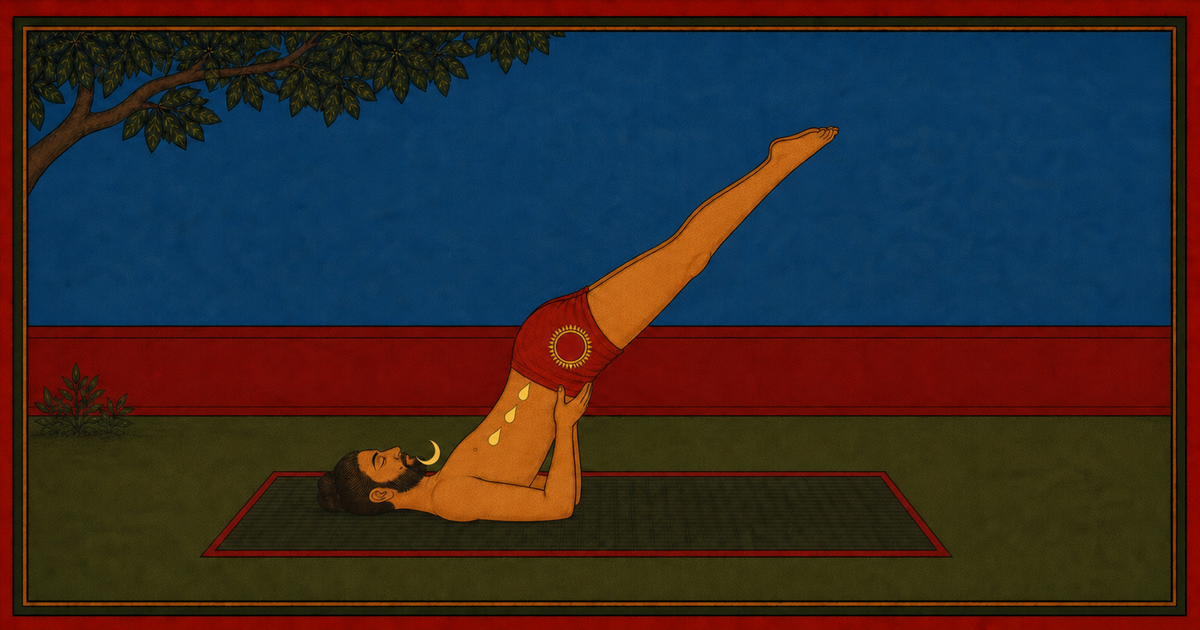
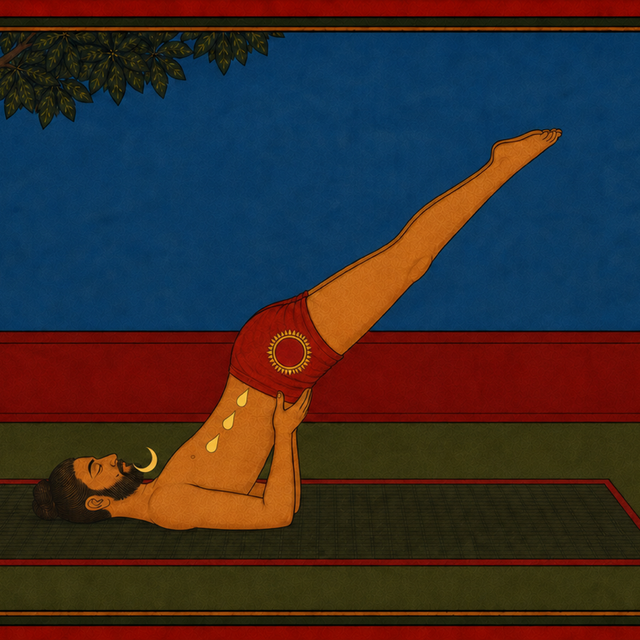
Illustration for the Haṭha Pradīpikā section “HP 3.73-3.78: Viparīta Karaṇī”.

Haṭha Pradīpikā 3.73-3.78: Reversal of the Flow

Viparīta Karaṇī reverses sun and moon; gradual practice and adjusted nourishment are intended to counter old age and death.

Haṭha Pradīpikā 3.73
Metre: Anuṣṭubh
The navel (nābhiḥ | nom sg) is above (ūrdhvam), the palate (tāluḥ | nom sg) below (adhaḥ); the sun (bhānuḥ | nom sg) is above (ūrdhvam), the moon (śaśī | nom sg) below (adhaḥ). The technique (karaṇī | nom sg) called inverted (viparīta-ākhyā | nom sg f) is obtained (labhyate | 3p sg pas pres) through the word of the guru (guru-vākyena | ins sg).
Dr. Ronald Steiner - 2026 - historically literal
Haṭha Pradīpikā 3.74
Metre: Anuṣṭubh
The technique (karaṇī | nom sg) called inverted (viparīta-ākhyā | nom sg f) destroys all diseases (sarva-vyādhi-vināśinī | nom sg f). For one regularly (nityam) devoted to practice (abhyāsa-yuktasya | gen sg m ppp), it increases the digestive fire (jaṭhara-agni-vivardhanī | nom sg f).
Dr. Ronald Steiner - 2026 - historically literal
Haṭha Pradīpikā 3.75
Metre: Anuṣṭubh
For this (tasya | gen sg m) practitioner (sādhakasya | gen sg), however (tu), abundant food (āhāraḥ bahulaḥ | nom sg) is to be provided (saṃpādyaḥ | nom sg m pfp). If (yadi) the diet is scant (alpa-āhāraḥ | nom sg), the fire (agniḥ | nom sg) will burn (dahet | 3p sg act opt) the body (deham | acc sg) at once (kṣaṇāt | abl sg).
Dr. Ronald Steiner - 2026 - historically literal
Haṭha Pradīpikā 3.76
Metre: Anuṣṭubh
On the first day (prathame dine | loc sg), one should remain (syāt | 3p sg act opt) for a moment (kṣaṇam | acc sg) with the head down (adhas-śiras | nom acc sg n) and (ca) the feet up (ūrdhva-pādaḥ | nom sg). Then, day (dine | loc sg) by day (dine | loc sg), one should practise (abhyaset | 3p sg act opt) for something (kiṃcit) more (adhikam | acc sg n) than a moment (kṣaṇāt | abl sg).
Dr. Ronald Steiner - 2026 - historically literal
Haṭha Pradīpikā 3.77
Metre: Anuṣṭubh
After six months have passed (ṣaṇ-māsa-ūrdhvam), wrinkles (valiḥ | nom sg) and (ca) grey hair (palitam | nom sg) are indeed also (caiva) not (na) seen (dṛśyate | 3p sg pas pres). But (tu) one who (yaḥ | nom sg m) regularly (nityam) practises (abhyaset | 3p sg act opt) for the duration of one Yāma (yāma-mātram | acc sg), he (saḥ | nom sg m), however (tu), conquers time, death (kāla-jit | nom sg m).
Dr. Ronald Steiner - 2026 - historically literal
Haṭha Pradīpikā 3.77*1
Metre: Anuṣṭubh
Whatever (yat | nom acc sg n), anything at all (kiṃcit | nom acc sg n), flows (sravate | 3p sg med pres) as nectar (amṛtam | nom acc sg) from the divinely formed (divya-rūpiṇaḥ | abl sg m) moon (candrāt | abl sg), that (tat | nom acc sg n), all of it (sarvam | nom acc sg n), the sun (sūryaḥ | nom sg) devours (grasate | 3p sg med pres). Through this (tena | ins sg n), the body (piṇḍam | nom acc sg) [becomes] joined with old age (jarā-yutam | nom acc sg n ppp).
Dr. Ronald Steiner - 2026 - historically literal
Haṭha Pradīpikā 3.77*2
Metre: Anuṣṭubh
There (tatra) exists (asti | 3p sg act pres) a divine technique (karaṇam divyam | nom acc sg n), namely the blocking of the mouth (mukha-bandhanam | nom acc sg) of the sun (sūryasya | gen sg). It is to be known (jñeyam | nom acc sg n pfp) from the guru's instruction (guru-upadeśataḥ | abl sg), but not (na tu) from millions of interpretations of the teachings (śāstra-artha-koṭibhiḥ | ins pl).
Dr. Ronald Steiner - 2026 - historically literal
Haṭha Pradīpikā 3.78
Metre: Anuṣṭubh
Even (api) one who lives (vartamānaḥ | nom sg m pca) according to his own wishes (sva-icchayā | ins sg), without (vinā) the observances taught in yoga (yoga-ukta-niyamaiḥ | ins pl), that yogi (saḥ yogī | nom sg) who (yaḥ | nom sg m) knows (vijānāti | 3p sg act pres) Vajrolī (vajrolīm | acc sg) is a vessel of accomplishment (siddhi-bhājanam | nom sg).
Dr. Ronald Steiner - 2026 - historically literal
Illustration for the Haṭha Pradīpikā section “HP 3.79-3.86*1: Vajrolī”.

Haṭha Pradīpikā 3.79-3.86*1: Vajrolī

Vajrolī is described as a difficult practice of Bindu with prerequisites, bodily technique, preservation of Bindu, and ethical maturity.

Haṭha Pradīpikā 3.79
Metre: Anuṣṭubh
In this connection (tatra), I shall name (vakṣye | 1p sg fut) two things (vastu-dvayam | acc sg) that are difficult to obtain (durlabham | acc sg n) for whomsoever (yasya | gen sg m), for anyone (kasya | gen sg m) at all (cit). The one (ekam | nom sg n) is milk (kṣīram | nom sg), and (ca) the second (dvitīyam | nom sg n), however (tu), is a woman (nārī | nom sg), namely (ca) one who is compliant (vaśa-vartinī | nom sg f).
Dr. Ronald Steiner - 2026 - historically literal
Haṭha Pradīpikā 3.80
Metre: Anuṣṭubh
Through the urethra (mehanena | ins sg), one should slowly (śanaiḥ) and properly (samyak) practise (abhyaset | 3p sg act opt) upward contraction (ūrdhva-ākuñcanam | acc sg). Whether a man (puruṣaḥ | nom sg) or also (vāpi) a woman (nārī | nom sg), one may attain (āpnuyāt | 3p sg act opt) success in Vajrolī (vajrolī-siddhim | acc sg).
Dr. Ronald Steiner - 2026 - historically literal
Haṭha Pradīpikā 3.81
Metre: Anuṣṭubh
Carefully (yatnataḥ), with a reed tube (śara-nālena | ins sg), one should perform (prakurvīta | 3p sg med opt) blowing (phūt-kāram | acc sg) into the opening of the penis (vajra-kandare | loc sg) very slowly (śanaiḥ), slowly (śanaiḥ), for the purpose of moving air (vāyu-saṃcāra-kāraṇāt | abl sg).
Dr. Ronald Steiner - 2026 - historically literal
Haṭha Pradīpikā 3.82
Metre: Anuṣṭubh
Through practice (abhyāsena | ins sg), one should draw (āharet | 3p sg act opt) upward (ūrdhvam) the falling Bindu (patat-bindum | acc sg) in the woman's (nāryā | gen sg) vulva (bhage | loc sg). And (ca), having drawn (ākṛṣya | abs) upward (ūrdhvam) one's own (svakam | acc sg m) Bindu (bindum | acc sg) when it has moved (calitam | acc sg m ppp), one should preserve it (rakṣayet | 3p sg act opt).
Dr. Ronald Steiner - 2026 - historically literal
Haṭha Pradīpikā 3.83
Metre: Anuṣṭubh
Thus (evam), however (tu), the knower of yoga (yoga-vit | nom sg m) should preserve (rakṣayet | 3p sg act opt) Bindu (bindum | acc sg) and conquers (jayati | 3p sg act pres) death (mṛtyum | acc sg); death (maraṇam | nom sg) arises from the falling of Bindu (bindu-pātena | ins sg), life (jīvitam | nom sg) from retaining Bindu (bindu-dhāraṇāt | abl sg).
Dr. Ronald Steiner - 2026 - historically literal
Haṭha Pradīpikā 3.84
Metre: Anuṣṭubh
Through the retention of Bindu (bindu-dhāraṇāt | abl sg), the body (deham | nom sg) of the yogi (yoginaḥ | gen sg) becomes (jāyate | 3p sg med pres) fragrant (sugandhi | nom sg n). As long as (yāvat) Bindu (binduḥ | nom sg) remains steady (sthiraḥ | nom sg m) in the body (dehe | loc sg), whence (kutaḥ), for so long (tāvat), could fear of death (mṛtyu-bhayam | nom sg) arise?
Dr. Ronald Steiner - 2026 - historically literal
Haṭha Pradīpikā 3.85
Metre: Anuṣṭubh
In men (nṛṇām | gen pl), Śukra (śukram | nom acc sg) depends on the mind (manas-āyattam | nom sg n), and life (jīvitam | nom sg) indeed (hi) depends on Śukra (śukra-āyattam | nom sg n). Therefore (tasmāt | abl sg), Śukra (śukram | nom acc sg) and the mind (manaḥ | nom acc sg) also indeed (caiva) are to be protected (rakṣaṇīyam | nom sg n pfp) carefully (prayatnataḥ).
Dr. Ronald Steiner - 2026 - historically literal
Haṭha Pradīpikā 3.86
Metre: Anuṣṭubh
Thus (evam), [he] should also (api) preserve (rakṣayet | 3p sg act opt) the Rajas (rajas | nom acc sg n) of a menstruating woman (ṛtumatyāḥ | gen sg f), generative fluid (bījam | acc sg), and (ca) [his] Bindu (bindum | acc sg). The practitioner endowed with correct practice (samyak-abhyāsa-yogavān | nom sg m) should draw [this] (ākarṣayet | 3p sg caus opt) upward (ūrdhvam) through the genital (meḍhreṇa | ins sg).
Dr. Ronald Steiner - 2026 - historically literal
Haṭha Pradīpikā 3.86*1
Metre: Anuṣṭubh
This yoga (ayaṃ yogaḥ | nom sg) may succeed (sidhyeta | 3p sg med opt) for the meritorious (puṇyavatām | gen pl m), the fortunate (dhanyānām | gen pl m), those established in truth (tattva-śālinām | gen pl m), and those without jealousy (nir-matsarāṇām | gen pl m), but (tu) not (na) for those filled with jealousy (matsara-śālinām | gen pl m).
Dr. Ronald Steiner - 2026 - historically literal
Illustration for the Haṭha Pradīpikā section “HP 3.87-3.93*7: Sahajolī and Amarolī”.

Haṭha Pradīpikā 3.87-3.93*7: Sahajolī and Amarolī

Sahajolī and Amarolī appear as forms of Vajrolī; preservation of Bindu and Rajas, control, and Deha Siddhi stand at the center.

Haṭha Pradīpikā 3.87
Metre: Anuṣṭubh
Sahajolī (sahajolī | nom sg) and Amarolī (cāmarolī | nom sg) are indeed (eva) varieties (bhedataḥ | abl sg) of Vajrolī (vajrolyāḥ | gen sg).
Dr. Ronald Steiner - 2026 - historically literal
Haṭha Pradīpikā 3.88
Metre: Anuṣṭubh
Having placed (nikṣipya | abs) ash (bhasma | acc sg) produced from burnt cow dung (dagdha-go-maya-saṃbhavam | acc sg n) in water (jaleṣu | loc pl), after Vajrolī intercourse (vajrolī-maithunāt | abl sg) and thereafter (ūrdhvam) follows the smearing of their own bodies (sva-aṅga-lepanam | nom sg) by woman and man (strī-puṃsoḥ | gen du).
Dr. Ronald Steiner - 2026 - historically literal
Haṭha Pradīpikā 3.89
Metre: Anuṣṭubh
When the two seated partners (āsīnayoḥ | gen du m f ppp), comfortably (sukhena | ins sg) and indeed (eva) for a moment (kṣaṇam | acc sg), are free from activity (mukta-vyāpārayoḥ | gen du), this (iyam | nom sg f) is called (proktā | nom sg f ppp) Sahajolī (sahajolīḥ | nom sg); it is always (sadā) to be trusted (śraddheyā | nom sg f pfp) by yogis (yogibhiḥ | ins pl).
Dr. Ronald Steiner - 2026 - historically literal
Haṭha Pradīpikā 3.89*1
Metre: Anuṣṭubh
This (ayam | nom sg m) beneficial yoga (śubha-karaḥ yogaḥ | nom sg m) bestows liberation (mukti-daḥ | nom sg m), even (api) when pleasure (bhoge | loc sg) has been enjoyed (bhukte | loc sg m n ppp).
Dr. Ronald Steiner - 2026 - historically literal
Haṭha Pradīpikā 3.90
Metre: Upajāti
Because of an excess of bile (pitta-ulbaṇatvāt | abl sg), the first stream (prathamāṃ dhārām | acc sg) is left aside (vihāya | abs), and because it is without essence (niḥ-sāratayā | ins sg), so is the last stream (antya-dhārām | acc sg). The cool middle stream (śītala-madhya-dhārā | nom sg) of Amarī (amaryāḥ | gen sg) is used (niṣevyate | 3p sg pas pres) by the Kāpālikas (kāpālikaiḥ | ins pl) of the Khaṇḍa school (khaṇḍa-mataiḥ | ins pl).
Dr. Ronald Steiner - 2026 - historically literal
Haṭha Pradīpikā 3.91
Metre: Anuṣṭubh
One who (yaḥ | nom sg m) should regularly (nityam) drink (pibet | 3p sg act opt) Amarī (amarīm | acc sg) and, day (dine | loc sg) by day (dine | loc sg), apply it nasally (nasyam | acc sg) while doing so (kurvan | nom sg m pca), should practise (abhyaset | 3p sg act opt) Vajrolī (vajrolīm | acc sg) in this way (evam); this is called (kathyate | 3p sg pas pres) Amarolī (amarolī | nom sg), thus (iti).
Dr. Ronald Steiner - 2026 - historically literal
Haṭha Pradīpikā 3.91*1
Metre: Anuṣṭubh
If (yadi), through proficiency in correct practice (samyak-abhyāsa-pāṭavāt | abl sg), a woman (nārī | nom sg) draws upward (samākṛṣya | abs) the man's (puṃsaḥ | gen sg) Bindu (bindum | acc sg) and preserves (rakṣet | 3p sg act opt) Rajas (rajas | acc sg) by means of Vajrolī (vajrolyā | ins sg), then she (sā | nom sg f) is indeed (hi) a yoginī (yoginī | nom sg).
Dr. Ronald Steiner - 2026 - historically literal
Haṭha Pradīpikā 3.91*2
Metre: Anuṣṭubh
None (na), not even a little (kiṃcit | nom acc sg n), of her (tasyāḥ | gen sg f) Rajas (rajaḥ | nom acc sg) goes (gacchati | 3p sg act pres) to destruction (nāśam | acc sg); there is no doubt (saṃśayaḥ | nom sg) about this. In her (tasyāḥ | gen sg f) body (śarīre | loc sg), however (tu), Nāda (nādaḥ | nom sg) itself (eva) passes (gacchati | 3p sg act pres) into the state of Bindu (bindutām | acc sg).
Dr. Ronald Steiner - 2026 - historically literal
Haṭha Pradīpikā 3.91*3
Metre: Anuṣṭubh
This (saḥ | nom sg m) Bindu (binduḥ | nom sg) and (ca) that (tad | nom acc sg n) very (eva) Rajas (rajaḥ | nom acc sg), both arising in one's own body (sva-deha-jau | nom du m n), become one (ekī-bhūya | abs) and, through engagement in the practice of Vajrolī (vajrolyābhyāsa-yogena | ins sg), produce (prakurvataḥ | 3p du act pres) every accomplishment (sarva-siddhim | acc sg).
Dr. Ronald Steiner - 2026 - historically literal
Haṭha Pradīpikā 3.92
Metre: Anuṣṭubh
She who (yā | nom sg f), by contraction (ākuñcanena | ins sg), preserves (rakṣet | 3p sg act opt) Rajas (rajaḥ | acc sg) upward (ūrdhvam), she (sā | nom sg f) is indeed (hi) a yoginī (yoginī | nom sg). She knows (vetti | 3p sg act pres) the past and the future (atīta-anāgatam | acc sg n) and (ca) will certainly (dhruvam) become (bhavet | 3p sg act opt) a Khecarī (khecarī | nom sg).
Dr. Ronald Steiner - 2026 - historically literal
Haṭha Pradīpikā 3.93
Metre: Anuṣṭubh
Through the application of Vajrolī practice (vajrolī-abhyāsa-yogataḥ), one also (ca) obtains (labhate | 3p sg med pres) perfection of the body (deha-siddhim | acc sg). This (ayam | nom sg m) auspicious yoga (śubha-karaḥ yogaḥ | nom sg m) bestows liberation (mukti-daḥ | nom sg m), even (api) when pleasure (bhoge | loc sg) has been experienced (bhukte | loc sg m n ppp).
Dr. Ronald Steiner - 2026 - historically literal
Haṭha Pradīpikā 3.93*1
Metre: Anuṣṭubh
Therefore (tasmāt), this yoga (ayaṃ yogaḥ | nom sg) succeeds (prasidhyati | 3p sg act pres) only (eva) for the meritorious (puṇyavatām | gen pl m).
Dr. Ronald Steiner - 2026 - historically literal
Haṭha Pradīpikā 3.93*2
Metre: Anuṣṭubh
She is the one with a crooked body (kuṭila-aṅgī | nom sg f), Kuṇḍalinī (kuṇḍalinī | nom sg), the serpent (bhujaṅgī | nom sg), the power (śaktiḥ | nom sg), the mistress (īśvarī | nom sg); Kuṇḍalī (kuṇḍalī | nom sg), Arundhatī (arundhatī | nom sg), and thus (ca iti) are words (śabdāḥ | nom pl) denoting synonyms (paryāya-vācakāḥ | nom pl m).
Dr. Ronald Steiner - 2026 - historically literal
Haṭha Pradīpikā 3.93*3
Metre: Anuṣṭubh
Just as (yathā) one forcefully (haṭhāt) opens (udghāṭayet | 3p sg caus opt) a door panel (kapāṭam | acc sg) with a key (kuñcikayā | ins sg), so (tathā) should the yogi (yogī | nom sg), by means of Kuṇḍalinī (kuṇḍalinyā | ins sg), break open (vibhedayet | 3p sg caus opt) the door to liberation (mokṣa-dvāram | acc sg).
Dr. Ronald Steiner - 2026 - historically literal
Haṭha Pradīpikā 3.93*4
Metre: Anuṣṭubh
The supreme mistress (parameśvarī | nom sg) sleeps (prasuptā | nom sg f ppp), having covered (ācchādya | abs) with her mouth (mukhena | ins sg) that door (tad-dvāram | acc sg) along which path (yena mārgeṇa | ins sg) the untroubled abode of Brahman (brahma-sthānam nirāmayam | nom acc sg) is to be reached (gantavyam | nom acc sg n pfp).
Dr. Ronald Steiner - 2026 - historically literal
Haṭha Pradīpikā 3.93*5
Metre: Anuṣṭubh
Above the Kanda (kanda-ūrdhvam) sleeps (suptā | nom sg f ppp) Kuṇḍalī (kuṇḍalī | nom sg), the Śakti (śaktiḥ | nom sg): for yogis (yoginām | gen pl), she leads to liberation (mokṣāya | dat sg), but also (ca), for the deluded (mūḍhānām | gen pl m), to bondage (bandhanāya | dat sg). He who (yaḥ | nom sg m) knows (vetti | 3p sg act pres) her (tām | acc sg f), he (saḥ | nom sg m) is a knower of yoga (yoga-vit | nom sg m).
Dr. Ronald Steiner - 2026 - historically literal
Haṭha Pradīpikā 3.93*6
Metre: Anuṣṭubh
Just as Śeṣa, the coiled serpent (śeṣa-kuṇḍalī | nom sg), is the foundation (ādhāraḥ | nom sg) of the oceans, mountains, and islands (ambhodhi-śaila-dvīpānām | gen pl), so (tathā) Kuṇḍalī (kuṇḍalī | nom sg) is the foundation (ādhāraḥ | nom sg) of all systems of yoga (aśeṣa-yoga-tantrāṇām | gen pl).
Dr. Ronald Steiner - 2026 - historically literal
Haṭha Pradīpikā 3.93*7
Metre: Anuṣṭubh
Kuṇḍalī (kuṇḍalī | nom sg) is described (parikīrtitā | nom sg f ppp) as crooked in form (kuṭila-ākārā | nom sg f) and like a serpent (sarpavat). By whom (yena | ins sg m) this (sā | nom sg f) Śakti (śaktiḥ | nom sg) has been moved (cālitā | nom sg f ppp), he (saḥ | nom sg m) is liberated (muktaḥ | nom sg m ppp); here (atra) there is no (na) doubt (saṃśayaḥ | nom sg).
Dr. Ronald Steiner - 2026 - historically literal
Illustration for the Haṭha Pradīpikā section “HP 3.94-3.102*1: Śakti-Cālana”.

Haṭha Pradīpikā 3.94-3.102*1: Śakti Cālana

Kuṇḍalinī is interpreted under many names, awakened, and moved; Suṣumṇā thereby opens and yogic accomplishment becomes possible.

Haṭha Pradīpikā 3.94
Metre: Anuṣṭubh
Between (madhye | loc sg) Gaṅgā and Yamunā (gaṅgā-yamunayoḥ | gen du) stands the ascetic young widow (bāla-raṇḍā tapasvinī | nom sg). One should seize her (gṛhṇīyāt | 3p sg act opt) forcefully (balātkāreṇa | ins sg); that (tat | nom sg n) is Viṣṇu's (viṣṇoḥ | gen sg) supreme state (paramam padam | nom sg).
Dr. Ronald Steiner - 2026 - historically literal
Haṭha Pradīpikā 3.94*1
Metre: Anuṣṭubh
Iḍā (iḍā | nom sg), the divine one (bhagavatī | nom sg f), is Gaṅgā (gaṅgā | nom sg); Piṅgalā (piṅgalā | nom sg) is Yamunā (yamunā | nom sg), the river (nadī | nom sg). Between (madhye | loc sg) Iḍā and Piṅgalā (iḍā-piṅgalayoḥ | gen loc du) stands Sarasvatī (sarasvatī | nom sg), the young widow (bāla-raṇḍā | nom sg).
Dr. Ronald Steiner - 2026 - historically literal
Haṭha Pradīpikā 3.95
Metre: Anuṣṭubh
Fearlessly (abhīḥ | nom sg m), one should take hold (pragṛhya | abs) of the sleeping (suptām | acc sg f ppp) serpent (bhujagīm | acc sg) by the tail (puccham | acc sg) and awaken her (udbodhayet | 3p sg caus opt); having abandoned (vihāya | abs) sleep (nidrām | acc sg), she (sā | nom sg f) forcefully (haṭhāt) rises (uttiṣṭhate | 3p sg med pres) straight (ṛjvī | nom sg f) upward (ūrdhvam).
Dr. Ronald Steiner - 2026 - historically literal
Haṭha Pradīpikā 3.95*1
Metre: Upajāti
She (sā | nom sg f), the hooded one (phaṇāvatī | nom sg f), has indeed (eva) a widely opened mouth (pravistṛta-āsyā | nom sg f). In the morning (prātas) and (ca) in the evening (sāyam), for the duration of half a Prahara (prahara-ardha-mātram | acc sg n), she is to be moved (paricālanīyā | nom sg f pfp) sideways (tiryak), after one has filled (prapūrya | abs) through the solar channel (sūryāt | abl sg) and taken hold of her (pragṛhya | abs) by the method of binding around (paridhāna-yuktyā | ins sg).
Dr. Ronald Steiner - 2026 - historically literal
Haṭha Pradīpikā 3.95*2
Metre: Anuṣṭubh
In length (dairghyam | nom acc sg), the cloth is measured by a handspan (vitasti-pramitam | nom acc sg n), and in width (vistāram | acc sg), by four fingerbreadths (catur-aṅgulam | nom acc sg). It is described (proktam | nom acc sg n ppp) as soft (mṛdulam | nom acc sg n), white (dhavalam | nom acc sg n), and having the character of a wrapping cloth (veṣṭana-ambara-lakṣaṇam | nom acc sg).
Dr. Ronald Steiner - 2026 - historically literal
Haṭha Pradīpikā 3.96
Metre: Anuṣṭubh
The yogi (yogī | nom sg) who is positioned in Vajrāsana (vajra-āsana-sthitaḥ | nom sg m ppp), having moved (cālayitvā | abs) Kuṇḍalinī (kuṇḍalīm | acc sg), should then (tu), immediately afterward (anantaram), perform (kuryāt | 3p sg act opt) Bhastrī (bhastrīm | acc sg) and quickly (āśu) awaken (bodhayet | 3p sg caus opt) Kuṇḍalinī (kuṇḍalīm | acc sg).
Dr. Ronald Steiner - 2026 - historically literal
Haṭha Pradīpikā 3.97
Metre: Anuṣṭubh
He should perform (kuryāt | 3p sg act opt) the contraction (ākuñcanam | acc sg) of the sun (bhānoḥ | gen sg) and thereafter (tataḥ) move (cālayet | 3p sg caus opt) Kuṇḍalinī (kuṇḍalīm | acc sg); whence (kutaḥ) could fear of death (mṛtyu-bhayam | nom sg) arise for him (tasya | gen sg m), even (api) when he has entered the jaws of death (mṛtyu-vaktra-gatasya | gen sg m ppp)?
Dr. Ronald Steiner - 2026 - historically literal
Haṭha Pradīpikā 3.97*1
Metre: Śārdūlavikrīḍita
When Prāṇa has been made excessively long (prāṇe’ti-dīrghī-kṛte | loc abs sg) as a result of the breath-wind flowing through the right nasal passage (nāsā-dakṣiṇa-mārga-vāhi-pavanāt | abl sg), the yogi, whose immortal body (paripūrita-amṛta-tanuḥ | nom sg m) has previously (prāk) been filled in this way (tathā) with lunar water from the uvula (candra-ambhaḥ, ghaṇṭikāyāḥ | gen sg), sprinkles (siñcan | nom sg m pca) the groups of Nāḍīs at the opening between the brows (bhrū-randhra-nāḍī-gaṇān | acc pl), which are subject to the immense fire of time (kāla-viśāla-vahni-vaśagān | acc pl m). Thus he makes (kurute | 3p sg med pres) that body (tat kāyam | acc sg) entirely new again (punar), more youthful (navataram | acc sg m), like the trunk of a withered tree (jīrṇa-druma-skandha-vat).
Dr. Ronald Steiner - 2026 - historically literal
Haṭha Pradīpikā 3.97*2
Metre: Anuṣṭubh
Having moved (cālayitvā | abs) Kuṇḍalinī (kuṇḍalīṃ | acc sg), one should then (tu), especially (viśeṣataḥ), perform (kuryāt | 3p sg act opt) Bhastrī (bhastrīṃ | acc sg); Yama (yamaḥ | nom sg) fears (śaṅkate | 3p sg med pres) the self-controlled practitioner (yaminaḥ | gen sg) who practises (abhyasataḥ | gen sg m pca) regularly (nityam) in this way (evam).
Dr. Ronald Steiner - 2026 - historically literal
Haṭha Pradīpikā 3.97*3
Metre: Anuṣṭubh
Then (tadā) one should practise (abhyaset | 3p sg act opt) Sūryabheda (sūrya-bhedam | acc sg), Ujjāyī (ujjāyīm | acc sg), and also (cāpi) Śītalī (śītalīm | acc sg); whence (kutaḥ) could the god of death (śamanaḥ | nom sg) come for the self-controlled practitioner (yaminaḥ | gen sg) who in this way (evam) is joined with practice (abhyāsa-yuktasya | gen sg m)?
Dr. Ronald Steiner - 2026 - historically literal
Haṭha Pradīpikā 3.98
Metre: Anuṣṭubh
Through fearless movement (nirbhayam cālanāt | abl sg) for as long as two Muhūrtas (muhūrta-dvaya-paryantam | acc sg), this (asau | nom sg f) Suṣumṇā situated within Kuṇḍalī (suṣumṇā kuṇḍalī-gatā | nom sg f) is drawn (ākṛṣyate | 3p sg pas pres) somewhat (kiṃcit) upward (ūrdhvam).
Dr. Ronald Steiner - 2026 - historically literal
Haṭha Pradīpikā 3.99
Metre: Anuṣṭubh
By this (tena | ins sg n), Kuṇḍalinī (kuṇḍalinī | nom sg), drawn out (samuddhṛtā | nom sg f ppp) from that Suṣumṇā (tasyāḥ suṣumṇāyāḥ | abl gen sg), leaves it (jahāti | 3p sg act pres). Therefore (tasmāt | abl sg), this (ayam | nom sg m) Prāṇa (prāṇaḥ | nom sg) enters (vrajati | 3p sg act pres) Suṣumṇā (suṣumṇām | acc sg) by itself (svataḥ).
Dr. Ronald Steiner - 2026 - historically literal
Haṭha Pradīpikā 3.100
Metre: Anuṣṭubh
Therefore (tasmāt | abl sg), one should regularly (nityam) move (saṃcālayet | 3p sg caus opt) Arundhatī (arundhatīm | acc sg), who contains sound (śabda-garbhām | acc sg f). By her (tasyāḥ | gen sg f) movement (saṃcālanena | ins sg) alone (eva), the yogi (yogī | nom sg) is freed (pramucyate | 3p sg pas pres) from diseases (rogaiḥ | abl pl).
Dr. Ronald Steiner - 2026 - historically literal
Haṭha Pradīpikā 3.101
Metre: Anuṣṭubh
The yogi (sa yogī | nom sg) by whom (yena | ins sg m) Śakti (śaktiḥ | nom sg) has been moved (saṃcālitā | nom sg f ppp) is a vessel of accomplishment (siddhi-bhājanam | nom sg). What (kim | nom acc sg n) more is to be said here (atra) with much that has already been stated (bahunā uktena | ins sg n)? He overcomes (jayati | 3p sg act pres) death (kālam | acc sg) playfully (līlayā | ins sg).
Dr. Ronald Steiner - 2026 - historically literal
Haṭha Pradīpikā 3.101*1
Metre: Anuṣṭubh
For the yogi (yoginaḥ | gen sg) whose vow is Brahmacarya (brahmacarya-vratasya | gen sg), who always (nityam) eats what is wholesome and moderate (hita-mita-āśinaḥ | gen sg m), and who is devoted to the practice of Kuṇḍalinī (kuṇḍalī-abhyāsa-yoginaḥ | gen sg), success (siddhiḥ | nom sg) becomes visible (dṛśyate | 3p sg pas pres) after forty days (maṇḍalāt | abl sg).
Dr. Ronald Steiner - 2026 - historically literal
Haṭha Pradīpikā 3.102
Metre: Anuṣṭubh
One should mix (miśrayet | 3p sg caus opt) the lunar fluid (cāndrīm | acc sg) produced through practice (abhyāsa-niḥsṛtām | acc sg f ppp) together (saha) with ash (vibhūtyā | ins sg). Wearing it (tad-dhāraṇam | nom sg), however (tu), on the head (uttama-aṅge | loc sg), bestows divine sight (divya-dṛṣṭi-pradāyakam | nom sg n).
Dr. Ronald Steiner - 2026 - historically literal
Haṭha Pradīpikā 3.102*1
Metre: Anuṣṭubh
For the cleansing of impurity (mala-śodhane | loc sg) from the seventy-two thousand (dvi-saptati-sahasrāṇām | gen pl) Nāḍīs (nāḍīnām | gen pl), whence (kutaḥ) could there be a means of washing (prakṣālana-upāyaḥ | nom sg) apart from (ṛte) the practice of Kuṇḍalī (kuṇḍalī-abhyasanāt | abl sg)?
Dr. Ronald Steiner - 2026 - historically literal
Illustration for the Haṭha Pradīpikā section “HP 3.103-3.107*2: Conclusion of the Mudrā Teaching”.

Haṭha Pradīpikā 3.103-3.107*2: Conclusion of the Mudrā Teaching

The conclusion brings together lunar fluid, purification of the Nāḍīs, the ten Mudrās, Rājayoga, and the transmission bound to the Guru.

Haṭha Pradīpikā 3.103
Metre: Anuṣṭubh
Thus (iti), the ten (daśa | nom pl f) Mudrās (mudrāḥ | nom pl) have been taught (proktāḥ | nom pl f ppp) by Ādinātha (ādi-nāthena | ins sg), Śambhu (śambhunā | ins sg). Each one (ekaikā | nom sg f) among them (tāsu | loc pl f) bestows great accomplishment (mahā-siddhi-pradāyinī | nom sg f) upon the self-controlled yogis (yaminām | gen pl).
Dr. Ronald Steiner - 2026 - historically literal
Haṭha Pradīpikā 3.104
Metre: Anuṣṭubh
Without union with the king (rāja-yogam | acc sg), the earth (pṛthvī | nom sg) does not shine; without this union (rāja-yogam | acc sg), the night (niśā | nom sg) does not shine. Without Rājayoga (rāja-yogam | acc sg), even (api) the wondrous (vicitrā | nom sg f) Mudrā (mudrā | nom sg) does not (na) shine (rājate | 3p sg med pres).
Dr. Ronald Steiner - 2026 - historically literal
Haṭha Pradīpikā 3.105
Metre: Anuṣṭubh
One should practise (samabhyaset | 3p sg act opt) the entire method (vidhiṃ sarvam | acc sg) of the breath (mārutasya | gen sg) with the mind joined to it (manas-yuktam | acc sg m ppp). The movement of the mind (mano-vṛttiḥ | nom sg) should not (na) be directed (kartavyā | nom sg f pfp) elsewhere (itaratra) by the wise practitioner (manīṣiṇā | ins sg).
Dr. Ronald Steiner - 2026 - historically literal
Haṭha Pradīpikā 3.106
Metre: Anuṣṭubh
Through firm practice (dṛḍha-abhyāsena | ins sg), even (api) the obstructed (khilā | nom sg f) middle Nāḍī (madhyamā nāḍī | nom sg) of yogis (yoginām | gen pl) becomes (bhavet | 3p sg act opt) straight (saralā | nom sg f) by means of Āsana, breath control, and Mudrās (āsana-prāṇa-saṃyāma-mudrābhiḥ | ins pl).
Dr. Ronald Steiner - 2026 - historically literal
Haṭha Pradīpikā 3.107
Metre: Anuṣṭubh
For those who remain untiring (vinidrāṇām | gen pl) in devoted practice (upāsane | loc sg), the incomparable Rudrāṇī Mudrā (rudrāṇī aparā mudrā | nom sg) also (ca) bestows (prayacchati | 3p sg act pres) auspicious accomplishment (bhadrāṃ siddhim | acc sg), like the ocean of Rājayoga (rāja-yoga-samudra-vat).
Dr. Ronald Steiner - 2026 - historically literal
Haṭha Pradīpikā 3.107*1
Metre: Anuṣṭubh
He who (yaḥ | nom sg m) indeed (hi) preserves (dhatte | 3p sg med pres) the traditional (sāmpradāyikam | acc sg m) instruction (upadeśam | acc sg) in the Mudrās (mudrāṇām | gen pl), he (saḥ | nom sg m) alone (eva) should be (astu | 3p sg imp) the guru (guruḥ | nom sg) and master (svāmī | nom sg); he (saḥ | nom sg m) is directly (sākṣāt) the Lord (īśvaraḥ | nom sg) himself (eva).
Dr. Ronald Steiner - 2026 - historically literal
Haṭha Pradīpikā 3.107*2
Metre: Anuṣṭubh
This very (saḥ ayam | nom sg m) collected practitioner (samāhitaḥ | nom sg m ppp), who (yaḥ | nom sg m) practises (abhyasyati | 3p sg act pres) a Mudrā (mudrām | acc sg) and is intent on his word (tasya-vākya-paraḥ | nom sg m), becomes (jāyate | 3p sg med pres), through the powers beginning with Aṇimā (aṇimā-ādi-guṇaiḥ | ins pl), one who cheats death (kāla-vañcakaḥ | nom sg).
Dr. Ronald Steiner - 2026 - historically literal

Continue with AYI Free

Illustrations: AI-generated.

Editor

Dr. Ronald Steiner

From Ulm

The "Yoga Doc" - Dr. Ronald Steiner is the founder of the AYI method. This method links traditional Ashtanga Yoga with innovative Yogatherapy and living Philosophy. This forms a practice that is personal for each and... more ›