
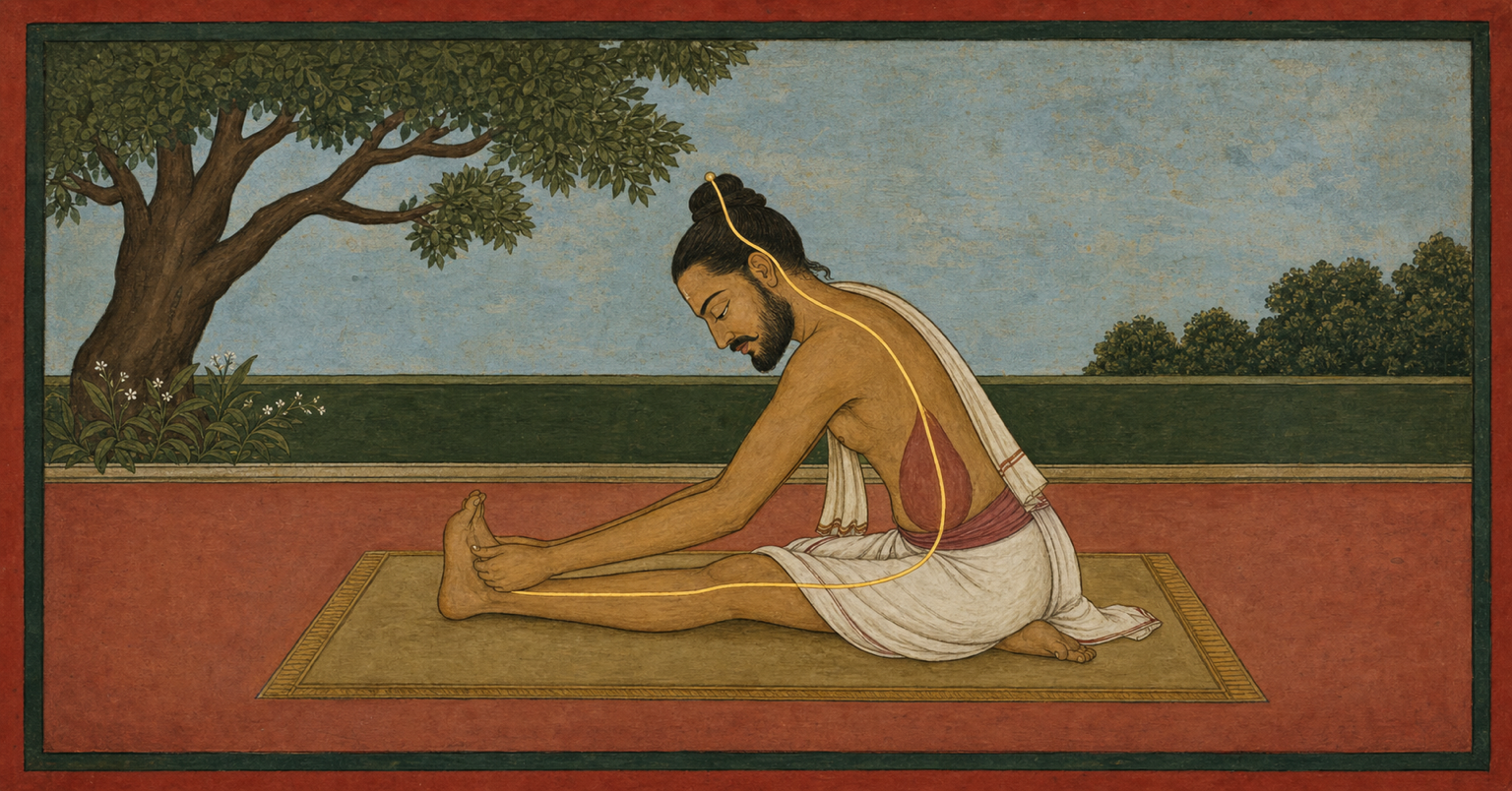
Illustration for the Haṭha Pradīpikā section “HP 3.10-3.18: Mahāmudrā”.

Haṭha Pradīpikā 3.10-3.18: Mahāmudrā

The section explains Mahāmudrā through body position, direction of the breath, changing sides, effects, and the duty of secrecy.

Dr. Ronald Steiner Dr. Ronald Steiner
Haṭha Pradīpikā 3.10
पादमूलेन वामेन योनिं संपीड्य दक्षिणम् |
pāda-mūlena vāmena; yoniṃ saṃpīḍya dakṣiṇam | Analysis ▾ Analysis ▴
pāda
tatpuruṣa-compound genitive
substantive masculine
foot
mūlena
instrumental case singular
substantive neuter
with the root, heel
vāmena
instrumental case singular neuter
adjective
left
yonim
accusative singular
substantive feminine
yoni, perineal region
saṃpīḍya
absolutus
previx
verbal root
having pressed
dakṣiṇam
accusative singular masculine
adjective
right
पादं प्रसारितं धृत्वा कराभ्यां पूरयेन्मुखे ||10||
pādaṃ prasāritaṃ dhṛtvā; karābhyāṃ pūrayen mukhe ||10|| Analysis ▾ Analysis ▴
pādam
accusative singular
substantive masculine
foot, leg
prasāritam
accusative singular masculine past participle passive
previx
verbal root
extended
dhṛtvā
absolutus
verbal root
having grasped
karābhyām
instrumental case dual
substantive masculine
with both hands
pūrayet
3rd person singular aktive optative causative
verbal root
he should fill, inhale
mukhe
lokative singular
substantive neuter
through the mouth
Metre: Anuṣṭubh
Having pressed (saṃpīḍya | abs) the perineal region (yonim | acc sg) with the heel of the left foot (pāda-mūlena vāmena | ins sg), one should hold (dhṛtvā | abs), with both hands (karābhyām | ins du), the right (dakṣiṇam | acc sg m), extended (prasāritam | acc sg m ppp) foot (pādam | acc sg) and inhale (pūrayet | 3p sg act opt caus) through the mouth (mukhe | loc sg).
Dr. Ronald Steiner - 2026 - historically literal
For Mahāmudrā, press the left heel against the perineum, extend the right leg and hold it with both hands, then inhale through the mouth.
Dr. Ronald Steiner - 2026 - modern transfer
pādaṃ prasāritaṃ dhṛtvā MBHDL2026 ] prasāritaṃ padaṃ kṛtvā NS1882

pūrayen mukhe MBHDL2026 ] dhārayed dṛḍham NS1882
Critical Apparatus
Pressing the Yoni (perineum) with the heel of the left foot, and stretching forth the right foot, its toe should be grasped by the thumb and first finger.
Pancham Sinh - 1915
Pressing the anus with the left heel and stretching out the right leg take hold of the toes with your hand.
Srinivasa Iyangar - 1893
Die Ferse des linken Fusses drücke man an die rechte Seite des perinaeum (yoni, vergl. I. 35), strecke den (rechten) Fuss aus und halte ihn mit beiden Händen fest.
Hermann Walter - 1893
Haṭha Pradīpikā 3.11
कण्ठे बन्धं समारोप्य धारयेद्वायुमूर्ध्वतः |
kaṇṭhe bandhaṃ samāropya; dhārayed vāyum ūrdhvataḥ | Analysis ▾ Analysis ▴
kaṇṭhe
lokative singular
substantive masculine
at the throat
bandham
accusative singular
substantive masculine
bandha, lock
samāropya
absolutus
previx
previx
verbal root
having applied
dhārayet
3rd person singular aktive optative causative
verbal root
he should retain
vāyum
accusative singular
substantive masculine
breath, wind
ūrdhvataḥ
adverb
upward, in the upper region
यथा दण्डाहतः सर्पो दण्डाकारः प्रजायते ||11||
yathā daṇḍāhataḥ sarpo; daṇḍākāraḥ prajāyate ||11|| Analysis ▾ Analysis ▴
yathā
adverb
like
daṇḍa
tatpuruṣa-compound instrumental case
substantive masculine
stick, staff
āhataḥ
nominative singular masculine past participle passive
previx
verbal root
struck
sarpaḥ
nominative singular
substantive masculine
serpent
daṇḍa
tatpuruṣa-compound genitive
substantive masculine
stick, staff
ākāraḥ
nominative singular
substantive masculine
form
prajāyate
3rd person singular medial present
previx
verbal root
becomes, arises
Metre: Anuṣṭubh
Having applied (samāropya | abs) the lock (bandham | acc sg) at the throat (kaṇṭhe | loc sg), one should hold (dhārayet | 3p sg act opt caus) the breath (vāyum | acc sg) above (ūrdhvataḥ), just as (yathā) a snake struck by a staff (daṇḍa-āhataḥ sarpaḥ | nom sg) assumes (prajāyate | 3p sg med pres) the shape of a staff (daṇḍa-ākāraḥ | nom sg).
Dr. Ronald Steiner - 2026 - historically literal
Apply the throat lock and hold the breath above. This is said to make Śakti stretch out like a serpent struck by a staff.
Dr. Ronald Steiner - 2026 - modern transfer

In the sequence of Mahāmudrā, Brahmānanda recognizes Jālandharabandha in the throat lock and an implied Mūlabandha in holding the breath upward within Suṣumṇā. According to the tradition he cites, the pressure of the heel and the tongue lock already perform its function. When Prāṇa leaves the two side channels Iḍā and Piṅgalā, the motionlessness called the “state of death” arises there. Exhalation is slow because hasty exhalation is said to diminish strength.

Brahmānanda's Jyotsnā - 19th c.
By stopping the throat (by Jâlandhara Bandha) the air is drawn in from the outside and carried down. Just as a snake struck with a stick becomes straight like a stick, in the same way, śakti (suṣumnâ) becomes straight at once. Then the Kuṇḍalinî, becoming as it were dead, and, leaving both the Idâ and the Pingalâ, enters the suṣumnâ (the middle passage).
Pancham Sinh - 1915
Then practise the Jalandhara Bandha and draw the breath through the Sushumna. Then the Kundalini becomes straight just as a coiled snake when struck by a rod suddenly straightens itself like the stick. Then the two other Nadis become dead, because the breath goes out of them.
Srinivasa Iyangar - 1893
Während man den Bandha am Halse (d. h. den Jalandharabandha, Com.) ausführt, halte man den Athem oben (ûrdhvatah = upari sushumnayam, Com.) an, so wird man gleich einem Stock, wie eine Schlange, die mit einem Stock geschlagen worden ist.
Hermann Walter - 1893
Haṭha Pradīpikā 3.12
ऋज्वीभूता तथा शक्तिः कुण्डली सहसा भवेत् |
ṛjvī-bhūtā tathā śaktiḥ; kuṇḍalī sahasā bhavet | Analysis ▾ Analysis ▴
ṛjvī
karmadhāraya-compound
adjective
straight
bhūtā
nominative singular feminine past participle passive
verbal root
become
tathā
adverb
thus, likewise
śaktiḥ
nominative singular
substantive feminine
śakti, power, goddess
kuṇḍalī
nominative singular
substantive feminine
Kuṇḍalinī
sahasā
adverb
suddenly
bhavet
3rd person singular aktive optative
verbal root
becomes
तदासौ मरणावस्था जायते द्विपुटाश्रिता ||12||
tadāsau maraṇāvasthā; jāyate dvi-puṭāśritā ||12|| Analysis ▾ Analysis ▴
tadā
adverb
then
asau
nominative singular feminine
pronoun dem
this
maraṇa
tatpuruṣa-compound genitive
substantive neuter
death, stillness
avasthā
nominative singular
substantive feminine
state
jāyate
3rd person singular medial present
verbal root
becomes, arises
dvi
dvigu-compound
numeral
two
puṭa
tatpuruṣa-compound lokative
substantive neuter
shell, half
aśritā
nominative singular feminine past participle passive
previx
verbal root
resting on, supported by
Metre: Anuṣṭubh
So (tathā) Śakti (śaktiḥ | nom sg), Kuṇḍalinī (kuṇḍalī | nom sg), becomes (bhavet | 3p sg act opt) suddenly (sahasā) straightened (ṛjvī-bhūtā | nom sg f ppp); then (tadā) arises (jāyate | 3p sg med pres) this (asau | nom sg f) death-like state (maraṇa-avasthā | nom sg), resting in the vessel with two halves (dvi-puṭa-aśritā | nom sg f ppp).
Dr. Ronald Steiner - 2026 - historically literal
Kuṇḍalinī suddenly straightens and is held in a state of stillness, imaged as a vessel formed of two halves.
Dr. Ronald Steiner - 2026 - modern transfer
tadāsau MBHDL2026 ] tadā sā NS1882

dvipuṭāśritā MBHDL2026 ] dvipuṭāśrayā NS1882
Critical Apparatus
Die Şakti Kundalî streckt sich nun schnell aus; dann tritt der Zustand des Sterbens (d. h. des Nichtfunktionirens) ein, welcher sich auf die zwei Gefässe (d. h. Ida und Pingala) erstreckt.
Hermann Walter - 1893
Haṭha Pradīpikā 3.13
ततः शनैः शनैरेव रेचयेन्न तु वेगतः |
tataḥ śanaiḥ śanair eva; recayen na tu vegataḥ | Analysis ▾ Analysis ▴
tataḥ
adverb
afterward, then
śanaiḥ
adverb
slowly
śanaiḥ
adverb
slowly
eva
particle
precisely
recayet
3rd person singular aktive optative causative
verbal root
he should exhale
na
particle
not
tu
particle
but
vegataḥ
adverb
quickly, forcefully
इयं खलु महामुद्रा महासिद्धैः प्रदर्शिता ||13||
iyaṃ khalu mahā-mudrā; mahā-siddhaiḥ pradarśitā ||13|| Analysis ▾ Analysis ▴
iyam
nominative singular feminine
pronoun dem
this
khalu
particle
indeed
mahā
karmadhāraya-compound
adjective
great
mudrā
nominative singular
substantive feminine
mudrā, seal
mahā
karmadhāraya-compound
adjective
great
siddhaiḥ
instrumental case plural
substantive masculine
by siddhas
pradarśitā
nominative singular feminine past participle passive
previx
verbal root
shown, revealed
Metre: Anuṣṭubh
Afterwards (tataḥ), one should exhale (recayet | 3p sg act opt caus) slowly (śanaiḥ), slowly (śanaiḥ), indeed (eva), but not (na tu) forcefully (vegataḥ); this (iyam | nom sg f) is truly (khalu) Mahāmudrā (mahā-mudrā | nom sg), revealed (pradarśitā | nom sg f ppp) by the great adepts (mahā-siddhaiḥ | ins pl).
Dr. Ronald Steiner - 2026 - historically literal
Then exhale very slowly, without haste. This is Mahāmudrā as transmitted by the great Siddhas.
Dr. Ronald Steiner - 2026 - modern transfer
na tu MBHDL2026 ] naiva NS1882

iyaṃ khalu mahāmudrā mahāsiddhaiḥ pradarśitā MBHDL2026 ] transp. NS1882 post HP 3.14b
Critical Apparatus
It should be expelled then, slowly only and not violently. For this very reason, the best of the wise men call it the Mahâ Mudrâ. This Mahâ Mudrâ has been propounded by great masters.
Pancham Sinh - 1915
Then he should breathe out very slowly and never quickly. The wise men call it Maha Mudra.
Srinivasa Iyangar - 1893
Dann athme man nicht schnell, sondern recht langsam aus; dies nennen die grössten Weisen Mahamudrâ.
Hermann Walter - 1893
Haṭha Pradīpikā 3.14
महाक्लेशादयो दोषा जीर्यन्ते मरणादयः |
mahā-kleśādayo doṣā; jīryante maraṇādayaḥ | Analysis ▾ Analysis ▴
mahā
karmadhāraya-compound
adjective
great
kleśa
tatpuruṣa-compound genitive
substantive masculine
affliction, suffering
ādayaḥ
nominative plural masculine
adjective
beginning with, and the like
doṣāḥ
nominative plural
substantive masculine
faults, disorders
jīryante
3rd person plural passive present
verbal root
are consumed, dissolve
maraṇa
tatpuruṣa-compound genitive
substantive neuter
death
ādayaḥ
nominative plural masculine
adjective
beginning with, and the like
महामुद्रां च तेनैव वदन्ति विबुधोत्तमाः ||14||
mahā-mudrāṃ ca tenaiva; vadanti vibudhottamāḥ ||14|| Analysis ▾ Analysis ▴
mahā
karmadhāraya-compound
adjective
great
mudrām
accusative singular
substantive feminine
mudrā
ca
particle
and
tena
instrumental case singular neuter
pronoun dem
thereby, therefore
eva
particle
indeed
vadanti
3rd person plural aktive present
verbal root
they call
vibudha
tatpuruṣa-compound genitive
substantive masculine
sage
uttamāḥ
nominative plural masculine
adjective
the highest, best
Metre: Anuṣṭubh
Disorders (doṣāḥ | nom pl) such as the great afflictions (mahā-kleśa-ādayaḥ | nom pl m), as well as death and the rest (maraṇa-ādayaḥ | nom pl m), dissolve (jīryante | 3p pl pas pres). And (ca) precisely for that reason (tena eva), the foremost sages (vibudha-uttamāḥ | nom pl m) call (vadanti | 3p pl act pres) it Mahāmudrā (mahā-mudrām | acc sg).
Dr. Ronald Steiner - 2026 - historically literal
Mahāmudrā is said to dissolve great afflictions and disturbances, even death and the like. The wise therefore call it the “great seal.”
Dr. Ronald Steiner - 2026 - modern transfer

The “great afflictions” are the five classical Kleśas: ignorance, ego attachment, desire, aversion, and clinging to life. Brahmānanda derives the name Mahāmudrā from its “sealing” of these Kleśas together with their consequences, such as grief and delusion, as well as old age and death. Here “sealing” means calming them or causing them to disappear.

Brahmānanda's Jyotsnā - 19th c.
mahāmudrāṃ ca tenaiva vadanti vibudhottamāḥ MBHDL2026 ] transp. NS1882 post HP 3.13a

mahākleśādayo doṣā jīryante maraṇādayaḥ MBHDL2026 ] transp. NS1882 post HP 3.13b

doṣā jīryante MBHDL2026 ] doṣāḥ kṣīyante NS1882
Critical Apparatus
Great evils and pains, like death, are destroyed by it, and for this reason wise men call it the Mahâ Mudrâ.
Pancham Sinh - 1915
This Maha Mudra destroys death and many other pains. As it had been given out by the great Siddhas, it is called Maha Mudra or the great Mudra, for its excellence.
Srinivasa Iyangar - 1893
Diese Mahamudra wird von den grossen Vollendeten gelehrt; Gebrechen, wie die grossen Klesa, der Tod u. s. w. verschwinden (durch dieselbe).
Hermann Walter - 1893
Haṭha Pradīpikā 3.15
चन्द्राङ्गे तु समभ्यस्य सूर्याङ्गे पुनरभ्यसेत् |
candrāṅge tu samabhyasya; sūryāṅge punar abhyaset | Analysis ▾ Analysis ▴
candra
tatpuruṣa-compound genitive
substantive masculine
moon
aṅge
lokative singular
substantive neuter
side, limb
tu
particle
but, now
samabhyasya
absolutus
previx
previx
verbal root
having practised
sūrya
tatpuruṣa-compound genitive
substantive masculine
sun
aṅge
lokative singular
substantive neuter
side, limb
punar
adverb
again, afterward
abhyaset
3rd person singular aktive optative
previx
verbal root
should practise
यावत्तुल्या भवेत्संख्या ततो मुद्रां विसर्जयेत् ||15||
yāvat tulyā bhavet saṃkhyā; tato mudrāṃ visarjayet ||15|| Analysis ▾ Analysis ▴
yāvat
adverb
until
tulyā
nominative singular feminine
adjective
equal
bhavet
3rd person singular aktive optative
verbal root
becomes
saṃkhyā
nominative singular
substantive feminine
number, count
tataḥ
adverb
then
mudrām
accusative singular
substantive feminine
mudrā
visarjayet
3rd person singular aktive optative
previx
verbal root
should conclude, release
Metre: Anuṣṭubh
Having now (tu) practised (samabhyasya | abs) on the lunar side (candra-aṅge | loc sg), one should then (punar) practise (abhyaset | 3p sg act opt) on the solar side (sūrya-aṅge | loc sg); when (yāvat) the count (saṃkhyā | nom sg) has become (bhavet | 3p sg act opt) equal (tulyā | nom sg f), then (tataḥ) one should release (visarjayet | 3p sg act opt) the mudrā (mudrām | acc sg).
Dr. Ronald Steiner - 2026 - historically literal
Practise Mahāmudrā on the left and the right, completing the practice only when both sides have received an equal count.
Dr. Ronald Steiner - 2026 - modern transfer
Having practised with the left nostril, it should be practised with the right one; and, when the number on both sides becomes equal, then the mudrâ should be discontinued.
Pancham Sinh - 1915
He should practise first on the left side, and then on the right, till both make an equal number.
Srinivasa Iyangar - 1893
Nachdem man mit der linken Seite des Körpers (candrânge) geübt hat, übe man auch mit der rechten (sûryânge), bis die Anzahl (der Uebungen auf beiden Seiten) gleich ist; dann gebe man die Mudrâ auf.
Hermann Walter - 1893
Haṭha Pradīpikā 3.16
न हि पथ्यमपथ्यं वा रसाः सर्वे ऽपि नीरसाः |
na hi pathyam apathyaṃ vā; rasāḥ sarve 'pi nīrasāḥ | Analysis ▾ Analysis ▴
na
particle
not
hi
particle
indeed, namely
pathyam
nominative singular neuter
adjective
wholesome
apathyam
nominative singular neuter
adjective
unwholesome
vā
particle
or
rasāḥ
nominative plural
substantive masculine
tastes, juices
sarve
nominative plural masculine
adjective
all
api
particle
also
nīrasāḥ
nominative plural masculine
adjective
tasteless, ineffective
अपि भुक्तं विषं घोरं पीयूषमिव जीर्यते ||16||
api bhuktaṃ viṣaṃ ghoraṃ; pīyūṣam iva jīryate ||16|| Analysis ▾ Analysis ▴
api
particle
even
bhuktam
nominative singular neuter past participle passive
verbal root
eaten
viṣam
nominative singular
substantive neuter
poison
ghoram
nominative singular neuter
adjective
terrible
pīyūṣam
nominative singular
substantive neuter
nectar
iva
particle
like
jīryate
3rd person singular passive present
verbal root
is digested
Metre: Anuṣṭubh
For (hi) there is no (na) wholesome food (pathyam | nom sg n) or (vā) unwholesome food (apathyam | nom sg n); all flavours (rasāḥ sarve | nom pl) are also (api) without effect (nīrasāḥ | nom pl m). Even (api) terrible poison that has been eaten (bhuktaṃ viṣaṃ ghoram | nom sg) is digested (jīryate | 3p sg pas pres) like (iva) nectar (pīyūṣam | nom sg).
Dr. Ronald Steiner - 2026 - historically literal
For one who practises in this way, categories and flavors of food lose their binding force; in the text's imagery, even poison is digested like nectar.
Dr. Ronald Steiner - 2026 - modern transfer
jīryate MBHDL2026 ] jīryati NS1882
Critical Apparatus
There is nothing wholesome or injurious; for the practice of this mudrâ destroys the injurious effects of all the rasas (chemicals). Even the deadliest of poisons, if taken, acts like nectar.
Pancham Sinh - 1915
There is nothing that he can eat or avoid. All objects of whatever taste, or having no taste at all, are digested. Even poison itself proves to him like nectar.
Srinivasa Iyangar - 1893
Da gibt es kein zuträglich und unzuträglich (d. h. beides gilt gleich), die Geschmacksempfindungen werden gleichgiltig (eig. geschmacklos nîrasah). Selbst wenn man schreckliches Gift verzehrt, wird es verdaut wie Ambrosia.
Hermann Walter - 1893
Haṭha Pradīpikā 3.17
क्षयकुष्ठगुदावर्तगुल्माजीर्णपुरोगमाः |
kṣaya-kuṣṭha-gudāvarta;-gulmājīrṇa-puro-gamāḥ | Analysis ▾ Analysis ▴
kṣaya
dvandva-compound
substantive masculine
consumption, wasting
kuṣṭha
dvandva-compound
substantive neuter
skin disease
gudāvarta
dvandva-compound
substantive masculine
intestinal or anal disorder, constipation
gulma
dvandva-compound
substantive masculine
tumour, abdominal swelling
ajīrṇa
dvandva-compound
substantive neuter
digestive disorder
puro
upapada-compound
adverb
foremost
gamāḥ
nominative plural masculine
adjective
going, headed by
तस्य दोषाः क्षयं यान्ति महामुद्रां तु यो ऽभ्यसेत् ||17||
tasya doṣāḥ kṣayaṃ yānti; mahā-mudrāṃ tu yo 'bhyaset ||17|| Analysis ▾ Analysis ▴
tasya
genitive singular masculine
pronoun dem
his, in him
doṣāḥ
nominative plural
substantive masculine
disorders, faults
kṣayam
accusative singular
substantive masculine
destruction, disappearance
yānti
3rd person plural aktive present
verbal root
go, reach
mahā
karmadhāraya-compound
adjective
great
mudrām
accusative singular
substantive feminine
mudrā
tu
particle
but, namely
yaḥ
nominative singular masculine
pronoun rel
whoever
abhyaset
3rd person singular aktive optative
previx
verbal root
practises
Metre: Anuṣṭubh
For one (tasya | gen sg m) who (yaḥ | nom sg m), indeed (tu), practises (abhyaset | 3p sg act opt) Mahāmudrā (mahā-mudrām | acc sg), disorders (doṣāḥ | nom pl) led by consumption, skin disease, constipation, swelling, and indigestion (kṣaya-kuṣṭha-gudāvarta-gulma-ajīrṇa-puro-gamāḥ | nom pl m) pass (yānti | 3p pl act pres) into dissolution (kṣayam | acc sg).
Dr. Ronald Steiner - 2026 - historically literal
One who practises Mahāmudrā is said to become free from severe disorders such as wasting, skin disease, constipation, swellings, and digestive problems.
Dr. Ronald Steiner - 2026 - modern transfer
Consumption, leprosy, prolapsus anii, colic, and the diseases due to indigestion,—all these irregularities are removed by the practice of this Mahâ Mudrâ.
Pancham Sinh - 1915
He who practises Maha Mudras overcomes consumption, leprosy, piles, Gulma, indigestion, &c.
Srinivasa Iyangar - 1893
Alle Krankheiten desjenigen, welcher die Mahamudra übt, wie Auszehrung, Aussatz, Verstopfung, Gulma, Verdauungsstörung u. s. w., verschwinden.
Hermann Walter - 1893
Haṭha Pradīpikā 3.18
कथितेयं महामुद्रा महासिद्धिकरी नृणाम् |
kathiteyaṃ mahā-mudrā; mahā-siddhi-karī nṛṇām | Analysis ▾ Analysis ▴
kathitā
nominative singular feminine past participle passive
verbal root
taught, explained
iyam
nominative singular feminine
pronoun dem
this
mahā
karmadhāraya-compound
adjective
great
mudrā
nominative singular
substantive feminine
mudrā
mahā
karmadhāraya-compound
adjective
great
siddhi
tatpuruṣa-compound accusative
substantive feminine
siddhi, perfection
karī
nominative singular feminine
adjective
producing
nṛṇām
genitive plural
substantive masculine
for people
गोपनीया प्रयत्नेन न देया यस्य कस्यचित् ||18||
gopanīyā prayatnena; na deyā yasya kasyacit ||18|| Analysis ▾ Analysis ▴
gopanīyā
nominative singular feminine future participle passive
verbal root
to be concealed
prayatnena
instrumental case singular
substantive masculine
carefully
na
particle
not
deyā
nominative singular feminine future participle passive
verbal root
to be given
yasya
genitive singular masculine
pronoun rel
to any
kasyacit
genitive singular masculine
pronoun
anyone
Metre: Anuṣṭubh
This (iyam | nom sg f) Mahāmudrā (mahā-mudrā | nom sg), which brings about great accomplishment (mahā-siddhi-karī | nom sg f) for people (nṛṇām | gen pl), has been taught (kathitā | nom sg f ppp); it is to be concealed (gopanīyā | nom sg f pfp) with care (prayatnena | ins sg) and not (na) given (deyā | nom sg f pfp) to whomever (yasya | gen sg m), that is, just anyone (kasyacit | gen sg m).
Dr. Ronald Steiner - 2026 - historically literal
This completes the explanation of Mahāmudrā. It is regarded as a source of great Siddhi, but is to be kept carefully secret and not passed on indiscriminately.
Dr. Ronald Steiner - 2026 - modern transfer
mahāsiddhikarī MBHDL2026 ] mahāsiddhikarā NS1882
Critical Apparatus
This Mahâ Mudrâ has been described as the giver of great success (Siddhi) to men. It should be kept secret by every effort, and not revealed to any and everyone.
Pancham Sinh - 1915
Thus has been described the Maha Mudra that can confer great Siddhis upon men. This should be carefully kept secret and should not be given out to any and every body.
Srinivasa Iyangar - 1893
Ich habe nun diese Mahamudra erklärt, welche den Menschen zu grossem Erfolg führt; sie ist sorgfältig zu verheimlichen und nicht jedem Beliebigen mitzutheilen.
Hermann Walter - 1893

Continue with AYI Free

Illustrations: AI-generated.

Editor

Dr. Ronald Steiner

From Ulm

The "Yoga Doc" - Dr. Ronald Steiner is the founder of the AYI method. This method links traditional Ashtanga Yoga with innovative Yogatherapy and living Philosophy. This forms a practice that is personal for each and... more ›

Messages and ratings
0 messages

Please log in to write a message. Go to login

No messages yet.