
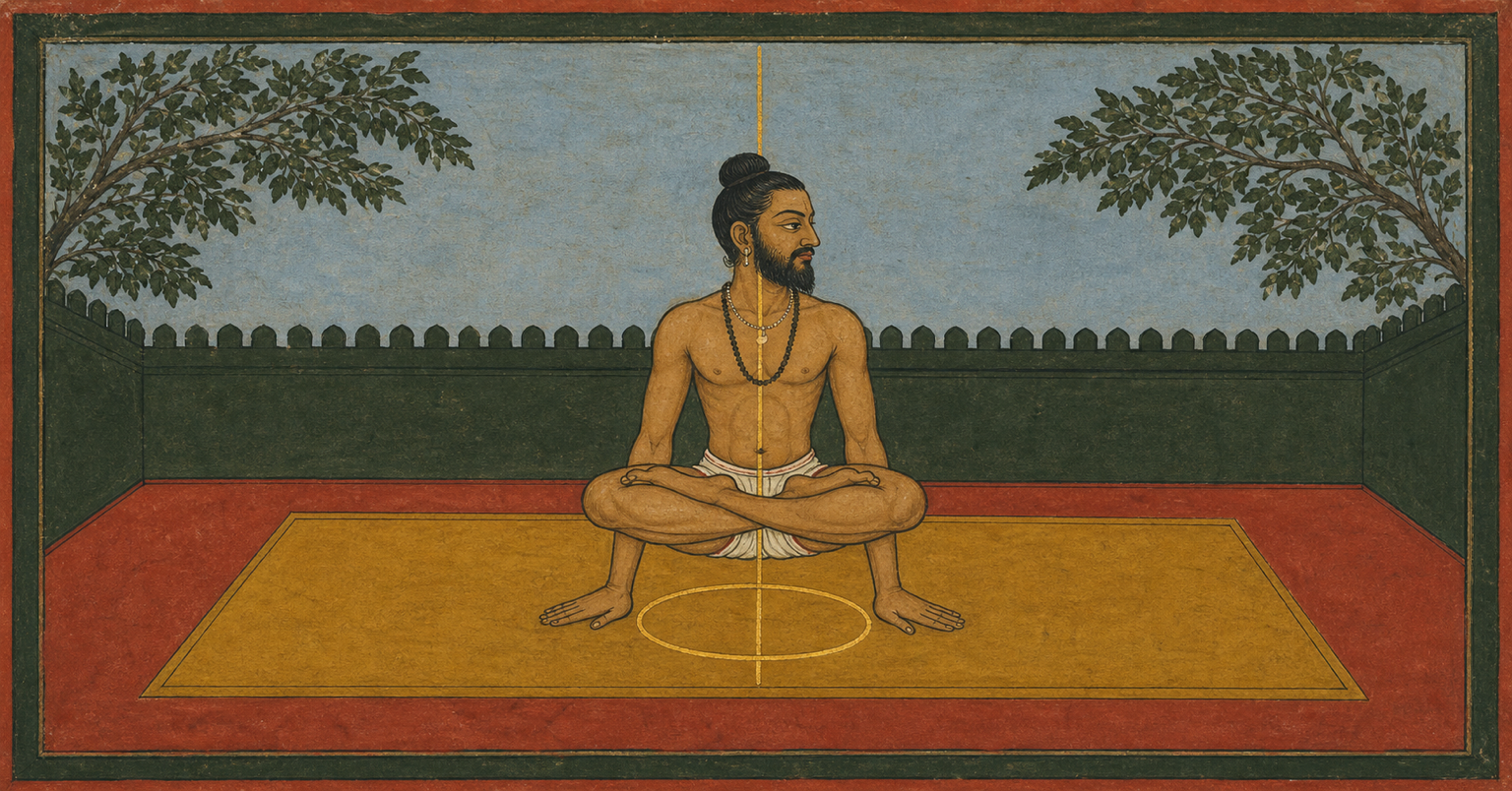
Illustration for the Haṭha Pradīpikā section “HP 3.26-3.31: Mahāvedha”.

Haṭha Pradīpikā 3.26-3.31: Mahāvedha and the Threefold Practice

Mahāvedha completes Mahāmudrā and Mahābandha; the three practices are regarded as secret means against old age and death.

Dr. Ronald Steiner Dr. Ronald Steiner
Haṭha Pradīpikā 3.26
समहस्तयुगो भूमौ स्फिजौ संताडयेच्छनैः |
sama-hasta-yugo bhūmau; sphijau saṃtāḍayec chanaiḥ | Analysis ▾ Analysis ▴
sama
karmadhāraya-compound
adjective
equal, even
hasta
tatpuruṣa-compound genitive
substantive neuter
hand
yugaḥ
nominative singular
substantive masculine
pair, yoke
bhūmau
lokative singular
substantive neuter
on the ground
sphijau
accusative dual
substantive neuter
both buttocks
saṃtāḍayet
3rd person singular causative optative
previx
verbal root
should strike, tap
śanaiḥ
adverb
gently, slowly
पुटद्वयं समाक्रम्य वायुः स्फुरति सत्वरम् ||26||
puṭa-dvayaṃ samākramya; vāyuḥ sphurati satvaram ||26|| Analysis ▾ Analysis ▴
puṭa
tatpuruṣa-compound genitive
substantive neuter
shell, half
dvayam
accusative singular
substantive neuter
pair, duality
samākramya
absolutus
previx
previx
verbal root
having entered, overcome
vāyuḥ
nominative singular
substantive masculine
breath, wind
sphurati
3rd person singular aktive present
verbal root
pulses, flashes
satvaram
adverb
quickly
Metre: Anuṣṭubh
with both hands placed evenly on the ground (sama-hasta-yugaḥ | nom sg), should gently (śanaiḥ) tap (saṃtāḍayet | 3p sg caus opt) both halves of the buttocks (sphijau | acc du) on the ground (bhūmau | loc sg). Having entered (samākramya | abs) the pair of two openings (puṭa-dvayam | acc sg), the breath (vāyuḥ | nom sg) pulses (sphurati | 3p sg act pres) quickly (satvaram).
Dr. Ronald Steiner - 2026 - historically literal
Supporting the body on the hands, gently tap the buttocks down. The breath is then said to overcome the two openings and pulse rapidly.
Dr. Ronald Steiner - 2026 - modern transfer

For Mahāvedha, Brahmānanda describes a precisely limited movement. The palms support the body on the floor; the buttocks and the heel at the perineum are raised only slightly and then placed down gently. This is said to make Prāṇa cross the two side channels and pulse within the central Suṣumṇā.

Brahmānanda's Jyotsnā - 19th c.
puṭadvayaṃ samākramya MBHDL2026 ] puṭadvayam atikramya NS1882

satvaram MBHDL2026 ] madhyagaḥ NS1882
Critical Apparatus
Resting both the hands equally on the ground, he should raise himself a little and strike his buttocks against the ground gently. The air, leaving both the passages (Idâ and Pingalâ), starts into the middle one.
Pancham Sinh - 1915
Resting his body upon his palms placed upon the ground, he should strike the ground softly with his posteriors. By this the Prâṇa, leaving Ida and Pingala, goes through the Sushumna.
Srinivasa Iyangar - 1893
Die beiden Hände flach auf den Boden stützend, schlage man (mit der Ferse, Com.) langsam die beiden Hinterbacken; ist nun der Athem über die beiden Gefässe (Candra und Sûrya) hinausgekommen, so wird er sich in der Mitte (Sushumna) weiterbewegen.
Hermann Walter - 1893
Haṭha Pradīpikā 3.27
सोमसूर्याग्निसंबन्धो जायते चामृताय वै |
soma-sūryāgni-saṃbandho; jāyate cāmṛtāya vai | Analysis ▾ Analysis ▴
soma
dvandva-compound
substantive neuter
moon, soma
sūrya
dvandva-compound
substantive masculine
sun
agni
dvandva-compound
substantive masculine
fire
saṃbandhaḥ
nominative singular
substantive masculine
conjunction
jāyate
3rd person singular medial present
verbal root
arises
ca
particle
and
amṛtāya
dative singular
substantive neuter
to immortality
vai
particle
indeed
मृतावस्था समुत्पन्ना ततो मृत्युभयं कुतः ||27||
mṛtāvasthā samutpannā; tato mṛtyu-bhayaṃ kutaḥ ||27|| Analysis ▾ Analysis ▴
mṛta
karmadhāraya-compound past participle passive
verbal root
dead
avasthā
nominative singular
substantive feminine
state
samutpannā
nominative singular feminine past participle passive
previx
previx
verbal root
arisen
tataḥ
adverb
then, therefore
mṛtyu
tatpuruṣa-compound genitive
substantive neuter
death
bhayam
nominative singular
substantive neuter
fear
kutaḥ
adverb
whence?
Metre: Anuṣṭubh
The union of moon, sun, and fire (soma-sūrya-agni-saṃbandhaḥ | nom sg) arises (jāyate | 3p sg med pres), and (ca) indeed (vai) leads to immortality (amṛtāya | dat sg); when the death-like state (mṛta-avasthā | nom sg) has arisen (samutpannā | nom sg f ppp), whence (kutaḥ), then (tataḥ), could fear of death (mṛtyu-bhayam | nom sg) come?
Dr. Ronald Steiner - 2026 - historically literal
Mahāvedha unites moon, sun, and fire and leads to a state of profound stillness; from this, deathlessness is said to arise.
Dr. Ronald Steiner - 2026 - modern transfer

According to Brahmānanda, moon, sun, and fire stand here for Iḍā, Piṅgalā, and Suṣumṇā. Their “meeting” occurs when Prāṇa enters the middle channel. The resulting “state of death” again does not mean the practitioner's death, but the absence of the breath current in the two side channels; only afterward is the breath exhaled slowly.

Brahmānanda's Jyotsnā - 19th c.
mṛtyubhayaṃ kutaḥ MBHDL2026 ] vāyuṃ virecayet NS1882
Critical Apparatus
The union of the Idâ and the Pingalâ is effected, in order to bring about immortality. When the air becomes as it were dead (by leaving its course through the Idâ and the Pingalâ) (i.e., when it has been kept confined), then it should be expelled.
Pancham Sinh - 1915
Then takes place the union of the Moon, Sun and Fire (Ida, Pingala and Sushumna) that leads to the immortality. The body assumes a deathlike aspect. Then he should breathe out.
Srinivasa Iyangar - 1893
Die Vereinigung (des Athems) von Soma (Ida), Sûrya (Pingala) und Agni (Sushumna) wird zum Zweck der Unsterblichkeit vollbracht. Es entsteht ein Zustand des Todtseins (d. h. des Nichtfunktionirens); dann athme man wieder aus.
Hermann Walter - 1893
Haṭha Pradīpikā 3.28
महावेधो ऽयमभ्यासान् महासिद्धिप्रदायकः |
mahā-vedho 'yam abhyāsān; mahā-siddhi-pradāyakaḥ | Analysis ▾ Analysis ▴
mahā
karmadhāraya-compound
adjective
great
vedhaḥ
nominative singular
substantive masculine
vedha, piercing
ayam
nominative singular masculine
pronoun
this
abhyāsāt
ablative singular
substantive masculine
through practice
mahā
karmadhāraya-compound
adjective
great
siddhi
tatpuruṣa-compound accusative
substantive feminine
siddhi
pradāyakaḥ
nominative singular masculine
adjective
bestowing
वलीपलितवेपघ्नः सेव्यते साधकोत्तमैः ||28||
valī-palita-vepa-ghnaḥ; sevyate sādhakottamaiḥ ||28|| Analysis ▾ Analysis ▴
valī
dvandva-compound
substantive feminine
wrinkle
palita
dvandva-compound
substantive neuter
grey hair
vepa
dvandva-compound
substantive masculine
trembling
ghnaḥ
nominative singular masculine
adjective
destroying
sevyate
3rd person singular passive present
verbal root
is practised
sādhaka
tatpuruṣa-compound genitive
substantive masculine
practitioners
uttamaiḥ
instrumental case plural
adjective
by the best
Metre: Anuṣṭubh
Through practice (abhyāsāt | abl sg), this Mahāvedha (mahāvedho’yam | nom sg) bestows great accomplishment (mahā-siddhi-pradāyakaḥ | nom sg m); it destroys wrinkles, grey hair, and trembling (valī-palita-vepa-ghnaḥ | nom sg m) and is practised (sevyate | 3p sg pas pres) by the foremost practitioners (sādhakottamaiḥ | ins pl).
Dr. Ronald Steiner - 2026 - historically literal
Through practice, Mahāvedha is said to bestow great Siddhi and dispel the signs of aging. Eminent practitioners therefore cultivate it.
Dr. Ronald Steiner - 2026 - modern transfer
The practice of this Mahâ Vedha, the giver of great Siddhis, destroys old age, grey hair, and shaking of the body, and therefore it is practised by the best masters.
Pancham Sinh - 1915
This is Maha Vedha and confers great Siddhis when practised. This removes the wrinkles and grey hair consequent on old age. So this is greatly esteemed by the practiser.
Srinivasa Iyangar - 1893
Dieser Mahavedha verleiht, wenn man ihn übt, grossen Erfolg; als Mittel gegen Runzeln, graue Haare und Zittern wird er von den ausgezeichnetsten Yogin verehrt.
Hermann Walter - 1893
Haṭha Pradīpikā 3.29
एतत्त्रयं महागुह्यं जरामृत्युविनाशनम् |
etat trayaṃ mahā-guhyaṃ; jarā-mṛtyu-vināśanam | Analysis ▾ Analysis ▴
etat
nominative singular neuter
pronoun
this
trayam
nominative singular
substantive neuter
triad
mahā
karmadhāraya-compound
adjective
great
guhyam
nominative singular neuter
adjective
secret
jarā
dvandva-compound
substantive feminine
age
mṛtyu
dvandva-compound
substantive neuter
death
vināśanam
nominative singular neuter
adjective
destroying
वह्निवृद्धिकरं चैव अणिमादिगुणप्रदम् ||29||
vahni-vṛddhi-karaṃ caiva; aṇimādi-guṇa-pradam ||29|| Analysis ▾ Analysis ▴
vahni
tatpuruṣa-compound genitive
substantive masculine
fire
vṛddhi
tatpuruṣa-compound accusative
substantive feminine
growth
karam
nominative singular neuter
adjective
producing
ca
particle
and
eva
particle
indeed
aṇimā
tatpuruṣa-compound genitive
substantive feminine
aṇimā, minuteness
ādi
tatpuruṣa-compound genitive
substantive neuter
and so forth
guṇa
tatpuruṣa-compound accusative
substantive masculine
quality, power
pradam
nominative singular neuter
adjective
giving
Metre: Anuṣṭubh
This triad (etat trayam | nom sg) is a great secret (mahā-guhyam | nom sg n), destroys old age and death (jarā-mṛtyu-vināśanam | nom sg n), brings about the growth of the fire (vahni-vṛddhi-karam | nom sg n), and indeed (caiva) bestows the powers beginning with Aṇimā (aṇimā-ādi-guṇa-pradam | nom sg n).
Dr. Ronald Steiner - 2026 - historically literal
Mahāmudrā, Mahābandha, and Mahāvedha form a great secret. They are said to overcome old age and death, strengthen the inner fire, and bestow Siddhis.
Dr. Ronald Steiner - 2026 - modern transfer
caiva aṇimādiguṇapradam MBHDL2026 ] caiva hy aṇimādiguṇapradam NS1882
Critical Apparatus
These THREE are the great secrets. They are the destroyers of old age and death, increase the appetite, confer the accomplishments of Anima, etc.
Pancham Sinh - 1915
These three Bandhas that ward off death and old-age, increase the gastric fire and confer the Siddhis, Anima, &c., and should be carefully kept secret.
Srinivasa Iyangar - 1893
Diese drei sollen sehr geheim gehalten werden; sie vernichten Alter und Tod, vermehren das Verdauungsfeuer und verleihen übernatürliche Kräfte wie Animâ u. s. w.
Hermann Walter - 1893
Haṭha Pradīpikā 3.30
अष्टधा क्रियते चैतद् यामे यामे दिने दिने |
aṣṭa-dhā kriyate caitad; yāme yāme dine dine | Analysis ▾ Analysis ▴
aṣṭa
dvigu-compound
numeral
eight
dhā
suffix
fold
kriyate
3rd person singular passive present
verbal root
is performed
ca
particle
and
etat
nominative singular neuter
pronoun
this
yāme
lokative singular
substantive neuter
in a yāma, time period
yāme
lokative singular
substantive neuter
in every yāma
dine
lokative singular
substantive neuter
by day
dine
lokative singular
substantive neuter
day after day
पुण्यसंभारसंभावि पापौघभिदुरं सदा ||30||
puṇya-saṃbhāra-saṃbhāvi; pāpaugha-bhiduraṃ sadā ||30|| Analysis ▾ Analysis ▴
puṇya
tatpuruṣa-compound genitive
substantive neuter
merit
saṃbhāra
tatpuruṣa-compound genitive
substantive neuter
accumulation, abundance
saṃbhāvi
nominative singular neuter
adjective
producing
pāpa
tatpuruṣa-compound genitive
substantive neuter
unwholesome
ogha
tatpuruṣa-compound genitive
substantive neuter
flood, mass
bhiduram
nominative singular neuter
adjective
breaking, splitting
sadā
adverb
always
Metre: Anuṣṭubh
This (etat | nom sg n) is practised (kriyate | 3p sg pas pres) eightfold (aṣṭa-dhā), at every three-hour period (yāme yāme | loc sg), day after day (dine dine | loc sg). It produces an abundance of merit (puṇya-saṃbhāra-saṃbhāvi | nom sg n) and always (sadā) breaks apart the flood of demerit (pāpa-ogha-bhiduram | nom sg n).
Dr. Ronald Steiner - 2026 - historically literal
This threefold practice is performed eight times during each period of the day, day after day. It is said to increase merit and break through a flood of negative effects.
Dr. Ronald Steiner - 2026 - modern transfer

The threefold practice of Mahāmudrā, Mahābandha, and Mahāvedha is to be performed eight times during each Yāma, a period of about three hours. Brahmānanda understands this as a recurring daily practice and connects it with the accumulation of merit and the reduction of harmful consequences from previous actions.

Brahmānanda's Jyotsnā - 19th c.
caitad MBHDL2026 ] caiva NS1882

puṇyasaṃbhārasaṃbhāvi MBHDL2026 ] puṇyasaṃbhārasandhāya NS1882
Critical Apparatus
They should, be practised in 8 ways, daily and hourly. They increase collection of good actions and lessen the evil ones. People, instructed well, should begin their practice, little by little, first.
Pancham Sinh - 1915
Diese Uebungen sollen täglich ausgeführt werden, acht Mal alle drei Stunden; sie verleihen (dem Uebenden) grosses Verdienst und, wenn sie Anfangs mit Mass ausgeführt werden, vernichten sie immer eine Menge von Sünden bei denen, welche die richtige Methode besitzen.
Hermann Walter - 1893
Haṭha Pradīpikā 3.31
सम्यक्शिक्षावतामेव स्वल्पं प्रथमसाधने |
samyak-śikṣā-vatām eva; svalpaṃ prathama-sādhane | Analysis ▾ Analysis ▴
samyak
karmadhāraya-compound
adverb
proper, complete
śikṣā
tatpuruṣa-compound genitive
substantive feminine
instruction
vatām
genitive plural
suffix
possessing
eva
particle
only, indeed
svalpam
accusative singular neuter
adjective
little, slight
prathama
tatpuruṣa-compound lokative
adjective
first
sādhane
lokative singular
substantive neuter
practice
वह्निस्त्रीपथसेवानाम् आदौ वर्जनमादिशेत् ||31||
vahni-strī-patha-sevānām; ādau varjanam ādiśet ||31|| Analysis ▾ Analysis ▴
vahni
dvandva-compound
substantive masculine
fire
strī
dvandva-compound
substantive feminine
woman
patha
dvandva-compound
substantive neuter
path, road
sevānām
genitive plural
substantive neuter
visiting, frequenting
ādau
lokative singular
substantive neuter
at the beginning
varjanam
accusative singular
substantive neuter
avoidance
ādiśet
3rd person singular aktive optative
previx
verbal root
should prescribe
Metre: Anuṣṭubh
Only (eva) to those who have been properly instructed (samyak-śikṣā-vatām | gen pl) should it be given in small measure (svalpam | acc sg n) at the beginning of practice (prathama-sādhane | loc sg); at the outset (ādau | loc sg), one should prescribe (ādiśet | 3p sg act opt) avoidance (varjanam | acc sg) of frequenting fire, women, and roads (vahni-strī-patha-sevānām | gen pl).
Dr. Ronald Steiner - 2026 - historically literal
This practice belongs only in the hands of those who have been properly instructed. At first it is practised in moderation; fire, sexual distraction, and wandering about are to be avoided.
Dr. Ronald Steiner - 2026 - modern transfer

For Brahmānanda, the high number of repetitions applies only to people who have received correct instruction from a guru within the tradition. Even they should practise only a little at first and increase the duration gradually. The commentary thus explicitly places the impressive numbers of the previous verse under a principle of progressive habituation.

Brahmānanda's Jyotsnā - 19th c.
samyakśikṣāvatām eva svalpaṃ prathamasādhane MBHDL2026 ] transp. NS1882 post HP 3.30b

vahnistrīpathasevānām ādau varjanam ādiśet MBHDL2026 ] om. NS1882
Critical Apparatus

Continue with AYI Free

Illustrations: AI-generated.

Editor

Dr. Ronald Steiner

From Ulm

The "Yoga Doc" - Dr. Ronald Steiner is the founder of the AYI method. This method links traditional Ashtanga Yoga with innovative Yogatherapy and living Philosophy. This forms a practice that is personal for each and... more ›

Messages and ratings
0 messages

Please log in to write a message. Go to login

No messages yet.