
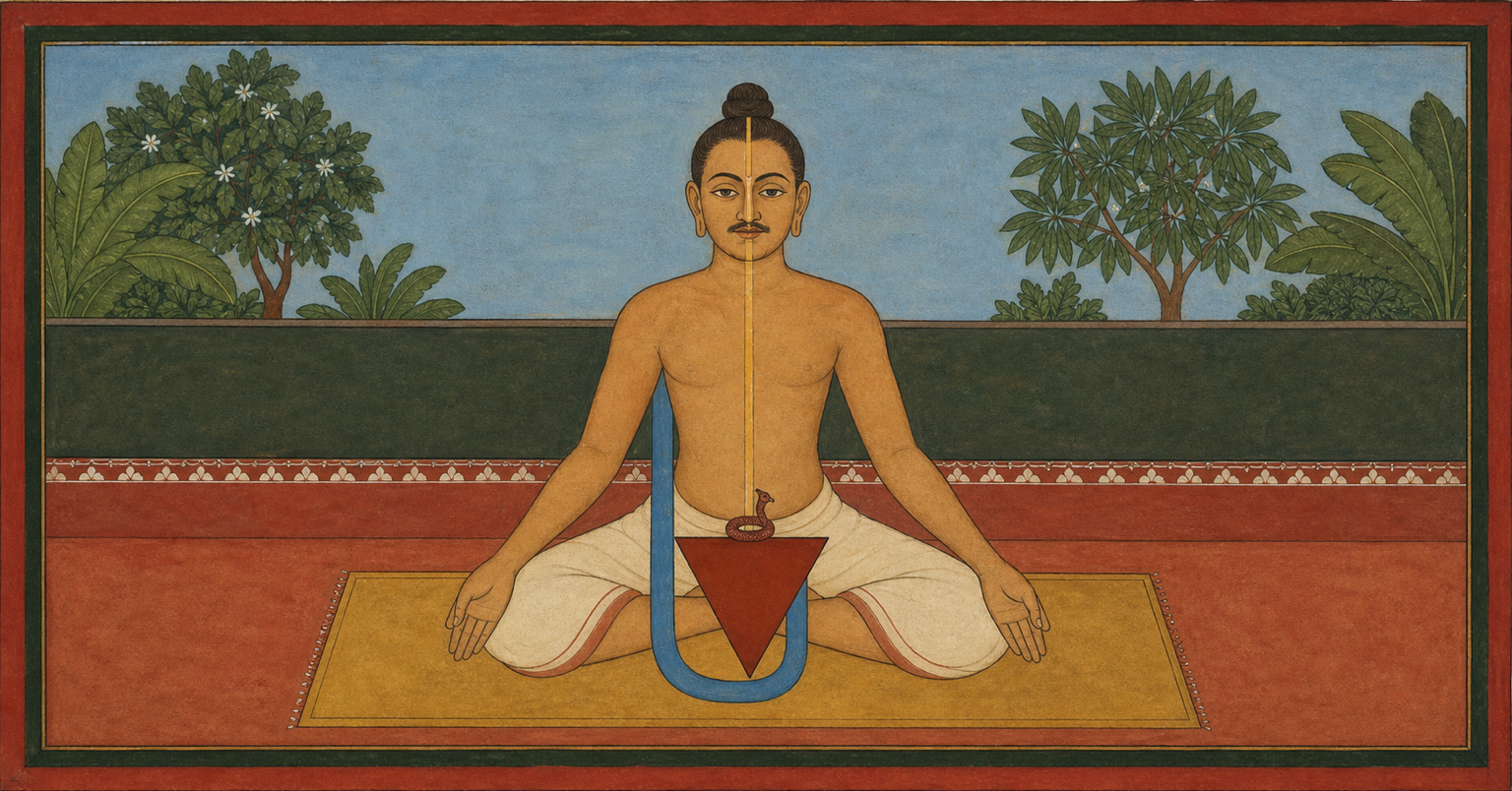
Illustration for the Haṭha Pradīpikā section “HP 3.49-3.57: Mūlabandha”.

Haṭha Pradīpikā 3.49-3.57: Mūlabandha

Mūlabandha raises Apāna, unites Prāṇa, Apāna, Nāda, and Bindu, and awakens the sleeping Kuṇḍalinī through inner heat.

Dr. Ronald Steiner Dr. Ronald Steiner
Haṭha Pradīpikā 3.49
पार्ष्णिभागेन संपीड्य योनिमाकुञ्चयेद्गुदम् |
pārṣṇi-bhāgena saṃpīḍya; yonim ākuñcayed gudam | Analysis ▾ Analysis ▴
pārṣṇi
tatpuruṣa-compound genitive
substantive feminine
heel
bhāgena
instrumental case singular
substantive neuter
with the part, side
saṃpīḍya
absolutus
previx
verbal root
having pressed
yonim
accusative singular
substantive feminine
yoni, perineum
ākuñcayet
3rd person singular aktive optative
previx
verbal root
should contract
gudam
accusative singular
substantive neuter
anus
अपानमूर्ध्वमाकृष्य मूलबन्धो ऽयमिष्यते ||49||
apānam ūrdhvam ākṛṣya; mūla-bandho 'yam iṣyate ||49|| Analysis ▾ Analysis ▴
apānam
accusative singular
substantive masculine
apāna
ūrdhvam
adverb
upward
ākṛṣya
absolutus
previx
verbal root
having drawn
mūla
tatpuruṣa-compound genitive
substantive neuter
root
bandhaḥ
nominative singular
substantive masculine
bandha, lock
ayam
nominative singular masculine
pronoun
this
iṣyate
3rd person singular passive present
verbal root
is taught, regarded as
Metre: Anuṣṭubh
Having pressed (saṃpīḍya | abs) the perineum (yonim | acc sg) with the part of the heel (pārṣṇi-bhāgena | ins sg), one should contract (ākuñcayet | 3p sg act opt) the anus (gudam | acc sg); having drawn (ākṛṣya | abs) Apāna (apānam | acc sg) upward (ūrdhvam), this (ayam | nom sg m) is considered (iṣyate | 3p sg pas pres) Mūlabandha (mūla-bandhaḥ | nom sg).
Dr. Ronald Steiner - 2026 - historically literal
Mūlabandha is formed by pressing the heel against the perineum, contracting the anus, and drawing Apāna upward.
Dr. Ronald Steiner - 2026 - modern transfer
pārṣṇibhāgena saṃpīḍya yonim ākuñcayed gudam … nityaṃ mūlabandhaḥ kartavyo yogibhiḥ sadā MBHDL2026 ] transp. NS1882 post HP 3.65
Critical Apparatus
Pressing Yoni (perineum) with the heel, contract up the anus. By drawing the Apâna thus, Mûla Bandha is made.
Pancham Sinh - 1915
Mit der Ferse das perinaeum drückend ziehe man den anus zusammen und bringe den Apâna aufwärts. Dies wird Mûlabandha genannt.
Hermann Walter - 1893
Haṭha Pradīpikā 3.50
अधोगतिमपानं वै ऊर्ध्वगं कुरुते बलात् |
adho-gatim apānaṃ vai; ūrdhva-gaṃ kurute balāt | Analysis ▾ Analysis ▴
adhas
karmadhāraya-compound
adverb
downward
gatim
accusative singular
substantive feminine
going, movement
apānam
accusative singular
substantive masculine
apāna
vai
particle
indeed
ūrdhva
karmadhāraya-compound
adjective
upward
gam
accusative singular masculine
adjective
going
kurute
3rd person singular medial present
verbal root
makes
balāt
ablative singular
substantive neuter
forcefully
आकुञ्चनेन तं प्राहुर् मूलबन्धं हि योगिनः ||50||
ākuñcanena taṃ prāhur; mūla-bandhaṃ hi yoginaḥ ||50|| Analysis ▾ Analysis ▴
ākuñcanena
instrumental case singular
substantive neuter
through contraction
tam
accusative singular masculine
pronoun
that, it
prāhuḥ
3rd person plural perfekte
verbal root
they call
mūla
tatpuruṣa-compound genitive
substantive neuter
root
bandham
accusative singular
substantive masculine
bandha
hi
particle
namely
yoginaḥ
nominative plural
substantive masculine
yogins
Metre: Anuṣṭubh
One forcefully (balāt | abl sg) makes (kurute | 3p sg med pres) Apāna (apānam | acc sg), which moves downward (adhas-gatim | acc sg), move upward (ūrdhva-gam | acc sg m), indeed (vai). Because of the contraction (ākuñcanena | ins sg), the yogis (yoginaḥ | nom pl) therefore (hi) call (prāhuḥ | 3p pl perf) it (tam | acc sg m) Mūlabandha (mūla-bandham | acc sg).
Dr. Ronald Steiner - 2026 - historically literal
Through contraction, Mūlabandha forces Apāna, which normally moves downward, to rise.
Dr. Ronald Steiner - 2026 - modern transfer
The Apâna, naturally inclining downward, is made to go up by force. This Mûla Bandha is spoken of by Yogîs as done by contracting the anus.
Pancham Sinh - 1915
Den abwärtsgehenden Apâna bringt man mit Gewalt zum Aufwärtsgehen durch Zusammendrücken; dies nennen die Yogin Mûlabandha.
Hermann Walter - 1893
Haṭha Pradīpikā 3.51
गुदं पार्ष्ण्या तु संपीड्य वायुमाकुञ्चयेद्बलात् |
gudaṃ pārṣṇyā tu saṃpīḍya; vāyum ākuñcayed balāt | Analysis ▾ Analysis ▴
gudam
accusative singular
substantive neuter
anus
pārṣṇyā
instrumental case singular
substantive feminine
with the heel
tu
particle
but, now
saṃpīḍya
absolutus
previx
verbal root
having pressed
vāyum
accusative singular
substantive masculine
breath, wind
ākuñcayet
3rd person singular aktive optative
previx
verbal root
should contract
balāt
ablative singular
substantive neuter
forcefully
वारं वारं यथा चोर्ध्वं समायाति समीरणः ||51||
vāraṃ vāraṃ yathā cordhvaṃ; samāyāti samīraṇaḥ ||51|| Analysis ▾ Analysis ▴
vāram
adverb
time
vāram
adverb
time after time
yathā
adverb
so that
ca
particle
and
ūrdhvam
adverb
upward
samāyāti
3rd person singular aktive present
previx
previx
verbal root
reaches
samīraṇaḥ
nominative singular
substantive masculine
breath, wind
Metre: Anuṣṭubh
Having pressed (saṃpīḍya | abs) the anus (gudam | acc sg) with the heel (pārṣṇyā | ins sg), one should now (tu) forcefully (balāt | abl sg) contract (ākuñcayet | 3p sg act opt) the wind (vāyum | acc sg), again (vāram) and again (vāram), so that (yathā) the breath (samīraṇaḥ | nom sg) also (ca) goes (samāyāti | 3p sg act pres) upward (ūrdhvam).
Dr. Ronald Steiner - 2026 - historically literal
Press the anus with the heel and repeatedly contract Apāna with force until the breath moves upward.
Dr. Ronald Steiner - 2026 - modern transfer
Pressing the heel well against the anus, draw up the air by force, again and again till it (air) goes up.
Pancham Sinh - 1915
Den anus mit der Ferse drückend presse man mit Gewalt verschiedene Male den Athem zusammen, so dass die Luft wieder und wieder aufwärts geht.
Hermann Walter - 1893
Haṭha Pradīpikā 3.52
प्राणापानौ नादबिन्दू मूलबन्धेन चैकताम् |
prāṇāpānau, nāda-bindū; mūla-bandhena caikatām | Analysis ▾ Analysis ▴
prāṇa
dvandva-compound
substantive masculine
prāṇa
apānau
nominative dual
substantive masculine
apāna
nāda
dvandva-compound
substantive masculine
nāda, sound
bindū
nominative dual
substantive masculine
bindu, point, semen
mūla
tatpuruṣa-compound genitive
substantive neuter
root
bandhena
instrumental case singular
substantive masculine
through the bandha
ca
particle
and
ekatām
accusative singular
substantive neuter
unity
गत्वा योगस्य संसिद्धिं यच्छतो नात्र संशयः ||52||
gatvā yogasya saṃsiddhiṃ; yacchato nātra saṃśayaḥ ||52|| Analysis ▾ Analysis ▴
gatvā
absolutus
verbal root
having gone, reached
yogasya
genitive singular
substantive masculine
of yoga
saṃsiddhim
accusative singular
substantive neuter
complete perfection
yacchataḥ
nominative dual present participle active
verbal root
giving
na
particle
not
atra
adverb
here
saṃśayaḥ
nominative singular
substantive masculine
doubt
Metre: Anuṣṭubh
Prāṇa and Apāna (prāṇa-apānau | nom du), as well as Nāda and Bindu (nāda-bindū | nom du), having reached (gatvā | abs) unity (ekatām | acc sg) through Mūlabandha (mūla-bandhena | ins sg), and (ca) bestowing (yacchataḥ | nom du pca) the complete accomplishment (saṃsiddhim | acc sg) of yoga (yogasya | gen sg), leave no (na) doubt (saṃśayaḥ | nom sg) here (atra).
Dr. Ronald Steiner - 2026 - historically literal
Mūlabandha unites Prāṇa with Apāna and Nāda with Bindu. From this, without doubt, arises the perfection of yoga.
Dr. Ronald Steiner - 2026 - modern transfer

Brahmānanda expands the concise statement about Mūlabandha into an inner chain of effects. Prāṇa and Apāna unite and enter Suṣumṇā. This makes the inner Nāda, the unstruck sound, audible. The forces of breath and Nāda rise past the heart, unite there with Bindu, and proceed to the head; yogic consummation is said to arise from this.

Brahmānanda's Jyotsnā - 19th c.
Prâṇa, Apâna, Nâda and Bindu uniting into one in this way, give success in Yoga, undoubtedly.
Pancham Sinh - 1915
Wenn Prâņa und Apâna, Nada und Bindu sich durch den Mûlabandha vereinigt haben, gewähren sie vollständigen Erfolg im Yoga; darüber herrscht kein Zweifel.
Hermann Walter - 1893
Haṭha Pradīpikā 3.53
अपानप्राणयोरैक्यं क्षयो मूत्रपुरीषयोः |
apāna-prāṇayor aikyaṃ; kṣayo mūtra-purīṣayoḥ | Analysis ▾ Analysis ▴
apāna
dvandva-compound
substantive masculine
apāna
prāṇayoḥ
genitive dual
substantive masculine
prāṇa
aikyam
nominative singular
substantive neuter
unity
kṣayaḥ
nominative singular
substantive masculine
reduction, decrease
mūtra
dvandva-compound
substantive neuter
urine
purīṣayoḥ
genitive dual
substantive neuter
faeces
युवा भवति वृद्धो ऽपि सततं मूलबन्धनात् ||53||
yuvā bhavati vṛddho 'pi; satataṃ mūla-bandhanāt ||53|| Analysis ▾ Analysis ▴
yuvā
nominative singular masculine
adjective
young
bhavati
3rd person singular aktive present
verbal root
becomes
vṛddhaḥ
nominative singular masculine
adjective
old
api
particle
even
satatam
adverb
constantly
mūla
tatpuruṣa-compound genitive
substantive neuter
root
bandhanāt
ablative singular
substantive neuter
through the lock
Metre: Anuṣṭubh
Through continuous (satatam) Mūlabandha (mūla-bandhanāt | abl sg) arise the unity (aikyam | nom sg) of Apāna and Prāṇa (apāna-prāṇayoḥ | gen du) and the reduction (kṣayaḥ | nom sg) of urine and faeces (mūtra-purīṣayoḥ | gen du); even (api) an old man (vṛddhaḥ | nom sg m) becomes (bhavati | 3p sg act pres) young (yuvā | nom sg m).
Dr. Ronald Steiner - 2026 - historically literal
Mūlabandha unites Apāna and Prāṇa, reduces elimination, and makes even an old person young again.
Dr. Ronald Steiner - 2026 - modern transfer
By the purification of Prâṇa, and Apâna, urine and excrements decrease. Even an old man becomes young by constantly practising Mûla Bandha.
Pancham Sinh - 1915
Durch den Mûlabandha werden immer Prâņa und Apâna vereinigt, Exkremente und Urin werden vernichtet und selbst ein Greis wird jung.
Hermann Walter - 1893
Haṭha Pradīpikā 3.54
अपाने चोर्ध्वगे जाते संप्राप्ते वह्निमण्डलम् |
apāne cordhva-ge jāte; saṃprāpte vahni-maṇḍalam | Analysis ▾ Analysis ▴
apāne
lokative singular
substantive masculine
when apāna
ca
particle
and
ūrdhva
karmadhāraya-compound
adjective
upward
ge
lokative singular masculine
adjective
going
jāte
lokative singular masculine past participle passive
verbal root
having become
saṃprāpte
lokative singular masculine past participle passive
previx
previx
verbal root
reaches
vahni
tatpuruṣa-compound genitive
substantive masculine
fire
maṇḍalam
accusative singular
substantive neuter
sphere
तदानलशिखा दीर्घा वर्धते वायुनाहता ||54||
tadānala-śikhā dīrghā; vardhate vāyunāhatā ||54|| Analysis ▾ Analysis ▴
tadā
adverb
then
anala
tatpuruṣa-compound genitive
substantive masculine
fire
śikhā
nominative singular
substantive feminine
flame
dīrghā
nominative singular feminine
adjective
long, high
vardhate
3rd person singular medial present
verbal root
grows
vāyunā
instrumental case singular
substantive masculine
by the wind
āhatā
nominative singular feminine past participle passive
previx
verbal root
struck, kindled
Metre: Anuṣṭubh
When Apāna (apāne | loc sg) has also (ca) become (jāte | loc sg m ppp) upward-moving (ūrdhva-ge | loc sg m) and has reached (saṃprāpte | loc sg m ppp) the orb of fire (vahni-maṇḍalam | acc sg), then (tadā) the flame of fire (anala-śikhā | nom sg), made tall (dīrghā | nom sg f), grows (vardhate | 3p sg med pres), fanned (āhatā | nom sg f ppp) by the wind (vāyunā | ins sg).
Dr. Ronald Steiner - 2026 - historically literal
When Apāna rises and reaches the center of fire, the flame is fanned by the wind and grows.
Dr. Ronald Steiner - 2026 - modern transfer

Brahmānanda locates the fire Maṇḍala below the navel and describes it in the human body as triangular. Apāna, rising through Mūlabandha, fans its flame; fire and Apāna then meet Prāṇa, which is likewise hot. The intensified inner heat awakens Kuṇḍalinī, who stretches like a serpent that has been struck and enters Suṣumṇā.

Brahmānanda's Jyotsnā - 19th c.
saṃprāpte MBHDL2026 ] prayāte NS1882

vardhate MBHDL2026 ] jāyate NS1882
Critical Apparatus
Going up, the Apâna enters the zone of fire, i.e., the stomach. The flame of fire struck by the air is thereby lengthened.
Pancham Sinh - 1915
Wenn der Apâna aufwärts gegangen ist und bis zur Feuergegend (vahnimandalam) vordringt, so wird die Feuerflamme, durch den Wind angefacht, grösser.
Hermann Walter - 1893
Haṭha Pradīpikā 3.55
ततो यातौ वह्न्यपानौ प्राणमुष्णस्वरूपकम् |
tato yātau, vahnyapānau; prāṇam uṣṇa-svarūpakam | Analysis ▾ Analysis ▴
tataḥ
adverb
thereupon, thereby
yātau
nominative dual masculine past participle passive
verbal root
gone, reached
vahni
dvandva-compound
substantive masculine
fire
apānau
nominative dual
substantive masculine
apāna
prāṇam
accusative singular
substantive masculine
prāṇa
uṣṇa
karmadhāraya-compound
adjective
hot
svarūpakam
accusative singular masculine
adjective
by nature, in form
तेनात्यन्तप्रदीप्तस्तु ज्वलनो देहजस्तदा ||55||
tenātyanta-pradīptas tu; jvalano deha-jas tadā ||55|| Analysis ▾ Analysis ▴
tena
instrumental case singular neuter
pronoun
thereby
atyanta
karmadhāraya-compound
adverb
exceedingly
pradīptaḥ
nominative singular masculine past participle passive
previx
verbal root
kindled
tu
particle
but
jvalanaḥ
nominative singular
substantive masculine
fire
deha
tatpuruṣa-compound lokative genitive
substantive masculine
body
jaḥ
nominative singular masculine
adjective
born
tadā
adverb
then
Metre: Anuṣṭubh
Thereupon (tataḥ), fire and Apāna (vahni-apānau | nom du) have gone (yātau | nom du m ppp) to Prāṇa (prāṇam | acc sg), which has a hot nature (uṣṇa-svarūpakam | acc sg m). Through this (tena | ins sg n), then (tadā), the fire (jvalanaḥ | nom sg) born in the body (deha-jaḥ | nom sg m) also (tu) becomes intensely kindled (atyanta-pradīptaḥ | nom sg m ppp).
Dr. Ronald Steiner - 2026 - historically literal
Fire and Apāna meet Prāṇa, which is hot by nature, causing the fire of the body to blaze powerfully.
Dr. Ronald Steiner - 2026 - modern transfer
yātau MBHDL2026 ] yāto NS1882
Critical Apparatus
These, fire and Apâna, go to the naturally hot Prâṇa, which, becoming inflamed thereby, causes burning sensation in the body.
Pancham Sinh - 1915
Dann kommen Feuer und Apâna zum Prâņa, dessen Natur (auch) feurig ist; dadurch wird das im Körper befindliche Feuer in hohem Masse angefacht.
Hermann Walter - 1893
Haṭha Pradīpikā 3.56
तेन कुण्डलिनी सुप्ता संतप्ता संप्रबुध्यते |
tena kuṇḍalinī suptā; saṃtaptā saṃprabudhyate | Analysis ▾ Analysis ▴
tena
instrumental case singular neuter
pronoun
thereby
kuṇḍalinī
nominative singular
substantive feminine
Kuṇḍalinī
suptā
nominative singular feminine past participle passive
verbal root
sleeping
saṃtaptā
nominative singular feminine past participle passive
previx
verbal root
heated
saṃprabudhyate
3rd person singular medial present
previx
previx
verbal root
awakens
दण्डाहता भुजङ्गीव निश्वस्य ऋजुतां व्रजेत् ||56||
daṇḍāhatā bhujaṅgīva; niśvasya ṛjutāṃ vrajet ||56|| Analysis ▾ Analysis ▴
daṇḍa
tatpuruṣa-compound instrumental case
substantive neuter
stick, staff
āhatā
nominative singular feminine past participle passive
previx
verbal root
struck
bhujaṅgī
nominative singular
substantive feminine
serpent
iva
particle
like
niśvasya
absolutus
previx
verbal root
having hissed, breathed
ṛjutām
accusative singular
substantive feminine
straightness
vrajet
3rd person singular aktive optative
verbal root
reaches, goes
Metre: Anuṣṭubh
Through this (tena | ins sg n), the sleeping (suptā | nom sg f ppp) Kuṇḍalinī (kuṇḍalinī | nom sg), heated (saṃtaptā | nom sg f ppp), awakens (saṃprabudhyate | 3p sg med pres). Like (iva) a female snake struck by a staff (daṇḍa-āhatā bhujaṅgī | nom sg), having hissed (niśvasya | abs), she should become (vrajet | 3p sg act opt) straight (ṛjutām | acc sg).
Dr. Ronald Steiner - 2026 - historically literal
The heat awakens the sleeping Kuṇḍalinī. Like a serpent that has been struck, she hisses and straightens.
Dr. Ronald Steiner - 2026 - modern transfer
The Kuṇḍalinî, which has been sleeping all this time, becomes well heated by this means and awakens well. It becomes straight like a serpent, struck dead with a stick.
Pancham Sinh - 1915
Dadurch wird die schlafende Kundalinî erwärmt und geweckt. Gerade wie die mit einem Stock geschlagene Schlange seufzt sie und streckt sich steif aus.
Hermann Walter - 1893
Haṭha Pradīpikā 3.57
बिलं प्रविष्टेव ततो ब्रह्मनाड्यन्तरं व्रजेत् |
bilaṃ praviṣṭeva tato; brahma-nāḍyantaraṃ vrajet | Analysis ▾ Analysis ▴
bilam
accusative singular
substantive neuter
hole, cavity
praviṣṭā
nominative singular feminine past participle passive
previx
verbal root
entered
iva
particle
like
tataḥ
adverb
then
brahma
tatpuruṣa-compound genitive
substantive neuter
Brahman
nāḍī
tatpuruṣa-compound genitive
substantive feminine
nāḍī
antaram
accusative singular
substantive neuter
interior
vrajet
3rd person singular aktive optative
verbal root
goes, should go
तस्मान्नित्यं मूलबन्धः कर्तव्यो योगिभिः सदा ||57||
tasmān nityaṃ, mūla-bandhaḥ; kartavyo yogibhiḥ sadā ||57|| Analysis ▾ Analysis ▴
tasmāt
ablative singular
pronoun
therefore
nityam
adverb
regularly, always
mūla
tatpuruṣa-compound genitive
substantive neuter
root
bandhaḥ
nominative singular
substantive masculine
bandha
kartavyaḥ
nominative singular masculine future participle passive
verbal root
to be performed
yogibhiḥ
instrumental case plural
substantive masculine
by yogins
sadā
adverb
always
Metre: Anuṣṭubh
Then (tataḥ), like (iva) one that has entered (praviṣṭā | nom sg f ppp) a hole (bilam | acc sg), she should enter (vrajet | 3p sg act opt) the interior of the Brahma channel (brahma-nāḍī-antaram | acc sg). Therefore (tasmāt | abl sg), Mūlabandha (mūla-bandhaḥ | nom sg) is to be practised (kartavyaḥ | nom sg m pfp) by yogis (yogibhiḥ | ins pl) always (sadā) and regularly (nityam).
Dr. Ronald Steiner - 2026 - historically literal
Kuṇḍalinī enters the Brahma Nāḍī as though entering a cave. Yogis should therefore practise Mūlabandha continually.
Dr. Ronald Steiner - 2026 - modern transfer
It enters the Brahma Nâdî, just as a serpent enters its hole. Therefore, the Yogî should always practise this Mûla Bandha.
Pancham Sinh - 1915
Und wie die Schlange in ihre Höhle geht, so begibt sich die Kundalinî in die Brahmanâdî (d.h. Sushumna). Daher sollen die Yogin immer den Mûlabandha üben.
Hermann Walter - 1893

Continue with AYI Free

Illustrations: AI-generated.

Editor

Dr. Ronald Steiner

From Ulm

The "Yoga Doc" - Dr. Ronald Steiner is the founder of the AYI method. This method links traditional Ashtanga Yoga with innovative Yogatherapy and living Philosophy. This forms a practice that is personal for each and... more ›

Messages and ratings
0 messages

Please log in to write a message. Go to login

No messages yet.