
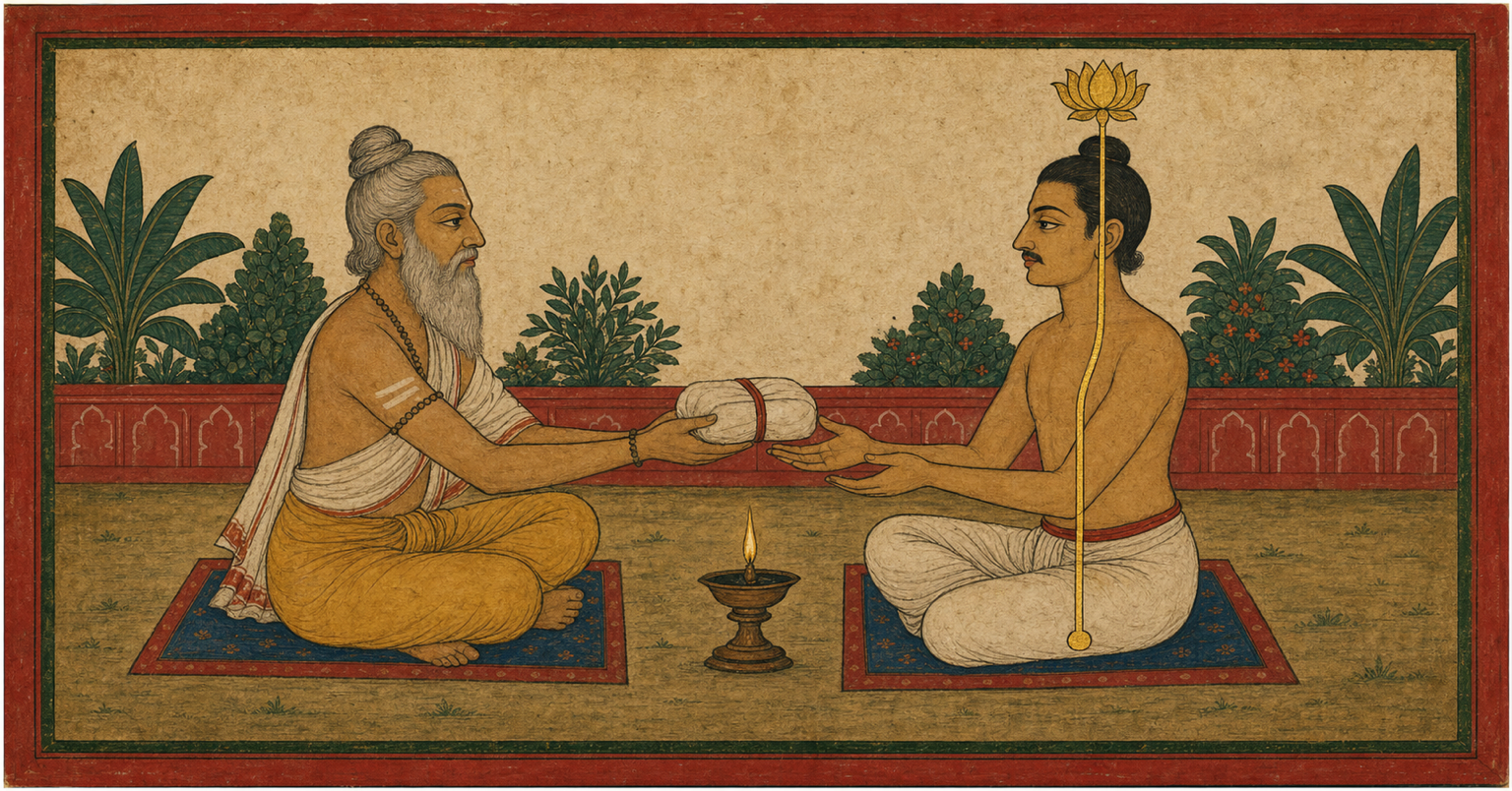
Illustration for the Haṭha Pradīpikā section “HP 3.103-3.107*2: Conclusion of the Mudrā Teaching”.

Haṭha Pradīpikā 3.103-3.107*2: Conclusion of the Mudrā Teaching

The conclusion brings together lunar fluid, purification of the Nāḍīs, the ten Mudrās, Rājayoga, and the transmission bound to the Guru.

Dr. Ronald Steiner Dr. Ronald Steiner
Haṭha Pradīpikā 3.103
इति मुद्रा दश प्रोक्ता आदिनाथेन शम्भुना |
iti mudrā daśa proktā; ādi-nāthena śambhunā | Analysis ▾ Analysis ▴
iti
particle
thus
mudrāḥ
nominative plural
substantive feminine
mudrās
daśa
nominative plural feminine
numeral
ten
proktāḥ
nominative plural feminine past participle passive
previx
verbal root
taught
ādi
karmadhāraya-compound
adjective
first, primordial
nāthena
instrumental case singular
substantive masculine
lord
śambhunā
instrumental case singular
substantive masculine
Śambhu
एकैका तासु यमिनां महासिद्धिप्रदायिनी ||103||
ekaikā tāsu yamināṃ; mahā-siddhi-pradāyinī ||103|| Analysis ▾ Analysis ▴
ekaikā
nominative singular feminine
adjective
each one
tāsu
lokative plural feminine
pronoun
among them
yaminām
genitive plural
substantive masculine
of yogins, self-controlled
mahā
karmadhāraya-compound
adjective
great
siddhi
tatpuruṣa-compound genitive
substantive feminine
siddhi
pradāyinī
nominative singular feminine
adjective
bestowing
Metre: Anuṣṭubh
Thus (iti), the ten (daśa | nom pl f) Mudrās (mudrāḥ | nom pl) have been taught (proktāḥ | nom pl f ppp) by Ādinātha (ādi-nāthena | ins sg), Śambhu (śambhunā | ins sg). Each one (ekaikā | nom sg f) among them (tāsu | loc pl f) bestows great accomplishment (mahā-siddhi-pradāyinī | nom sg f) upon the self-controlled yogis (yaminām | gen pl).
Dr. Ronald Steiner - 2026 - historically literal
This completes the ten Mudrās taught by Śambhu Ādinātha. Each one can bestow great Siddhi.
Dr. Ronald Steiner - 2026 - modern transfer
iti mudrā daśa proktā ādināthena śambhunā ekaikā tāsu yamināṃ mahāsiddhipradāyinī MBHDL2026 ] transp. NS1882 post HP 3.105
Critical Apparatus
These are the Mudrâs, as explained by Âdinâtha (Śiva). Every one of them is the giver of great accomplishments to the practiser.
Pancham Sinh - 1915
Dies sind die zehn von Sambhu, dem obersten Gott, erwähnten Mudra; jede von diesen verleiht dem Yogin grossen Erfolg.
Hermann Walter - 1893
Haṭha Pradīpikā 3.104
राजयोगं विना पृथ्वी राजयोगं विना निशा |
rāja-yogaṃ vinā pṛthvī; rāja-yogaṃ vinā niśā | Analysis ▾ Analysis ▴
rāja
tatpuruṣa-compound genitive
substantive masculine
king
yogam
accusative singular
substantive masculine
yoga
vinā
particle
without
pṛthvī
nominative singular
substantive feminine
earth
rāja
tatpuruṣa-compound genitive
substantive masculine
king
yogam
accusative singular
substantive masculine
yoga
vinā
particle
without
niśā
nominative singular
substantive feminine
night
राजयोगं विना मुद्रा विचित्रापि न राजते ||104||
rāja-yogaṃ vinā mudrā; vicitrāpi na rājate ||104|| Analysis ▾ Analysis ▴
rāja
tatpuruṣa-compound genitive
substantive masculine
king
yogam
accusative singular
substantive masculine
yoga
vinā
particle
without
mudrā
nominative singular
substantive feminine
mudrā
vicitrā
nominative singular feminine
adjective
wondrous, manifold
api
particle
even
na
particle
not
rājate
3rd person singular medial present
verbal root
shines, gleams
Metre: Anuṣṭubh
Without union with the king (rāja-yogam | acc sg), the earth (pṛthvī | nom sg) does not shine; without this union (rāja-yogam | acc sg), the night (niśā | nom sg) does not shine. Without Rājayoga (rāja-yogam | acc sg), even (api) the wondrous (vicitrā | nom sg f) Mudrā (mudrā | nom sg) does not (na) shine (rājate | 3p sg med pres).
Dr. Ronald Steiner - 2026 - historically literal
Mudrā remains incomplete without Rājayoga. Just as the earth does not shine without a king and the night without the moon, Mudrā does not shine without Rājayoga.
Dr. Ronald Steiner - 2026 - modern transfer

Brahmānanda develops the wordplay around Rājayoga on two levels. Yogically, “earth” stands for the stability of Āsana, “night” for motionless Kumbhaka, and “seal” for the Mudrās; without Rājayoga they do not reach their highest goal. In worldly terms, the earth without a king, the night without its “king,” the moon, and a royal seal without a king likewise do not shine. The verse thus explicitly binds Haṭha to mental concentration.

Brahmānanda's Jyotsnā - 19th c.
rājayogaṃ vinā pṛthvī rājayogaṃ vinā niśā rājayogaṃ vinā mudrā vicitrāpi na rājate MBHDL2026 ] transp. NS1882 post HP 3.107, ante HP 3.105

rājate MBHDL2026 ] śobhate NS1882
Critical Apparatus
Without Raja Yoga, this earth, the night, and the Mudrâs, be they howsoever wonderful, do not appear beautiful.
Pancham Sinh - 1915
Ohne Rajayoga übt man vergebens Asana, Kumbhaka und die verschiedenen Mudrâ.
Hermann Walter - 1893
Haṭha Pradīpikā 3.105
मारुतस्य विधिं सर्वं मनोयुक्तं समभ्यसेत् |
mārutasya vidhiṃ sarvaṃ; mano-yuktaṃ samabhyaset | Analysis ▾ Analysis ▴
mārutasya
genitive singular
substantive masculine
of the breath, wind
vidhim
accusative singular
substantive masculine
method, rule
sarvam
accusative singular masculine
adjective
wholly, all
manas
tatpuruṣa-compound instrumental case
substantive neuter
mind
yuktam
accusative singular masculine past participle passive
verbal root
joined
samabhyaset
3rd person singular aktive optative
previx
previx
verbal root
should practise
इतरत्र न कर्तव्या मनोवृत्तिर्मनीषिणा ||105||
itaratra na kartavyā; mano-vṛttir manīṣiṇā ||105|| Analysis ▾ Analysis ▴
itaratra
adverb
elsewhere
na
particle
not
kartavyā
nominative singular feminine future participle passive
verbal root
to be made
manas
tatpuruṣa-compound genitive
substantive neuter
mind
vṛttiḥ
nominative singular
substantive feminine
movement, activity
manīṣiṇā
instrumental case singular
substantive masculine
by the wise one
Metre: Anuṣṭubh
One should practise (samabhyaset | 3p sg act opt) the entire method (vidhiṃ sarvam | acc sg) of the breath (mārutasya | gen sg) with the mind joined to it (manas-yuktam | acc sg m ppp). The movement of the mind (mano-vṛttiḥ | nom sg) should not (na) be directed (kartavyā | nom sg f pfp) elsewhere (itaratra) by the wise practitioner (manīṣiṇā | ins sg).
Dr. Ronald Steiner - 2026 - historically literal
Breath practice should always be performed with a collected mind. The wise practitioner does not allow attention to wander.
Dr. Ronald Steiner - 2026 - modern transfer

All procedures involving the breath, including Kumbhakas and Mudrās, are to be practised with the mind fully engaged. Brahmānanda understands the instruction strictly: during the direction of the breath, no mental movement may turn toward another object. Technical execution without undivided attention therefore does not fulfill the practice.

Brahmānanda's Jyotsnā - 19th c.
mārutasya vidhiṃ sarvaṃ manoyuktaṃ samabhyaset itaratra na kartavyā manovṛttir manīṣiṇā MBHDL2026 ] transp. NS1882 post HP 3.104, ante HP 3.103
Critical Apparatus
All the practices relating to the air should be performed with concentrated mind. A wise man should not allow his mind to wander away.
Pancham Sinh - 1915
Man übe jede Athemregel mit Bewusstsein aus; auf anderem Gebiet aber soll der Weise keine Geistesthätigkeit an den Tag legen.
Hermann Walter - 1893
Haṭha Pradīpikā 3.106
खिलापि मध्यमा नाडी दृढाभ्यासेन योगिनाम् |
khilāpi madhyamā nāḍī; dṛḍhābhyāsena yoginām | Analysis ▾ Analysis ▴
khilā
nominative singular feminine
adjective
blocked, inactive
api
particle
even
madhyamā
nominative singular feminine
adjective
middle
nāḍī
nominative singular
substantive feminine
nāḍī
dṛḍha
karmadhāraya-compound
adjective
firm
abhyāsena
instrumental case singular
substantive masculine
through practice
yoginām
genitive plural
substantive masculine
of yogins
आसनप्राणसंयाममुद्राभिः सरला भवेत् ||106||
āsana-prāṇa-saṃyāma;-mudrābhiḥ saralā bhavet ||106|| Analysis ▾ Analysis ▴
āsana
dvandva-compound
substantive neuter
āsana
prāṇa
tatpuruṣa-compound genitive
substantive masculine
prāṇa, breath
saṃyāma
dvandva-compound
substantive neuter
control, restraint
mudrābhiḥ
instrumental case plural
substantive feminine
through mudrās
saralā
nominative singular feminine
adjective
straight, open
bhavet
3rd person singular aktive optative
verbal root
becomes
Metre: Anuṣṭubh
Through firm practice (dṛḍha-abhyāsena | ins sg), even (api) the obstructed (khilā | nom sg f) middle Nāḍī (madhyamā nāḍī | nom sg) of yogis (yoginām | gen pl) becomes (bhavet | 3p sg act opt) straight (saralā | nom sg f) by means of Āsana, breath control, and Mudrās (āsana-prāṇa-saṃyāma-mudrābhiḥ | ins pl).
Dr. Ronald Steiner - 2026 - historically literal
Even a blocked middle Nāḍī becomes straight and open through steady practice with Āsana, breath control, and Mudrā.
Dr. Ronald Steiner - 2026 - modern transfer
khilāpi madhyamā nāḍī dṛḍhābhyāsena yoginām āsanaprāṇasaṃyāmamudrābhiḥ saralā bhavet MBHDL2026 ] transp. NS1882 ante HP 3.104

khilāpi MBHDL2026 ] iyaṃ tu NS1882
Critical Apparatus
This middle Nâdî becomes straight by steady practice of postures; Prâṇâyâma and Mudrâs of Yogîs.
Pancham Sinh - 1915
Die mittlere Nâdî (Sushumna) wird durch das eifrige Ueben der Yogin, durch Asana, Prânasamyâma und Mudrâ, gerade.
Hermann Walter - 1893
Haṭha Pradīpikā 3.107
उपासने विनिद्राणां राजयोगसमुद्रवत् |
upāsane vinidrāṇāṃ; rāja-yoga-samudra-vat | Analysis ▾ Analysis ▴
upāsane
lokative singular
substantive neuter
devotion, dedication
vinidrāṇām
genitive plural
adjective
of the sleepless, tireless
rāja
tatpuruṣa-compound genitive
substantive masculine
king
yoga
tatpuruṣa-compound genitive
substantive masculine
yoga
samudra
tatpuruṣa-compound genitive
substantive masculine
ocean
vat
suffix
like, equal
रुद्राणी चापरा मुद्रा भद्रां सिद्धिं प्रयच्छति ||107||
rudrāṇī cāparā mudrā; bhadrāṃ siddhiṃ prayacchati ||107|| Analysis ▾ Analysis ▴
rudrāṇī
nominative singular
substantive feminine
Rudrāṇī
ca
particle
and, also
aparā
nominative singular feminine
adjective
incomparable, another
mudrā
nominative singular
substantive feminine
mudrā
bhadrām
accusative singular feminine
adjective
auspicious, beneficial
siddhim
accusative singular
substantive feminine
siddhi, perfection
prayacchati
3rd person singular aktive present
previx
verbal root
gives, bestows
Metre: Anuṣṭubh
For those who remain untiring (vinidrāṇām | gen pl) in devoted practice (upāsane | loc sg), the incomparable Rudrāṇī Mudrā (rudrāṇī aparā mudrā | nom sg) also (ca) bestows (prayacchati | 3p sg act pres) auspicious accomplishment (bhadrāṃ siddhim | acc sg), like the ocean of Rājayoga (rāja-yoga-samudra-vat).
Dr. Ronald Steiner - 2026 - historically literal
To those who practise tirelessly, the incomparable Rudrāṇī Mudrā bestows an auspicious perfection like the ocean of Rājayoga.
Dr. Ronald Steiner - 2026 - modern transfer

Brahmānanda identifies Rudrāṇī Mudrā with Śāmbhavī; alternatively, another higher Mudrā such as Unmanī may be intended. Its efficacy presupposes holding the mind in one-pointedness through Samādhi and overcoming lethargy. The commentary therefore reads the verse as a statement about how Rājayoga completes the Haṭha procedures.

Brahmānanda's Jyotsnā - 19th c.
upāsane vinidrāṇāṃ rājayogasamudravat rudrāṇī cāparā mudrā bhadrāṃ siddhiṃ prayacchati MBHDL2026 ] transp. NS1882 ante HP 3.104

upāsane MBHDL2026 ] abhyāse tu NS1882

rājayogasamudravat MBHDL2026 ] mano dhṛtvā samādhinā NS1882
Critical Apparatus
Those whose sleep has decreased by practice and mind has become calm by samâdhi, get beneficial accomplishments by Sâmbhavî and other Mudrâs.
Pancham Sinh - 1915
Rudrânî oder irgend eine andere Mudra wird zu schönem Erfolg verhelfen, indem sie den Geist der durch Ueben schlaflos gewordenen durch Samadhi gefesselt hält.
Hermann Walter - 1893
Haṭha Pradīpikā 3.107*1
उपदेशं हि मुद्राणां यो धत्ते सांप्रदायिकम् |
upadeśaṃ hi mudrāṇāṃ; yo dhatte sāṃpradāyikam | Analysis ▾ Analysis ▴
upadeśam
accusative singular
substantive masculine
instruction
hi
particle
indeed, certainly
mudrāṇām
genitive plural
substantive feminine
of the mudrās
yaḥ
nominative singular masculine
pronoun
whoever
dhatte
3rd person singular medial present
verbal root
holds, preserves
sāṃpradāyikam
accusative singular masculine
adjective
transmitted
स एवास्तु गुरुः स्वामी साक्षादीश्वर एव सः ||107*1||
sa evāstu guruḥ svāmī; sākṣād īśvara eva saḥ ||107*1|| Analysis ▾ Analysis ▴
saḥ
nominative singular masculine
pronoun
he
eva
particle
indeed
astu
3rd person singular imperative
verbal root
may be
guruḥ
nominative singular
substantive masculine
guru
svāmī
nominative singular
substantive masculine
master
sākṣāt
adverb
directly
īśvaraḥ
nominative singular
substantive masculine
lord
eva
particle
indeed
saḥ
nominative singular masculine
pronoun
he
Metre: Anuṣṭubh
He who (yaḥ | nom sg m) indeed (hi) preserves (dhatte | 3p sg med pres) the traditional (sāmpradāyikam | acc sg m) instruction (upadeśam | acc sg) in the Mudrās (mudrāṇām | gen pl), he (saḥ | nom sg m) alone (eva) should be (astu | 3p sg imp) the guru (guruḥ | nom sg) and master (svāmī | nom sg); he (saḥ | nom sg m) is directly (sākṣāt) the Lord (īśvaraḥ | nom sg) himself (eva).
Dr. Ronald Steiner - 2026 - historically literal
One who bears the traditional instruction in the Mudrās may be guru and master; that person is directly Īśvara himself.
Dr. Ronald Steiner - 2026 - modern transfer

For Brahmānanda, a true guru is one who transmits the Mudrās as instruction handed down through a lineage of teachers. He is described as teacher, lord, and visible Īśvara. His authority is grounded in this lineage.

Brahmānanda's Jyotsnā - 19th c.
dhatte MBHDL2026 ] datte NS1882
Critical Apparatus
He is really the guru and to be considered as Îśvara in human form who teaches the Mudrâs as handed down from guru to guru.
Pancham Sinh - 1915
Wer die Unterweisung in den Mudra überlieferungsgemäss ertheilt, der wird selbst ein Srîguru, ein König, ein verkörperter Îşvara.
Hermann Walter - 1893
Haṭha Pradīpikā 3.107*2
तस्य वाक्यपरो मुद्रां यो ऽभ्यस्यति समाहितः |
tasya vākya-paro mudrāṃ; yo 'bhyasyati samāhitaḥ | Analysis ▾ Analysis ▴
tasya
genitive singular
pronoun
whose
vākya
tatpuruṣa-compound genitive
substantive neuter
word, teaching
paraḥ
nominative singular masculine
adjective
intent on, devoted to
mudrām
accusative singular
substantive feminine
mudrā
yaḥ
nominative singular masculine
pronoun
whoever
abhyasyati
3rd person singular aktive present
previx
verbal root
practises
samāhitaḥ
nominative singular masculine past participle passive
previx
previx
verbal root
collected, concentrated
अणिमादिगुणैः सो ऽयं जायते कालवञ्चकः ||107*2||
aṇimādi-guṇaiḥ so 'yaṃ; jāyate kāla-vañcakaḥ ||107*2|| Analysis ▾ Analysis ▴
aṇimā
tatpuruṣa-compound genitive
substantive feminine
aṇimā, minuteness
ādi
tatpuruṣa-compound genitive
substantive neuter
beginning with
guṇaiḥ
instrumental case plural
substantive masculine
through the powers
saḥ
nominative singular masculine
pronoun
he
ayam
nominative singular masculine
pronoun
this
jāyate
3rd person singular medial present
verbal root
becomes
kāla
tatpuruṣa-compound genitive
substantive masculine
time, death
vañcakaḥ
nominative singular
substantive masculine
deceiver, outwitter
Metre: Anuṣṭubh
This very (saḥ ayam | nom sg m) collected practitioner (samāhitaḥ | nom sg m ppp), who (yaḥ | nom sg m) practises (abhyasyati | 3p sg act pres) a Mudrā (mudrām | acc sg) and is intent on his word (tasya-vākya-paraḥ | nom sg m), becomes (jāyate | 3p sg med pres), through the powers beginning with Aṇimā (aṇimā-ādi-guṇaiḥ | ins pl), one who cheats death (kāla-vañcakaḥ | nom sg).
Dr. Ronald Steiner - 2026 - historically literal
One who aligns with the word of the guru and practises a Mudrā with collected attention becomes, through powers such as Aṇimā, one who outwits death.
Dr. Ronald Steiner - 2026 - modern transfer

According to Brahmānanda, following the word of the guru encompasses more than a single Mudrā. It includes instructions on Āsana, Kumbhaka, suitable food, conduct of life, and prescribed discipline. One who attentively and repeatedly carries out this teaching is said to attain, together with powers such as Aṇimā, the “deception of time,” meaning the overcoming of death.

Brahmānanda's Jyotsnā - 19th c.
mudrāṃ yo’bhyasyati MBHDL2026 ] bhūtvā mudrābhyāse NS1882

so’yaṃ jāyate kālavañcakaḥ MBHDL2026 ] sārdhaṃ labhate kālavañcanam NS1882
Critical Apparatus
Engaging in practice, by putting faith in his words, one gets the Siddhis of Anima, etc., as also evades death.
Pancham Sinh - 1915
Wer dessen Worten lauscht und sich in die Mudra vertieft, der erlangt zugleich mit den übernatürlichen Zauberkräften wie Animâ u. s. w. auch das Hintergehen des Todes.
Hermann Walter - 1893

Continue with AYI Free

Illustrations: AI-generated.

Editor

Dr. Ronald Steiner

From Ulm

The "Yoga Doc" - Dr. Ronald Steiner is the founder of the AYI method. This method links traditional Ashtanga Yoga with innovative Yogatherapy and living Philosophy. This forms a practice that is personal for each and... more ›

Messages and ratings
0 messages

Please log in to write a message. Go to login

No messages yet.