
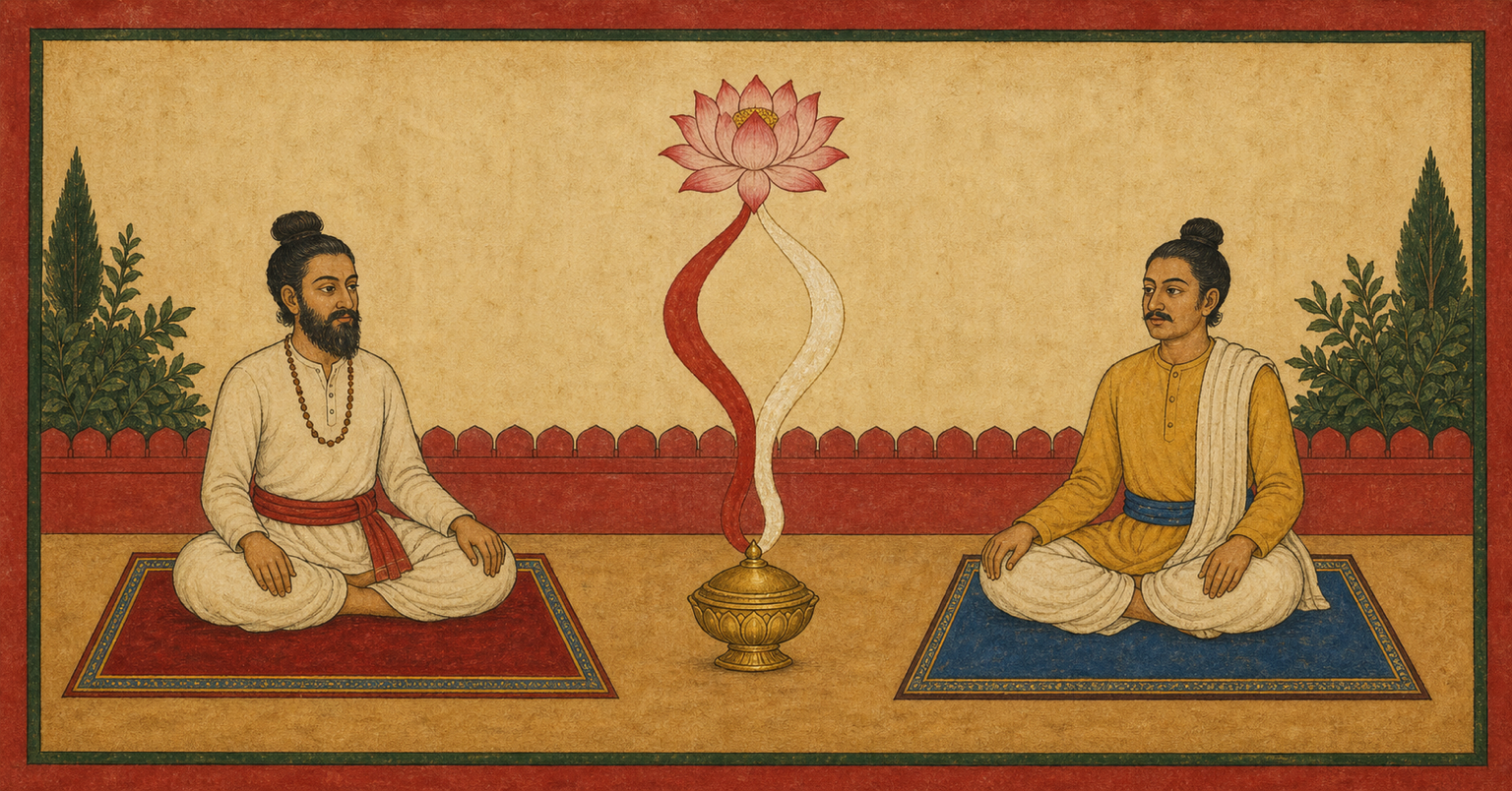

For Sahajolī, ash from burned cow dung is mixed with water. After sexual intercourse, the seated woman and man smear their “own limbs” with it. Brahmānanda specifies these as the head, forehead, eyes, heart, shoulders, and arms. Despite its connection with sensual experience, he regards the practice as directed toward liberation.
vajrolīmaithunād ūrdhvaṃ strīpuṃsoḥ svāṅgalepanam MBHDL2026 ] transp. NS1882 ante HP 3.89a
jaleṣu bhasma MBHDL2026 ] jale subhasma NS1882
sahajolīr iyaṃ proktā śraddheyā yogibhiḥ sadā MBHDL2026 ] transp. NS1882 ante HP 3.89*1
kṣaṇam MBHDL2026 ] kṣaṇāt NS1882
bhoge bhukte’pi MBHDL2026 ] bhogayukto’pi NS1882
pittolbaṇatvāt prathamāṃ ca dhārāṃ; vihāya niḥ-sāratayāntya-dhārām | Analysis ▾ Analysis ▴
niṣevyate śītala-madhya-dhārā; kāpālikaiḥ khaṇḍa-matair amaryāḥ ||90|| Analysis ▾ Analysis ▴
Brahmānanda assigns Amarolī to the tradition of the Khaṇḍa Kāpālikas. It concerns the stream of urine called śivāmbu: the first part is discarded because of an excess of bile and the last as lacking substance; the cool middle part is used. The commentary thus gives a sect-specific and physically literal explanation.
kāpālikaiḥ khaṇḍamatair amaryāḥ MBHDL2026 ] kāpālike khaṇḍamate’marolī NS1882
For Brahmānanda, Amarolī comprises three actions: daily drinking of the middle portion of śivāmbu, its application through the nose, and the Vajrolī practice already described. In this explanation, Amarolī denotes the combination of these procedures.
(Redaktionelle deutsche Übersetzung aus dem Latein: Wenn eine Frau, nachdem sie durch Übung Geschick erlangt und den Samen des Mannes aufgesogen hat, auf dieselbe Weise durch Vajrolī auch ihre Menstruationsflüssigkeit bewahren kann, wird sie Yoginī genannt.)
Alongside the physical explanation of Vajrolī, Brahmānanda cites the Amṛtasiddhi for an inner interpretation. Male Bindu is lunar and female Rajas solar. Their external union produces a child; only their inner union makes a person a yogi and leads to the supreme state. The commentary thus places a physical and a subtle meaning side by side without retroactively reducing the preceding practice instructions to symbolism alone.
(Redaktionelle deutsche Übersetzung aus dem Latein: Sie wird zweifellos nichts von ihrer Menstruationsflüssigkeit verlieren; in ihrem Körper verbindet sich Nāda mit Anusvāra (und Nāda geht in den Zustand des Bindu über).)
(Redaktionelle deutsche Übersetzung aus dem Latein: Wenn Tropfen (Bindu) und Menstruationsflüssigkeit im Körper vereint sind, erlangt die Frau durch die Vajrolī genannte Übung jede Vollkommenheit.)
(Redaktionelle deutsche Übersetzung aus dem Latein: Diejenige, die ihre Menstruationsflüssigkeit zum Aufsteigen gebracht hat und sie oben bewahren kann, ist eine Yoginī; sie kennt Vergangenheit und Zukunft und wird gewiss eine Khecarī (d. h. sie erlangt die Fähigkeit, sich in der Luft zu bewegen).)
Kuṇḍalinī sleeps above the Kanda, the region from which the channels originate, and seals the entrance to Suṣumṇā. The same condition signifies the potential for liberation to yogis, who can move the power, but bondage to the ignorant. For Brahmānanda, knowing Kuṇḍalinī therefore means knowing yoga, because every yogic procedure depends upon her.
Continue with AYI Free
Illustrations: AI-generated.

Please log in to write a message. Go to login
No messages yet.