
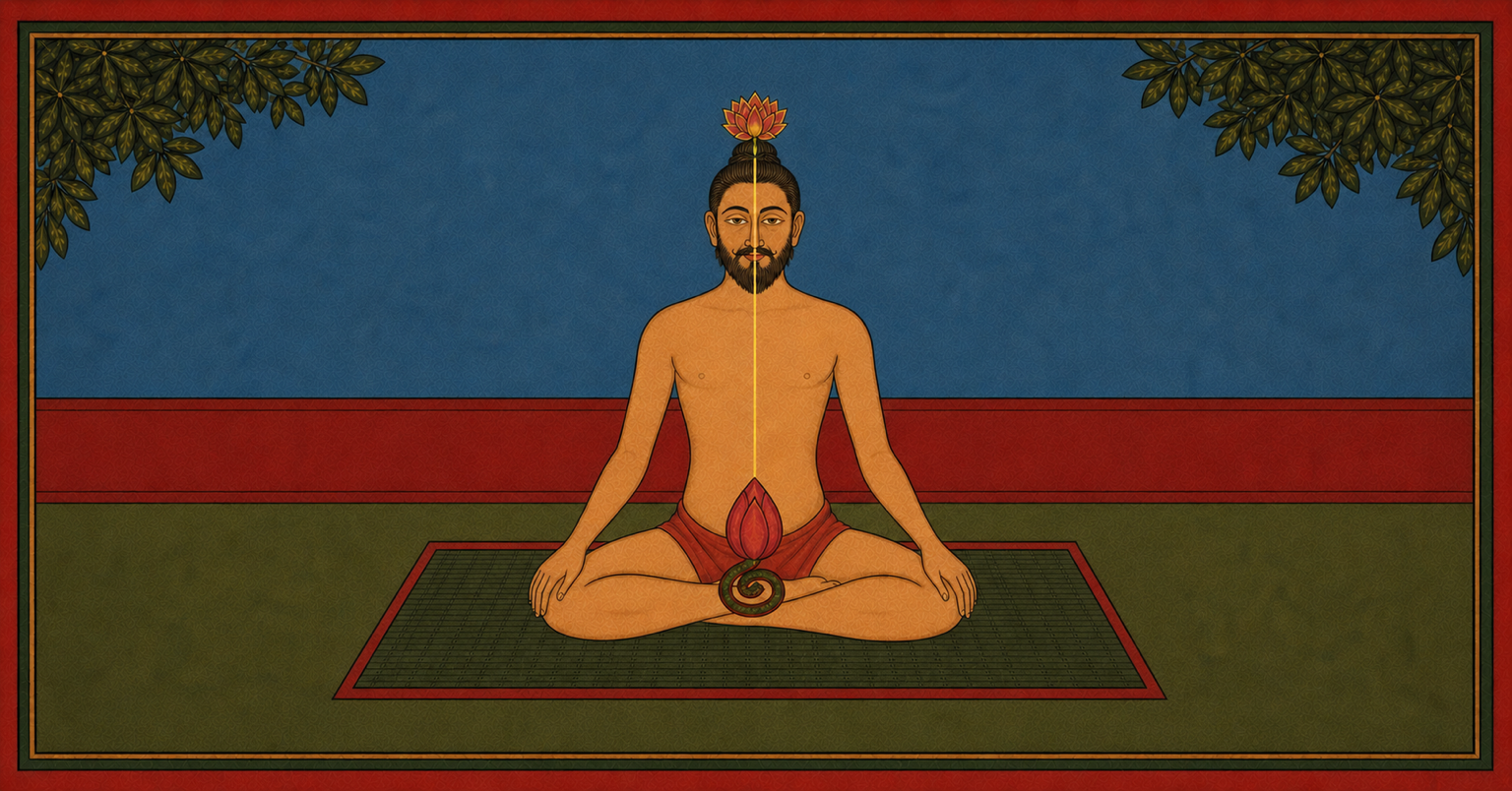
Illustration for the Haṭha Pradīpikā section “HP 3.1-3.5: Foundations of Kuṇḍalinī”.

Haṭha Pradīpikā 3.1-3.5: Kuṇḍalinī and the Practice of Mudrā

Kuṇḍalinī, Suṣumṇā, and the gate of Brahman are introduced as the foundation and goal of the practice of Mudrā that now begins.

Dr. Ronald Steiner Dr. Ronald Steiner
Haṭha Pradīpikā 3.1
सशैलवनधात्रीणां यथाधारो ऽहिनायकः |
sa-śaila-vana-dhātrīṇāṃ; yathādhāro 'hi-nāyakaḥ | Analysis ▾ Analysis ▴
sa
bahuvrīhi-compund
previx
with
śaila
dvandva-compound
substantive neuter
mountain
vana
dvandva-compound
substantive neuter
forest
dhātrīṇām
genitive plural
substantive feminine
of the earth regions, of the earth
yathā
adverb
like
ādhāraḥ
nominative singular
substantive masculine
support, foundation
ahi
tatpuruṣa-compound genitive
substantive neuter
serpent
nāyakaḥ
nominative singular
substantive masculine
lord, leader
सर्वेषां योगतन्त्राणां तथाधारो हि कुण्डली ||1||
sarveṣāṃ yoga-tantrāṇāṃ; tathādhāro hi kuṇḍalī ||1|| Analysis ▾ Analysis ▴
sarveṣām
genitive plural
adjective
all
yoga
tatpuruṣa-compound genitive
substantive masculine
yoga
tantrāṇām
genitive plural
substantive neuter
systems, schools
tathā
adverb
thus, likewise
ādhāraḥ
nominative singular
substantive masculine
support, foundation
hi
particle
indeed, namely
kuṇḍalī
nominative singular
substantive feminine
Kuṇḍalinī
Metre: Anuṣṭubh
Just as (yathā) the lord of snakes (ahi-nāyakaḥ | nom sg) is the foundation (ādhāraḥ | nom sg) of the earth together with its mountains and forests (sa-śaila-vana-dhātrīṇām | gen pl), so (tathā) Kuṇḍalinī (kuṇḍalī | nom sg) is indeed (hi) the foundation (ādhāraḥ | nom sg) of all systems of yoga (sarveṣām yoga-tantrāṇām | gen pl).
Dr. Ronald Steiner - 2026 - historically literal
Just as the lord of serpents supports the earth with its mountains and forests, Kuṇḍalinī is the foundation of every system of yoga.
Dr. Ronald Steiner - 2026 - modern transfer

Just as Śeṣa supports the earth with its mountains and forests, Kuṇḍalinī, according to Brahmānanda, supports every yogic procedure. The comparison establishes more than her preeminence: without the awakening of this foundational power, all other means of yoga are ultimately futile.

Brahmānanda's Jyotsnā - 19th c.
As the chief of the snakes is the support of the earth with all the mountains and forests on it, so all the Tantras (Yoga practices) rest on the Kuṇḍalinî. (The Vertebral column.)
Pancham Sinh - 1915
As Ananta, the Lord of Serpents, supports this whole universe with its mountains and forests, so Kundalini is the main support of all the Yoga practices.
Srinivasa Iyangar - 1893
Wie der Schlangenfürst die Welten mit ihren Gebirgen und Wäldern umschliesst, so umfasst (die Lehre von der) Kundalî alle Yogalehren.
Hermann Walter - 1893
Haṭha Pradīpikā 3.2
सुप्ता गुरुप्रसादेन यदा जागर्ति कुण्डली |
suptā guru-prasādena; yadā jāgarti kuṇḍalī | Analysis ▾ Analysis ▴
suptā
nominative singular feminine past participle passive
verbal root
sleeping
guru
tatpuruṣa-compound genitive
substantive masculine
guru
prasādena
instrumental case singular
substantive neuter
through grace
yadā
adverb
when
jāgarti
3rd person singular aktive present
verbal root
awakened
kuṇḍalī
nominative singular
substantive feminine
Kuṇḍalinī
तदा सर्वाणि पद्मानि भिद्यन्ते ग्रन्थयो ऽपि च ||2||
tadā sarvāṇi padmāni; bhidyante granthayo 'pi ca ||2|| Analysis ▾ Analysis ▴
tadā
adverb
then
sarvāṇi
nominative plural neuter
adjective
all
padmāni
nominative plural
substantive neuter
lotuses
bhidyante
3rd person plural passive present
verbal root
are pierced, opened
granthayaḥ
nominative plural
substantive masculine
knots
api
particle
also
ca
particle
and
Metre: Anuṣṭubh
When (yadā) Kuṇḍalinī (kuṇḍalī | nom sg), asleep (suptā | nom sg f ppp), awakens (jāgarti | 3p sg act pres) through the guru's favour (guru-prasādena | ins sg), then (tadā) all the lotuses (sarvāṇi padmāni | nom pl) and also (api ca) the knots (granthayaḥ | nom pl) are pierced open (bhidyante | 3p pl pas pres).
Dr. Ronald Steiner - 2026 - historically literal
When Kuṇḍalinī awakens through the grace of the guru, the lotuses open and the inner knots are released.
Dr. Ronald Steiner - 2026 - modern transfer

When Kuṇḍalinī awakens, according to Brahmānanda, the six Cakras are penetrated and three inner “knots” are released: Brahma Granthi, Viṣṇu Granthi, and Rudra Granthi. He therefore reads the verse as the complete opening of the central path, not merely as a general image of increased energy.

Brahmānanda's Jyotsnā - 19th c.
When the sleeping Kuṇḍalinî awakens by favour of a guru, then all the lotuses (in the six chakras or centres) and all the knots are pierced through.
Pancham Sinh - 1915
When Kundalini is sleeping, it is aroused by the favour of the Guru, then all the lotuses (nervous centres) and Granthis (knots) are pierced: Then Prâna goes through the royal road: Sushumna. Then the mind remains suspended and then the Yogi cheats death.
Srinivasa Iyangar - 1893
Wenn durch die Gunst des Lehrers die schlafende Kundalî erwacht, dann werden alle Cakra (padma = cakra, Com.) und Granthi gelöst.
Hermann Walter - 1893
Haṭha Pradīpikā 3.3
प्राणस्य शून्यपदवी तदा राजपथायते |
prāṇasya śūnya-padavī; tadā rāja-pathāyate | Analysis ▾ Analysis ▴
prāṇasya
genitive singular
substantive masculine
of prāṇa
śūnya
karmadhāraya-compound
adjective
empty
padavī
nominative singular
substantive feminine
path, way
tadā
adverb
then
rāja
karmadhāraya-compound
substantive masculine
royal, king
pathāyate
3rd person singular denominative present
substantive neuter
becomes the path
तदा चित्तं निरालम्बं तदा कालस्य वञ्चनम् ||3||
tadā cittaṃ nir-ālambaṃ; tadā kālasya vañcanam ||3|| Analysis ▾ Analysis ▴
tadā
adverb
then
cittam
nominative singular
substantive neuter
mind
nir
bahuvrīhi-compund
previx
without, free from
ālambam
nominative singular
substantive neuter
support
tadā
adverb
then
kālasya
genitive singular
substantive masculine
of time, death
vañcanam
nominative singular
substantive neuter
deception, outwitting
Metre: Anuṣṭubh
Then (tadā) the empty pathway (śūnya-padavī | nom sg) becomes the royal road (rāja-pathāyate | 3p sg denom pres) for Prāṇa (prāṇasya | gen sg); then (tadā) the mind (cittam | nom sg) becomes supportless (nir-ālambam | nom sg), and then (tadā) occurs the deceiving (vañcanam | nom sg) of time, death (kālasya | gen sg).
Dr. Ronald Steiner - 2026 - historically literal
The empty channel becomes the royal road of Prāṇa; the mind is left without support, and the power of time is deceived.
Dr. Ronald Steiner - 2026 - modern transfer

Brahmānanda identifies the “empty pathway” with Suṣumṇā. As soon as Prāṇa flows there unobstructed, as if along a royal road, the mind becomes nirālamba, free from an object or support. The “deception of time” accordingly means the overcoming of death.

Brahmānanda's Jyotsnā - 19th c.
Suṣumnâ (Sûnya Padavî) becomes a main road for the passage of Prâṇa, and the mind then becomes free from all connections (with its objects of enjoyments) and Death is then evaded.
Pancham Sinh - 1915
Dann wird die Şûnyapadavi (Sushumna) zur Hauptstrasse des Athems, dann wird der Geist von der Sinnenwelt befreit und man hintergeht den Tod.
Hermann Walter - 1893
Haṭha Pradīpikā 3.4
सुषुम्णा शून्यपदवी ब्रह्मरन्ध्रमहापथः |
suṣumṇā śūnya-padavī; brahma-randhra-mahā-pathaḥ | Analysis ▾ Analysis ▴
suṣumṇā
nominative singular
substantive feminine
Suṣumṇā
śūnya
karmadhāraya-compound
adjective
empty
padavī
nominative singular
substantive feminine
path
brahma
tatpuruṣa-compound genitive
substantive neuter
Brahman
randhra
tatpuruṣa-compound genitive
substantive neuter
opening
mahā
karmadhāraya-compound
adjective
great
pathaḥ
nominative singular
substantive masculine
way
श्मशानं शाम्भवी मध्यमार्गश्चेत्येकवाचकाः ||4||
śmaśānaṃ śāmbhavī madhya;-mārgaś cety eka-vācakāḥ ||4|| Analysis ▾ Analysis ▴
śmaśānam
nominative singular
substantive neuter
cremation ground
śāmbhavī
nominative singular
substantive feminine
Śāmbhavī
madhya
karmadhāraya-compound
adjective
central, middle
mārgaḥ
nominative singular
substantive masculine
path
ca
particle
and
iti
particle
thus
eka
karmadhāraya-compound
numeral
one
vācakāḥ
nominative plural masculine
adjective
designating, synonyms
Metre: Anuṣṭubh
Suṣumṇā (suṣumṇā | nom sg), the empty pathway (śūnya-padavī | nom sg), the great path to the aperture of Brahman (brahma-randhra-mahā-pathaḥ | nom sg), the cremation ground (śmaśānam | nom sg), Śāmbhavī (śāmbhavī | nom sg), and the middle path (madhya-mārgaḥ | nom sg), and so (ca iti), are a set of synonymous designations (eka-vācakāḥ | nom pl m).
Dr. Ronald Steiner - 2026 - historically literal
Suṣumṇā, the empty path, the way to the Brahmarandhra, Śāmbhavī, and the middle way all refer here to the same inner channel.
Dr. Ronald Steiner - 2026 - modern transfer
brahmarandhramahāpathaḥ MBHDL2026 ] brahmarandhraṃ mahāpathaḥ NS1882
Critical Apparatus
Suṣumnâ, Sunya Padavî, Brahma Randhra, Mahâ Patha, Śmaśâna, Śambhavî, Madhya Mârga, are names of one and the same thing.
Pancham Sinh - 1915
Sushumna the great void, the Brahmarandhra the great road, the burning ground, Sambhavi and the middle path, all refer to the same thing.
Srinivasa Iyangar - 1893
Sushumna, Şûnyapadavi, Brahmarandhra, Mahapatha, Smaşâna, Şâmbhavî, Madhyamârga; das sind Synonyma.
Hermann Walter - 1893
Haṭha Pradīpikā 3.5
तस्मात्सर्वप्रयत्नेन प्रबोधयितुमीश्वरीम् |
tasmāt sarva-prayatnena; prabodhayitum īśvarīm | Analysis ▾ Analysis ▴
tasmāt
ablative singular
pronoun dem
therefore
sarva
karmadhāraya-compound
adjective
wholly, every
prayatnena
instrumental case singular
substantive masculine
with effort
prabodhayitum
infinitive causative
previx
verbal root
to be awakened
īśvarīm
accusative singular
substantive feminine
the mistress, goddess
ब्रह्मद्वारमुखे सुप्तां मुद्राभ्यासं समाचरेत् ||5||
brahma-dvāra-mukhe suptāṃ; mudrābhyāsaṃ samācaret ||5|| Analysis ▾ Analysis ▴
brahma
tatpuruṣa-compound genitive
substantive neuter
Brahman
dvāra
tatpuruṣa-compound genitive
substantive neuter
gate
mukhe
lokative singular
substantive neuter
at the entrance, mouth
suptām
accusative singular feminine past participle passive
verbal root
sleeping
mudrā
tatpuruṣa-compound genitive
substantive feminine
mudrā
abhyāsam
accusative singular
substantive masculine
practice
samācaret
3rd person singular aktive optative
previx
previx
verbal root
should perform
Metre: Anuṣṭubh
Therefore (tasmāt | abl sg), with every effort (sarva-prayatnena | ins sg), in order to awaken (prabodhayitum | inf caus) the goddess (īśvarīm | acc sg) sleeping (suptām | acc sg f ppp) at the entrance to the gate of Brahman (brahma-dvāra-mukhe | loc sg), one should perform (samācaret | 3p sg act opt) the practice of mudrā (mudrā-abhyāsam | acc sg).
Dr. Ronald Steiner - 2026 - historically literal
The yogi should therefore practise Mudrā to awaken the goddess Kuṇḍalinī, who sleeps at the entrance to the gate of Brahman.
Dr. Ronald Steiner - 2026 - modern transfer

For Brahmānanda, the gate to Brahman is Suṣumṇā as the means of reaching Brahman. He defines Brahman as being, consciousness, and bliss (sat-cit-ānanda). Kuṇḍalinī seals the entrance to this path with her mouth; the Mudrās are therefore intended to awaken her and open access.

Brahmānanda's Jyotsnā - 19th c.
In order, therefore, to awaken this goddess, who is sleeping at the entrance of Brahma Dwâra (the great door), mudrâs should be practised well.
Pancham Sinh - 1915
So, the Yogi should carefully practise the various Mudras to rouse the great goddess (Kundalini) that sleeps closing the mouth of Sushumna.
Srinivasa Iyangar - 1893
Daher soll man recht fleissig Mudra üben, um die Herrin (Kundalî) zu wecken, die am Eingang zum Brahmadvâra schläft.
Hermann Walter - 1893

Continue with AYI Free

Illustrations: AI-generated.

Editor

Dr. Ronald Steiner

From Ulm

The "Yoga Doc" - Dr. Ronald Steiner is the founder of the AYI method. This method links traditional Ashtanga Yoga with innovative Yogatherapy and living Philosophy. This forms a practice that is personal for each and... more ›

Messages and ratings
0 messages

Please log in to write a message. Go to login

No messages yet.