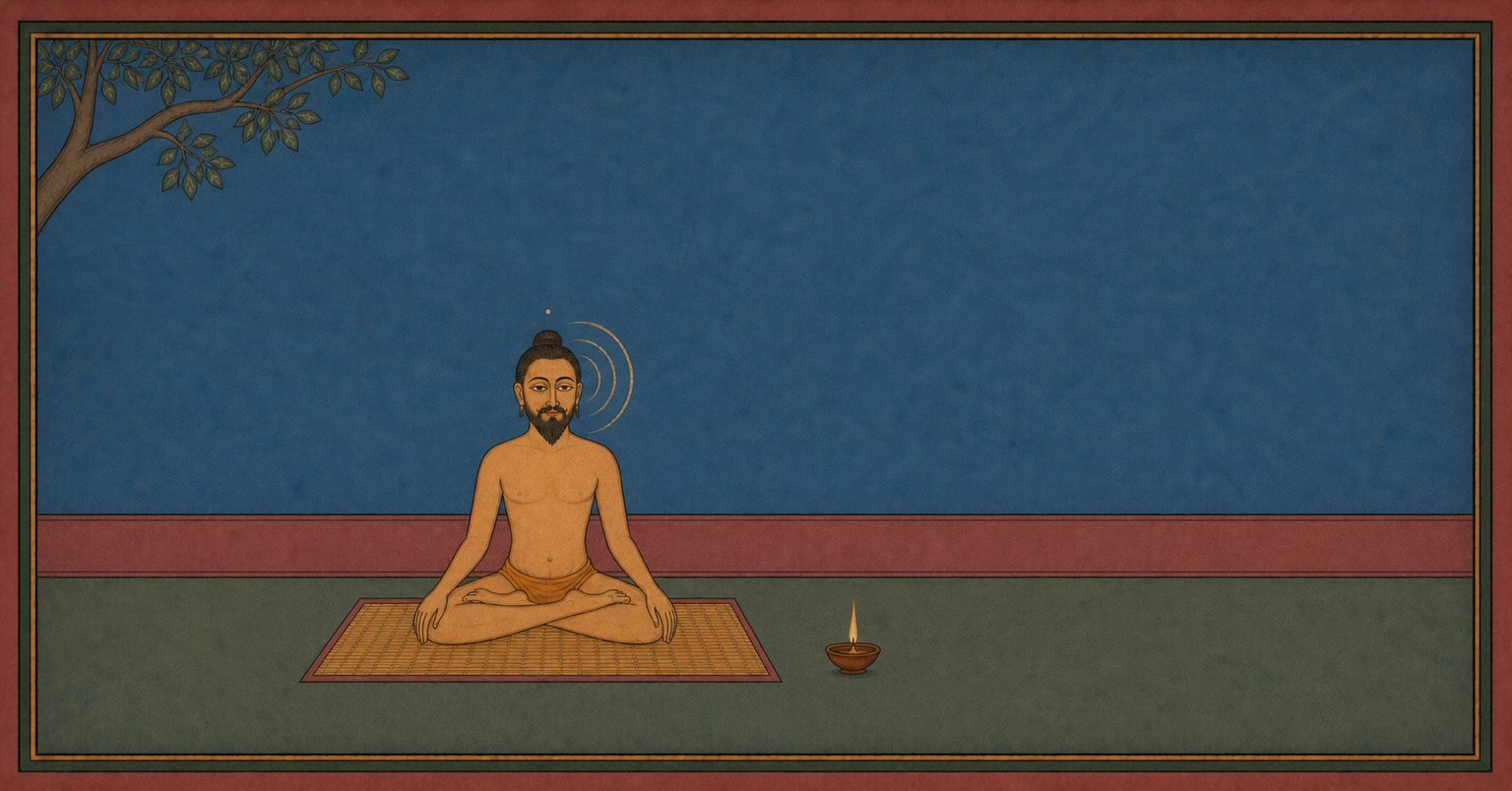
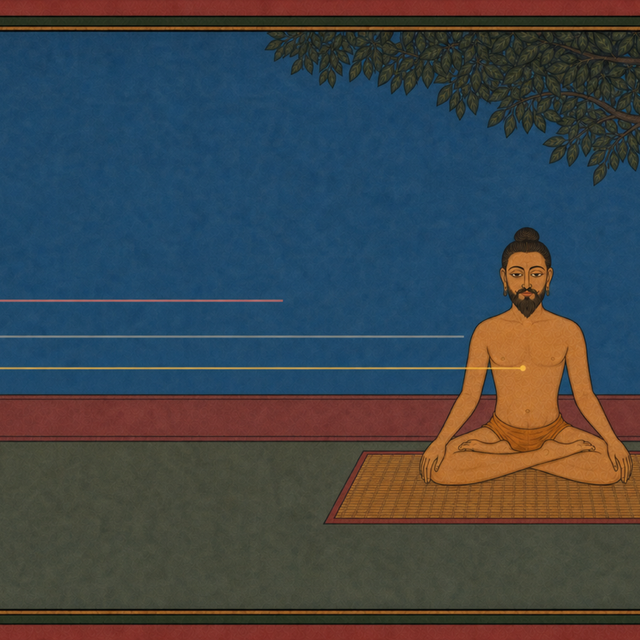
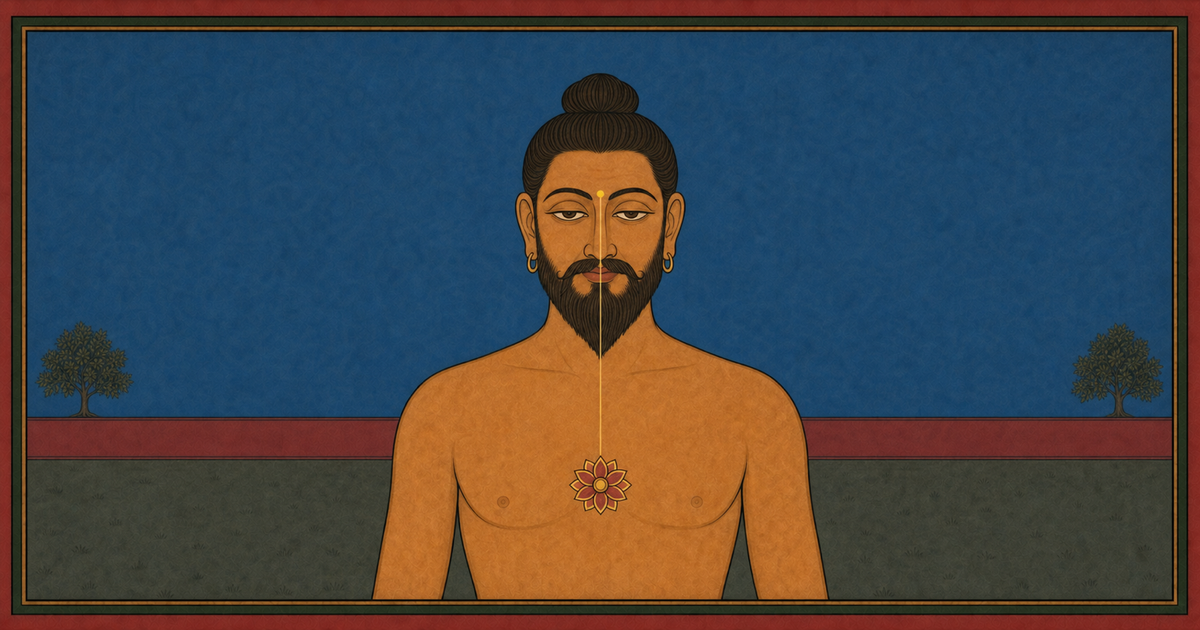
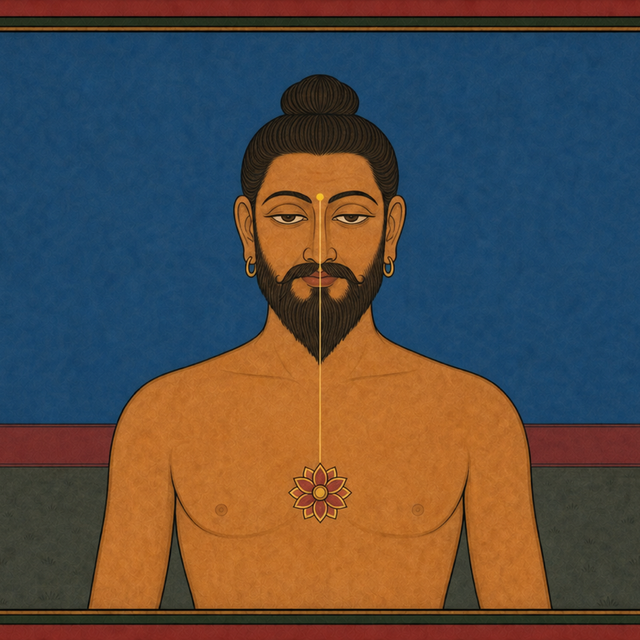
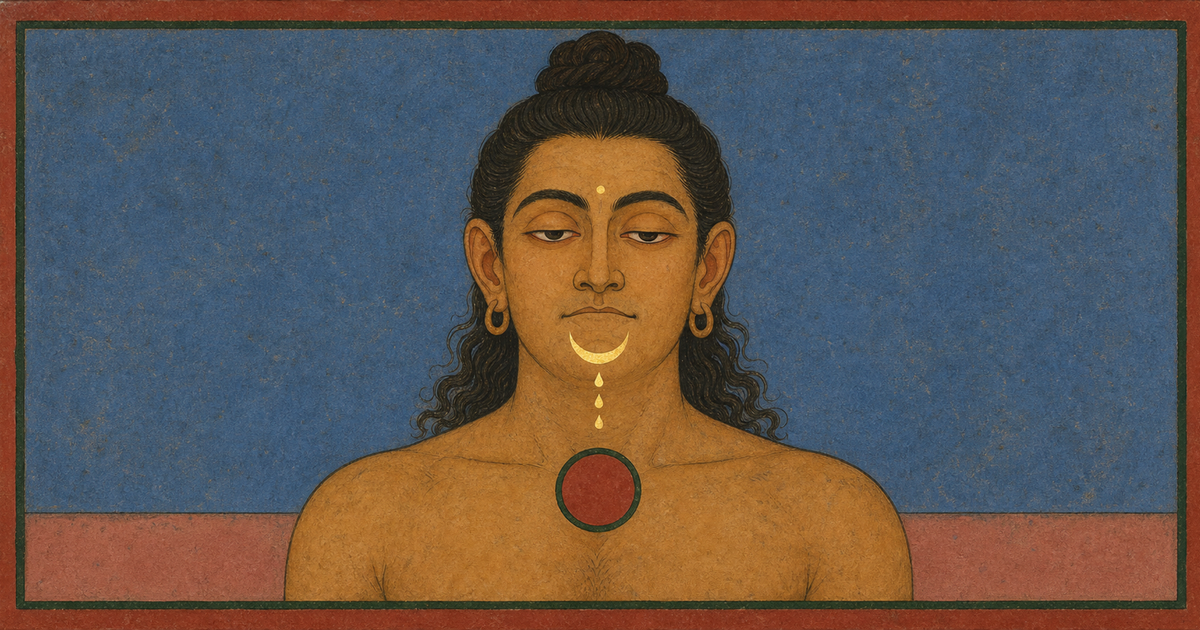

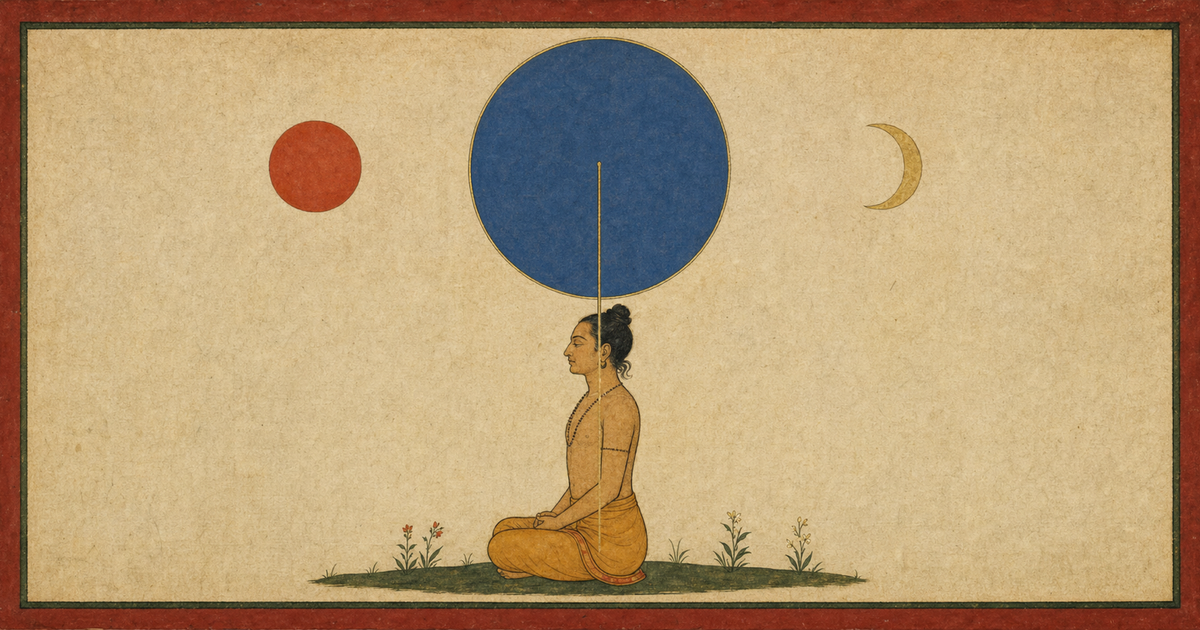
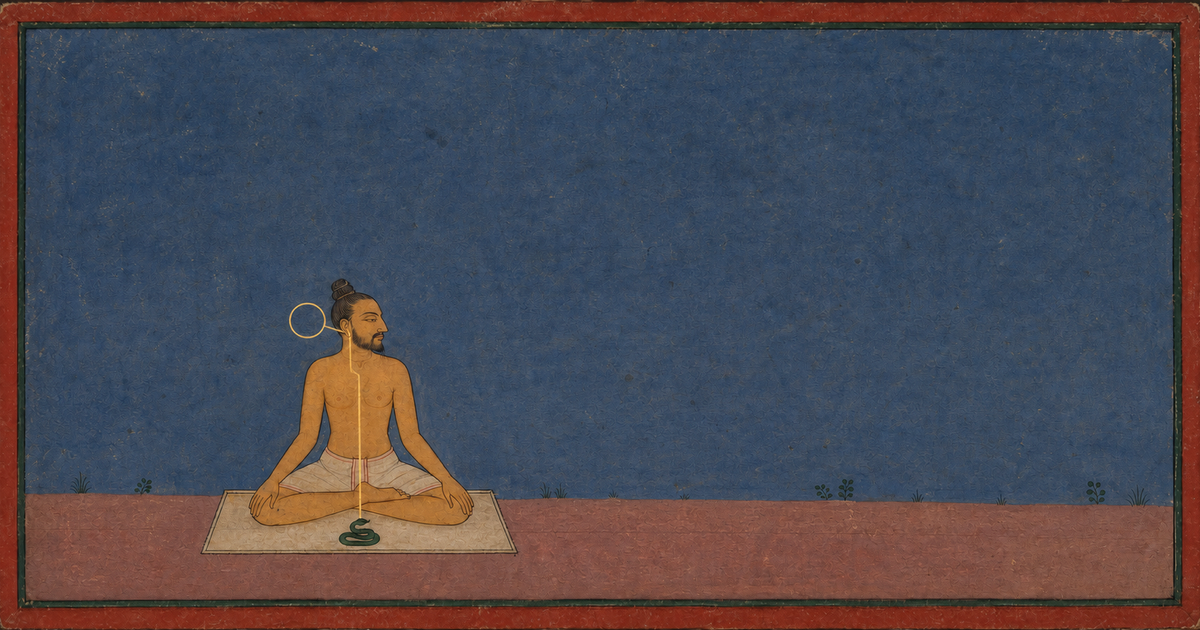
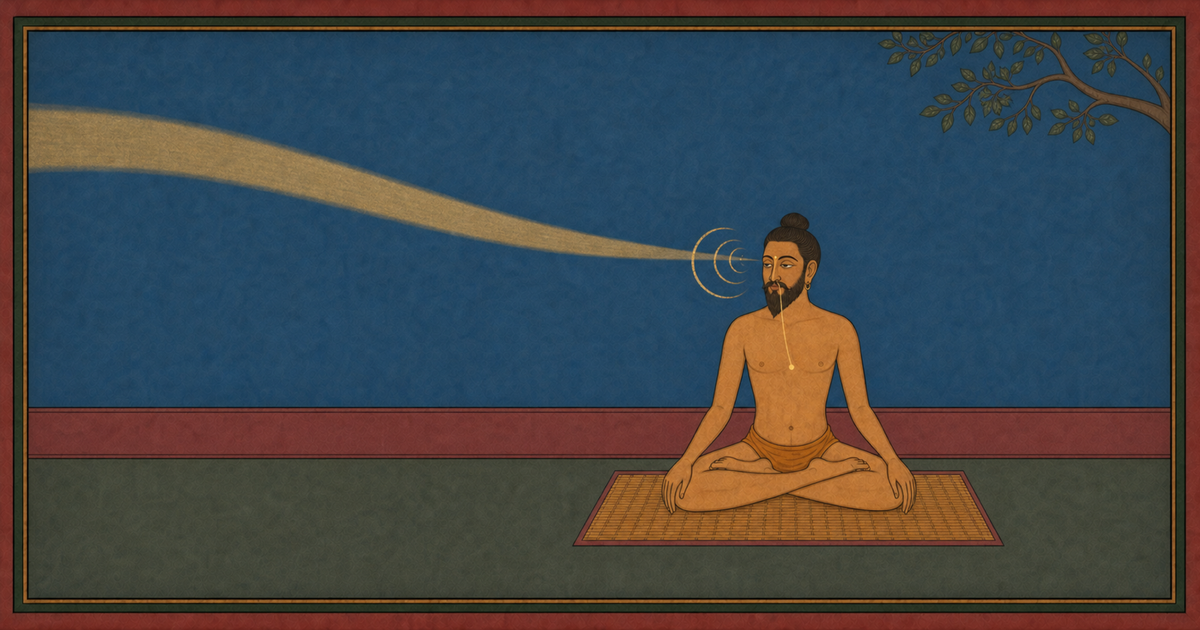
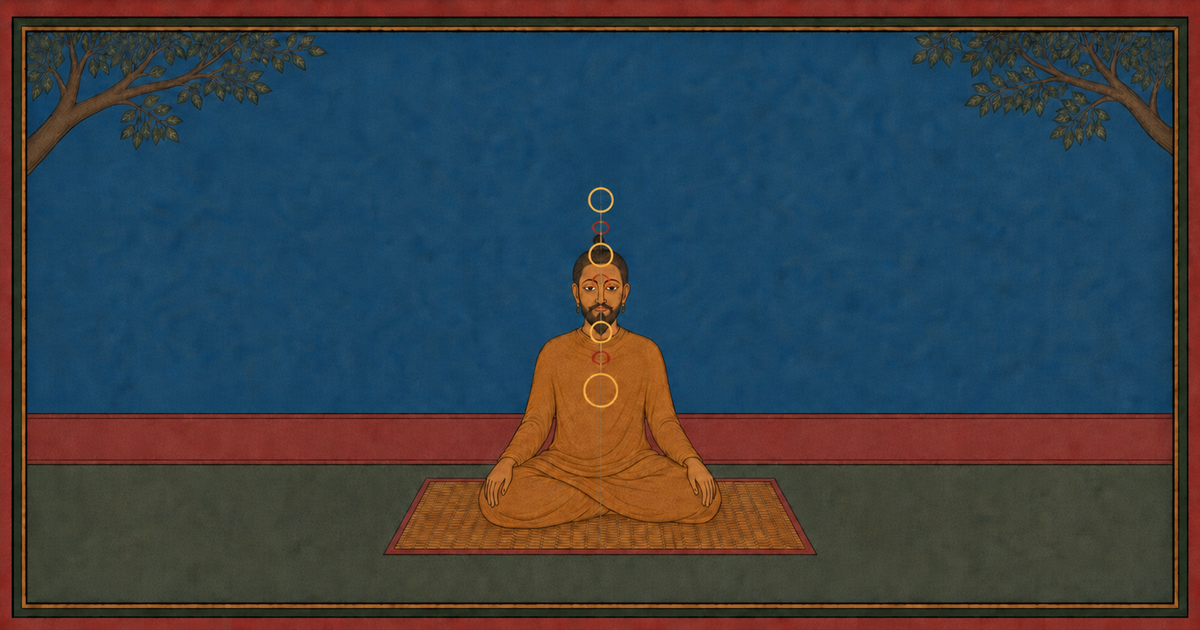
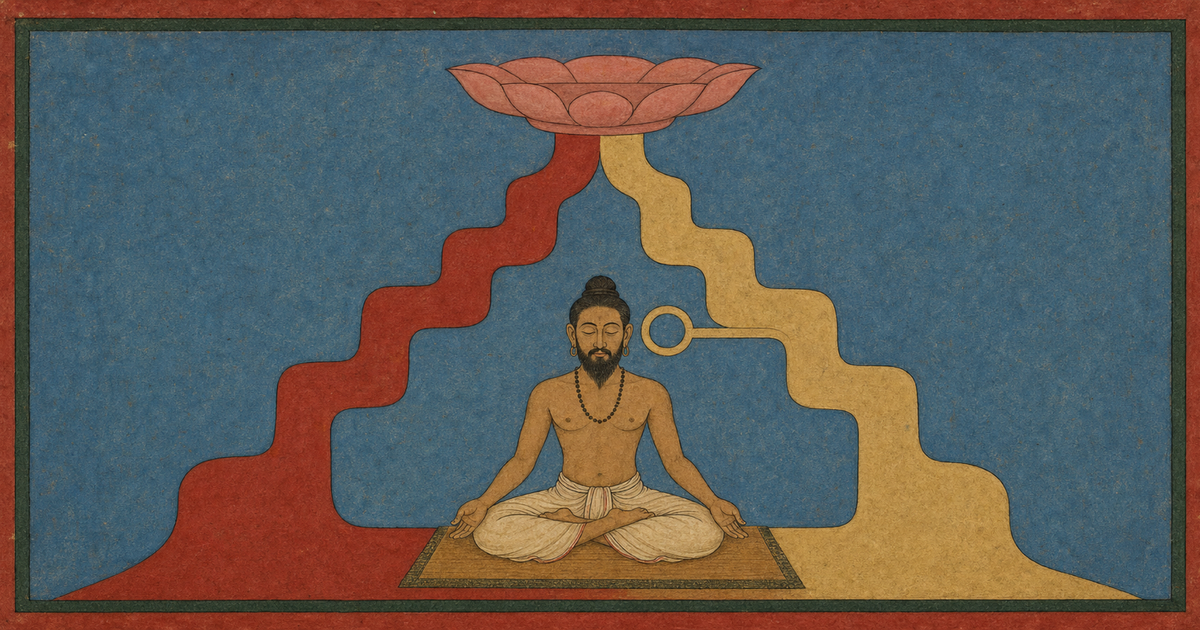
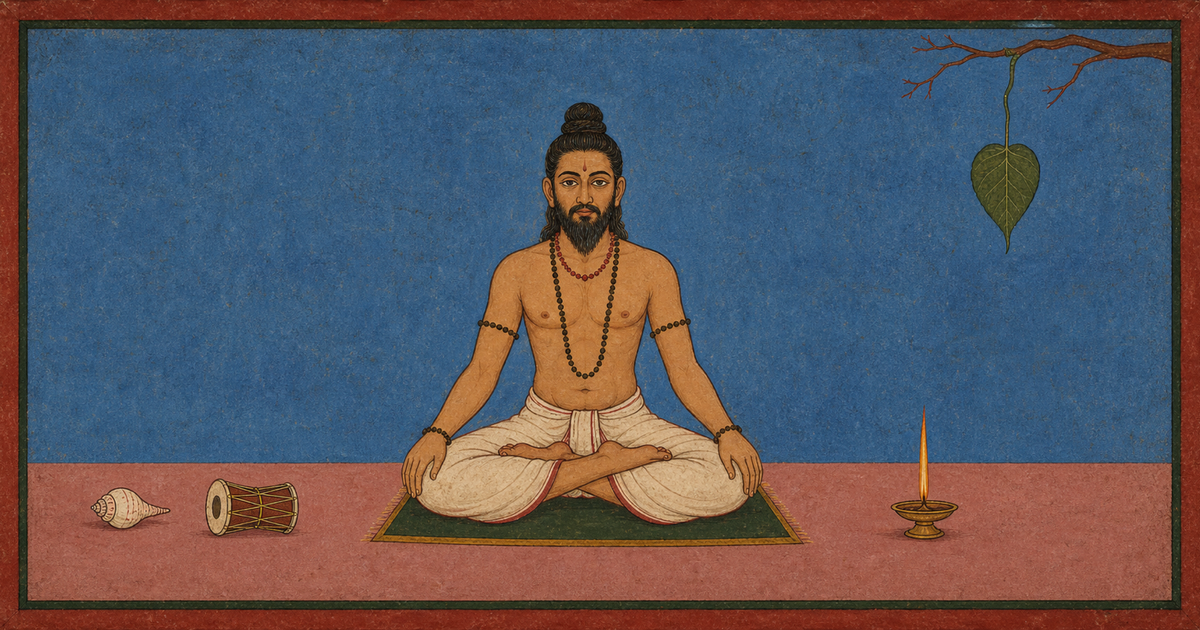


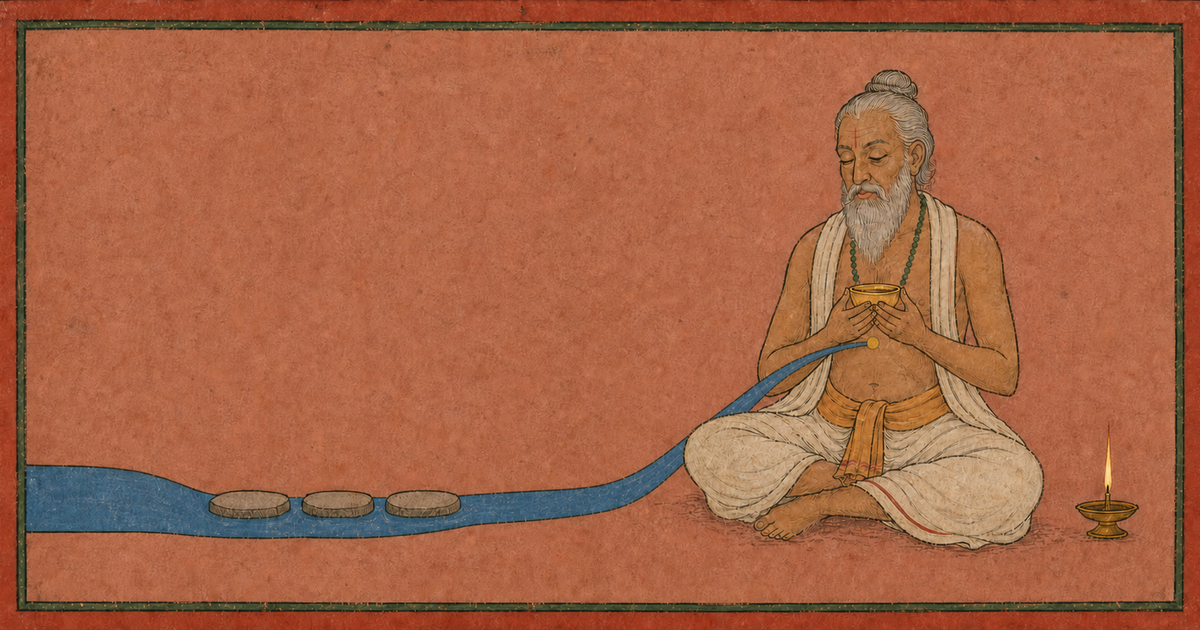
A seated yogi listens inwardly; subtle sound waves spread beside his head and an oil lamp burns nearby.

Haṭhapradīpikā 4: Samādhi, Nāda, and Laya

Laya, the practice of inner sound, and Samādhi describe the dissolution of mental movement and the completion of the path of Haṭha.

Dr. Ronald Steiner Dr. Ronald Steiner
HP 4.0*1-4.0*14: Samādhi and Laya

Haṭha Pradīpikā 4.0*1-4.0*14: Prelude to Samādhi

The prelude gathers definitions and conditions of Samādhi, Rājayoga, Laya, the awakening of Śakti, and the binding of mind and breath.

Haṭha Pradīpikā 4.0*1
Metre: Anuṣṭubh
Homage (namas) to Śiva (śivāya | dat sg), the guru (gurave | dat sg), whose nature consists of Nāda, Bindu, and Kalā (nāda-bindu-kalātmane | dat sg). [Those] constantly (nityam) devoted to that (yatra-parāyaṇāḥ | nom pl m) reach (yānti | 3p pl act pres) the stainless state (nirañjana-padam | acc sg).
Dr. Ronald Steiner - 2026 - historically literal
Haṭha Pradīpikā 4.0*2
Metre: Anuṣṭubh
Now, at this point (atha idānīm), I shall teach (pravakṣyāmi | 1p sg act fut) the supreme path of Samādhi (samādhi-kramam uttamam | acc sg): it destroys death (mṛtyu-ghnam | acc sg m), yet (tu) is an easy means (sukhopāyam | acc sg), produces the bliss of Brahman (brahma-ānanda-karam | acc sg m), and is supreme (param | acc sg m).
Dr. Ronald Steiner - 2026 - historically literal
Haṭha Pradīpikā 4.0*3
Metre: Anuṣṭubh
Just as (yadvat) salt (saindhavam | nom acc sg) assumes (bhajati | 3p sg act pres) sameness (sāmyaṃ | acc sg) with water (salile | loc sg) through union (yogataḥ), so (tathā) the unity (aikyam | nom acc sg) of self and mind (ātma-manasoḥ | gen loc du) is called (abhidhīyate | 3p sg pas pres) Samādhi (samādhiḥ | nom sg).
Dr. Ronald Steiner - 2026 - historically literal
Haṭha Pradīpikā 4.0*4
Metre: Anuṣṭubh
That equality (yat samatvam | nom acc sg) which exists here (atra) between the two (dvayoḥ | gen loc du), the individual self and the supreme self (jīvātma-paramātmanoḥ | gen du), and in which all conceptions have vanished (samasta-naṣṭa-saṃkalpaḥ | nom sg m), that is called (saḥ abhidhīyate | 3p sg pas pres) Samādhi (samādhiḥ | nom sg).
Dr. Ronald Steiner - 2026 - historically literal
Haṭha Pradīpikā 4.0*5
Metre: Anuṣṭubh
Who (kaḥ | nom sg m), indeed (vā), truly (tattvataḥ) knows (jānāti | 3p sg act pres) the greatness (māhātmyam | acc sg) of Rājayoga (rāja-yogasya | gen sg)? Through knowledge (jñānāt | abl sg), liberation (muktiḥ | nom sg) becomes firm (sthirā | nom sg f); accomplishment (siddhiḥ | nom sg) is attained (labhyate | 3p sg pas pres) through the word of the guru (guru-vākyena | ins sg).
Dr. Ronald Steiner - 2026 - historically literal
Haṭha Pradīpikā 4.0*6
Metre: Anuṣṭubh
Difficult to attain (durlabhaḥ | nom sg m) is the abandonment of sense objects (viṣaya-tyāgaḥ | nom sg); difficult to attain (durlabham | nom acc sg n) is the vision of reality (tattva-darśanam | nom acc sg). Difficult to attain (durlabhā | nom sg f) is the natural state (sahaja-avasthā | nom sg) without (vinā) the grace (karuṇām | acc sg) of the true guru (sad-guroḥ | gen sg).
Dr. Ronald Steiner - 2026 - historically literal
Haṭha Pradīpikā 4.0*7
Metre: Anuṣṭubh
Through various (vividhaiḥ | ins pl) Āsanas (āsanaiḥ | ins pl), Kumbhakas (kumbhaiḥ | ins pl), and also (api) manifold (vicitraiḥ | ins pl) techniques (karaṇaiḥ | ins pl), when the primordial Śakti (ādi-śaktau | loc sg) has awakened (prabuddhāyām | loc sg f ppp), Prāṇa (prāṇaḥ | nom sg) dissolves (vilīyate | 3p sg med pres) into the void (śūnye | loc sg n).
Dr. Ronald Steiner - 2026 - historically literal
Haṭha Pradīpikā 4.0*8
Metre: Anuṣṭubh
For the yogi (yoginaḥ | gen sg) whose awareness of Śakti has arisen (utpanna-śakti-bodhasya | gen sg) and who has abandoned every action without remainder (tyakta-niḥśeṣa-karmaṇaḥ | gen sg), the natural state (sahajāvasthā | nom sg) shines forth (prakāśate | 3p sg med pres) entirely of itself (svayam eva).
Dr. Ronald Steiner - 2026 - historically literal
Haṭha Pradīpikā 4.0*9
Metre: Anuṣṭubh
When Prāṇa flows through Suṣumṇā (suṣumṇā-vāhini prāṇe | loc sg), the void (śūnyam | nom acc sg) enters (viśati | 3p sg act pres) the mind (mānase | loc sg). In this way (tathā), the knower of the innermost secret (marmavit | nom sg) uproots (nirmūlayati | 3p sg act pres) all actions (samasta-karmāṇi | acc pl).
Dr. Ronald Steiner - 2026 - historically literal
Haṭha Pradīpikā 4.0*10
Metre: Anuṣṭubh
O Amaraugha (amaraugha | voc sg), homage (namas) to you (tubhyam | dat sg). Even (api) death itself (saḥ kālaḥ | nom sg) has been slain (hataḥ | nom sg m ppp) by you (tvayā | ins sg), into whose (yasya | gen sg) mouth (vadane | loc sg) this world (etaj jagat | nom acc sg n), with all that moves and does not move (carācaram | nom acc sg n), has fallen (patitam | nom acc sg n ppp).
Dr. Ronald Steiner - 2026 - historically literal
Haṭha Pradīpikā 4.0*11
Metre: Anuṣṭubh
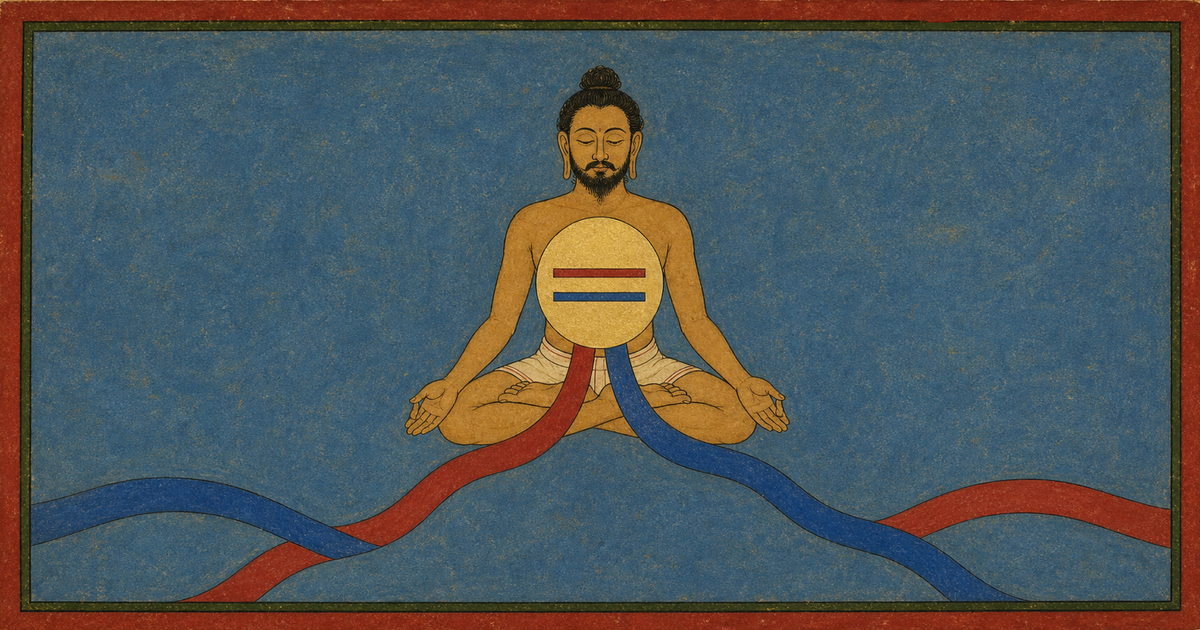
When equality (samatvam | nom acc sg) has arisen (āpanne | loc sg) in the mind (citte | loc sg) and the breath-wind (vāyau | loc sg) moves (vrajati | 3p sg act pres) into the middle channel (madhyame | loc sg), then (tadā) [there arises] the Vajrolī of the Amaraugha lineage (amaraugha-vajrolī | nom sg); †then (tadā) there is also (api ca) hope (āśā | nom sg) of life (jīvite | loc sg)†.
Dr. Ronald Steiner - 2026 - historically literal
Haṭha Pradīpikā 4.0*12
Metre: Vasantatilakā
Whence (kutaḥ) can knowledge (jñānam | nom acc sg) arise as long as (yāvat) the mind (manasi | loc sg) lives (jīvati | 3p sg act pres), O Goddess (devi | voc sg)? For as long (tāvat) as Prāṇa (prāṇaḥ | nom sg) also (api) lives (jīvati | 3p sg act pres), the mind (manaḥ | nom acc sg) does not (na) die (mriyate | 3p sg med pres). Prāṇa and mind (prāṇo manaḥ), this pair (dvayam idam | nom acc sg n), proceeds (prayāti | 3p sg act pres) to dissolution (vilayam | acc sg). That person (sa naraḥ | nom sg) reaches (gacchati | 3p sg act pres) liberation (mokṣam | acc sg), and in no way (na kathaṃcit) does another (anyaḥ | nom sg m).
Dr. Ronald Steiner - 2026 - historically literal
Haṭha Pradīpikā 4.0*13
Metre: Anuṣṭubh
Restlessness (cañcalatvam | nom acc sg) belongs by nature (svabhāvataḥ) to mercury (rasasya | gen sg) and likewise (caiva) to the mind (manasaḥ | gen sg). When mercury is bound (rasa-bandhe | loc sg) and the mind is bound (mano-bandhe | loc sg), what (kim | nom acc sg n) on earth (bhūtale | loc sg) does not (na) succeed (sidhyati | 3p sg act pres)?
Dr. Ronald Steiner - 2026 - historically literal
Haṭha Pradīpikā 4.0*14
Metre: Anuṣṭubh
Stupefied (mūrchitaḥ | nom sg m ppp), [mercury or the breath-wind] removes disease (vyādhim | acc sg); stilled (mṛtaḥ | nom sg m ppp), it revives (jīvayati | 3p sg act pres caus) by itself (svayam). Bound (baddhaḥ | nom sg m ppp), mercury (rasaḥ | nom sg) and (ca) the breath-wind (vāyuḥ | nom sg) confer (dhatte | 3p sg med pres) the state of Khecarī (khecaratām | acc sg), O Bhairavī (bhairavi | voc sg).
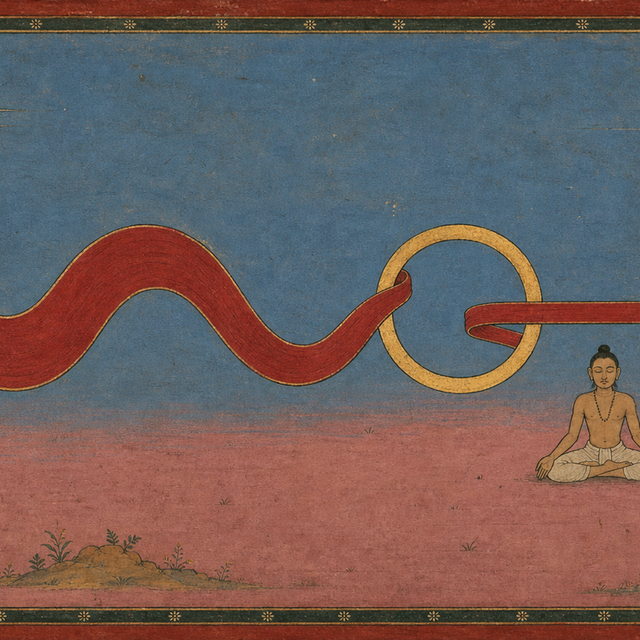
Dr. Ronald Steiner - 2026 - historically literal
HP 4.1-4.4: Laya and Breath

Haṭha Pradīpikā 4.1-4.4: Laya as Lord of the Breath

The section explains the sequence of senses, mind, and breath and describes Laya as the immediate state into which the gaze enters.

Haṭha Pradīpikā 4.1
Metre: Anuṣṭubh
The mind (manas | nom sg) is the lord (nāthaḥ | nom sg) of the senses (indriyāṇām | gen pl), while (tu) the breath-wind (mārutaḥ | nom sg) is the lord of the mind (mano-nāthaḥ | nom sg). Dissolution (layaḥ | nom sg) is the lord (nāthaḥ | nom sg) of the breath-wind (mārutasya | gen sg); one should take refuge (āśrayet | 3p sg act opt) in that lord (taṃ nātham | acc sg), Laya (layam | acc sg).
Dr. Ronald Steiner - 2026 - historically literal
Haṭha Pradīpikā 4.1*1
Metre: Anuṣṭubh
This [Laya] (saḥ ayam | nom sg m) may indeed (eva) be called Mokṣa (mokṣa-ākhyaḥ | nom sg m), or according to another doctrine (matāntare | loc sg) perhaps not (mā astu vā api). A certain (kaścit | nom sg m) bliss arising from the dissolution of mind and Prāṇa (manaḥ-prāṇa-laya-ānandaḥ | nom sg) manifests (pravartate | 3p sg med pres) within me (mayi | loc sg).
Dr. Ronald Steiner - 2026 - historically literal
Haṭha Pradīpikā 4.2
Metre: Anuṣṭubh
Among yogis (yoginām | gen pl), Laya (layaḥ | nom sg) excels (jayati | 3p sg act pres): inhalation and exhalation have vanished (pranaṣṭa-ucchvāsa-niśvāsaḥ | nom sg m), the grasping of sense objects has been destroyed (pradhvasta-viṣaya-grahaḥ | nom sg), and the practitioner is motionless (niśceṣṭaḥ | nom sg m), unchanging (nirvikāraḥ | nom sg m), and (ca) [beyond activity].
Dr. Ronald Steiner - 2026 - historically literal
Haṭha Pradīpikā 4.3
Metre: Anuṣṭubh
May this extraordinary Laya (layaḥ ko'pi | nom sg m) prevail (jayatām | 3p sg act imp): all conceptions have been severed (ucchinna-sarva-saṃkalpaḥ | nom sg m), every activity has ended without remainder (niḥśeṣa-aśeṣa-ceṣṭitaḥ | nom sg m), it is knowable only through itself (svāvagamyaḥ | nom sg m), and it is beyond the reach of speech (vāg-agocaraḥ | nom sg m).
Dr. Ronald Steiner - 2026 - historically literal
Haṭha Pradīpikā 4.4
Metre: Anuṣṭubh
Where (yatra) the gaze (dṛṣṭiḥ | nom sg) is, there (tatra) is Laya (layaḥ | nom sg), eternal among the elements and senses (bhūta-indriya-sanātanaḥ | nom sg m). The gaze (dṛṣṭiḥ | nom sg) that has entered dissolution (layaṃ gatā | nom sg f ppp) in the target (lakṣye | loc sg) becomes the power (śaktiḥ | nom sg) of living beings (jīva-bhūtānām | gen pl).
Dr. Ronald Steiner - 2026 - historically literal
HP 4.5-4.8: Śāmbhavī and Khecarī

Haṭha Pradīpikā 4.5-4.8: Śāmbhavī and Khecarī

Śāmbhavī connects the inner goal with the outward gaze; Khecarī leads into the same empty space in which the mind dissolves.

Haṭha Pradīpikā 4.5
Metre: Anuṣṭubh
The Vedas, Śāstras, and Purāṇas (veda-śāstra-purāṇāni | nom pl) are like (iva) a common courtesan (sāmānya-gaṇikā | nom sg); the one (ekā | nom sg f), namely (eva) Śāmbhavī Mudrā (śāṃbhavī mudrā | nom sg), is concealed (guptā | nom sg f ppp), like (iva) a woman from a good family (kula-vadhūḥ | nom sg).
Dr. Ronald Steiner - 2026 - historically literal
Haṭha Pradīpikā 4.6
Metre: Anuṣṭubh
Within (antar) is the target (lakṣyam | nom acc sg), without (bahiḥ) is the gaze (dṛṣṭiḥ | nom sg), free from closing and opening [the eyes] (nimeṣa-unmeṣa-varjitā | nom sg f ppp): this (eṣā sā | nom sg f) is Śāmbhavī Mudrā (śāṃbhavī mudrā | nom sg), concealed (gopitā | nom sg f ppp) in all Tantras (sarva-tantreṣu | loc pl).
Dr. Ronald Steiner - 2026 - historically literal
Haṭha Pradīpikā 4.7
Metre: Śārdūlavikrīḍita
When (yadā) the yogi (yogī | nom sg), whose mind and breath have dissolved into the inner target (antar-lakṣya-vilīna-citta-pavanaḥ | nom sg), remains (vartate | 3p sg med pres) with motionless pupils (niścala-tārayā | ins sg), looking (paśyan | nom sg m pca) outward and downward (bahir adhaḥ), not seeing (apaśyan | nom sg m pca) and yet (api) seeing, then this Mudrā (mudrā iyam | nom sg) is indeed (khalu) Khecarī (khecarī | nom sg). Through your grace (yuṣmat-prasādāt | abl sg), O Guru (guro | voc sg), the Śāṃbhava state (padaṃ śāṃbhavam | nom acc sg n) shines forth (sphurati | 3p sg act pres) as that reality (yat tattvam | nom acc sg n) which is free from both void and non-void (śūnya-aśūnya-vivarjitam | nom acc sg n ppp).
Dr. Ronald Steiner - 2026 - historically literal
Haṭha Pradīpikā 4.8
Metre: Anuṣṭubh
In the state (avasthāyām | loc sg) of venerable Śāmbhavī (śrī-śāmbhavyāḥ | gen sg) and (ca) Khecarī (khecaryāḥ | gen sg), there is non-difference (abhedatā | nom sg).
Dr. Ronald Steiner - 2026 - historically literal
HP 4.9-4.11*4: Gaze and Lunar Nectar

Haṭha Pradīpikā 4.9-4.11*4: Gaze, Sun, and Moon

Direction of the gaze, lunar nectar, and binding the sun are connected with the path to Unmanī that is accessible only through instruction.

Haṭha Pradīpikā 4.9
Metre: Mandākrāntā
That which (yat | nom acc sg n) enters (viśati | 3p sg act pres) the hollow (suṣiram | acc sg) situated in the underworld (pātāle | loc sg) at the root of Meru (meru-mūle | loc sg), the wise person (sudhīḥ | nom sg) calls (pravadati | 3p sg act pres), within that [hollow] (tat asmin | loc sg), this principle (etat tattvam | nom acc sg n), that mouth (tat mukham | nom acc sg n) of the downward-flowing streams (nimna-gānām | gen pl). From the moon (candrāt | abl sg) flows (sravati | 3p sg act pres) the essence (sāraḥ | nom sg) of the body (vapuṣaḥ | gen sg); through this (tena | ins sg n) comes the death (mṛtyuḥ | nom sg) of human beings (narāṇām | gen pl). One should bind (badhnīyāt | 3p sg act opt) this [essence] (tam | acc sg m) with the earth that is the effective means [the Mudrā] (su-karaṇa-mṛdā | ins sg); otherwise (anyathā) there is no (na) perfection of the body (kāya-siddhiḥ | nom sg).
Dr. Ronald Steiner - 2026 - historically literal
Haṭha Pradīpikā 4.10
Metre: Anuṣṭubh
Whatever (yat kiṃcit | nom acc sg n) nectar (amṛtam | nom acc sg) of the divinely formed one (divya-rūpiṇaḥ | gen sg m) flows (sravate | 3p sg med pres) from the moon (candrāt | abl sg), all of that (tat sarvam | acc sg n) the sun (sūryaḥ | nom sg) devours (grasate | 3p sg med pres). Through this (tena | ins sg n), the body (piṇḍam | acc sg) is joined with old age (jarā-yutam | acc sg m).
Dr. Ronald Steiner - 2026 - historically literal
Haṭha Pradīpikā 4.11*1
Metre: Anuṣṭubh
Having directed (saṃyojya | abs) the two pupils (tāre | acc du) toward a light (jyotiṣi | loc sg), one should raise (unnamayet | 3p sg caus opt) the two brows (bhruvau | acc du) slightly (kiṃcit). This (ayam | nom sg m) is the path of preparatory yoga (pūrva-yogasya mārgaḥ | nom sg), which brings about Unmanī (unmanī-kārakaḥ | nom sg m) in an instant (kṣaṇāt | abl sg).
Dr. Ronald Steiner - 2026 - historically literal
Haṭha Pradīpikā 4.11*2
Metre: Anuṣṭubh
Some (kecit | nom pl m) become confused by the net of Āgamas (āgama-jālena | ins sg), some by the profusion of Vedic texts (nigama-saṃkulaiḥ | ins pl m), and some (kecit | nom pl m) by reasoning (tarkeṇa | ins sg). They do not at all (na eva) recognize (jānanti | 3p pl act pres) that which carries one across (tārakam | acc sg n).
Dr. Ronald Steiner - 2026 - historically literal
Haṭha Pradīpikā 4.11*3
Metre: Śārdūlavikrīḍita
With half-open eyes (ardha-udghāṭita-locanaḥ | nom sg m), a steady mind (sthira-manāḥ | nom sg m), and the gaze directed toward the tip of the nose (nāsāgra-datta-īkṣaṇaḥ | nom sg m), leading (upanayan | nom sg m pca) the moon and sun (candrārkau | acc du) into dissolution (līnatām | acc sg) within an inner state of motionlessness (niṣpanda-bhāva-antare | loc sg), he reaches (eti | 3p sg act pres) that state (tat padam | acc sg): the supreme principle (paraṃ tattvam | acc sg), whose form is light (jyotī-rūpam | acc sg n), free from everything external (aśeṣa-bāhya-rahitam | acc sg n), shining brightly (dedīpyamānam | acc sg n pca), the supreme reality (paramaṃ vastu | acc sg). What (kim | nom acc sg n) more (adhikam | nom acc sg n) is there to be said (vācyam | nom acc sg n pfp) here (atra)?
Dr. Ronald Steiner - 2026 - historically literal
Haṭha Pradīpikā 4.11*4
Metre: Anuṣṭubh
By day (divā), one should not (na) worship (pūjayet | 3p sg act opt) the Liṅga (liṅgam | acc sg), and (ca) at night (rātrau | loc sg) one should likewise not at all (na eva) worship it. Through the suspension of day and night (divā-rātri-nirodhataḥ | abl sg), one should continually (satatam) worship (pūjayet | 3p sg act opt) the Liṅga (liṅgam | acc sg).
Dr. Ronald Steiner - 2026 - historically literal
HP 4.11*5-4.11*14: Khecarī in Space

Haṭha Pradīpikā 4.11*5-4.11*14: Khecarī in Empty Space

Khecarī is located in Suṣumṇā, the Vyoma Cakra, the center of the brows, and between sun and moon, and is connected with Unmanī.

Haṭha Pradīpikā 4.11*5
Metre: Anuṣṭubh
There is a hollow (suṣiraḥ | nom sg m) that gives rise to knowledge (jñāna-janakaḥ | nom sg m) and is furnished with five streams (pañca-srotaḥ-samanvitaḥ | nom sg m). In that (tasmin | loc sg n) stainless void (śūnye nirañjane | loc sg n) abides (tiṣṭhate | 3p sg med pres) Khecarī Mudrā (khecarī mudrā | nom sg).
Dr. Ronald Steiner - 2026 - historically literal
Haṭha Pradīpikā 4.11*6
Metre: Anuṣṭubh
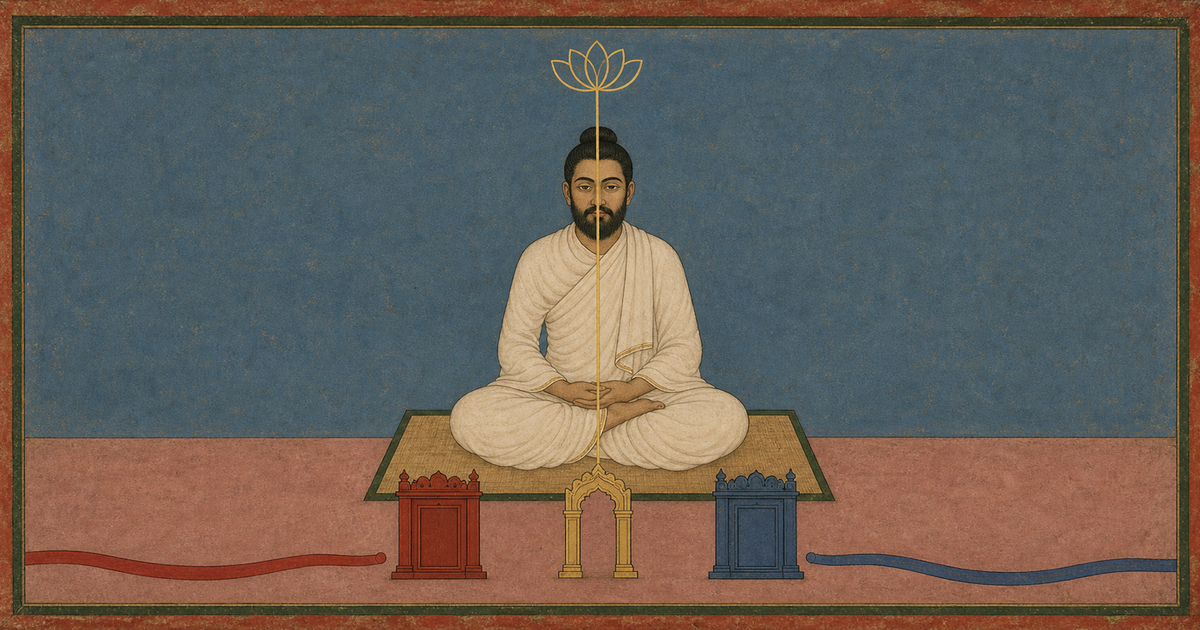
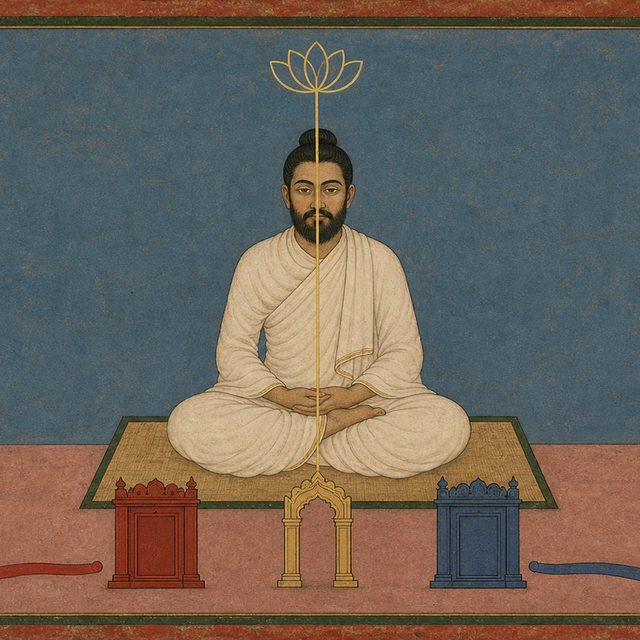
The breath-wind (mārutaḥ | nom sg), situated in the left and right channels (savya-dakṣiṇa-nāḍī-sthaḥ | nom sg m), moves (calati | 3p sg act pres) into the middle (madhye | loc sg). In that place (tasmin sthāne | loc sg) abides (tiṣṭhate | 3p sg med pres) Khecarī Mudrā (khecarī mudrā | nom sg); there is no doubt about this (na saṃśayaḥ | nom sg).
Dr. Ronald Steiner - 2026 - historically literal
Haṭha Pradīpikā 4.11*8
Metre: Anuṣṭubh
At the union of Iḍā and Piṅgalā (iḍā-piṅgalayoḥ yoge | loc sg), the void (śūnyam | nom acc sg n) itself (eva) should devour (graset | 3p sg act opt) the breath-wind (anilam | acc sg). There (tatra) abides (tiṣṭhate | 3p sg med pres) Khecarī Mudrā (khecarī mudrā | nom sg); this is true (satyam), and there is no doubt about it (na saṃśayaḥ | nom sg).
Dr. Ronald Steiner - 2026 - historically literal
Haṭha Pradīpikā 4.11*9
Metre: Anuṣṭubh
That (yā | nom sg f) Mudrā (mudrā | nom sg) which is situated between the pair of Soma and the sun (soma-sūrya-dvayoḥ madhye | loc sg), again (punaḥ) on the ground without support (nirālambe tale | loc sg), and established within the wheel of space (vyoma-cakre saṃsthitā | nom sg f ppp), that (sā | nom sg f) is called Khecarī (khecarī nāma | nom sg).
Dr. Ronald Steiner - 2026 - historically literal
Haṭha Pradīpikā 4.11*10
Metre: Anuṣṭubh
She (sā | nom sg f), the beautiful one (vāmā | nom sg f) opened up by me (mayā udbheditā | nom sg f ppp), directly (sākṣāt) Śiva's beloved (śiva-vallabhā | nom sg), Suṣumṇā (suṣumṇā | nom sg), should fill (pūrayet | 3p sg caus opt) the divine breath-wind (mārutaṃ divyam | acc sg m) at the rear opening (paścime mukhe | loc sg).
Dr. Ronald Steiner - 2026 - historically literal
Haṭha Pradīpikā 4.11*11
Metre: Anuṣṭubh
When she is filled (pūryeta | 3p sg pas opt) also precisely from the front (purastāt ca eva), Khecarī (khecarī | nom sg) surely arises (niścitā | nom sg f ppp). One should practise (abhyaset | 3p sg act opt) Khecarī Mudrā (khecarī-mudrām | acc sg); Unmanī (unmanī | nom sg) arises (saṃprajāyate | 3p sg med pres).
Dr. Ronald Steiner - 2026 - historically literal
Haṭha Pradīpikā 4.11*12
Metre: Anuṣṭubh
One should practise (abhyaset | 3p sg act opt) Khecarī Mudrā (khecarī-mudrām | acc sg) for so long (tāvat) that one is (syāt | 3p sg act opt) immersed in yogic sleep (yoga-nidritaḥ | nom sg m ppp). For one who has attained yogic sleep (saṃprāpta-yoga-nidrasya | gen sg), death (kālaḥ | nom sg) never (kadācana) exists (asti | 3p sg act pres).
Dr. Ronald Steiner - 2026 - historically literal
Haṭha Pradīpikā 4.11*13
Metre: Anuṣṭubh
Between the two brows (bhruvoḥ madhye | loc sg) is Śiva's abode (śiva-sthānam | nom acc sg); there (tatra) the mind (manas | nom acc sg) dissolves (vilīyate | 3p sg med pres). That fourth state (tat padaṃ turyam | nom acc sg n) is to be known (jñātavyam | nom acc sg n pfp); there (tatra) death (kālaḥ | nom sg) does not (na) exist (vidyate | 3p sg med pres).
Dr. Ronald Steiner - 2026 - historically literal
Haṭha Pradīpikā 4.11*14
Metre: Anuṣṭubh
Between the pair of moon and sun (candra-sūrya-dvayoḥ madhye | loc sg), one should apply (dadyāt | 3p sg act opt) Khecarī Mudrā (mudrāṃ khecarīm | acc sg), which is firmly established (vyavasthitām | acc sg f ppp) in the great unsupported void (nirālambe mahā-śūnye | loc sg n), in the wheel of space (vyoma-cakre | loc sg).
Dr. Ronald Steiner - 2026 - historically literal
HP 4.11*15-4.11*28: Space and Laya

Haṭha Pradīpikā 4.11*15-4.11*28: Space and Laya

Unsupported meditation on space, the abandonment of inner and outer thoughts, and the dissolution of mind and object define Laya.

Haṭha Pradīpikā 4.11*15
Metre: Anuṣṭubh
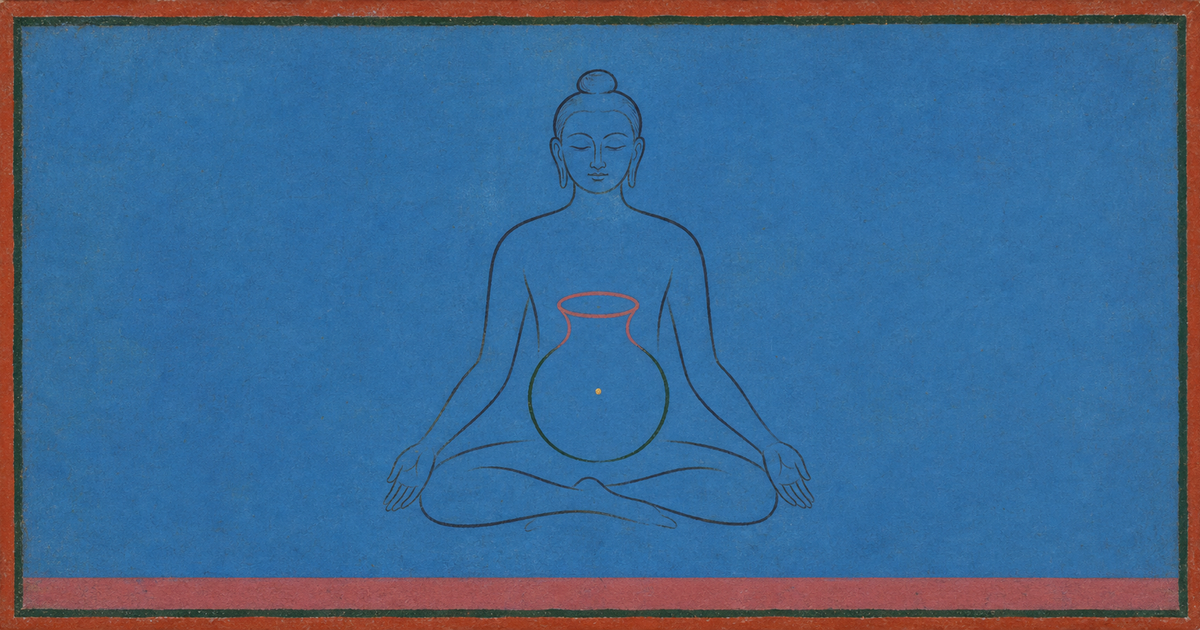
Having made the mind (manaḥ | nom acc sg) unsupported (nirālambaṃ kṛtvā | abs), one should not think (cintayet | 3p sg act opt) of anything at all (na kiṃcid api | nom acc sg n). Certainly (dhruvam), one remains (tiṣṭhate | 3p sg med pres) like a pot (ghaṭa-vat) in space (vyomni | loc sg), both within and without (sa-bāhya-abhyantare | loc sg n).
Dr. Ronald Steiner - 2026 - historically literal
Haṭha Pradīpikā 4.11*16
Metre: Anuṣṭubh
Just as (yathā) the external breath-wind (bāhya-vāyuḥ | nom sg) has dissolved (līnaḥ | nom sg m ppp) in the midst of space (khasya madhye | loc sg), so (tathā) Prāṇa (prāṇaḥ | nom sg) goes (gacchati | 3p sg act pres), without doubt (na saṃśayaḥ | nom sg), to its own place (svasthānam | acc sg). The final Pāda is text-critically uncertain: †in the region of the sun (sūrya-aṅge | loc sg), likewise (tathā), with the mind (manasā | ins sg)†.
Dr. Ronald Steiner - 2026 - historically literal
Haṭha Pradīpikā 4.11*17
Metre: Anuṣṭubh
For one who practises (abhyasyamānasya | gen sg m pcm) in this way (evam), day and night (divā-niśam), on the pathway of the breath (vāyu-mārge | loc sg), the breath-wind (vāyuḥ | nom sg) is consumed (jīryate | 3p sg med pres) through practice (abhyāsāt | abl sg), and the mind (manas | nom acc sg) dissolves (vilīyate | 3p sg med pres) there (tatra).
Dr. Ronald Steiner - 2026 - historically literal
Haṭha Pradīpikā 4.11*18
Metre: Anuṣṭubh
One should flood (plāvayet | 3p sg caus opt) the body (deham | acc sg), from the soles of the feet to the crown of the head (ā pāda-tala-mastakam | acc sg), with nectar (amṛtam | nom acc sg). The body (kāyaḥ | nom sg) truly (eva) becomes perfect (sidhyati | 3p sg act pres) forever (sadā) and possesses great strength and prowess (mahā-bala-parākramaḥ | nom sg m).
Dr. Ronald Steiner - 2026 - historically literal
Haṭha Pradīpikā 4.11*19
Metre: Anuṣṭubh
Having placed the mind (manaḥ | nom acc sg) in the midst of Śakti (śakti-madhye kṛtvā | abs) and Śakti (śaktim | acc sg) in the midst of the mind (mana-madhyagām | acc sg f), one should behold (ālokya | abs) the mind (mana | nom acc sg) with the mind (manasā | ins sg) and meditate (dhyāyet | 3p sg act opt) on that (tat | nom acc sg n) as the supreme state (paramaṃ padam | acc sg).
Dr. Ronald Steiner - 2026 - historically literal
Haṭha Pradīpikā 4.11*20
Metre: Anuṣṭubh
Place the self (ātmānam | acc sg) in the midst of space (kha-madhye | loc sg) and space (kham | acc sg) in the midst of the self (ātma-madhye | loc sg). Having made the self (ātmānam | acc sg) consist of space (kha-mayaṃ kṛtvā | abs), one should not think (cintayet | 3p sg act opt) of anything at all (na kiṃcid api | nom acc sg n).
Dr. Ronald Steiner - 2026 - historically literal
Haṭha Pradīpikā 4.11*21
Metre: Anuṣṭubh
Like an empty pot (śūnya-kumbhaḥ | nom sg) in space (ambare | loc sg), one is empty within (antaḥ-śūnyaḥ | nom sg m) and empty without (bahiḥ-śūnyaḥ | nom sg m); like a full pot (pūrṇa-kumbhaḥ | nom sg) in the ocean (arṇave | loc sg), one is full within (antaḥ-pūrṇaḥ | nom sg m) and full without (bahiḥ-pūrṇaḥ | nom sg m).
Dr. Ronald Steiner - 2026 - historically literal
Haṭha Pradīpikā 4.11*22
Metre: Anuṣṭubh
External thought (bāhya-cintā | nom sg) is not to be produced (na kartavyā | nom sg f pfp), and likewise (tathā), indeed (eva), neither is internal thought (antara-cintanam | nom acc sg). Having abandoned (parityajya | abs) all thought (sarva-cintām | acc sg), one should not think (cintayet | 3p sg act opt) of anything (na kiṃcit | nom acc sg n) whatsoever (api).
Dr. Ronald Steiner - 2026 - historically literal
Haṭha Pradīpikā 4.11*23
Metre: Vasantatilakā
The entire world (jagat samagram | nom acc sg n) is only (eva) a fabrication consisting of conception alone (saṃkalpa-mātra-kalanā | nom sg); for (hi) the fabrication consisting of conception alone (saṃkalpa-mātra-kalanā | nom sg) is the mind's play (mano-vilāsaḥ | nom sg). Therefore (ata), abandon (utsṛja | 2p sg act imp) this conception (saṃkalpam etam | acc sg), take refuge (āśritya | abs) in certainty free from conceptual alternatives (nirvikalpaṃ niścayam | acc sg), and attain (avāpnuhi | 2p sg act imp), O Rāma (rāma | voc sg), peace (śāntim | acc sg).
Dr. Ronald Steiner - 2026 - historically literal
Haṭha Pradīpikā 4.11*24
Metre: Anuṣṭubh
Just as (yadvat) camphor (karpūram | nom acc sg) dissolves in fire (anale | loc sg), and just as (yathā) salt (saindhavam | nom acc sg) dissolves in water (salile | loc sg), so (tathā) the mind (manas | nom acc sg), when joined (saṃdhīyamānam | nom acc sg n pcp), dissolves (vilīyate | 3p sg med pres) into reality (tattve | loc sg).
Dr. Ronald Steiner - 2026 - historically literal
Haṭha Pradīpikā 4.11*25
Metre: Anuṣṭubh
Everything that can be known (jñeyaṃ sarvam | nom acc sg n), what is perceived (pratītam | nom acc sg n ppp), and (ca) the knowledge of it (taj-jñānam | nom acc sg) is called (ucyate | 3p sg pas pres) mind (mana | nom acc sg). When knowledge (jñānam | nom acc sg) and what is knowable (jñeyam | nom acc sg n) have vanished (naṣṭam | nom acc sg n ppp) together (samam), there is no other (na anyaḥ | nom sg m), second path (panthāḥ dvitīyakaḥ | nom sg).
Dr. Ronald Steiner - 2026 - historically literal
Haṭha Pradīpikā 4.11*26
Metre: Anuṣṭubh
All of this (idaṃ sarvam | nom acc sg n), whatever (yat kiṃcit | nom acc sg n) is moving or unmoving (sa-cara-acaram | nom acc sg n), is an object seen by the mind (mano-dṛśyam | nom acc sg n pfp). For (hi), when the mind (manasaḥ | gen sg) is in the state of Unmanī (unmanī-bhāve | loc sg), they call (pracakṣate | 3p pl med pres) this the absence of duality (dvaita-abhāvam | acc sg).
Dr. Ronald Steiner - 2026 - historically literal
Haṭha Pradīpikā 4.11*27
Metre: Anuṣṭubh
Through the abandonment of knowable things (jñeya-vastu-parityāgāt | abl sg), the mind (mānasam | nom acc sg) goes (yāti | 3p sg act pres) into dissolution (vilayam | acc sg). When the mind (mānase | loc absl sg) has gone (yāte | loc absl sg ppp) into dissolution (vilayam | acc sg), Kaivalya (kaivalyam | nom acc sg) remains (avaśiṣyate | 3p sg pas pres).
Dr. Ronald Steiner - 2026 - historically literal
Haṭha Pradīpikā 4.11*28
Metre: Anuṣṭubh
“Laya, Laya” (layaḥ layaḥ | nom sg), thus (iti) they say (prāhuḥ | 3p pl act perf). Of what kind (kīdṛśam | nom acc sg n) is the defining mark of Laya (laya-lakṣaṇam | nom acc sg)? Because the Vāsanās do not arise again (a-punar-vāsanā-utthānāt | abl sg), Laya (layaḥ | nom sg) is the forgetting of sense objects (viṣaya-vismṛtiḥ | nom sg).
Dr. Ronald Steiner - 2026 - historically literal
HP 4.11*29-4.11*31: Transition to Nāda

Haṭha Pradīpikā 4.11*29-4.11*31: Transition to Nāda

Experiential paths to Samādhi, reverence for Suṣumṇā and Śakti, and Gorakṣa's teaching lead into the practice of Nāda.

Haṭha Pradīpikā 4.11*29
Metre: Anuṣṭubh
In this way (evam), various kinds of means (nānā-vidha-upāyāḥ | nom pl), properly (samyak) accompanied by personal experience (sva-anubhava-anvitāḥ | nom pl m ppp), were taught (kathitāḥ | nom pl m ppp) by the earlier great teachers (pūrva-ācāryaiḥ mahā-ātmabhiḥ | ins pl) as paths to Samādhi (samādhi-mārgāḥ | nom pl).
Dr. Ronald Steiner - 2026 - historically literal
Haṭha Pradīpikā 4.11*30
Metre: Anuṣṭubh
Homage (namas | nom acc sg) to you (tubhyam | dat sg): to Suṣumṇā (suṣumṇāyai | dat sg), to Kuṇḍalinī (kuṇḍalinyai | dat sg), to the nectar (sudhāyai | dat sg) within the lunar sphere (candra-maṇḍale | loc sg), to Manonmanī (manonmanyai | dat sg), and to the nature of the great Śakti as consciousness (mahā-śakti-cid-ātmane | dat sg).
Dr. Ronald Steiner - 2026 - historically literal
Haṭha Pradīpikā 4.11*31
Metre: Anuṣṭubh
For those for whom knowledge of reality is impossible (aśakya-tattva-bodhānām | gen pl), and also (api) for the deluded (mūḍhānām | gen pl m ppp), the recognized (saṃmatam | nom acc sg n ppp) practice of Nāda (nāda-upāsanam | nom acc sg), taught (proktam | nom acc sg n ppp) by Gorakṣanātha (gorakṣa-nāthena | ins sg), is set forth (ucyate | 3p sg pas pres).
Dr. Ronald Steiner - 2026 - historically literal
HP 4.12-4.19: Path of Nāda

Haṭha Pradīpikā 4.12-4.19: Nāda as the Best Path of Laya

Nāda Anusandhāna is explained and developed through the seat, Śāmbhavī Mudrā, listening to inner sound, and four stages.

Haṭha Pradīpikā 4.12
Metre: Upajāti
The twelve and a half million kinds of Laya (sa-pāda-koṭi-laya-prakārāḥ | nom pl) taught (kathitāḥ | nom pl m ppp) by Śrī Ādinātha (śrī-ādināthena | ins sg) excel (jayante | 3p pl med pres). Among the forms of dissolution (layānām | gen pl), we regard (manyāmahe | 1p pl med pres) the one (ekam | nom acc sg n), namely (eva), attending to the inner sound (nāda-anusaṃdhānakam | nom acc sg n), as the most venerable (mānyatamam | acc sg n).
Dr. Ronald Steiner - 2026 - historically literal
Haṭha Pradīpikā 4.13
Metre: Anuṣṭubh
The yogi (yogī | nom sg), seated in Muktāsana (mukta-āsana-sthitaḥ | nom sg m ppp), should assume (saṃdhāya | abs) Śāmbhavī Mudrā (mudrāṃ śāmbhavīm | acc sg) and, with one-pointed attention (eka-dhīḥ | nom sg), listen (śṛṇuyāt | 3p sg act opt) in the right ear (dakṣiṇe karṇe | loc sg) to the sound situated within (nādam antaḥ-stham | acc sg m).
Dr. Ronald Steiner - 2026 - historically literal
Haṭha Pradīpikā 4.14
Metre: Anuṣṭubh
Just as a fire (pravartito vahniḥ | nom sg m ppp) kindled in wood (kāṣṭhe | loc sg) becomes extinguished (śāmyati | 3p sg act pres) together with (saha) the wood (kāṣṭhena | ins sg), so the mind (cittam | nom acc sg), directed (pravartitam | nom acc sg n ppp) toward the inner sound (nāde | loc sg), dissolves (līyate | 3p sg med pres) together with (saha) the inner sound (nādena | ins sg).
Dr. Ronald Steiner - 2026 - historically literal
Haṭha Pradīpikā 4.15
Metre: Anuṣṭubh
Having forgotten (vismṛtya | abs) everything (sakalam | acc sg n) external (bāhyam | acc sg n), the mind (manaḥ | nom acc sg) becomes one in the inner sound (nāde | loc sg), like milk and water (dugdha-ambu-vat). Then (atha), having become one (ekī-bhūya | abs), it rapidly (sahasā) dissolves (vilīyate | 3p sg med pres) into the space of consciousness (cid-ākāśe | loc sg).
Dr. Ronald Steiner - 2026 - historically literal
Haṭha Pradīpikā 4.16
Metre: Anuṣṭubh
Having become (bhūtvā | abs), through constant practice (sadābhyāsena | ins sg), intent upon equanimity (audāsīnya-paraḥ | nom sg m), the self-controlled practitioner (saṃyamī | nom sg) should at once (sadyas) attend firmly (avadhārayet | 3p sg caus opt) only (eva) to the inner sound (nādam | acc sg), which brings about Unmanī (unmanī-karaṇam | nom acc sg).
Dr. Ronald Steiner - 2026 - historically literal
Haṭha Pradīpikā 4.17
Metre: Śālinī
In the cold season (śīte kāle | loc sg), it is all the same whether one stays in the open (caupaṭī) or in a hut (kuṭī); with wholesome food (pathyāhāre | loc sg), whether cow's milk (go-payaḥ | nom acc sg) or water (payaḥ | nom acc sg); for food (bhojye | loc sg), whether a quantity of alms or forest roots (bhikṣā-vṛndam āraṇya-kandam | nom acc sg); and for an eating vessel (bhojya-pātre | loc sg), whether the hand (pāṇiḥ | nom sg) or any bowl (kā api droṇī | nom sg).
Dr. Ronald Steiner - 2026 - historically literal
Haṭha Pradīpikā 4.18
Metre: Anuṣṭubh
Having forever (sarvadā) entirely abandoned (samutsṛjya | abs) all thoughts (sarva-cintām | acc sg) and all activity (sarva-ceṣṭām | acc sg), the mind (cittam | nom acc sg), through attending (anusaṃdhānāt | abl sg) only (eva) to the inner sound (nādam | acc sg), dissolves (vilīyate | 3p sg med pres) into the inner sound (nāde | loc sg).
Dr. Ronald Steiner - 2026 - historically literal
Haṭha Pradīpikā 4.19
Metre: Anuṣṭubh
Beginning (ārambhaḥ | nom sg), integration (ghaṭaḥ | nom sg), likewise (tathā) familiarity (paricayaḥ | nom sg), and consummation (niṣpattiḥ | nom sg): these (tāḥ | nom pl f) are (bhavanti | 3p pl act pres) the stages of yoga (yoga-avasthāḥ | nom pl) in all yogas (sarva-yogeṣu | loc pl).
Dr. Ronald Steiner - 2026 - historically literal
HP 4.20-4.27: Four Stages of Nāda

Haṭha Pradīpikā 4.20-4.27: The Four Stages of Nāda Practice

From Ārambha through Ghaṭa and Paricaya to Niṣpatti, knots are pierced, sounds become subtler, and Rājayoga arises.

Haṭha Pradīpikā 4.20
Metre: Anuṣṭubh
Through the piercing (bhedāt | abl sg) of the Brahma knot (brahma-grantheḥ | gen sg), joy (ānandaḥ | nom sg) arising from the void (śūnya-saṃbhavaḥ | nom sg m) comes about (bhavet | 3p sg act opt). Within the body (dehe | loc sg), the unstruck sound (anāhataḥ dhvaniḥ | nom sg), resonating in manifold ways (vicitra-kvaṇakaḥ | nom sg m), is heard (śrūyate | 3p sg pas pres).
Dr. Ronald Steiner - 2026 - historically literal
Haṭha Pradīpikā 4.21
Metre: Anuṣṭubh
At the beginning stage (ārambhe | loc sg), in the void (śūnye | loc sg n), the yogi established in yoga (yogavān | nom sg m) becomes (bhavet | 3p sg act opt) one with a divine body (divya-dehaḥ | nom sg), radiant (tejasvī | nom sg m), divinely fragrant (divya-gandhaḥ | nom sg), free from illness (arogavān | nom sg m), and full in heart (saṃpūrṇa-hṛdayaḥ | nom sg).
Dr. Ronald Steiner - 2026 - historically literal
Haṭha Pradīpikā 4.22
Metre: Anuṣṭubh
In the second stage (dvitīyāyām | loc sg f), after integration has been effected (ghaṭī-kṛtya | abs), the breath-wind (vāyuḥ | nom sg) becomes (bhavati | 3p sg act pres) one that moves in the middle (madhya-gaḥ | nom sg m). Then (tadā) the yogi (yogī | nom sg) becomes (bhavet | 3p sg act opt) firm in posture (dṛḍha-āsanaḥ | nom sg m), knowledgeable (jñānī | nom sg), and equal to a god (deva-samaḥ | nom sg m).
Dr. Ronald Steiner - 2026 - historically literal
Haṭha Pradīpikā 4.23
Metre: Anuṣṭubh
Then (tadā), through the piercing (bhedāt | abl sg) of the Viṣṇu knot (viṣṇu-grantheḥ | gen sg), an indication of supreme joy (parama-ānanda-sūcakaḥ | nom sg m) arises. In the great void (atiśūnye | loc sg n), there then (tadā) arises (bhavet | 3p sg act opt) a reverberation (vimardaḥ | nom sg) and (ca) the sound of a Bherī drum (bherī-śabdaḥ | nom sg).
Dr. Ronald Steiner - 2026 - historically literal
Haṭha Pradīpikā 4.24
Metre: Anuṣṭubh
In the third stage (tṛtīyāyām | loc sg f), having then (tatas) pierced through (bhittvā | abs), the sound of a Mardala drum appears in space (vihāyo-mardala-dhvaniḥ | nom sg). Then (tadā) one enters (yāti | 3p sg act pres) the great void (mahā-śūnyam | acc sg), the abode of all accomplishments (sarva-siddhi-samāśrayam | acc sg).
Dr. Ronald Steiner - 2026 - historically literal
Haṭha Pradīpikā 4.25
Metre: Anuṣṭubh
Having then (tatas) overcome (jitvā | abs) the joy of the mind (citta-ānandam | acc sg), innate joy arises (sahaja-ānanda-saṃbhavaḥ | nom sg m). One is free from disease, suffering, old age, death, hunger, and sleep (doṣa-duḥkha-jarā-mṛtyu-kṣudhā-nidrā-vivarjitaḥ | nom sg m ppp).
Dr. Ronald Steiner - 2026 - historically literal
Haṭha Pradīpikā 4.26
Metre: Anuṣṭubh
Having then (tatas) pierced (bhittvā | abs) the Rudra knot (rudra-granthim | acc sg), the breath (anilaḥ | nom sg) has entered all seats (sarva-pīṭha-gataḥ | nom sg m ppp). At consummation (niṣpattau | loc sg), the flute-like sound (vaiṇavaḥ śabdaḥ | nom sg) becomes (bhavet | 3p sg act opt) the resonance of a sounding Vīṇā (kvaṇad-vīṇā-kvaṇaḥ | nom sg).
Dr. Ronald Steiner - 2026 - historically literal
Haṭha Pradīpikā 4.27
Metre: Anuṣṭubh
When the mind (cittam | nom acc sg) has then (tadā) become one (ekī-bhūtam | nom acc sg n ppp), this is designated Rājayoga (rāja-yoga-abhidhāyakam | nom acc sg n). This (asau | nom sg m) yogi becomes (bhavet | 3p sg act opt) a creator and dissolver (sṛṣṭi-saṃhāra-kartā | nom sg), equal to the Lord of yogis (yogī-īśvara-samaḥ | nom sg m).
Dr. Ronald Steiner - 2026 - historically literal
HP 4.27*1-4.35: Rājayoga and Haṭha

Haṭha Pradīpikā 4.27*1-4.35: Rājayoga and Haṭha

Nāda Laya, Haṭha, and Rājayoga are connected; names, conditions, and two approaches to the highest state are gathered.

Haṭha Pradīpikā 4.27*1
Metre: Anuṣṭubh
For people of limited understanding (alpa-cetasām | gen pl), an easy means (sukha-upāyaḥ | nom sg) is given for attaining the state of Rājayoga (rāja-yoga-pada-prāptau | loc sg): Laya born of Nāda (nāda-jaḥ layaḥ | nom sg) arises (jāyate | 3p sg med pres) and at once (sadyas) gathers attention (pratyaya-saṃdhāyī | nom sg m).
Dr. Ronald Steiner - 2026 - historically literal
Haṭha Pradīpikā 4.28
Metre: Anuṣṭubh
Whether liberation (muktiḥ | nom sg) be (astu | 3p sg act imp), or (vā) not (mā) be (astu | 3p sg act imp), or (vā) otherwise: here (atra), indeed (eva), a great (mahat | nom acc sg n), unbroken (akhaṇḍitam | nom acc sg n) happiness consisting of the nectar of dissolution (laya-amṛta-mayaṃ saukhyam | nom acc sg) is attained (avāpyate | 3p sg pas pres) through Rājayoga (rāja-yogāt | abl sg).
Dr. Ronald Steiner - 2026 - historically literal
Haṭha Pradīpikā 4.29
Metre: Anuṣṭubh
Without (vinā) Haṭha (haṭham | acc sg), Rājayoga (rāja-yogaḥ | nom sg) does not (na) succeed (sidhyati | 3p sg act pres); without (vinā) Rājayoga (rāja-yogam | acc sg), Haṭha (haṭhaḥ | nom sg) does not succeed. Therefore (tatas), one should practise (samabhyaset | 3p sg act opt) both together (yugmam | acc sg) up to (ā) consummation (niṣpatteḥ | abl sg).
Dr. Ronald Steiner - 2026 - historically literal
Haṭha Pradīpikā 4.30
Metre: Anuṣṭubh
Those who do not know (ajānantaḥ | nom pl m pca) Rājayoga (rāja-yogam | acc sg) and are occupied solely (kevalam) with Haṭha practices (haṭha-karmaṭhāḥ | nom pl m), those (tān | acc pl m), however (tu), I consider (manye | 1p sg med pres) to be laborers (karṣakān | acc pl) deprived of the fruit of their exertion (prayāsa-phala-varjitān | acc pl m ppp).
Dr. Ronald Steiner - 2026 - historically literal
Haṭha Pradīpikā 4.31
Metre: Anuṣṭubh
Reality (tattvam | nom acc sg) is the seed (bījam | nom acc sg), Haṭha (haṭhaḥ | nom sg) the field (kṣetram | nom acc sg), and equanimity (audāsīnyam | nom acc sg) the water (jalam | nom acc sg). Through these three (tribhiḥ | ins pl), the wish-fulfilling vine of Unmanī (unmanī-kalpa-latikā | nom sg) will immediately (sadyas), indeed (eva), sprout (udbhaviṣyati | 3p sg act fut).
Dr. Ronald Steiner - 2026 - historically literal
Haṭha Pradīpikā
Metre: Anuṣṭubh
Rājayoga (rāja-yogaḥ | nom sg), Samādhi (samādhiḥ | nom sg), Unmanī (unmanī | nom sg), Manonmanī (manonmanī | nom sg), and also (api) Amaraugha (amaraughaḥ | nom sg), non-duality (advaitam | nom acc sg n), the unsupported (nirālambam | nom acc sg n), the stainless (nirañjanam | nom acc sg n), freedom from mind (amanaskaḥ | nom sg m), dissolution (layaḥ | nom sg), reality (tattvam | nom acc sg n), the void-and-non-void (śūnya-aśūnyam | nom acc sg n), the supreme state (paraṃ padam | nom acc sg n), liberation while living (jīvan-muktiḥ | nom sg), the natural (sahajam | nom acc sg n), and the fourth state (turyam | nom acc sg n) are expressions for one and the same thing (eka-vācakāḥ | nom pl m).
Dr. Ronald Steiner - 2026 - historically literal
Haṭha Pradīpikā 4.34
Metre: Anuṣṭubh
For the swift (śīghram) attainment of Unmanī (unmanī-avāptaye | dat sg), two paths (mārgau dvau | nom du m) are recognized (saṃmatau | nom du m ppp) by me (mama | gen sg): reality or supreme happiness (tattvaṃ parama-saukhyaṃ vā | nom acc sg), and (ca) indeed (eva) devotion to the inner sound (nāda-upāsanam | nom acc sg).
Dr. Ronald Steiner - 2026 - historically literal
Haṭha Pradīpikā 4.35
Metre: Anuṣṭubh
This is recognized (saṃmatam | nom acc sg n ppp) even (api) for the deluded (mūḍhānām | gen pl m), whose minds are absorbed in pleasure (saukhya-praviṣṭa-cittānām | gen pl): Laya born of Nāda (nāda-jaḥ layaḥ | nom sg) arises (jāyate | 3p sg med pres) and immediately produces joy (sadya-ānanda-saṃdhāyī | nom sg m).
Dr. Ronald Steiner - 2026 - historically literal
HP 4.35*1-4.36: Signs of Samādhi

Haṭha Pradīpikā 4.35*1-4.36: Signs of Unmanī and Samādhi

Unmanī and Samādhi appear as liberation beyond sensory perception, movement of the breath, honor, suffering, and ordinary consciousness.

Haṭha Pradīpikā 4.35*1
Metre: Anuṣṭubh
A seed consisting of creation (sṛṣṭi-mayaṃ bījam | nom acc sg), one (ekā | nom sg f) Mudrā (mudrā | nom sg), namely (ca) Khecarī (khecarī | nom sg); one god (ekaḥ devaḥ | nom sg), the unsupported (nirālamba | nom sg m), and one state (ekāvasthā | nom sg), Manonmanī (manonmanī | nom sg).
Dr. Ronald Steiner - 2026 - historically literal
Haṭha Pradīpikā 4.35*2
Metre: Anuṣṭubh
One does not (na) ever (kadācana) hear (śṛṇoti | 3p sg act pres) the sound of conch and drum (śaṅkha-dundubhi-nādam | acc sg). Through the state of Unmanī (unmany-avasthayā | ins sg), the body (dehaḥ | nom sg) surely (dhruvam) becomes (jāyate | 3p sg med pres) like wood (kāṣṭha-vat).
Dr. Ronald Steiner - 2026 - historically literal
Haṭha Pradīpikā 4.35*3
Metre: Anuṣṭubh
Free from all states (sarvāvasthā-vinirmuktaḥ | nom sg m ppp) and free from all thoughts (sarva-cintā-vivarjitaḥ | nom sg m ppp), the yogi (yogī | nom sg) remains (tiṣṭhate | 3p sg med pres) as if dead (mṛtavat). He (saḥ | nom sg m) is liberated (muktaḥ | nom sg m ppp); here (atra) there is no (na) doubt (saṃśayaḥ | nom sg).
Dr. Ronald Steiner - 2026 - historically literal
Haṭha Pradīpikā 4.35*4
Metre: Anuṣṭubh
The yogi (yogī | nom sg), joined (yuktaḥ | nom sg m ppp) through Samādhi (samādhinā | ins sg), knows (jānāti | 3p sg act pres), indeed (hi), neither (na) cold and heat (śītoṣṇam | acc sg n), nor suffering (duḥkham | acc sg), nor happiness (sukham | acc sg), and likewise (tathā) neither honor (mānam | acc sg) nor dishonor (apamānam | acc sg).
Dr. Ronald Steiner - 2026 - historically literal
Haṭha Pradīpikā 4.35*5
Metre: Anuṣṭubh
The yogi (yogī | nom sg), joined (yuktaḥ | nom sg m ppp) through Samādhi (samādhinā | ins sg), knows (vetti | 3p sg act pres) neither (na) smell (gandham | acc sg), taste (rasam | acc sg), form (rūpam | acc sg), touch (sparśanam | acc sg), nor (na ca) what is heard (śrutam | acc sg n ppp), neither oneself (ātmānam | acc sg) nor (na) another (param | acc sg).
Dr. Ronald Steiner - 2026 - historically literal
Haṭha Pradīpikā 4.35*6
Metre: Anuṣṭubh
The yogi (yogī | nom sg), joined (yuktaḥ | nom sg m ppp) through Samādhi (samādhinā | ins sg), cannot be pierced by any weapons (avedhyaḥ sarva-śastrāṇām | nom sg m pfp), cannot be killed by any embodied beings (avadhyaḥ sarva-dehinām | nom sg m pfp), and cannot be seized by Mantras or Tantras (agrāhyo mantra-tantrāṇām | nom sg m pfp).
Dr. Ronald Steiner - 2026 - historically literal
Haṭha Pradīpikā 4.35*7
Metre: Anuṣṭubh
One whose (yasya | gen sg) mind (cittam | nom acc sg) is neither asleep (na suptam | nom acc sg n ppp) nor awake (no jāgrat | nom acc sg n pca), neither possessed of memory (smṛtimān na | nom sg m) nor otherwise (na ca anyathā), neither sets (na astam eti | 3p sg act pres) nor rises (na ca udeti | 3p sg act pres), that very person (asau saḥ | nom sg m) is indeed (eva) liberated (muktaḥ | nom sg m ppp).
Dr. Ronald Steiner - 2026 - historically literal
Haṭha Pradīpikā 4.35*8
Metre: Anuṣṭubh
One who (yaḥ | nom sg m), in the waking state (jāgrad-avasthāyām | loc sg), rests in oneself (svasthaḥ | nom sg m) and remains (avatiṣṭhate | 3p sg med pres) as though asleep (suptavat), but (tu) free from inhalation and exhalation (niḥśvāsa-ucchvāsa-hīnaḥ | nom sg m ppp), that person (saḥ | nom sg m) is certainly (niścitam) liberated (muktaḥ | nom sg m ppp), indeed (eva).
Dr. Ronald Steiner - 2026 - historically literal
Haṭha Pradīpikā 4.36
Metre: Upajāti
The one (ekam | acc sg m) joy inexpressible (avācyam ānandam | acc sg m) by words (vacasām | gen pl), which has arisen (prarūḍham | acc sg m ppp) in the heart (hṛdaye | loc sg) of the lords among yogis (yogī-īśvarāṇām | gen pl) who experience Nāda-Anusaṃdhāna-Samādhi (nāda-anusaṃdhāna-samādhi-bhājām | gen pl m), that (tam | acc sg m) is known (jānāti | 3p sg act pres) only (eva) by the venerable lordly guru (śrī-guru-nāthaḥ | nom sg).
Dr. Ronald Steiner - 2026 - historically literal
HP 4.37-4.46: Listening to Nāda

Haṭha Pradīpikā 4.37-4.46: Listening to and Refining Nāda

Listening, the receding of external sounds, and the sequence from coarse sounds of nature to subtle humming collect the mind.

Haṭha Pradīpikā 4.37
Metre: Anuṣṭubh
One who desires (icchatā | ins sg m pca) sovereignty in yoga (yoga-sāmrājyam | acc sg), having abandoned (parityajya | abs) all thoughts (sarva-cintām | acc sg), should with an attentive mind (sāvadhānena cetasā | ins sg) follow (anusaṃdheyaḥ | nom sg m pfp) only (eva) the inner sound (nādaḥ | nom sg).
Dr. Ronald Steiner - 2026 - historically literal
Haṭha Pradīpikā 4.38
Metre: Anuṣṭubh
Having closed (pidhāya | abs) both ears (karṇau | acc du) with cotton (tūlena | ins sg), the sage (muniḥ | nom sg) should make (sthirī-kuryāt | 3p sg act opt) the mind (cittam | nom acc sg) steady there (tatra), upon the sound (dhvanim | acc sg) which (yam | acc sg m) one hears (śṛṇoti | 3p sg act pres), until (yāvat) one reaches (vrajet | 3p sg act opt) the stable state (sthira-padam | acc sg).
Dr. Ronald Steiner - 2026 - historically literal
Haṭha Pradīpikā 4.39
Metre: Anuṣṭubh
When practised (abhyasyamānaḥ | nom sg m pcp), this inner sound (nādo'yam | nom sg m) covers over (āvṛṇute | 3p sg med pres) external sound (bāhyam dhvanim | acc sg m). Having conquered (jitvā | abs) every distraction (vikṣepam akhilam | acc sg m) after a fortnight (pakṣāt | abl sg), the yogi (yogī | nom sg) becomes (bhavet | 3p sg act opt) happy (sukhī | nom sg m).
Dr. Ronald Steiner - 2026 - historically literal
Haṭha Pradīpikā 4.40
Metre: Anuṣṭubh
During the initial practice (prathamābhyāse | loc sg), the inner sound (nādaḥ | nom sg), great and of many kinds (nānā-vidho mahān | nom sg m), is heard (śrūyate | 3p sg pas pres). When the practice (abhyāse | loc sg) then (tatas) increases (vardhamāne | loc sg m n pca), it is heard (śrūyate | 3p sg pas pres) as progressively subtler (sūkṣma-sūkṣmataḥ).
Dr. Ronald Steiner - 2026 - historically literal
Haṭha Pradīpikā 4.41
Metre: Anuṣṭubh
At first (ādau | loc sg), sounds arise like those of the ocean, clouds, a drum, and a waterfall (jaladhi-jīmūta-bherī-nirjhara-saṃbhavāḥ | nom pl m); in the middle (madhye | loc sg), they arise like a Mardala drum and conch (mardala-śaṃkhotthāḥ | nom pl m), and likewise (tathā) they are born of a bell and trumpet (ghaṇṭā-kāhala-jāḥ | nom pl m).
Dr. Ronald Steiner - 2026 - historically literal
Haṭha Pradīpikā 4.42
Metre: Anuṣṭubh
At the end (ante | loc sg), however (tu), there are the sounds of small bells, flute, Vīṇā, and bee (kiṅkiṇī-vaṃśa-vīṇā-bhramara-nisvanāḥ | nom pl). Thus (iti), various kinds of sounds (nānā-vidhā nādāḥ | nom pl m) are heard (śrūyante | 3p pl pas pres) from the center of the body (deha-madhyataḥ).
Dr. Ronald Steiner - 2026 - historically literal
Haṭha Pradīpikā 4.43
Metre: Anuṣṭubh
Even when (api) a loud (mahati | loc sg m n) sound of clouds, drums, and the like (megha-bhery-ādika-dhvanau | loc sg) is being heard (śrūyamāṇe | loc sg m n pcp), one should apprehend (parāmṛśet | 3p sg act opt) within it (tatra), beginning from the subtle (sūkṣmāt | abl sg n), only (eva) the still subtler sound (sūkṣmataraṃ nādam | acc sg m).
Dr. Ronald Steiner - 2026 - historically literal
Haṭha Pradīpikā 4.44
Metre: Anuṣṭubh
Having abandoned (utsṛjya | abs) the dense sound (ghanam | acc sg n), one may remain in the subtle (sūkṣme | loc sg n); or (vā), having abandoned (utsṛjya | abs) the subtle (sūkṣmam | acc sg n), one may remain in the dense (ghane | loc sg n); or (vā), having abandoned (tyaktvā | abs) both (tau | acc du n), one may remain (syād | 3p sg act opt) in the middle (madhyame | loc sg n). One should not move (cālayet | 3p sg act opt caus) the mind (manas | nom acc sg) elsewhere (nānyatra).
Dr. Ronald Steiner - 2026 - historically literal
Haṭha Pradīpikā 4.45
Metre: Anuṣṭubh
Wherever (yatra) at all (kutrāpi), or (vā) upon whichever sound (nāde | loc sg), the mind (manaḥ | nom acc sg) first (prathamam) becomes attached (lagati | 3p sg act pres), there precisely (tatraiva) this (tat | nom acc sg n) becomes steady (sthirībhūtvā | abs) and dissolves (vilīyate | 3p sg med pres) together with it (tena sārdham).
Dr. Ronald Steiner - 2026 - historically literal
Haṭha Pradīpikā 4.46
Metre: Anuṣṭubh
Just as (yathā) a bee drinking (piban bhṛṅgaḥ | nom sg) the nectar of flowers (makarandam | acc sg) does not attend (nāpekṣate | 3p sg med pres) to their fragrances (gandhān | acc pl), so (tathā) the mind attached to Nāda (nādāsaktaṃ cittam | nom acc sg) does not indeed (na hi) desire (kāṅkṣate | 3p sg med pres) the sense objects (viṣayān | acc pl).
Dr. Ronald Steiner - 2026 - historically literal
HP 4.47-4.55*4: Nāda Binds the Mind

Haṭha Pradīpikā 4.47-4.55*4: Nāda Binds the Mind

Nāda binds the fleeting mind, weakens sensory stimuli, and leads attention from sound to soundless Brahman.

Haṭha Pradīpikā 4.47
Metre: Anuṣṭubh
Through processing with the sulfur of Nāda (nāda-gandhaka-jāraṇāt | abl sg), the mercury of the mind (manaḥ-pāradam | nom acc sg) is bound (baddham | nom acc sg n ppp), freed from its restlessness (vimukta-cāñcalyam | nom acc sg), and attains (āpnoti | 3p sg act pres) the immobility called unsupported (nirālambākhya-khoṭatām | acc sg).
Dr. Ronald Steiner - 2026 - historically literal
Haṭha Pradīpikā 4.47*1
Metre: Anuṣṭubh
Bound (baddhaḥ | nom sg m ppp) by the good sulfur of Nāda (su-nāda-gandhena | ins sg), the lord of the mercury of mind (cetaḥ-sūtendraḥ | nom sg), immediately (sadyaḥ) relinquishing his restlessness (saṃtyakta-cāpalaḥ | nom sg m), attains (prayāti | 3p sg act pres) the renown (prathām | acc sg) of being “one whose wings are clipped” (pakṣa-chinna | nom sg m), thus (iti).
Dr. Ronald Steiner - 2026 - historically literal
Haṭha Pradīpikā 4.48
Metre: Anuṣṭubh
Through hearing Nāda (nāda-śravaṇataḥ | abl sg), the inner serpent (antaraṅga-bhujaṅgamaḥ | nom sg), the mind (cittam | nom acc sg), forgets everything (sarvam | acc sg n); one-pointed (ekāgraḥ | nom sg m), it indeed (hi) no longer runs (dhāvati | 3p sg act pres) anywhere (kutracin na).
Dr. Ronald Steiner - 2026 - historically literal
Haṭha Pradīpikā 4.49
Metre: Anuṣṭubh
This inner resonance (ayaṃ ninādaḥ | nom sg) is a sharp goad (niśita-aṅkuśaḥ | nom sg), capable of restraining (niyāmana-samarthaḥ | nom sg m) the intoxicated king-elephant of the mind (mano-matta-gajendrasya | gen sg), which roams in the garden of sense objects (viṣaya-udyāna-cāriṇaḥ | gen sg m).
Dr. Ronald Steiner - 2026 - historically literal
Haṭha Pradīpikā 4.50
Metre: Anuṣṭubh
Devotion to the inner sound (nādopāstiḥ | nom sg) becomes a barrier (parighāyate | 3p sg med pres denom) for the swift horse of the inner faculty (antaraṅgasya javino vājinaḥ | gen sg); therefore (ataḥ), it must also always (nityam) be attended to (avadhāryāpi | nom sg f pfp) by the yogi (yoginā | ins sg).
Dr. Ronald Steiner - 2026 - historically literal
Haṭha Pradīpikā 4.50*1
Metre: Anuṣṭubh
Nāda (nādaḥ | nom sg) becomes a net (vāgurāyate | 3p sg med pres denom) for capturing the antelope of the inner faculty (antaraṅga-sāraṅga-bandhane | loc sg); and also (api ca), for restraining (rodhe | loc sg) the horse of the inner faculty (antaraṅga-kuraṅgasya | gen sg), it becomes a rein (valgāyate | 3p sg med pres denom).
Dr. Ronald Steiner - 2026 - historically literal
Haṭha Pradīpikā 4.51
Metre: Upagīti
If (cet) the archer (śara-saṃdhātā | nom sg) is skilled (pravīṇaḥ | nom sg m), striking (praharaṇam | nom acc sg) the deer of the inner instrument, transfixed and stilled by attachment to sounds such as that of a bell (ghaṇṭādi-nāda-sakta-stabdhāntaḥkaraṇa-hariṇasya | gen sg), would be (syāt | 3p sg act opt) very easy (ati-sukaram | nom acc sg n).
Dr. Ronald Steiner - 2026 - historically literal
Haṭha Pradīpikā 4.52
Metre: Anuṣṭubh
The resonance (dhvaniḥ | nom sg) of that sound (tasya śabdasya | gen sg) is the resonance of the unstruck sound (anāhatasya śabdasya | gen sg). Within the resonance (dhvaneḥ | gen sg) is light (antargataṃ jyotiḥ | nom sg n); within the light (jyotiḥ) is the mind (antargataṃ manaḥ | nom acc sg). That mind (tan manaḥ | nom acc sg) goes (yāti | 3p sg act pres) into dissolution (vilayam | acc sg); that (tad | nom acc sg n) is Viṣṇu's (viṣṇoḥ | gen sg) supreme state (paramaṃ padam | nom acc sg).
Dr. Ronald Steiner - 2026 - historically literal
Haṭha Pradīpikā 4.52*1
Metre: Anuṣṭubh
When the mind (manas | nom sg) goes (yāti | 3p sg act pres) into dissolution (layam | acc sg) there (tatra), where within (antar) the unstruck resonance (anāhata-dhvaneḥ | gen sg) is the knowable (jñeyam | nom acc sg n), which (yat | nom acc sg n) is exceedingly subtle (sūkṣma-sūkṣmakam | nom acc sg n), then that (tad | nom acc sg n) is Viṣṇu's (viṣṇoḥ | gen sg) supreme state (paramaṃ padam | nom acc sg).
Dr. Ronald Steiner - 2026 - historically literal
Haṭha Pradīpikā 4.53
Metre: Anuṣṭubh
For so long (tāvat) as sound (śabdaḥ | nom sg) continues (pravartate | 3p sg med pres), the conception of space (ākāśa-saṃkalpaḥ | nom sg) also continues, for as long (yāvat) as sound itself continues. The soundless (niḥśabdam | nom acc sg n), that supreme Brahman (tat paraṃ brahma | nom acc sg), is declared (samīryate | 3p sg pas pres) to be the supreme self (paramātmā | nom sg).
Dr. Ronald Steiner - 2026 - historically literal
Haṭha Pradīpikā 4.54
Metre: Anuṣṭubh
Whatever (yat kiṃcin) is heard (śrūyate | 3p sg pas pres) in the form of the inner sound (nāda-rūpeṇa | ins sg), that is indeed (eva) Śakti (śaktiḥ | nom sg). The formless hearer of it (yas tac-chrotā nirākāraḥ | nom sg), that one (sa | nom sg m) is indeed (eva) the supreme Lord (parama-īśvaraḥ | nom sg).
Dr. Ronald Steiner - 2026 - historically literal
Haṭha Pradīpikā 4.55
Metre: Upagīti
Closing the ears, mouth, eyes, and nose (śravaṇa-mukha-nayana-nāsā-nirodhanam | nom acc sg) is by no means (na eva) to be done (kartavyam | nom acc sg n pfp). Along the pathway of purified Suṣumṇā (śuddha-suṣumṇā-saraṇau | loc sg), the pure inner sound (amalaḥ nādaḥ | nom sg) is heard (śrūyate | 3p sg pas pres) distinctly (sphuṭam).
Dr. Ronald Steiner - 2026 - historically literal
Haṭha Pradīpikā 4.55*1
Metre: Anuṣṭubh
The inner sound (nādaḥ | nom sg) is known (khyātaḥ | nom sg m ppp) as Śakti (śaktiḥ | nom sg), thus (iti); knowledge of Nāda (nāda-jñānam | nom acc sg) is Sadāśiva (sadā-śivaḥ | nom sg). But (tu) when the knowable (jñeye | loc sg) and (ca) knowledge (jñāne | loc sg) have vanished (naṣṭe | loc absl), only (eva) Unmanī (unmanī | nom sg), the state beyond mind, remains (avaśiṣyate | 3p sg med pres).
Dr. Ronald Steiner - 2026 - historically literal
Haṭha Pradīpikā 4.55*2
Metre: Anuṣṭubh
As long as (yāvat) there is inner sound (nādaḥ | nom sg), so long (tāvat) there is mind (manas | nom acc sg). At the end of Nāda (nādānte | loc sg), however (tu), Manonmanī, the state beyond mind (manas-unmanī | nom sg), arises. Space (vyoma | nom acc sg) is said (kathitam | nom acc sg n ppp) to possess sound (sa-śabdam | nom acc sg n); Brahman (brahma | nom acc sg) is said (kathyate | 3p sg pas pres) to be soundless (niḥ-śabdam | nom acc sg n).
Dr. Ronald Steiner - 2026 - historically literal
Haṭha Pradīpikā 4.55*3
Metre: Anuṣṭubh
Through constant (sadā) immersion in Nāda (nāda-anusaṃdhānāt | abl sg), when the accumulation of Vāsanās has been exhausted (saṃkṣīṇe vāsanā-caye | loc absl sg), mind and breath-wind (mana-mārutau | nom du) certainly (niścitam) dissolve (vilīyete | 3p du med pres) into the stainless (nirañjane | loc sg).
Dr. Ronald Steiner - 2026 - historically literal
Haṭha Pradīpikā 4.55*4
Metre: Anuṣṭubh
Thousands of Koṭis of inner sounds (nāda-koṭi-sahasrāṇi | nom pl n) and (ca) hundreds of Koṭis of visual concentration points (bindu-koṭi-śatāni | nom pl n), all of them (sarve | nom pl m), enter dissolution (layam | acc sg) there (tatra) where (yatra) the stainless god is (devo nirañjanaḥ | nom sg). A Koṭi denotes ten million.
Dr. Ronald Steiner - 2026 - historically literal
HP 4.56-4.66: The Middle Path

Haṭha Pradīpikā 4.56-4.66: Suṣumṇā and the Middle Path

The text turns from talk to practice: breath, Bindu, Suṣumṇā, Kuṇḍalinī, and Manonmanī form the secret middle path.

Haṭha Pradīpikā 4.56
Metre: Anuṣṭubh
What use is (kim) the dry discourse of an assembly of scholars (kāṣṭha-goṣṭhī-prapañcena | ins sg), friend (sakhe | voc sg)? Let this (idam | nom acc sg n) utterance (vacaḥ | nom acc sg), spoken long ago (purā) by the first Lord (ādi-nāthoditam | nom acc sg n ppp) in order to awaken Matsyendra (matsyendra-bodhārtham | acc sg), be heard (śrūyatām | 3p sg imp pas).
Dr. Ronald Steiner - 2026 - historically literal
Haṭha Pradīpikā 4.57
Metre: Mandākrāntā
As long as (yāvat) the moving breath-wind (caran mārutaḥ | nom sg) does not (naiva) enter (praviśati | 3p sg act pres) the middle pathway (madhya-mārge | loc sg), as long as (yāvat) Bindu (binduḥ | nom sg) is not (na) firm (dṛḍhaḥ | nom sg m) and bound by the breath-wind (prāṇa-vāta-prabaddhaḥ | nom sg m ppp), and as long as (yāvat) realization of reality (tattvam | nom sg n), resembling space (vyomnā | ins sg) in naturalness (sahaja-sadṛśam | nom sg n), does not (naiva) arise (jāyate | 3p sg med pres), so long (tāvat) everything (sarvam) one says (vadati) is merely hypocritical and false chatter (dambha-mithyā-pralāpaḥ | nom sg).
Dr. Ronald Steiner - 2026 - historically literal
Haṭha Pradīpikā 4.58
Metre: Anuṣṭubh
Having understood (jñātvā | abs) the true piercing of Suṣumṇā (suṣumṇā-sad-bhedam | acc sg) and (ca) brought the breath (vāyum | acc sg) into the middle channel (madhya-gam kṛtvā | abs), this practitioner (asau | nom sg m), having brought it to the lunar place (kṛtvā aindave sthāne | abs, loc sg), should close (nirodhayet | 3p sg act opt caus) both nostrils (ghrāṇa-randhre | acc du).
Dr. Ronald Steiner - 2026 - historically literal
Haṭha Pradīpikā 4.59
Metre: Anuṣṭubh
In Iḍā (iḍāyām | loc sg) and (ca) Piṅgalā (piṅgalāyām | loc sg), moon and sun (candra-bhāskarau | nom du) move (carataḥ | 3p du act pres). The moon (candraḥ | nom sg) is said (uktaḥ | nom sg m ppp) to be tamasic (tāmasa | nom sg m), thus (iti), and the sun (sūryaḥ | nom sg) is said (ucyate | 3p sg pas pres) to be rajasic (rājasa | nom sg m).
Dr. Ronald Steiner - 2026 - historically literal
Haṭha Pradīpikā 4.60
Metre: Anuṣṭubh
These two (tau | nom du m) alone (eva) produce (dhattaḥ | 3p du act pres) the entirety of time (sakalaṃ kālam | acc sg), which consists of night and day (rātriṃ-diva-ātmakam | acc sg m). Suṣumṇā (suṣumṇā | nom sg) is the devourer (bhoktrī | nom sg) of time (kālasya | gen sg); this (etad | nom acc sg n) has been declared (udāhṛtam | nom acc sg n ppp) as a secret (guhyam | nom acc sg n).
Dr. Ronald Steiner - 2026 - historically literal
Haṭha Pradīpikā 4.61
Metre: Anuṣṭubh
Six Cakras (ṣaṭ-cakram | nom acc sg), sixteen supports (ṣoḍaśādhāram | nom acc sg), the threefold target (tridhā lakṣyam | nom acc sg), and the triad of Guṇas (guṇa-trayam | nom acc sg): the rest (śeṣam | nom acc sg n), however (tu), is merely an expansion of the texts (grantha-vistāram | nom acc sg); Trikūṭa (trikūṭam | nom acc sg) is the supreme place (paramaṃ padam | nom acc sg).
Dr. Ronald Steiner - 2026 - historically literal
Haṭha Pradīpikā 4.62
Metre: Anuṣṭubh
Kuṇḍalinī (kuṇḍalī | nom sg), crooked in form (kuṭila-ākārā | nom sg), is described (parikīrtitā | nom sg f ppp) as being like a serpent (sarpa-vat). By whom (yena | ins sg m n) she (sā | nom sg f), Śakti (śaktiḥ | nom sg), has been moved (cālitā | nom sg f ppp), that person (sa | nom sg m) is liberated (muktaḥ | nom sg m ppp); there is no doubt about this (nātra saṃśayaḥ | nom sg).
Dr. Ronald Steiner - 2026 - historically literal
Haṭha Pradīpikā 4.63
Metre: Anuṣṭubh
When (yadā) the Kūṭa (kūṭam | nom sg n) is situated in Trikūṭa (trikūṭa-stham | nom sg n), the mind (cittam | nom sg n) is wondrous (citram | nom sg n) and uninterrupted (nirantaram). Through the application (prayogeṇa | ins sg) of Kuṇḍalinī (kuṇḍalyāḥ | gen sg), however (tu), the yogi (sa | nom sg m) is liberated (muktaḥ | nom sg m ppp); there is no doubt about this (nātra saṃśayaḥ | nom sg).
Dr. Ronald Steiner - 2026 - historically literal
Haṭha Pradīpikā 4.64
Metre: Anuṣṭubh
Seventy-two thousand (dvā-saptati-sahasrāṇi | nom acc pl) openings of the Nāḍīs (nāḍī-dvārāṇi | nom acc pl) are in the cage of the body (pañjare | loc sg). Suṣumṇā (suṣumṇā | nom sg) is the Śāmbhavī power (śāmbhavī śaktiḥ | nom sg); all the others (śeṣāḥ | nom pl f), however, are indeed (tv eva) useless (nirarthakāḥ | nom pl f).
Dr. Ronald Steiner - 2026 - historically literal
Haṭha Pradīpikā 4.65
Metre: Anuṣṭubh
The breath (vāyuḥ | nom sg), gathered (paricitaḥ | nom sg m ppp) through effort (yatnāt | abl sg), having awakened (bodhayitvā | abs caus) Kuṇḍalinī (kuṇḍalīm | acc sg) together (saha) with the fire (agninā | ins sg), should enter (praviśet | 3p sg act opt) Suṣumṇā (suṣumṇāyām | loc sg) without obstruction (anirodhataḥ).
Dr. Ronald Steiner - 2026 - historically literal
Haṭha Pradīpikā 4.66
Metre: Anuṣṭubh
When the breath (prāṇe | loc sg) flows through Suṣumṇā (suṣumṇā-vāhini | loc sg m n), the mind's Unmanī (manonmanī | nom sg) indeed (eva) succeeds (sidhyati | 3p sg act pres). Otherwise (anyathā), various practices (vividha-abhyāsāḥ | nom pl) are only (eva) exertion (prayāsāya | dat sg) for yogis (yoginām | gen pl).
Dr. Ronald Steiner - 2026 - historically literal
HP 4.67-4.77: Mind and Breath

Haṭha Pradīpikā 4.67-4.77: Mind, Breath, and Liberation

Mind and breath bind one another; their common stillness completes Haṭha, Laya, and Rājayoga and opens into liberation.

Haṭha Pradīpikā 4.67
Metre: Anuṣṭubh
By that through which (yena | ins sg m n) the breath-wind (pavanaḥ | nom sg) is bound (badhyate | 3p sg pas pres), by that very thing (tenaiva | ins sg m n) the mind (manas | nom acc sg) is bound (badhyate | 3p sg pas pres). And (ca) by that through which (yena | ins sg m n) the mind (manaḥ | nom acc sg) is bound (badhyate | 3p sg pas pres), by that (tena | ins sg m n) the breath-wind (pavanaḥ | nom sg) is bound (badhyate | 3p sg pas pres).
Dr. Ronald Steiner - 2026 - historically literal
Haṭha Pradīpikā 4.68
Metre: Anuṣṭubh
The pair of causes (hetu-dvayam | nom acc sg) of the mind (cittasya | gen sg), however (tu), is conditioning (vāsanā | nom sg) and (ca) the breath-wind (samīraṇaḥ | nom sg). When one (ekasmin | loc sg m n) of these two (tayoḥ | gen loc du) has been destroyed (vinaṣṭa | nom sg m n ppp), both (dvau | nom du m) also (api) perish (naśyataḥ | 3p du act pres) quickly (drutam).
Dr. Ronald Steiner - 2026 - historically literal
Haṭha Pradīpikā 4.69
Metre: Anuṣṭubh
Where (yatra) the mind (manas | nom acc sg) might dissolve (vilīyeta | 3p sg med opt), there (tatra) the breath-wind (pavanaḥ | nom sg) dissolves (līyate | 3p sg med pres). Where (yatra) the breath-wind (pavanaḥ | nom sg) dissolves (līyate | 3p sg med pres), precisely there (tatraiva) the mind (manas | nom acc sg) dissolves (līyate | 3p sg med pres).
Dr. Ronald Steiner - 2026 - historically literal
Haṭha Pradīpikā 4.70
Metre: Upajāti
Like milk and water (dugdha-ambu-vat), mind and breath-wind (mānasa-mārutau | nom du) are always (sadā eva) joined together (saṃmilitau | nom du m ppp), for (hi) they act alike (tulya-kriyau | nom du). As long as (yāvat) mind (manas | nom sg) exists, the activity of the breath-wind (marut-pravṛttiḥ | nom sg) continues; as long as (yāvat) breath-wind (marut | nom sg) exists, the activity of the mind (manaḥ-pravṛttiḥ | nom sg) also (ca api) continues.
Dr. Ronald Steiner - 2026 - historically literal
Haṭha Pradīpikā 4.71
Metre: Upajāti
Therefore (tatra), from the disappearance of one (eka-nāśāt | abl sg) follows the disappearance (nāśaḥ | nom sg) of the other (aparasya | gen sg); from the activity of one (eka-pravṛtteḥ | abl sg) follows the activity of the other (apara-pravṛttiḥ | nom sg). When neither has disappeared (adhvastayoḥ | loc du), there is cognition through the whole group of senses (indriya-varga-buddhiḥ | nom sg); when both have disappeared (vidhvastayoḥ | loc du), the state of liberation is attained (mokṣa-padasya siddhiḥ | gen sg, nom sg).
Dr. Ronald Steiner - 2026 - historically literal
Haṭha Pradīpikā 4.72
Metre: Anuṣṭubh
When, however (tu), no movement occurs (asaṃcāre | loc sg) in the pathway of the breath (vāyu-mārge | loc sg), the yogi attains (labhate | 3p sg med pres) the entire earth (sakalāṃ mahīm | acc sg f) and likewise (tathā) eightfold sovereignty (aṣṭa-guṇam aiśvaryam | acc sg). True (satyam), true (satyam), O fair-faced one (varānane | voc sg f).
Dr. Ronald Steiner - 2026 - historically literal
Haṭha Pradīpikā 4.73
Metre: Anuṣṭubh
When (yadā) the breath (prāṇaḥ | nom sg) is exhausted (saṃkṣīyate | 3p sg pas pres) and (ca) the mind (mānasam | nom acc sg) dissolves (vilīyate | 3p sg med pres), then (tadā) the state of equal taste (samarasa-tvam | nom acc sg n), which (yat | nom acc sg n) is Samādhi (samādhiḥ | nom sg), is what (saḥ | nom sg m) is so called ('bhidhīyate | 3p sg pas pres).
Dr. Ronald Steiner - 2026 - historically literal
Haṭha Pradīpikā 4.74
Metre: Anuṣṭubh
When the mind is stable (manaḥ-sthairye | loc sg), the breath-wind (vāyuḥ | nom sg) becomes stable (sthiraḥ | nom sg m); from this (tataḥ), Bindu (binduḥ | nom sg) becomes stable (sthiraḥ | nom sg m). From the arising of stability in Bindu (bindu-sthairya-udayāt | abl sg), son (putra | voc sg), stability of the body (piṇḍa-sthairyam | nom acc sg) arises (prajāyate | 3p sg med pres).
Dr. Ronald Steiner - 2026 - historically literal
Haṭha Pradīpikā 4.75
Metre: Upajāti
One whose (yasya | gen sg m n) gaze (dṛṣṭiḥ | nom sg) is steady (sthirā | nom sg f), entirely without (vinaiva) a visible object (dṛśyāt | abl sg), whose breath (vāyuḥ | nom sg) is steady (sthiraḥ | nom sg m), without (vinā) effort (prayatnāt | abl sg), and whose mind (cittam | nom acc sg) is steady (sthiram | nom acc sg n), without (vinā) support (avalambāt | abl sg): that one (sa | nom sg m) alone (eva) is a yogi (yogī | nom sg), that one (sa | nom sg m) is the guru (guruḥ | nom sg), that one (sa | nom sg m) is to be served (sevyaḥ | nom sg m pfp).
Dr. Ronald Steiner - 2026 - historically literal
Haṭha Pradīpikā 4.76
Metre: Anuṣṭubh
One whose (yasya | gen sg m n) breath-wind (vāyuḥ | nom sg) does not (na) flow (vahati | 3p sg act pres) upon entry (praveśe | loc sg), upon exit (nirgame | loc sg), to the left (vāme | loc sg m n), to the right (dakṣiṇe | loc sg m n), and (ca) upward (ūrdhvam) or also (api) downward (adhaḥ), that person (sa | nom sg m) is liberated (muktaḥ | nom sg m ppp); about this (atra) there is no (na) doubt (saṃśayaḥ | nom sg).
Dr. Ronald Steiner - 2026 - historically literal
Haṭha Pradīpikā 4.77
Metre: Anuṣṭubh
All (sarve | nom pl m) the methods of Haṭha and Laya (haṭha-layopāyāḥ | nom pl) serve the perfection (siddhaye | dat sg) of Rājayoga (rāja-yogasya | gen sg). A person (puruṣaḥ | nom sg) who has ascended Rājayoga (rāja-yoga-samārūḍhaḥ | nom sg m ppp) is one who cheats death (kāla-vañcakaḥ | nom sg m).
Dr. Ronald Steiner - 2026 - historically literal
HP 4.78-4.78*1: Conclusion and Tīrtha

Haṭha Pradīpikā 4.78-4.78*1: Conclusion, Nectar, and Tīrtha

The conclusion praises the nectar of Haṭha as the essence of the Yoga scriptures and adds the image of inner Tīrthas of purification.

Haṭha Pradīpikā 4.78
Metre: Puṣpitāgrā
Thus, indeed (iti tu), O best among the self-controlled yogis (yamīndrāḥ | voc pl), experience (anubhavata | 2p pl act imp) the nectar of Haṭha (haṭhāmṛtam | acc sg), which has been drawn out and become the essence (avakṛṣṭa-sāra-bhūtam | acc sg n ppp) from the ocean of all Yoga scriptures (sakala-yoga-śāstra-sindhoḥ | abl sg), after it was churned (parimathitāt | abl sg m ppp), if (yadi) there is in you (bhavatām | gen pl) a desire for freedom from aging and immortality (ajarāmaratva-vāñchā | nom sg).
Dr. Ronald Steiner - 2026 - historically literal
Haṭha Pradīpikā 4.78*1
Metre: Mandākrāntā
In the world (jagati | loc sg), the wise (vibudhāḥ | nom pl) wash away their sin at the ford of learning (vidyā-tīrthe | loc sg), the good (sādhavaḥ | nom pl) at the ford of truth (satya-tīrthe | loc sg), people of impure mind (malina-manasaḥ | nom pl) at the ford of the Gaṅgā (gaṅgā-tīrthe | loc sg), yogis (yoginaḥ | nom pl) at the ford of knowledge (jñāna-tīrthe | loc sg), the lords of the earth (dharaṇī-patayaḥ | nom pl) at the ford of the blade (dhārā-tīrthe | loc sg), the wealthy (dhanāḍhyāḥ | nom pl m) at the ford of giving (dāna-tīrthe | loc sg), and young women of good family (kula-yuvatayaḥ | nom pl) at the ford of modesty (lajjā-tīrthe | loc sg). They all wash away (kṣālayanti | 3p pl act pres) sin (pātakam | acc sg).
Dr. Ronald Steiner - 2026 - historically literal

Continue with AYI Free

Illustrations: AI-generated.

Editor

Dr. Ronald Steiner

From Ulm

The "Yoga Doc" - Dr. Ronald Steiner is the founder of the AYI method. This method links traditional Ashtanga Yoga with innovative Yogatherapy and living Philosophy. This forms a practice that is personal for each and... more ›