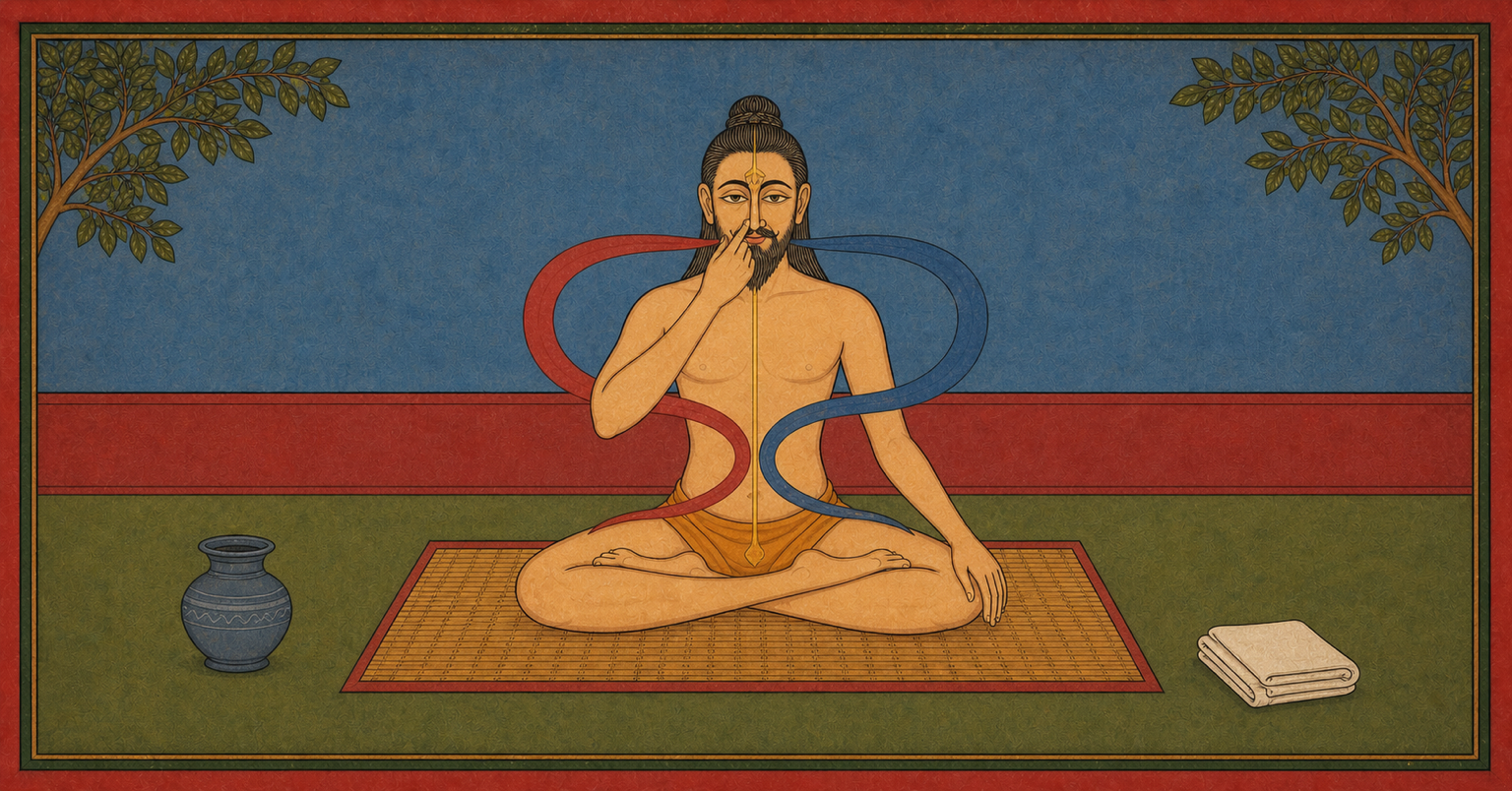
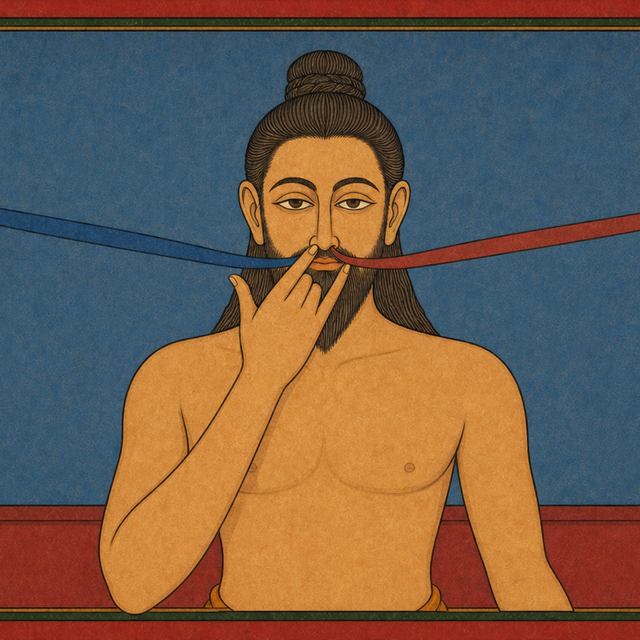
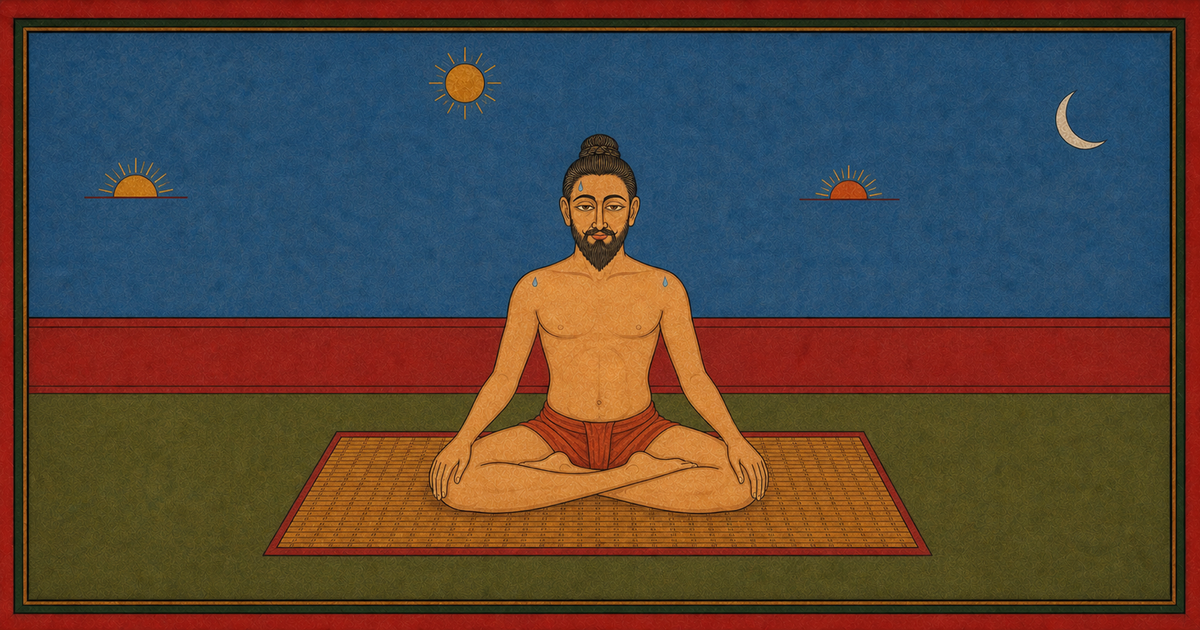

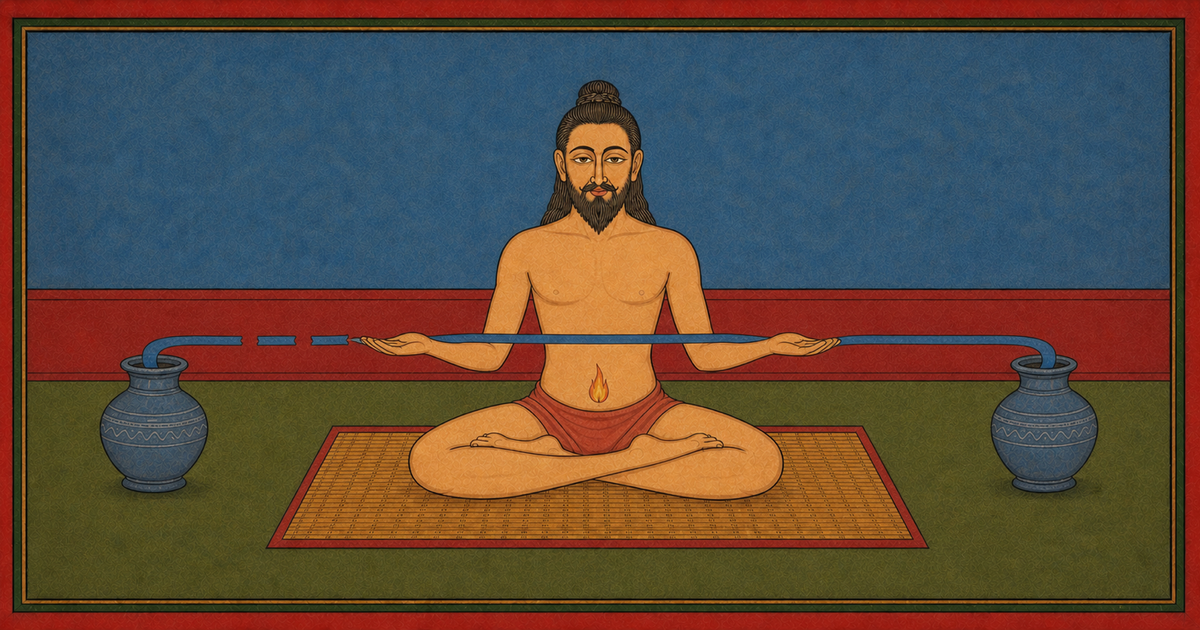
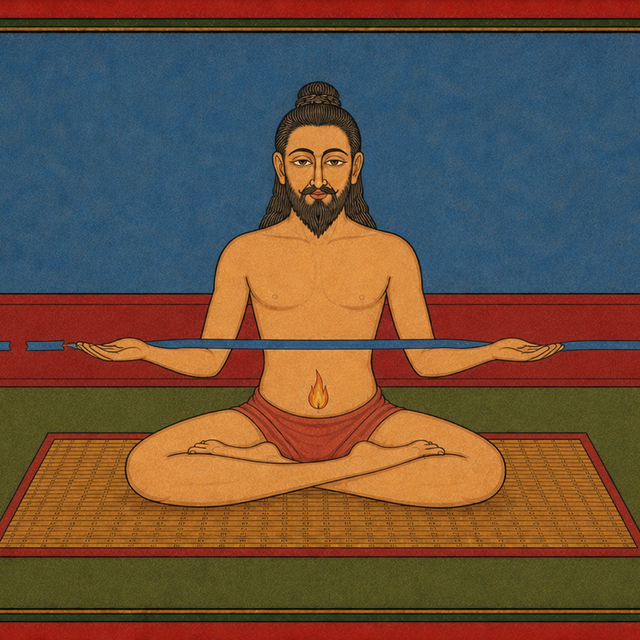
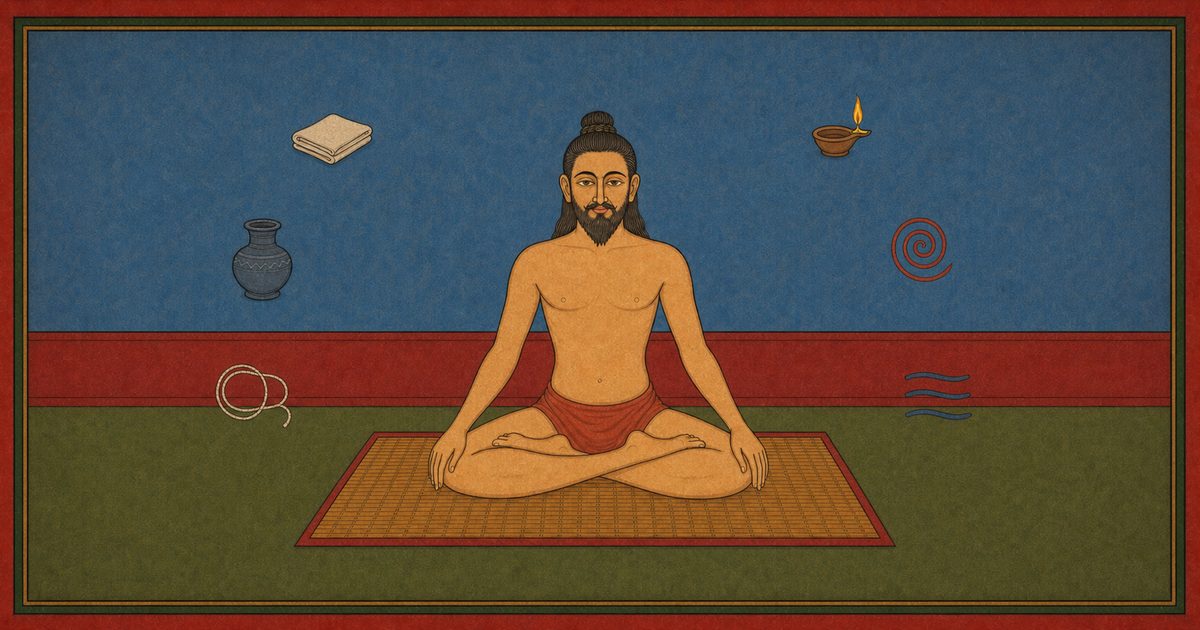
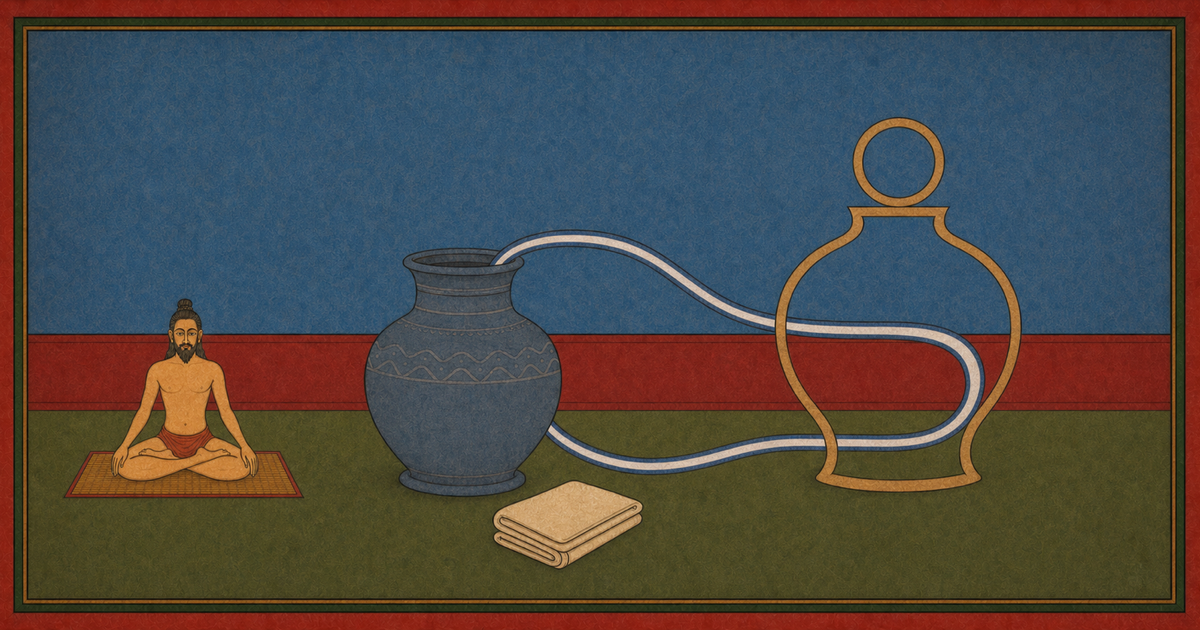
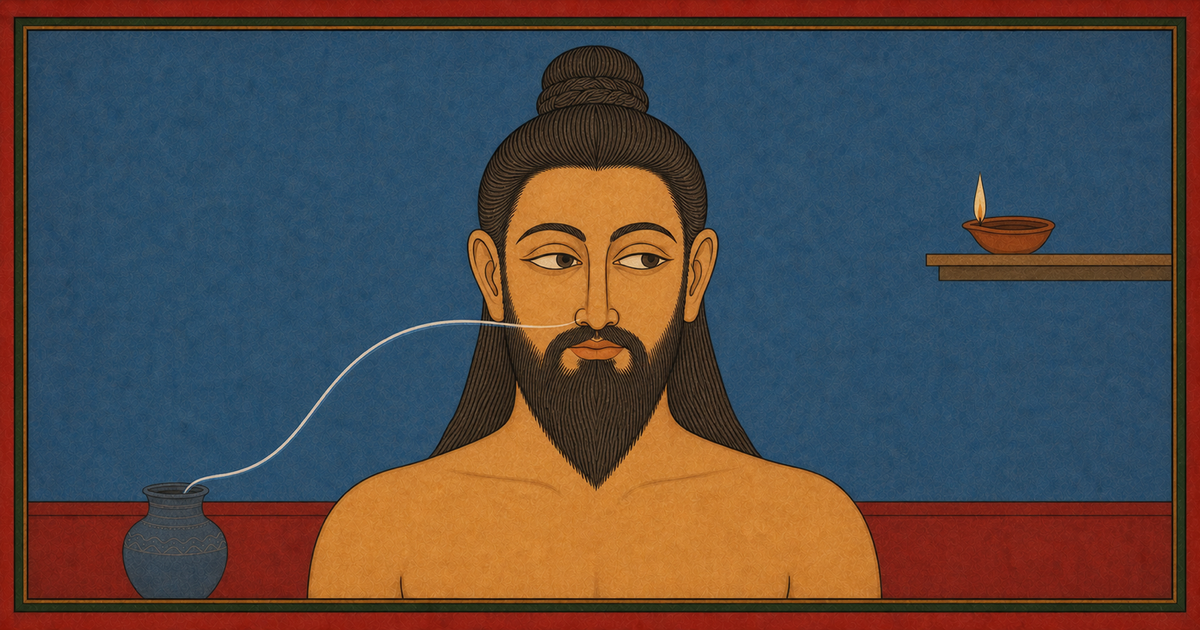

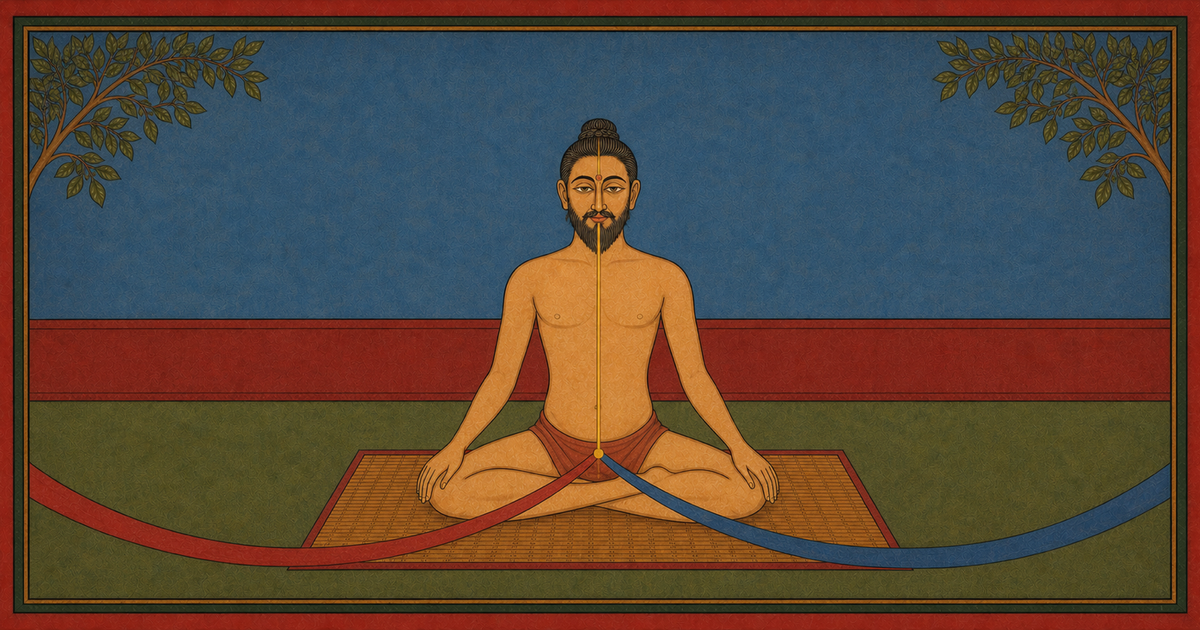
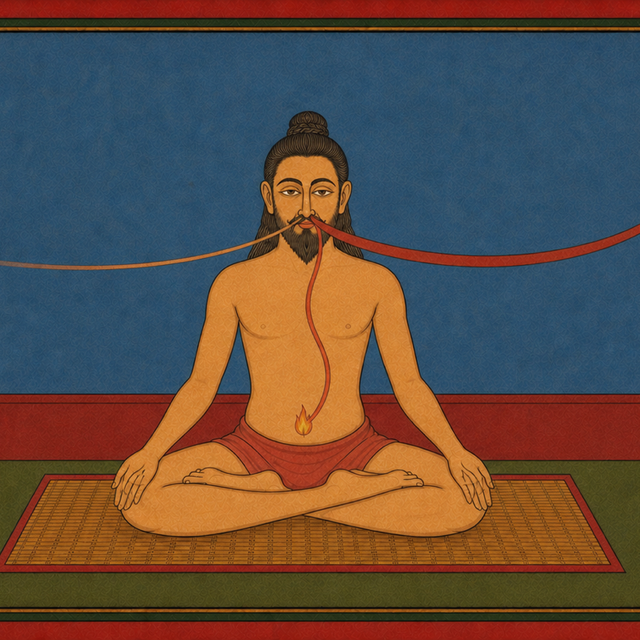
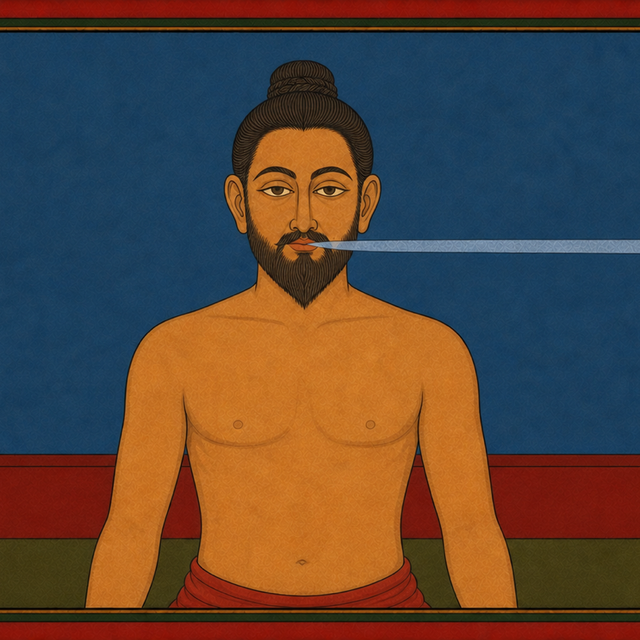
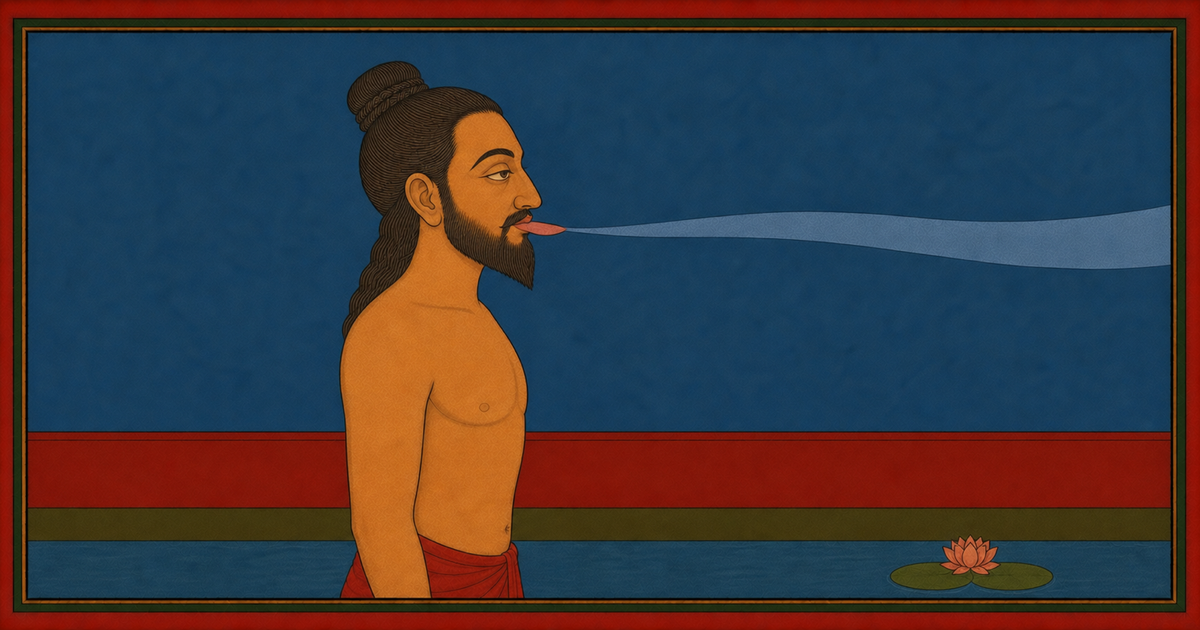
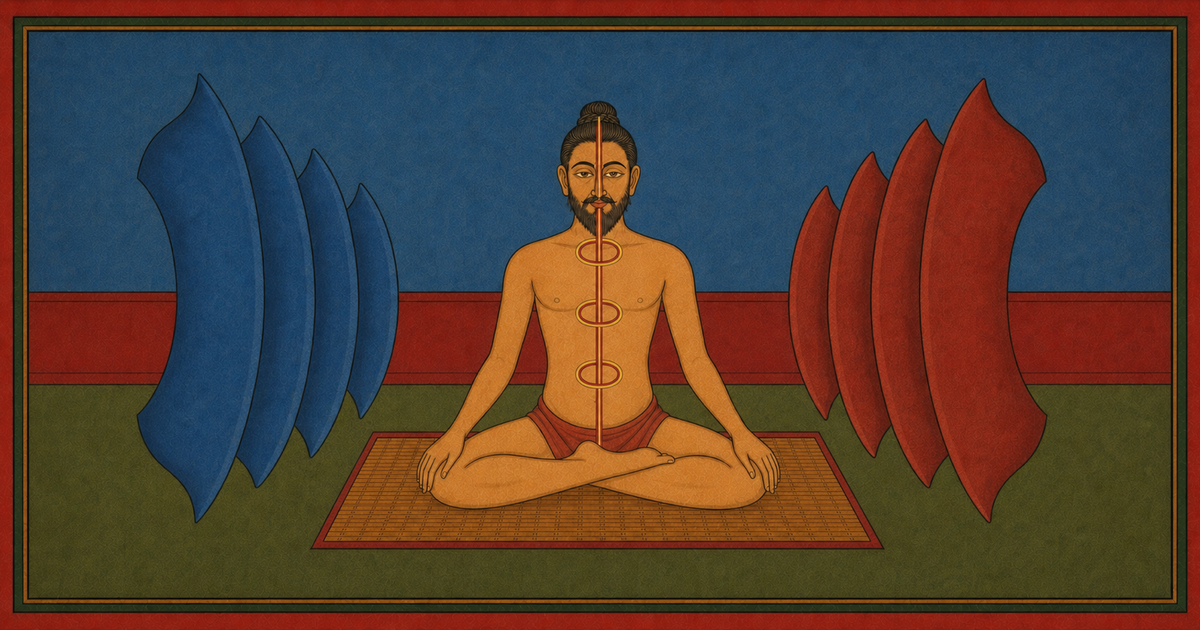
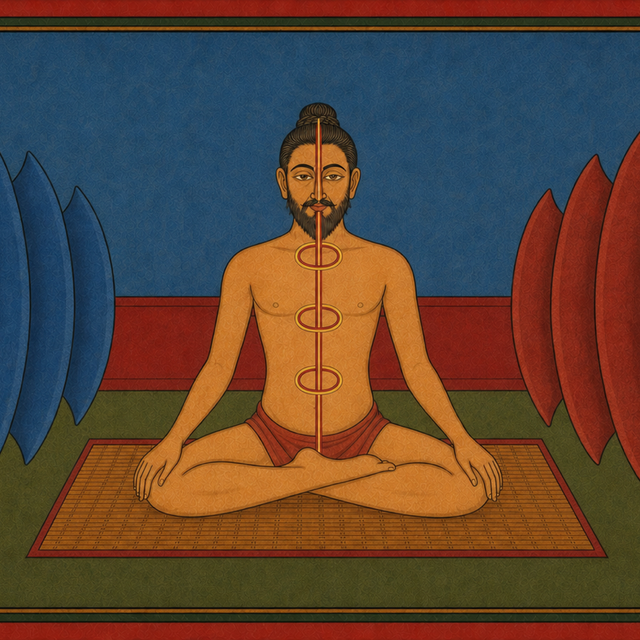
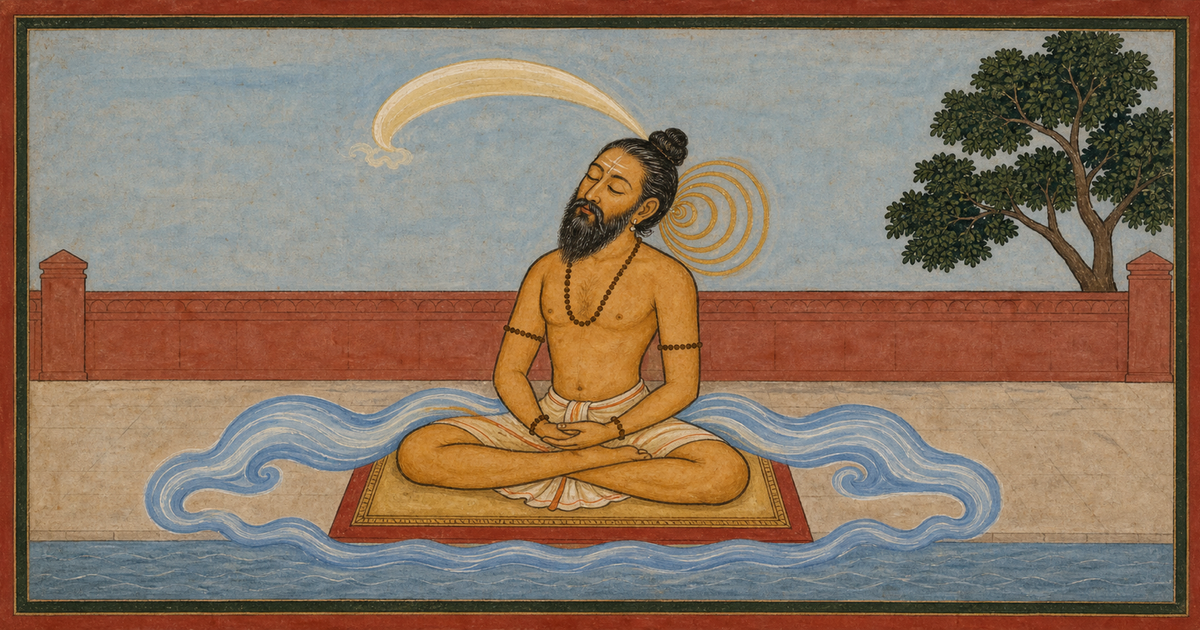
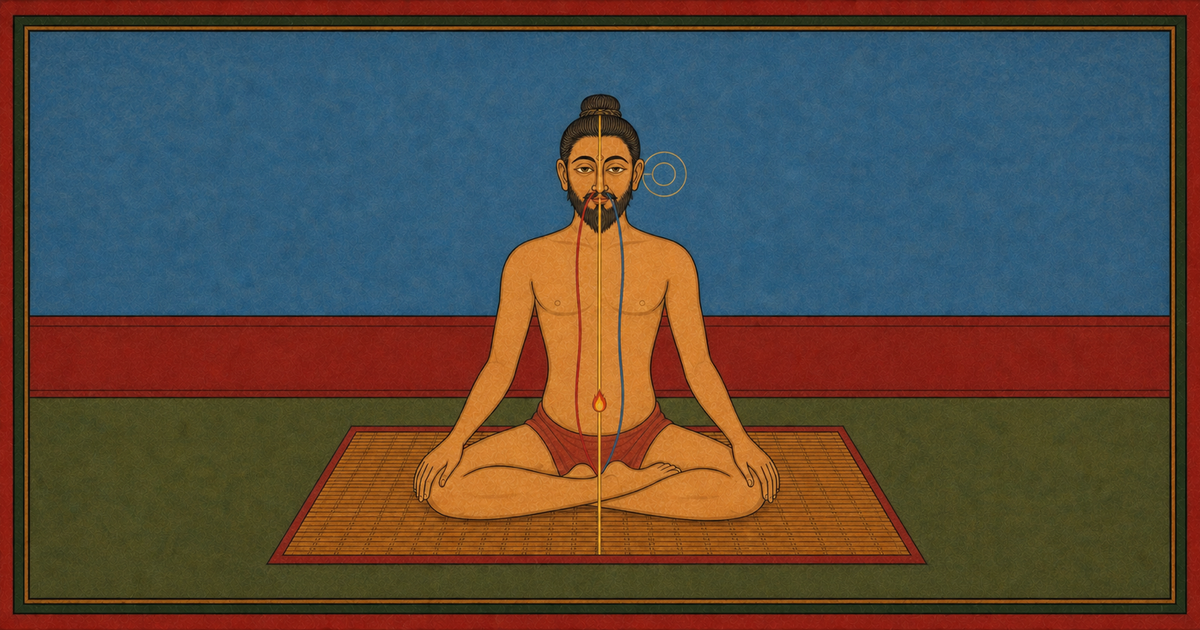
A yogi practices alternate-nostril breathing; red and blue breath streams circle the body, with a water vessel and cloth nearby.

Haṭhapradīpikā 2: Prāṇāyāma and Purification

Purification, control of the breath, and Kumbhaka regulate vital energy and prepare the transition to subtler practices.

Dr. Ronald Steiner Dr. Ronald Steiner
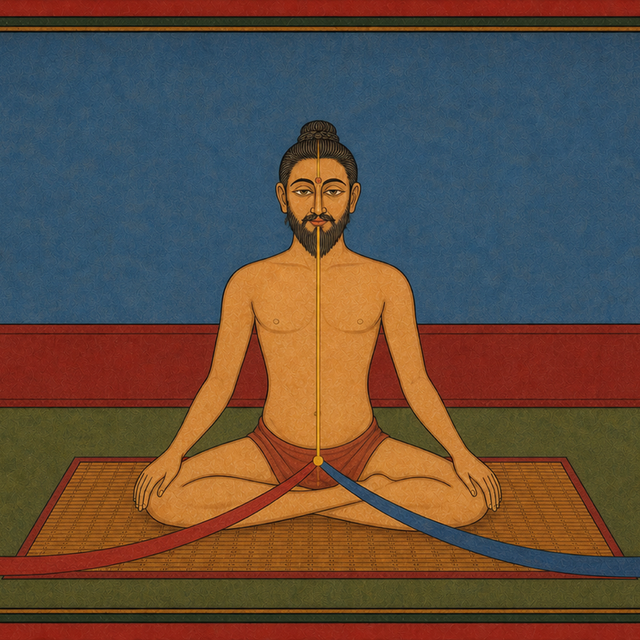
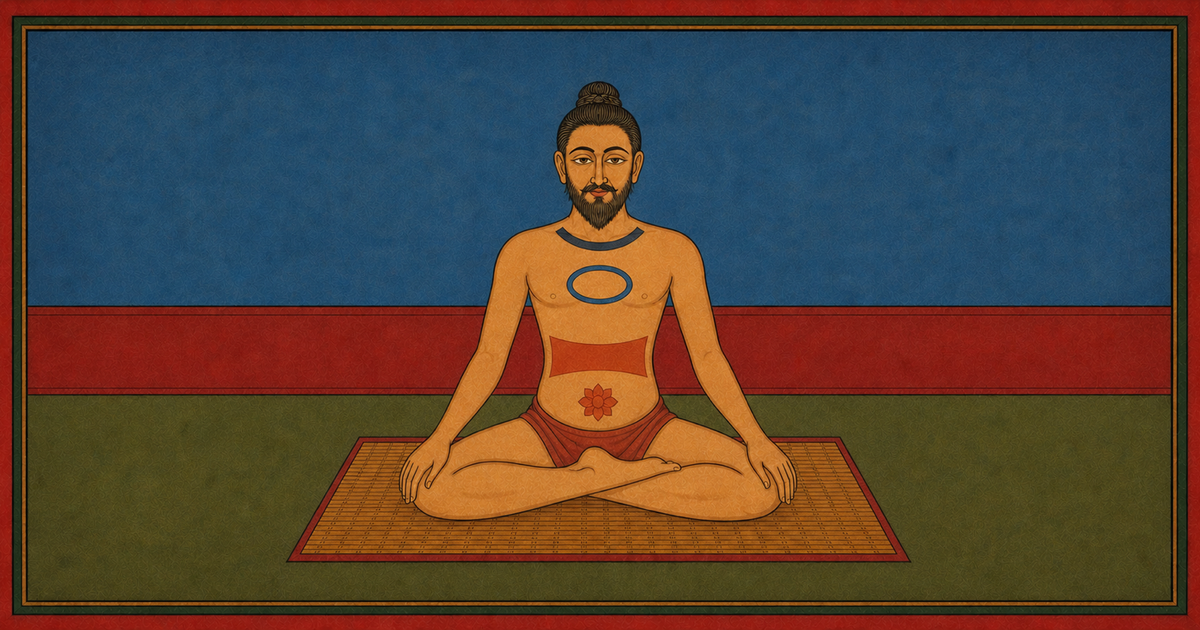
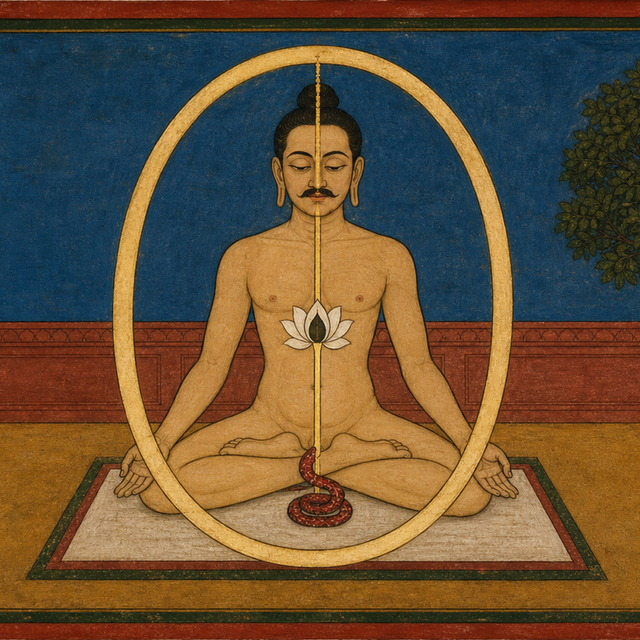
Illustration for the Haṭha Pradīpikā section “HP 2.1-2.6: Entering Prāṇāyāma”.

Haṭha Pradīpikā 2.1-2.6: Introduction to Prāṇāyāma

Once Āsana is firm, Prāṇāyāma is introduced: breath, life, stillness of mind, and purification of the Nāḍīs form its foundation.

Haṭha Pradīpikā 2.1
Metre: Anuṣṭubh
Now (atha), when the posture is steady (āsane dṛḍhe | loc absl sg), the self-disciplined yogi (yogī vaśī | nom sg), whose diet is wholesome and measured (hita-mita-āśanaḥ | nom sg m), should practise (samabhyaset | 3p sg act opt) breath control (prāṇāyāmam | acc sg) in the way taught by the guru (guru-upadiṣṭa-mārgeṇa | ins sg).
Dr. Ronald Steiner - 2026 - historically literal
Haṭha Pradīpikā 2.2
Metre: Anuṣṭubh
When the breath (vāte | loc absl sg) is moving (cale | loc absl sg n), everything (sarvam | nom sg n) moves (calam | nom sg n); when it is unmoving (niścale | loc absl sg n), everything is firmly bound (dṛḍha-bandhanam | nom sg). Therefore (tataḥ), the yogi (yogī | nom sg) attains (āpnoti | 3p sg act pres) motionlessness (sthāṇutvam | acc sg) by restraining the breath (vāyu-nibandhanāt | abl sg).
Dr. Ronald Steiner - 2026 - historically literal
Haṭha Pradīpikā 2.3
Metre: Anuṣṭubh
As long as (yāvat) the breath (vāyuḥ | nom sg) remains (sthitaḥ | nom sg m ppp) in the body (dehe | loc sg), so long (tāvat) it is called (ucyate | 3p sg pas pres) life (jīvitam | nom sg). Its (tasya | gen sg m) departure (niṣkrāntiḥ | nom sg) is death (maraṇam | nom sg); therefore (tataḥ), one should retain (nibandhayet | 3p sg act opt caus) the breath (vāyum | acc sg).
Dr. Ronald Steiner - 2026 - historically literal
Haṭha Pradīpikā 2.4
Metre: Anuṣṭubh
When the channels are full of impurities (malākulāsu nāḍīṣu | loc pl), the breath (mārutaḥ | nom sg m) does not at all (naiva) enter the middle (madhyagaḥ | nom sg m); how (kathaṃ) could the state beyond mind (unmanī-bhāvaḥ | nom sg m) arise (syāt | 3p sg act opt), and how (kathaṃ) could perfection of the body (kāya-siddhiḥ | nom sg f) occur (bhavet | 3p sg act opt)?
Dr. Ronald Steiner - 2026 - historically literal
Haṭha Pradīpikā 2.5
Metre: Anuṣṭubh
When (yadā) the entire network of channels filled with impurities (sarvaṃ nāḍī-cakraṃ mala-ākulam | nom sg n) attains (eti | 3p sg act pres) purity (śuddhim | acc sg), then alone (tadaiva) the yogi (yogī | nom sg) becomes (jāyate | 3p sg med pres) capable (kṣamaḥ | nom sg m) of retaining the breath (prāṇa-saṃgrahaṇe | loc sg).
Dr. Ronald Steiner - 2026 - historically literal
Haṭha Pradīpikā 2.6
Metre: Anuṣṭubh
Therefore (tataḥ), the yogi should regularly (nityam) practise (kuryāt | 3p sg act opt) breath training (prāṇābhyāsam | acc sg) with a sattvic mind (sāttvikayā dhiyā | ins sg), so that (yathā) Suṣumṇā (suṣumṇā | nom sg) is in good condition (susvasthā | nom sg f) and the impurities (malāḥ | nom pl) become dry (śoṣaṃ | acc sg m) and pass away (prayānti | 3p pl act pres).
Dr. Ronald Steiner - 2026 - historically literal
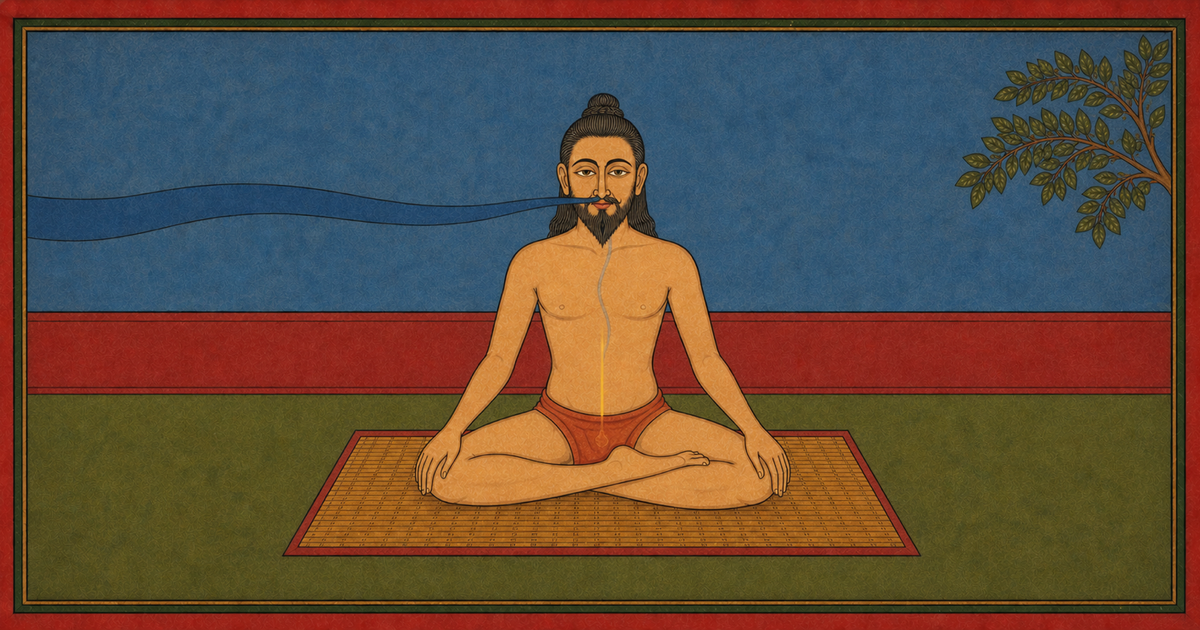
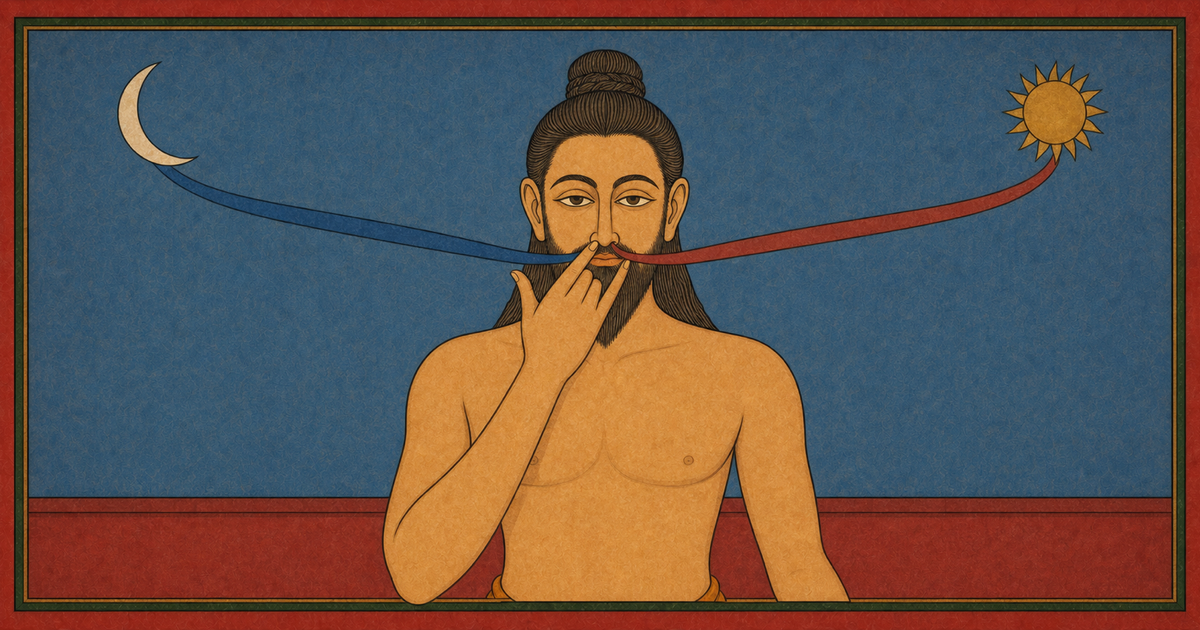
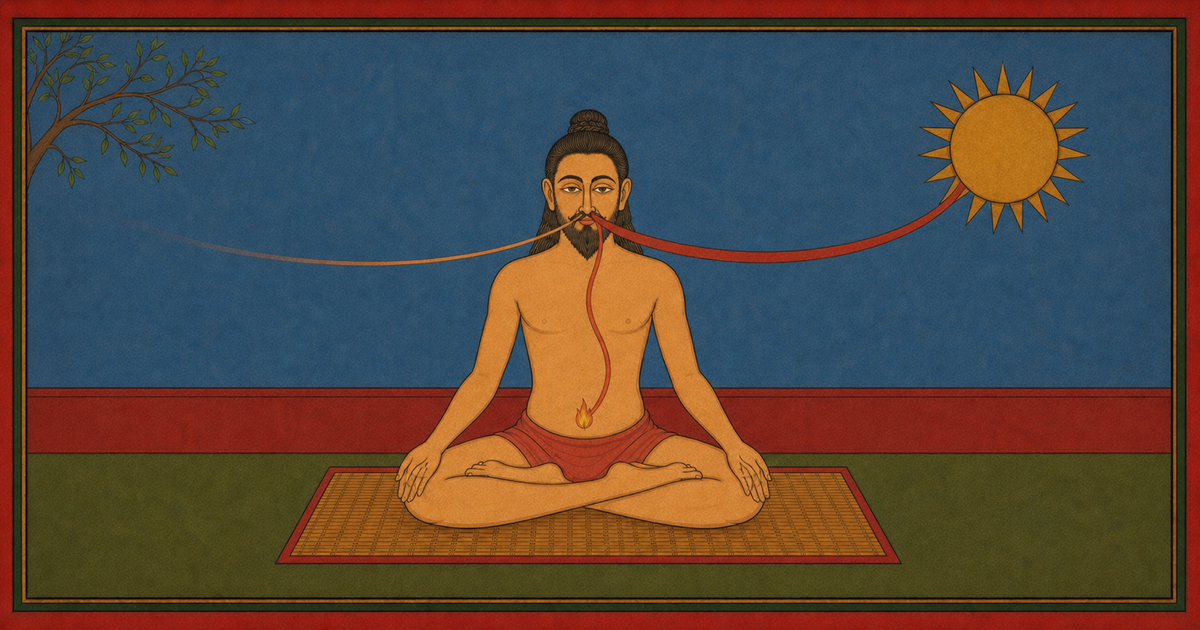
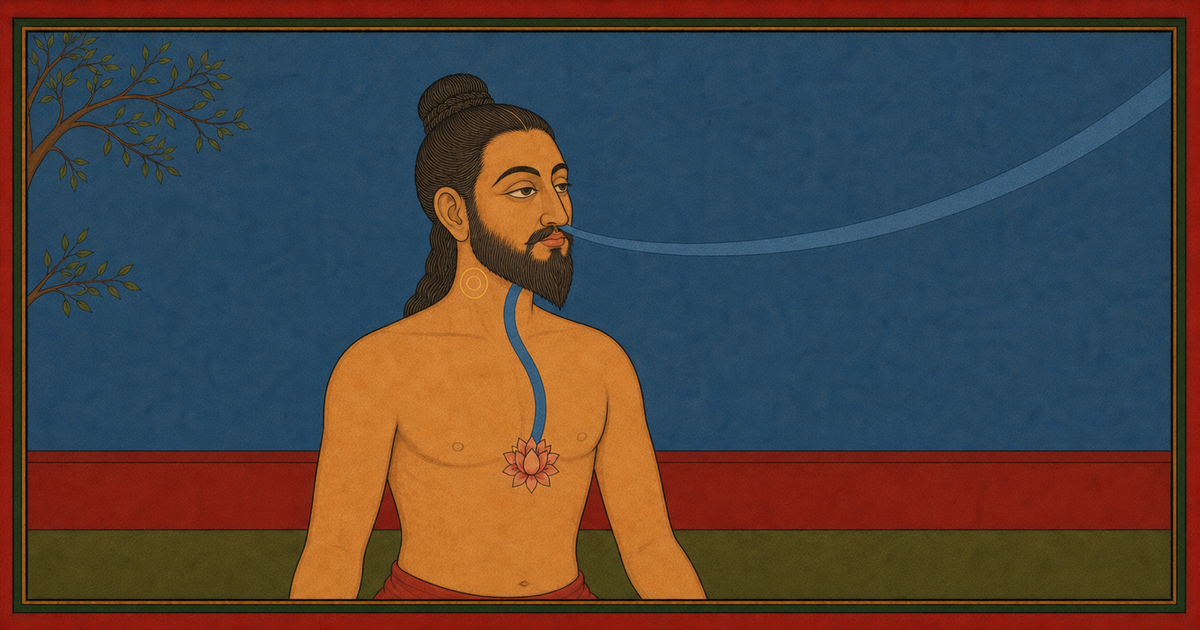
Illustration for the Haṭha Pradīpikā section “HP 2.7-2.10: Nāḍīśodhana”.

Haṭha Pradīpikā 2.7-2.10: Nāḍīśodhana through Alternate-Nostril Breathing

The practice purifies the Nāḍīs through alternating filling, retention, and exhalation by way of Candra and Sūrya.

Haṭha Pradīpikā 2.7
Metre: Anuṣṭubh
Seated in the bound lotus pose (baddha-padmāsanaḥ | nom sg), the yogi (yogī | nom sg) should inhale (pūrayet | 3p sg act opt) the breath (prāṇam | acc sg) through the moon channel (candreṇa | ins sg); having held it (dhārayitvā | abs) according to his capacity (yathāśaktyā | ins sg), he should then (punaḥ) exhale (recayet | 3p sg act opt) through the sun channel (sūryeṇa | ins sg).
Dr. Ronald Steiner - 2026 - historically literal
Haṭha Pradīpikā 2.8
Metre: Anuṣṭubh
Then, having drawn in (ākṛṣya | abs) the breath (prāṇam | acc sg) through the sun (sūryeṇa | ins sg), he should gradually (śanaiḥ) fill (pūrayet | 3p sg act opt) the abdomen (udaram | acc sg); having performed (kṛtvā | abs) the retention (kumbhakam | acc sg) as prescribed (vidhivat), he should then (punar) exhale (recayet | 3p sg act opt) through the moon channel (candreṇa | ins sg).
Dr. Ronald Steiner - 2026 - historically literal
Haṭha Pradīpikā 2.9
Metre: Anuṣṭubh
Through whichever channel (yena | ins sg m) he is to exhale (tyajet | 3p sg act opt), through that same one (tena | ins sg m) he should inhale again (pūrya | abs) and hold (dhārayet | 3p sg act opt caus) the breath without discomfort (avirodhataḥ). Then (tataḥ), he should exhale (recayet | 3p sg act opt caus) through the other (anyena | ins sg m), and indeed (ca eva) slowly (śanaiḥ), not forcefully (na vegataḥ | abl sg).
Dr. Ronald Steiner - 2026 - historically literal
Haṭha Pradīpikā 2.10
Metre: Śārdūlavikrīḍita
If (cet) he inhales (pibet | 3p sg act opt) the breath (prāṇam | acc sg) through Iḍā (iḍayā | ins sg), he should then (bhūyaḥ) exhale (recayet | 3p sg act opt caus) the restrained breath (niyamitam | acc sg m ppp) through the other side (anyayā | ins sg f). Having inhaled (pītvā | abs) the current of breath (samīraṇam | acc sg) through Piṅgalā (piṅgalayā | ins sg) and held it (baddhvā | abs) sufficiently (alam), he should release it (tyajet | 3p sg act opt) through the left side (vāmayā | ins sg f). For self-restrained practitioners (yaminām | gen pl) who meditate (dhyāyatām | gen pl m pca), by this method (anena vidhinā | ins sg), on the pair of orbs (bimba-dvayam | acc sg) of the sun and moon (sūryā-candramasoḥ | gen du), the groups of channels (nāḍi-gaṇāḥ | nom pl) become (bhavanti | 3p pl act pres) pure (śuddhāḥ | nom pl m) after three months (māsa-trayāt | abl sg n).
Dr. Ronald Steiner - 2026 - historically literal
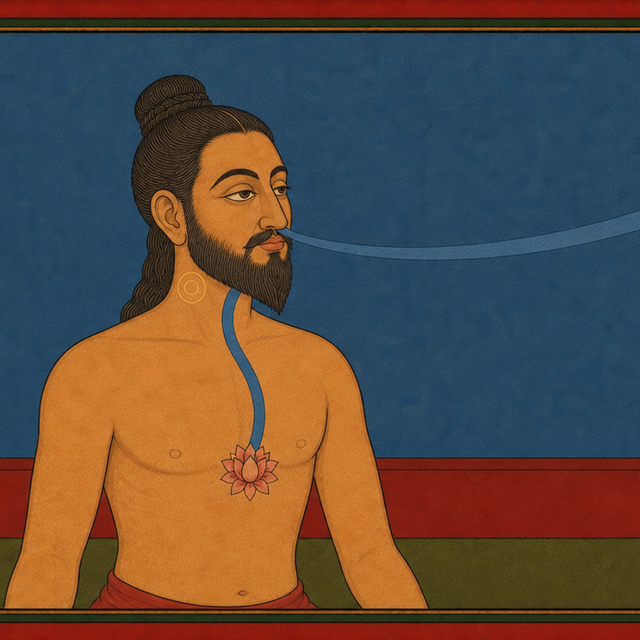
Illustration for the Haṭha Pradīpikā section “HP 2.11-2.14: Measure of Practice”.

Haṭha Pradīpikā 2.11-2.14: Measure of Practice and Initial Signs

Four daily practice times, stages of effect, the massaging of perspiration, and initial dietary rules structure the early practice.

Haṭha Pradīpikā 2.11
Metre: Anuṣṭubh
In the morning (prātaḥ), at midday (madhyaṃdine | loc sg), in the evening (sāyam), and (ca) at midnight (ardha-rātre | loc sg), he should gradually (śanaiḥ) practise thoroughly (samabhyaset | 3p sg act opt) the retentions (kumbhakān | acc pl), up to eighty (aśīti-paryantam | acc sg), across four practice sessions (catur-vāram | acc sg).
Dr. Ronald Steiner - 2026 - historically literal
Haṭha Pradīpikā 2.12
Metre: Anuṣṭubh
At the lesser stage (kanīyasi | loc sg n), sweat (svedaḥ | nom sg) arises (bhavet | 3p sg act opt); at the middle stage (madhyame | loc sg n), trembling (kampaḥ | nom sg) occurs (bhavati | 3p sg act pres); and at the highest (uttame | loc sg n), during retention of the breath (prāṇa-rodhe | loc sg), he repeatedly (muhuḥ) rises up (uttiṣṭhati | 3p sg act pres) in the lotus pose (padmāsane | loc sg).
Dr. Ronald Steiner - 2026 - historically literal
Haṭha Pradīpikā 2.13
Metre: Anuṣṭubh
One should perform (ācaret | 3p sg act opt) a rubbing of the body (gātra-mardanam | acc sg) with (jalena | ins sg) the fluid produced by exertion (śrama-jātena | ins sg); through this (tena | ins sg) arise (jāyate | 3p sg med pres) firmness (dṛḍhatā | nom sg) and also (cāpi) lightness (laghutā | nom sg) of the body (gātrasya | gen sg).
Dr. Ronald Steiner - 2026 - historically literal
Haṭha Pradīpikā 2.14
Metre: Anuṣṭubh
During the period of practice (abhyāsa-kāle | loc sg), at the first stage (prathame | loc sg n), a diet of milk and ghee (kṣīra-ājya-bhojanam | nom sg) is recommended (śastam | nom sg n); afterwards (tataḥ), when the practice has become firmly established (abhyāse dṛḍhī-bhūte | loc sg), there is no clinging to such rules (na tādṛṅ-niyama-grahaḥ | nom sg).
Dr. Ronald Steiner - 2026 - historically literal
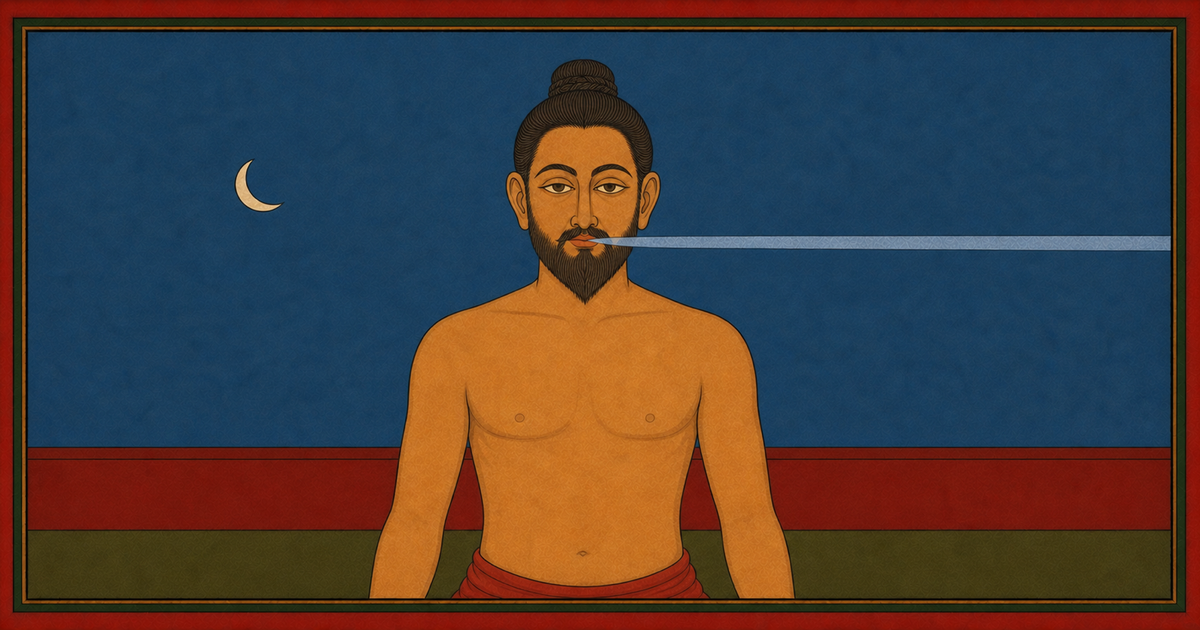
Illustration for the Haṭha Pradīpikā section “HP 2.15-2.20: Correct Practice”.

Haṭha Pradīpikā 2.15-2.20: Correct Practice

The text warns against incorrect practice and names the effects of proper breath control: health, sound, fire, and purity of the Nāḍīs.

Haṭha Pradīpikā 2.15
Metre: Anuṣṭubh
Just as (yathā) a lion (siṃhaḥ | nom sg), an elephant (gajaḥ | nom sg), or a tiger (vyāghraḥ | nom sg) should become (bhavet | 3p sg act opt) tame (vaśyaḥ | nom sg m) slowly and gradually (śanaiḥ śanaiḥ), so indeed (tathaiva) the breath (vāyuḥ | nom sg) is to be cultivated (sevitaḥ | nom sg m ppp). Otherwise (anyathā), it kills (hanti | 3p sg act pres) the practitioner (sādhakam | acc sg).
Dr. Ronald Steiner - 2026 - historically literal
Haṭha Pradīpikā 2.16
Metre: Anuṣṭubh
Through properly applied (yuktena | ins sg m ppp) breath control (prāṇāyāmena | ins sg), the destruction of all diseases (sarva-roga-kṣayaḥ | nom sg) should occur (bhavet | 3p sg act opt); through the discipline of incorrect practice (ayukta-abhyāsa-yogena | ins sg) [comes] the arising of all diseases (sarva-roga-samudbhavaḥ | nom sg).
Dr. Ronald Steiner - 2026 - historically literal
Haṭha Pradīpikā 2.17
Metre: Anuṣṭubh
Hiccups (hikkā | nom sg), breathlessness (śvāsaḥ | nom sg), and (ca) coughing (kāsaḥ | nom sg), as well as (ca) pains in the head, ears, and eyes (śiraḥ-karṇa-akṣi-vedanāḥ | nom pl): various disorders (vividhā doṣāḥ | nom pl) arise (bhavanti | 3p pl act pres) from the breath wind (pavanasya | gen sg) going awry (vyatikramāt | abl sg).
Dr. Ronald Steiner - 2026 - historically literal
Haṭha Pradīpikā 2.18
Metre: Anuṣṭubh
Appropriately (yuktam yuktam), he should exhale (tyajet | 3p sg act opt) the breath (vāyum | acc sg), and (ca), appropriately (yuktam yuktam), he should inhale (pūrayet | 3p sg act opt); and (ca), appropriately (yuktam yuktam), he should hold it (badhnīyāt | 3p sg act opt). Thus (evam), he should attain (avāpnuyāt | 3p sg act opt) purification (śuddhim | acc sg).
Dr. Ronald Steiner - 2026 - historically literal
Haṭha Pradīpikā 2.19
Metre: Anuṣṭubh
When (yadā), however (tu), purity of the channels (nāḍī-śuddhiḥ | nom sg) is present (syāt | 3p sg act opt), then (tadā) signs (cihnāni | nom pl) [appear] outwardly (bāhyataḥ): leanness (kṛśatā | nom sg) and lustre (kāntiḥ | nom sg) of the body (kāyasya | gen sg) then (tathā) certainly (niścitam) arise (jāyeta | 3p sg med opt).
Dr. Ronald Steiner - 2026 - historically literal
Haṭha Pradīpikā 2.20
Metre: Anuṣṭubh
From purification of the channels (nāḍī-śodhanāt | abl sg) arise (jāyate | 3p sg med pres) the ability to hold the breath at will (yatheṣṭaṃ vāyoḥ dhāraṇam | nom sg), kindling of the fire (analasya pradīpanam | nom sg), manifestation of the inner sound (nāda-abhivyaktiḥ | nom sg), and health (ārogyam | nom sg).
Dr. Ronald Steiner - 2026 - historically literal
Illustration for the Haṭha Pradīpikā section “HP 2.21-2.23: Ṣaṭkarma”.

Haṭha Pradīpikā 2.21-2.23: Ṣaṭkarma as Preparation

The six actions are recommended only when needed and summarized as a secret group of practices for cleansing the body.

Haṭha Pradīpikā 2.21
Metre: Anuṣṭubh
One who has an excess of fat and phlegm (medaḥ-śleṣma-adhikaḥ | nom sg m) should first (pūrvam) practise (samācaret | 3p sg act opt) the six techniques (ṣaṭ karmāṇi | acc pl); another, however (anyas tu), should not practise them (nācaret | 3p sg act opt), because (samabhāvataḥ | abl sg) the doṣas (doṣāṇāṃ | gen pl) are in balance, [and should not practise] these (tāni | acc pl n).
Dr. Ronald Steiner - 2026 - historically literal
Haṭha Pradīpikā 2.22
Metre: Anuṣṭubh
Dhautī (dhautī | nom sg), Basti (bastiḥ | nom sg), Nīti (nitiḥ | nom sg), and indeed (ca eva) Trāṭaka (trāṭakam | nom sg), likewise (tathā) Laulikī (laulikam | nom sg) and Kapālabhāti (kapāla-bhātiḥ | nom sg): these (etāni | nom pl n) are called (pracakṣate | 3p pl med pres) the six techniques (ṣaṭ karmāṇi | nom pl).
Dr. Ronald Steiner - 2026 - historically literal
Haṭha Pradīpikā 2.23
Metre: Anuṣṭubh
This (idam | nom sg n) group of six techniques (karma-ṣaṭkam | nom sg) is to be kept secret (gopyam | nom sg n pfp) and brings about purification of the body (ghaṭa-śodhana-kārakam | nom sg n). Bestowing manifold qualities (vicitra-guṇa-saṃdhāyi | nom sg n), it is revered (pūjyate | 3p sg pas pres) by the foremost yogis (yogi-puṃgavaiḥ | ins pl).
Dr. Ronald Steiner - 2026 - historically literal
Illustration for the Haṭha Pradīpikā section “HP 2.24-2.29: Dhauti and Basti”.

Haṭha Pradīpikā 2.24-2.29: Dhauti, Basti, and Gajakaraṇī

Dhauti and Basti are explained through their procedures and effects; Gajakaraṇī follows as an expulsive act of cleansing.

Haṭha Pradīpikā 2.24
Metre: Anuṣṭubh
He should slowly (śanaiḥ) swallow (graset | 3p sg act opt) a cloth (vastram | acc sg) four finger-widths wide (catur-aṅgula-vistāram | acc sg n) and moistened (siktam | acc sg n ppp), and (ca) afterwards (tataḥ) draw this (etad | acc sg n) out again (pratyāharet | 3p sg act opt). This (tat | nom sg n) ejection from the mouth (ukhālam | acc sg) is the Dhautī technique (dhauti-karma | nom sg).
Dr. Ronald Steiner - 2026 - historically literal
Haṭha Pradīpikā 2.25
Metre: Anuṣṭubh
Coughing, breathlessness, splenic disorders, and skin disease (kāsa-śvāsa-plīha-kuṣṭham | nom sg), as well as (ca) the twenty (viṃśatiḥ | nom sg) diseases of phlegm (kapha-rogāḥ | nom pl), certainly (eva) flee (dhāvanti | 3p pl act pres) through the power of the Dhautī technique (dhautī-karma-prabhāveṇa | ins sg); there is no (na) doubt (saṃśayaḥ | nom sg).
Dr. Ronald Steiner - 2026 - historically literal
Haṭha Pradīpikā 2.26
Metre: Anuṣṭubh
In water reaching to the navel (nābhi-daghna-jale | loc sg), squatting with a tube inserted in the anus (pāyu-nyasta-nāla-utkaṭa-āsanaḥ | nom sg m bv), one should perform (kuryāt | 3p sg act opt) a contraction of the perineal base (ādhāra-ākuñcanam | acc sg). This (tat | nom sg n) flushing (pakhālam | acc sg) is the Basti technique (basti-karma | nom sg).
Dr. Ronald Steiner - 2026 - historically literal
Haṭha Pradīpikā 2.27
Metre: Anuṣṭubh
Swelling, splenic disorders, and abdominal disease (gulma-plīha-udaram | nom sg), and also (cāpi) all diseases (sakalāmayāḥ | nom pl) arising from Vāta, Pitta, and Kapha (vāta-pitta-kaphodbhavāḥ | nom pl), are removed (vāryante | 3p pl pas pres) through the power of the Basti practice (basti-karma-prabhāvena | ins sg).
Dr. Ronald Steiner - 2026 - historically literal
Haṭha Pradīpikā 2.28
Metre: Upajāti
When repeatedly practised (abhyasyamānam | nom sg n pcp), the water-Basti technique (jala-basti-karma | nom sg) should bestow (dadyāt | 3p sg act opt) clarity of the bodily constituents, senses, and inner faculty (dhātu-indriya-antaḥkaraṇa-prasādam | acc sg), and (ca) lustre (kāntim | acc sg) and kindling of the fire (dahana-pradīptim | acc sg); it should eliminate (nihanyāt | 3p sg act opt) every accumulation of the doṣas (aśeṣa-doṣopacayam | acc sg).
Dr. Ronald Steiner - 2026 - historically literal
Haṭha Pradīpikā 2.29
Metre: Puṣpitāgrā
Raising (udīrya | abs) the Apāna wind (apānam | acc sg) into the throat passage (kaṇṭha-nāle | loc sg), expelling (udvamantī | nom sg f pca) the contents situated in the abdomen (udara-gata-padārtham | acc sg) from the wind passage mastered by gradual practice (krama-paricaya-vaśya-vāyu-mārgāt | abl sg): thus (iti), this is called (nigadyate | 3p sg pas pres) the elephant technique (gaja-karaṇī | nom sg) by those who know Haṭha (haṭha-jñaiḥ | ins pl m).
Dr. Ronald Steiner - 2026 - historically literal
Illustration for the Haṭha Pradīpikā section “HP 2.30-2.33: Neti and Trāṭaka”.

Haṭha Pradīpikā 2.30-2.33: Neti and Trāṭaka

Neti cleanses the region of the skull and senses; Trāṭaka collects the gaze and protects against eye disorders and lethargy.

Haṭha Pradīpikā 2.30
Metre: Anuṣṭubh
He should insert (praveśayet | 3p sg act opt caus) into the nasal passage (nāsā-nāle | loc sg) a thread (sūtram | acc sg) that has been well stiffened for one handspan (vitasti-su-stabdham | acc sg n ppp), and (ca) draw it out (nirgamayet | 3p sg act opt caus) through the mouth (mukhāt | abl sg). This (eṣā | nom sg f) technique is called (nigadyate | 3p sg pas pres) Nīti (nītiḥ | nom sg) by the Siddhas (siddhaiḥ | ins pl).
Dr. Ronald Steiner - 2026 - historically literal
Haṭha Pradīpikā 2.31
Metre: Anuṣṭubh
The excellent (satī | nom sg f) Nīti technique (nitiḥ | nom sg) purifies the skull (kapāla-śodhanī | nom sg f), bestows divine sight (divya-dṛṣṭi-pradāyinī | nom sg f), and (ca) quickly (āśu) overcomes (jayati | 3p sg act pres) the host of diseases arising above the collarbone (jatru-ūrdhva-jāta-roga-ogham | acc sg).
Dr. Ronald Steiner - 2026 - historically literal
Haṭha Pradīpikā 2.32
Metre: Anuṣṭubh
Composed (samāhitaḥ | nom sg m ppp), one should gaze (nirīkṣet | 3p sg act opt) with an unmoving gaze (niścala-dṛśā | ins sg) at a subtle target (sūkṣma-lakṣyam | acc sg) until tears fall (aśru-saṃpāta-paryantam | acc sg). This is regarded (matam | nom sg n ppp) by the teachers (ācāryaiḥ | ins pl) as Trāṭaka (trāṭakam | nom sg).
Dr. Ronald Steiner - 2026 - historically literal
Haṭha Pradīpikā 2.33
Metre: Anuṣṭubh
[Trāṭaka is] a destroyer (moṭakam | nom sg) of diseases of the eyes (netra-rogāṇām | gen pl) and a bolt (kapāṭakam | nom sg) against lethargy and the rest (tandrādīnām | gen pl); Trāṭaka (trāṭakam | acc sg) is to be kept secret (gopyam | acc sg n) carefully (yatnataḥ), like (yathā) a chest of gold (hāṭaka-peṭakam | nom sg).
Dr. Ronald Steiner - 2026 - historically literal
Illustration for the Haṭha Pradīpikā section “HP 2.34-2.36: Naulī and Kapālabhātī”.

Haṭha Pradīpikā 2.34-2.36: Naulī and Kapālabhātī

Naulī moves the abdomen and strengthens the fire; Kapālabhātī is named as a bellows-like technique that dries up Kapha.

Haṭha Pradīpikā 2.34
Metre: Anuṣṭubh
With the shoulders lowered (nata-aṃsaḥ | nom sg m), one should rotate (bhramayet | 3p sg act opt caus) the abdomen (tuṇḍam | acc sg) to the left and right (savya-apasavyataḥ) with the speed of a powerful whirlpool (amanda-āvarta-vegena | ins sg). This (eṣā | nom sg f) Laulī (laulī | nom sg) is praised (praśasyate | 3p sg pas pres) by the people of Gauḍa (gauḍaiḥ | ins pl).
Dr. Ronald Steiner - 2026 - historically literal
Haṭha Pradīpikā 2.35
Metre: Upajāti
Laulī (laulī | nom sg) brings about the kindling of the abdominal fire, digestion, and the like (tunda-agni-saṃdīpana-pācana-ādi-saṃdhāyikā | nom sg f) and always (sadā eva) produces joy (ānanda-karī | nom sg f). It makes all doṣas and diseases disappear (aśeṣa-doṣa-āmaya-śoṣaṇī | nom sg f), and (ca) this (iyam | nom sg f) is the crown of the Haṭha practices (haṭha-kriyā-mauliḥ | nom sg).
Dr. Ronald Steiner - 2026 - historically literal
Haṭha Pradīpikā 2.36
Metre: Anuṣṭubh
Like the bellows of a blacksmith (bhastrāvat loha-kārasya | gen sg), exhalation and inhalation (reca-pūrau | nom du) are very rapid (su-saṃbhramau | nom du m). Kapālabhāti (kapāla-bhātiḥ | nom sg) is known (vikhyātā | nom sg f ppp) as a technique that dries up the disorder of phlegm (kapha-doṣa-viśoṣiṇī | nom sg f pca).
Dr. Ronald Steiner - 2026 - historically literal
Illustration for the Haṭha Pradīpikā section “HP 2.37-2.43: The Path to Manonmanī”.

Haṭha Pradīpikā 2.37-2.43: Prāṇāyāma as the Path to Manonmanī

After the cleansing practices, correctly practiced Prāṇāyāma leads to purity of the Nāḍīs, entry into Suṣumṇā, and stillness of mind.

Haṭha Pradīpikā 2.37
Metre: Anuṣṭubh
One whose excess weight, phlegm, fat, impurities, and the like have been removed (gata-sthaulya-kapha-medo-mala-ādikaḥ | nom sg m) by the six techniques (ṣaṭ-karmabhiḥ | ins pl) should then (tataḥ) perform (kuryāt | 3p sg act opt) breath control (prāṇāyāmam | acc sg). It succeeds (sidhyati | 3p sg act pres) without effort (anāyāsena | ins sg).
Dr. Ronald Steiner - 2026 - historically literal
Haṭha Pradīpikā 2.38
Metre: Anuṣṭubh
All impurities (sarve malāḥ | nom pl) dry up (praśuṣyanti | 3p pl act pres) through breath controls (prāṇāyāmaiḥ | ins pl) alone (eva), so it is said (iti). Therefore, among some teachers (ācāryāṇāṃ keṣāṃcit | gen pl), no (na) other (anyat | nom sg n) practice (karma | nom sg) is approved (saṃmatam | nom sg n ppp).
Dr. Ronald Steiner - 2026 - historically literal
Haṭha Pradīpikā 2.39
Metre: Anuṣṭubh
Even (api) Brahmā and the other gods (brahma-ādayaḥ tridaśāḥ | nom pl), out of fear of death (antaka-bhayāt | abl sg), became (abhūvan | 3p pl act aor) devoted to the practice of breath (pavana-abhyāsa-tatparāḥ | nom pl m). Therefore (tasmāt), one should practise (abhyaset | 3p sg act opt) the breath (pavanam | acc sg).
Dr. Ronald Steiner - 2026 - historically literal
Haṭha Pradīpikā 2.40
Metre: Anuṣṭubh
As long as (yāvat) the breath (marut | nom sg) is bound (baddhaḥ | nom sg m ppp) in the body (dehe | loc sg), as long as (yāvat) the mind (cittam | nom sg) is without support (nirāśrayam | nom sg n), and as long as (yāvat) the gaze (vīkṣā | nom sg) rests between the two eyebrows (bhruvoḥ madhye | gen du, loc sg), whence (kutaḥ), then (tāvat), could fear of death (kāla-bhayam | nom sg) arise?
Dr. Ronald Steiner - 2026 - historically literal
Haṭha Pradīpikā 2.41
Metre: Anuṣṭubh
When the network of channels (nāḍī-cakre | loc absl sg) has been purified (viśodhite | loc absl sg n ppp) by breath controls performed as prescribed (vidhivat prāṇa-saṃyāmaiḥ | ins pl), the breath (mārutaḥ | nom sg), having pierced (bhittvā | abs) the mouth of Suṣumṇā (suṣumṇā-vadanam | acc sg), enters (viśati | 3p sg act pres) with ease (sukhāt | abl sg).
Dr. Ronald Steiner - 2026 - historically literal
Haṭha Pradīpikā 2.42
Metre: Anuṣṭubh
When the breath flows in the middle (mārute madhya-saṃcāre | loc absl sg), steadiness of mind (manaḥ-sthairyam | nom sg) arises (prajāyate | 3p sg med pres). That complete stabilisation of the mind (yaḥ manaḥ-su-sthirī-bhāvaḥ | nom sg) is precisely (eva) this (sā | nom sg f) state (avasthā | nom sg), Manonmanī (manonmanī | nom sg).
Dr. Ronald Steiner - 2026 - historically literal
Haṭha Pradīpikā 2.43
Metre: Anuṣṭubh
To attain this (tat-siddhaye | dat sg), one who knows the method (vidhāna-jñaḥ | nom sg m) should perform (kurvīta | 3p sg med opt) various (citrān | acc pl m) retentions (kumbhakān | acc pl). Through the practice of various retentions (vicitra-kumbhaka-abhyāsāt | abl sg), one should attain (āpnuyāt | 3p sg act opt) manifold accomplishment (vicitrāṃ siddhim | acc sg).
Dr. Ronald Steiner - 2026 - historically literal
Illustration for the Haṭha Pradīpikā section “HP 2.44-2.47: Eight Kumbhakas”.

Haṭha Pradīpikā 2.44-2.47: Eight Kumbhakas and Bandhas

The eight Kumbhakas are enumerated; Jālandhara, Uḍḍiyāna, and the reversal of Prāṇa and Apāna prepare the practice.

Haṭha Pradīpikā 2.44
Metre: Anuṣṭubh
Sūryabhedana (sūrya-bhedanam | nom sg), Ujjāyī (ujjāyī | nom sg), likewise (tathā) Sītkā (sītkā | nom sg) and (ca) Śītalī (śītalī | nom sg), Bhastrikā (bhastrikā | nom sg), Bhramarī (bhramarī | nom sg), Mūrcchā (mūrcchā | nom sg), and Kevala (kevalaḥ | nom sg m): these are the eight retentions (aṣṭa kumbhakāḥ | nom pl).
Dr. Ronald Steiner - 2026 - historically literal
Haṭha Pradīpikā 2.45
Metre: Anuṣṭubh
At the end of inhalation (pūrakānte | loc sg), the lock called Jālandhara (bandhaḥ jālandhara-abhidhaḥ | nom sg) is to be performed (kartavyaḥ | nom sg m pfp). At the end of retention and the beginning of exhalation (kumbhakānte recakādau | loc sg), Uḍḍiyāṇaka (uḍḍiyāṇakaḥ | nom sg) is to be performed (kartavyaḥ | nom sg m pfp).
Dr. Ronald Steiner - 2026 - historically literal
Haṭha Pradīpikā 2.46
Metre: Anuṣṭubh
When the throat has been contracted (kaṇṭha-saṃkocane kṛte | loc absl sg), through a rapid contraction from below (adhastāt kuñcanena āśu | ins sg) and a backward stretch in the middle (madhye paścima-tāṇena | loc sg, ins sg), Prāṇa (prāṇaḥ | nom sg) should enter the channel of Brahman (brahma-nāḍi-gaḥ syāt | nom sg m, 3p sg act opt).
Dr. Ronald Steiner - 2026 - historically literal
Haṭha Pradīpikā 2.47
Metre: Anuṣṭubh
Having raised (utthāpya | abs) Apāna (apānam | acc sg) upward (ūrdhvam), the yogi should lead (nayet | 3p sg act opt) Prāṇa (prāṇam | acc sg) downward (adhas) from the throat (kaṇṭhāt | abl sg); being (san | nom sg m pca) free from ageing (jarā-vimuktaḥ | nom sg m), he becomes sixteen years old (ṣoḍaśaḥ | nom sg m) in age (vayasā | ins sg).
Dr. Ronald Steiner - 2026 - historically literal
Illustration for the Haṭha Pradīpikā section “HP 2.48-2.50: Sūryabhedana”.

Haṭha Pradīpikā 2.48-2.50: Sūryabhedana

Sūryabhedana is described as inhaling through the right, retaining, and exhaling through the left; it cleanses, warms, and removes Doṣas.

Haṭha Pradīpikā 2.48
Metre: Anuṣṭubh
On a comfortable seat (āsane sukhade | loc sg), the yogi (yogī | nom sg), having adopted (baddhvā | abs) Vajrāsana (vajrāsanaṃ | acc sg), should then (tataḥ) slowly (śanaiḥ) draw in (samākṛṣya | abs) the external air (bahiḥsthaṃ pavanam | acc sg) through the right channel (dakṣa-nāḍyā | ins sg).
Dr. Ronald Steiner - 2026 - historically literal
Haṭha Pradīpikā 2.49
Metre: Anuṣṭubh
He should hold the breath (kumbhayet | 3p sg act opt) from the tips of the nails (nakhāgrāt | abl sg) as far as the tips of the hair (ā keśāgrān | acc pl), up to the limit of cessation (nirodhāvadhi | acc sg); afterwards (tataḥ), the wise man (sudhīḥ | nom sg) should slowly (śanaiḥ) exhale (recayet | 3p sg act opt) the breath (pavanam | acc sg) through the left channel (savya-nāḍyā | ins sg).
Dr. Ronald Steiner - 2026 - historically literal
Haṭha Pradīpikā 2.50
Metre: Anuṣṭubh
This (idam | nom sg n) purifies the skull (kapāla-śodhanam | nom sg), removes disorders of Vāta (vāta-doṣa-ghnam | nom sg n), and dispels diseases caused by worms (kṛmi-doṣa-ham | nom sg n). It is to be performed (kāryam | nom sg n pfp) again and again (punaḥ punar) and is called (udāhṛtam | nom sg n ppp) Sūryabheda (sūrya-bhedam | acc sg).
Dr. Ronald Steiner - 2026 - historically literal
Illustration for the Haṭha Pradīpikā section “HP 2.51-2.53: Ujjāyī”.

Haṭha Pradīpikā 2.51-2.53: Ujjāyī

Ujjāyī directs the breath audibly through the throat and heart region; the practice clears the throat, disorders of Kapha, and the inner channels.

Haṭha Pradīpikā 2.51
Metre: Anuṣṭubh
Having closed (saṃyamya | abs) the mouth (mukhaṃ | acc sg) and slowly (śanaiḥ) drawn in (ākṛṣya | abs) the breath (pavanam | acc sg) through both channels (nāḍībhyām | ins du), it should be felt (lagati | 3p sg act pres) with a sound (sa-svanam | acc sg), as (yathā) from the throat (kaṇṭhāt | abl sg) as far as the heart (hṛdaya-avadhi | acc sg).
Dr. Ronald Steiner - 2026 - historically literal
Haṭha Pradīpikā 2.52
Metre: Anuṣṭubh
As before (pūrvavat), one should retain (kumbhayet | 3p sg act opt) Prāṇa (prāṇam | acc sg) and afterwards (tataḥ) exhale (recayet | 3p sg act opt) through Iḍā (iḍayā | ins sg); this practice removes the disorder of phlegm (śleṣma-doṣa-haram | acc sg n) in the throat (kaṇṭhe | loc sg) and increases the body's fire (deha-anala-vivardhanam | acc sg n).
Dr. Ronald Steiner - 2026 - historically literal
Haṭha Pradīpikā 2.53
Metre: Anuṣṭubh
The retention called Ujjāyī (ujjāyī-ākhyam kumbhakam | nom sg n) removes (vināśanam | nom sg n) disorders situated in the channels, bodily fluids, abdomen, and as far as all the bodily constituents (nāḍī-jala-udara-ādhātu-gata-doṣa | tp acc). It is also (tu) to be performed (kāryam | nom sg n pfp) while walking or standing still (gacchataḥ tiṣṭhataḥ | gen sg m pca).
Dr. Ronald Steiner - 2026 - historically literal
Illustration for the Haṭha Pradīpikā section “HP 2.54-2.56: Sītkārī”.

Haṭha Pradīpikā 2.54-2.56: Sītkārī

Sītkārī works with sound in the mouth and nose; it is associated with beauty, freedom from hunger and thirst, and mastery of the body.

Haṭha Pradīpikā 2.54
Metre: Anuṣṭubh
One should always (sadā) produce (dadyāt | 3p sg act opt) the Sītkā sound (sītkām | acc sg) in the mouth (vaktre | loc sg), and also (caiva) maintain an opening (vijṛmbhikām | acc sg) in the nose (ghrāṇe | loc sg); through practice in this way (evam abhyāsa-yogena | ins sg), one becomes a second god of love (kāma-devaḥ dvitīyakaḥ | nom sg).
Dr. Ronald Steiner - 2026 - historically literal
Haṭha Pradīpikā 2.55
Metre: Anuṣṭubh
One becomes connected with the circle of yoginīs (yoginī-cakra-sāmānyaḥ | nom sg m) and a maker of creation and dissolution (sṛṣṭi-saṃhāra-kārakaḥ | nom sg m); neither (na) hunger (kṣudhā | nom sg) nor (na) thirst (tṛṣā | nom sg), neither sleep (nidrā | nom sg) nor even (naiva) lethargy (ālasyam | nom sg), arises (prajāyate | 3p sg med pres).
Dr. Ronald Steiner - 2026 - historically literal
Haṭha Pradīpikā 2.56
Metre: Anuṣṭubh
His body becomes freely responsive (svacchanda-dehaḥ | nom sg m) and free from all afflictions (sarva-upadrava-varjitaḥ | nom sg m); through this method (anena vidhinā | ins sg), he truly (satyam) becomes a lord of yogis (yogīndraḥ | nom sg) upon the earth (bhuvi-maṇḍale | loc sg).
Dr. Ronald Steiner - 2026 - historically literal
Illustration for the Haṭha Pradīpikā section “HP 2.57-2.59: Śītalī”.

Haṭha Pradīpikā 2.57-2.59: Śītalī

Śītalī draws the breath in through the tongue and mouth, exhales through the nose, and is said to cool Pitta and relieve hunger and thirst.

Haṭha Pradīpikā 2.57
Metre: Anuṣṭubh
For one who (yaḥ | nom sg m) constantly (satatam) drinks in (pibet | 3p sg act opt) Prāṇa (prāṇam | acc sg) through the root region of the tongue and palate (rasanā-tālu-mūlena | ins sg), there (tasya | gen sg) arises (bhavet | 3p sg act opt), after half a year (abda-ardhena | ins sg), the complete disappearance of all diseases (sarva-roga-parikṣayaḥ | nom sg).
Dr. Ronald Steiner - 2026 - historically literal
Haṭha Pradīpikā 2.58
Metre: Anuṣṭubh
Having drawn in (ākṛṣya | abs) the breath (vāyum | acc sg) with the tongue (jihvayā | ins sg), the wise one (sudhīḥ | nom sg m), after retaining the breath as before (pūrvavat kumbhanāt anu | abl sg), should slowly (śanaiḥ) exhale (recayet | 3p sg act opt) the air (anilam | acc sg) through both nostrils (ghrāṇa-randhrābhyām | ins du).
Dr. Ronald Steiner - 2026 - historically literal
Haṭha Pradīpikā 2.59
Metre: Anuṣṭubh
This (ayam | nom sg m) retention (kumbhakaḥ | nom sg), called Śītalī (śītalī nāma | nom sg), removes (nihanti | 3p sg act pres) disorders such as swelling and splenic disease (gulma-plīha-ādikān doṣān | acc pl), fever (jvaram | acc sg), Pitta (pittam | acc sg), hunger (kṣudhām | acc sg), thirst (tṛṣām | acc sg), and also (ca) poisons (viṣāṇi | acc pl).
Dr. Ronald Steiner - 2026 - historically literal
Illustration for the Haṭha Pradīpikā section “HP 2.60-2.68: Bhastrikā”.

Haṭha Pradīpikā 2.60-2.68: Bhastrikā

Bhastrikā combines Padmāsana, forceful strokes of breath, and Kumbhaka; it awakens Kuṇḍalinī and breaks through obstacles.

Haṭha Pradīpikā 2.60
Metre: Anuṣṭubh
When one places (dhatte | 3p sg med pres) both soles of the feet (ubhe pāda-tale | acc du) upon (upari) the two thighs (ūrvoḥ | gen du), then (tathā) Padmāsana (padmāsanam | nom sg), which destroys all bad deeds (sarva-pāpa-praṇāśanam | nom sg n), properly (samyak) arises.
Dr. Ronald Steiner - 2026 - historically literal
Haṭha Pradīpikā 2.61
Metre: Anuṣṭubh
Having correctly (samyak) adopted (baddhvā | abs) Padmāsana (padmāsanaṃ | acc sg), with neck and abdomen straight (sama-grīva-udaraḥ | nom sg m), the wise one (sudhīḥ | nom sg m) should close (saṃyamya | abs) the mouth (mukham | acc sg) and, carefully (yatnena | ins sg), exhale (recayet | 3p sg act opt) Prāṇa (prāṇam | acc sg) through the nose (ghrāṇena | ins sg).
Dr. Ronald Steiner - 2026 - historically literal
Haṭha Pradīpikā 2.62
Metre: Anuṣṭubh
So that (yathā) [the breath] audibly (sasvanam | acc sg n) reaches (lagati | 3p sg act pres) the chest, throat, and skull (hṛd-kaṇṭha-kapāle | loc sg), [he] should then (tataḥ) forcefully (vegena | ins sg) draw in (pūrayet | 3p sg act opt) a little (kiṃcit) breath (mārutam | acc sg) as far as the heart lotus (hṛd-padma-avadhi | acc sg).
Dr. Ronald Steiner - 2026 - historically literal
Haṭha Pradīpikā 2.63
Metre: Anuṣṭubh
Then he should again (punar) exhale (virecayet | 3p sg act opt) in the same way (tadvat) and repeatedly (punaḥ punaḥ) inhale (pūrayet | 3p sg act opt), just as (yathā eva) the bellows (bhastrā | nom sg) of blacksmiths (loha-kārāṇām | gen pl) are moved (cālyate | 3p sg pas pres) forcefully (vegena | ins sg).
Dr. Ronald Steiner - 2026 - historically literal
Haṭha Pradīpikā 2.64
Metre: Anuṣṭubh
In just the same way (tathā eva), he should move (cālayet | 3p sg act opt), with attention (dhiyā | ins sg), the breath situated in his own body (sva-śarīra-sthaṃ pavanam | acc sg). When (yadā) fatigue (śramaḥ | nom sg) arises (bhavet | 3p sg act opt) in the body (dehe | loc sg), then (tadā) he should inhale (pūrayet | 3p sg act opt) through the sun channel (sūryeṇa | ins sg).
Dr. Ronald Steiner - 2026 - historically literal
Haṭha Pradīpikā 2.65
Metre: Anuṣṭubh
So that (yathā) the abdomen (udaram | nom sg) becomes (bhavet | 3p sg act opt) filled (pūrṇam | nom sg n) with the breath (pavanena | ins sg) and at the same time light (laghu | nom sg n), he should firmly (dṛḍham) hold (dhārayet | 3p sg act opt) the nose (nāsikām | acc sg), without (vinā) the middle and index fingers (madhyā-tarjanībhyām | ins du).
Dr. Ronald Steiner - 2026 - historically literal
Haṭha Pradīpikā 2.66
Metre: Anuṣṭubh
Having performed (kṛtvā | abs) the retention (kumbhakam | acc sg) as before (pūrvavat), he should exhale (recayet | 3p sg act opt) the air (anilam | acc sg) through Iḍā (iḍayā | ins sg); the practice removes Vāta, Pitta, and Śleṣman (vāta-pitta-śleṣma-haram | acc sg n) and increases the body's fire (śarīra-agni-vivardhanam | acc sg n).
Dr. Ronald Steiner - 2026 - historically literal
Haṭha Pradīpikā 2.67
Metre: Anuṣṭubh
This [retention] awakens Kuṇḍalinī (kuṇḍalī-bodhakam | nom/acc sg n), removes her coiled condition (vakra-bhāva-ghnam | nom/acc sg n), bestows well-being (sukha-dam | nom/acc sg n), and is auspicious (śubham | nom/acc sg n). It removes the barrier made of phlegm and the like that is situated at the mouth of the Brahma channel (brahma-nāḍī-mukhe saṃstha-kapha-ādi-argala-nāśanam | nom/acc sg n).
Dr. Ronald Steiner - 2026 - historically literal
Haṭha Pradīpikā 2.68
Metre: Anuṣṭubh
This retention called Bhastrā (bhastrā-ākhyaṃ kumbhakam idam | acc sg) pierces the three knots that have arisen from the three guṇas (guṇa-traya-samudbhūta-granthi-traya-vibhedakam | acc sg n); therefore it is to be performed (kartavyam | nom/acc sg n pfp) especially and indeed (viśeṣeṇa eva).
Dr. Ronald Steiner - 2026 - historically literal
Illustration for the Haṭha Pradīpikā section “HP 2.69-2.71: Three Kumbhakas”.

Haṭha Pradīpikā 2.69-2.71: Bhrāmarī, Mūrchā, and Plāvanī

The three Kumbhakas are described concisely as humming, entrancing, and buoyancy-giving forms of breath.

Haṭha Pradīpikā 2.69
Metre: Śālinī
The inhalation (pūrakam | nom sg n) is forcefully loud (vega-udghoṣam | nom sg n), sounding like a male bee (bhṛṅga-nādam | nom sg n); the exhalation (recakam | nom sg n) sounds like a female bee (bhṛṅgī-nādam | nom sg n) and is very slow (manda-mandam | nom sg n). Through practice in this way (evam abhyāsa-yogāt | abl sg), a certain (kācit | nom sg f) blissful absorption (ānanda-mūrchā | nom sg) arises (jātā | nom sg f ppp) in the minds (citte | loc sg) of the foremost yogis (yogīndrāṇām | gen pl).
Dr. Ronald Steiner - 2026 - historically literal
Haṭha Pradīpikā 2.70
Metre: Anuṣṭubh
At the end of inhalation (pūrakānte | loc sg), having applied (baddhvā | abs) Jālandhara (jālandharam | acc sg) very firmly (gāḍhataram), one should exhale (recayet | 3p sg act opt) slowly (śanaiḥ); this practice is called Mūrcchā (mūrchanā-ākhyeyam | nom sg n) and bestows the pleasure of mental absorption (mano-mūrcchā-sukha-pradā | nom sg f).
Dr. Ronald Steiner - 2026 - historically literal
Haṭha Pradīpikā 2.71
Metre: Anuṣṭubh
One whose abdomen has been filled by the wind of eructation directed inward (antar-pravartita-udgāra-māruta-āpūrita-udaraḥ | nom sg) floats (plavate | 3p sg med pres), even (api) in deep water (payasi agādhe | loc sg), with ease (sukhāt), like a lotus leaf (padma-patravat).
Dr. Ronald Steiner - 2026 - historically literal
Illustration for the Haṭha Pradīpikā section “HP 2.72-2.78: Kevala-Kumbhaka”.

Haṭha Pradīpikā 2.72-2.78: Sahita and Kevala Kumbhaka

Prāṇāyāma is divided into Reca, Pūraka, and Kumbhaka; Kevala leads to Rājayoga and opens the gate through Kuṇḍalinī.

Haṭha Pradīpikā 2.72
Metre: Anuṣṭubh
Breath control (prāṇāyāmaḥ | nom sg) is said (proktaḥ | nom sg m ppp) to be threefold (tridhā), through exhalation, inhalation, and retention (reca-pūraka-kumbhakaiḥ | ins pl); retention (kumbhakaḥ | nom sg) is considered (mataḥ | nom sg m ppp) twofold (dvi-vidhaḥ | nom sg m), accompanied (sahitaḥ | nom sg m) and unaccompanied (kevalaḥ | nom sg m), and so it is said (ceti).
Dr. Ronald Steiner - 2026 - historically literal
Haṭha Pradīpikā 2.73
Metre: Anuṣṭubh
The breath retention that is to be performed (yaḥ kāryaḥ | nom sg m pfp) after exhaling (recya | abs) and (ca) inhaling (āpūrya | abs) is indeed this (sa vai), the accompanied retention (sahita-kumbhakaḥ | nom sg). As long as (yāvat) perfection of Kevala (kevala-siddhiḥ | nom sg) has not arisen (syāt | 3p sg act opt), so long (tāvat) one should practise (abhyaset | 3p sg act opt) the accompanied retention (sahitam | acc sg m).
Dr. Ronald Steiner - 2026 - historically literal
Haṭha Pradīpikā 2.74
Metre: Anuṣṭubh
Having relinquished (muktvā | abs) exhalation (recakaṃ | acc sg) and inhalation (pūrakaṃ | acc sg), the comfortable holding of the breath (sukhaṃ vāyu-dhāraṇam | nom sg) that [then arises] (yad | nom sg n) is called (uktaḥ | nom sg m ppp) this breath control (ayam prāṇāyāmaḥ | nom sg), thus (iti); it (saḥ | nom sg m) is indeed (vai) Kevala Kumbhaka (kevala-kumbhakaḥ | nom sg).
Dr. Ronald Steiner - 2026 - historically literal
Haṭha Pradīpikā 2.75
Metre: Anuṣṭubh
When unaccompanied retention (kevale kumbhake | loc absl sg) has been mastered (siddhe | loc absl sg m ppp), free from exhalation and inhalation (reca-pūraka-varjite | loc absl sg m ppp), then nothing (kiṃcit) difficult to attain (durlabham | nom sg n) in the three worlds (triṣu lokeṣu | loc pl) exists (vidyate | 3p sg med pres) for him (tasya | gen sg).
Dr. Ronald Steiner - 2026 - historically literal
Haṭha Pradīpikā 2.76
Metre: Anuṣṭubh
One who is capable (śaktaḥ | nom sg m), through Kevala Kumbhaka (kevala-kumbhena | ins sg), of holding the breath (vāyu-dhāraṇam | acc sg) at will (yatheṣṭam), also indeed (caiva) attains (labhate | 3p sg med pres) the state of Rājayoga (rāja-yoga-padam | acc sg); here (atra) there is no (na) doubt (saṃśayaḥ | nom sg).
Dr. Ronald Steiner - 2026 - historically literal
Haṭha Pradīpikā 2.77
Metre: Anuṣṭubh
Rājayoga (rāja-yogaḥ | nom sg) does not succeed (na sidhyati | 3p sg act pres) without Haṭha (haṭhaṃ vinā | acc sg), and Haṭha (haṭhaḥ | nom sg) [does not succeed] without Rājayoga (rāja-yogaṃ vinā | acc sg); therefore (tataḥ), one should practise (samabhyaset | 3p sg act opt) both together (yugmam | acc sg) until completion (ā niṣpatteḥ | abl sg).
Dr. Ronald Steiner - 2026 - historically literal
Haṭha Pradīpikā 2.78
Metre: Anuṣṭubh
At the end of exhaling the retained Prāṇa (kumbhita-prāṇa-reca-ante | loc sg), one should make (kuryāt | 3p sg act opt) the mind (cittam | acc sg) supportless (nirāśrayam | acc sg n); through practice in this way (evam abhyāsa-yogena | ins sg), one should reach (vrajet | 3p sg act opt) the state of Rājayoga (rāja-yoga-padam | acc sg).
Dr. Ronald Steiner - 2026 - historically literal
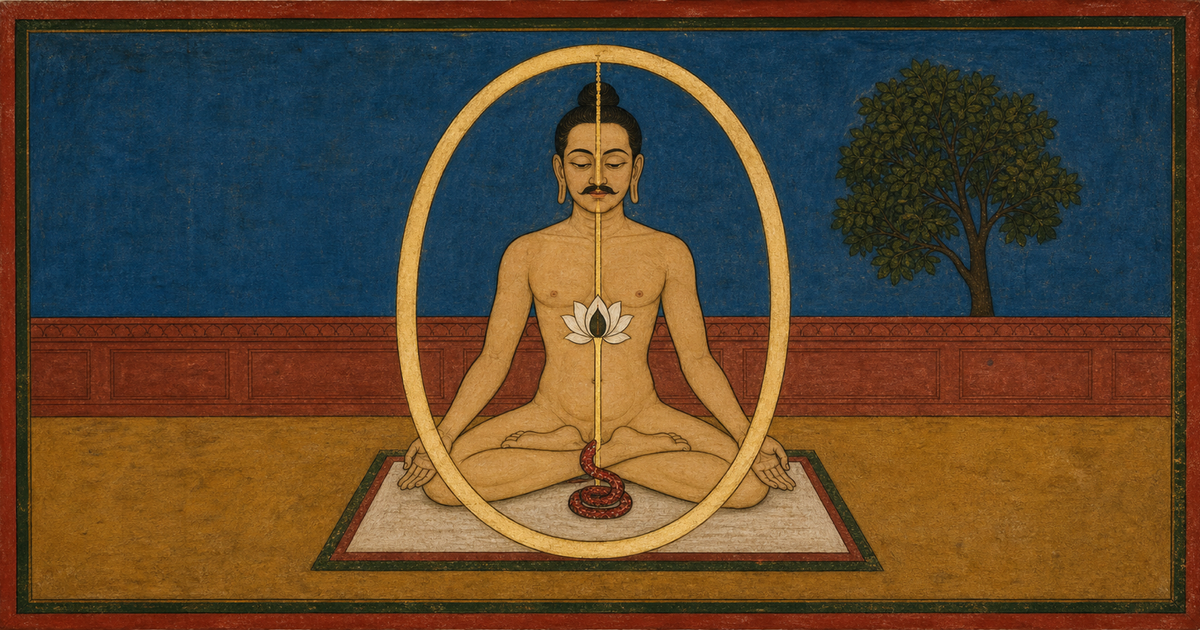
Illustration for the Haṭha Pradīpikā section “HP 2.79-2.80: Haṭha-Siddhi”.

Haṭha Pradīpikā 2.79-2.80: Signs of Haṭha Siddhi

The awakening of Kuṇḍalinī opens Suṣumṇā; slenderness, health, clarity of Nāda, and purification of the Nāḍīs indicate Haṭha Siddhi.

Continue with AYI Free

Illustrations: AI-generated.

Editor

Dr. Ronald Steiner

From Ulm

The "Yoga Doc" - Dr. Ronald Steiner is the founder of the AYI method. This method links traditional Ashtanga Yoga with innovative Yogatherapy and living Philosophy. This forms a practice that is personal for each and... more ›