
HP 4.1-4.4: Laya and Breath

Haṭha Pradīpikā 4.1-4.4: Laya as Lord of the Breath

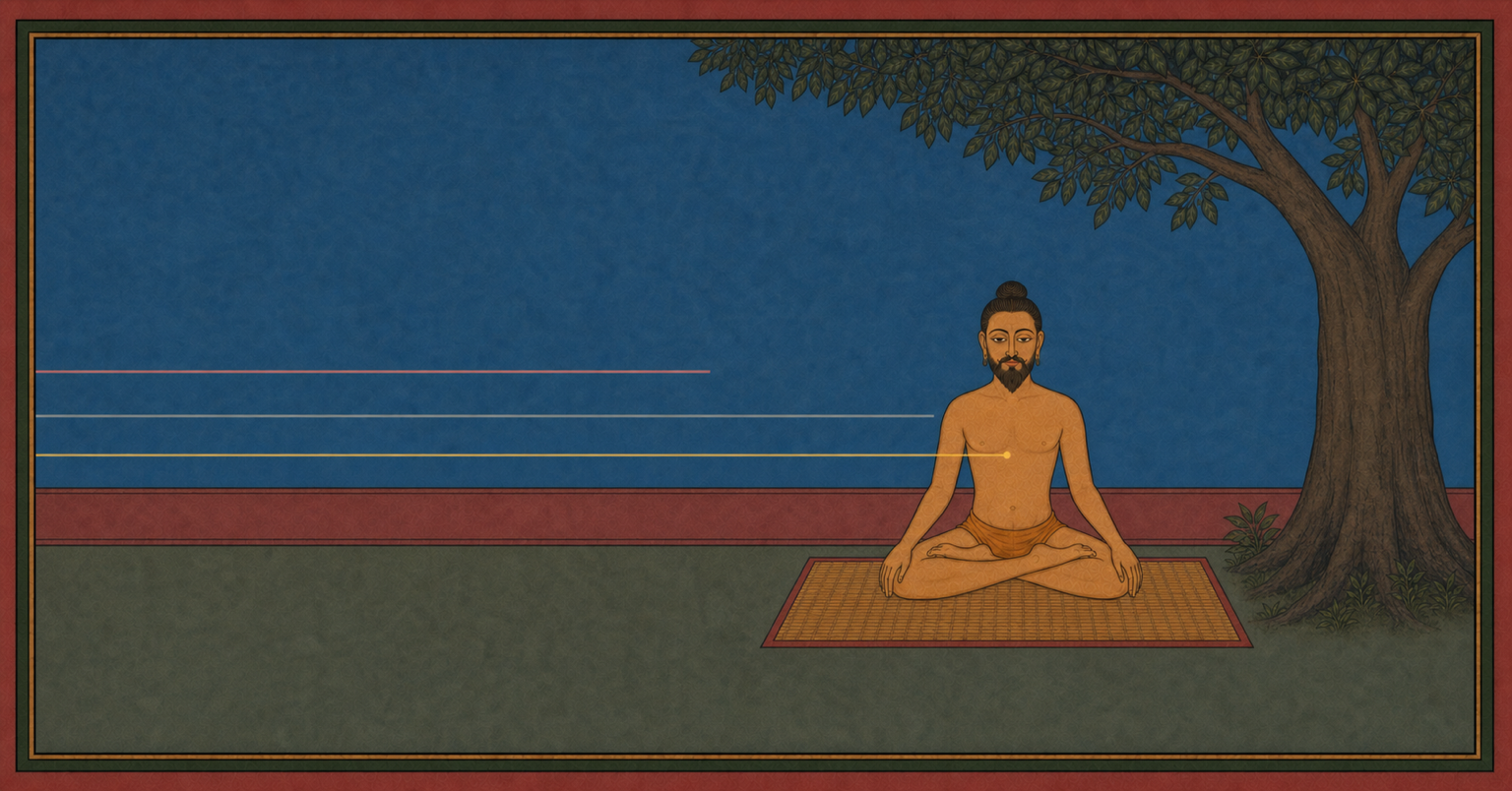
The section explains the sequence of senses, mind, and breath and describes Laya as the immediate state into which the gaze enters.

Dr. Ronald Steiner Dr. Ronald Steiner
Haṭha Pradīpikā 4.1
इन्द्रियाणां मनो नाथो मनोनाथस्तु मारुतः |
indriyāṇāṃ mano nātho; mano-nāthas tu mārutaḥ | Analysis ▾ Analysis ▴
indriyāṇām
genitive plural
substantive neuter
of the senses
manas
nominative singular
substantive neuter
mind
nāthaḥ
nominative singular
substantive masculine
lord, master
manas
tatpuruṣa-compound genitive
substantive neuter
of the mind
nāthaḥ
nominative singular
substantive masculine
lord
tu
particle
but, now
mārutaḥ
nominative singular
substantive masculine
breath, wind
मारुतस्य लयो नाथस् तं नाथं लयमाश्रयेत् ||1||
mārutasya layo nāthas; taṃ nāthaṃ layam āśrayet ||1|| Analysis ▾ Analysis ▴
mārutasya
genitive singular
substantive masculine
of the breath
layaḥ
nominative singular
substantive masculine
dissolution
nāthaḥ
nominative singular
substantive masculine
lord, master
tam
accusative singular masculine
pronoun
this
nātham
accusative singular
substantive masculine
lord
layam
accusative singular
substantive masculine
dissolution
āśrayet
3rd person singular aktive optative
previx
verbal root
should take refuge in
Metre: Anuṣṭubh
The mind (manas | nom sg) is the lord (nāthaḥ | nom sg) of the senses (indriyāṇām | gen pl), while (tu) the breath-wind (mārutaḥ | nom sg) is the lord of the mind (mano-nāthaḥ | nom sg). Dissolution (layaḥ | nom sg) is the lord (nāthaḥ | nom sg) of the breath-wind (mārutasya | gen sg); one should take refuge (āśrayet | 3p sg act opt) in that lord (taṃ nātham | acc sg), Laya (layam | acc sg).
Dr. Ronald Steiner - 2026 - historically literal
The senses are directed by the mind, and the mind by the breath. The breath, in turn, comes to rest in dissolution. The yogi should therefore seek refuge in Laya.
Dr. Ronald Steiner - 2026 - modern transfer

For Brahmānanda, the verse describes a chain of reciprocal control. The mind directs the senses, Prāṇa moves the mind, the dissolution of the mind brings Prāṇa to rest, and this dissolution is supported by Nāda. The inner sound therefore becomes the methodological link in the rest of the chapter between direction of the breath and mental absorption.

Brahmānanda's Jyotsnā - 19th c.
nāthas taṃ nāthaṃ layam āśrayet MBHDL2026 ] nāthaḥ sa layo nādam āśritaḥ NS1882
Critical Apparatus
Mind is the master of the senses, and the breath is the master of the mind. The breath in its turn is subordinate to the laya (absorption), and that laya depends on the nâda.
Pancham Sinh - 1915
Das Bewusstsein ist Herr der Sinne, der Athem Herr des Bewusstseins, die Vernichtung (des Bewusstseins) Herrin des Athems, und die Vernichtung (des Bewusstseins) hängt vom Nâda ab (d. h. im Nada wird das Bewusstsein vernichtet).
Hermann Walter - 1893
Haṭha Pradīpikā 4.1*1
सो ऽयम् एवास्तु मोक्षाख्यो मास्तु वापि मतान्तरे |
so 'yam evāstu mokṣākhyo; māstu vāpi matāntare | Analysis ▾ Analysis ▴
saḥ
nominative singular masculine
pronoun
this
ayam
nominative singular masculine
pronoun
this
eva
particle
indeed
astu
3rd person singular aktive imperative
verbal root
may it be
mokṣa
tatpuruṣa-compound genitive
substantive masculine
of liberation
ākhyaḥ
nominative singular masculine
previx
verbal root
called
mā
particle
not
astu
3rd person singular aktive imperative
verbal root
may it be
vā
particle
or
api
particle
also
matāntare
lokative singular
substantive neuter
according to another doctrine
मनःप्राणलयानन्दो मयि कश्चित्प्रवर्तते ||1*1||
manaḥ-prāṇa-layānando; mayi kaścit pravartate ||1*1|| Analysis ▾ Analysis ▴
manas
dvandva-compound
substantive neuter
mind
prāṇa
dvandva-compound
substantive masculine
prāṇa
laya
tatpuruṣa-compound genitive
substantive masculine
of dissolution
ānandaḥ
nominative singular
substantive masculine
bliss
mayi
lokative singular
pronoun pers 1p
in me
kaścit
nominative singular masculine
pronoun
a certain
pravartate
3rd person singular medial present
previx
verbal root
arises, occurs
Metre: Anuṣṭubh
This [Laya] (saḥ ayam | nom sg m) may indeed (eva) be called Mokṣa (mokṣa-ākhyaḥ | nom sg m), or according to another doctrine (matāntare | loc sg) perhaps not (mā astu vā api). A certain (kaścit | nom sg m) bliss arising from the dissolution of mind and Prāṇa (manaḥ-prāṇa-laya-ānandaḥ | nom sg) manifests (pravartate | 3p sg med pres) within me (mayi | loc sg).
Dr. Ronald Steiner - 2026 - historically literal
Whether or not another teaching calls this dissolution Mokṣa, a special joy rises within the speaker from the dissolution of mind and Prāṇa.
Dr. Ronald Steiner - 2026 - modern transfer

Against the objection that the mind also dissolves in deep sleep and that such dissolution therefore cannot be liberation, Brahmānanda emphasizes the joint dissolution of mind and Prāṇa. Only this establishes Jīvanmukti, which he understands as inexpressible bliss. The addition explicitly distinguishes yogic absorption from unconsciousness and ordinary sleep.

Brahmānanda's Jyotsnā - 19th c.
manaḥprāṇalayānando mayi kaścit pravartate MBHDL2026 ] manaḥprāṇalaye kaś cid ānandaḥ sampravartate NS1882
Critical Apparatus
This very laya is what is called mokṣa, or, being a sectarian, you may not call it mokṣa; but when the mind becomes absorbed, a sort of ecstasy is experienced.
Pancham Sinh - 1915
Ob nun diese Vernichtung Moksha genannt werde, oder, wie von andern Sekten, nicht, auf jeden Fall entsteht bei der Vernichtung von Bewusstsein und Athem ein gewisses Wonnegefühl.
Hermann Walter - 1893
Haṭha Pradīpikā 4.2
प्रनष्टोच्छ्वासनिश्वासः प्रध्वस्तविषयग्रहः |
pranaṣṭocchvāsa-niśvāsaḥ; pradhvasta-viṣaya-grahaḥ | Analysis ▾ Analysis ▴
pranaṣṭa
karmadhāraya-compound past participle passive
previx
verbal root
vanished
ucchvāsa
dvandva-compound
substantive masculine
inhalation
niśvāsaḥ
nominative singular
substantive masculine
exhalation
pradhvasta
karmadhāraya-compound past participle passive
previx
verbal root
destroyed
viṣaya
tatpuruṣa-compound genitive
substantive masculine
of sense objects
grahaḥ
nominative singular
substantive masculine
apprehension
निश्चेष्टो निर्विकारश्च लयो जयति योगिनाम् ||2||
niśceṣṭo nirvikāraś ca; layo jayati yoginām ||2|| Analysis ▾ Analysis ▴
niśceṣṭa
nominative singular masculine
adjective
motionless
nirvikāraḥ
nominative singular masculine
adjective
unchanged
ca
particle
and
layaḥ
nominative singular
substantive masculine
laya, dissolution
jayati
3rd person singular aktive present
verbal root
triumphs, excels
yoginām
genitive plural
substantive masculine
of yogins
Metre: Anuṣṭubh
Among yogis (yoginām | gen pl), Laya (layaḥ | nom sg) excels (jayati | 3p sg act pres): inhalation and exhalation have vanished (pranaṣṭa-ucchvāsa-niśvāsaḥ | nom sg m), the grasping of sense objects has been destroyed (pradhvasta-viṣaya-grahaḥ | nom sg), and the practitioner is motionless (niśceṣṭaḥ | nom sg m), unchanging (nirvikāraḥ | nom sg m), and (ca) [beyond activity].
Dr. Ronald Steiner - 2026 - historically literal
For yogis, Laya is the state in which the movement of breath, the grasping of the senses, and inner change come to rest.
Dr. Ronald Steiner - 2026 - modern transfer
pranaṣṭocchvāsaniśvāsaḥ MBHDL2026 ] pranaṣṭaśvāsaniśvāsaḥ NS1882; praṇaṣṭocchvāsaniśvāsaḥ MBHDL2024
Critical Apparatus
By the suspension of respiration and the annihilation of the enjoyments of the senses, when the mind becomes devoid of all the activities and remains changeless, then the Yogî attains to the Laya Stage.
Pancham Sinh - 1915
Nur die Vernichtung nützt dem Yogin, die in der Vernichtung des Einathmens und des Ausathmens besteht, in der Vernichtung der Sinnesfunktionen, in der Unbeweglichkeit und dem Stillstand der Geistesthätigkeit.
Hermann Walter - 1893
Haṭha Pradīpikā 4.3
उच्छिन्नसर्वसंकल्पो निःशेषाशेषचेष्टितः |
ucchinna-sarva-saṃkalpo; niḥśeṣāśeṣa-ceṣṭitaḥ | Analysis ▾ Analysis ▴
ucchinna
karmadhāraya-compound past participle passive
previx
verbal root
cut off
sarva
tatpuruṣa-compound genitive
adjective
all
saṃkalpaḥ
nominative singular
substantive masculine
conceptions
niḥśeṣa
karmadhāraya-compound
adjective
entirely
aśeṣa
tatpuruṣa-compound genitive
adjective
all
ceṣṭitaḥ
nominative singular masculine past participle passive
verbal root
activities
स्वावगम्यो लयः को ऽपि जयतां वागगोचरः ||3||
svāvagamyo layaḥ ko 'pi; jayatāṃ vāg-agocaraḥ ||3|| Analysis ▾ Analysis ▴
sva-avagamya
nominative singular masculine
pronoun
verbal root
knowable only by oneself
layaḥ
nominative singular
substantive masculine
laya
kaḥ
nominative singular masculine
pronoun
a certain
api
particle
also
jayatām
3rd person singular aktive imperative
verbal root
may it triumph, arise
vāk
tatpuruṣa-compound genitive
substantive feminine
of speech
agocara
nominative singular masculine
adjective
inaccessible
Metre: Anuṣṭubh
May this extraordinary Laya (layaḥ ko'pi | nom sg m) prevail (jayatām | 3p sg act imp): all conceptions have been severed (ucchinna-sarva-saṃkalpaḥ | nom sg m), every activity has ended without remainder (niḥśeṣa-aśeṣa-ceṣṭitaḥ | nom sg m), it is knowable only through itself (svāvagamyaḥ | nom sg m), and it is beyond the reach of speech (vāg-agocaraḥ | nom sg m).
Dr. Ronald Steiner - 2026 - historically literal
Laya is a wordless state: all inner constructions and activities fall away, and it can only be experienced directly.
Dr. Ronald Steiner - 2026 - modern transfer
jayatāṃ MBHDL2026 ] jāyate NS1882
Critical Apparatus
When all the thoughts and activities are destroyed, then the Laya Stage is produced, to describe which is beyond the power of speech, being known by self-experience alone.
Pancham Sinh - 1915
Es entsteht eine Vernichtung, die aus sich selbst verstanden werden muss, die nicht durch Worte ausgedrückt werden kann, die aber dadurch charakterisirt wird, dass alle Geistesfunktionen aufhören, ebenso sämmtliche Bewegungen.
Hermann Walter - 1893
Haṭha Pradīpikā 4.4
यत्र दृष्टिर् लयस्तत्र भूतेन्द्रियसनातनः |
yatra dṛṣṭir layas tatra; bhūtendriya-sanātanaḥ | Analysis ▾ Analysis ▴
yatra
adverb
where
dṛṣṭiḥ
nominative singular
substantive feminine
gaze
layaḥ
nominative singular
substantive masculine
laya
tatra
adverb
there
bhūta
dvandva-compound
substantive neuter
elements
indriya
dvandva-compound
substantive neuter
senses
sanātanaḥ
nominative singular masculine
adjective
eternally
स्याच्छक्तिर् जीवभूतानां दृष्टिर् लक्ष्ये लयं गता ||4||
syāc chaktir jīva-bhūtānāṃ; dṛṣṭir lakṣye layaṃ gatā ||4|| Analysis ▾ Analysis ▴
syāt
3rd person singular aktive optative
verbal root
shall be, becomes
śaktiḥ
nominative singular
substantive feminine
śakti, power
jīva
karmadhāraya-compound
adjective
living
bhūtānām
genitive plural
substantive neuter
being
dṛṣṭiḥ
nominative singular
substantive feminine
gaze
lakṣye
lokative singular
substantive neuter
into the focus
layam
accusative singular
substantive masculine
dissolution
gatā
nominative singular feminine past participle passive
verbal root
gone, entered
Metre: Anuṣṭubh
Where (yatra) the gaze (dṛṣṭiḥ | nom sg) is, there (tatra) is Laya (layaḥ | nom sg), eternal among the elements and senses (bhūta-indriya-sanātanaḥ | nom sg m). The gaze (dṛṣṭiḥ | nom sg) that has entered dissolution (layaṃ gatā | nom sg f ppp) in the target (lakṣye | loc sg) becomes the power (śaktiḥ | nom sg) of living beings (jīva-bhūtānām | gen pl).
Dr. Ronald Steiner - 2026 - historically literal
The gaze leads into Laya. When it is wholly absorbed in the target, it becomes the living power of the practice.
Dr. Ronald Steiner - 2026 - modern transfer

Brahmānanda explains the “pair” to be dissolved as Avidyā and Vidyā. According to the Satkāryavāda he presupposes, ignorance is the ground from which the elements and senses arise; Vidyā appears as the animating power of knowledge. In attributeless Brahman, both lose their separate function. For him, Laya thus transcends not only error, but also the means of knowledge that removes it.

Brahmānanda's Jyotsnā - 19th c.
bhūtendriyasanātanaḥ syāc chaktir MBHDL2026 ] bhūtendriyasanātanī sā śaktir NS1882

dṛṣṭir lakṣye layaṃ gatā MBHDL2026 ] dve alakṣye layaṃ gate NS1882
Critical Apparatus
Wo der Blick ist (d. h. wenn er auf das alakshya, brahma konzentrirt ist), da ist die Vernichtung. Die ewige Sakti der Elemente und Sinne und die Şakti der lebenden Wesen werden beide im Brahma (alakshye) vernichtet.
Hermann Walter - 1893

Continue with AYI Free

Illustrations: AI-generated.

Editor

Dr. Ronald Steiner

From Ulm

The "Yoga Doc" - Dr. Ronald Steiner is the founder of the AYI method. This method links traditional Ashtanga Yoga with innovative Yogatherapy and living Philosophy. This forms a practice that is personal for each and... more ›

Messages and ratings
0 messages

Please log in to write a message. Go to login

No messages yet.