
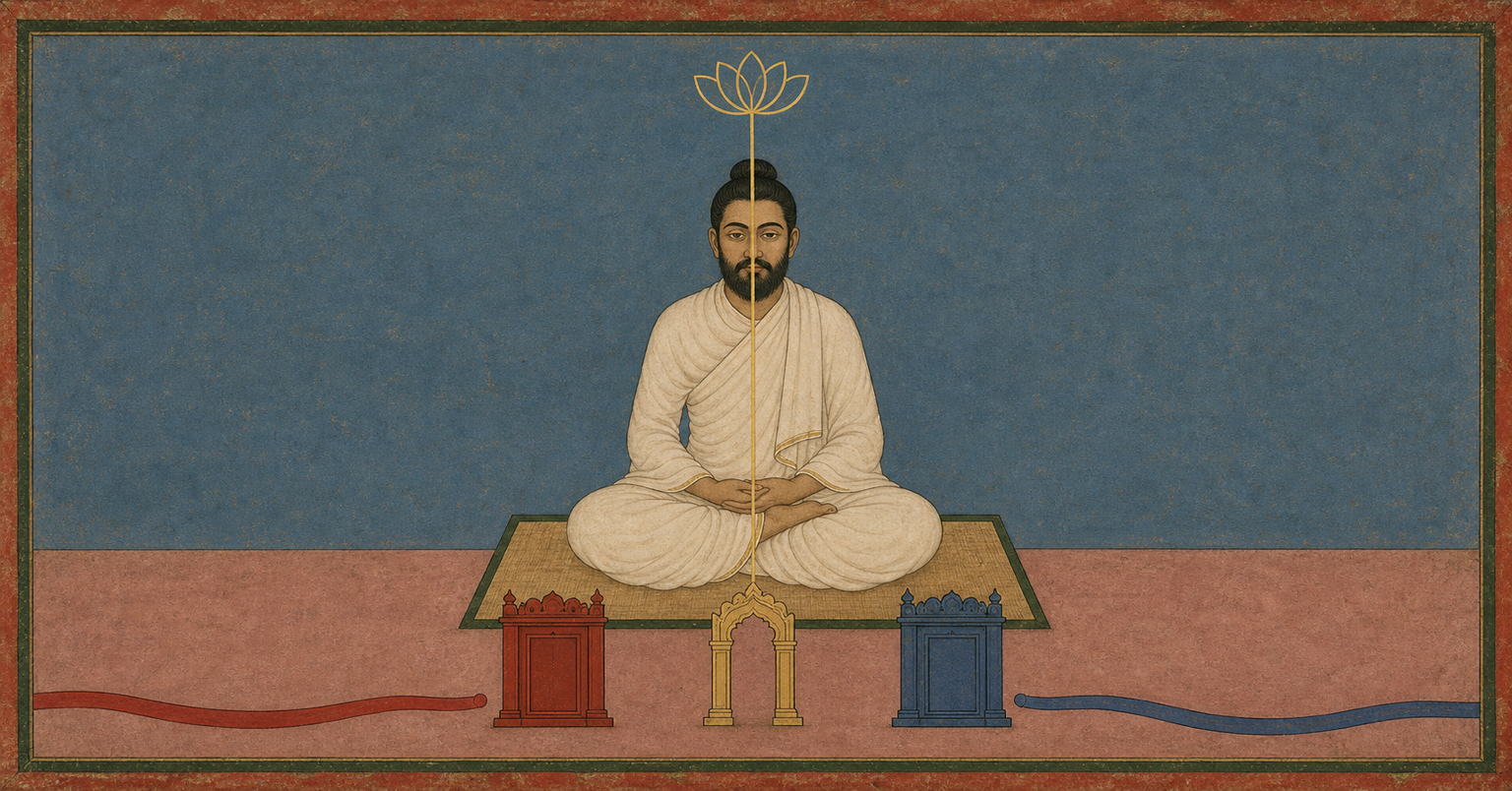

yāvan naiva, praviśati caran, māruto madhya-mārge; yāvad bindur, na bhavati dṛḍhaḥ, prāṇa-vāta-prabaddhaḥ | Analysis ▾ Analysis ▴
|
yāvat
|
as long as | |
|
na
|
not | |
|
eva
|
indeed | |
|
praviśati
|
entered | |
|
caran
|
flows | |
|
mārutaḥ
|
breath, wind | |
|
madhya
|
middle | |
|
mārge
|
path | |
|
yāvat
|
as long as | |
|
binduḥ
|
bindu | |
|
na
|
not | |
|
bhavati
|
becomes | |
|
dṛḍhaḥ
|
firm | |
|
prāṇa
|
through breath | |
|
vāta
|
by wind | |
|
prabaddhaḥ
|
held |
yāvad vyomnā, sahaja-sadṛśaṃ, jāyate naiva tattvaṃ; tāvat sarvaṃ, vadati yad idaṃ, dambha-mithyā-pralāpaḥ ||57|| Analysis ▾ Analysis ▴
|
yāvat
|
as long as | |
|
vyomnā
|
of space | |
|
sahaja
|
innate | |
|
sadṛśam
|
equal | |
|
jāyate
|
arises | |
|
na
|
not | |
|
eva
|
indeed | |
|
tattvam
|
reality | |
|
tāvat
|
so long | |
|
sarvam
|
all | |
|
vadati
|
said | |
|
yad
|
whatever | |
|
idam
|
this | |
|
dambha
|
hypocrisy | |
|
mithyā
|
false | |
|
pralāpaḥ
|
chatter |
For Brahmānanda, knowledge is credible only when Prāṇa has entered Suṣumṇā and stands firm in Brahmarandhra, Bindu has become stable through Kumbhaka, and the mind grasps supreme reality as naturally as an ordinary object. Anyone who speaks of knowledge without this mastery, he says, makes only empty assertions. The commentary preserves here a deliberately polemical primacy of yogic experience.
Brahmānanda then integrates seemingly different paths into eight-limbed yoga. Listening to and reflecting on the teaching belong to Svādhyāya, deep contemplation to Dhyāna, Karma Yoga to Kriyāyoga, and devotion to Īśvarapraṇidhāna or to a form of Samādhi. Knowledge, action, and Bhakti thus appear as components of a comprehensive system of yoga.
In the textual version of the Jyotsnā, the yogi is to learn the opening of Suṣumṇā from the guru at a suitable place already described in the first chapter, lead Prāṇa into the middle path, and hold it in Brahmarandhra. MBHDL2026 gives different details at this point; the practice explained here is therefore source-bound.
kṛtvāsāv aindave sthāne ghrāṇarandhre MBHDL2026 ] sthitvā sadaiva susthāne brahmarandhre NS1882
For Brahmānanda, the solar and lunar currents produce the yogic alternation of day and night, each in periods of two and a half Ghaṭikās. Suṣumṇā “devours” time because this alternation ends there. The experienced yogi is thereby said to recognize the time of death, hold Prāṇa in Brahmarandhra, and leave the body voluntarily; this belongs to the traditional bodily and soteriological model of the commentary.
tāv eva dhattaḥ sakalaṃ kālaṃ MBHDL2026 ] sūryacandramasau dhattaḥ kālaṃ NS1882
Among the 72,000 openings of the channels, only Suṣumṇā possesses the decisive salvific function. Brahmānanda calls it Śāmbhavī because it leads to Śambhu and reveals the self. When the other channels are called “purposeless,” this concerns the final purpose of liberation; the commentary does not deny their significance for other bodily functions.
bodhayitvā suṣumṇāyāṃ; praviśed anirodhataḥ ||65|| Analysis ▾ Analysis ▴
|
bodhayitvā
|
should awaken | |
|
suṣumṇāyām
|
Suṣumṇā | |
|
praviśet
|
entered | |
|
anirodhatas
|
without obstruction |
Carefully gathered Prāṇa joins the digestive fire, awakens Kuṇḍalinī, and enters Suṣumṇā without obstruction. Brahmānanda treats these three processes as a continuous causal chain. In the following verse, he draws the sharp conclusion: as long as the central current of breath is absent, other yogic efforts remain futile for the highest goal.
Continue with AYI Free
Illustrations: AI-generated.

Please log in to write a message. Go to login
No messages yet.