
HP 4.5-4.8: Śāmbhavī and Khecarī

Haṭha Pradīpikā 4.5-4.8: Śāmbhavī and Khecarī

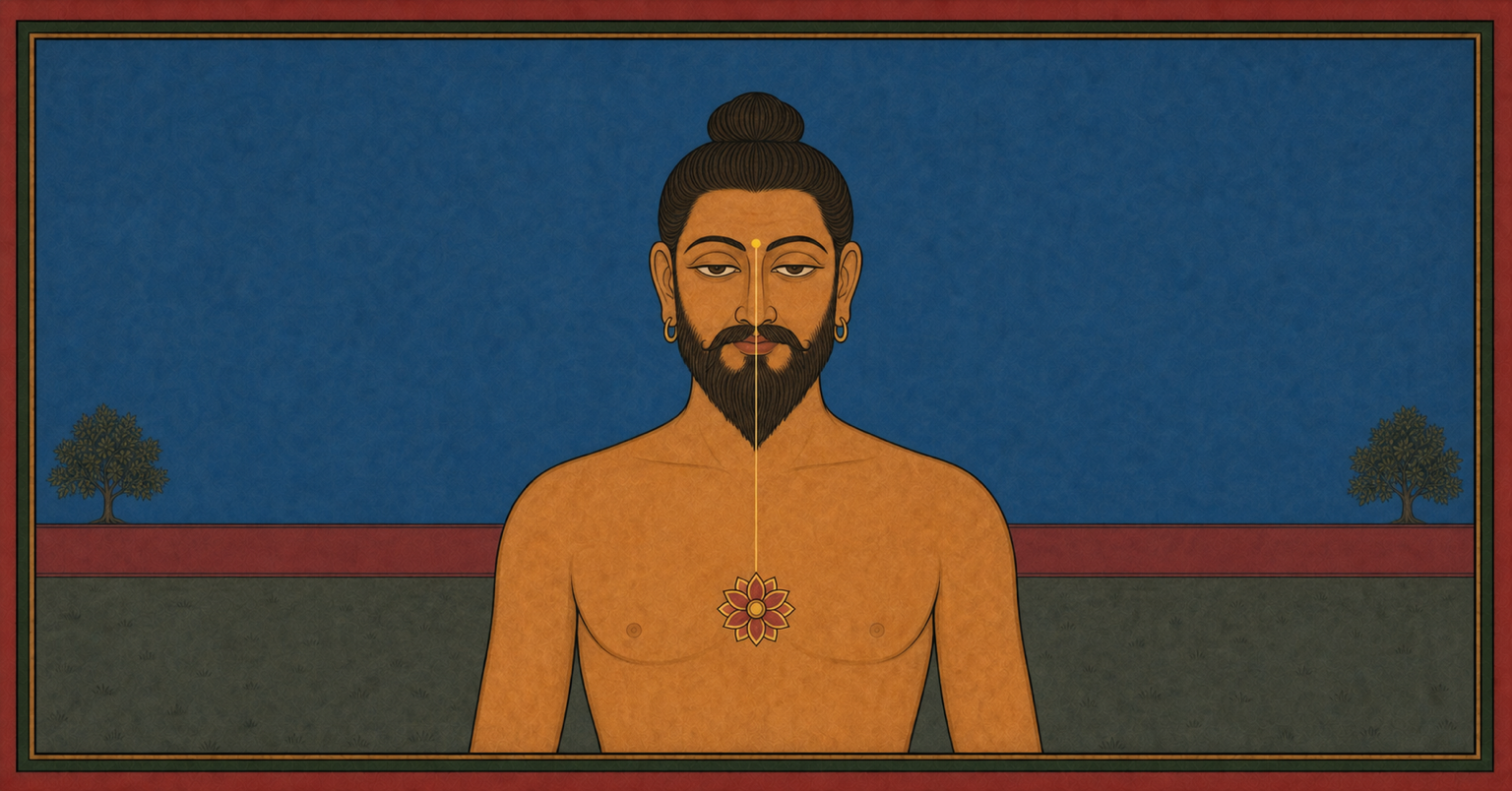
Śāmbhavī connects the inner goal with the outward gaze; Khecarī leads into the same empty space in which the mind dissolves.

Dr. Ronald Steiner Dr. Ronald Steiner
Haṭha Pradīpikā 4.5
वेदशास्त्रपुराणानि सामान्यगणिका इव |
veda-śāstra-purāṇāni; sāmānya-gaṇikā iva | Analysis ▾ Analysis ▴
veda
dvandva-compound
substantive masculine
Vedas
śāstra
dvandva-compound
substantive neuter
śāstras
purāṇāni
nominative plural
substantive neuter
Purāṇas
sāmānya
karmadhāraya-compound
adjective
common
gaṇikā
nominative singular
substantive feminine
courtesan
iva
particle
like
एकैव शाम्भवी मुद्रा गुप्ता कुलवधूर् इव ||5||
ekaiva śāmbhavī mudrā; guptā kula-vadhūr iva ||5|| Analysis ▾ Analysis ▴
ekā
nominative singular feminine
numeral
one alone
eva
particle
indeed
śāmbhavī
nominative singular
substantive feminine
Śāmbhavī
mudrā
nominative singular
substantive feminine
mudrā
guptā
nominative singular feminine past participle passive
verbal root
hidden, protected
kula
tatpuruṣa-compound genitive
substantive neuter
of good family
vadhūḥ
nominative singular
substantive feminine
woman
iva
particle
like
Metre: Anuṣṭubh
The Vedas, Śāstras, and Purāṇas (veda-śāstra-purāṇāni | nom pl) are like (iva) a common courtesan (sāmānya-gaṇikā | nom sg); the one (ekā | nom sg f), namely (eva) Śāmbhavī Mudrā (śāṃbhavī mudrā | nom sg), is concealed (guptā | nom sg f ppp), like (iva) a woman from a good family (kula-vadhūḥ | nom sg).
Dr. Ronald Steiner - 2026 - historically literal
Learned knowledge lies openly available; Śāmbhavī Mudrā, by contrast, is regarded as a protected and hidden practice.
Dr. Ronald Steiner - 2026 - modern transfer
The Vedas and the Śâstras are like ordinary public women. Śâmhhavî Mudrâ is the one, which is secluded like a respectable lady.
Pancham Sinh - 1915
Veda, Şâstra und Purâņa sind wie öffentliche Frauenzimmer, die Allen gehören, aber diese eine Şambhavi Mudra wird verborgen gehalten wie ein ehrbares Frauenzimmer.
Hermann Walter - 1893
Haṭha Pradīpikā 4.6
अन्तर् लक्ष्यं बहिर्दृष्टिर् निमेषोन्मेषवर्जिता |
antar lakṣyaṃ bahir dṛṣṭir; nimeṣonmeṣa-varjitā | Analysis ▾ Analysis ▴
antar
adverb
inside
lakṣyam
nominative accusative singular
substantive neuter
focus
bahis
adverb
outside
dṛṣṭiḥ
nominative singular
substantive feminine
gaze
nimeṣa
dvandva-compound
substantive neuter
closing, blinking
unmeṣa
dvandva-compound
substantive neuter
opening
varjitā
nominative singular feminine past participle passive
verbal root
free from, without
एषा सा शाम्भवी मुद्रा सर्वतन्त्रेषु गोपिता ||6||
eṣā sā śāmbhavī mudrā; sarva-tantreṣu gopitā ||6|| Analysis ▾ Analysis ▴
eṣā
nominative singular feminine
pronoun
this
sā
nominative singular feminine
pronoun
that
śāmbhavī
nominative singular
substantive feminine
Śāmbhavī
mudrā
nominative singular
substantive feminine
mudrā
sarva
karmadhāraya-compound
adjective
in all
tantreṣu
lokative plural
substantive neuter
Tantras
gopitā
nominative singular feminine past participle passive
verbal root
hidden, guarded
Metre: Anuṣṭubh
Within (antar) is the target (lakṣyam | nom acc sg), without (bahiḥ) is the gaze (dṛṣṭiḥ | nom sg), free from closing and opening [the eyes] (nimeṣa-unmeṣa-varjitā | nom sg f ppp): this (eṣā sā | nom sg f) is Śāmbhavī Mudrā (śāṃbhavī mudrā | nom sg), concealed (gopitā | nom sg f ppp) in all Tantras (sarva-tantreṣu | loc pl).
Dr. Ronald Steiner - 2026 - historically literal
Śāmbhavī means that the focus remains within while the gaze rests outward without blinking. This Mudrā is said to be concealed in every Tantra.
Dr. Ronald Steiner - 2026 - modern transfer

According to Brahmānanda, the inner target of Śāmbhavī can be any chosen Cakra from the lower bodily center to Brahmarandhra. The outer gaze remains motionless because the mind is completely gathered in the inner target. Open eyes therefore do not mean that external objects continue to be perceived.

Brahmānanda's Jyotsnā - 19th c.
sarvatantreṣu MBHDL2026 ] vedaśāstreṣu NS1882
Critical Apparatus
Aiming at Brahman inwardly, while keeping the sight directed to the external objects, without blinking the eyes, is called the Sâmbhavî Mudrâ, hidden in the Vedas and the Sâstras.
Pancham Sinh - 1915
Man richte das Auge, dasselbe weder auf- noch zumachend, auf eine Stelle an der Oberfläche des Körpers, die dem entspricht, was im Innern wahrzunehmen ist (d. h. man fixire einen der mystischen Kreise). Dies ist die Şambhavî Mudrâ, die in den heiligen Schriften bewahrt wird (d. h. unter andern in den Yoga-Büchern: sâmkhyapatanjaladishu, Com.).
Hermann Walter - 1893
Haṭha Pradīpikā 4.7
अन्तर्लक्ष्यविलीनचित्तपवनो योगी यदा वर्तते दृष्ट्या निश्चलतारया बहिरधः पश्यन्नपश्यन्नपि |
antar-lakṣya-vilīna-citta-pavano, yogī yadā vartate dṛṣṭyā niścala-tārayā bahir adhaḥ, paśyann apaśyann api | Analysis ▾ Analysis ▴
antar
karmadhāraya-compound
adverb
inner
lakṣya
tatpuruṣa-compound lokative
substantive neuter
in the focus
vilīna
karmadhāraya-compound past participle passive
previx
verbal root
dissolved
citta
dvandva-compound
substantive neuter
mind
pavanaḥ
nominative singular
substantive masculine
breath, wind
yogī
nominative singular
substantive masculine
the yogin
yadā
adverb
when
vartate
3rd person singular medial present
verbal root
remains, abides
dṛṣṭyā
instrumental case singular
substantive feminine
with gaze
niścala
karmadhāraya-compound
adjective
unmoving
tārayā
instrumental case singular
substantive feminine
pupil
bahis
adverb
outward
adhas
adverb
downward
paśyan
nominative singular masculine present participle active
verbal root
seeing
apaśyan
nominative singular masculine present participle active
particle
verbal root
not seeing
api
particle
though, even
मुद्रेयं खलु खेचरी भवति सा युष्मत्प्रसादाद्गुरो शून्याशून्यविवर्जितं स्फुरति यत्तत्त्वं पदं शाम्भवम् ||7||
mudreyaṃ khalu khecarī bhavati sā, yuṣmat-prasādād guro śūnyāśūnya-vivarjitaṃ sphurati yat, tattvaṃ padaṃ śāmbhavam ||7|| Analysis ▾ Analysis ▴
mudrā
nominative singular
substantive feminine
mudrā
iyam
nominative singular feminine
pronoun
this
khalu
particle
indeed
khecarī
nominative singular
substantive feminine
Khecarī
bhavati
3rd person singular aktive present
verbal root
becomes, is
sā
nominative singular feminine
pronoun
it
yuṣmad
tatpuruṣa-compound genitive
pronoun
through your
prasādāt
ablative singular
substantive masculine
grace
guro
vokative singular
substantive masculine
O guru
śūnya
dvandva-compound
adjective
empty
aśūnya
dvandva-compound
adjective
nonempty
vivarjitam
nominative accusative singular neuter past participle passive
previx
verbal root
free from
sphurati
3rd person singular aktive present
verbal root
shines forth
yat
nominative accusative singular neuter
pronoun
which
tattvam
nominative accusative singular
substantive neuter
reality
padam
nominative accusative singular
substantive neuter
state, abode
śāmbhavam
nominative accusative singular neuter
adjective
belonging to Śambhu
Metre: Śārdūlavikrīḍita
When (yadā) the yogi (yogī | nom sg), whose mind and breath have dissolved into the inner target (antar-lakṣya-vilīna-citta-pavanaḥ | nom sg), remains (vartate | 3p sg med pres) with motionless pupils (niścala-tārayā | ins sg), looking (paśyan | nom sg m pca) outward and downward (bahir adhaḥ), not seeing (apaśyan | nom sg m pca) and yet (api) seeing, then this Mudrā (mudrā iyam | nom sg) is indeed (khalu) Khecarī (khecarī | nom sg). Through your grace (yuṣmat-prasādāt | abl sg), O Guru (guro | voc sg), the Śāṃbhava state (padaṃ śāṃbhavam | nom acc sg n) shines forth (sphurati | 3p sg act pres) as that reality (yat tattvam | nom acc sg n) which is free from both void and non-void (śūnya-aśūnya-vivarjitam | nom acc sg n ppp).
Dr. Ronald Steiner - 2026 - historically literal
When mind and breath have dissolved into the inner focus and the unmoving gaze rests outward without clinging to anything, the Śāmbhava state beyond void and non-void appears through the grace of the guru.
Dr. Ronald Steiner - 2026 - modern transfer

As the inner target, Brahmānanda names either a formed Īśvara in the lotus of the heart or Brahman as designated by the great statements of the Upaniṣads. Although the eyes face outward, the mind grasps no external things. For him, the reality recognized through the guru's grace is neither mere nothingness nor a limited entity; this formulation protects the emptiness of the experience from a nihilistic interpretation.

Brahmānanda's Jyotsnā - 19th c.
khecarī MBHDL2026 ] śāmbhavī NS1882
Critical Apparatus
When the Yogî remains inwardly attentive to the Brahman, keeping the mind and the Prâṇa absorbed, and the sight steady, as if seeing everything while in reality seeing nothing outside, below, or above, verily then it is called the Sâmbhavî Mudrâ, which is learnt by the favour of a guru. Whatever, wonderful, Śûnya or Aśûnya, is perceived is to be regarded as the manifestation of that great Śambhû (Śiva).
Pancham Sinh - 1915
Wenn der Yogin Bewusstsein und Athem auf das innerlich Wahrnehmbare konzentrirt hat und mit gesenktem Kopf (adhas = adhahşirah, Com.) und unbeweglichem Augapfel die Stelle ausserhalb des Körpers betrachtet und doch nicht betrachtet (denn in Wirklichkeit ist ja seine ganze Aufmerksamkeit auf das innerlich Wahrnehmbare gerichtet), so entsteht diese Mudrâ Şâmbhavî, die bloss durch die Gunst des Lehrers zu erlangen ist, und es entspringt jene höchste, seligmachende Wirklichkeit, deren Kennzeichen die Erlösung (sûnyâşûnyam) ist.
Hermann Walter - 1893
Haṭha Pradīpikā 4.8
श्रीशाम्भव्याश्च खेचर्या अवस्थायामभेदता ||8||
śrī-śāmbhavyāś ca khecaryā; avasthāyām abhedatā ||8|| Analysis ▾ Analysis ▴
śrī
karmadhāraya-compound
adjective
venerable
śāmbhavyāḥ
genitive singular
substantive feminine
of Śāmbhavī
ca
particle
and
khecaryā
genitive singular
substantive feminine
of Khecarī
avasthāyām
lokative singular
substantive feminine
in the state
abhedatā
nominative singular
substantive feminine
nondifference
Metre: Anuṣṭubh
In the state (avasthāyām | loc sg) of venerable Śāmbhavī (śrī-śāmbhavyāḥ | gen sg) and (ca) Khecarī (khecaryāḥ | gen sg), there is non-difference (abhedatā | nom sg).
Dr. Ronald Steiner - 2026 - historically literal
In their essential state, Śāmbhavī and Khecarī are not different.
Dr. Ronald Steiner - 2026 - modern transfer

Śāmbhavī directs the outer gaze straight ahead and the inner target toward the heart, whereas Khecarī directs both gaze and inner target toward the space between the eyebrows. Despite this methodological difference, according to Brahmānanda both lead to the same self as consciousness and bliss, beyond time, place, object, and distinction.

Brahmānanda's Jyotsnā - 19th c.
avasthāyām abhedatā MBHDL2026 ] avasthādhāmabhedataḥ NS1882

om. MBHDL2026 ] add. bhavec cittalayānandaḥ śūnye citsukharūpiṇi NS1882 post avasthādhāmabhedataḥ
Critical Apparatus
The two states, the Sâmbhavî and the Khecharî, are different because of their seats (being the heart and the space between the eyebrows respectively); but both cause happiness, for the mind becomes absorbed in the Chita-sukha-Rupa-âtmana which is void.
Pancham Sinh - 1915
In Folge dieser Unterscheidung von Wesen und Ort von Şâmbhavî und Khecarî entsteht durch die Vernichtung des Bewusstseins Wonne in dem Leeren, dessen Kennzeichen eben diese Geisteswonne ist.
Hermann Walter - 1893

Continue with AYI Free

Illustrations: AI-generated.

Editor

Dr. Ronald Steiner

From Ulm

The "Yoga Doc" - Dr. Ronald Steiner is the founder of the AYI method. This method links traditional Ashtanga Yoga with innovative Yogatherapy and living Philosophy. This forms a practice that is personal for each and... more ›

Messages and ratings
0 messages

Please log in to write a message. Go to login

No messages yet.