
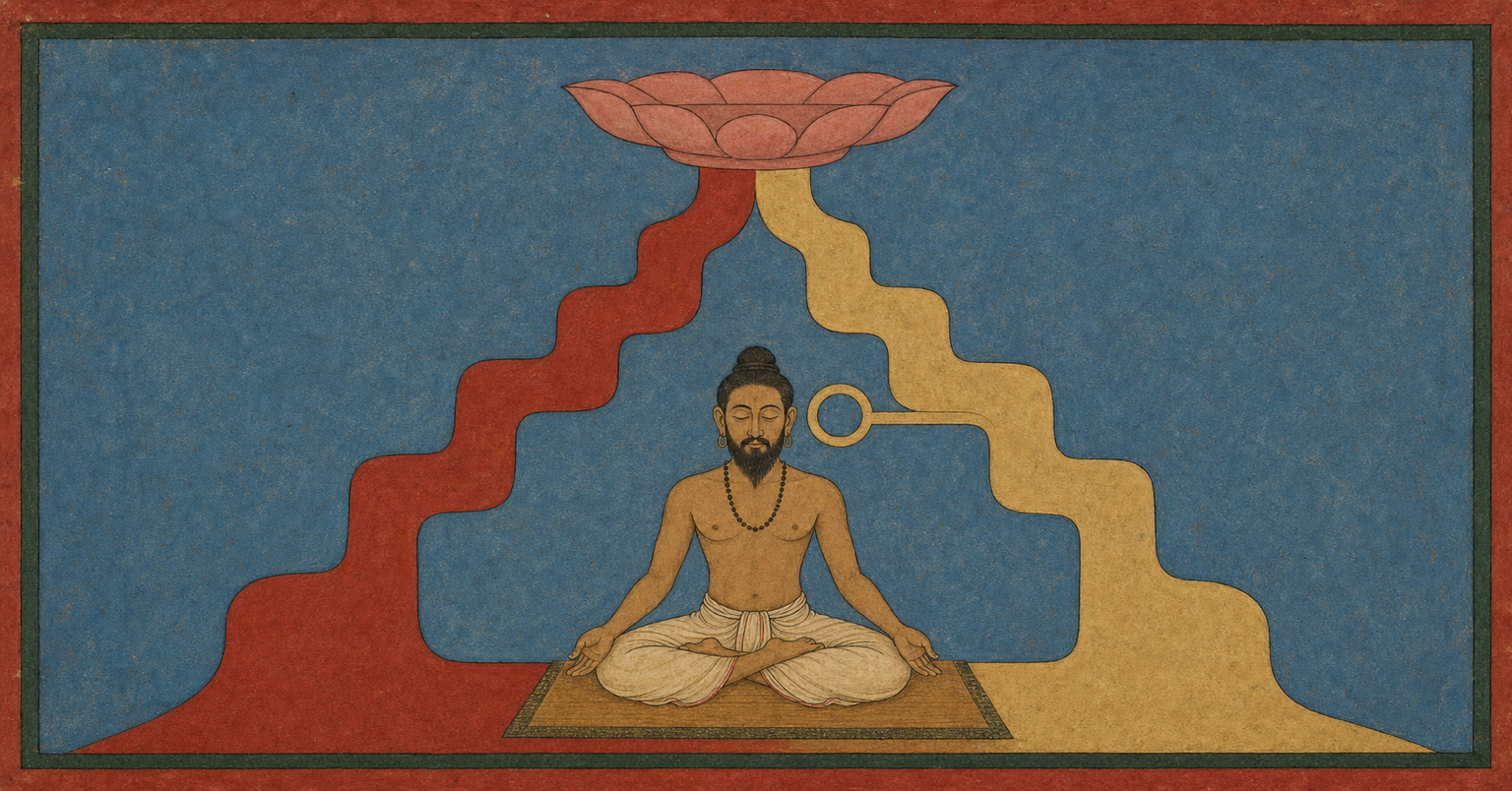
HP 4.27*1-4.35: Rājayoga and Haṭha

Haṭha Pradīpikā 4.27*1-4.35: Rājayoga and Haṭha

Nāda Laya, Haṭha, and Rājayoga are connected; names, conditions, and two approaches to the highest state are gathered.

Dr. Ronald Steiner Dr. Ronald Steiner
Haṭha Pradīpikā 4.27*1
राजयोगपदप्राप्तौ सुखोपायो ऽल्पचेतसाम् |
rāja-yoga-pada-prāptau; sukhopāyo 'lpa-cetasām | Analysis ▾ Analysis ▴
rāja
tatpuruṣa-compound genitive
substantive masculine
royal
yoga
tatpuruṣa-compound genitive
substantive masculine
yoga
pada
tatpuruṣa-compound genitive
substantive neuter
state
prāptau
lokative singular
substantive feminine
in attaining
sukha
karmadhāraya-compound
adjective
easy
upāyaḥ
nominative singular
substantive masculine
means, approach
alpa
karmadhāraya-compound
adjective
small
cetasām
genitive plural
substantive neuter
of minds
सद्यः प्रत्ययसंधायी जायते नादजो लयः ||27*1||
sadyaḥ pratyaya-saṃdhāyī; jāyate nāda-jo layaḥ ||27*1|| Analysis ▾ Analysis ▴
sadyas
adverb
immediately
pratyaya
tatpuruṣa-compound genitive
substantive masculine
attention, cognition
saṃdhāyī
nominative singular masculine
previx
verbal root
joining, concentrating
jāyate
3rd person singular medial present
verbal root
arises
nāda
tatpuruṣa-compound ablative
substantive masculine
from inner sound
jaḥ
nominative singular masculine
adjective
born
layaḥ
nominative singular
substantive masculine
dissolution
Metre: Anuṣṭubh
For people of limited understanding (alpa-cetasām | gen pl), an easy means (sukha-upāyaḥ | nom sg) is given for attaining the state of Rājayoga (rāja-yoga-pada-prāptau | loc sg): Laya born of Nāda (nāda-jaḥ layaḥ | nom sg) arises (jāyate | 3p sg med pres) and at once (sadyas) gathers attention (pratyaya-saṃdhāyī | nom sg m).
Dr. Ronald Steiner - 2026 - historically literal
For people of limited understanding, Laya born of Nāda is an easy approach to the state of Rājayoga and immediately gathers the attention.
Dr. Ronald Steiner - 2026 - modern transfer

Brahmānanda regards concentration on the space between the eyebrows as an especially rapid path. Nāda Laya is said to be suitable even for people with limited conceptual understanding because its object is directly audible and progress is thereby experientially accessible. The statement explains the method's didactic appeal; it is not a general promise of success.

Brahmānanda's Jyotsnā - 19th c.
rājayogapadaprāptau sukhopāyo’lpacetasām sadyaḥpratyayasaṃdhāyī jāyate nādajo layaḥ MBHDL2026 ] transp. NS1882 post HP 4.34a
Critical Apparatus
Contemplation on the space between the eyebrows is, in my opinion, best for accomplishing soon the Unmanî state. For people of small intellect, it is a very easy method for obtaining perfection in the Raja-Yoga. The Laya produced by nâda, at once gives experience (of spiritual powers).
Pancham Sinh - 1915
Nach meiner Ansicht führt das Bhrûdhyâna schnell zum Erreichen der Unmanî. Das Erlangen des Rajayoga verschafft selbst einem kleinen Geist Glückseligkeit; denn dem Nâda entspringt sofort der Laya (des Geistes), der die vollkommene Einsicht verleiht (pratyayasandhayî == pratîtikaraḥ, Com.)
Hermann Walter - 1893
Haṭha Pradīpikā 4.28
अस्तु वा मास्तु वा मुक्तिर् अत्रैवाखण्डितं महत् |
astu vā māstu vā muktir; atraivākhaṇḍitaṃ mahat | Analysis ▾ Analysis ▴
astu
3rd person singular aktive imperative
verbal root
may it be
vā
particle
or
mā
particle
not
astu
3rd person singular aktive imperative
verbal root
may it be
vā
particle
or
muktiḥ
nominative singular
substantive feminine
liberation
atra
adverb
here
eva
particle
indeed
akhaṇḍitam
nominative accusative singular neuter
adjective
unbroken
mahat
nominative accusative singular neuter
adjective
great
लयामृतमयं सौख्यं राजयोगादवाप्यते ||28||
layāmṛta-mayaṃ saukhyaṃ; rāja-yogād avāpyate ||28|| Analysis ▾ Analysis ▴
laya
tatpuruṣa-compound genitive
substantive masculine
of dissolution
amṛta
tatpuruṣa-compound genitive
substantive neuter
nectar
mayam
nominative accusative singular neuter
adjective
consisting of
saukhyam
nominative accusative singular
substantive neuter
happiness
rāja
tatpuruṣa-compound genitive
substantive masculine
royal
yogāt
ablative singular
substantive masculine
yoga
avāpyate
3rd person singular passive present
previx
verbal root
is attained
Metre: Anuṣṭubh
Whether liberation (muktiḥ | nom sg) be (astu | 3p sg act imp), or (vā) not (mā) be (astu | 3p sg act imp), or (vā) otherwise: here (atra), indeed (eva), a great (mahat | nom acc sg n), unbroken (akhaṇḍitam | nom acc sg n) happiness consisting of the nectar of dissolution (laya-amṛta-mayaṃ saukhyam | nom acc sg) is attained (avāpyate | 3p sg pas pres) through Rājayoga (rāja-yogāt | abl sg).
Dr. Ronald Steiner - 2026 - historically literal
Whether or not one calls this Mokṣa, Rājayoga gives rise to unbroken happiness steeped in the nectar of dissolution.
Dr. Ronald Steiner - 2026 - modern transfer
ākhaṇḍitaṃ mahat MBHDL2026 ] ākhaṇḍitaṃ sukham NS1882
Critical Apparatus
Perpetual Happiness is achieved by this; I do not care if the mukti be not attained. This happiness, resulting from absorption [in Brahma], is obtained by means of Raja-Yoga.
Pancham Sinh - 1915
Es entstehe nun Erlösung oder nicht, so ist auf jeden Fall die Glückseligkeit vollständig. Diese dem Laya entsprungene Glückseligkeit wird durch Rajayoga erlangt.
Hermann Walter - 1893
Haṭha Pradīpikā 4.29
हठं विना राजयोगो राजयोगं विना हठः |
haṭhaṃ vinā, rāja-yogo; rāja-yogaṃ vinā haṭhaḥ | Analysis ▾ Analysis ▴
haṭham
accusative singular
substantive masculine
Haṭha
vinā
particle
without
rāja
tatpuruṣa-compound genitive
substantive masculine
royal
yogaḥ
nominative singular
substantive masculine
yoga
rāja
tatpuruṣa-compound genitive
substantive masculine
royal
yogam
accusative singular
substantive masculine
yoga
vinā
particle
without
haṭhaḥ
nominative singular
substantive masculine
Haṭha
न सिध्यति ततो युग्मम् आ निष्पत्तेः समभ्यसेत् ||29||
na sidhyati tato yugmam; ā niṣpatteḥ samabhyaset ||29|| Analysis ▾ Analysis ▴
na
particle
not
sidhyati
3rd person singular aktive present
verbal root
succeeds
tatas
adverb
therefore
yugmam
accusative singular
substantive neuter
the pair, both
ā
particle
up to
niṣpatteḥ
ablative singular
substantive feminine
completion
samabhyaset
3rd person singular aktive optative
previx
previx
verbal root
one should practise thoroughly
Metre: Anuṣṭubh
Without (vinā) Haṭha (haṭham | acc sg), Rājayoga (rāja-yogaḥ | nom sg) does not (na) succeed (sidhyati | 3p sg act pres); without (vinā) Rājayoga (rāja-yogam | acc sg), Haṭha (haṭhaḥ | nom sg) does not succeed. Therefore (tatas), one should practise (samabhyaset | 3p sg act opt) both together (yugmam | acc sg) up to (ā) consummation (niṣpatteḥ | abl sg).
Dr. Ronald Steiner - 2026 - historically literal
Haṭha and Rājayoga belong together. Practice of body and breath and inner dissolution must be cultivated together until consummation.
Dr. Ronald Steiner - 2026 - modern transfer
haṭhaṃ vinā rājayogo rājayogaṃ vinā haṭhaḥ na sidhyati tato yugmam ā niṣpatteḥ samabhyaset MBHDL2026 ] om. NS1882
Critical Apparatus
Haṭha Pradīpikā 4.30
राजयोगमजानन्तः केवलं हठकर्मठाः |
rāja-yogam ajānantaḥ; kevalaṃ haṭha-karmaṭhāḥ | Analysis ▾ Analysis ▴
rāja
tatpuruṣa-compound genitive
substantive masculine
royal
yogam
accusative singular
substantive masculine
yoga
ajānantaḥ
nominative plural masculine present participle active
previx
verbal root
not knowing
kevalam
adverb
only
haṭha
tatpuruṣa-compound lokative
substantive masculine
in Haṭha
karmaṭhāḥ
nominative plural masculine
adjective
occupied, industrious
ये तु तान्कर्षकान्मन्ये प्रयासफलवर्जितान् ||30||
ye tu tān karṣakān manye; prayāsa-phala-varjitān ||30|| Analysis ▾ Analysis ▴
ye
nominative plural masculine
pronoun
those who
tu
particle
but
tān
accusative plural masculine
pronoun
them
karṣakān
accusative plural
substantive masculine
labourers, farmhands
manye
1st person singular medial present
verbal root
I consider
prayāsa
tatpuruṣa-compound genitive
substantive masculine
of effort
phala
tatpuruṣa-compound ablative
substantive neuter
of the reward
varjitān
accusative plural masculine past participle passive
previx
verbal root
deprived
Metre: Anuṣṭubh
Those who do not know (ajānantaḥ | nom pl m pca) Rājayoga (rāja-yogam | acc sg) and are occupied solely (kevalam) with Haṭha practices (haṭha-karmaṭhāḥ | nom pl m), those (tān | acc pl m), however (tu), I consider (manye | 1p sg med pres) to be laborers (karṣakān | acc pl) deprived of the fruit of their exertion (prayāsa-phala-varjitān | acc pl m ppp).
Dr. Ronald Steiner - 2026 - historically literal
Haṭha without Rājayoga remains external labor: much effort, but no true fruit.
Dr. Ronald Steiner - 2026 - modern transfer
haṭhakarmaṭhāḥ ye tu tān karṣakān MBHDL2026 ] haṭhakarmiṇaḥ etān abhyāsino NS1882
Critical Apparatus
Those who are ignorant of the Râja-Yoga and practise only the Haṭha-Yoga, will, in my opinion, waste their energy fruitlessly.
Pancham Sinh - 1915
Diejenigen Yogin, welche Râjayoga nicht kennen und sich bloss mit Hathayoga abgeben, halte ich für Menschen, welche die Früchte ihrer Anstrengung nicht geniessen.
Hermann Walter - 1893
Haṭha Pradīpikā 4.31
तत्त्वं बीजं हठः क्षेत्रम् औदासीन्यं जलं त्रिभिः |
tattvaṃ bījaṃ haṭhaḥ kṣetram; audāsīnyaṃ jalaṃ tribhiḥ | Analysis ▾ Analysis ▴
tattvam
nominative accusative singular
substantive neuter
reality
bījam
nominative accusative singular
substantive neuter
seed
haṭhaḥ
nominative singular
substantive masculine
Haṭha
kṣetram
nominative accusative singular
substantive neuter
field, ground
audāsīnyam
nominative accusative singular
substantive neuter
indifference, equanimity
jalam
nominative accusative singular
substantive neuter
water
tribhiḥ
instrumental case plural
numeral
by the three
उन्मनीकल्पलतिका सद्य एवोद्भविष्यति ||31||
unmanī-kalpa-latikā; sadya evodbhaviṣyati ||31|| Analysis ▾ Analysis ▴
unmanī
karmadhāraya-compound
substantive feminine
Unmanī
kalpa
tatpuruṣa-compound genitive
substantive masculine
wish-fulfilling
latikā
nominative singular
substantive feminine
vine
sadyas
adverb
immediately
eva
particle
indeed
udbhaviṣyati
3rd person singular aktive future
previx
verbal root
will sprout
Metre: Anuṣṭubh
Reality (tattvam | nom acc sg) is the seed (bījam | nom acc sg), Haṭha (haṭhaḥ | nom sg) the field (kṣetram | nom acc sg), and equanimity (audāsīnyam | nom acc sg) the water (jalam | nom acc sg). Through these three (tribhiḥ | ins pl), the wish-fulfilling vine of Unmanī (unmanī-kalpa-latikā | nom sg) will immediately (sadyas), indeed (eva), sprout (udbhaviṣyati | 3p sg act fut).
Dr. Ronald Steiner - 2026 - historically literal
Realization grows from three conditions: truth as the seed, Haṭha as the ground, and equanimity as the water.
Dr. Ronald Steiner - 2026 - modern transfer

The garden image is resolved systematically. Tattva, supreme reality, is the seed; Haṭha, here the union of Prāṇa and Apāna through breath control, is the soil; and Audāsīnya, highest non-attachment, is the water. From these three conditions, Unmanī grows like a wish-fulfilling vine. Bodily technique, insight, and detachment are therefore not separate from one another.

Brahmānanda's Jyotsnā - 19th c.
tattvaṃ bījaṃ haṭhaḥ kṣetram audāsīnyaṃ jalaṃ tribhiḥ unmanīkalpalatikā sadya evodbhaviṣyati MBHDL2026 ] transp. NS1882 post HP 4.77, ante HP 4.55*3

sadya evodbhaviṣyati MBHDL2026 ] sadya eva pravartate NS1882
Critical Apparatus
Tatwa is the seed, Haṭha the field; and Indifference (Vairâgya) the water. By the action of these three, the creeper Unmanî thrives very rapidly.
Pancham Sinh - 1915
Der Geist ist der Same, Hatha das Feld, höchste Entsagung das Wasser. Durch diese drei entsteht sofort die Zauberliane Unmanî.
Hermann Walter - 1893
Haṭha Pradīpikā
राजयोगः समाधिश्च उन्मनी च मनोन्मनी |
rāja-yogaḥ samādhiś ca; unmanī ca manonmanī | Analysis ▾ Analysis ▴
rāja
tatpuruṣa-compound genitive
substantive masculine
royal
yogaḥ
nominative singular
substantive masculine
yoga
samādhiḥ
nominative singular
substantive masculine
samādhi
ca
particle
and
unmanī
nominative singular
substantive feminine
Unmanī, mind beyond mind
ca
particle
and
manonmanī
nominative singular
substantive feminine
Manonmanī, transmental state
अमरौघो ऽपि चाद्वैतं निरालम्बं निरञ्जनम् ||32||
amaraugho 'pi cādvaitaṃ; nirālambaṃ nirañjanam ||32|| Analysis ▾ Analysis ▴
amaraughaḥ
nominative singular
substantive masculine
stream of immortals
api
particle
also
ca
particle
and
advaitam
nominative accusative singular neuter
substantive neuter
non-duality
nirālambam
nominative accusative singular neuter
adjective
unsupported
nirañjanam
nominative accusative singular neuter
adjective
stainless
अमनस्को लयस्तत्त्वं शून्याशून्यं परं पदम् |
amanasko layas tattvaṃ; śūnyāśūnyaṃ paraṃ padam | Analysis ▾ Analysis ▴
amanaskaḥ
nominative singular masculine
adjective
without mind
layaḥ
nominative singular
substantive masculine
dissolution
tattvam
nominative accusative singular neuter
substantive neuter
reality
śūnya
dvandva-compound
adjective
void
aśūnyam
nominative accusative singular neuter
adjective
not void
param
nominative accusative singular neuter
adjective
highest
padam
nominative accusative singular
substantive neuter
state
जीवन्मुक्तिश्च सहजं तुर्यं चेत्येकवाचकाः ||33||
jīvan-muktiś ca sahajaṃ; turyaṃ cety eka-vācakāḥ ||33|| Analysis ▾ Analysis ▴
jīvan
tatpuruṣa-compound lokative
adjective
while living
muktiḥ
nominative singular
substantive feminine
liberation
ca
particle
and
sahajam
nominative accusative singular neuter
adjective
innate
turyam
nominative accusative singular neuter
adjective
fourth state
ca
particle
and
iti
particle
thus
eka
karmadhāraya-compound
numeral
one and the same
vācakāḥ
nominative plural masculine
adjective
designating, synonymous
Metre: Anuṣṭubh
Rājayoga (rāja-yogaḥ | nom sg), Samādhi (samādhiḥ | nom sg), Unmanī (unmanī | nom sg), Manonmanī (manonmanī | nom sg), and also (api) Amaraugha (amaraughaḥ | nom sg), non-duality (advaitam | nom acc sg n), the unsupported (nirālambam | nom acc sg n), the stainless (nirañjanam | nom acc sg n), freedom from mind (amanaskaḥ | nom sg m), dissolution (layaḥ | nom sg), reality (tattvam | nom acc sg n), the void-and-non-void (śūnya-aśūnyam | nom acc sg n), the supreme state (paraṃ padam | nom acc sg n), liberation while living (jīvan-muktiḥ | nom sg), the natural (sahajam | nom acc sg n), and the fourth state (turyam | nom acc sg n) are expressions for one and the same thing (eka-vācakāḥ | nom pl m).
Dr. Ronald Steiner - 2026 - historically literal
Rājayoga, Samādhi, Unmanī, Manonmanī, Amaraugha, Advaita, Nirālamba, Nirañjana, Amanaska, Laya, Tattva, Śūnyāśūnya, the supreme state, Jīvanmukti, Sahaja, and Turya are different names for one and the same state.
Dr. Ronald Steiner - 2026 - modern transfer
rājayogaḥ samādhiś ca unmanī ca … ca sahajaṃ turyaṃ cety ekavācakāḥ MBHDL2026 ] transp. NS1882 post HP 4.0*2, ante HP 4.0*3
Critical Apparatus
Râja Yoga, Samâdhi, Unmanî, Manonmanî, Amaratva, Laya, Tattva, Śûnya, Aśûnya, Parama Pada, Amanaska, Advaita, Nirâlamba, Nirañjana, Jîvanmukti, Sahajâ and Turyâ are all synonymous.
Pancham Sinh - 1915
Synonyma sind: Rajayoga, Samadhi, Unmanî, Manonmanî, Amaratva, Laya, Tattva, Şûnyâşûnya, Parapada, Amanaska, Advaita, Niralamba, Niranjana, Jivanmukti, Sahaja, Turya.
Hermann Walter - 1893
Haṭha Pradīpikā 4.34
उन्मन्यवाप्तये शीघ्रं मार्गौ द्वौ मम संमतौ |
unmany-avāptaye śīghraṃ; mārgau dvau mama saṃmatau | Analysis ▾ Analysis ▴
unmanī
tatpuruṣa-compound genitive
substantive feminine
of Unmanī
avāptaye
dative singular
substantive feminine
for attaining
śīghram
adverb
quickly
mārgau
nominative dual
substantive masculine
paths
dvau
nominative dual masculine
numeral
two
mama
genitive singular
pronoun
by me
saṃmatau
nominative dual masculine past participle passive
previx
verbal root
approved
तत्त्वं परमसौख्यं वा नादोपासनमेव च ||34||
tattvaṃ parama-saukhyaṃ vā; nādopāsanam eva ca ||34|| Analysis ▾ Analysis ▴
tattvam
nominative accusative singular
substantive neuter
reality
parama
karmadhāraya-compound
adjective
supreme
saukhyam
nominative accusative singular
substantive neuter
happiness
vā
particle
or
nāda
tatpuruṣa-compound genitive
substantive masculine
inner sound
upāsanam
nominative accusative singular
substantive neuter
cultivation, worship
eva
particle
indeed
ca
particle
and
Metre: Anuṣṭubh
For the swift (śīghram) attainment of Unmanī (unmanī-avāptaye | dat sg), two paths (mārgau dvau | nom du m) are recognized (saṃmatau | nom du m ppp) by me (mama | gen sg): reality or supreme happiness (tattvaṃ parama-saukhyaṃ vā | nom acc sg), and (ca) indeed (eva) devotion to the inner sound (nāda-upāsanam | nom acc sg).
Dr. Ronald Steiner - 2026 - historically literal
For rapid entry into Unmanī, the text names two paths: direct realization of reality and the practice of the inner sound.
Dr. Ronald Steiner - 2026 - modern transfer
unmanyavāptaye śīghraṃ mārgau dvau mama saṃmatau MBHDL2026 ] transp. NS1882 ante HP 4.27*1

mārgau dvau MBHDL2026 ] bhrūdhyānaṃ NS1882
Critical Apparatus
Haṭha Pradīpikā 4.35
सौख्यप्रविष्टचित्तानां मूढानामपि संमतम् |
saukhya-praviṣṭa-cittānāṃ; mūḍhānām api saṃmatam | Analysis ▾ Analysis ▴
saukhya
tatpuruṣa-compound lokative
substantive neuter
in pleasure
praviṣṭa
karmadhāraya-compound past participle passive
previx
verbal root
immersed
cittānām
genitive plural
substantive neuter
of minds
mūḍhānām
genitive plural masculine
adjective
of the deluded
api
particle
also
saṃmatam
nominative accusative singular neuter past participle passive
previx
verbal root
approved
सद्याअनन्दसंधायी जायते नादजो लयः ||35||
sadya-ānanda-saṃdhāyī; jāyate nāda-jo layaḥ ||35|| Analysis ▾ Analysis ▴
sadyas
karmadhāraya-compound
adverb
immediate
ānanda
tatpuruṣa-compound accusative
substantive masculine
bliss
saṃdhāyī
nominative singular masculine
previx
verbal root
joining, bestowing
jāyate
3rd person singular medial present
verbal root
arises
nāda
tatpuruṣa-compound ablative
substantive masculine
from inner sound
jaḥ
nominative singular masculine
adjective
born
layaḥ
nominative singular
substantive masculine
dissolution
Metre: Anuṣṭubh
This is recognized (saṃmatam | nom acc sg n ppp) even (api) for the deluded (mūḍhānām | gen pl m), whose minds are absorbed in pleasure (saukhya-praviṣṭa-cittānām | gen pl): Laya born of Nāda (nāda-jaḥ layaḥ | nom sg) arises (jāyate | 3p sg med pres) and immediately produces joy (sadya-ānanda-saṃdhāyī | nom sg m).
Dr. Ronald Steiner - 2026 - historically literal
Nāda Laya is regarded as accessible even to people whose minds remain strongly attached to pleasure. It immediately brings forth joy and dissolution.
Dr. Ronald Steiner - 2026 - modern transfer
saukhyapraviṣṭacittānāṃ mūḍhānām api saṃmatam sadyaānandasaṃdhāyī jāyate nādajo layaḥ MBHDL2026 ] om. NS1882
Critical Apparatus

Continue with AYI Free

Illustrations: AI-generated.

Editor

Dr. Ronald Steiner

From Ulm

The "Yoga Doc" - Dr. Ronald Steiner is the founder of the AYI method. This method links traditional Ashtanga Yoga with innovative Yogatherapy and living Philosophy. This forms a practice that is personal for each and... more ›

Messages and ratings
0 messages

Please log in to write a message. Go to login

No messages yet.