
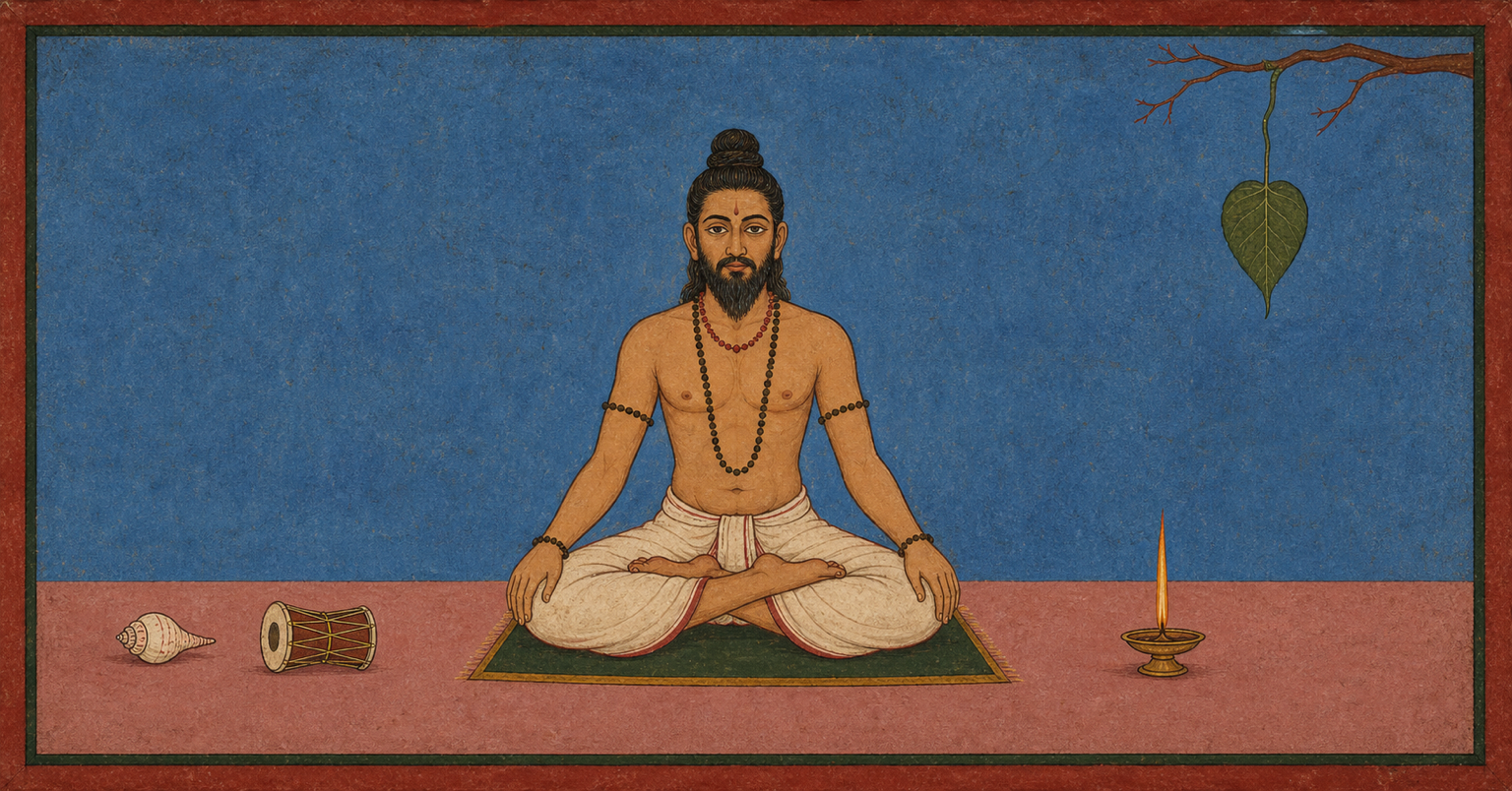
HP 4.35*1-4.36: Signs of Samādhi

Haṭha Pradīpikā 4.35*1-4.36: Signs of Unmanī and Samādhi

Unmanī and Samādhi appear as liberation beyond sensory perception, movement of the breath, honor, suffering, and ordinary consciousness.

Dr. Ronald Steiner Dr. Ronald Steiner
Haṭha Pradīpikā 4.35*1
एकं सृष्टिमयं बीजमेका मुद्रा च खेचरी |
ekaṃ sṛṣṭi-mayaṃ bījam; ekā mudrā ca khecarī | Analysis ▾ Analysis ▴
ekam
nominative accusative singular neuter
numeral
one
sṛṣṭi
tatpuruṣa-compound genitive
substantive feminine
of creation
mayam
nominative accusative singular neuter
adjective
consisting of
bījam
nominative accusative singular
substantive neuter
seed, seed syllable
ekā
nominative singular feminine
numeral
one
mudrā
nominative singular
substantive feminine
mudrā
ca
particle
and
khecarī
nominative singular
substantive feminine
Khecarī
एको देवो निरालम्ब एकावस्था मनोन्मनी ||35*1||
eko devo nirālamba; ekāvasthā manonmanī ||35*1|| Analysis ▾ Analysis ▴
ekaḥ
nominative singular masculine
numeral
one
devaḥ
nominative singular
substantive masculine
god
nirālambaḥ
nominative singular masculine
adjective
unsupported
eka
karmadhāraya-compound
numeral
one
avasthā
nominative singular
substantive feminine
state
manas
tatpuruṣa-compound genitive
substantive neuter
of mind
unmanī
nominative singular
substantive feminine
Unmanī, mind beyond mind
Metre: Anuṣṭubh
A seed consisting of creation (sṛṣṭi-mayaṃ bījam | nom acc sg), one (ekā | nom sg f) Mudrā (mudrā | nom sg), namely (ca) Khecarī (khecarī | nom sg); one god (ekaḥ devaḥ | nom sg), the unsupported (nirālamba | nom sg m), and one state (ekāvasthā | nom sg), Manonmanī (manonmanī | nom sg).
Dr. Ronald Steiner - 2026 - historically literal
There is one seed consisting of creation, one Mudrā, Khecarī, one unsupported god, and one state, Manonmanī.
Dr. Ronald Steiner - 2026 - modern transfer
ekaṃ sṛṣṭimayaṃ bījam ekā mudrā ca khecarī eko devo nirālamba ekāvasthā manonmanī MBHDL2026 ] om. NS1882
Critical Apparatus
Haṭha Pradīpikā 4.35*2
शङ्खदुन्दुभिनादं च न शृणोति कदाचन |
śaṅkha-dundubhi-nādaṃ ca; na śṛṇoti kadācana | Analysis ▾ Analysis ▴
śaṅkha
dvandva-compound
substantive masculine
conch shell
dundubhi
dvandva-compound
substantive feminine
large drum
nādam
accusative singular
substantive masculine
sound
ca
particle
and
na
particle
not
śṛṇoti
3rd person singular aktive present
verbal root
hears
kadācana
adverb
ever
काष्ठवज्जायते देह उन्मन्यावस्थया ध्रुवम् ||35*2||
kāṣṭha-vaj jāyate deha; unmanyāvasthayā dhruvam ||35*2|| Analysis ▾ Analysis ▴
kāṣṭha
tatpuruṣa-compound genitive
substantive neuter
of wood
vat
suffix
like
jāyate
3rd person singular medial present
verbal root
becomes
dehaḥ
nominative singular
substantive masculine
body
unmanī
tatpuruṣa-compound genitive
substantive feminine
of Unmanī
avasthayā
instrumental case singular
substantive feminine
through the state
dhruvam
adverb
certainly
Metre: Anuṣṭubh
One does not (na) ever (kadācana) hear (śṛṇoti | 3p sg act pres) the sound of conch and drum (śaṅkha-dundubhi-nādam | acc sg). Through the state of Unmanī (unmany-avasthayā | ins sg), the body (dehaḥ | nom sg) surely (dhruvam) becomes (jāyate | 3p sg med pres) like wood (kāṣṭha-vat).
Dr. Ronald Steiner - 2026 - historically literal
The yogi does not even hear conches and drums; through Unmanī, the body surely becomes like wood.
Dr. Ronald Steiner - 2026 - modern transfer

The body of one absorbed in Unmanī is compared to a piece of wood because even very loud sounds no longer provoke a response. Brahmānanda thereby describes a radical withdrawal of perception, not the practitioner's death. The stark comparison is intended to make the complete interruption of contact between sensory stimuli and mind clear.

Brahmānanda's Jyotsnā - 19th c.
śaṅkhadundubhinādaṃ ca na śṛṇoti kadācana … ca niścitaṃ mukta eva saḥ MBHDL2026 ] transp. NS1882 post HP 4.55*3
Critical Apparatus
Such a one. does not hear the noise of the conch and Dundubhi. Being in the Unmanî avasthâ, his body becomes like a piece of wood.
Pancham Sinh - 1915
Den Nâda der Muschel und der Dundubhi- Trommel hört der Yogin nimmer, (denn) durch die Unmanî wird der Körper sicher wie ein Stück Holz (d. h. er wird sehr bald kataleptisch).
Hermann Walter - 1893
Haṭha Pradīpikā 4.35*3
सर्वावस्थाविनिर्मुक्तः सर्वचिन्ताविवर्जितः |
sarvāvasthā-vinirmuktaḥ; sarva-cintā-vivarjitaḥ | Analysis ▾ Analysis ▴
sarva
karmadhāraya-compound
adjective
all
avasthā
tatpuruṣa-compound ablative
substantive feminine
from states
vinirmuktaḥ
nominative singular masculine past participle passive
previx
previx
verbal root
completely freed
sarva
karmadhāraya-compound
adjective
all
cintā
tatpuruṣa-compound ablative
substantive feminine
from thoughts
vivarjitaḥ
nominative singular masculine past participle passive
previx
verbal root
free
मृतवत्तिष्ठते योगी स मुक्तो नात्र संशयः ||35*3||
mṛtavat tiṣṭhate yogī; sa mukto nātra saṃśayaḥ ||35*3|| Analysis ▾ Analysis ▴
mṛtavat
adverb
like one dead
tiṣṭhate
3rd person singular medial present
verbal root
remains
yogī
nominative singular
substantive masculine
the yogin
saḥ
nominative singular masculine
pronoun
he
muktaḥ
nominative singular masculine past participle passive
verbal root
liberated
na
particle
not
atra
adverb
here
saṃśayaḥ
nominative singular
substantive masculine
doubt
Metre: Anuṣṭubh
Free from all states (sarvāvasthā-vinirmuktaḥ | nom sg m ppp) and free from all thoughts (sarva-cintā-vivarjitaḥ | nom sg m ppp), the yogi (yogī | nom sg) remains (tiṣṭhate | 3p sg med pres) as if dead (mṛtavat). He (saḥ | nom sg m) is liberated (muktaḥ | nom sg m ppp); here (atra) there is no (na) doubt (saṃśayaḥ | nom sg).
Dr. Ronald Steiner - 2026 - historically literal
Free from every state and abandoned by every thought, the yogi remains as if dead. Such a yogi is liberated; of this there is no doubt.
Dr. Ronald Steiner - 2026 - modern transfer
sarvāvasthāvinirmuktaḥ sarvacintāvivarjitaḥ mṛtavat tiṣṭhate yogī sa mukto nātra saṃśayaḥ MBHDL2026 ] transp. NS1882 post HP 4.35*2

om. MBHDL2026 ] add. khādyate na ca kālena bādhyate na ca karmaṇā / sādhyate na sa kenāpi yogī yuktaḥ samādhinā NS1882 post sa mukto nātra saṃśayaḥ
Critical Apparatus
There is no doubt, such a Yogî becomes free from all states, from all cares, and remains like one dead.
Pancham Sinh - 1915
Von allen Zuständen befreit, von allen Gedanken verlassen ist nun der Yogin gleich einem Todten, aber erlöst.
Hermann Walter - 1893
Haṭha Pradīpikā 4.35*4
न हि जानाति शीतोष्णं न दुःखं न सुखं तथा |
na hi jānāti śītoṣṇaṃ; na duḥkhaṃ na sukhaṃ tathā | Analysis ▾ Analysis ▴
na
particle
not
hi
particle
indeed
jānāti
3rd person singular aktive present
verbal root
is known
śīta
dvandva-compound
adjective
cold
uṣṇam
accusative singular neuter
adjective
heat
na
particle
not
duḥkham
accusative singular
substantive neuter
suffering
na
particle
not
sukham
accusative singular
substantive neuter
comfort
tathā
adverb
likewise
न मानं नापमानं च योगी युक्तः समाधिना ||35*4||
na mānaṃ nāpamānaṃ ca; yogī yuktaḥ samādhinā ||35*4|| Analysis ▾ Analysis ▴
na
particle
not
mānam
accusative singular
substantive neuter
honour
na
particle
not
apamānam
accusative singular
substantive neuter
dishonour
ca
particle
and
yogī
nominative singular
substantive masculine
the yogin
yuktaḥ
nominative singular masculine past participle passive
verbal root
properly
samādhinā
instrumental case singular
substantive masculine
in samādhi
Metre: Anuṣṭubh
The yogi (yogī | nom sg), joined (yuktaḥ | nom sg m ppp) through Samādhi (samādhinā | ins sg), knows (jānāti | 3p sg act pres), indeed (hi), neither (na) cold and heat (śītoṣṇam | acc sg n), nor suffering (duḥkham | acc sg), nor happiness (sukham | acc sg), and likewise (tathā) neither honor (mānam | acc sg) nor dishonor (apamānam | acc sg).
Dr. Ronald Steiner - 2026 - historically literal
The yogi united in Samādhi experiences neither cold nor heat, neither suffering nor happiness, neither honor nor dishonor.
Dr. Ronald Steiner - 2026 - modern transfer
na hi jānāti śītoṣṇaṃ na duḥkhaṃ na sukhaṃ tathā na mānaṃ nāpamānaṃ ca yogī yuktaḥ samādhinā MBHDL2026 ] transp. NS1882 post HP 4.35*7, ante HP 4.35*8

na hi jānāti MBHDL2026 ] na vijānāti NS1882
Critical Apparatus
He feels neither heat, cold, pain, pleasure, respect nor disrespect. Such a Yogî is absorbed in Samâdhi.
Pancham Sinh - 1915
Haṭha Pradīpikā 4.35*5
न गन्धं न रसं रूपं न स्पर्शनं न च श्रुतम् |
na gandhaṃ na rasaṃ rūpaṃ; na sparśanaṃ na ca śrutam | Analysis ▾ Analysis ▴
na
particle
not
gandham
accusative singular
substantive masculine
smell
na
particle
not
rasam
accusative singular
substantive masculine
tastes
rūpam
accusative singular
substantive neuter
forms
na
particle
not
sparśanam
accusative singular
substantive neuter
touch
na
particle
not
ca
particle
and
śrutam
accusative singular neuter past participle passive
verbal root
sound
नात्मानं न परं वेत्ति योगी युक्तः समाधिना ||35*5||
nātmānaṃ na paraṃ vetti; yogī yuktaḥ samādhinā ||35*5|| Analysis ▾ Analysis ▴
na
particle
not
ātmānam
accusative singular
substantive masculine
self
na
particle
not
param
accusative singular masculine neuter
adjective
another
vetti
3rd person singular aktive present
verbal root
knows
yogī
nominative singular
substantive masculine
the yogin
yuktaḥ
nominative singular masculine past participle passive
verbal root
properly
samādhinā
instrumental case singular
substantive masculine
in samādhi
Metre: Anuṣṭubh
The yogi (yogī | nom sg), joined (yuktaḥ | nom sg m ppp) through Samādhi (samādhinā | ins sg), knows (vetti | 3p sg act pres) neither (na) smell (gandham | acc sg), taste (rasam | acc sg), form (rūpam | acc sg), touch (sparśanam | acc sg), nor (na ca) what is heard (śrutam | acc sg n ppp), neither oneself (ātmānam | acc sg) nor (na) another (param | acc sg).
Dr. Ronald Steiner - 2026 - historically literal
The yogi united in Samādhi knows neither smell, taste, form, touch, nor sound, neither oneself nor another.
Dr. Ronald Steiner - 2026 - modern transfer
na gandhaṃ na rasaṃ rūpaṃ na sparśanaṃ na ca śrutam nātmānaṃ na paraṃ vetti yogī yuktaḥ samādhinā MBHDL2026 ] transp. NS1882 post add. at HP 4.35*3, ante HP 4.35*7

sparśanaṃ na ca śrutam MBHDL2026 ] ca sparśaṃ na niḥsvanam NS1882
Critical Apparatus
The Yogî, engaged in Samâdhi, feels neither smell, taste, color, touch, sound, nor is conscious of his own self.
Pancham Sinh - 1915
Der Yogin, der Samadhi erreicht hat, kennt weder Geruch, noch Geschmack, noch Farbe, noch Tastgefühl, noch Laut, noch sich selbst, noch einen Andern.
Hermann Walter - 1893
Haṭha Pradīpikā 4.35*6
अवेध्यः सर्वशस्त्राणाम् अवध्यः सर्वदेहिनाम् |
avedhyaḥ sarva-śastrāṇām; avadhyaḥ sarva-dehinām | Analysis ▾ Analysis ▴
avedhyaḥ
nominative singular masculine future participle passive
previx
verbal root
not to be wounded
sarva
karmadhāraya-compound
adjective
by any
śastrāṇām
genitive plural
substantive neuter
weapon
avadhyaḥ
nominative singular masculine future participle passive
previx
verbal root
not to be killed
sarva
karmadhāraya-compound
adjective
by any
dehinām
genitive plural
substantive masculine
embodied being
अग्राह्यो मन्त्रतन्त्राणां योगी युक्तः समाधिना ||35*6||
agrāhyo mantra-tantrāṇāṃ; yogī yuktaḥ samādhinā ||35*6|| Analysis ▾ Analysis ▴
agrāhyaḥ
nominative singular masculine future participle passive
previx
verbal root
not to be seized
mantra
dvandva-compound
substantive masculine
by mantras
tantrāṇām
genitive plural
substantive neuter
or tantras
yogī
nominative singular
substantive masculine
the yogin
yuktaḥ
nominative singular masculine past participle passive
verbal root
properly
samādhinā
instrumental case singular
substantive masculine
in samādhi
Metre: Anuṣṭubh
The yogi (yogī | nom sg), joined (yuktaḥ | nom sg m ppp) through Samādhi (samādhinā | ins sg), cannot be pierced by any weapons (avedhyaḥ sarva-śastrāṇām | nom sg m pfp), cannot be killed by any embodied beings (avadhyaḥ sarva-dehinām | nom sg m pfp), and cannot be seized by Mantras or Tantras (agrāhyo mantra-tantrāṇām | nom sg m pfp).
Dr. Ronald Steiner - 2026 - historically literal
The yogi united in Samādhi cannot be wounded by any weapon, killed by any being, or seized by Mantra or Tantra.
Dr. Ronald Steiner - 2026 - modern transfer

Brahmānanda names as obstacles lethargy, unsuitable company, Mantras directed toward worldly power, alchemical aims, and desire for sexuality, wealth, heavenly rank, and ritual merit. Even extraordinary abilities can interrupt absorption. The remedies are non-attachment to such attainments and renewed concentration on Viṣṇu or Śiva.

Brahmānanda's Jyotsnā - 19th c.
avedhyaḥ sarvaśastrāṇām avadhyaḥ sarvadehinām agrāhyo mantratantrāṇāṃ yogī yuktaḥ samādhinā MBHDL2026 ] transp. NS1882 post HP 4.35*8

avedhyaḥ sarvaśastrāṇām MBHDL2026 ] avadhyaḥ sarvaśastrāṇām NS1882
Critical Apparatus
The Yogî, engaged in Samâdhi, cannot be killed by any instrument, and is beyond the controlling power of beings. He is beyond the reach of incantations and charms.
Pancham Sinh - 1915
Haṭha Pradīpikā 4.35*7
चित्तं न सुप्तं नो जाग्रत् स्मृतिमन्न न चान्यथा |
cittaṃ na suptaṃ, no jāgrat; smṛtiman na na cānyathā | Analysis ▾ Analysis ▴
cittam
nominative accusative singular
substantive neuter
mind
na
particle
not
suptam
nominative accusative singular neuter past participle passive
verbal root
sleeping
na
particle
not
jāgrat
nominative accusative singular neuter present participle active
verbal root
awake
smṛtiman
nominative singular masculine
adjective
remembering, conscious
na
particle
not
na
particle
not
ca
particle
and
anyathā
adverb
otherwise
नास्तमेति न चोदेति यस्यासौ मुक्त एव सः ||35*7||
nāstam eti na codeti; yasyāsau mukta eva saḥ ||35*7|| Analysis ▾ Analysis ▴
na
particle
not
astam
adverb
down
eti
3rd person singular aktive present
verbal root
goes
na
particle
not
ca
particle
and
udeti
3rd person singular aktive present
previx
verbal root
rises
yasya
genitive singular masculine neuter
pronoun
whoever
asau
nominative singular masculine
pronoun
this one
muktaḥ
nominative singular masculine past participle passive
verbal root
liberated
eva
particle
indeed
saḥ
nominative singular masculine
pronoun
he
Metre: Anuṣṭubh
One whose (yasya | gen sg) mind (cittam | nom acc sg) is neither asleep (na suptam | nom acc sg n ppp) nor awake (no jāgrat | nom acc sg n pca), neither possessed of memory (smṛtimān na | nom sg m) nor otherwise (na ca anyathā), neither sets (na astam eti | 3p sg act pres) nor rises (na ca udeti | 3p sg act pres), that very person (asau saḥ | nom sg m) is indeed (eva) liberated (muktaḥ | nom sg m ppp).
Dr. Ronald Steiner - 2026 - historically literal
One whose mind neither sleeps nor wakes, neither remembers nor assumes another state, neither sets nor rises, is truly liberated.
Dr. Ronald Steiner - 2026 - modern transfer

According to Brahmānanda, Unmanī transcends five recurring states: waking, dreaming, deep sleep, fainting, and death. The mind does not sleep because there is no dull lethargy, and it does not wake in the ordinary sense because it grasps no objects. Earlier impressions may still persist, but no new mental movements arise; the commentary sees Jīvanmukti in this condition.

Brahmānanda's Jyotsnā - 19th c.
cittaṃ na suptaṃ no jāgrat smṛtiman na na cānyathā nāstam eti na codeti yasyāsau mukta eva saḥ MBHDL2026 ] transp. NS1882 post HP 4.35*5, ante HP 4.35*4

smṛtiman na na cānyathā MBHDL2026 ] smṛtivismṛtivarjitam NS1882
Critical Apparatus
He whose mind is neither sleeping, waking, remembering, destitute of memory, disappearing nor appearing, is liberated.
Pancham Sinh - 1915
Haṭha Pradīpikā 4.35*8
स्वस्थो जाग्रदवस्थायां सुप्तवद्यो ऽवतिष्ठते |
svastho jāgrad-avasthāyāṃ; suptavad yo 'vatiṣṭhate | Analysis ▾ Analysis ▴
svasthaḥ
nominative singular masculine
adjective
resting in oneself
jāgrat
karmadhāraya-compound present participle active
verbal root
in the waking
avasthāyām
lokative singular
substantive feminine
state
suptavat
adverb
like one asleep
yaḥ
nominative singular masculine
pronoun
whoever
avatiṣṭhate
3rd person singular medial present
previx
verbal root
remains
निःश्वासोच्छ्वासहीनस्तु निश्चितं मुक्त एव सः ||35*8||
niḥśvāsocchvāsa-hīnas tu; niścitaṃ mukta eva saḥ ||35*8|| Analysis ▾ Analysis ▴
niḥśvāsa
dvandva-compound
substantive masculine
exhalation
ucchvāsa
dvandva-compound
substantive masculine
inhalation
hīnaḥ
nominative singular masculine past participle passive
verbal root
free from
tu
particle
but
niścitam
adverb
certainly
muktaḥ
nominative singular masculine past participle passive
verbal root
liberated
eva
particle
indeed
saḥ
nominative singular masculine
pronoun
he
Metre: Anuṣṭubh
One who (yaḥ | nom sg m), in the waking state (jāgrad-avasthāyām | loc sg), rests in oneself (svasthaḥ | nom sg m) and remains (avatiṣṭhate | 3p sg med pres) as though asleep (suptavat), but (tu) free from inhalation and exhalation (niḥśvāsa-ucchvāsa-hīnaḥ | nom sg m ppp), that person (saḥ | nom sg m) is certainly (niścitam) liberated (muktaḥ | nom sg m ppp), indeed (eva).
Dr. Ronald Steiner - 2026 - historically literal
One who rests within oneself in the waking state as if asleep, free from inhalation and exhalation, is certainly liberated.
Dr. Ronald Steiner - 2026 - modern transfer
svastho jāgradavasthāyāṃ suptavad yo’vatiṣṭhate niḥśvāsocchvāsahīnas tu niścitaṃ mukta eva saḥ MBHDL2026 ] transp. NS1882 post HP 4.35*4, ante HP 4.35*6

hīnas tu MBHDL2026 ] hīnaś ca MBHDL2024
Critical Apparatus
He who, though awake, appears like one sleeping, and is without inspiration and expiration, is certainly free.
Pancham Sinh - 1915
Haṭha Pradīpikā 4.36
नादानुसन्धानसमाधिभाजां योगीश्वराणां हृदये प्ररूढम् |
nādānusandhāna-samādhi-bhājāṃ; yogī-śvarāṇāṃ hṛdaye prarūḍham | Analysis ▾ Analysis ▴
nāda
tatpuruṣa-compound genitive
substantive masculine
inner sound
anusaṃdhāna
tatpuruṣa-compound genitive
substantive neuter
concentration
samādhi
tatpuruṣa-compound genitive
substantive masculine
samādhi
bhājām
genitive plural masculine
adjective
experiencing
yogin
tatpuruṣa-compound genitive
substantive masculine
of yogins
īśvarāṇām
genitive plural
substantive masculine
of lords
hṛdaye
lokative singular
substantive neuter
in the hearts
prarūḍham
accusative singular masculine past participle passive
previx
verbal root
arisen
आनन्दमेकं वचसामवाच्यं जानाति तंश्रीगुरुनाथ एव ||36||
ānandam ekaṃ vacasām avācyaṃ; jānāti taṃ śrī-guru-nātha eva ||36|| Analysis ▾ Analysis ▴
ānandam
accusative singular
substantive masculine
bliss
ekam
accusative singular masculine
numeral
one
vacasām
genitive plural
substantive neuter
by words
avācyam
accusative singular masculine future participle passive
previx
verbal root
inexpressible
jānāti
3rd person singular aktive present
verbal root
to be known
tam
accusative singular masculine
pronoun
that
śrī
karmadhāraya-compound
adjective
venerable
guru
tatpuruṣa-compound genitive
substantive masculine
guru
nāthaḥ
nominative singular
substantive masculine
lord
eva
particle
alone
Metre: Upajāti
The one (ekam | acc sg m) joy inexpressible (avācyam ānandam | acc sg m) by words (vacasām | gen pl), which has arisen (prarūḍham | acc sg m ppp) in the heart (hṛdaye | loc sg) of the lords among yogis (yogī-īśvarāṇām | gen pl) who experience Nāda-Anusaṃdhāna-Samādhi (nāda-anusaṃdhāna-samādhi-bhājām | gen pl m), that (tam | acc sg m) is known (jānāti | 3p sg act pres) only (eva) by the venerable lordly guru (śrī-guru-nāthaḥ | nom sg).
Dr. Ronald Steiner - 2026 - historically literal
The joy of Nāda Samādhi arises in the hearts of accomplished yogis and remains beyond words. Only the guru truly knows it.
Dr. Ronald Steiner - 2026 - modern transfer
nādānusandhānasamādhibhājāṃ yogīśvarāṇāṃ hṛdaye prarūḍham ānandam ekaṃ vacasām avācyaṃ jānāti taṃ śrīgurunātha eva MBHDL2026 ] transp. NS1882 post HP 4.27*1, ante HP 4.38

hṛdaye prarūḍham MBHDL2026 ] hṛdi vardhamānam NS1882
Critical Apparatus
The happiness which increases in the hearts of Yogiśwaras, who have gained success in Samâdhi by means of attention to the nâda, is beyond description, and is known to Śri Gurû Nâtha alone.
Pancham Sinh - 1915
Der Lehrer und Meister allein kennt die einzige, unaussprechliche Glückseligkeit, die im Herzen der vollendeten Yogin entsteht, welche der Vertiefung in den Nâda und des Samadhi theilhaftig geworden sind.
Hermann Walter - 1893

Continue with AYI Free

Illustrations: AI-generated.

Editor

Dr. Ronald Steiner

From Ulm

The "Yoga Doc" - Dr. Ronald Steiner is the founder of the AYI method. This method links traditional Ashtanga Yoga with innovative Yogatherapy and living Philosophy. This forms a practice that is personal for each and... more ›

Messages and ratings
0 messages

Please log in to write a message. Go to login

No messages yet.