

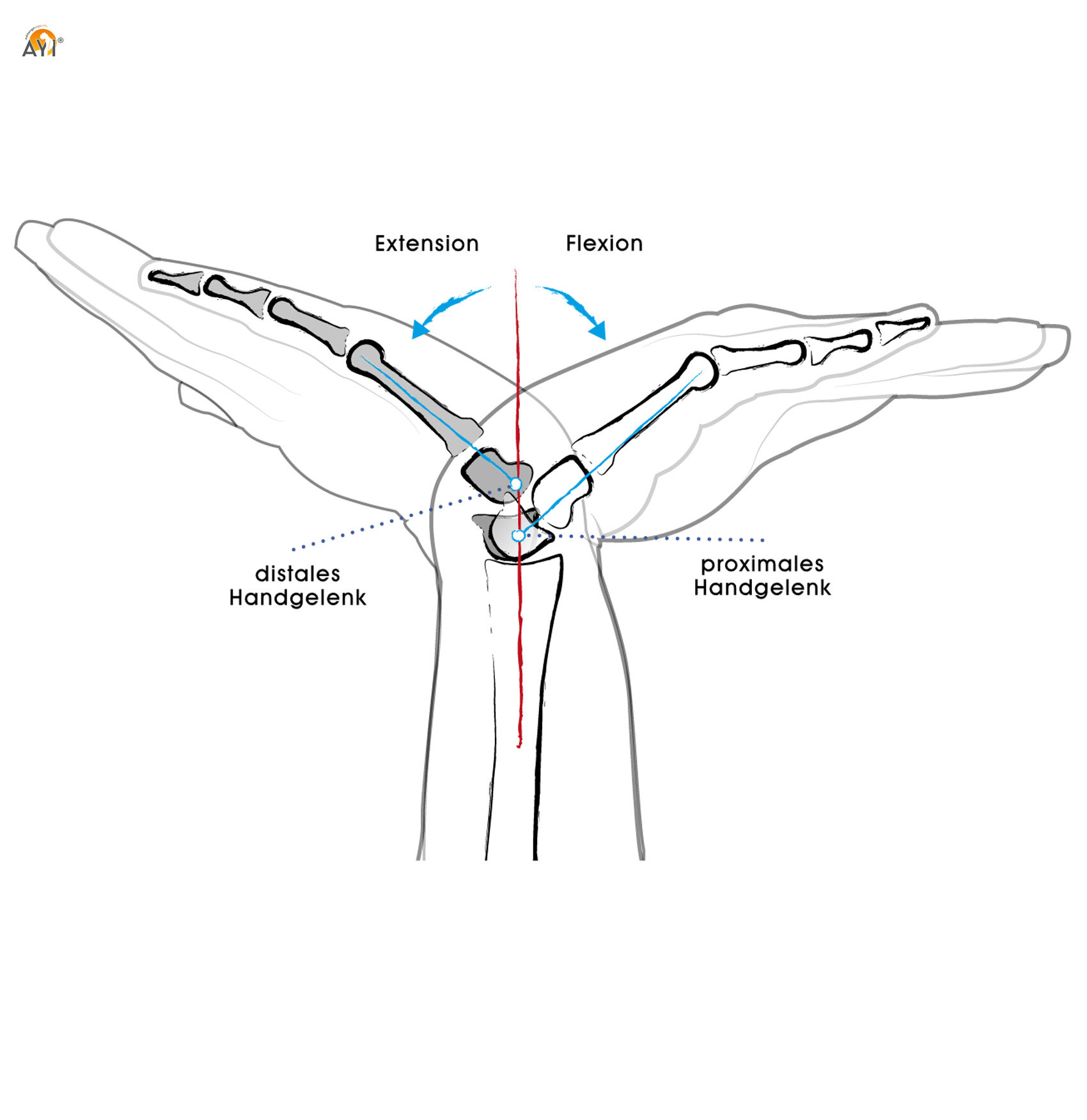
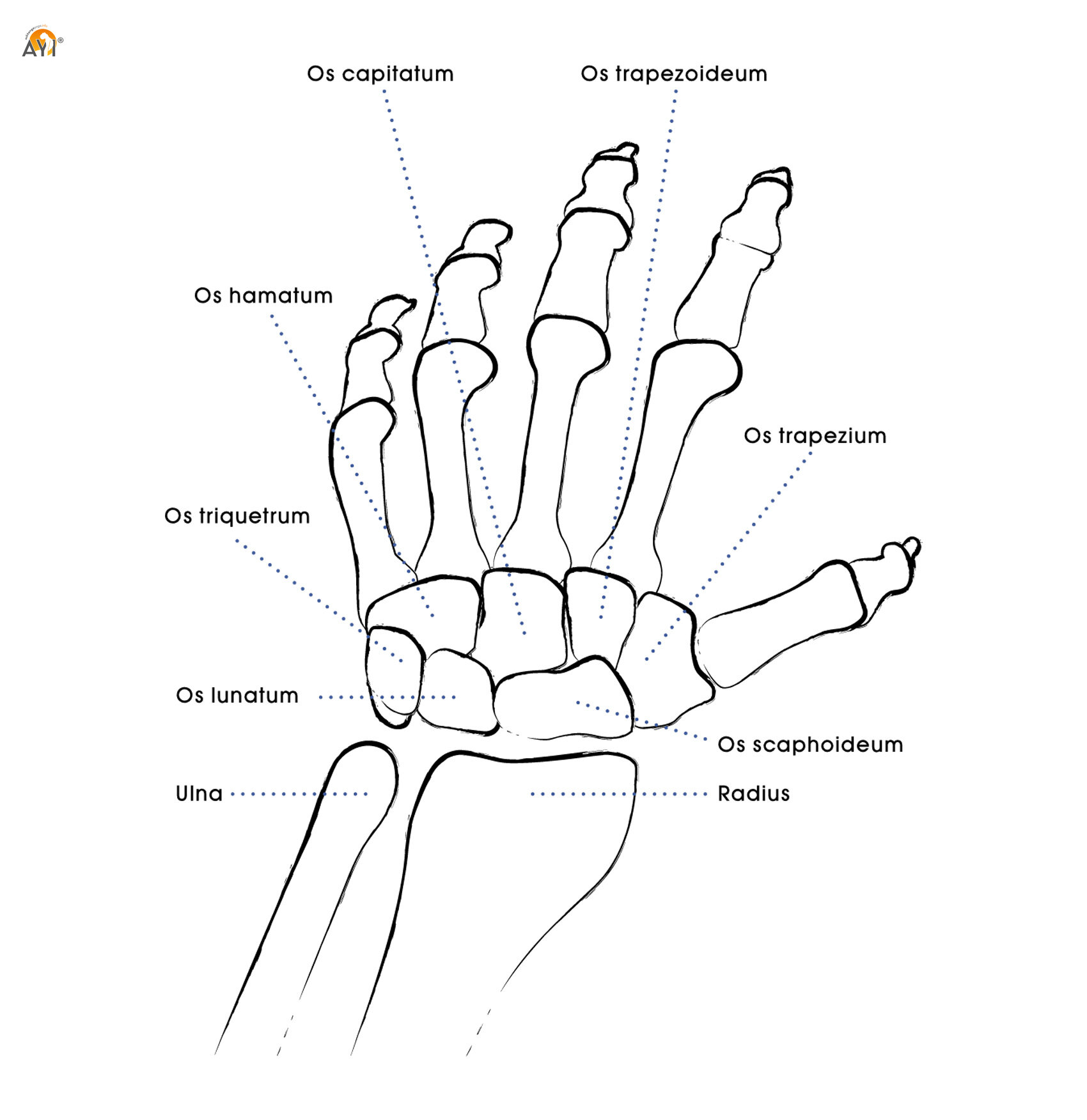
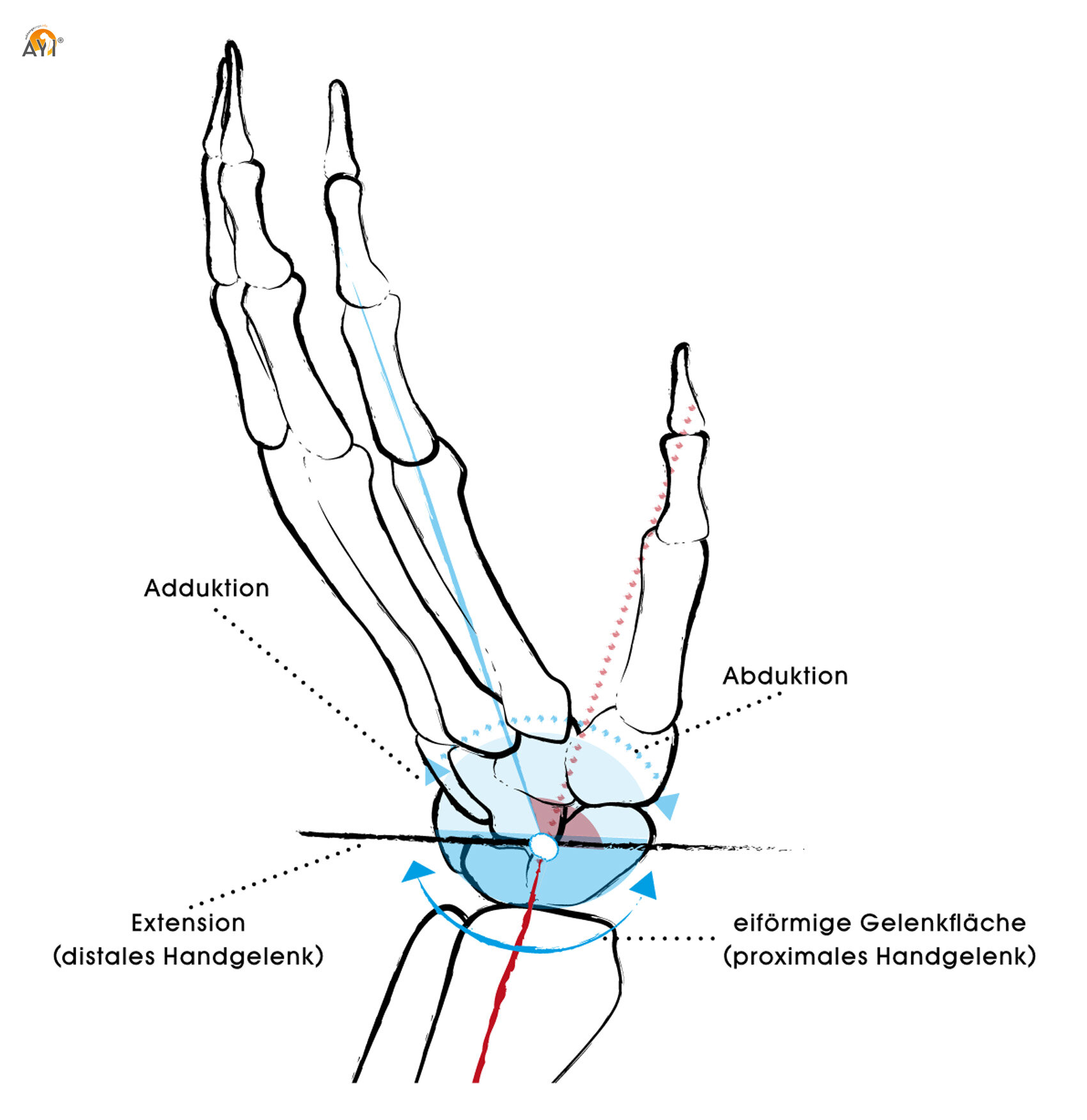
From the egg-like shape of the joint we can also derive its function. The proximal wrist is designed to move the palm towards the lower arm (flexion) and, to only a very small degree, the back of the hand towards the lower arm (extension). Lateral, waving movements (abduction and adduction) are also possible but, due to its anatomical structures, the wrist is not suited for any rotating movements.
Alignment in neutral position
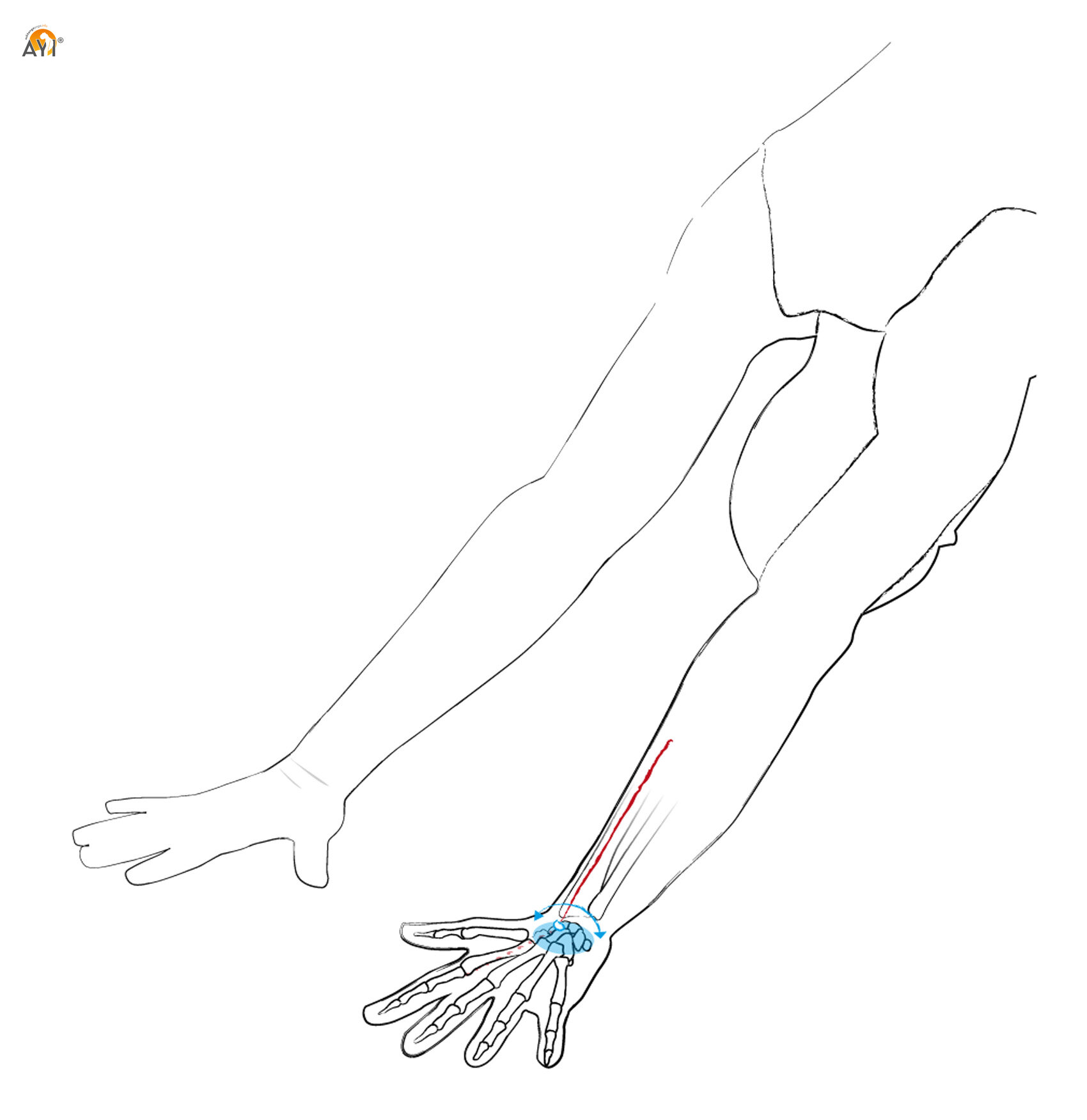
In positions in which the wrist is approximately in neutral position, you should make sure that the palms are placed in parallel to the broad side of the lower arm.
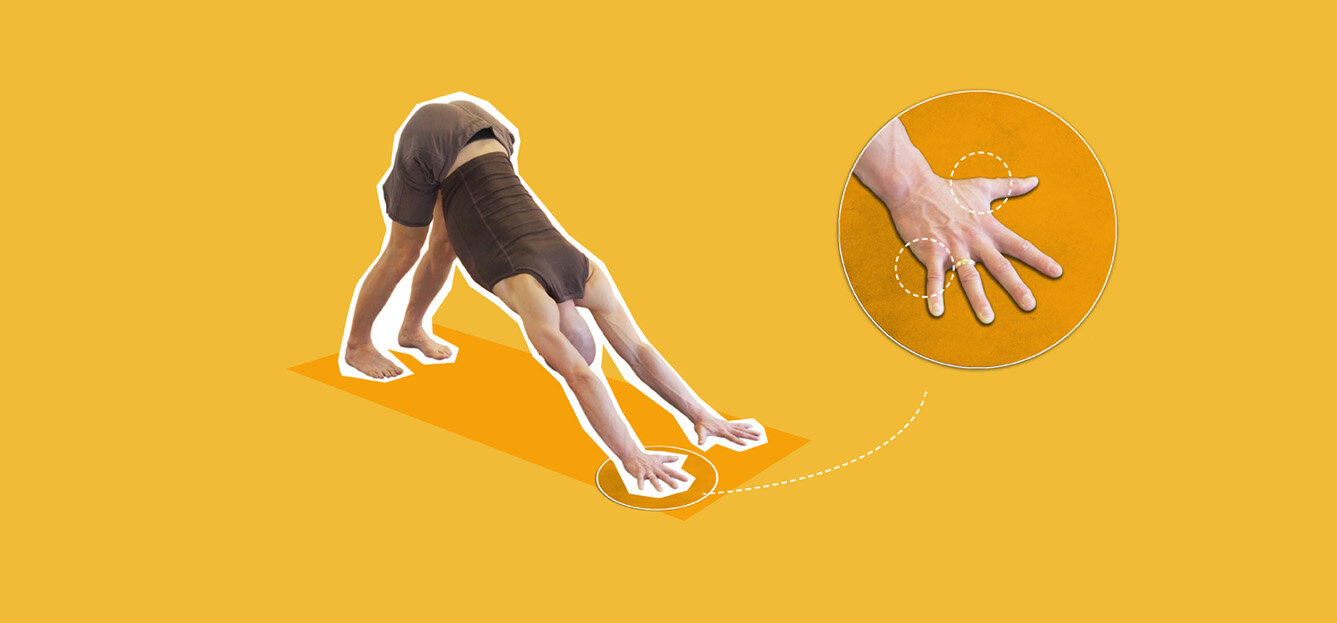
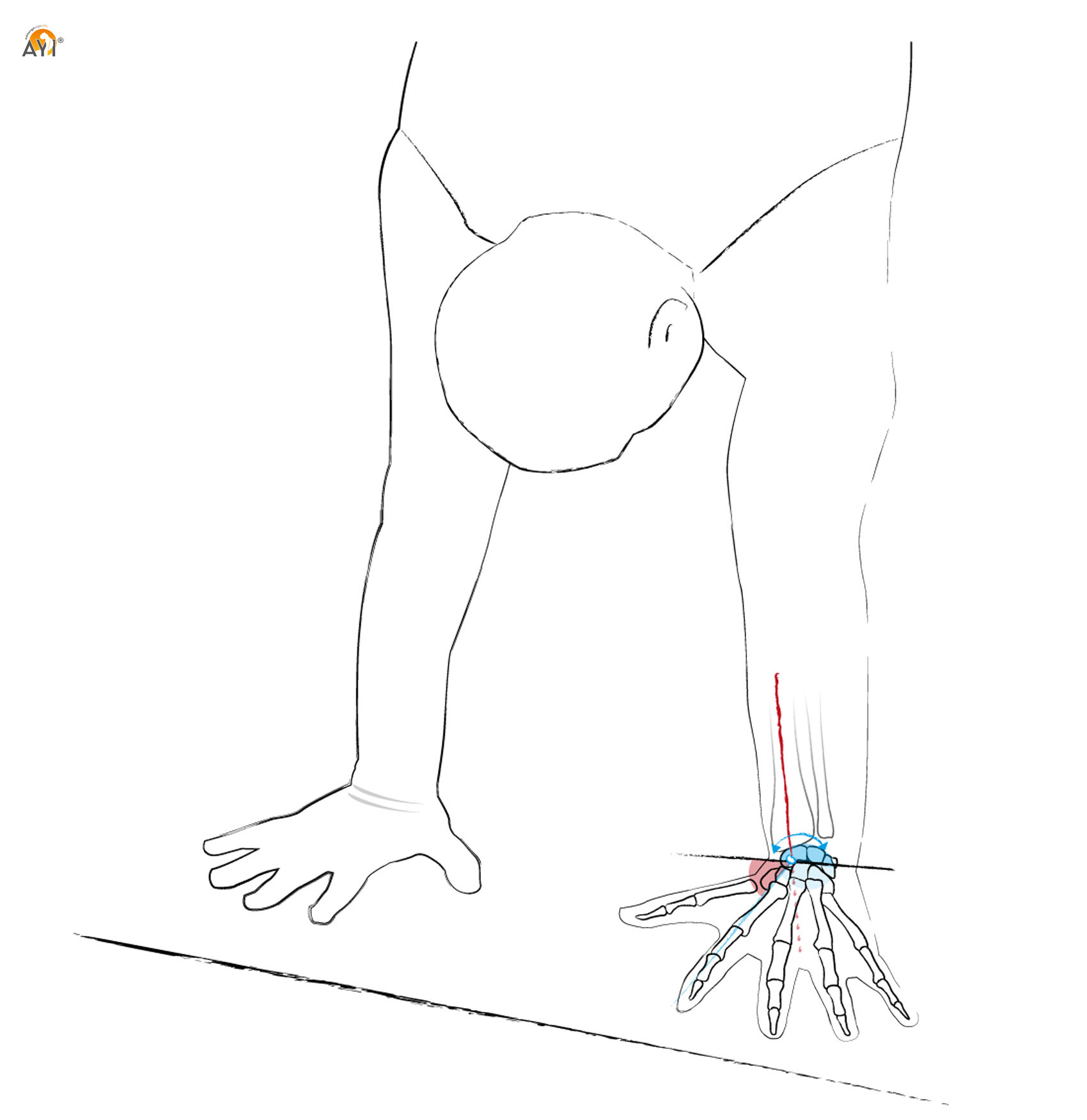
In the downward-facing dog (Adho Mukha Shvanasana, for instance, your wrist is almost in neutral position or in a slight extension. Here, the entire length of the hand, both on the side of the thumb and the little finger, should be rooted into the mat with equal pressure. Lifting either of the sides would cause a rotating distortion of the wrist, a movement for which the proximal wrist is not designed.
Alignment in extension
Once the wrist has reached its maximum extension, everything seems to change. The extension movement is mainly performed by the distal wrist with hardly any changes in the position of the proximal wrist. While, in a neutral wrist position, an abduction or adduction changes the direction of the fingers in relation to the lower arm, it is now the position of the palm in relation to the lower arm that changes. Changing the direction of the fingers in relation to the lower arm now would correspond to a rotation for which the proximal wrist is anatomically not suited.
Accordingly, in positions in which the wrist is in extension, you should always make sure that your index finger is placed approximately in a right angle to your wrist. In the upward-facing dog (Urdhva Mukha Shvanasana), the handstand (Vrikshasana), the crow pose (Kakasana) and the crane pose (Bakasana), the axis of the index finger should run in approximately a 90-degree angle from the wrist since all deviations from this axis corresponded to a rotated distortion. Neither the proximal nor the distal wrist is anatomically suited for this type of movement.
Please note: this does by no means mean that your index finger has to point directly to the front in all positions in which you bear weight on your hands. In contrast, it means that it should be in a right angle in relation to the wrist. The actual direction of the index finger ultimately depends on the direction in which the wrist is positioned. Which, in turn, depends on the yoga position, the flexibility of the shoulder and the rotation ability of the lower arm.
Attentiveness and patience
Even when you pay attention to a precise alignment, all balance positions in which you support your weight with your arms represent a challenge for your wrists. For this reason, give your wrists enough time to adapt. Never practice positions with a great strain when you feel pain in them. An attentive, regular but at the same time measured practice will increase the strength in your arms and wrists. Ultimately, with correct alignment, you will experience that your hands give you as much support and stability as your feet.

Please log in to write a message. Go to login
No messages yet.