



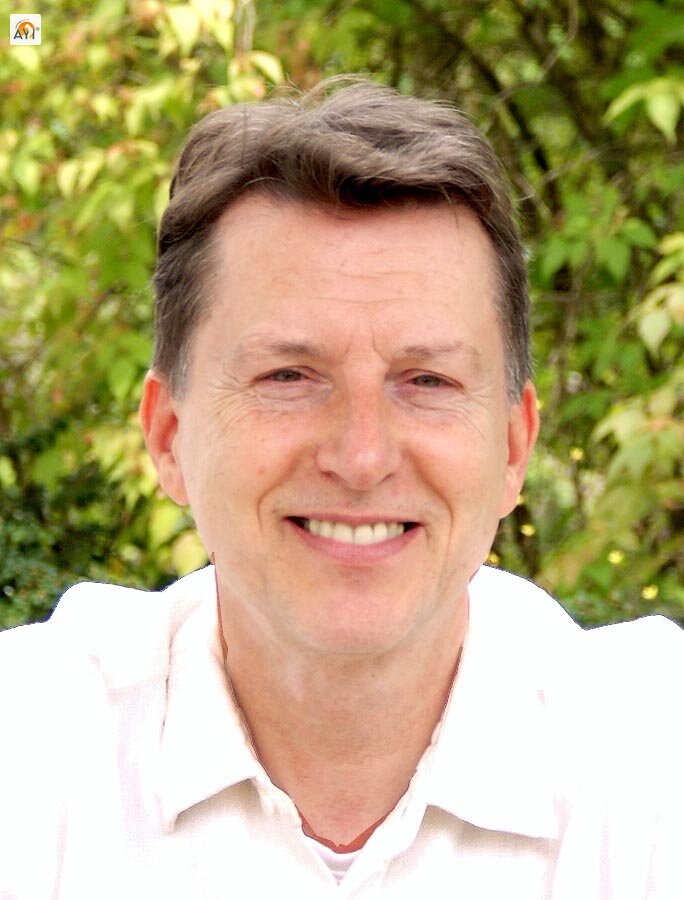
Sabine: You yourself apply yoga practices in your therapy sessions. And for you, do they support traditional therapy approaches, or is yoga more an integral part of the treatment as a whole?
Joachim Pfahl: Both, actually. Yoga itself can be a therapy when it is done under the guidelines of TSY, or Trauma-Sensitive Yoga (TSY ingradual®). We have developed a TSY ingradual® program with the goal of bringing healing for trauma survivors through a careful, sensitive form of yoga. Through relaxation, which is an integral part of yoga, as well as strengthening and stretching, old wounds which present themselves as everyday stress for example, can be opened up and dissolved. The concept of addressing the body's stored memory of experiences and events is what led to the need for a special form of yoga, one that is sensitive to the body's trauma. In this practice, one can reawaken parts of the body injured through trauma, sensing them once again and slowly integrating these parts back into the whole. When practicing in this way, it is very clearly an independent form of therapy. It can also be used to inform and accompany the know how of yoga teachers or trauma yoga therapists who work together with psychologists or phsychotherapists.

The Basics of Yoga Trauma Therapy with Exercises (in German) will be available to purchase on 8.4.17 by Klett Cotta.
1. Aufl. 2017, 248 Seiten,
broschiert, mit zahlreichen Abbildungen
ISBN: 978-3-608-89181-2
Sabine: What kind of reactions do you get when people hear you are offering yoga as a form of therapy? I could imagine that especially in environments such as barracks or prisons that at least in the beginning that many would be rather unwilling to give the class a try because of the stigma attached to yoga as effeminate or only for softies.
Joachim Pfahl: This can definitely be true, especially at the beginning. But word gets around fast in such closed populations like in barracks or prisons. If one soldier can sleep again or his panic attacks disappear, labels such as 'girly gymnastics' are dropped and people start to respect the practice naturally. At least, that is my experience with it.
Sabine: As yoga teachers we are coming into contact with people who may have survived trauma and working in a very close and personal way with people. How, or where can we learn the tools to help us to use yoga appropriately to best serve our students?
Joachim Pfahl: We have seen that the various pioneers in the field of yoga and meditation for trauma survivors all come to very similar conclusions and outcomes through their experiences. More and more we are seeing a wide array of specifically outlined guidelines for offering Trauma-Sensitive Yoga, a term that was actually coined in the United States. There are continuing education courses available for Trauma-Sensitive Yoga as well as for Trauma Yoga Therapists. There are also trainings taking into consideration that some teachers work with the general public and do not know who may or may not have survived trauma in the room.
Sabine: Thanks to the growing popularity of yoga, it is no longer only classified as an esoteric practice. As there is more awareness of the effects of yoga and its ability to help people to find inner balance, there is probably a growing number of people who are coming to classes in search of this harmony. It is highly possible that a person comes to one of my classes who has survived trauma and I would never know it. Can this be problematic, specifically at the end of the lesson when we take constructive rest? Is there a way to recognize the red flags? And if so, what can I do to accommodate all of my students regardless of whether or not they have a trauma history?
Joachim Pfahl: As a yoga teacher's awareness grows on the subject, they are able to sense and identify possible triggers in their yoga classes. Now this is not about offering a substitution for therapy, we are talking about learning how to deal with a triggering situation and how to best respond to it. I can't offer a lot of information on this because it requires looking at a lot of factors and there is no single recipe for dealing with this type of situation. However, there is a principle approach that can be learned and then implemented in a meaningful way in order to best support the students in your classes.
Sabine: Thank you for sharing your insights on the topic of trauma sensitive yoga and how it can support trauma therapy. I am looking forward to learning about new developments and research in the area and hope that we can soon report more about the topic in the near future.
More information about trauma sensitive yoga (TSY ingradual®) teacher trainings can be found here:
http://www.traumasensiblesyoga.de


Please log in to write a message. Go to login
No messages yet.