


Man: As with all mammals, the human being utilizes this elasticity with each step and every movement. In human walking and running, the fascial system stores energy in every step. It's not just your calf muscles that are involved. When your heel hits the pavement the impact is absorbed in the fascial back line that runs all the way up the the back of the head.
Creeping Effect: Increase flexibility by slowing down
Power needs to be complimented by sufficient flexibility in order to create efficient movement. Flexibility allows us to create the necessary space in order to take on new shapes and forms.
While short pulses cause the rebound effect on fascia, an appropriately long pull on the fascial lines will deform them. This happens because the tension causes the molecular components (collagen fibers) to align themselves along the line. In this way, the fascial sheaths can glide smoothly past one another. The fascial system needs about 30 seconds of tension to trigger the so-called creeping effect.
Repetitive Stretching: The most effective way to increase flexibility
But watch out! If we hold the stretch too long, or pull too hard, the molecular fibers become entangled. The result is hardening of the fascia, which works counter to our goal of being more limber. The phenomenon is known as the hardening effect.
It is in fact advisable to move in and out of a stretched position to avoid this effect. Warming up the fascia in movement has been proven to avoid this entangling of the fibers and will actually loosen things up so that the next stretch can be repeated with better efficacy. The new repetition of stretching will in turn re-trigger the creeping effect.
Alternating Rebound and Creeping
So, let's say that we are performing a powerful, explosive movement. This would be an exercise that activates the rebound effect. As you know, there will be a point where you are fatigued and cannot go on with the movement, and this happens relatively quickly with such movements. Often times there is a recovery period required.
This break can be optimized through a stretch which will activate the creeping effect. The muscles are warmed up and the fascia have the right level of tension to get the most out of the stretch. Thus, we can utilize the recovery period effectively, all the while still allowing us to catch our breath between rounds. Before we cool down too much and bring on the hardening effect, we dive straight into the next round.
The series of exercises described below builds on this principle. We become strong and more flexible at the same time.
Myofibroblasts: Relaxation for the fascial fibers
With the activities we described above, we have contributed a lot to the health of our fascial system. The properties of fascia are not limited to the collagen fiber molecules, but also connective tissue cells, knows as myofibroblasts. These cells regulate the tension of the system based on what is required. Myofibroblasts pull collagenous fibers toward them, thus stretching the fascial network.
The activation of this function of the myofibroblasts is initiated by injuries, stress and excessive acidity. If we suffer from chronic stress, our fascial network hardens as a result. The result is stiffness and decreased mobility.
The easiest way to deactivate the myofibroblasts is through relaxation. Through relaxation, they begin to release the collagen fibers again. This is why we feel not only mentally balanced after a good relaxation, but also physically more soft and elastic.
Exercise Sequence
This series of exercises is a bit different from others that you may be familiar with. Here powerful, explosive movements are alternated with repetitive stretching. We begin with powerful movements which activate the rebound effect, then we move into a phase of stretching which activates the creeping effect for flexibility. Combining the two effects in such a way compliment one another. At the end, we enjoy a long constructive rest period to allow our myofibroblasts to release their pull, which will allow us to wake up with refreshed with a notable softness in our fascial network.
Sprinter – Round 1 (Rebound Effect)
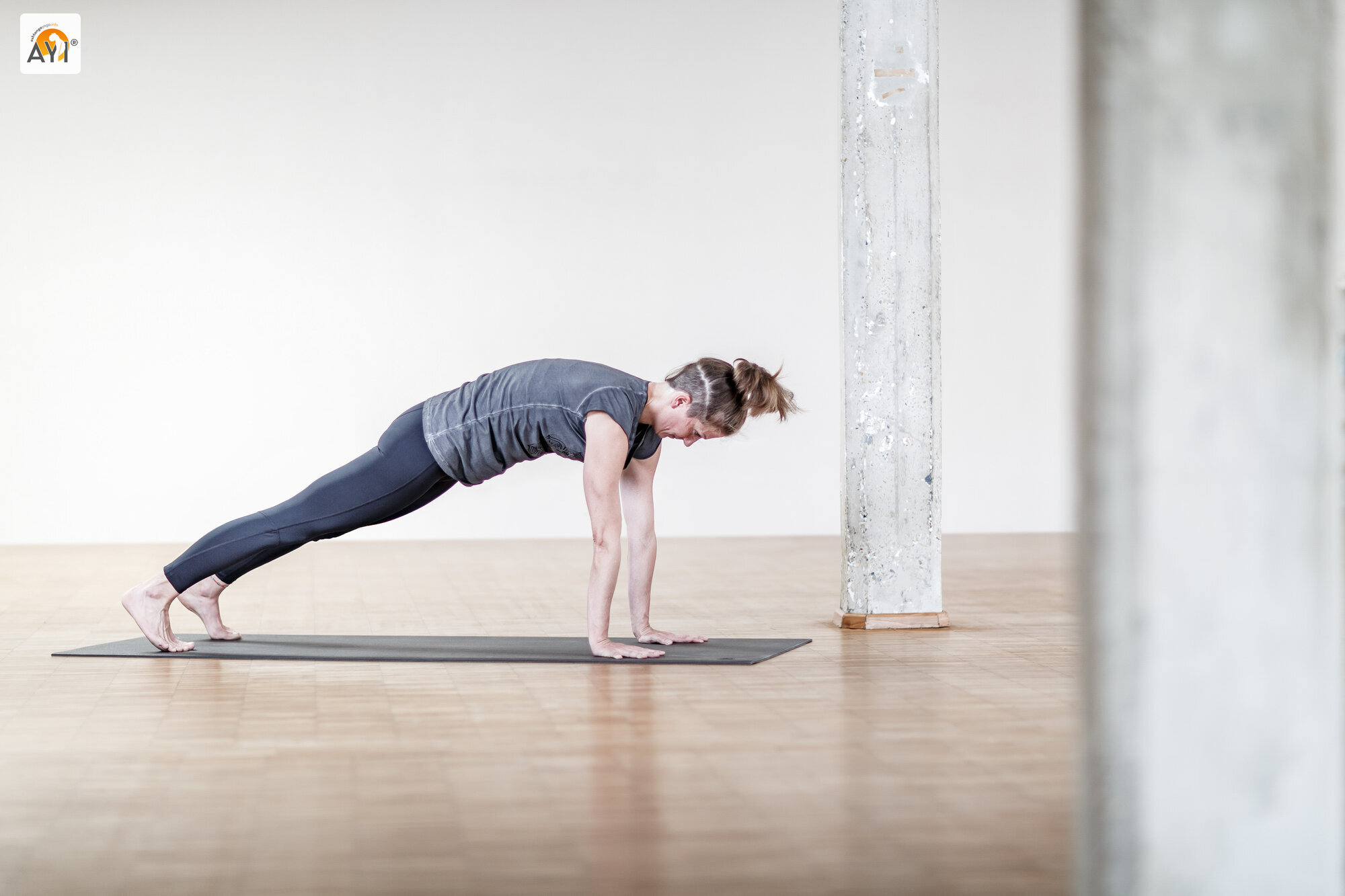
Start in plank. Be sure to push into the floor in such a way that your shoulders are floating directly on your ribs. Activate tension in your core in order to hollow out the belly a bit. Your pelvis will be a bit over the line of your shoulders to heels (Fig 1).
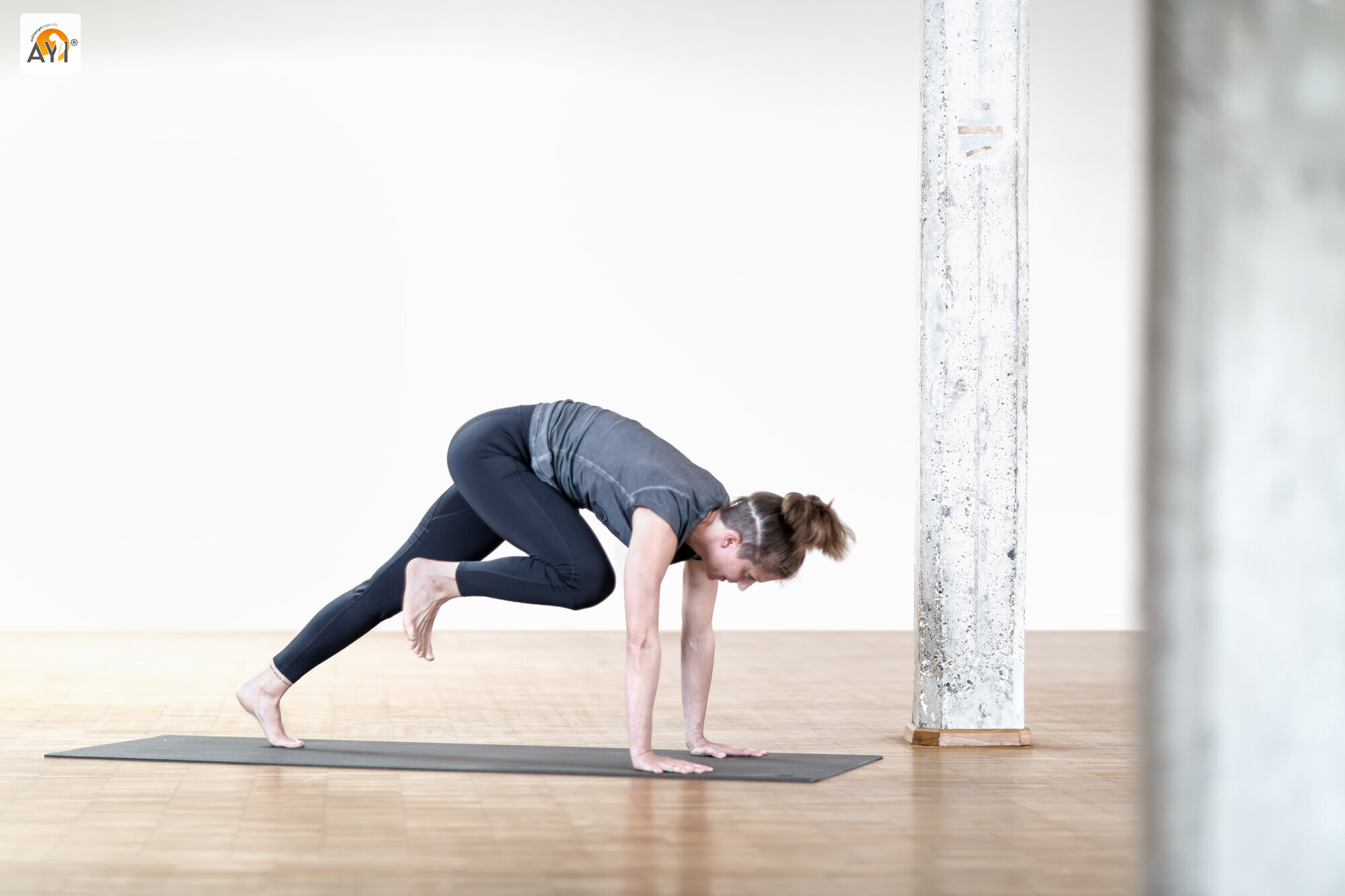
Lift your right leg and draw the knee in towards the right armpit. Hold and then set the foot back down. Repeat slowly with the left side now. Start to slowly increase your speed until you can feel the bouncing effect of the movement (Fig 2).
Keep going until you are out of breath.
Effect: Here you are working the elasticity of the fascial system. The movement will eventually emulate uphill running. The human body has developed many mechanisms designed to store the energy from each step and release it with the next. At a given pace, the human being is actually the land-dwelling creature with the most energy-efficient movement.
Backbend – Bow Pose (Creeping Effect)
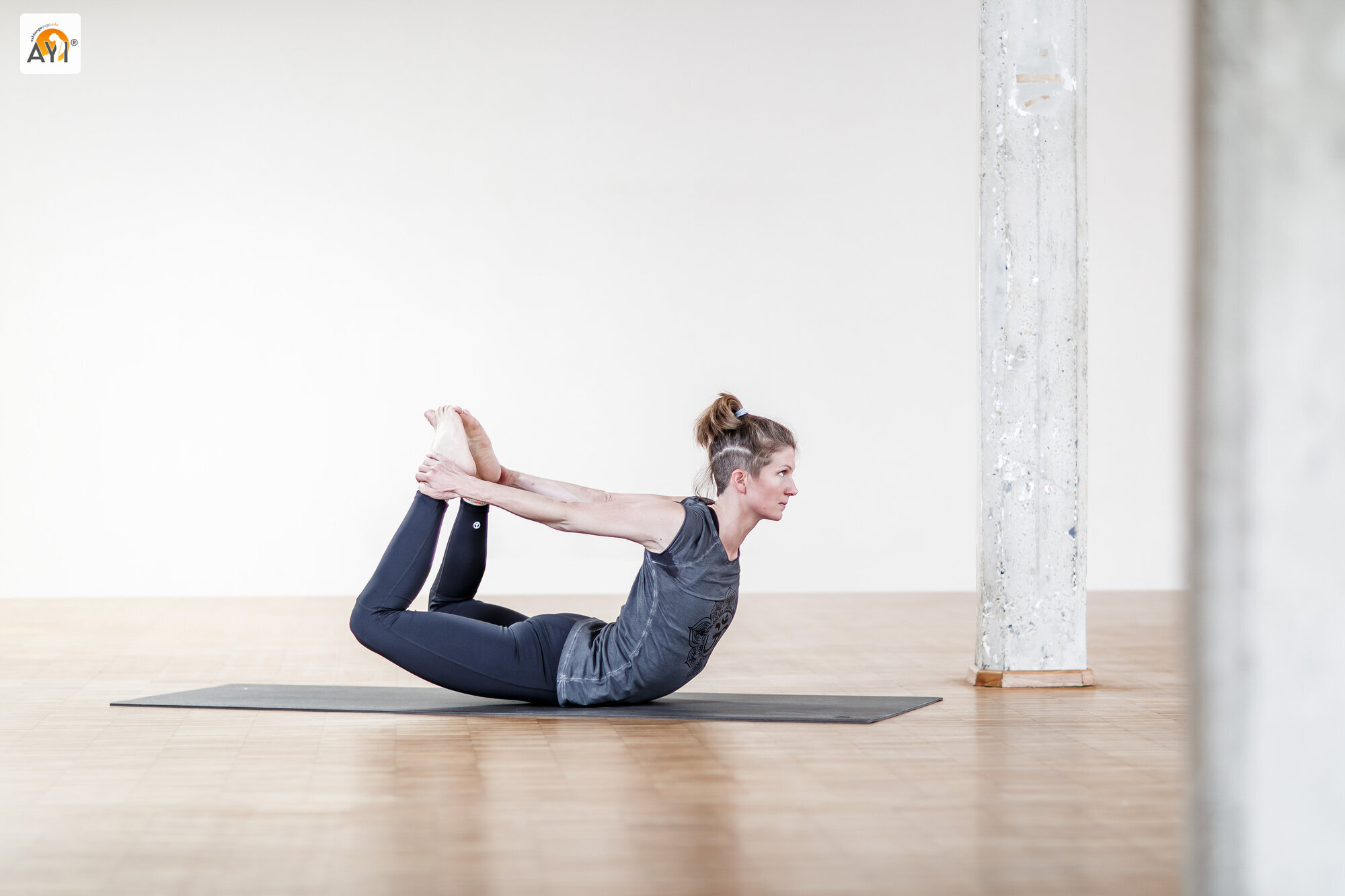
For the first round, start in a prone position on the ground. Lift your legs back and up and catch your shins with your hands. Stretch your legs actively. Enjoy the stretch across the front body over the next 5 breaths, taking care to breath slowly and deeply (Fig 3).
Effect: This pose lengthens the front line. This fascial line spans across the entire front body. In holding the pose for 30 seconds, we access the creeping effect. The fascial lines get longer and more flexibility is cultivated.
Forward bend – Pashchimottanasana (Creeping Effect)
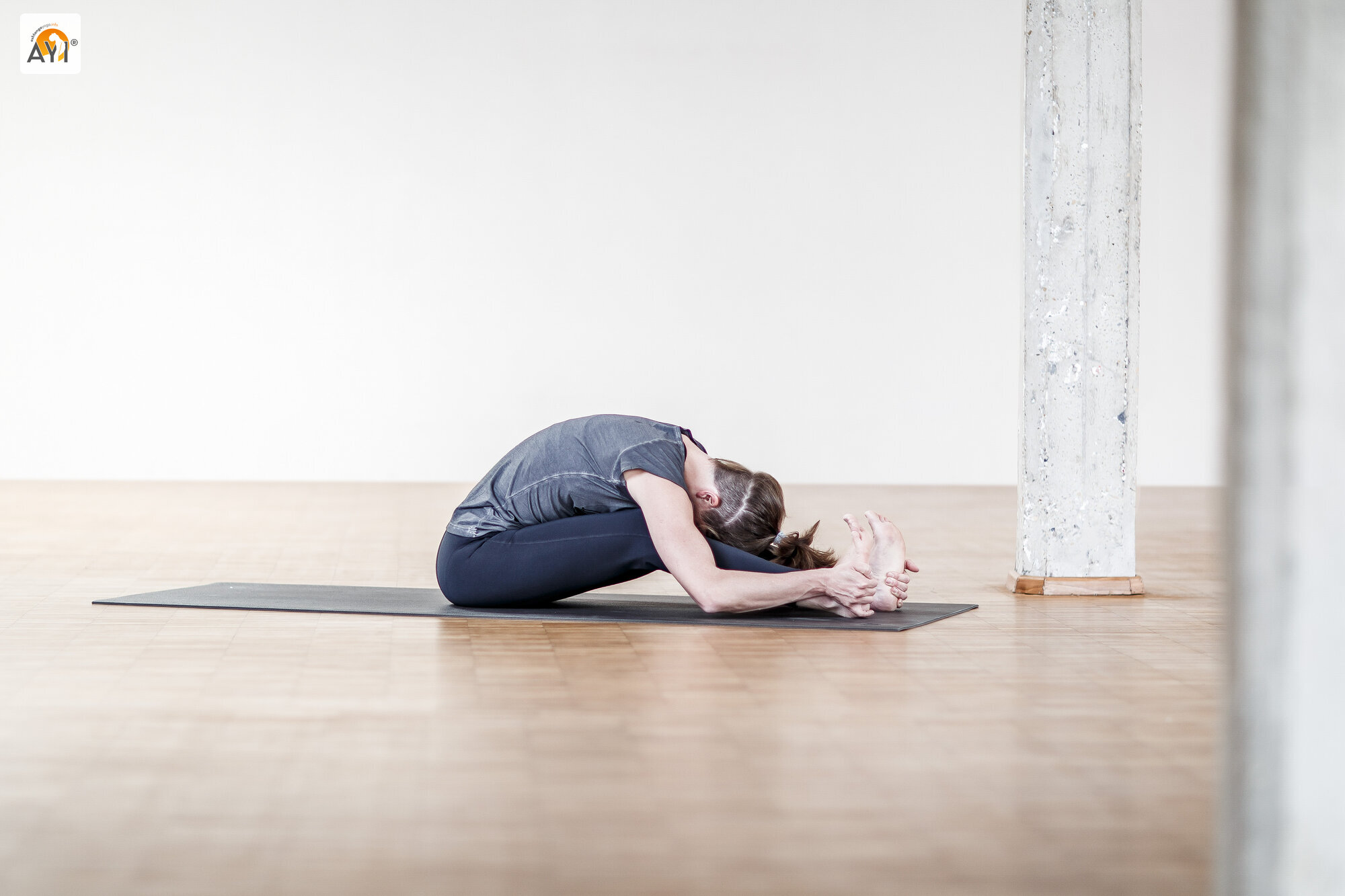
Then find an upright seat on the floor. Stretch your legs out in front of you. Be sure not to overextend the knees. In order to sit directly on your sitzt bones, you may try pulling the buttocks flesh out to the side, and or bend your knees.
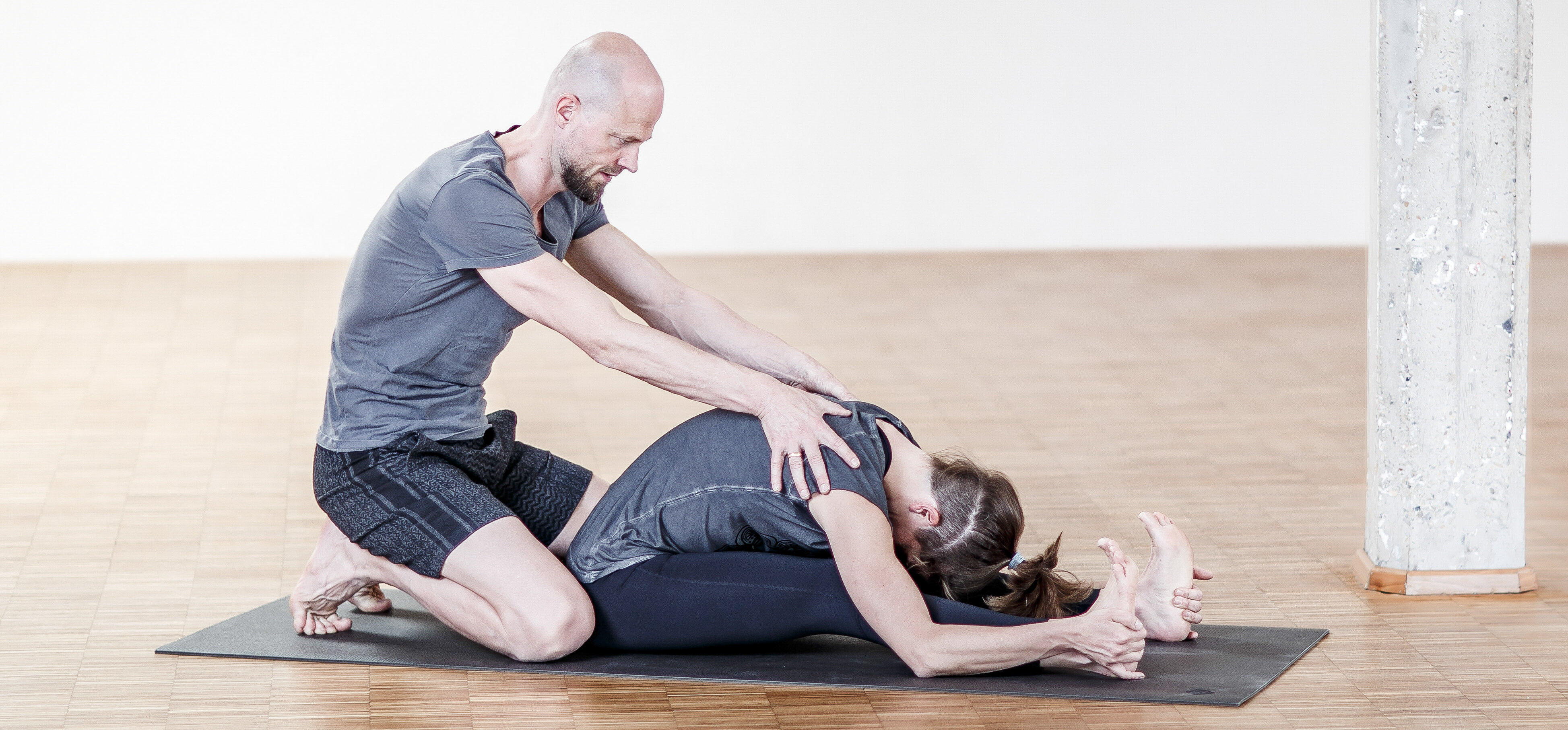
Stretch yourself over your legs and hold on to the outer edges of the feet. Again here breathe slowly and deeply for about five breaths, taking special care to create space for lengthening the back. Enjoy the stretch along the backs of the legs upwards along the entire back body (Fig 4).
Effect: Now we are lengthening the back line of fascia. This line travels from the sole of the foot, along the entire back body all the way up to the eyebrows. Again the 30 second hold allows us to trigger the creeping effect, thus lengthening the fascia of the back body.
Sprinter – Round 2 (Rebound Effect)
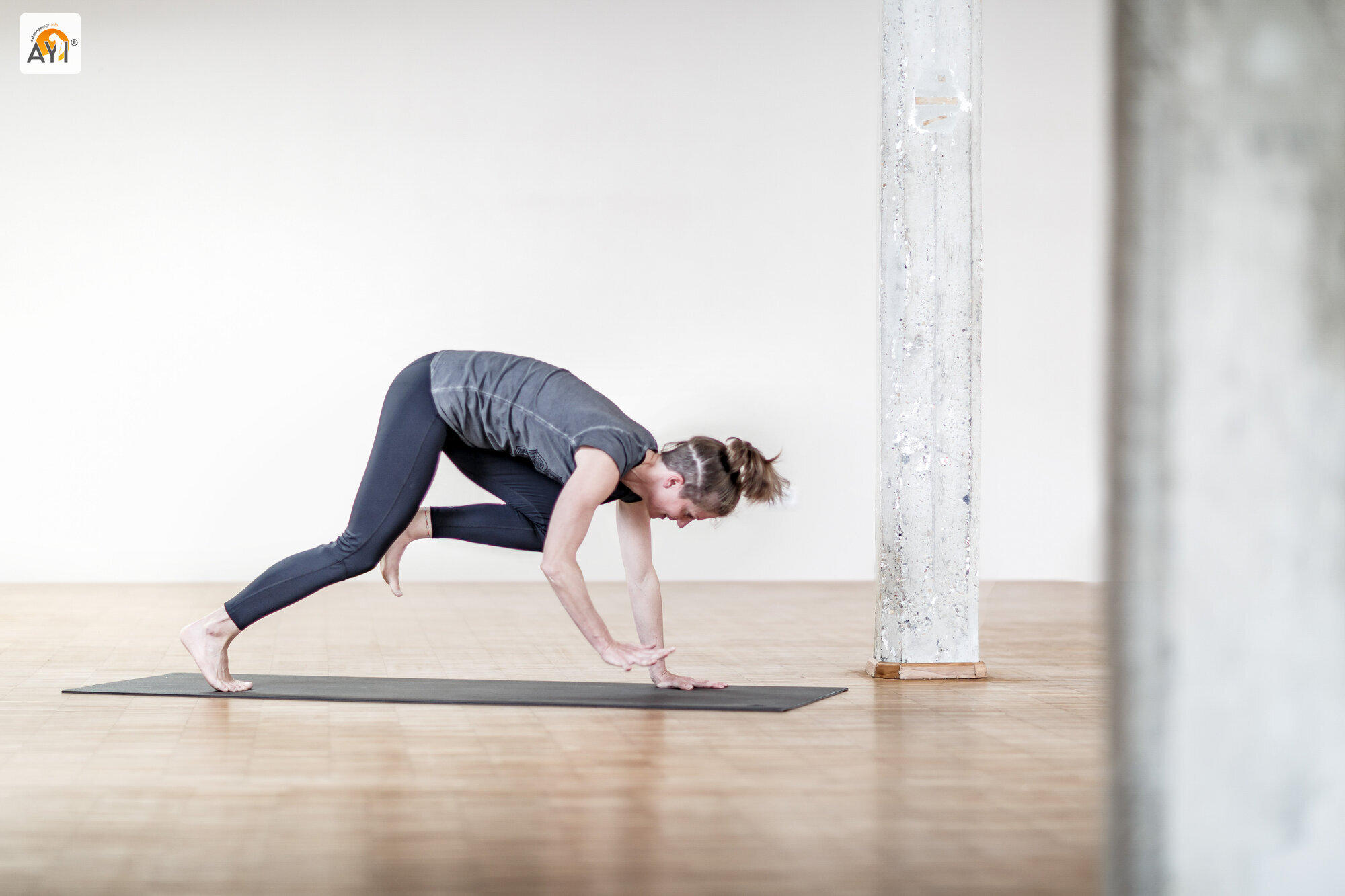
Repeat a second round of sprinter. If you want more of a challenge, start to lift one hand from the ground (Fig 5).
Effect: Here we revisit the opposite end of the spectrum. This dynamic movement, in contrast to static stretching, picks up the impulses from the movement. This generates heat which is needed to optimize the next stretch, and the fascia starts to pull to adapt to this new elastic challenge. Elastic fibers get lodged, which is important in maintaining stability even when higher levels of flexibility are present.
Backbend – Upward Facing Bow (Creeping Effect)
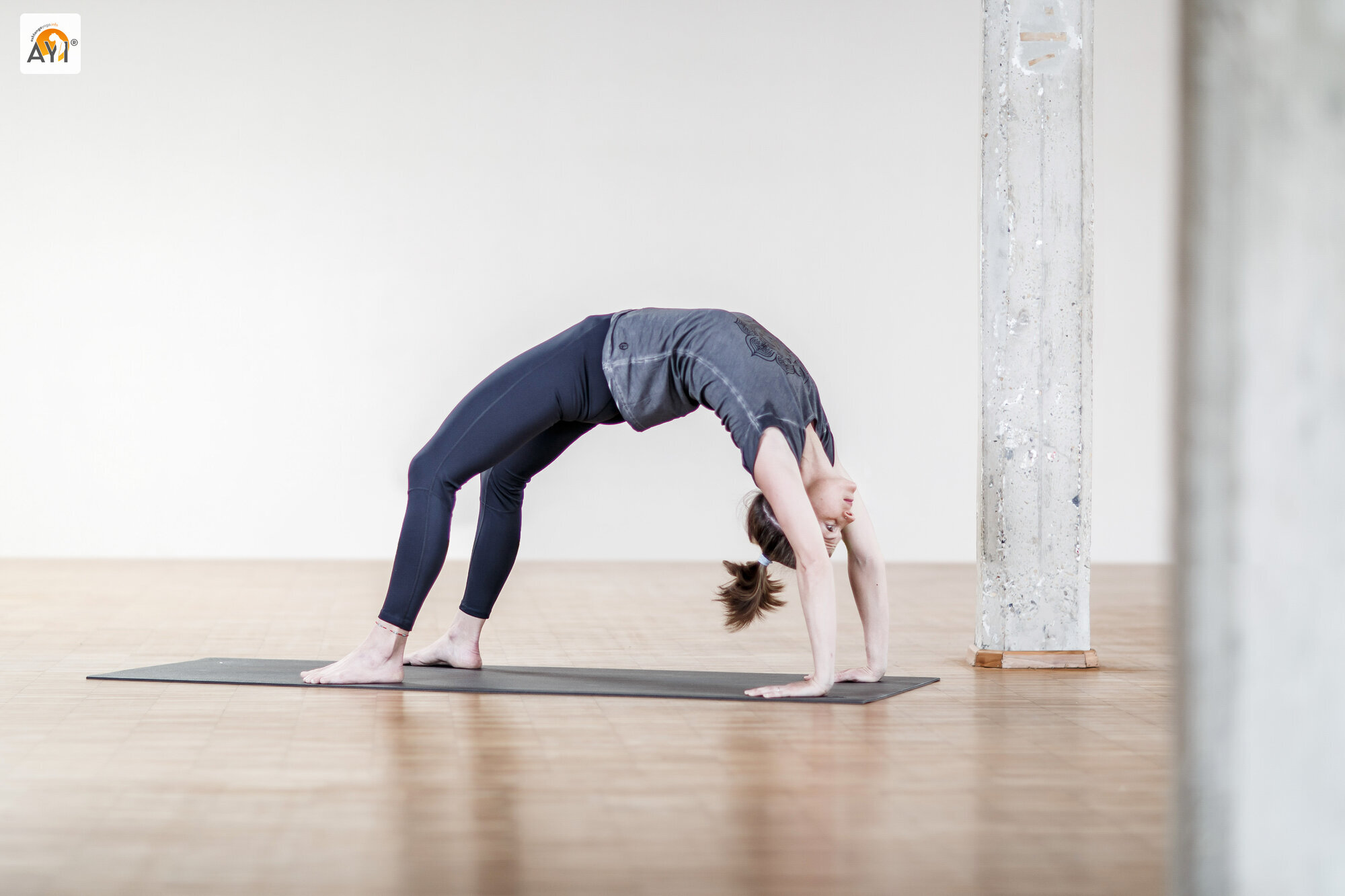
For the second round, we can further intensify the stretch. Start in a supine position on the ground. Lie down flat on your back. Place your hands on the floor close to your shoulders and your feet close to your hips. Make sure that the feet are approximately parallel and that the fingers turned slightly outwards.
On an inhale lift your pelvis upwards and then push upwards with your hands. Even though the stretch is intense, breath slowly and deeply for about five breaths (Fig 6).
Effect: The Upward Facing Bow pose is an even more intense stretch of the front fascial lines. Because of the position of the arms, the line extends even further. This pose is fundamental for building flexibility in all back bends.
Forward bend – Upavishta Konasana (Creeping Effect)
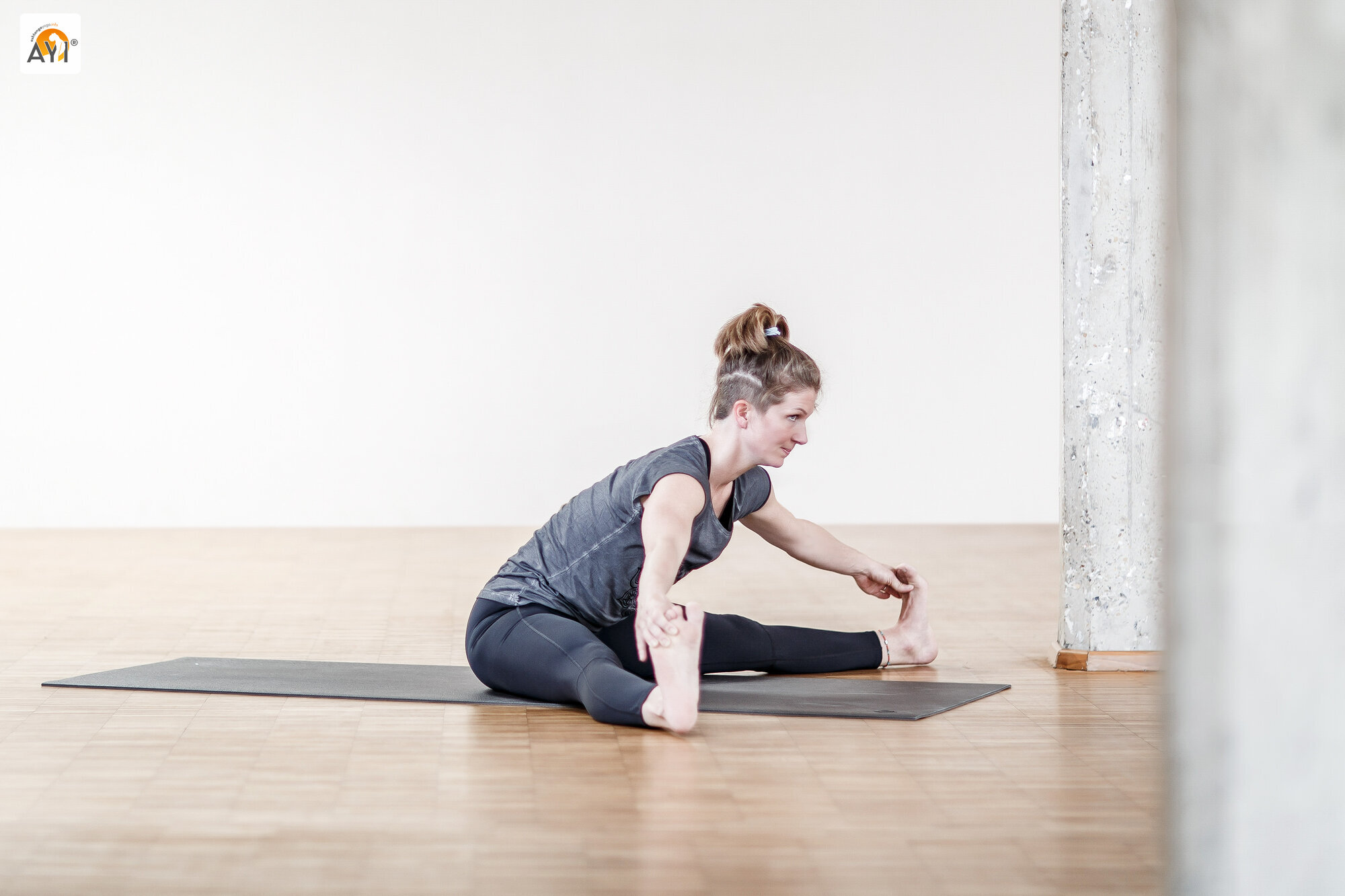
After stretching the front line, we switch to the back line with a forward bend. Her sit again upright and then take the legs out wide in a 'V' shape. Stretch forward between the your legs. Hold the stretch and breathe deeply for about 5 breaths (Fig 7).
Effect: Compared to the previous forward bend, the legs are now spread wide. Here we see the same back fascial line being stretched, but now at a slightly different angle. This allows us to develop more comprehensive flexibility.
Further Rounds
You can follow the blueprint of this principle to create further rounds. A dynamic exercise will be alternated with two stretching postures. The dynamic movement invigorates the fascia with energy, the first stretch stretches the front line and the second the back line.
If you vary each round a little bit, you will activate the fascia at a slightly different angle. This is ideal when you are re-triggering the rebound and creeping effect over and over again.
This practice is demanding, and you will certainly sweat. To close such a practice it is important to take a long and complete constructive rest. This will not only help with recovery, but it will also disable the myofibroblasts so that the cells of the fascial network can create more flexibility and softness.
Savasana
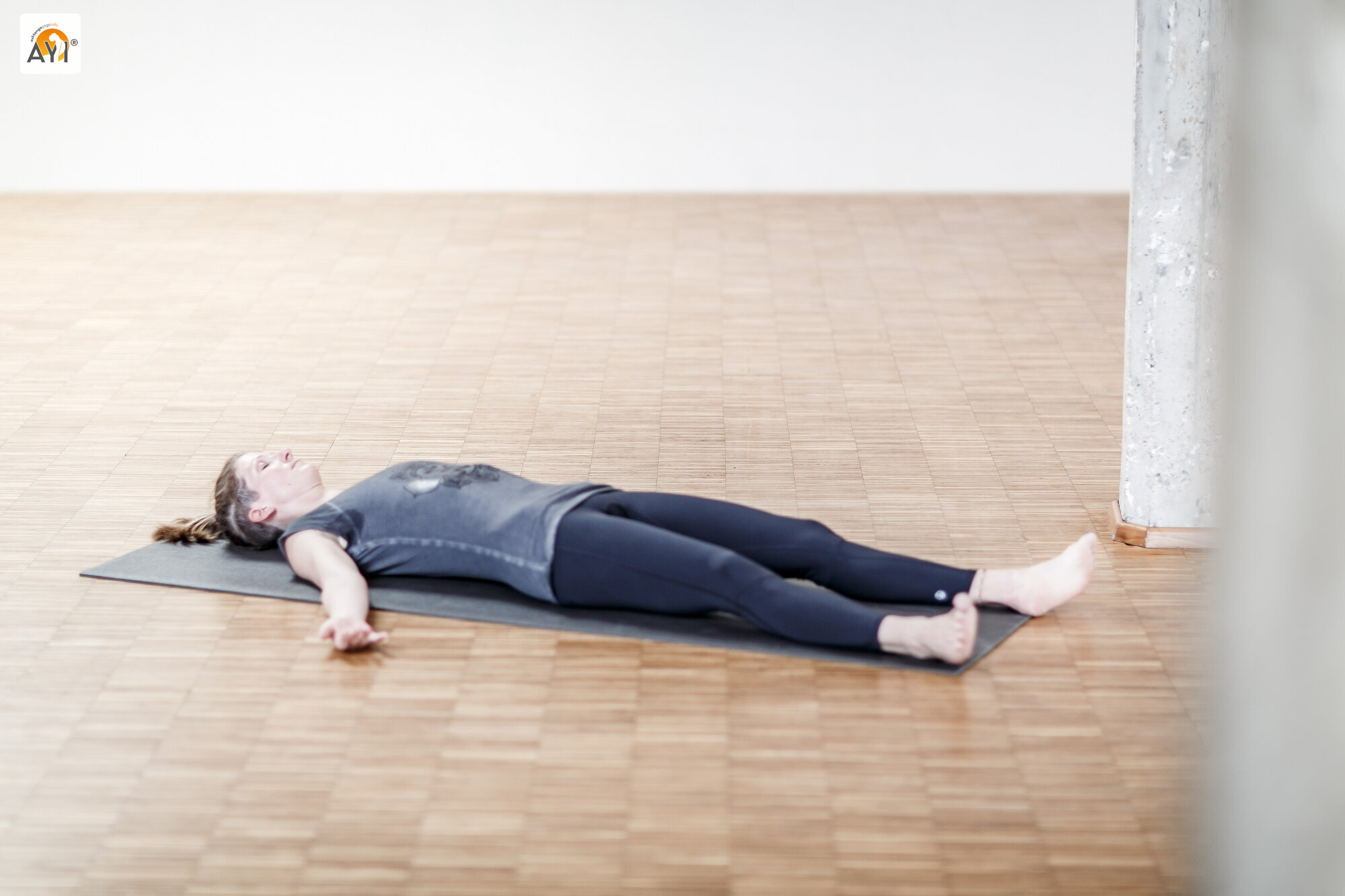
The classic form of constructive rest, or Savasana, is done lying supine on the floor. Place your hands about 20 cm to either the side of the body with the palms facing up. Your feet are also about 20 cm apart from one another and fall outwards to either side.
If you find this position uncomfortable, choose a position that will allow you to relax completely. Try different things such as lying prone or even on your side until you find a position that you find comfortable.
Close your eyes and allow your breath to become flatter. You may observe your heartbeat as it gradually beats more calmly. If you were sweating, observe how the sweat begins to evaporate from your skin leaving a mild tingling sensation. Rest until you feel complete calm (Fig 8).
Effect: Constructive rest is the most important part of the yoga practice. In relation to the fascial system, rest helps the myofibroblasts to loosen the collagen fibers that they are pulling toward them. The entire myofascial network becomes softer and our body becomes more flexible. Relaxation promotes flexibility.
Have fun practicing!
Teacher: Dr. Ronald Steiner
Yogini: Kristen Sikorsky Racco
Photographer: Paul Königer
Apparel: OGNX
Continue with AYI Free
Quiz: Rebound and creeping
3 questions to deepen this article.



Please log in to write a message. Go to login