



Breathing with floating tension for healthy, more elastic fascia
To be healthy, a muscles requires tension and relaxation. It is vital to have both of these aspects because only in this way can the fascia be nourished properly. To maintain elasticity, fascia needs to be stretched and relaxed. If it does not, it cannot maintain its innate elasticity. As the saying goes, use it or lose it.
The human torso requires constant stabilization in order to convert pressure into tension through this helical system. Only when this is working can the spine be protected from this load.
In order to coordinate this seemingly contradictory demand, each of the muscular parts associated with the said individual sections of the double helix stretch while other segments stretch. The result is a constant and well-distributed tension across the entire helix. But in each of these individual segments, muscular and elastic tension alternate in a pulsing manner.
The rhythm of this pulsing arises from the diaphragm, which is the strongest muscle of respiration. The deeper we breathe, the more vibration within the breath penetrates the more superficial helical myofascial layers of the torso. The breath brings life to seemingly static tension. This is why we are able to stay upright so long without fatigue. The intervertebral discs are protected from pressure loading.
Exercises to support stability and elasticity
With the following sequences you can systematically activate the four double helices. In doing so you can maintain spinal health, improve your posture and at the same time develop a lot of power for demanding yoga poses.
Bellows breath
Find an upright seat and make sure that your spine maintains its natural curvature. In order to maintain the natural lumbar curve (anterior pelvic tilt), it often helps to elevate your seat on a pillow, a block or a chair.
Place your hands on either side of your abdomen so that the thumb can easily reach the floating ribs. Inhale and let your belly relax and stretch outwards as your fill your lungs with air. On the exhale, draw your stomach inward from both above and below the navel (Fig. 1).
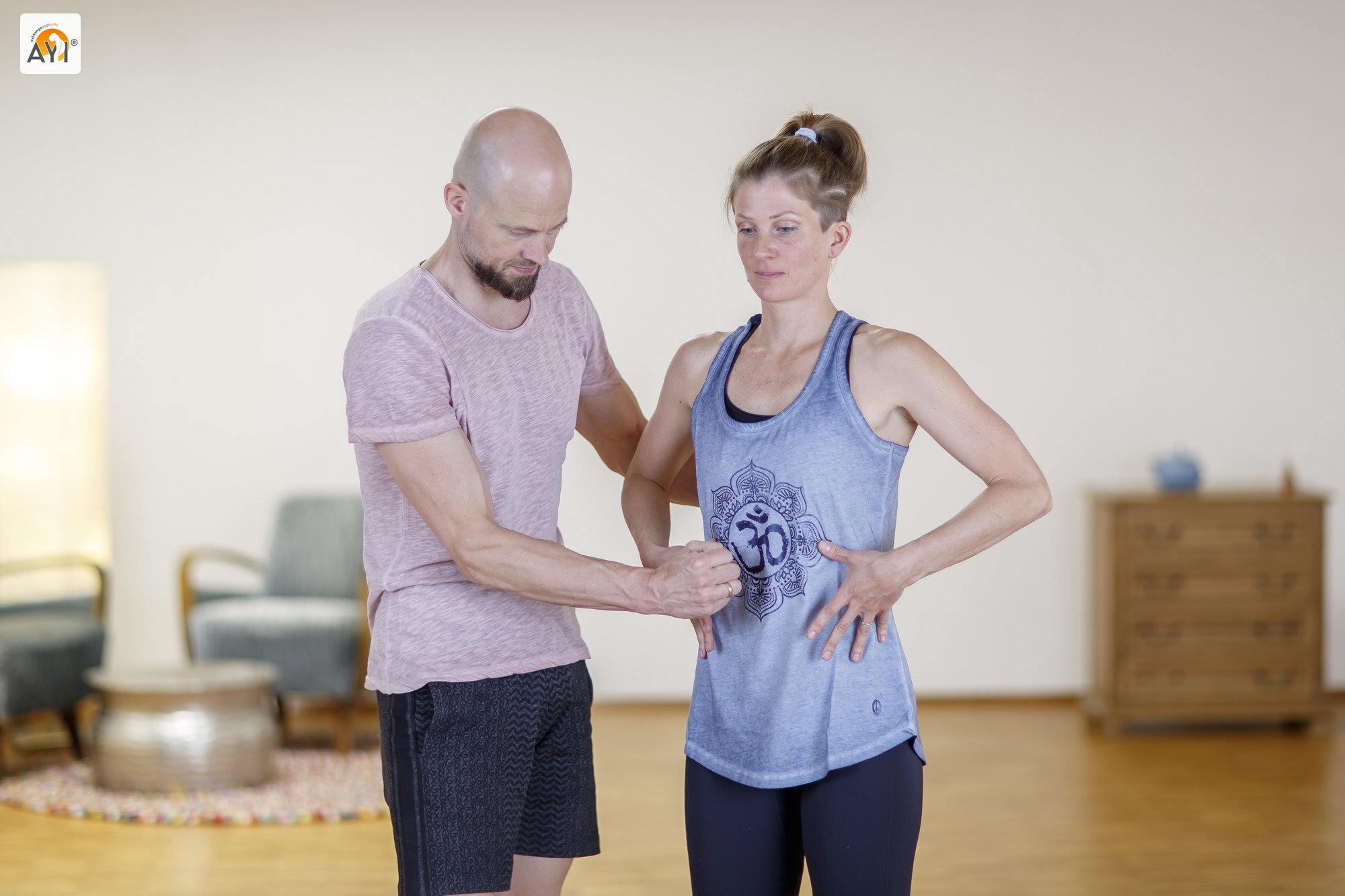
As you proceed inhaling passively and exhaling forcefully, start to observe the shape change of the body as you inhale and exhale. Keep practicing until you can sense fatigue in the inner layers of your abdominal muscles. You may also be able to recognize the activation of the double helix of respiration (pelvic floor, diaphragm and the base of the mouth) as you breathe.
Effect: This exercise strengthens the deepest layer of your abdominal muscles (M. Transversus Abdominus). This is your inner corset, enclosing the contents of your abdomen. This muscle works as the antagonist to the diaphragm in respiration. This powerful breathing exercise activates the entire double helix of respiration and brings vibration into the deep lines of fascia. This is the basis for which we establish floating tension in the torso.
Bellows breath in prone, supine and all-fours
Lay flat on your back. Place your hands on the upper abdomen as described before. Again, exhale forcefully while drawing the upper and lower abdomen inwards, and inhale passively (Fig. 2).
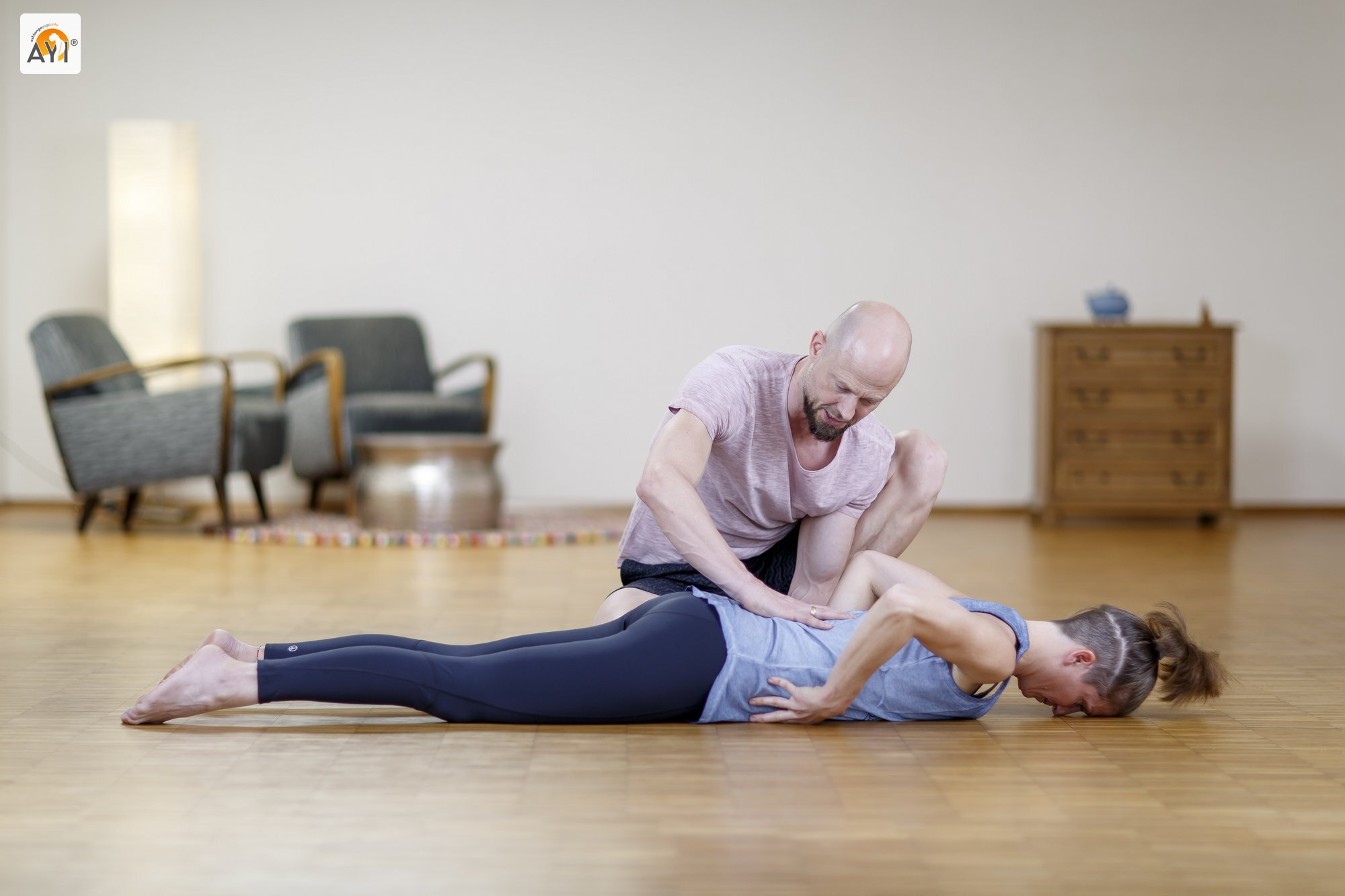
After a while, reverse your position with the ground by laying on your stomach. As you exhale you will try to life the entire abdomen above the floor and as you inhale you will let your belly fall back into the floor (Fig. 3).
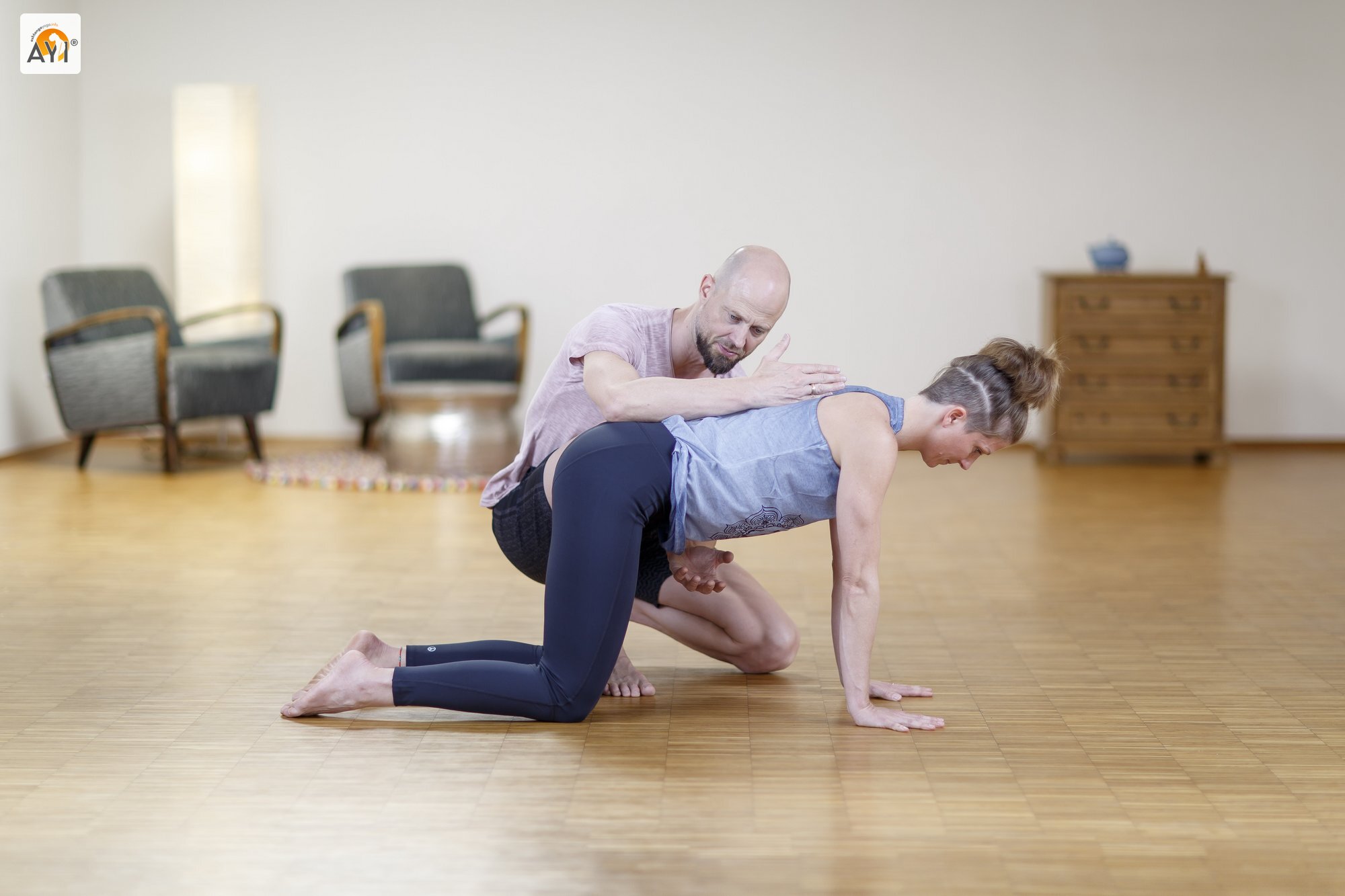
After a few repetitions, switch to all-fours taking care to line up the knees and hips and the wrists and shoulders. Again, following the same procedure in a new perspective exhale with power and inhale passively. Keep going until you sense mild fatigue in the deepest layers of myofascial muscle (Fig. 4).
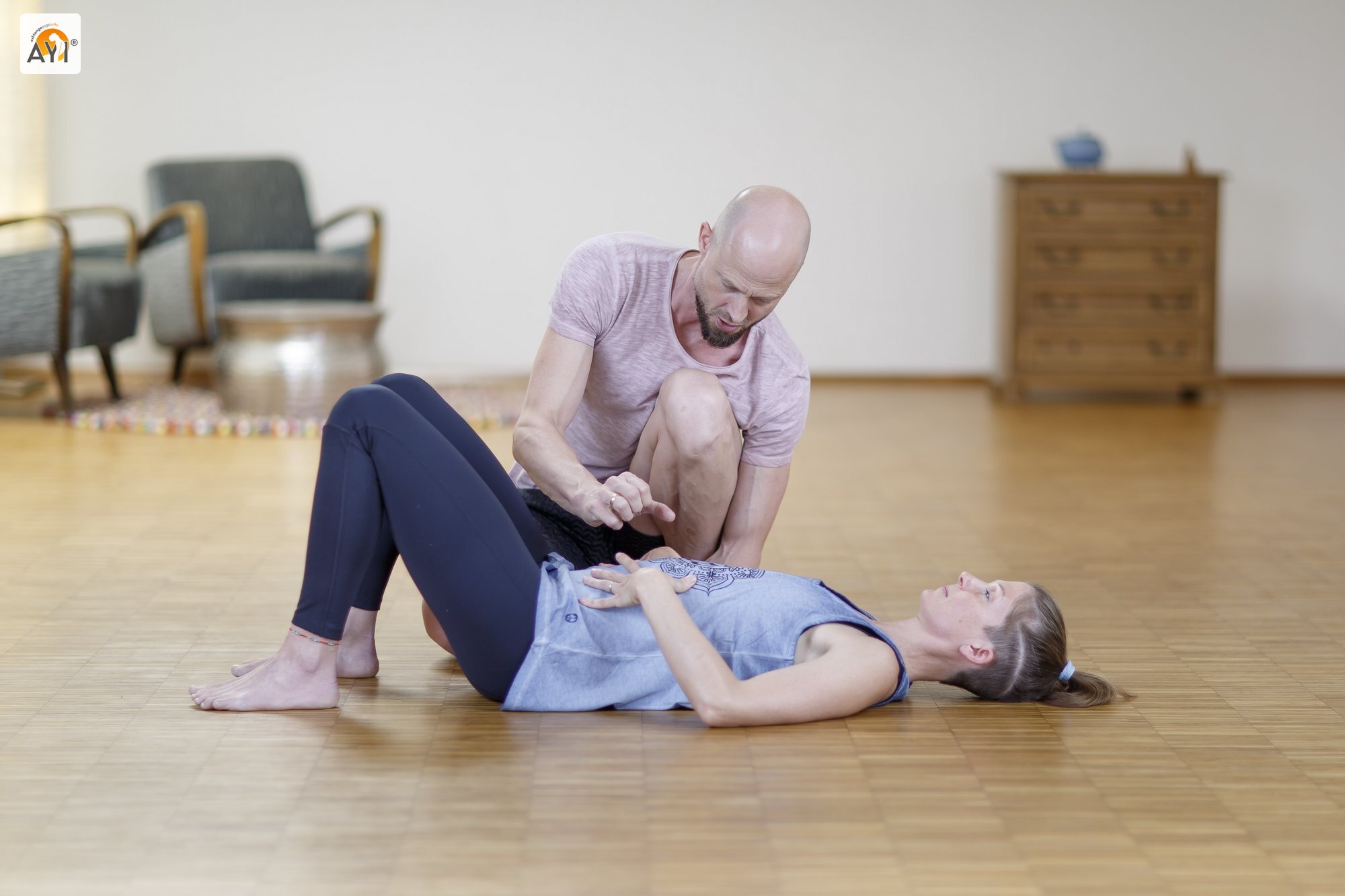
Effect: By changing your physical orientation you can intensify the activation of the double helix of respiration. You can quickly access, work and bring the transverse abdominis muscles to the point of mild fatigue.
Four-zone breathing
Return to an upright seat of your choice. Again pay attention to any changes you might want to make to maintain proper pelvic alignment. Place one fist on the lower abdomen between the navel and pubic bone. The other hand is placed opened on the upper abdomen. Breathe slowly. Draw the low belly inwards and breath into your hand with your upper abdomen so that your back seems to arch (Fig. 5).
Going further with your next inhale place your hands on the side body at the ribs. Breathe into your hands to lift the ribs laterally (Fig. 6).
Take the breath even further towards the back body. Place a hand between the shoulder blades and breath into that space. Your thoracic spine will likely round a bit.
Deepening the breath yet again, place a hand on your sternum and breathe into your hand as you chest lifts as you inhale (Fig. 7).
Start exhaling from the upper abdomen first. Then continue exhaling in the side body, the back body and the sternum. Use your hands as support to give you a sense of space and where your body can move. This is a great way to train your body to sense the movement of breath and to be more familiar with the muscular activation associated with it.
Keep going until you can clearly recognize the activity of the deep double helix. The opposing helices are directly recruited during the movement of respiration.
Effect: This exercise activates the deep double helix. The two opposing helices surround the ribcage and abdomen. This deep double helix is key in creating the floating tension needed in the torso.
Four-zone breathing in supine, prone and plank
Lie down on your back and continue the breath exercise as described above. By changing your orientation to a supine position you should be able to clearly sense into the back body as you breathe (Fig. 8).
Turn over onto your belly and continue the breathing exercise in a prone position. Here follow the movements with your hands and try to give as much time and space to each of the four areas (Fig. 9).
Finally set yourself up in the top of a pushup position, taking care to line up the shoulders and wrists. The exercise can be done on the forearms if this brings undue strain to the wrists. Again breath into the four walls evenly and deeply. (Fig. 10).
Effect: Again here you can train your deep double helix in different positions to acquire a feeling for your breath, regardless of where your body is in space.
Enjoy and have fun practicing!
Teacher: Dr. Ronald Steiner
Yogini: Kristen Sikorsky Racco
Photographer: Paul Königer
Apparel: OGNX
Continue with AYI Free
Quiz: Atmende Helixspannung
5 questions to deepen this article.



Please log in to write a message. Go to login