
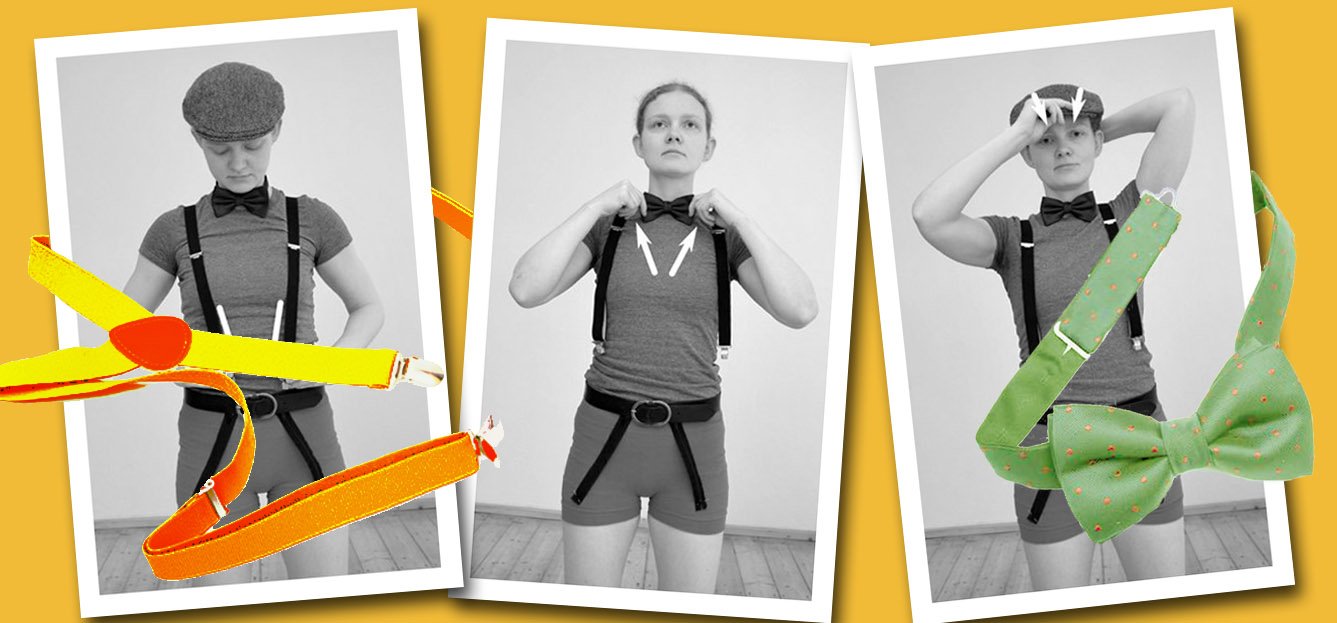


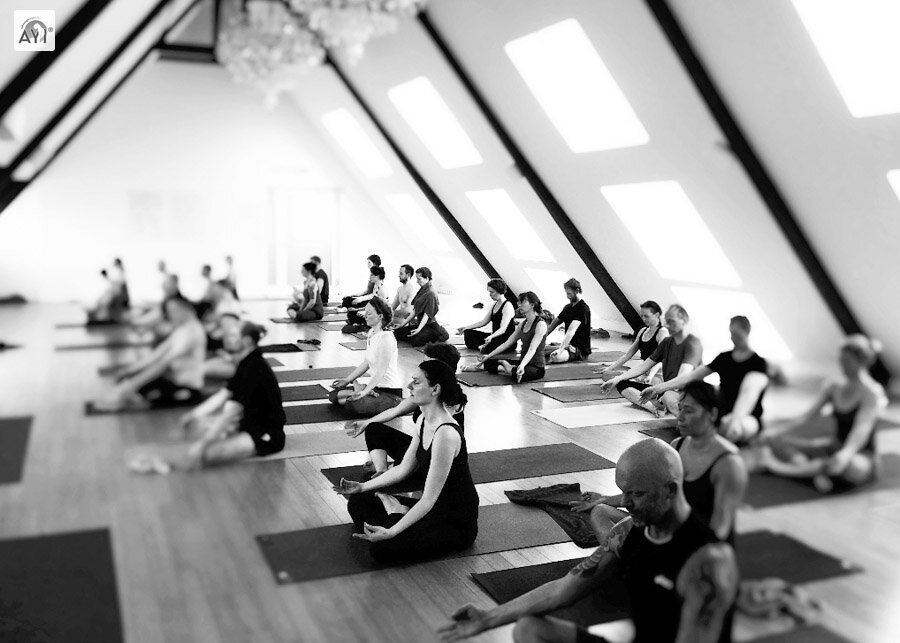
Ultimately, a certain pattern evolves, for instance:
- Inhalation:
you pull your iliac spine forward, the belly button inwards and upwards, erect your spine and raise your sternum; the throat widens and the neck gains length - Exhalation:
you lower your chin, pull your shoulder blades downwards, close your lower ribs, push your coccyx down and widen your ischial tuberosity
Sabine: Well, that sounds like there is quite a lot to remember and do all at the same time!
Kati: That's right. However, Ronald did not only give us the anatomical background but always came up with images to help us visualize the individual actions better. The image that definitely stuck in our minds was the "smiling underpants" - to be purchased at commercialyoga.com ;-) .
This is what gave me the idea to visualize all five dynamics with the help of different pieces of clothing. The result is a "dress code" for yoga practice with the individual images illustrating the anatomical processes I've already described.
Sabine: So much for the theoretical part. Did you manage to put this new concept into practice right away?
Kati: At first, it was a bit difficult to put all Bandhaligns® into practice at the same time; you also tend to lose the meditative flow since your mind focuses quite a lot on technical details. However, this quickly changes and, having practiced the new patterns only about ten times, they enter your subconscious and you don't really have to think about them anymore during your practice. Usually it is then sufficient to remind yourself of them during the sun salutations so as to set the basis for your practice. Due to the "gearwheel effect" it also suffices to, for instance, focus on the dynamics in the pelvis because your body will then instinctively perform all the other Bandhaligns®. At the same time, this focus makes sense since the lumbar spine, which is probably most prone to injuries, is lengthened and stabilized in this way.
Sabine: Do you have another tip that proved particularly helpful when putting theory into practice?
Kati: Yes, when experimenting with the concept, it proved helpful in almost all positions to pull in the belly button because that produces a wonderful length in your lower back. In extreme frontbends, it feels very good to move the coccyx downwards because this reduces the stress on the intervertebral discs. And in backbends, it feels best to keep the ischial tuberosity wide.
Sabine: Wow, thank you so much! I guess that most of our readers have already started trying those new ideas in their mind ☺. Therefore just one short last question: how did you experience the MTC and how helpful was the input for your own practice?
Kati: I can give you a clear answer to that: it is definitely worthwhile to look into the concept of Bandhaligns® and to get a deeper understanding. You, for instance, learn how to move the spine in an anatomically correct way. That, in turn, leads to more stability and ease in practice. Also, you reduce the risk for injuries which otherwise might have an impact on a lively and dynamic yoga practice.
Sabine: Thank you very much for the interview and for sharing your experiences and tips!
You've become curious? See our further education section for a complete overview of all our MTCs, workshops and retreats!
Continue with AYI Free
Quiz: Bandha and inner imagery
4 questions to deepen this article.

Please log in to write a message. Go to login
No messages yet.