



Over time this will lead to a dysbalance. While some regions along the dorsal fascial line remain taut, others start to wear down. The complaints are usually in those areas that are too firm. The lumbar spine is often affected. Inflammation often occurs at the points where the worn areas connect to the more taut areas. Inflammation at the back of the legs is a common complaint for yoga practitioners.

Exercise sequence
With the right method, however, we can direct the stretch into different areas of our dorsal fascia. This allows us to specifically develop flexibility in the firmer areas which will harmonize the dorsal fascia overall.

Prepare the dorsal fascia
This one you can try out right away. You can use a tennis ball or a hedgehog ball or any other fascia ball. Stand behind the ball and place the right sole of the foot on the ball. Roll the ball back and forth under the foot while pressing lightly into the ball.
You will clearly feel the sole of the foot soften after some time of rolling. From here try out a standing forward bend. Typically you will feel more flexible along the entire right side of the body.

Repeat the entire exercise with the left foot. You can balance out the two sides by testing with forward bends and repeating as necessary.
Effect: Rolling the ball under the sole of the foot (plantar aponeurosis) brings movement and thus warmth to the sole of the foot. As a result, the collagen fibers slide past each other when there is tension. Because the plantar aponeurosis is part of the dorsal fascia line, the entire line benefits from this warm up exercise.
Seated forward bend stretching the backs of the legs
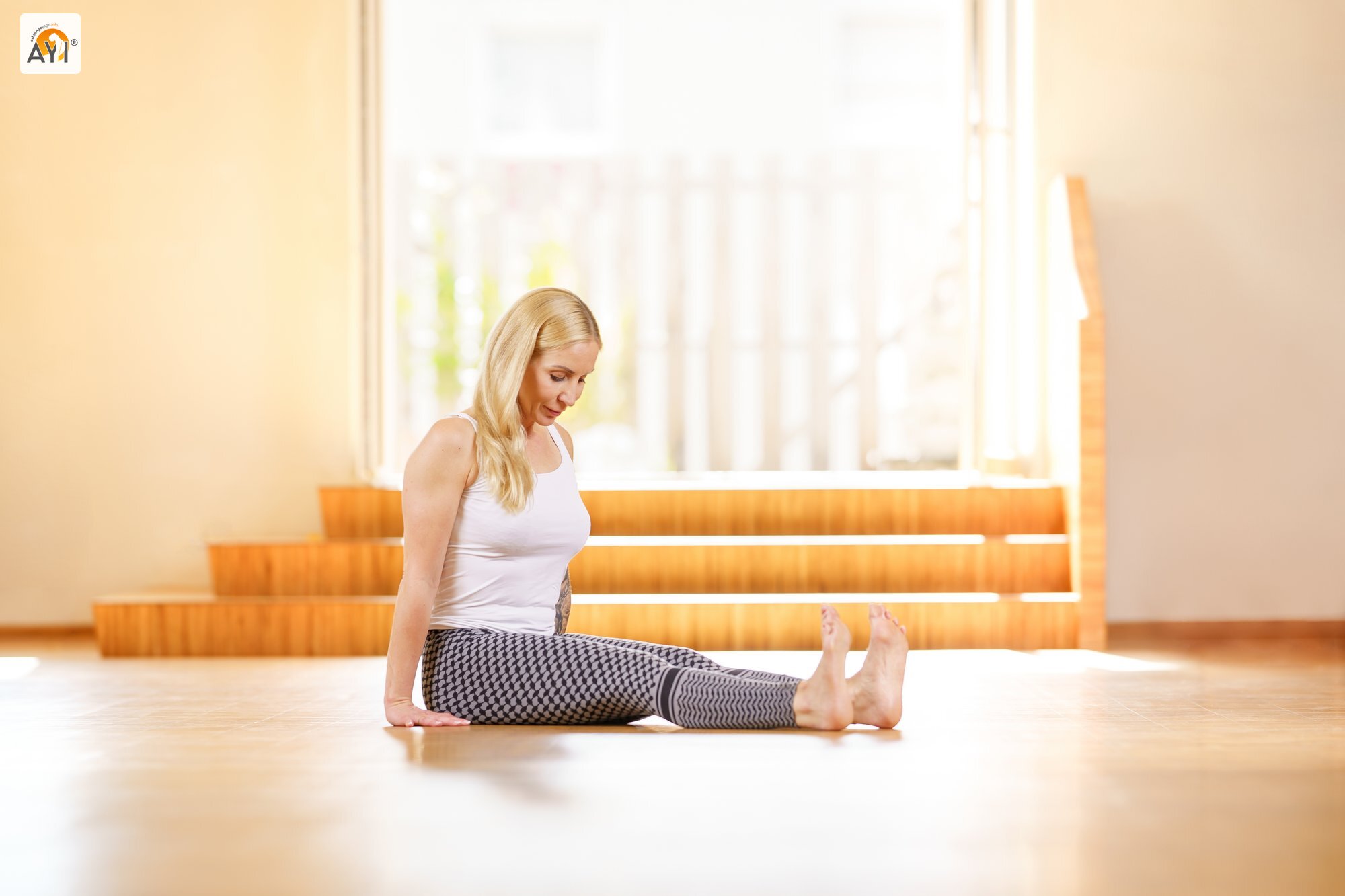
Sit on the floor with your legs stretched all the way out. Pull the buttocks flesh behind the sitting bones and pull back and outwards. In this way you can help the spine stay neutral in the L-seat position (Fig. 3).

Now micro-bend the knees and press the balls of the feet away from you. Raise your gaze and lift your chest. Reach forward toward your feet with your arms stretched out long. Continue to tilt your pelvis forward by drawing the sitting bones back and away from one another as you lean forward (Fig. 4).

As you continue to lengthen forward, inhale in the front body. As you exhale, wrap the back body inwards (Fig. 5).

You will feel a very clear stretch along the backs of the legs. The dorsial fascia of the back is active. Stay here and enjoy the stretch for about ten slow breaths.
Effect: For many people, the hamstrings are shortened. As a result, there is a constant pull at the sitting bones. The pelvis starts to lose its ability to swing and this results in SI joint complaints. With this type of stretch you ensure the softness in this area. This will allow for natural balance to be established and for symptoms to gradually diminish.
Contraindication: If the fascia of the lower back is too taut compared to the backs of the legs, this would not be the right exercise for you. In this case you can skip directly to the next exercise.
Seated forward bend with a fascial pull in the lumbar region
Come back to an L-seat. Consciously straighten the legs out as much as possible (Fig. 6).

Place one fist at your lower abdomen and the other at the back of the head. Pull the skin of the back of the head upwards towards the eyebrows and with your gaze downwards. Tucking your chin towards the chest start rolling downwards (Fig. 7).
Inhale and breathe deeply into the upper region of the back body. Eventually you will come forward over the legs (Fig. 8).

The stretch will now be felt in the lumbar fascia and also between the shoulder blades and possible all the way from the neck to the eyebrows. Remain in this stretch for 10 slow breaths.
Effect: This type of forward bend will seem strange to may at first. The chronic back pain that many suffer from often comes from hardened fascia in the lumbar region. The targeted stretching in this area regulates the pain receptors. A change can be noticed surprisingly quickly. This type of backbend is also effective for those who have inflammation at the sitting bones. When the entire dorsal fascia line softens, it reduces tension on the thinner or worn out regions. This again will result in surprisingly quick results.
Contraindication: This is not the right exercise for you if the excessive firmness occurs for you in the hamstrings and/or if the lumbar spine lacks stability. This exercise is not suitable for herniated discs (in this case see the previous exercise)
Standing forward bend for the hamstrings
These exercises illustrate a principle. Depending on how we position ourselves, we can control the direction and intensity of the stretch and how it is distributed across the dorsal fascia.
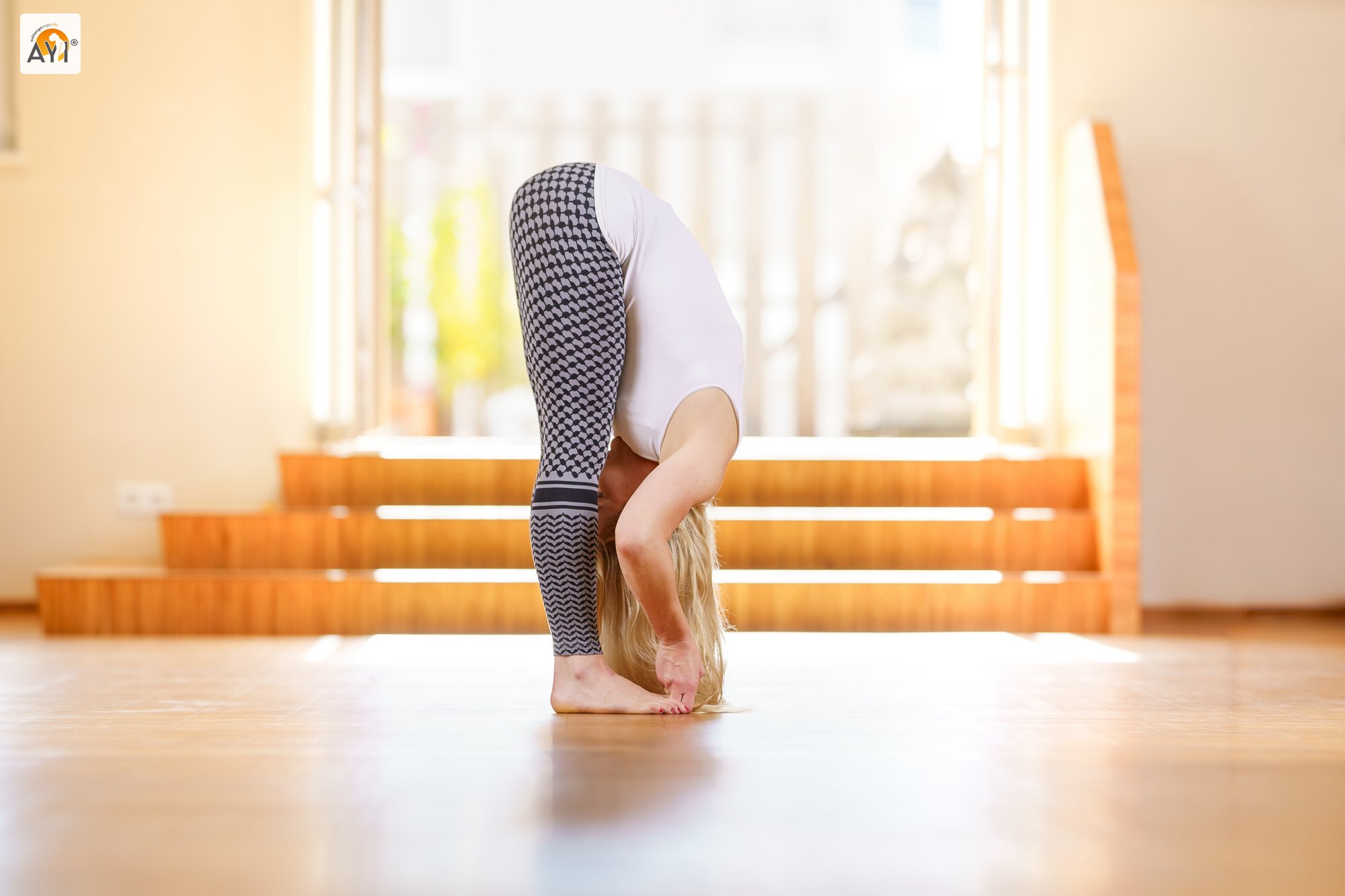
Next, we can try the same method in standing. Ben your knees going into the posture, draw the sitting bones away from one another and look toward your toes. Widen across the abdomen and chest as you inhale and wrap the side body and back bodies inwards as you exhale. In this way you will quickly achieve a stretch along the backs of the legs (Fig. 9).
Effect: In the standing version the practitioner can tilt the pelvis slightly while standing forward. The stretch is centered in the middle of the dorsal fascia, at the center of the hamstrings. This exercise is particularly effective when hamstring shortness is present.
Standing forward bends for the lumbar dorsal fascia
In order to direct the stretch of the forward bend to the lumbar region of the fascia, start by coming all the way out of the posture. Straighten the legs out completely and curl downward from top to bottom. Just as in the seated version, your downward gaze will guide the movement. In this exercise, deepen the inhalation in the back and side bodies as you deliberately draw the upper abdomen and chest inwards (Fig. 10).
Effect: With this version of the standing forward bend, the stretch along the line of dorsal fascial is better distributed. At the sitting bones there is practically no pull. By breathing deeply, the practitioner can mobilize the area between the shoulder blades and the neck. Tension in the dorsal facia can as a whole disappear with this form of practice.
Downward dog with stretch in the backs of the legs
Downward dog is a very popular yoga posture. Here you can also direct the stretch to the backs of the legs with mindful execution.
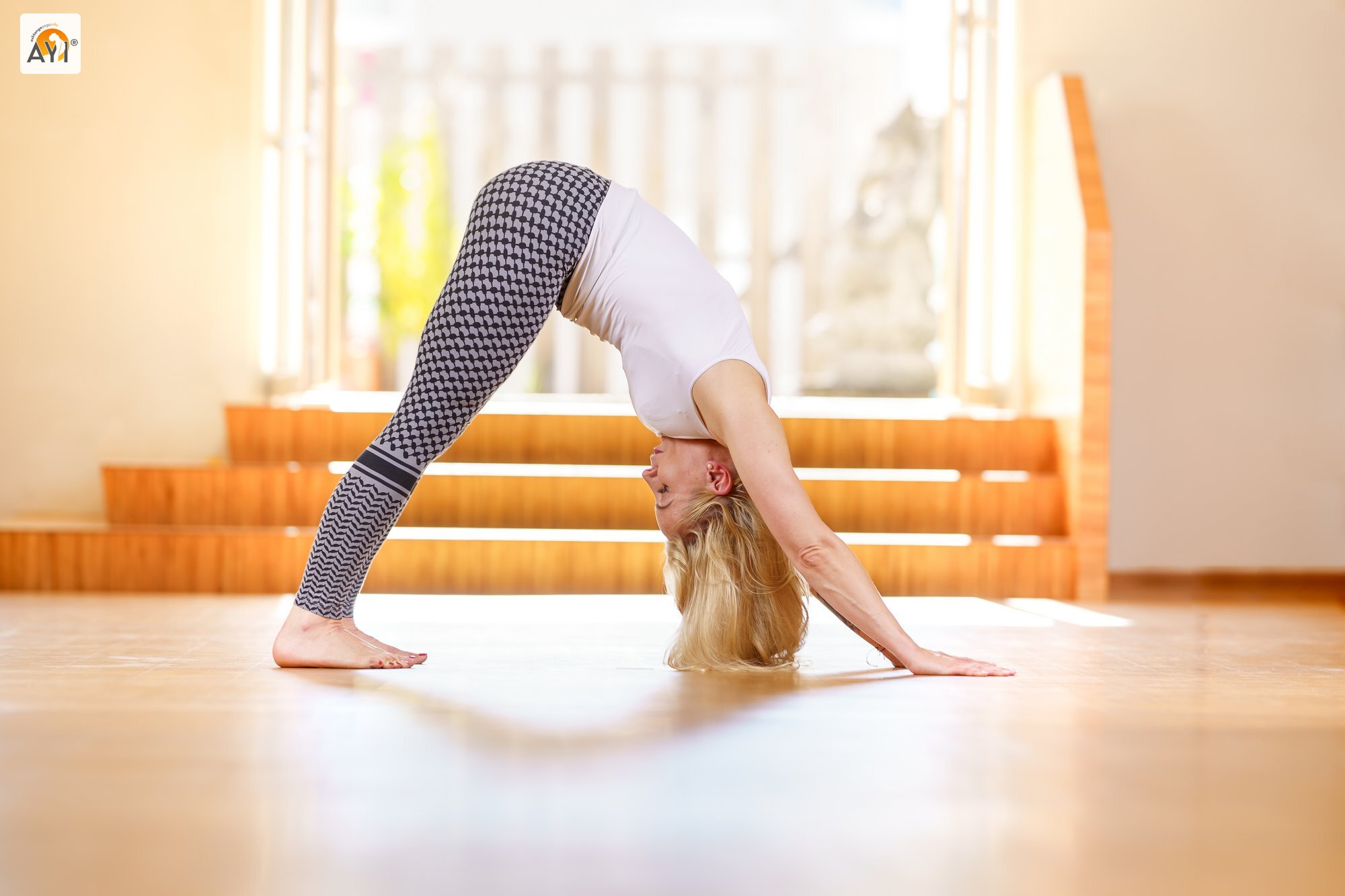
To do this, start in all fours. The knees are under the hips approximately, but the hands will be in front of the shoulders. Keeping the heels lifted from the ground and staying on the balls of the feet you deliberately will start to arch your back.
Try to maintain this curvature as you press your pelvis back and up. Keep your gaze forward and breathing (inhalation to the front body, exhalation to the back body) and you will be able to direct the stretch to the hamstrings (Fig. 11).
Effect: Downward dog is a classic and is found in almost every yoga class. Keeping the knees bent and staying on the balls of the feet, the spine remains pretty straight. Downward dog is excellent for people with problems with intervertebral discs. The stretch in this form is mainly in the hamstrings.
Downward dog for the lumbar fascia
For the opposite effect, start again in downward dog. Reposition the knees under the hips and the hands are directly under the shoulders.
Inhale stretching the legs out and pushing the heels into the floor as you allow your back to curve upwards. Bring your gaze to your navel and breathe (inhalation at the back, exhalation at the front) in order to guide the stretch into the lumbar fascia (Fig. 12).
Effect: This version of downward dog also seems a bit strange at first. But it allows us to evenly distribute the pull of the fascia along the entire back line. The stretch will dial down the sensitivity of the pain receptors in the lumbar regions. This is a great solution with chronic back pain. For the intervertebral discs, the pressure created by the rounding of the spine gives a healthy massage. Caution is to be taken in the case of herniated discs.
Have fun discovering!
Photographer: Paul Königer- www.yogafotograf.de
Apparel: OGNX
Continue with AYI Free
Quiz: Dorsal fascia
3 questions to deepen this article.


Please log in to write a message. Go to login