
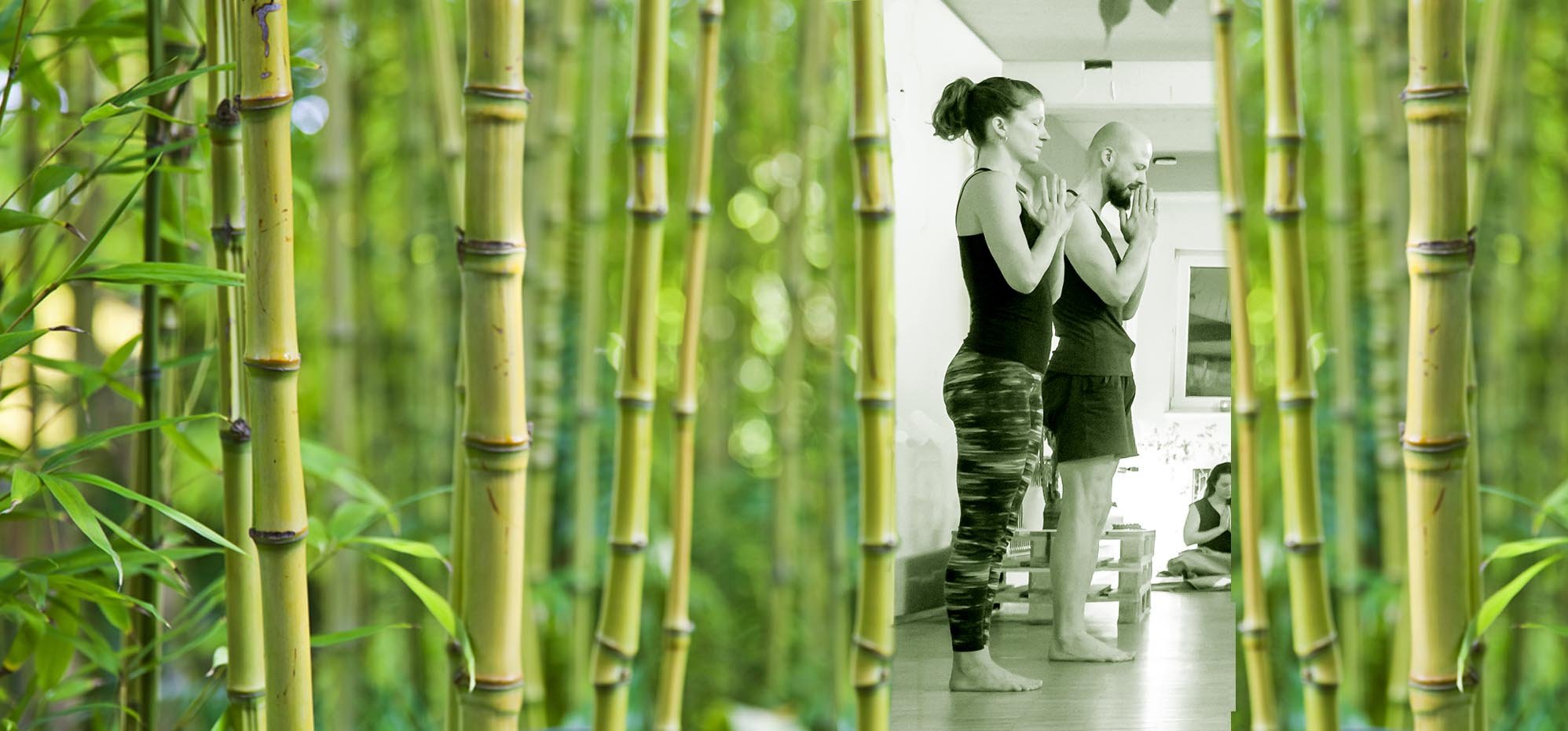


Exercise for February: Proprioception Awareness through Standing Savasana
Note: As this exercise is tough to self-gauge you may want to take a short video of it to look at afterwards.
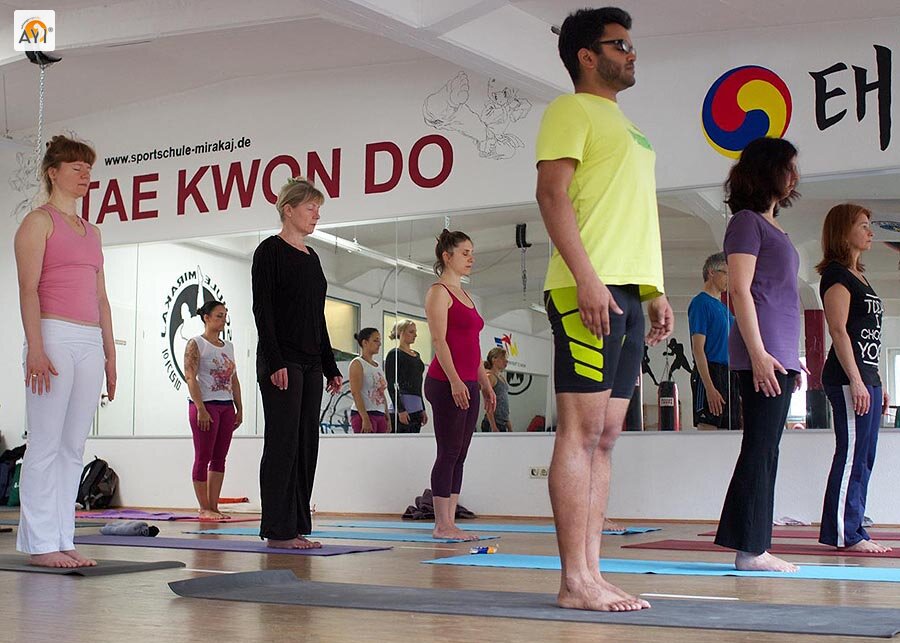
Step off of your mat if it’s rolled out, take your gaze directly before you and take a walk around the room. Resist the urge to look at your feet! Stop somewhere in the room and come to a variation of Samasthiti where you bring the big toes so close together that they almost touch, heels two fingers apart without letting the big toes or knees touch. Lift the toes and spread them out wide, then relax them downward. Close your eyes, keeping an active forward gaze from behind your eyelids. Wait and breathe. Feel where you are in space and feel if your feet are aligned. Take a few more breaths, then open your eyes take a look at your feet and adjust as needed.
In the process of developing and establishing an Aṣṭāṅga Vinyasa yoga practice, one will sooner or later be drawn to examining the Yoga Sutras. While we may hear and read about them all the time, there is little room to hash out the the philosophy in the framework of a daily Mysore lesson. My first teacher offered me small tidbits of philosophy when she felt it was appropriate. A teacher who I studied with later told me that it was time for me to start working through the sutras, but left it as an invitation. I took the advice, I waited, but nothing happened.
Close your eyes again. Scruff the heels inwards, then outwards. Feel the talon of the heel and sense the stacking of bone on bone as you line up your structure to bear the weight of your body with lightness, using as little muscle activation as is needed to remain upright. Let your body take the breaths it needs. Use as little effort as possible to keep yourself tall. How do you feel? Stable and unwavering like a sequoia or wobbly like a willow… or something else? What thoughts are churning, how do those thoughts affect the way you are feeling in this posture?
Stay there for about 5 minutes, then take a rest and either have a look at your video or journal your experience.
My final words of advice are to stick with it, enjoy and try to practice this with vairagya. By that I mean, take it as seriously as the most challenging pose you are working on and work through the good, bad and neutral with consistency. Who knows, perhaps the key to what challenges you in that beloved pose could be hidden in your Passive Tadasana.
I hope you enjoy practicing this exercise over the course of the next month!

Here are some words of wisdom from Chris about the skin in our practice:
“I think that it is very important to realize that the skin is our largest organ, and that exposing as much of it as possible during asana practice greatly heightens one’s sensitivity, and facilitates being absolutely present. Mindfulness activities using the skin prepare us for the journey from the gross to the subtle, and in many ways it’s a metaphor for just that. In the end bringing yourself to the finer aspects of yoga is what the asana practice is all about. The skin and one’s quality of awareness of it are very important components of a truly embodied practice.”
This exercise comes from my mentor Chris Hoskins, one of the main teacher trainers at Piedmont Yoga and owner of Studio 6 in Oakland California. We spoke about this article and after asking him if I could share his Passive Tadasana/ Standing Savasana exercise, he gave me his approval. Over the months that I was his mentee I practiced Passive Tadasana at the start of my normal daily practice.
Note: I am always very eager to move and have never really wanted to take the time to observe my body in neutral. I really hated this practice, which was part of our ritual each time we began an asana practice with Chris, be it in teacher training, at his studio or during private sessions. I felt wobbly like a palm tree, I had the sense that my feet were falling asleep and I was irritated that I had to stand there for sometimes 10 minutes or more. At some point after about 3 months of consequent and disciplined practice, I started to realize that what I was feeling was possibly muscular imbalances on either sides of the body. I started to feel how my bones wanted to line up but that there was also some kind of muscular tension pulling them out of alignment. Sometimes I would break a sweat simply trying to isometrically draw my right foot inward and back to set my femur parallel relative to the left one. This over time helped me to really feel my body in space, to sense my structure and to know what I was doing by feeling and not looking in asana practice, because I studied my structure and worked through those imbalances with more awareness and mindfulness. First, I did so with sprinter, then I moved on to seated poses and was able to find more and more stability in my passive Tadasana.

Please log in to write a message. Go to login
No messages yet.