

da द – gebend; schenkend
Adjektiv · Substantiv Feminin · Substantiv Maskulin · Substantiv Neutrum · Worttyp nicht bestimmt
Wörterbuchquellen
AYI Wörterbuch Adjektiv
gebend; schenkend
Cappeller 1891 Worttyp nicht bestimmt
Originaltext · Englisch · Worttyp nicht bestimmt
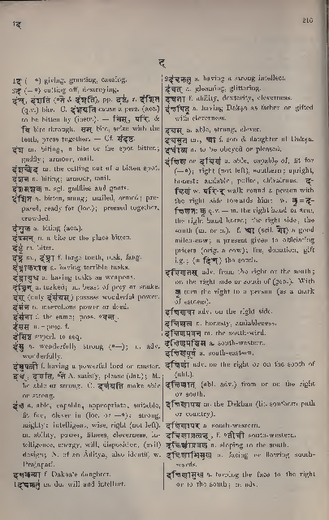
da1 ·(--°) giving, granting, causing.
Originaltext · Englisch · Worttyp nicht bestimmt
da2 ·(--°) cutting off, destroying.
Monier-Williams 1872 Adjektiv · Substantiv Maskulin · Worttyp nicht bestimmt
Originaltext · Englisch · Adjektiv
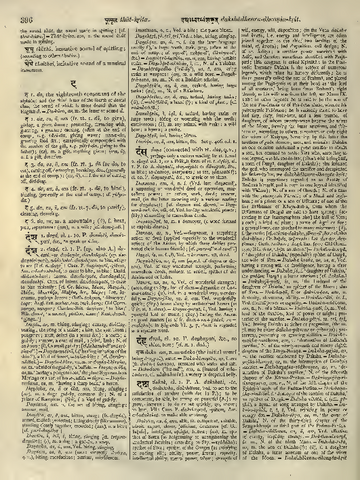
da 2 . da, as, ā, am (fr. rt. 1. dā, to give), giving, a giver, donor; presenting, favouring with, granting, a granter; causing, (often at the end of comp., e. g. vāri-da, giving water; anna-da, granting food &c.; exceptionally compounded with the receiver of the gift, e. g. pitṛ-da, giving to the father); (as), m. a gift, anything given; (am, ā), n. f. a gift, donation.
Originaltext · Englisch · Adjektiv
da 3 . da, as, ā, am (fr. rt. 3. dā for do, to cut), cutting off, destroying, breaking, &c., (generally at the end of comp.); (as, ā), m. f. the act of cutting off, dividing.
Originaltext · Englisch · Adjektiv
da 4 . da, as, ā, am (fr. rt. 4. dā, to bind), binding, (generally at the end of comp.; cf. ṛśya- da.)
Originaltext · Englisch · Adjektiv
da 5 . da, as, ā, am (fr. rt. 7. dā, to purify), cleaning, cleansing.
Originaltext · Englisch · Substantiv Maskulin
da 6 . da, as, m. a mountain; (ā), f. heat, pain, repentance; (am), n. a wife; [cf. dam-patī.]
Originaltext · Englisch · Worttyp nicht bestimmt
da 1 . da, the eighteenth consonant of the alphabet and the third letter of the fourth or dental class, the sound of which is more dental than the English d.
Petersburger 1855 Adjektiv · Substantiv Maskulin · Substantiv Neutrum · Worttyp nicht bestimmt
Originaltext · Deutsch · Adjektiv · Substantiv Maskulin
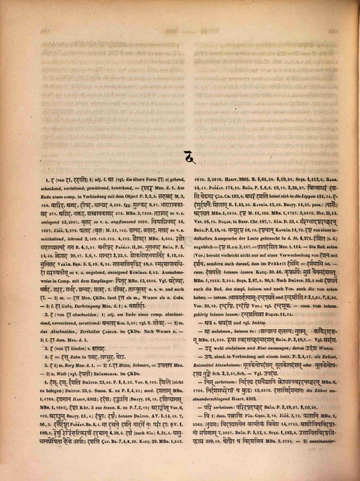
1. da (von dā, dadāti) 1〉 adj. f. ā (vgl. die ältere Form dā) a〉 gebend, schenkend, verleihend, gewährend, bewirkend, = dātar MED. d. 1. Am Ende eines comp. in Verbindung mit dem Object P. 3,2,3. sahasrada M. 3,186. vārida, annada, dīpada, dhānyada M. 4,229. fgg. śulkada M. 9,97. bhāṇḍāvakāśada 271. agnida, bhaktada, śastrāvakāśada M. 278. MBH. 5,7238. taḍāgada so v. a. anlegend MBH. 13,2987. vṛkṣada so v. a. anpflanzend MBH. 13,2999. viṣāgnibhayada MBH. 14,1687. YĀJÑ. 2,279. phalada (vṛkṣa) M. 11,142. jñānada, brahmada, mantrada so v. a. mittheilend, lehrend M. 2,109. M. 2,146. M. 2,153. M. 4,232. śaucadā MBH. 4,604. rakṣo mahāvyasanadaṃ mama R. 4,5,21. abhīṣṭada PAÑCAT. II, 50. bhūtabhayada BHĀG. P. 3,14,42. kleśada BHĀG. P. 20,27. BHĀG. P. 5,6,1. mānadā BHĀG. P. 3,23,6. śokamohabhayārtida BHĀG. P. 6,15,23. subhikṣada VARĀH. BṚH. S. 5,89. VARĀH. BṚH. S. 8,34. gajavājivṛddhida VARĀH. BṚH. S. 18,5. smaraśāpāvadhidāṃ sarasvatīm so v. a. angebend, anzeigend KUMĀRAS. 4,43. Ausnahmsweise in Comp. mit dem Empfänger: pitṛda MBH. 13,6606. Vgl. adomada, arthada, garada, garbhada, janmada, jalada, 1. jīvada, tāmbūlada u. s. w. und auch dā. — 2〉 m. = datta MED. ŚKDR. fasst datta als m., WILSON als n. Gabe. — 3〉 f. dā Gabe, Darbringung MED. d. 1; s. āśīrdā.
Originaltext · Deutsch · Adjektiv · Substantiv Maskulin
2. da (von dā abschneiden) 1〉 adj. am Ende eines comp. abschneidend, vernichtend, zerstörend: analada KIR. 5,25; vgl. 2. jīvada. — 2〉 m. das Abschneiden, Zertheilen ŚABDAR._im_ŚKDR. Nach WILSON n. — 3〉 f. dā dass. MED. d. 1.
Originaltext · Deutsch · Substantiv Maskulin · Substantiv Neutrum
5. da 1〉 m. Berg MED. d. 1. — 2〉 f. dā Hitze, Schmerz, = upatāpa MED. — 3〉 n. Weib (vgl. daṃpatī) EKĀKṢARAK._im_ŚKDR.
Originaltext · Deutsch · Worttyp nicht bestimmt
3. da (von dā binden) s. ṛśyada.
Originaltext · Deutsch · Worttyp nicht bestimmt
4. da = dant Zahn in pannada, lapsuda, ṣoḍa.
Böhtlingk 1879 Adjektiv · Substantiv Feminin · Substantiv Maskulin · Substantiv Neutrum · Worttyp nicht bestimmt
Originaltext · Deutsch · Adjektiv · Substantiv Feminin · Substantiv Maskulin · Substantiv Neutrum
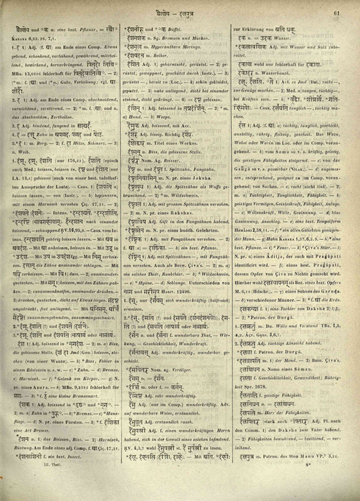
1. da — 1〉 Adj. (f. ā) am Ende eines Comp. Etwas gebend, schenkend, verleihend, gewährend, mittheilend, bewirkend, hervorbringend pitṛdo tithi˚ MBH. 13,6606 fehlerhaft für pitṛdevātithi˚. — 2〉 (*m.) f. (ā) und (*n.) Gabe, Verleihung; vgl. āśīrdā́.
Originaltext · Deutsch · Adjektiv · Substantiv Feminin · Substantiv Maskulin · Substantiv Neutrum
2. da — 1〉 Adj. am Ende eines Comp. abschneidend, vernichtend, zerstörend. — 2〉 *m. f. (ā) und n. das Abschneiden, Zertheilen.
Originaltext · Deutsch · Adjektiv
3. da Adj. bindend, fangend in ṛśyadá.
Originaltext · Deutsch · Substantiv Maskulin · Substantiv Neutrum
5. *da — 1〉 m. Berg. — 2〉 f. dā Hitze, Schmerz. — 3〉 n. Weib.
Originaltext · Deutsch · Worttyp nicht bestimmt
4. da = dant Zahn in apannada, pannada und ṣoḍa.
Apte 1890 Adjektiv · Substantiv Maskulin · Substantiv Neutrum
Originaltext · Englisch · Adjektiv · Substantiv Maskulin · Substantiv Neutrum
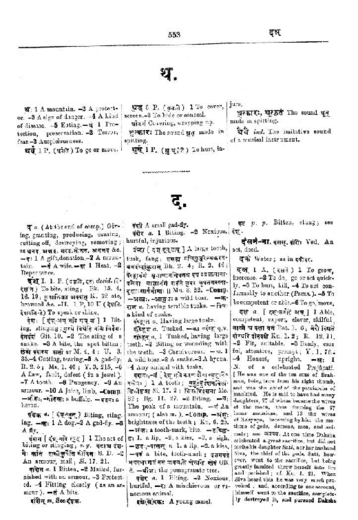
da a. (At the end of comp.) Giving, granting, producing, causing, cutting off, destroying, removing; as dhanada, annada, garada, toyada, analada &c. — daḥ 1 A gift, donation. 2 A mountain. — daṃ A wife. — dā 1 Heat. 2 Repentance.
Cappeller 1887 Worttyp nicht bestimmt
Originaltext · Deutsch · Worttyp nicht bestimmt
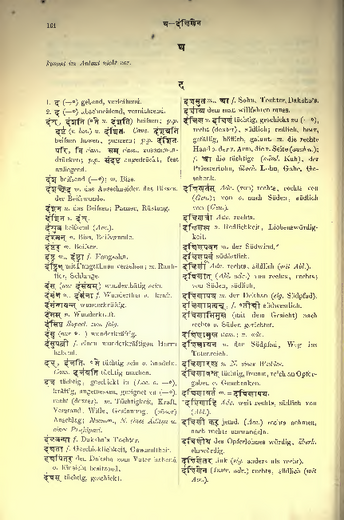
1. da (—˚) gebend, verleihend.
Originaltext · Deutsch · Worttyp nicht bestimmt
2. da (—˚) abschneidend, vernichtend.
Burnouf 1866 Worttyp nicht bestimmt
Originaltext · Französisch · Worttyp nicht bestimmt
da da 32ᵉ lettre et 3ᵉ dentale de l'alphabet sanscrit. Elle répond au d, et qqf. au t, à l' l ou même au z des autres langues âryennes.

Originaltext · Französisch · Worttyp nicht bestimmt
da da (dā) [à la fin des composés] qui donne; (do) qui coupe. M. montagne, cf. ta. — N. femme, cf. dam. — F. dā purification; préservation; repentir.
Quelltextfundstellen (17)
DYS 1 Fundstelle
GoS 3 Fundstellen
HP 5 Fundstellen
HTK 4 Fundstellen
PJH 1 Fundstelle
SiSa 2 Fundstellen
VBT 1 Fundstelle
Mit AYI Free weitermachen
Bildquelle: AYI Archiv.